Interband Berry connection measurement in the optical honeycomb lattice
Pith reviewed 2026-05-20 22:19 UTC · model grok-4.3
The pith
The strength of resonant excitations from lattice shaking maps out the interband Berry connection in the honeycomb lattice.
A machine-rendered reading of the paper's core claim, the machinery that carries it, and where it could break.
Core claim
Periodic shaking of the optical lattice position induces resonant excitations whose strength at each quasimomentum and for different polarizations directly corresponds to the interband Berry connection, allowing its experimental mapping in the honeycomb lattice between the lowest band and higher bands.
What carries the argument
Interband Berry connection measured through the polarization-resolved resonant response to lattice shaking.
If this is right
- Geometric properties of band structures can be characterized using this optical response method.
- Transparency lines mark quasimomenta with no excitation response for given polarizations.
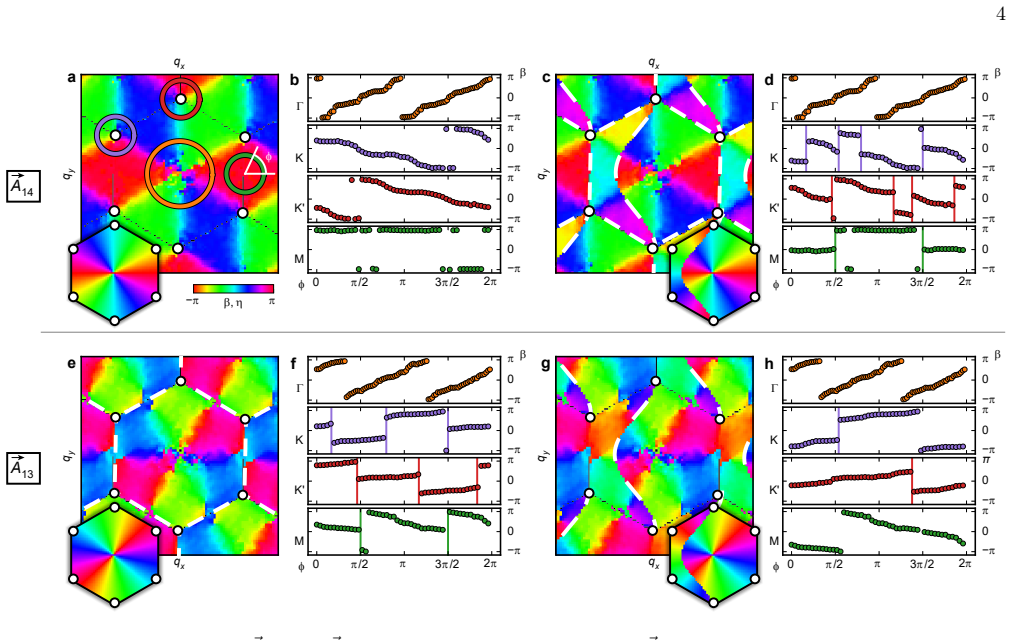
- Dirac strings appear in the interband Berry connection between bands 1 and 3, connecting K and K' points where the orientation changes abruptly.
Where Pith is reading between the lines
- Similar shaking techniques could characterize Berry connections in other periodic potentials or for different band pairs.
- This atomic system offers a controllable testbed for understanding optical responses tied to band geometry in solid-state physics.
- Future work might use this to extract topological invariants from the mapped connections.
Load-bearing premise
The atomic response to lattice shaking precisely mimics the interband optical matrix elements of electrons in solids under corresponding light polarizations.
What would settle it
Observation of excitation strengths that deviate from those expected from the independently computed interband Berry connection would disprove the direct mapping claim.
Figures


read the original abstract
The geometry of Bloch bands affects many physical properties of crystalline solids and other spatially periodic systems. Direct experimental determination of such geometry is an active area of research. In this work, we focus on the fundamental connection between optical excitations and the relative geometry of pairs of Bloch bands, as characterized by the interband Berry connection. We simulate the response of electrons in solids to optical excitation by the response of ultracold fermionic atoms in optical lattices to periodic modulation of the lattice position. The strength of resonant excitation between bands, measured at each quasimomentum and for various lattice-shaking polarizations, directly maps out the interband Berry connection. We apply this method to the optical honeycomb lattice, driving excitations between the ground $n=1$ band and the excited $n'=\{2,3,4\}$ bands. We observe transparency lines of quasimomenta at which the response to excitation of specific polarization is zero. Further, the interband Berry connection between bands 1 and 3 shows irreducible Dirac strings connecting the $K$ and $K'$ points in the Brillouin zone, lines along which the interband Berry connection abruptly changes orientation. Our work establishes optical response as a powerful tool for characterizing geometrical and topological properties of band structure.
Editorial analysis
A structured set of objections, weighed in public.
Referee Report
Summary. The paper claims to experimentally determine the interband Berry connection in an optical honeycomb lattice by measuring resonant excitation rates of ultracold fermionic atoms under periodic lattice shaking. The excitation strength at each quasimomentum for different shaking polarizations is asserted to map |A_nm(k) · ê_pol|^2, revealing transparency lines of vanishing response and irreducible Dirac strings in the Berry connection between the n=1 and n'=3 bands that connect the K and K' points.
Significance. If the central mapping from shaking response to Berry connection holds with the reported precision, the work is significant for providing a direct, vectorial probe of band geometry in a tunable atomic system. It strengthens the analogy between lattice shaking and optical driving in solids and offers a practical route to characterize topological features such as Dirac strings without requiring full band tomography.
major comments (2)
- The central claim that resonant excitation strength directly yields the interband Berry connection (up to energy denominator) is load-bearing; the manuscript must include an explicit derivation or self-contained reference to the precise formula relating the position matrix element, the driving force, and A_nm(k) in the relevant theory section, including any gauge or approximation details.
- Results describing the transparency lines and orientation changes (abstract and main figures): without quantitative data plots, error bars, or statistical analysis of the measured rates versus polarization, it is not possible to verify that the observed features quantitatively reproduce the expected |A_nm · ê_pol|^2 dependence rather than qualitative trends.
minor comments (2)
- Notation for band indices (n=1 and n'={2,3,4}) should be used consistently in all equations and figure labels.
- Figure captions should explicitly state which component of the Berry connection is being plotted for each polarization direction.
Simulated Author's Rebuttal
We thank the referee for their careful reading of the manuscript and for the constructive comments. We appreciate the positive assessment of the work's significance. We address each major comment below and have revised the manuscript accordingly to strengthen the presentation of the central claims and supporting data.
read point-by-point responses
-
Referee: The central claim that resonant excitation strength directly yields the interband Berry connection (up to energy denominator) is load-bearing; the manuscript must include an explicit derivation or self-contained reference to the precise formula relating the position matrix element, the driving force, and A_nm(k) in the relevant theory section, including any gauge or approximation details.
Authors: We agree that an explicit derivation is essential for rigor. In the revised manuscript we have added a self-contained subsection (now Section II.C) that derives the relation from first principles. Beginning from the time-periodic driving Hamiltonian in the lattice frame, we apply time-dependent perturbation theory under the rotating-wave approximation to obtain the resonant transition rate. The position matrix element is expressed via the commutator [H_0, r] and shown to reduce to the interband Berry connection A_nm(k) for the relevant bands; the driving force enters through the polarization vector ê_pol. Gauge choice (Berry connection in the periodic gauge) and validity conditions (weak driving amplitude, detuning within linewidth) are discussed explicitly, with a reference to the underlying formalism in Ref. [new citation]. revision: yes
-
Referee: Results describing the transparency lines and orientation changes (abstract and main figures): without quantitative data plots, error bars, or statistical analysis of the measured rates versus polarization, it is not possible to verify that the observed features quantitatively reproduce the expected |A_nm · ê_pol|^2 dependence rather than qualitative trends.
Authors: We acknowledge that the original figures emphasized visual identification of the features. In the revision we have added quantitative panels to Figures 3 and 4 showing measured excitation rates as a function of polarization angle at representative quasimomenta (including points on and off the transparency lines). Each data set now includes error bars from at least five independent experimental realizations, together with a direct overlay of the theoretical |A_nm(k) · ê_pol|^2 curve. A supplementary table reports reduced-chi-squared values for the fits, confirming quantitative agreement within experimental uncertainty. revision: yes
Circularity Check
No significant circularity; experimental mapping relies on established external theory
full rationale
The paper reports an experimental measurement in which resonant excitation rates under lattice shaking are observed to map the interband Berry connection via the standard relation between position matrix elements and Berry curvature. This relation is invoked as prior knowledge from solid-state physics rather than derived or fitted within the work. No self-definitional steps, fitted inputs renamed as predictions, or load-bearing self-citations appear in the derivation chain. The observations (transparency lines, Dirac strings) are presented as direct experimental outcomes consistent with the vectorial mapping, without reducing the central claim to its own inputs by construction. The result is self-contained against external benchmarks.
Axiom & Free-Parameter Ledger
axioms (1)
- domain assumption Periodic modulation of lattice position produces resonant excitations whose strength directly encodes the interband Berry connection.
Lean theorems connected to this paper
-
IndisputableMonolith/Cost/FunctionalEquation.leanwashburn_uniqueness_aczel unclear?
unclearRelation between the paper passage and the cited Recognition theorem.
The strength of resonant excitation between bands, measured at each quasimomentum and for various lattice-shaking polarizations, directly maps out the interband Berry connection.
-
IndisputableMonolith/Foundation/AlexanderDuality.leanalexander_duality_circle_linking unclear?
unclearRelation between the paper passage and the cited Recognition theorem.
We apply this method to the optical honeycomb lattice, driving excitations between the ground n=1 band and the excited n'={2,3,4} bands.
What do these tags mean?
- matches
- The paper's claim is directly supported by a theorem in the formal canon.
- supports
- The theorem supports part of the paper's argument, but the paper may add assumptions or extra steps.
- extends
- The paper goes beyond the formal theorem; the theorem is a base layer rather than the whole result.
- uses
- The paper appears to rely on the theorem as machinery.
- contradicts
- The paper's claim conflicts with a theorem or certificate in the canon.
- unclear
- Pith found a possible connection, but the passage is too broad, indirect, or ambiguous to say the theorem truly supports the claim.
Reference graph
Works this paper leans on
-
[1]
T. Jungwirth, Q. Niu, and A. H. MacDonald, Anomalous hall effect in ferromagnetic semiconductors, Phys. Rev. Lett.88, 207208 (2002)
work page 2002
-
[2]
M.-C. Chang and Q. Niu, Berry phase, hyperorbits, and the hofstadter spectrum: Semiclassical dynamics in mag- netic bloch bands, Phys. Rev. B53, 7010 (1996)
work page 1996
- [3]
-
[4]
Resta, Macroscopic polarization in crystalline di- electrics: the geometric phase approach, Rev
R. Resta, Macroscopic polarization in crystalline di- electrics: the geometric phase approach, Rev. Mod. Phys. 66, 899 (1994)
work page 1994
-
[5]
X.-L. Qi and S.-C. Zhang, Topological insulators and superconductors, Reviews of Modern Physics83, 1057 (2011)
work page 2011
-
[6]
M. V. Berry, Quantal phase factors accompanying adia- batic changes, Proceedings of the Royal Society of Lon- don. A. Mathematical and Physical Sciences392, 45 (1984)
work page 1984
-
[7]
D. Xiao, M.-C. Chang, and Q. Niu, Berry phase effects on electronic properties, Rev. Mod. Phys.82, 1959 (2010)
work page 1959
-
[8]
Y.-Q. Ma, S. Chen, H. Fan, and W.-M. Liu, Abelian and non-abelian quantum geometric tensor, Physical Review B81, 245129 (2010)
work page 2010
-
[9]
F. Wilczek and A. Zee, Appearance of gauge structure in simple dynamical systems, Phys. Rev. Lett.52, 2111 (1984)
work page 1984
-
[10]
E. I. Blount, Formalisms of band theory, inSolid State Physics, Vol. 13, edited by F. Seitz and D. Turnbull (Aca- demic Press, 1962) p. 305
work page 1962
-
[11]
W. J. Jankowski, A. S. Morris, A. Bouhon, F. N. Ünal, and R.-J. Slager, Optical manifestations and bounds of topological euler class, Physical Review B111, L081103 (2025)
work page 2025
-
[12]
Y. Onishi and L. Fu, Fundamental bound on topological gap, Physical Review X14, 011052 (2024)
work page 2024
-
[13]
J. L. P. Hughes and J. E. Sipe, Calculation of second- order optical response in semiconductors, Physical Re- view B53, 10751 (1996)
work page 1996
-
[14]
T. Morimoto and N. Nagaosa, Topological nature of nonlinear optical effects in solids, Science Advances2, e1501524 (2016)
work page 2016
- [15]
-
[16]
F. de Juan, A. G. Grushin, T. Morimoto, and J. E. Moore, Quantized circular photogalvanic effect in weyl semimetals, Nature Communications8, 15995 (2017)
work page 2017
-
[17]
T. Cao, M. Wu, and S. G. Louie, Unifying optical selec- tion rules for excitons in two dimensions: Band topol- ogy and winding numbers, Physical Review Letters120, 087402 (2018)
work page 2018
-
[18]
M. Aidelsburger, M. Lohse, C. Schweizer, M. Atala, J. T. Barreiro, S. Nascimbene, N. R. Cooper, I. Bloch, and N. Goldman, Measuring the chern number of hofstadter bands with ultracold bosonic atoms, Nature Physics11, 162 (2015)
work page 2015
-
[19]
K. Wintersperger, C. Braun, F. N. Ünal, A. Eckardt, M. D. Liberto, N. Goldman, I. Bloch, and M. Aidels- burger, Realization of an anomalous floquet topological system with ultracold atoms, Nature Physics16, 1058 (2020)
work page 2020
-
[20]
L. Duca, T. Li, M. Reitter, I. Bloch, M. Schleier-Smith, and U. Schneider, An aharonov-bohm interferometer for determining bloch band topology, Science347, 288 (2015)
work page 2015
-
[21]
C. D. Brown, S.-W. Chang, M. N. Schwarz, T.-H. Leung, V. Kozii, A. Avdoshkin, J. E. Moore, and D. Stamper- Kurn, Direct geometric probe of singularities in band structure, Science377, 1319 (2022)
work page 2022
-
[22]
S. Kim, Y. Chung, Y. Qian, S. Park, C. Jozwiak, E. Rotenberg, A. Bostwick, K. S. Kim, and B.-J. Yang, Direct measurement of the quantum metric tensor in solids, Science388, 1050 (2025)
work page 2025
-
[23]
A. Gianfrate, O. Bleu, L. Dominici, V. Ardizzone, M. De Giorgi, D. Ballarini, G. Lerario, K. W. West, L. N. 10 Pfeiffer, D.D.Solnyshkov, D.Sanvitto,andG.Malpuech, Measurement of the quantum geometric tensor and of the anomalous hall drift, Nature578, 381 (2020)
work page 2020
-
[24]
N. Fläschner, B. S. Rem, M. Tarnowski, D. Vogel, D. S. Lühmann, K. Sengstock, and C. Weitenberg, Experimen- tal reconstruction of the berry curvature in a floquet bloch band, Science352, 1091 (2016)
work page 2016
-
[25]
T. Li, L. Duca, M. Reitter, F. Grusdt, E. Demler, M. En- dres, M. Schleier-Smith, I. Bloch, and U. Schneider, Bloch state tomography using wilson lines, Science352, 1094 (2016)
work page 2016
-
[26]
C.-R. Yi, J. Yu, H. Yuan, R.-H. Jiao, Y.-M. Yang, X. Jiang, J.-Y. Zhang, S. Chen, and J.-W. Pan, Extract- ing the quantum geometric tensor of an optical raman lattice by bloch-state tomography, Physical Review Re- search5, L032016 (2023)
work page 2023
- [27]
-
[28]
Measuring non-Abelian quantum geometry and topology in a multi-gap photonic lattice
M. Guillot, C. Blanchard, M. Morassi, A. Lemaître, L. Le Gratiet, A. Harouri, I. Sagnes, R.-J. Slager, F. N. Ünal, J. Bloch, and S. Ravets, Measuring non-abelian quantum geometry and topology in a multi-gap photonic lattice (2025), preprint, arXiv:2511.03894
work page internal anchor Pith review Pith/arXiv arXiv 2025
-
[29]
D. T. Tran, A. Dauphin, A. G. Grushin, P. Zoller, and N. Goldman, Probing topology by “heating”: Quantized circular dichroism in ultracold atoms, Science Advances 3, e1701207 (2017)
work page 2017
-
[30]
L. Asteria, D. T. Tran, T. Ozawa, M. Tarnowski, B. S. Rem, N. Fläschner, K. Sengstock, N. Goldman, and C. Weitenberg, Measuring quantized circular dichroism in ultracold topological matter, Nature Physics15, 449 (2019)
work page 2019
- [31]
-
[32]
T.OzawaandN.Goldman,Extractingthequantummet- ric tensor through periodic driving, Physical Review B 97, 201117 (2018)
work page 2018
-
[33]
G.-B. Jo, J. Guzman, C. K. Thomas, P. Hosur, A. Vish- wanath, and D. M. Stamper-Kurn, Ultracold atoms in a tunable optical kagome lattice, Phys. Rev. Lett.108, 045305 (2012)
work page 2012
-
[34]
W. Zhao, Y.-B. Yang, Y. Jiang, Z. Mao, W. Guo, L. Qiu, G. Wang, L. Yao, L. He, Z. Zhou, Y. Xu, and L. Duan, Quantum simulation for topological euler insu- lators, Communications Physics5, 223 (2022)
work page 2022
- [35]
-
[36]
H. C. Po, H. Watanabe, and A. Vishwanath, Fragile topology and wannier obstructions, Physical Review Let- ters121, 126402 (2018)
work page 2018
-
[37]
F. N. Ünal, A. Bouhon, and R.-J. Slager, Topological euler class as a dynamical observable in optical lattices, Physical Review Letters125, 053601 (2020)
work page 2020
-
[38]
J. J. Esteve-Paredes and J. J. Palacios, A comprehensive study of the velocity, momentum and position matrix elements for bloch states: Application to a local orbital basis, SciPost Physics Core6, 002 (2023)
work page 2023
discussion (0)
Sign in with ORCID, Apple, or X to comment. Anyone can read and Pith papers without signing in.