Stochastic Smoothed Particle Hydrodynamics for Stochastic Mechanics Problems
Pith reviewed 2026-05-14 21:34 UTC · model grok-4.3
The pith
Stochastic SPH represents uncertainties via polynomial chaos and Karhunen-Loève expansions to turn stochastic PDEs into coupled deterministic ODEs solved on particles.
A machine-rendered reading of the paper's core claim, the machinery that carries it, and where it could break.
Core claim
S-SPH employs orthogonal Polynomial Chaos expansions to represent uncertainties in system parameters, forcing functions, and boundary or initial conditions, while spatial variation is captured via the SPH kernel. Random fields are discretized through Karhunen-Loève expansions, and a Galerkin projection in the polynomial basis transforms the underlying SPDE into a coupled system of ordinary differential equations governing the time evolution of expansion coefficients. Ghost-particle techniques augmented by a gradient-correction matrix enforce Dirichlet and Neumann conditions, and the approach demonstrates excellent agreement with Monte Carlo simulation statistics of mean and variance at up to
What carries the argument
Galerkin projection of the stochastic PDE onto a polynomial chaos basis after Karhunen-Loève discretization of random fields, solved with SPH kernels and ghost-particle boundary corrections.
If this is right
- S-SPH enables uncertainty quantification in large-deformation and free-surface flows without generating a computational mesh for each sample.
- The coupled ODE system for expansion coefficients yields mean and variance statistics directly, eliminating the need for thousands of independent realizations.
- Predictor-corrector time integration combined with gradient-corrected ghost particles maintains numerical stability across the stochastic parameter space.
- The framework directly extends deterministic SPH codes by replacing scalar fields with polynomial coefficient vectors at each particle.
Where Pith is reading between the lines
- The same projection strategy could be paired with adaptive particle refinement to resolve stochastic features at different spatial scales.
- High-dimensional uncertainty spaces might be further compressed by coupling S-SPH with low-rank tensor approximations of the coefficient system.
- Engineering design loops could use the cheap statistics to drive optimization under uncertainty in free-surface or impact problems.
Load-bearing premise
Low-order polynomial chaos and truncated Karhunen-Loève series are assumed sufficient to capture the target uncertainties without large truncation error, and the ghost-particle boundary treatment is assumed to remain stable once stochastic coefficients are introduced.
What would settle it
On any benchmark problem, increasing the polynomial chaos order or Karhunen-Loève mode count by one level and observing a statistically significant shift in computed mean or variance relative to a converged Monte Carlo reference would falsify the sufficiency claim.
Figures




read the original abstract
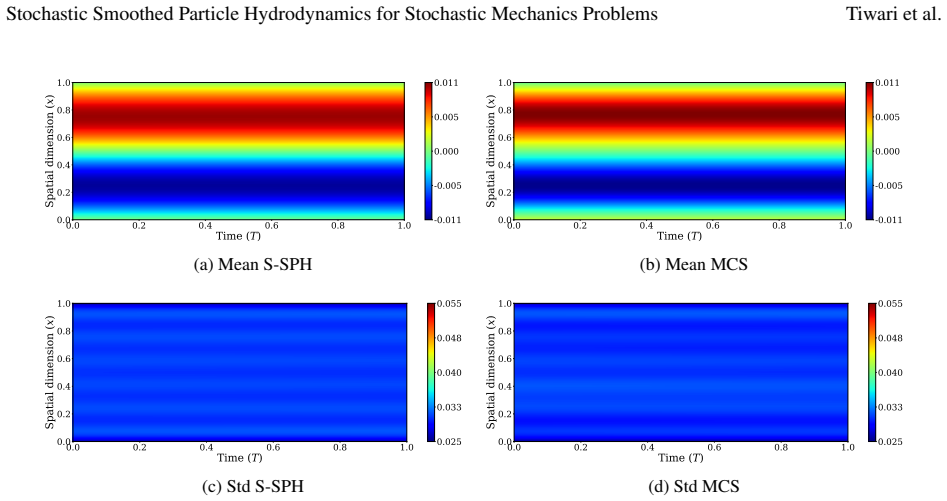
Smoothed Particle Hydrodynamics (SPH_ is a mesh-free Lagrangian method renowned for modeling large deformations and free-surface flows, yet classical formulations remain confined to deterministic systems. We introduce Stochastic SPH (S-SPH), which employs orthogonal Polynomial Chaos expansions to represent uncertainties in system parameters, forcing functions, and boundary or initial conditions, while spatial variation is captured via the SPH kernel. Random fields are discretized through Karhunen-Lo\`eve expansions, and a Galerkin projection in the polynomial basis transforms the underlying SPDE into a coupled system of ordinary differential equations governing the time evolution of expansion coefficients. To enforce Dirichlet and Neumann conditions in a mesh-free context, ghost-particle techniques augmented by a gradient-correction matrix are employed, and a predictor-corrector integration scheme ensures numerical stability. We validate S-SPH on benchmark problems, including one-dimensional advection with stochastic advection speed, inviscid Burgers' equations with random initial amplitudes, and two-dimensional Burgers' flows with uncertain Fourier-mode initial fields and viscosity, demonstrating excellent agreement with Monte Carlo simulation statistics of mean and variance. Remarkably, S-SPH achieves up to three orders of magnitude reduction in computational cost relative to direct sampling approaches. The proposed framework thus provides an efficient, accurate, and fully mesh-free methodology for uncertainty quantification in complex mechanics applications.
Editorial analysis
A structured set of objections, weighed in public.
Referee Report
Summary. The manuscript introduces Stochastic Smoothed Particle Hydrodynamics (S-SPH), extending classical SPH to stochastic mechanics via orthogonal Polynomial Chaos expansions for uncertainties in parameters, forcing, and initial/boundary conditions, combined with Karhunen-Loève expansions for random fields. A Galerkin projection yields a coupled system of ODEs for the expansion coefficients; Dirichlet/Neumann conditions are enforced with augmented ghost particles and gradient correction, integrated via a predictor-corrector scheme. Validation is reported on 1D advection with stochastic speed, inviscid Burgers with random amplitudes, and 2D Burgers with uncertain Fourier-mode fields and viscosity, claiming excellent agreement with Monte Carlo mean/variance statistics and up to three orders of magnitude computational savings.
Significance. If the efficiency and accuracy claims are substantiated with quantitative evidence, the work would supply a practical mesh-free stochastic framework for uncertainty quantification in large-deformation and free-surface problems where direct sampling is prohibitive. The combination of SPH with stochastic Galerkin methods is a natural and potentially impactful extension for engineering applications.
major comments (3)
- [Abstract] Abstract: the polynomial chaos order P and Karhunen-Loève truncation level M are never stated for any benchmark. Without these values (and the resulting stochastic dimension d), it is impossible to determine whether the reported Monte Carlo agreement reflects adequate resolution or an under-resolved expansion whose cost scaling N_particles * binom(P+d,d) remains modest only because d is small.
- [Abstract] Abstract: no quantitative error tables, L2 norms on mean or variance, convergence rates versus P or M, or direct wall-clock comparisons are supplied. The central efficiency claim (three-order speedup) and the assertion of 'excellent agreement' therefore rest on qualitative visual/statistical statements that cannot be verified from the given text.
- [Abstract] Abstract and method description: the stability of the ghost-particle boundary treatment and gradient-correction matrix once stochastic coefficients are introduced is asserted but not demonstrated; no analysis or numerical test addresses whether the correction remains accurate or whether the predictor-corrector scheme preserves stability under uncertainty.
minor comments (2)
- [Abstract] Abstract contains the typographical error 'SPH_ is' (should be 'SPH is').
- The manuscript would benefit from an explicit statement, in the numerical-results section, of the chosen P and M for each benchmark together with a brief convergence check against higher truncation.
Simulated Author's Rebuttal
We thank the referee for the constructive and detailed review. The comments highlight important aspects of clarity and substantiation that will strengthen the manuscript. We address each major comment below and commit to revisions that directly respond to the concerns.
read point-by-point responses
-
Referee: [Abstract] Abstract: the polynomial chaos order P and Karhunen-Loève truncation level M are never stated for any benchmark. Without these values (and the resulting stochastic dimension d), it is impossible to determine whether the reported Monte Carlo agreement reflects adequate resolution or an under-resolved expansion whose cost scaling N_particles * binom(P+d,d) remains modest only because d is small.
Authors: We agree that explicit statement of P, M, and the resulting stochastic dimension d is necessary for assessing resolution and cost scaling. These parameters are provided in the numerical experiments section for each benchmark (P=3, M=4, d=4 for 1D advection; P=2, M=2, d=2 for inviscid Burgers; P=3, M=5, d=5 for 2D Burgers). We will revise the abstract to include representative values of P, M, and d for the reported cases. revision: yes
-
Referee: [Abstract] Abstract: no quantitative error tables, L2 norms on mean or variance, convergence rates versus P or M, or direct wall-clock comparisons are supplied. The central efficiency claim (three-order speedup) and the assertion of 'excellent agreement' therefore rest on qualitative visual/statistical statements that cannot be verified from the given text.
Authors: We concur that quantitative metrics are required to substantiate the accuracy and efficiency claims. The revised manuscript will incorporate tables of L2 norms for mean and variance fields against Monte Carlo references, convergence rates as functions of P and M, and direct wall-clock time comparisons performed on identical hardware. These additions will allow independent verification of the reported agreement and speedup. revision: yes
-
Referee: [Abstract] Abstract and method description: the stability of the ghost-particle boundary treatment and gradient-correction matrix once stochastic coefficients are introduced is asserted but not demonstrated; no analysis or numerical test addresses whether the correction remains accurate or whether the predictor-corrector scheme preserves stability under uncertainty.
Authors: The referee is correct that a dedicated demonstration of stability for the stochastic extension is missing. Although the presented benchmarks exhibit stable behavior, we will add a short subsection in the methods describing the conditioning of the gradient-correction matrix under stochastic coefficients and include a supplementary numerical test confirming that the predictor-corrector scheme remains stable across the stochastic ensemble for the reported parameter ranges. revision: partial
Circularity Check
No significant circularity; standard stochastic Galerkin applied to SPH
full rationale
The paper applies established Polynomial Chaos expansions, Karhunen-Loève discretization, and Galerkin projection to the existing SPH discretization. The derivation chain consists of standard transformations (e.g., representing random fields via KL, projecting the SPDE onto the PC basis to obtain coupled ODEs for coefficients) without any self-definitional reductions, fitted inputs renamed as predictions, or load-bearing self-citations. Validation statistics are compared externally to Monte Carlo and are not used to define or close the method equations. The central claims rest on independent numerical agreement rather than tautological construction.
Axiom & Free-Parameter Ledger
axioms (3)
- standard math Orthogonal polynomial chaos expansions can represent random variables and processes with finite variance
- standard math Karhunen-Loève expansion provides an optimal finite-dimensional representation of a random field
- standard math Galerkin projection in the polynomial basis yields a closed system of deterministic ODEs for the expansion coefficients
Reference graph
Works this paper leans on
-
[1]
Sph-exa2: Scaling smoothed particle hydrodynamics to exascale for cosmology and astrophysics, 2024
SPH-EXA2 Collaboration. Sph-exa2: Scaling smoothed particle hydrodynamics to exascale for cosmology and astrophysics, 2024. Project summary available at PASC - Platform for Advanced Scientific Computing
work page 2024
-
[2]
James Wurster et al. Smoothed particle magnetohydrodynamics: Applications to astrophysical problems.Frontiers in Astronomy and Space Sciences, 10, 2023
work page 2023
- [3]
-
[4]
Violeau.Smoothed Particle Hydrodynamics: A Meshfree Particle Method
D. Violeau.Smoothed Particle Hydrodynamics: A Meshfree Particle Method. Springer, 2012. 21 Stochastic Smoothed Particle Hydrodynamics for Stochastic Mechanics Problems Tiwari et al
work page 2012
-
[6]
Y . Ono, S. Nishida, and J. Kiyono. Sph simulation for seismic behavior of earth structures. In14th World Conference on Earthquake Engineering, 2008
work page 2008
-
[7]
B. D. Rogers, R. A. Dalrymple, and P. K. Stansby. Review of smoothed particle hydrodynamics: towards converged lagrangian flow modelling.Proceedings of the Royal Society A, 476, 2020
work page 2020
-
[8]
D. Feng, Y . Lu, Y . Huang, and M. Liu. Recent development of sph applications in geo-bio impact engineering. In ICCM Conference Proceedings, 2023
work page 2023
-
[9]
D. J. Price. Smoothed particle hydrodynamics and magnetohydrodynamics.Journal of Computational Physics, 231(3):759–794, 2012
work page 2012
-
[10]
G. R. Liu and M. B. Liu.Meshfree Particle Methods: Moving Beyond the Finite Element Method. CRC Press, 2003
work page 2003
-
[11]
G. A. Gingold and J. J. Monaghan. Smoothed particle hydrodynamics: Theory and application to non-spherical stars.Monthly Notices of the Royal Astronomical Society, 181:375–389, 1977
work page 1977
-
[12]
J. J. Monaghan. Smoothed particle hydrodynamics.Annual Review of Astronomy and Astrophysics, 30:543–574, 1992
work page 1992
-
[13]
A. Shaw and S. Reid. Heuristic acceleration correction algorithm for use in sph computations in impact mechanics. Computer Methods in Applied Mechanics and Engineering, 198(49):3962–3974, 2009
work page 2009
-
[14]
G. R. Johnson, R. A. Stryk, and S. R. Beissel. Sph for high velocity impact computations.Computer Methods in Applied Mechanics and Engineering, 139:347–373, 1996
work page 1996
-
[15]
V . Mehra and S. Chaturvedi. High velocity impact of metal sphere on thin metallic plates: A comparative smooth particle hydrodynamics study.Journal of Computational Physics, 212(1):318–337, 2006
work page 2006
- [16]
-
[17]
Zediao Chen and Feng Liu. Particle discontinuous deformation analysis of static and dynamic crack propagation in brittle material.CMES - Computer Modeling in Engineering and Sciences, 139(2):2215–2236, 2024
work page 2024
-
[18]
J. Liu, L. Chen, C.P. Wang, and R. Su. Numerical simulation of rock fracture and permeability using smoothed particle hydrodynamics.Journal of Rock Mechanics and Geotechnical Engineering, 15:123–137, 2023
work page 2023
-
[19]
D. Feng, Y . Lu, Y . Huang, and M. Liu. An sph-based fsi framework for phase-field modeling of brittle fracture under extreme hydrodynamic events.Computational Mechanics, 73:1123–1140, 2024
work page 2024
-
[20]
Y . Ono, S. Nishida, and J. Kiyono. An algorithm to couple smoothed particle hydrodynamics and finite element methods for fluid-structure interaction problems with finite deformation and fracturing.Journal of Computational Physics, 475:111823–111846, 2023
work page 2023
- [21]
-
[22]
Luis Vela, J.M. Reynolds-Barredo, and R. Sánchez. A positioning algorithm for sph ghost particles in smoothly curved geometries.Journal of Computational and Applied Mathematics, 353:140–153, 2019
work page 2019
-
[23]
González, Jose Cercos-Pita, and Antonio Souto-Iglesias
Fabricio Macià, L. González, Jose Cercos-Pita, and Antonio Souto-Iglesias. A boundary integral sph formulation — consistency and applications to isph and wcsph —. 2012. Semantic Scholar entry on boundary integral methods
work page 2012
-
[24]
A. Colagrossi et al. Sph simulation of oblique shocks in compressible flows.International Journal for Numerical Methods in Fluids, 83:302–325, 2017
work page 2017
-
[25]
Carlos Alberto Dutra Fraga Filho. Reflective boundary conditions coupled with the sph method for the three- dimensional simulation of fluid-structure interaction with solid boundaries.SSRN, 2024
work page 2024
-
[26]
H. Schechter and R. Bridson. Ghost sph for animating water.ACM Transactions on Graphics, 31(4), 2012
work page 2012
-
[27]
An improved dynamic boundary condition in sph method.Mechanika, 2024
Yuan Dekui ZHANG Haiwen. An improved dynamic boundary condition in sph method.Mechanika, 2024
work page 2024
- [28]
-
[29]
M. Geni and A.F. Jin. An algorithm for fluid-solid coupling based on sph method and its preliminary verification. International Journal of Computational Methods, 15:1846008, 2018
work page 2018
-
[30]
Mohsen Rajab Doost Khoshdel, Ehsan Taheri, and Ali Fakhimi. Combined sph-dem modeling of solid-fluid interactions.Journal of Hydraulic Structures, 7(2):72–99, 2021. 22 Stochastic Smoothed Particle Hydrodynamics for Stochastic Mechanics Problems Tiwari et al
work page 2021
-
[31]
Mostafa Safdari Shadloo, Amir Zainali, Mehmet Yildiz, and Suleman Afzal. A robust weakly compressible sph method and its comparison with an incompressible sph.International Journal for Numerical Methods in Engineering, 87:570–590, 2011
work page 2011
-
[32]
B. Solenthaler and R. Pajarola. Predictive-corrective incompressible sph.ACM Transactions on Graphics, 28:40:1–40:6, 2009
work page 2009
-
[33]
Eky Febrianto. Total lagrangian smoothed particle hydrodynamics with an improved bond-based deformation gradient for large strain solid dynamics.arXiv preprint arXiv:2407.04021, 2024
-
[34]
Martin Krog and Anne C. Elster. Fast gpu-based fluid simulations using sph. Technical report, Norwegian University of Science and Technology, 2010
work page 2010
-
[35]
Dominguez JM Crespo AC, Barreiro A, Gómez-Gesteira M, and Rogers BD. Gpus, a new tool of acceleration in cfd: Efficiency and reliability on smoothed particle hydrodynamics methods.PLoS ONE, 6:e20685, 2011
work page 2011
-
[36]
Smoothed particle hydrodynamics on gpus
Yoichiro Kawaguchi Takahiro Harada, Seiichi Koshizuka. Smoothed particle hydrodynamics on gpus. InComputer Graphics International Conference Proceedings, pages 63–70, 2007
work page 2007
-
[37]
R. Y . Rubinstein. Simulation and the monte carlo method. 1st Edition, John Wiley & Sons, Inc., 1981
work page 1981
-
[38]
S. K. Seaholm, E. Ackerman, and S.-C. Wu. Latin hypercube sampling and the sensitivity analysis of a monte carlo epidemic model. International Journal of Bio-Medical Computing, 1988
work page 1988
-
[39]
Ivo Babuška, Fabio Nobile, and Raul Tempone. A stochastic collocation method for elliptic partial differential equations with random input data.SIAM Journal on Numerical Analysis, 45(3):1005–1034, 2007
work page 2007
-
[40]
Peter W. Glynn and Donald L. Iglehart. Importance sampling for markov chains.Management Science, 35(11):1367–1392, 1989
work page 1989
-
[41]
Basic framework and main methods of uncertainty quantification
Juan Zhang, Junping Yin, and Ruili Wang. Basic framework and main methods of uncertainty quantification. Journal of Engineering, 2020:1–12, 2020
work page 2020
- [42]
-
[43]
Carl Edward Rasmussen and Christopher K. I. Williams.Gaussian Processes for Machine Learning. MIT Press, 2006
work page 2006
-
[44]
Author et al. A spectral method via orthogonal polynomial expansions on sparse grids for solving stochastic partial differential equations.Semantic Scholar, 2010
work page 2010
-
[45]
Author et al. Non-intrusive reduced-order model for time-dependent stochastic partial differential equations utilizing dynamic mode decomposition and polynomial chaos expansion.PubMed, 2024
work page 2024
-
[46]
H. Wang and X. et al. Li. Multiscale stochastic reaction–diffusion algorithms combining markov chain models with stochastic partial differential equations.PMC, 2019
work page 2019
-
[47]
Predictor-corrector methods, 2008
MIT Course Notes. Predictor-corrector methods, 2008
work page 2008
-
[48]
He Zhang, Ran Zhang, and Tao Zhou. A predictor-corrector deep learning algorithm for high dimensional stochastic partial differential equations.arXiv, 2022
work page 2022
-
[49]
University of Sheffield. Predictor-corrector methods. Technical report, 2008
work page 2008
-
[50]
JK Chen, JE Beraun, and TC Carney. A corrective smoothed particle method for boundary value problems in heat conduction.International Journal for Numerical Methods in Engineering, 46(2):231–252, 1999
work page 1999
-
[51]
Roger G Ghanem and Pol D Spanos.Stochastic finite elements: a spectral approach. Courier Corporation, 2003
work page 2003
-
[52]
Princeton university press, 2010
Dongbin Xiu.Numerical methods for stochastic computations: a spectral method approach. Princeton university press, 2010
work page 2010
-
[53]
Simulation of stochastic processes by spectral representation
Masanobu Shinozuka and George Deodatis. Simulation of stochastic processes by spectral representation. 1991
work page 1991
-
[54]
Springer Science & Business Media, 2013
Mircea Grigoriu.Stochastic calculus: applications in science and engineering. Springer Science & Business Media, 2013
work page 2013
-
[55]
Radu Alexandru Todor and Christoph Schwab. Convergence rates for sparse chaos approximations of elliptic problems with stochastic coefficients.IMA Journal of Numerical Analysis, 27(2):232–261, 2007
work page 2007
-
[56]
Ivo Babuska, Raúl Tempone, and Georgios E Zouraris. Galerkin finite element approximations of stochastic elliptic partial differential equations.SIAM Journal on Numerical Analysis, 42(2):800–825, 2004. 23
work page 2004
discussion (0)
Sign in with ORCID, Apple, or X to comment. Anyone can read and Pith papers without signing in.