JAX-Based Batched AC Power Flow for GPU Acceleration and AI Ecosystem Integration
Pith reviewed 2026-05-15 05:10 UTC · model grok-4.3
The pith
A batched implementation of AC power flow solvers on accelerators achieves over 10 times the speed of existing methods and integrates directly with AI techniques for power system management.
A machine-rendered reading of the paper's core claim, the machinery that carries it, and where it could break.
Core claim
The paper claims that a batched implementation of the Newton-Raphson method for transmission networks and the Z-Bus method for three-phase unbalanced distribution networks achieves more than 10 times the speed of previous power flow solvers. Because the implementation supports direct use within AI ecosystems, it facilitates embedding power-flow evaluation in AI methods for larger-scale power-system operation.
What carries the argument
The central object is the batched implementation of Newton-Raphson and Z-Bus power flow methods designed for execution on accelerators.
Load-bearing premise
The accelerator implementations must match the numerical accuracy, results, and convergence properties of conventional solvers without introducing hidden errors or instabilities.
What would settle it
A direct numerical comparison of voltage solutions and iteration counts on any standard benchmark power network would falsify the equivalence if mismatches occur beyond floating-point precision.
Figures
read the original abstract
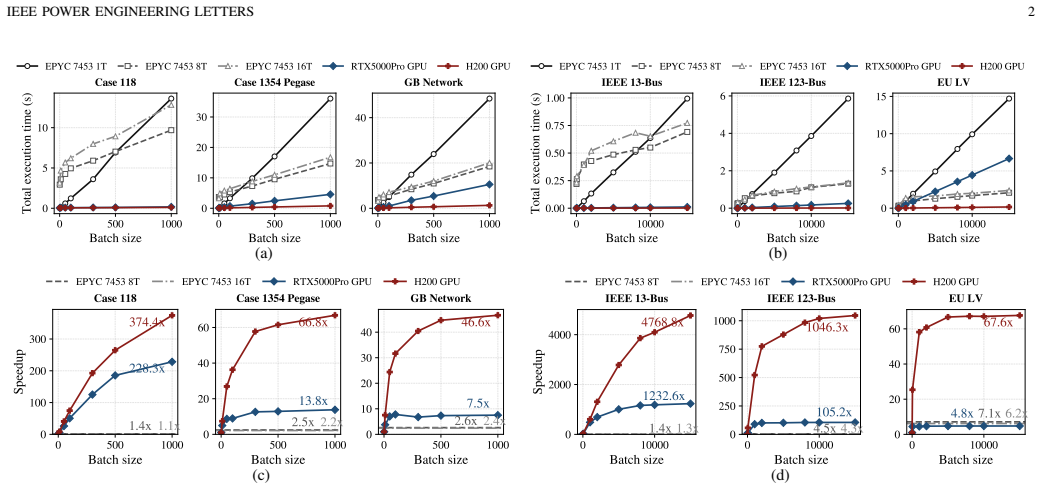
Coordinating growing grid flexibility under uncertainty is becoming increasingly important for efficient and reliable power-system operation. A core computational requirement is the efficient large-scale batched evaluation of AC power flow across candidate operating actions and uncertainty scenarios. Previous work has explored GPU-based batched power-flow evaluation, but has largely relied on hand-written C or CUDA code, creating barriers to customisation, efficient kernel optimisation, and long-term maintenance. JAX is a Python-based framework that enables efficient accelerator execution while keeping implementations in Python. This letter therefore proposes a JAX-based batched AC power-flow solver that uses current JAX functionality to implement Newton--Raphson for transmission networks and Z-Bus power flow for three-phase unbalanced distribution networks, achieving more than 10x speed-ups relative to pandapower and OpenDSS. In addition, JAX integrates seamlessly with the broader JAX-based AI ecosystem, making it straightforward to embed power-flow evaluation within AI methods for future larger-scale and more complex power-system operation.
Editorial analysis
A structured set of objections, weighed in public.
Referee Report
Summary. The paper proposes a JAX-based implementation of batched AC power-flow solvers, using Newton-Raphson for transmission networks and Z-Bus for three-phase unbalanced distribution networks. It reports >10x speedups relative to pandapower and OpenDSS while emphasizing seamless integration with the JAX AI ecosystem for embedding power-flow evaluations in larger-scale optimization and uncertainty-handling workflows.
Significance. If the numerical equivalence and reported speedups are confirmed, the work would be significant for enabling accessible, maintainable GPU-accelerated batched power-flow computations without custom CUDA kernels. This lowers barriers to integrating power-flow models into JAX-based machine-learning pipelines for grid flexibility and uncertainty management, a growing need in power-system operation.
major comments (2)
- [Results / Numerical Experiments] The central performance claim (>10x speedup) and the assumption of numerical equivalence to pandapower (Newton-Raphson) and OpenDSS (Z-Bus) are load-bearing but unsupported by any benchmark tables, network sizes, batch dimensions, hardware specifications, residual norms, voltage-error metrics, or convergence statistics in the manuscript. Without these data the speedup cannot be evaluated and downstream AI embeddings risk inheriting hidden instability.
- [Implementation] §3 (Implementation): the JAX Newton-Raphson and Z-Bus routines are stated to reproduce reference solvers, yet no discussion appears of linear-solver choice, Jacobian singularity handling, iteration tolerances, or floating-point differences that could alter convergence on realistic networks; this directly affects the validity of the speedup comparison.
minor comments (1)
- [Abstract] The abstract and introduction would benefit from a brief statement of the largest network size and batch size for which timings were obtained.
Simulated Author's Rebuttal
We thank the referee for the constructive comments, which highlight important areas for strengthening the manuscript. We address each major comment below and will revise the paper accordingly to provide the requested supporting data and implementation details.
read point-by-point responses
-
Referee: [Results / Numerical Experiments] The central performance claim (>10x speedup) and the assumption of numerical equivalence to pandapower (Newton-Raphson) and OpenDSS (Z-Bus) are load-bearing but unsupported by any benchmark tables, network sizes, batch dimensions, hardware specifications, residual norms, voltage-error metrics, or convergence statistics in the manuscript. Without these data the speedup cannot be evaluated and downstream AI embeddings risk inheriting hidden instability.
Authors: We agree that explicit benchmark data are essential to substantiate the performance claims and numerical equivalence. In the revised manuscript we will add a new Numerical Experiments section containing tables that report: specific network sizes (IEEE test cases and larger realistic networks), batch dimensions, hardware specifications (GPU model and CPU baseline), residual norms, voltage-error metrics relative to pandapower and OpenDSS, and convergence statistics. These additions will allow direct evaluation of the reported speedups and will mitigate concerns about hidden instability in downstream AI applications. revision: yes
-
Referee: [Implementation] §3 (Implementation): the JAX Newton-Raphson and Z-Bus routines are stated to reproduce reference solvers, yet no discussion appears of linear-solver choice, Jacobian singularity handling, iteration tolerances, or floating-point differences that could alter convergence on realistic networks; this directly affects the validity of the speedup comparison.
Authors: We acknowledge that additional implementation details are required for reproducibility and to validate the speedup comparisons. In the revised §3 we will expand the discussion to cover: the specific JAX linear solvers employed (jax.scipy.linalg.solve and related routines), handling of Jacobian singularity via regularization or pivoting, the iteration tolerances used (e.g., 1e-6 on the residual), and floating-point precision considerations. Key code excerpts and pseudocode will be included to clarify these choices. revision: yes
Circularity Check
No circularity: empirical implementation benchmarks with no self-referential derivations
full rationale
The paper presents a JAX reimplementation of standard Newton-Raphson (transmission) and Z-Bus (distribution) power-flow algorithms, with >10x speedup claims measured directly against pandapower and OpenDSS on benchmark networks. No equations, fitted parameters, or predictions are introduced that reduce to the inputs by construction. No uniqueness theorems, ansatzes, or self-citations are invoked to justify core results. The AI-ecosystem integration follows immediately from the choice of JAX and requires no additional derivation. The central claims remain falsifiable via external timing and accuracy tests.
Axiom & Free-Parameter Ledger
axioms (2)
- domain assumption Newton-Raphson iteration converges for the AC power-flow equations on transmission networks
- domain assumption Z-Bus method is valid and stable for three-phase unbalanced distribution networks
Lean theorems connected to this paper
-
IndisputableMonolith/Cost/FunctionalEquation.leanwashburn_uniqueness_aczel unclear?
unclearRelation between the paper passage and the cited Recognition theorem.
JAX-based batched AC power-flow solver that uses current JAX functionality to implement Newton–Raphson for transmission networks and Z-Bus power flow for three-phase unbalanced distribution networks
What do these tags mean?
- matches
- The paper's claim is directly supported by a theorem in the formal canon.
- supports
- The theorem supports part of the paper's argument, but the paper may add assumptions or extra steps.
- extends
- The paper goes beyond the formal theorem; the theorem is a base layer rather than the whole result.
- uses
- The paper appears to rely on the theorem as machinery.
- contradicts
- The paper's claim conflicts with a theorem or certificate in the canon.
- unclear
- Pith found a possible connection, but the passage is too broad, indirect, or ambiguous to say the theorem truly supports the claim.
Reference graph
Works this paper leans on
- [1]
-
[2]
Thurner, Leon and Scheidler, Alexander and Schäfer, Florian and Menke, Jan-Hendrik and Dollichon, Julian and Meier, Friederike and Meinecke, Steffen and Braun, Martin , journal=. Pandapower—An Open-Source Python Tool for Convenient Modeling, Analysis, and Optimization of Electric Power Systems , year=
- [3]
-
[4]
Network Topology Optimisation , year =
- [5]
-
[6]
GPU-Based Batch LU-Factorization Solver for Concurrent Analysis of Massive Power Flows , year=
Zhou, Gan and others , journal=. GPU-Based Batch LU-Factorization Solver for Concurrent Analysis of Massive Power Flows , year=
-
[7]
Su, Xueneng and He, Chuan and Liu, Tianqi and Wu, Lei , journal=. Full Parallel Power Flow Solution: A GPU-CPU-Based Vectorization Parallelization and Sparse Techniques for Newton–Raphson Implementation , year=
-
[8]
GPU-Accelerated Algorithm for Online Probabilistic Power Flow , year=
Zhou, Gan and Bo, Rui and Chien, Lungsheng and Zhang, Xu and Yang, Shengchun and Su, Dawei , journal=. GPU-Accelerated Algorithm for Online Probabilistic Power Flow , year=
-
[9]
Accelerating Unbalanced Distribution Power Flow on GPUs Using Sparse Inverse Factors , year=
Alla, Ravi Teja and Matavalam, Amarsagar Reddy Ramapuram , journal=. Accelerating Unbalanced Distribution Power Flow on GPUs Using Sparse Inverse Factors , year=
-
[10]
Superposition Theorem for Flexible Grids , year=
Marot, Antoine and Henka, Noureddine and Donnot, Benjamin and Tazi, Sami , journal=. Superposition Theorem for Flexible Grids , year=
-
[11]
OPEN: An open-source platform for developing smart local energy system applications , author=. Applied Energy , volume=. 2020 , publisher=
work page 2020
-
[12]
Advances in Neural Information Processing Systems , volume=
Jaxmarl: Multi-agent rl environments and algorithms in jax , author=. Advances in Neural Information Processing Systems , volume=
discussion (0)
Sign in with ORCID, Apple, or X to comment. Anyone can read and Pith papers without signing in.