Motional-Current-Sensing Method and Simplified Closed-Loop Control Strategy for Piezoelectric-Resonator-based DC-DC Converters
Pith reviewed 2026-05-19 16:03 UTC · model grok-4.3
The pith
A ring-dot shaped piezoelectric transformer senses motional current to enable simplified closed-loop control and ZVS in PR-based DC-DC converters.
A machine-rendered reading of the paper's core claim, the machinery that carries it, and where it could break.
Core claim
The ring-dot shaped piezoelectric transformer supplies an isolated, low-delay replica of the motional current that is physically robust to piezoceramic and circuit non-idealities; this signal directly feeds an event-driven control law consisting only of a finite state machine, PI compensator, low-speed ADC, and comparators, which maintains zero-voltage switching on all device transitions within each cycle.
What carries the argument
Ring-dot shaped piezoelectric transformer inserted to sense the motional current of the main resonator while preserving isolation and robustness to non-ideals.
If this is right
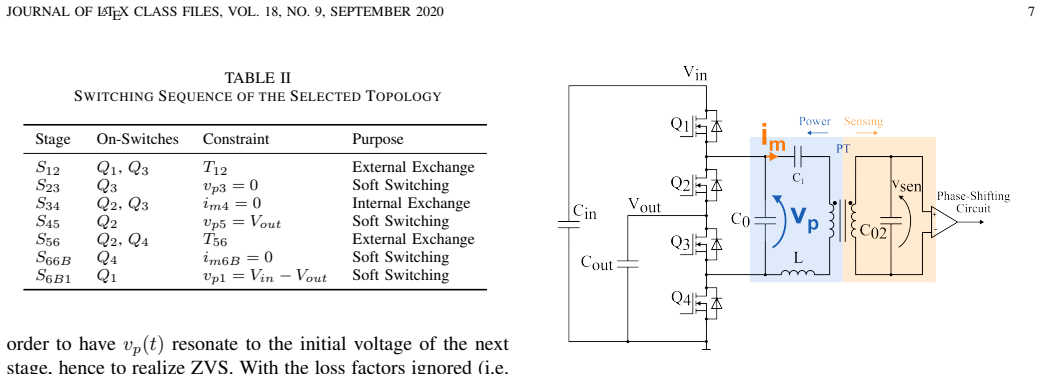
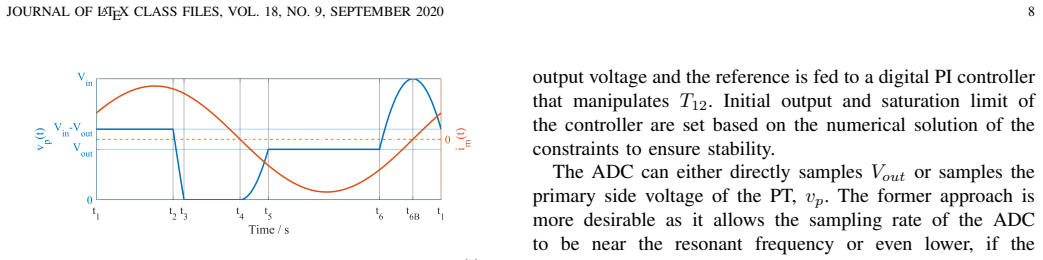
- The controller needs only a finite state machine, one PI loop, a low-speed ADC, and comparators instead of high-speed sampling or complex analog circuits.
- Zero-voltage switching is obtained on every transition inside a switching cycle, lowering switching losses.
- The converter exhibits self-start capability and improved stability margins.
- The usable operating frequency range of PR-based converters is extended by removing the prior sensing bottleneck.
Where Pith is reading between the lines
- The sensing approach could transfer to other resonant topologies that require indirect measurement of internal currents.
- Lower hardware and software overhead may allow integration of PR-based stages into space- or cost-constrained portable power supplies.
- Because the method tolerates non-ideals without extra compensation, it could support operation across wide temperature ranges without frequent recalibration.
Load-bearing premise
The added ring-dot piezoelectric transformer can be integrated without altering the main resonator's motional current waveform or adding measurable losses and delays that would corrupt the sensed signal.
What would settle it
Measurement showing that the ring-dot transformer output develops phase shift or amplitude error under varying load or temperature sufficient to cause loss of ZVS on one or more switching transitions.
Figures









read the original abstract
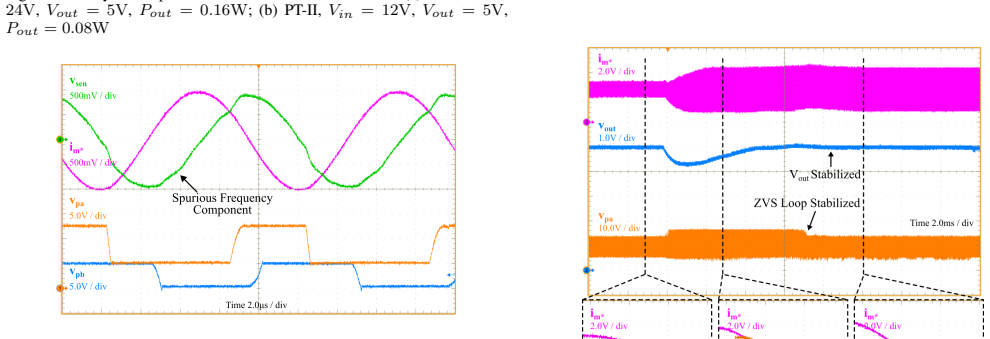
Piezoelectric resonators (PRs) have been seen as a competitive alternative to magnetic components. In PR-based converters, the motional current (in the LC series branch of the equivalent circuit) is vital for control proposes but cannot be measured directly. The difficulties to detect the zero-crossing points or to measure the amplitude of the motional current has been one of the most dominating obstacles that complicates the control strategies and limits the frequency range of the PR-based converters. This work discusses a ring-dot shaped piezoelectric transformer (PT) based motional current sensing method that provides current information with low-delay, low-loss and intrinsic isolation. It is physically proven that the proposed method is robust with various non-ideal factors of the piezoceramic and circuit implementation. Based on this, an event-driven control strategy is introduced, consisting of only a finite state machine, a PI loop, a low-speed ADC and several comparators. Experiments on a step-down PR-based converter verify that the proposed approach realize ZVS for all transitions within a switching cycle with reduced hardware and software resources, enhances stability and is capable of self-startup.
Editorial analysis
A structured set of objections, weighed in public.
Referee Report
Summary. The paper proposes a ring-dot shaped piezoelectric transformer (PT) for sensing the motional current in piezoelectric-resonator (PR) based DC-DC converters, claiming low-delay, low-loss, and isolated sensing. It states a physical proof of robustness to non-ideal factors of the piezoceramic and circuit, then introduces a simplified event-driven closed-loop control using only a finite state machine, PI loop, low-speed ADC, and comparators. Experiments on a step-down converter are said to verify ZVS for all transitions within a switching cycle, reduced hardware/software resources, enhanced stability, and self-startup.
Significance. If the robustness proof holds and the experimental ZVS results are reproducible with quantified error bounds, the work could meaningfully simplify control implementation for PR-based converters, addressing a key practical barrier. The low-resource event-driven approach and intrinsic isolation are potentially useful for compact, low-EMI power conversion applications. The experimental demonstration of full-cycle ZVS and self-startup provides concrete grounding for the claims.
major comments (1)
- [§III] §III (Motional-Current-Sensing Method), equivalent-circuit model: the central robustness claim rests on the ring-dot PT acting as a weakly coupled, low-delay sensor that leaves the primary LC motional branch dynamics unchanged. The manuscript should supply the explicit transfer-function derivation or measured isolation data (e.g., cross-coupling capacitance or phase-shift bounds) showing that any mechanical/electrical interaction remains negligible; without this, zero-crossing errors would directly compromise the event-driven ZVS logic.
minor comments (1)
- [Experimental Results] Table I or experimental setup section: adding a column or footnote that quantifies the added loss and delay of the ring-dot PT relative to the main resonator would help readers assess the overhead of the sensing approach.
Simulated Author's Rebuttal
We thank the referee for the detailed and constructive feedback. The suggestion to strengthen the presentation of the robustness claim in Section III is helpful. We address the major comment below and indicate the corresponding revision.
read point-by-point responses
-
Referee: [§III] §III (Motional-Current-Sensing Method), equivalent-circuit model: the central robustness claim rests on the ring-dot PT acting as a weakly coupled, low-delay sensor that leaves the primary LC motional branch dynamics unchanged. The manuscript should supply the explicit transfer-function derivation or measured isolation data (e.g., cross-coupling capacitance or phase-shift bounds) showing that any mechanical/electrical interaction remains negligible; without this, zero-crossing errors would directly compromise the event-driven ZVS logic.
Authors: We agree that an explicit transfer-function derivation and supporting measured data would make the robustness argument more transparent. The original Section III already contains a physical proof based on the ring-dot PT equivalent-circuit model, showing that the sensing branch remains weakly coupled to the primary LC motional branch with negligible effect on its dynamics. To address the request directly, we have added the full transfer-function derivation (including the sensed-to-motional current ratio and explicit bounds on phase shift and cross-coupling capacitance) to the revised Section III. We have also incorporated prototype measurements confirming isolation performance (cross-coupling capacitance below 0.05 pF and phase error below 0.5° over the operating range). These additions confirm that zero-crossing detection errors remain negligible for the event-driven ZVS logic. revision: yes
Circularity Check
No circularity: derivation relies on physical model and external experiments
full rationale
The paper introduces a ring-dot PT sensing method for motional current in PR converters, claims physical proof of robustness to non-ideals, and verifies ZVS via experiments with a simplified FSM+PI controller. No equations or steps reduce by construction to fitted parameters or self-citations; the sensing approach is presented as an independent circuit addition whose isolation is asserted via equivalent-circuit analysis and then tested externally. The central claims rest on model assumptions plus measured results rather than re-labeling inputs as outputs. This is the normal self-contained case.
Axiom & Free-Parameter Ledger
axioms (1)
- domain assumption Piezoelectric resonators can be modeled by an LC series branch plus parasitic elements whose motional current must be sensed for ZVS control.
Lean theorems connected to this paper
-
IndisputableMonolith/Cost/FunctionalEquation.leanwashburn_uniqueness_aczel unclear?
unclearRelation between the paper passage and the cited Recognition theorem.
The reduced Mason model of piezoelectric transformers... Z[i,m,o][1,2,3] denotes the mechanical impedances... complete current-sensing transfer function derived from the electromechanical model
-
IndisputableMonolith/Foundation/ArithmeticFromLogic.leanLogicNat induction and recovery unclear?
unclearRelation between the paper passage and the cited Recognition theorem.
event-driven control strategy... finite state machine, a PI loop, a low-speed ADC and several comparators... realize ZVS for all transitions
What do these tags mean?
- matches
- The paper's claim is directly supported by a theorem in the formal canon.
- supports
- The theorem supports part of the paper's argument, but the paper may add assumptions or extra steps.
- extends
- The paper goes beyond the formal theorem; the theorem is a base layer rather than the whole result.
- uses
- The paper appears to rely on the theorem as machinery.
- contradicts
- The paper's claim conflicts with a theorem or certificate in the canon.
- unclear
- Pith found a possible connection, but the passage is too broad, indirect, or ambiguous to say the theorem truly supports the claim.
Reference graph
Works this paper leans on
-
[1]
Opportunities, Progress, and Challenges in Piezoelectric-Based Power Electronics,
J. D. Boles, J. J. Piel, E. Ng, J. E. Bonavia, B. M. Wanyeki, J. H. Lang, and D. J. Perreault, “Opportunities, Progress, and Challenges in Piezoelectric-Based Power Electronics,”IEEJ Journal of Industry Applications, vol. 12, no. 3, pp. 254–263, May 2023
work page 2023
-
[2]
Enumeration and Analysis of DC–DC Converter Implementations Based on Piezoelectric Resonators,
J. D. Boles, J. J. Piel, and D. J. Perreault, “Enumeration and Analysis of DC–DC Converter Implementations Based on Piezoelectric Resonators,” IEEE Transactions on Power Electronics, vol. 36, no. 1, pp. 129–145, Jan. 2021
work page 2021
-
[3]
A Piezoelectric-Resonator-Based DC–DC Converter Demonstrating 1 kW/cm Resonator Power Density,
J. D. Boles, J. E. Bonavia, J. H. Lang, and D. J. Perreault, “A Piezoelectric-Resonator-Based DC–DC Converter Demonstrating 1 kW/cm Resonator Power Density,”IEEE Transactions on Power Elec- tronics, vol. 38, no. 3, pp. 2811–2815, Mar. 2023
work page 2023
-
[4]
A Series/Parallel Magnetic-Less Step- Down Converter based on Piezoelectric Resonators,
W.-C. B. Liu and P. P. Mercier, “A Series/Parallel Magnetic-Less Step- Down Converter based on Piezoelectric Resonators,” in2023 IEEE Applied Power Electronics Conference and Exposition (APEC), Mar. 2023, pp. 484–489
work page 2023
-
[5]
Fixed-Frequency Control of Piezoelectric Resonator DC-DC Converters for Spurious Mode Avoidance,
E. Stolt, W. D. Braun, L. Gu, J. Segovia-Fernandez, S. Chakraborty, R. Lu, and J. Rivas-Davila, “Fixed-Frequency Control of Piezoelectric Resonator DC-DC Converters for Spurious Mode Avoidance,”IEEE Open Journal of Power Electronics, vol. 2, pp. 582–590, 2021
work page 2021
-
[6]
Current Mode Control for High Frequency Piezoelectric Resonator-Based DC–DC Converters,
E. Stolt, M. Affolter, Z. Ye, and J. Rivas-Davila, “Current Mode Control for High Frequency Piezoelectric Resonator-Based DC–DC Converters,” IEEE Transactions on Power Electronics, vol. 40, no. 9, pp. 12 730– 12 738, Sep. 2025
work page 2025
-
[7]
A hybrid piezoelectric resonator-based DC-DC converter,
J.-Y . Ko, W.-C. B. Liu, and P. P. Mercier, “A hybrid piezoelectric resonator-based DC-DC converter,”Nature Communications, Mar. 2026
work page 2026
-
[8]
Closed-loop Control of A Dual-side Series/Parallel Piezoelectric-Resonator-based DC-DC Converter,
W.-C. B. Liu, G. Pillonnet, and P. P. Mercier, “Closed-loop Control of A Dual-side Series/Parallel Piezoelectric-Resonator-based DC-DC Converter,” in2025 IEEE Applied Power Electronics Conference and Exposition (APEC), Mar. 2025, pp. 315–320
work page 2025
-
[9]
An Integrated Dual-Side Series/Parallel Piezoelectric Resonator- Based DC–DC Converter,
——, “An Integrated Dual-Side Series/Parallel Piezoelectric Resonator- Based DC–DC Converter,”IEEE Journal of Solid-State Circuits, pp. 1–13, 2024
work page 2024
-
[10]
Phase-Shift V oltage Regulation of DC-DC Converters Based on Piezoelectric Resonators,
M. Touhami, H. Liew, and J. D. Boles, “Phase-Shift V oltage Regulation of DC-DC Converters Based on Piezoelectric Resonators,” in2024 IEEE Workshop on Control and Modeling for Power Electronics (COMPEL), Jun. 2024, pp. 1–8
work page 2024
-
[11]
M. Touhami and J. D. Boles, “Closed-Loop Control of Symmetric Switching Sequences for Piezoelectric-Resonator-Based DC-DC Con- verters,”IEEE Open Journal of Power Electronics, pp. 1–10, 2026
work page 2026
-
[12]
Feedback Control for a Piezoelectric-Resonator-Based DC-DC Power Converter,
J. J. Piel, J. D. Boles, J. H. Lang, and D. J. Perreault, “Feedback Control for a Piezoelectric-Resonator-Based DC-DC Power Converter,” in2021 IEEE 22nd Workshop on Control and Modelling of Power Electronics (COMPEL), Nov. 2021, pp. 1–8
work page 2021
-
[13]
Z. Yang, J. Forrester, J. N. Davidson, M. P. Foster, and D. A. Stone, “Resonant Current Estimation and Phase-Locked Loop Feedback Design for Piezoelectric Transformer-Based Power Supplies,”IEEE Transac- tions on Power Electronics, vol. 35, no. 10, pp. 10 466–10 476, Oct. 2020
work page 2020
-
[14]
Bidirectional inverting piezo resonator-based (BIPR) converter for cell balancing applications,
J. Forrester, J. Davidson, and M. Foster, “Bidirectional inverting piezo resonator-based (BIPR) converter for cell balancing applications,” in 2023 IEEE Energy Conversion Congress and Exposition (ECCE), Oct. 2023, pp. 195–201
work page 2023
-
[15]
Operating Frequency Prediction of Piezoelectric DC–DC Converters,
L. d. A. Pereira, A. Morel, M. Touhami, T. Lamorelle, G. Despesse, and G. Pillonnet, “Operating Frequency Prediction of Piezoelectric DC–DC Converters,”IEEE Transactions on Power Electronics, vol. 37, no. 3, pp. 2508–2512, Mar. 2022
work page 2022
-
[16]
First 6 MHz 8- Phases Regulated Lno Based Piezoelectric DC-DC Converter,
A. Marques, E. Bigot, G. Perez, and G. Despesse, “First 6 MHz 8- Phases Regulated Lno Based Piezoelectric DC-DC Converter,” in2025 IEEE 10th Southern Power Electronics Conference (SPEC), Dec. 2025, pp. 1–6
work page 2025
-
[17]
E. Bigot, G. Despesse, V . Breton, and F. Costa, “A new closed-loop regulation method dedicated to piezoelectric resonators based isolated DC-DC converter,”IET Conference Proceedings, vol. 2024, no. 3, pp. 146–153, Jun. 2024
work page 2024
-
[18]
A Spurious-Free Piezoelectric Resonator Based 3.2 kW DC– DC Converter for EV On-Board Chargers,
E. Stolt, W. Braun, K. Nguyen, V . Chulukhadze, R. Lu, and J. Rivas- Davila, “A Spurious-Free Piezoelectric Resonator Based 3.2 kW DC– DC Converter for EV On-Board Chargers,”IEEE Transactions on Power Electronics, vol. 39, no. 2, pp. 2478–2488, Feb. 2024
work page 2024
-
[19]
Implementation of Control Strategy for Step-down DC-DC Converter Based on Piezo- electric Resonator,
M. Touhami, G. Despesse, F. Costa, and B. Pollet, “Implementation of Control Strategy for Step-down DC-DC Converter Based on Piezo- electric Resonator,” in2020 22nd European Conference on Power Electronics and Applications (EPE’20 ECCE Europe), Sep. 2020, pp. 1–9
work page 2020
-
[20]
High-Efficiency Isolated Piezoelectric Transformers for Magnetic-less DC-DC Power Conversion,
S. Naval, W. Xu, M. Touhami, and J. D. Boles, “High-Efficiency Isolated Piezoelectric Transformers for Magnetic-less DC-DC Power Conversion,”IEEE Transactions on Power Electronics, pp. 1–16, 2026
work page 2026
-
[21]
Piezoelectric Transformer Component Design for DC-DC Power Conversion,
E. Ng, J. D. Boles, J. H. Lang, and D. J. Perreault, “Piezoelectric Transformer Component Design for DC-DC Power Conversion,”2023 IEEE 24th Workshop on Control and Modeling for Power Electronics (COMPEL), pp. 1–8, Jun. 2023
work page 2023
-
[22]
Planar Piezoelectric Transformer- Based High Step-Down V oltage-Ratio DC–DC Converter,
L. Wang, K. Sun, and R. Burgos, “Planar Piezoelectric Transformer- Based High Step-Down V oltage-Ratio DC–DC Converter,”IEEE Trans- actions on Power Electronics, vol. 37, no. 9, pp. 10 833–10 848, Sep. 2022
work page 2022
-
[23]
D. Morgan,Surface Acoustic Wave Filters: With Applications to Elec- tronic Communications and Signal Processing. Academic Press, Jul. 2010
work page 2010
-
[24]
Low Phase Noise RF Oscillators Based on Thin-Film Lithium Niobate Acoustic Delay Lines,
M.-H. Li, R. Lu, T. Manzaneque, and S. Gong, “Low Phase Noise RF Oscillators Based on Thin-Film Lithium Niobate Acoustic Delay Lines,” Journal of Microelectromechanical Systems, vol. 29, no. 2, pp. 129–131, Apr. 2020
work page 2020
-
[25]
Z. Xi, Z. Cen, D. Wang, J. G. Thomas, B. R. Srijanto, I. I. Kravchenko, J. Zuo, H. Liu, J. Ji, Y . Zhu, Y . Yao, and L. Shao, “Room- Temperature Mid-Infrared Detection Using Metasurface-Absorber- Integrated Phononic Crystal Oscillator,”Laser & Photonics Reviews, vol. 19, no. 20, p. e00498, 2025
work page 2025
-
[26]
W. Ding, M. Bavencoffe, and M. Lethiecq, “Accurate coupled vibra- tion analysis of a piezoelectric ceramic cylinder by the superposition method,”Ultrasonics, vol. 115, p. 106474, Aug. 2021
work page 2021
-
[27]
Measurement and prediction of the frequency spectrum of piezoelectric disks by modal analysis,
N. Guo and P. Cawley, “Measurement and prediction of the frequency spectrum of piezoelectric disks by modal analysis,”The Journal of the Acoustical Society of America, vol. 92, no. 6, pp. 3379–3388, Dec. 1992
work page 1992
-
[28]
C.-H. Huang, Y .-C. Lin, and C. C. Ma, “Theoretical analysis and experimental measurement for resonant vibration of piezoceramic cir- cular plates,”IEEE Transactions on Ultrasonics, Ferroelectrics, and Frequency Control, vol. 51, no. 1, pp. 12–24, Jan. 2004
work page 2004
-
[29]
W. P. W. P. Mason,Physical Acoustics and the Properties of Solids. Princeton, N.J., Van Nostrand, 1958
work page 1958
-
[30]
Ikeda,Fundamentals of Piezoelectricity
T. Ikeda,Fundamentals of Piezoelectricity. Oxford University Press, 1996
work page 1996
-
[31]
Overtone Piezoelectric Transformers for Magnetic-less Power Conversion,
S. Naval, W. Xu, M. Touhami, and J. D. Boles, “Overtone Piezoelectric Transformers for Magnetic-less Power Conversion,” in2025 IEEE 26th Workshop on Control and Modeling for Power Electronics (COMPEL), Jun. 2025, pp. 1–8
work page 2025
-
[32]
Nonlinear Losses and Material Limits of Piezoelectric Resonators for DC-DC Converters,
C. Daniel, E. Stolt, W. Braun, R. Lu, and J. Rivas-Davila, “Nonlinear Losses and Material Limits of Piezoelectric Resonators for DC-DC Converters,” in2024 IEEE Applied Power Electronics Conference and Exposition (APEC), Feb. 2024, pp. 1560–1565
work page 2024
-
[33]
Electrical properties of PZT piezoelectric ceramic at high temperatures,
Z. Gubinyi, C. Batur, A. Sayir, and F. Dynys, “Electrical properties of PZT piezoelectric ceramic at high temperatures,”Journal of Electroce- ramics, vol. 20, no. 2, pp. 95–105, Apr. 2008
work page 2008
-
[34]
Piezoelectric Materials for High Temperature Sensors,
S. Zhang and F. Yu, “Piezoelectric Materials for High Temperature Sensors,”Journal of the American Ceramic Society, vol. 94, no. 10, pp. 3153–3170, 2011
work page 2011
-
[35]
Evaluating Piezoelectric Materials and Vibration Modes for Power Conversion,
J. D. Boles, J. E. Bonavia, P. L. Acosta, Y . K. Ramadass, J. H. Lang, and D. J. Perreault, “Evaluating Piezoelectric Materials and Vibration Modes for Power Conversion,”IEEE Transactions on Power Electronics, vol. 37, no. 3, pp. 3374–3390, Mar. 2022
work page 2022
-
[36]
Circuit Sim- ulator Compatible Model for the Ring-Dot Piezoelectric Transformer,
J. Forrester, J. N. Davidson, M. P. Foster, and D. A. Stone, “Circuit Sim- ulator Compatible Model for the Ring-Dot Piezoelectric Transformer,” Journal of Microelectromechanical Systems, vol. 32, no. 1, pp. 103–116, Feb. 2023
work page 2023
-
[37]
The NIST Handbook of Mathematical Functions,
F. W. Olver, D. W. Lozier, R. Boisvert, and C. W. Clark, “The NIST Handbook of Mathematical Functions,”NIST, May 2010
work page 2010
- [38]
discussion (0)
Sign in with ORCID, Apple, or X to comment. Anyone can read and Pith papers without signing in.