Eff-WRFGS: Efficient Wireless Radiance Field Using 3D Gaussian Splatting
Pith reviewed 2026-05-19 15:45 UTC · model grok-4.3
The pith
Eff-WRFGS adds learnable masks to 3D Gaussian primitives to prune wireless radiance fields for compact CSI prediction.
A machine-rendered reading of the paper's core claim, the machinery that carries it, and where it could break.
Core claim
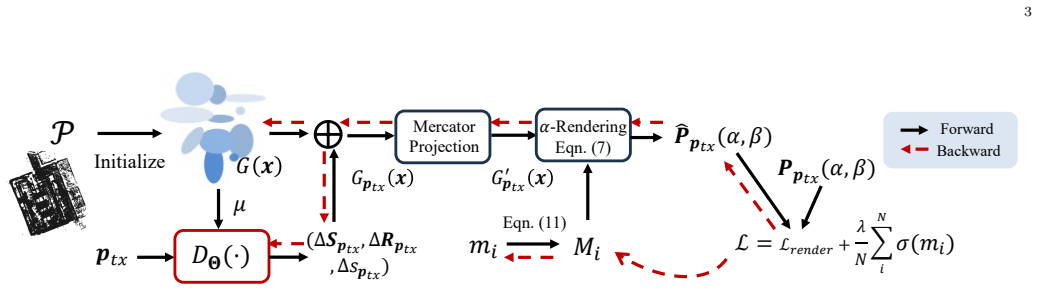
Eff-WRFGS models the wireless channel as a radiance field composed of 3D Gaussian primitives, each carrying a learnable mask that signals its contribution to rendered CSI values. Training minimizes a weighted sum of image-based rendering loss and a mask regularization term, which drives pruning of negligible primitives and yields compact scene representations that enable rapid queries for new transmitter positions.
What carries the argument
Learnable per-primitive mask that scores importance and guides pruning inside the 3D Gaussian Splatting rendering pipeline.
If this is right
- Storage requirements for the radiance field drop by up to 44 times, easing deployment on memory-limited hardware.
- Rendering time decreases by up to 7 times, supporting quicker CSI lookups during operation.
- Pilot and feedback overhead in wireless systems can be reduced by replacing repeated channel measurements with model queries.
- Initializing from a 3D point cloud of the environment produces a better quality-efficiency trade-off than random starts.
Where Pith is reading between the lines
- The same mask-based pruning could be applied to other radiance-field tasks such as visual rendering or acoustic modeling.
- On-device versions of the pruned model might enable real-time CSI prediction inside mobile terminals without cloud access.
- Combining the approach with additional compression techniques could yield even smaller representations for very large scenes.
Load-bearing premise
The learnable mask per Gaussian primitive can be trained to reliably identify and prune elements without systematically degrading CSI prediction accuracy for new transmitter locations.
What would settle it
After pruning guided by the masks, CSI predictions for transmitter locations held out from training show large errors compared with ground-truth measurements from the same scene.
Figures


read the original abstract
Wireless channel modeling is a key building block for next-generation wireless systems. Predicting the channel state information (CSI) across different transmitter locations can substantially reduce the pilot and feedback overhead of conventional channel estimation. We propose Eff-WRFGS, an efficient wireless radiance field modeling framework built upon 3D Gaussian Splatting. Eff-WRFGS introduces a learnable mask for each 3D Gaussian primitive to indicate its importance, which guides the pruning of less significant primitives for more efficient rendering. The model is trained using a weighted combination of rendering and regularization losses, allowing a flexible trade-off between rendering quality and efficiency. Numerical results on the $\text{NeRF}^2$ dataset demonstrate that Eff-WRFGS achieves up to 44$\times$ storage reduction and 7$\times$ rendering speed-up with only marginal quality degradation. Moreover, initializing the Gaussian primitives from a 3D point cloud of the scene further improves the entire quality-efficiency trade-off.
Editorial analysis
A structured set of objections, weighed in public.
Referee Report
Summary. The manuscript proposes Eff-WRFGS, an efficient wireless radiance field modeling framework based on 3D Gaussian Splatting for CSI prediction. It introduces a learnable mask per Gaussian primitive to guide pruning of less important elements, optimized jointly with rendering and regularization losses to trade off quality and efficiency. Numerical results on the NeRF² dataset report up to 44× storage reduction and 7× rendering speed-up with marginal quality degradation, with further gains from 3D point cloud initialization of the primitives.
Significance. If the reported efficiency gains hold while preserving CSI accuracy for unseen transmitter locations, the work could meaningfully reduce storage and compute requirements for wireless channel modeling, supporting lower pilot overhead in next-generation systems by adapting 3D Gaussian representations to propagation path prediction.
major comments (2)
- [Experiments] Experiments section: the headline claims of 44× storage reduction and 7× speed-up with only marginal quality degradation are stated without reporting the number of training versus test transmitter locations, the precise construction of the held-out set, error bars, or multiple-run statistics. These details are required to assess whether the learned mask generalizes to new transmitter positions rather than overfitting to the training distribution.
- [Method] Method section (description of the learnable mask): the joint optimization of the per-primitive mask with rendering and regularization losses lacks an ablation or sensitivity analysis showing that pruned Gaussians do not increase NMSE for transmitter locations outside the training set. Because CSI depends on tx-specific paths, this generalization property is load-bearing for the practical claim.
minor comments (2)
- [Abstract] Abstract: the term 'marginal quality degradation' should be replaced by explicit quantitative values (e.g., NMSE or PSNR delta) to allow immediate assessment of the quality-efficiency trade-off.
- [Method] Notation: the definition and initialization of the learnable mask parameter should be stated more clearly, including its range and how it interacts with the Gaussian opacity and covariance during pruning.
Simulated Author's Rebuttal
We thank the referee for their thorough review and valuable suggestions. We have carefully considered each comment and revised the manuscript to enhance the clarity and completeness of our experimental results and method analysis.
read point-by-point responses
-
Referee: [Experiments] Experiments section: the headline claims of 44× storage reduction and 7× speed-up with only marginal quality degradation are stated without reporting the number of training versus test transmitter locations, the precise construction of the held-out set, error bars, or multiple-run statistics. These details are required to assess whether the learned mask generalizes to new transmitter positions rather than overfitting to the training distribution.
Authors: We agree that these details are important for assessing generalization. In the revised manuscript, we have included the number of training and test transmitter locations, a description of the held-out set construction (transmitter locations excluded from the training data), error bars representing variability across runs, and results from multiple independent runs with different random seeds. These additions allow readers to evaluate that the learned mask generalizes rather than overfits to the training transmitter distribution. revision: yes
-
Referee: [Method] Method section (description of the learnable mask): the joint optimization of the per-primitive mask with rendering and regularization losses lacks an ablation or sensitivity analysis showing that pruned Gaussians do not increase NMSE for transmitter locations outside the training set. Because CSI depends on tx-specific paths, this generalization property is load-bearing for the practical claim.
Authors: We agree that an ablation study on the generalization of the pruned model to unseen transmitter locations is necessary. We have added such an analysis in the revised manuscript, evaluating NMSE on held-out transmitter positions for different levels of pruning. The results indicate that the joint optimization with regularization losses ensures that pruning does not substantially increase NMSE for out-of-distribution transmitters, supporting the practical applicability of the approach. revision: yes
Circularity Check
Empirical results on external NeRF² dataset; no definitional or self-referential circularity in core claims
full rationale
The paper adapts 3D Gaussian Splatting with a learnable per-primitive mask, trained via a weighted sum of rendering and regularization losses. Reported gains (44× storage, 7× speed) are numerical outcomes measured on the held-out portions of the external NeRF² dataset rather than quantities defined by the fitted parameters themselves. No equation reduces the final CSI prediction or efficiency metric to a tautology of the training objective, and no load-bearing uniqueness theorem or ansatz is imported via self-citation. The generalization concern raised in the skeptic note is an empirical assumption risk, not a circularity in the derivation chain.
Axiom & Free-Parameter Ledger
free parameters (1)
- loss weights
axioms (1)
- domain assumption 3D Gaussian Splatting primitives can represent wireless propagation effects sufficiently for CSI prediction
invented entities (1)
-
learnable mask for each 3D Gaussian primitive
no independent evidence
Reference graph
Works this paper leans on
-
[1]
Channel estimation techniques based on pilot arrangement in OFDM systems,
S. Coleri, M. Ergen, A. Puri, and A. Bahai, “Channel estimation techniques based on pilot arrangement in OFDM systems,” IEEE Trans. Broadcast., vol. 48, no. 3, pp. 223–229, 2002
work page 2002
-
[2]
Deep learning for massive MIMO CSI feedback,
C.-K. Wen, W.-T. Shih, and S. Jin, “Deep learning for massive MIMO CSI feedback,” IEEE Wireless Commun. Lett., vol. 7, no. 5, pp. 748–751, 2018
work page 2018
-
[3]
RadioUNet: Fast radio map estimation with convolutional neural networks,
R. Levie, Ç. Yapar, G. Kutyniok, and G. Caire, “RadioUNet: Fast radio map estimation with convolutional neural networks,” IEEE Trans. Wireless Commun., vol. 20, no. 6, pp. 4001–4015, 2021
work page 2021
-
[4]
Learning radio environments by differentiable ray tracing,
J. Hoydis, F. A. Aoudia, S. Cammerer, F. Euchner, M. Nimier- David, S. T. Brink, and A. Keller, “Learning radio environments by differentiable ray tracing,” IEEE Trans. Mach. Learn. Com- mun. Netw., vol. 2, pp. 1527–1539, 2024
work page 2024
-
[5]
A tutorial on environment- aware communications via channel knowledge map for 6g,
Y. Zeng, J. Chen, J. Xu, D. Wu, X. Xu, S. Jin, X. Gao, D. Gesbert, S. Cui, and R. Zhang, “A tutorial on environment- aware communications via channel knowledge map for 6g,” IEEE Commun. Surveys Tuts., 2024
work page 2024
-
[6]
NeRF: representing scenes as neural radiance fields for view synthesis,
B. Mildenhall, P. P. Srinivasan, M. Tancik, J. T. Barron, R. Ramamoorthi, and R. Ng, “NeRF: representing scenes as neural radiance fields for view synthesis,” Commun. ACM, vol. 65, no. 1, p. 99–106, Dec. 2021
work page 2021
-
[7]
Graph.42, 4, Article 139 (jul 2023), 14 pages
B. Kerbl, G. Kopanas, T. Leimkuehler, and G. Drettakis, “3D gaussian splatting for real-time radiance field rendering,” ACM Trans. Graph., vol. 42, no. 4, Jul. 2023. [Online]. A vailable: https://doi.org/10.1145/3592433
-
[8]
NeRF2: Neural radio- frequency radiance fields,
X. Zhao, Z. An, Q. Pan, and L. Yang, “NeRF2: Neural radio- frequency radiance fields,” in Proc. 29th Annu. Int. Conf. Mobile Comput. Netw., ser. ACM MobiCom ’23, 2023
work page 2023
-
[9]
Neural representation for wireless radiation field reconstruction: A 3D gaussian splatting approach,
C. Wen, J. Tong, Y. Hu, Z. Lin, and J. Zhang, “Neural representation for wireless radiation field reconstruction: A 3D gaussian splatting approach,” IEEE Trans. Wireless Commun., vol. 25, pp. 7490–7504, 2026
work page 2026
-
[10]
L. Zhang, H. Sun, S. Berweger, C. Gentile, and R. Q. Hu, “RF- 3DGS: Wireless channel modeling with radio radiance field and 3D gaussian splatting,” arXiv:2411.19420, 2025
-
[11]
Bridging Visual and Wireless Sensing via a Unified Radiation Field for 3D Radio Map Construction
C. Wen, J. Tong, Z. Lin, C. Bian, and J. Zhang, “Bridging visual and wireless sensing via a unified radiation field for 3D radio map construction,” 2026. [Online]. A vailable: https://arxiv.org/abs/2601.19216
work page internal anchor Pith review Pith/arXiv arXiv 2026
-
[12]
Lightgaussian: Unbounded 3d gaussian compression with 15x reduction and 200+ fps,
Z. Fan, K. Wang, K. Wen, Z. Zhu, D. Xu, and Z. Wang, “Lightgaussian: Unbounded 3d gaussian compression with 15x reduction and 200+ fps,” in Adv. Neural Inf. Process. Syst., vol. 37. Curran Associates, Inc., 2024, pp. 140 138–140 158
work page 2024
-
[13]
Compact 3D gaussian representation for radiance field,
J. C. Lee, D. Rho, X. Sun, J. H. Ko, and E. Park, “Compact 3D gaussian representation for radiance field,” in CVPR, 2024, pp. 21 719–21 728
work page 2024
discussion (0)
Sign in with ORCID, Apple, or X to comment. Anyone can read and Pith papers without signing in.