On the fundamental solution for viscous internal waves and Brinkman flows. Part 1. Two dimensions
Pith reviewed 2026-05-19 14:29 UTC · model grok-4.3
The pith
The fundamental solutions for viscous internal waves and Brinkman flows are single integrals with logarithmic singularities.
A machine-rendered reading of the paper's core claim, the machinery that carries it, and where it could break.
Core claim
The viscous and diffusive fundamental solution for monochromatic internal waves in a uniformly stratified medium takes the form of a single integral with logarithmic singularities. A parallel integral form holds for anisotropic Brinkman flow. For Prandtl numbers greater than or equal to order one the wave field is a superposition of wave-like and Stokeslet-like terms, with density diffusion attenuating amplitude by the factor (1 + Pr^{-1})^{-2/3} and broadening beam width by the factor (1 + Pr^{-1})^{1/3}. Evanescent waves and anisotropic Brinkman flows display analogous integral structures, the latter remaining purely real and increasingly confined to the direction of least resistance as an
What carries the argument
The single-integral representation of the fundamental solution obtained by Fourier or integral-transform methods applied to the linearized viscous and diffusive governing equations.
If this is right
- The integral forms permit efficient numerical quadrature and direct insertion into boundary integral formulations for solving more complex boundary-value problems.
- Far-field asymptotics recover and extend earlier results such as those of Thomas and Stevenson for wave beams both inside and outside the characteristic angle.
- Evanescent waves in stratified fluids and anisotropic Brinkman flows admit the same integral structure and exhibit single dominant circulation cells.
- Increasing anisotropy in Brinkman flow progressively confines the circulation to the direction of least resistance.
Where Pith is reading between the lines
- The explicit scaling of beam width and amplitude with Prandtl number supplies a testable prediction for laboratory experiments that vary the diffusivity ratio.
- These fundamental solutions can serve as kernels for modeling wave propagation through regions with spatially varying stratification or weak nonlinearity.
- The two-dimensional integral construction offers a template for deriving analogous three-dimensional representations in a subsequent study.
Load-bearing premise
The medium is assumed to be uniformly stratified with constant buoyancy frequency and the governing equations are linearized for monochromatic small-amplitude waves.
What would settle it
Direct numerical evaluation of the single-integral expression for a chosen Prandtl number followed by comparison against a finite-difference solution of the linearized point-forced equations would confirm or refute the predicted amplitude and beam-width scalings.
Figures




read the original abstract
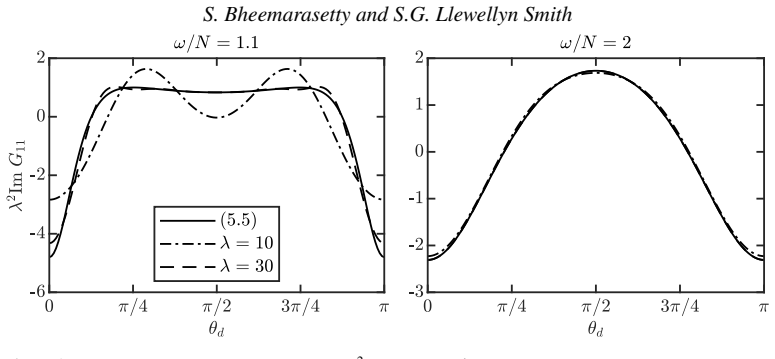
We obtain the viscous and diffusive fundamental solution for monochromatic internal waves in a uniformly stratified medium and for anisotropic Brinkman flow. These solutions take the form of single integrals with logarithmic singularities, and can be computed numerically in an efficient manner for possible use in boundary integral methods. Far-field asymptotic results are obtained, giving solutions valid far from and inside a ``beam'' corresponding to the internal wave angle in the internal wave case, consistent with Thomas & Stevenson (1972). For Prandtl numbers $\text{Pr} \gtrsim O(1)$, the wave field is given by a superposition of wave- and Stokeslet-like terms. Unlike previous studies, a uniform asymptotic expansion of the wave-field for $\text{Pr} \gtrsim O(1)$ can be computed rigorously. Density diffusion attenuates the wave amplitude as to $(1+\text{Pr}^{-1})^{-2/3}$ and broadens the beam width according to $(1+\text{Pr}^{-1})^{1/3}$. Evanescent waves in a stratified medium and anisotropic Brinkman flows have similar behaviour. Anisotropic Brinkman flow is purely real, dominated by a single circulation cell. As anisotropy increases, the flow becomes increasingly confined to the direction with least resistance. The stratified evanescent wave field has near-vertical cells in its real part, and a dominant single circulation cell in its imaginary part.
Editorial analysis
A structured set of objections, weighed in public.
Referee Report
Summary. The manuscript derives the viscous and diffusive fundamental solutions for monochromatic internal waves in a uniformly stratified medium and for anisotropic Brinkman flows in two dimensions. These solutions are expressed as single integrals containing logarithmic singularities, suitable for efficient numerical evaluation and boundary integral methods. Far-field asymptotics are developed, including a uniform asymptotic expansion for Pr ≳ O(1) that superposes internal-wave beam and Stokeslet-like contributions, with density diffusion producing amplitude attenuation by the factor (1 + Pr^{-1})^{-2/3} and beam broadening by (1 + Pr^{-1})^{1/3}. The work also treats evanescent waves and shows increasing flow confinement with anisotropy in the Brinkman case.
Significance. If the central derivations hold, the single-integral representations and the rigorously derived uniform asymptotics would supply a practical analytical and computational tool for modeling viscous internal waves and anisotropic flows. The explicit Pr-dependent scalings and consistency with Thomas & Stevenson (1972) far-field observations add value for applications in stratified fluid dynamics. The absence of free parameters or post-hoc fitting in the scalings is a methodological strength.
major comments (1)
- [uniform asymptotic expansion for Pr ≳ O(1)] In the derivation of the uniform asymptotic expansion for Pr ≳ O(1), the treatment of the logarithmic singularity inside the beam requires an explicit error estimate. After the Pr-dependent rescaling of the stationary-phase contour or inner variable, the manuscript should demonstrate (e.g., via integration by parts or contour analysis) that the branch of the log term is preserved and the singular contribution cancels uniformly across the beam width; without such a bound the claimed exponents for amplitude attenuation and beam broadening remain formal rather than rigorously controlled.
minor comments (2)
- [Abstract] The abstract asserts that the integrals 'can be computed numerically in an efficient manner'; a short description of the quadrature scheme or singularity-handling technique in the main text would improve reproducibility.
- [governing equations and integral representation] Notation for the complex vertical wavenumber and the precise definition of the logarithmic argument should be stated explicitly when the integral kernel is first introduced.
Simulated Author's Rebuttal
We thank the referee for the positive assessment of the manuscript and for the constructive comment on strengthening the rigor of the uniform asymptotic expansion. We address the point below and will incorporate the requested analysis in the revision.
read point-by-point responses
-
Referee: In the derivation of the uniform asymptotic expansion for Pr ≳ O(1), the treatment of the logarithmic singularity inside the beam requires an explicit error estimate. After the Pr-dependent rescaling of the stationary-phase contour or inner variable, the manuscript should demonstrate (e.g., via integration by parts or contour analysis) that the branch of the log term is preserved and the singular contribution cancels uniformly across the beam width; without such a bound the claimed exponents for amplitude attenuation and beam broadening remain formal rather than rigorously controlled.
Authors: We agree that an explicit error estimate for the logarithmic singularity after the Pr-dependent rescaling would make the uniform asymptotic expansion fully rigorous. In the revised manuscript we will add a dedicated paragraph (or short subsection) performing integration by parts on the rescaled contour integral. This will show that the branch of the logarithm is preserved and that the singular contribution is bounded by a term that is uniformly small across the beam width, with the remainder being of higher order in the far-field parameter. The analysis will thereby confirm that the amplitude attenuation factor (1 + Pr^{-1})^{-2/3} and the beam-broadening factor (1 + Pr^{-1})^{1/3} are rigorously controlled rather than formal. revision: yes
Circularity Check
Derivation from governing equations via integral transforms is self-contained
full rationale
The paper constructs the viscous and diffusive fundamental solutions directly from the linearized governing equations for monochromatic internal waves and anisotropic Brinkman flow using Fourier or integral-transform methods, yielding single-integral representations with logarithmic singularities. Far-field asymptotics, including the uniform expansion for Pr ≳ O(1) with explicit factors (1+Pr^{-1})^{-2/3} for amplitude attenuation and (1+Pr^{-1})^{1/3} for beam broadening, are obtained by stationary-phase analysis and superposition of wave and Stokeslet terms applied to these integrals. No load-bearing step reduces by construction to a fitted parameter, self-definition, or self-citation chain; the scalings emerge from the Pr-dependent rescaling of the contour and inner variable in the asymptotic analysis of the integral kernel. The derivation remains independent of external fitted data or prior results by the same authors.
Axiom & Free-Parameter Ledger
axioms (2)
- domain assumption Linearised governing equations for monochromatic internal waves in a uniformly stratified medium with constant buoyancy frequency and constant viscosity and diffusivity coefficients.
- domain assumption Anisotropic Brinkman equations with direction-dependent permeability coefficients.
Reference graph
Works this paper leans on
- [1]
-
[2]
P. G. Baines , title =. Deep-Sea Res. , year = 1973, volume = 20, pages =
work page 1973
- [3]
-
[4]
Critical slope singularities in rotating and stratified fluids , author=. Phys. Rev. Fluids , volume=
-
[5]
A. J. M. Davis and Llewellyn Smith, S. G. , title =. J. Fluid Mech. , year = 2010, volume = 656, pages =
work page 2010
-
[6]
R. Estrada and R. P. Kanwal , year=. Singular integral equations , publisher=
-
[7]
C. Garrett and E. Kunze , title =. Ann. Rev. Fluid Mech. , year = 2007, volume = 39, pages =
work page 2007
-
[8]
D. Gordon and T. N. Stevenson , title =. J. Fluid Mech. , year = 1972, volume = 56, pages =
work page 1972
-
[9]
E. J. Hinch , title =
-
[10]
P. E. Holloway and M. A. Merrifield , title =. J. Geophys. Res. , year = 1999, volume = 104, pages =
work page 1999
-
[11]
D. G. Hurley , title =. J. Fluid Mech. , year =
-
[12]
D. G. Hurley and G. Keady , title =. J. Fluid Mech. , year =
-
[13]
Kohr, M. and Sekhar, G. P. R. and Blake, J. R. , title =. IMA J. Appl Math , volume =
-
[14]
A. V. Kistovich and Yu. D. Chasechkin , title =. Izv. Atmos. Ocean. Phys. , year = 2014, volume = 50, pages =
work page 2014
-
[15]
L. H. Larsen , title =. Deep-Sea Res. , year =
-
[16]
S. A. Makarov and V. I. Neklyudov and Yu. D. Chashechkin , title =. Izv. Atmos. Ocean. Phys. , year = 1990, volume = 26, pages =
work page 1990
-
[17]
Llewellyn Smith, S. G. and Young, W. R. , title =. J. Phys. Oceanogr. , year = 2002, volume = 32, pages =
work page 2002
-
[18]
Llewellyn Smith, S. G. and Young, W. R. , title =. J. Fluid Mech. , year = 2003, volume = 495, pages =
work page 2003
-
[19]
P. A. Martin and Llewellyn Smith, S. G. , title =. Proc. R. Soc. Lond
-
[20]
Internal gravity waves, boundary integral equations and radiation conditions , journal =. 2012 , author =
work page 2012
-
[21]
P. A. Martin , title=. IMA J. Appl. Math. , year=2019, volume=
work page 2019
-
[22]
D. E. Mowbray and B. S. H. Rarity , title =. J. Fluid Mech. , year = 1967, volume = 28, pages =
work page 1967
-
[23]
P\'etr\'elis and Llewellyn Smith, S
F. P\'etr\'elis and Llewellyn Smith, S. G. and Young, W. R. , title =. J. Phys. Oceanogr. , year = 2006, volume = 36, pages =
work page 2006
- [24]
-
[25]
Ramachandra Rao, A. and K. C. Balan , title =. Proc. Indian Acad. Sci
- [26]
-
[27]
B. R. Sutherland , title =
-
[28]
D. N. Thomas and T. N. Stevenson , title =. J. Fluid Mech. , year = 1972, volume = 54, pages =
work page 1972
-
[29]
B. Voisin , title =. J. Fluid Mech. , year = 1991, volume = 231, pages =
work page 1991
-
[30]
B. Voisin , title =. J. Fluid Mech. , year = 2003, volume = 496, pages =
work page 2003
-
[31]
B. Voisin and Ermanyuk, E. V. and Fl\'or, J.-B. , title =. J. Fluid Mech. , year = 2011, volume = 666, pages =
work page 2011
-
[32]
B. Voisin , title =. J. Fluid Mech. , year = 2020, volume = 900, pages =
work page 2020
-
[33]
B. Voisin , title =. J. Fluid Mech. , year = 2021, volume = 927, pages =
work page 2021
-
[34]
B. Voisin , title =. J. Fluid Mech. , year = 2024, volume = 984, pages =
work page 2024
-
[35]
B. Voisin , title =. J. Fluid Mech. , year = 2024, volume = 987, pages =
work page 2024
discussion (0)
Sign in with ORCID, Apple, or X to comment. Anyone can read and Pith papers without signing in.