Itinerant antiferromagnetism in the antagonistic pair compound Y₄Co₃Ag
Pith reviewed 2026-05-19 15:57 UTC · model grok-4.3
The pith
Y4Co3Ag orders antiferromagnetically at 14.9 K with small itinerant moments below 0.2 μB per Co in a quasi-one-dimensional chain structure.
A machine-rendered reading of the paper's core claim, the machinery that carries it, and where it could break.
Core claim
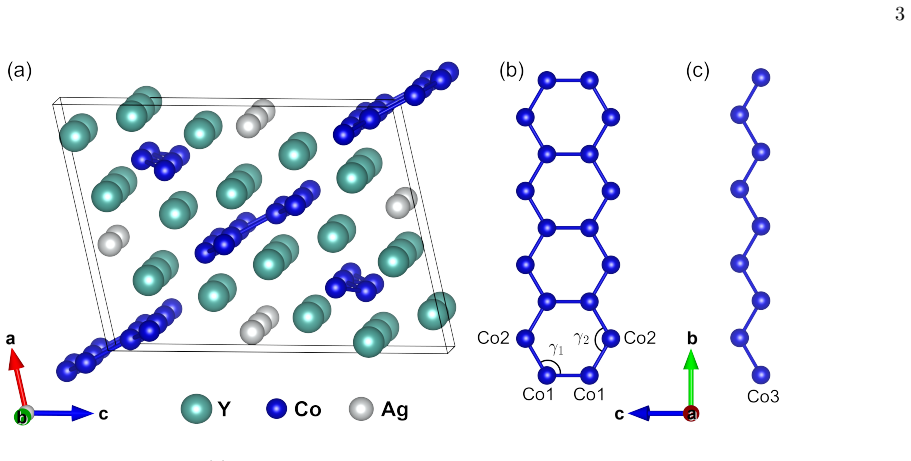
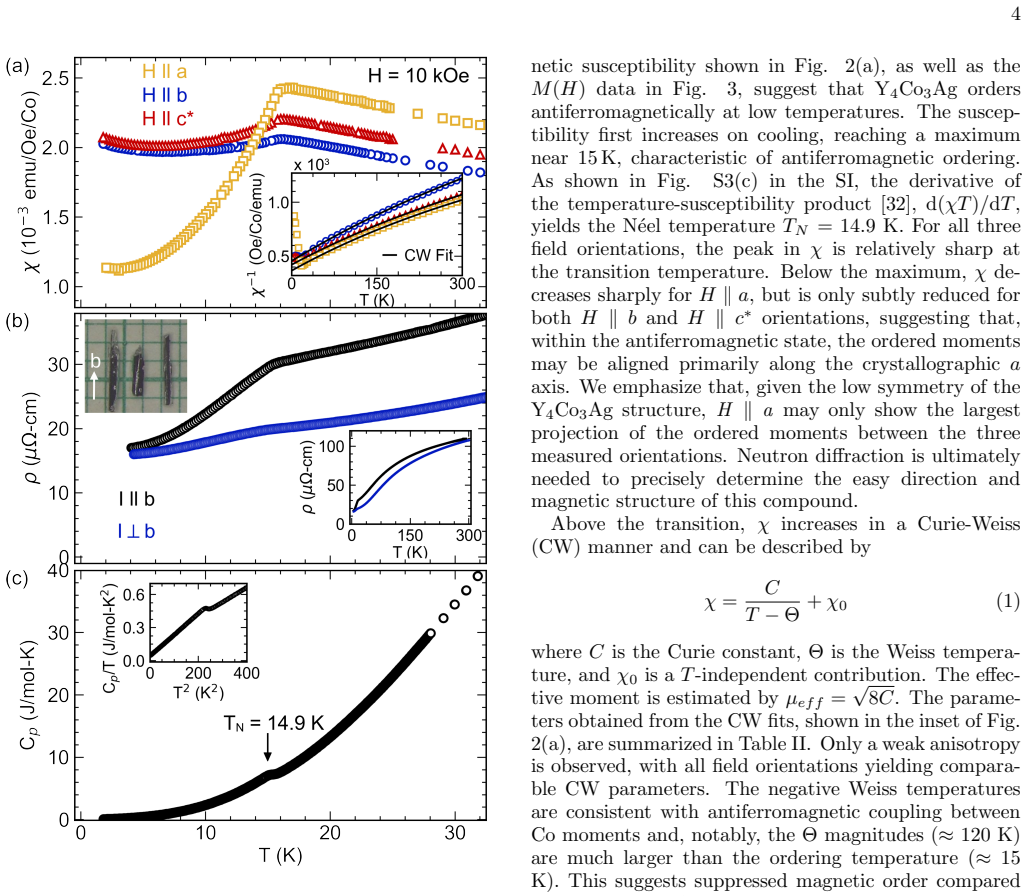
Y4Co3Ag adopts a monoclinic I2/m structure consisting of Y channels filled by one-dimensional zigzag and hexagonal Co chains extending along the b-axis with no nearest-neighbor Co-Ag contacts. Transport, magnetic, and specific-heat measurements establish antiferromagnetic order at TN = 14.9 K with μeff = 1.4 μB/Co, yet the ordered moment remains below 0.2 μB/Co and the magnetic entropy loss is only ~0.1 R ln2, implying small itinerant moments and strong fluctuations in this quasi-one-dimensional system.
What carries the argument
The antagonistic pair concept that stabilizes Y4Co3Ag from the immiscible Co-Ag pair, producing a structure of isolated one-dimensional Co chains that confine electrons and support itinerant antiferromagnetism.
If this is right
- Antiferromagnetic order appears at 14.9 K.
- The ordered moment stays below 0.2 μB per Co despite an effective moment of 1.4 μB/Co.
- Only ~0.1 R ln2 of magnetic entropy is released at the transition.
- Strong magnetic fluctuations arise from the quasi-one-dimensional Co chains.
- The material offers a platform to study itinerant magnetic interactions in reduced dimensions.
Where Pith is reading between the lines
- Neutron scattering or muon spin rotation could directly map the spin dynamics and confirm the itinerant character.
- The antagonistic-pair synthesis route might generate additional quasi-1D compounds from other immiscible element pairs.
- Similar small-moment antiferromagnets could be searched for in related transition-metal chain structures to test the role of dimensionality.
- High-pressure or doping experiments might tune the fluctuations and reveal a quantum critical point.
Load-bearing premise
The small ordered moment, low entropy release, and lack of Co-Ag contacts suffice to distinguish itinerant from localized magnetism without direct probes such as neutron diffraction or band calculations.
What would settle it
A neutron diffraction measurement that detects an ordered moment larger than 0.2 μB/Co consistent with localized spins, or a band-structure calculation showing localized cobalt d-electrons, would falsify the itinerant interpretation.
Figures
read the original abstract
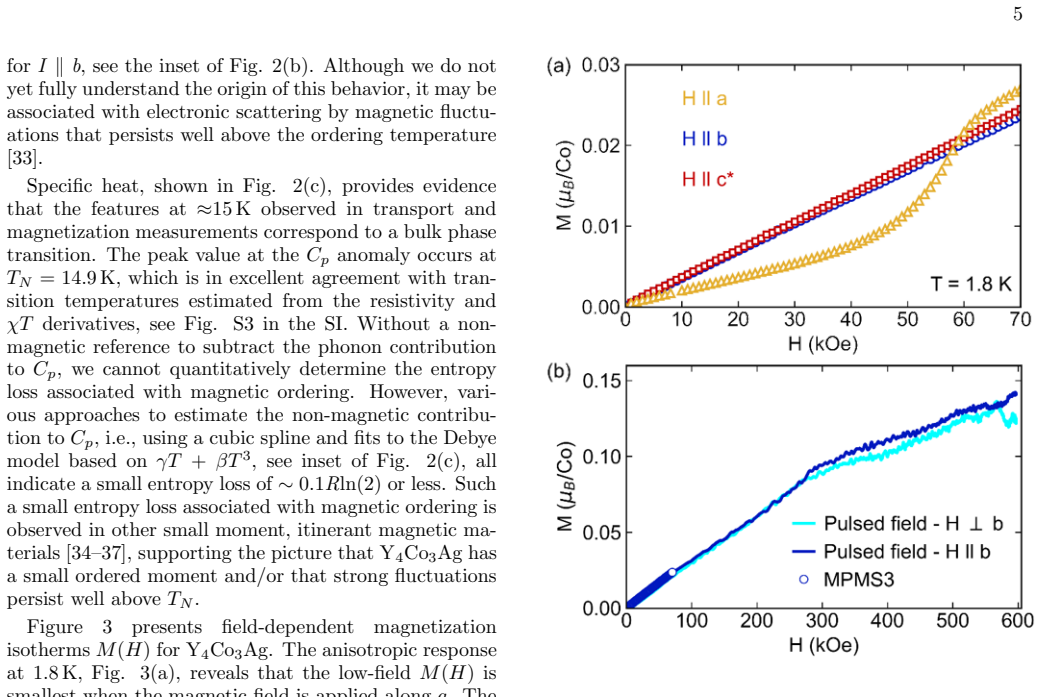
Low dimensional crystallographic motifs have long been associated with desirable physical properties. The confinement of electrons to low dimensions is thought to enhance quantum fluctuations and may promote correlated phenomena. Here, using the antagonistic pair concept, we add Y to the immiscible Co-Ag pair to discover Y$_4$Co$_3$Ag. This compound adopts a monoclinic $I$2/$m$ structure consisting of Y channels that are filled by one-dimensional zigzag and hexagonal Co chains, which extend along the crystallographic $b$-axis with no nearest neighbor contacts between Co and Ag atoms. Transport, magnetic, and specific heat measurements reveal that Y$_4$Co$_3$Ag orders antiferromagnetically at $T_N=14.9$ K with an effective magnetic moment $\mu_{\text{eff}}$ = 1.4 $\mu_{\text{B}}$/Co. Specific heat measurements show only a small entropy loss on the order of $0.1\,R\ln2$ associated with magnetic order, and magnetization isotherms, in DC fields up to 70 kOe at 1.8 K and in pulsed fields up to 600 kOe at 500 mK, indicate a small ordered moment of less than 0.2 $\mu_B$/Co. Taken together, our results imply the presence of small, itinerant moments and strong fluctuations in Y$_4$Co$_3$Ag, suggesting that Y$_4$Co$_3$Ag may be a promising candidate material to investigate itinerant magnetic interactions in a quasi-one dimensional system.
Editorial analysis
A structured set of objections, weighed in public.
Referee Report
Summary. The manuscript reports the synthesis of Y4Co3Ag via the antagonistic pair concept, revealing a monoclinic I2/m structure with Y channels containing one-dimensional zigzag and hexagonal Co chains along the b-axis and no nearest-neighbor Co-Ag contacts. Transport, magnetization (DC fields to 70 kOe and pulsed fields to 600 kOe), and specific-heat data establish antiferromagnetic order at TN = 14.9 K with μ_eff = 1.4 μB/Co, an ordered moment upper bound < 0.2 μB/Co, and a magnetic entropy release of only ~0.1 R ln 2. The authors conclude that these signatures indicate small itinerant moments with strong fluctuations, positioning Y4Co3Ag as a candidate for studying itinerant antiferromagnetism in a quasi-1D system.
Significance. If the itinerant interpretation is confirmed, the work would add a structurally clean quasi-1D platform for itinerant magnetism, complementing existing localized-moment chain compounds. The inclusion of pulsed-field data to 600 kOe and the internal consistency of TN, moment, and entropy values across multiple probes constitute a solid experimental foundation.
major comments (1)
- [Abstract and Discussion] Abstract and Discussion section: The central claim that μ_eff = 1.4 μB/Co, ordered moment <0.2 μB/Co, and ~0.1 R ln2 entropy release demonstrate itinerant rather than localized Co moments with strong 1D fluctuations is not uniquely established by the thermodynamic data. Localized moments in quasi-1D antiferromagnets commonly exhibit comparable moment suppression and reduced entropy release due to fluctuations and reduced dimensionality; the reported chain geometry and absence of Co-Ag contacts support the structural motif but do not distinguish the two regimes. A direct test such as DFT band-structure calculations or neutron form-factor measurements is required to anchor the itinerant assignment.
minor comments (2)
- [Figure 2] Figure 2 (magnetization isotherms): The high-field pulsed data would benefit from explicit statement of any background subtraction protocol or impurity-phase checks that set the <0.2 μB/Co upper limit.
- [Discussion] The manuscript would be strengthened by adding a brief comparison table of entropy release and moment suppression in other quasi-1D Co or Ni chain compounds (e.g., Sr2CuO3 or related systems) to contextualize the observed values.
Simulated Author's Rebuttal
We thank the referee for their careful reading of the manuscript and for the constructive major comment. We address the point directly below and have revised the manuscript accordingly.
read point-by-point responses
-
Referee: [Abstract and Discussion] Abstract and Discussion section: The central claim that μ_eff = 1.4 μB/Co, ordered moment <0.2 μB/Co, and ~0.1 R ln2 entropy release demonstrate itinerant rather than localized Co moments with strong 1D fluctuations is not uniquely established by the thermodynamic data. Localized moments in quasi-1D antiferromagnets commonly exhibit comparable moment suppression and reduced entropy release due to fluctuations and reduced dimensionality; the reported chain geometry and absence of Co-Ag contacts support the structural motif but do not distinguish the two regimes. A direct test such as DFT band-structure calculations or neutron form-factor measurements is required to anchor the itinerant assignment.
Authors: We agree with the referee that the thermodynamic signatures alone do not uniquely distinguish itinerant from localized moments, as moment reduction and entropy suppression due to fluctuations are known in quasi-1D localized systems. The effective moment of 1.4 μB/Co is notably lower than typical free-ion values for localized Co^{2+} (~3.9 μB), and the ordered-moment upper bound together with the minimal entropy release of ~0.1 R ln 2 is consistent with strong itinerant character when viewed alongside the isolated Co-chain geometry. Nevertheless, we accept that this remains an inference rather than a definitive demonstration. We have revised the abstract and discussion to replace the phrasing “imply the presence of small, itinerant moments” with “are consistent with small itinerant moments and strong fluctuations,” and we now explicitly note that neutron form-factor measurements or DFT calculations would provide a direct microscopic test. These changes clarify the evidential basis without overstating the current data. revision: yes
Circularity Check
No circularity; claims rest on direct experimental observations
full rationale
The paper reports a new compound synthesized via the antagonistic pair approach, its monoclinic structure with Co chains, and direct measurements of TN=14.9 K, μeff=1.4 μB/Co, ~0.1 R ln2 entropy release, and ordered moment <0.2 μB/Co from magnetization and specific heat. The central implication of small itinerant moments and strong fluctuations follows as an interpretive summary of these observed quantities. No equations, fitted parameters renamed as predictions, or self-citation chains reduce the reported results to their own inputs by construction. The derivation chain is observational and self-contained.
Axiom & Free-Parameter Ledger
axioms (1)
- domain assumption Standard interpretation of magnetization and specific-heat data suffices to distinguish itinerant from localized magnetism in the absence of microscopic probes.
Lean theorems connected to this paper
-
IndisputableMonolith/Cost/FunctionalEquation.leanwashburn_uniqueness_aczel unclear?
unclearRelation between the paper passage and the cited Recognition theorem.
Taken together, our results imply the presence of small, itinerant moments and strong fluctuations in Y4Co3Ag, suggesting that Y4Co3Ag may be a promising candidate material to investigate itinerant magnetic interactions in a quasi-one dimensional system.
-
IndisputableMonolith/Foundation/AlexanderDuality.leanalexander_duality_circle_linking unclear?
unclearRelation between the paper passage and the cited Recognition theorem.
The Co ions form both hexagonal and zigzag chains that occupy the channels formed by Y... minimum interchain Co-Co distance is ~4.2 Å, which suggests a possible quasi-one dimensional behavior
What do these tags mean?
- matches
- The paper's claim is directly supported by a theorem in the formal canon.
- supports
- The theorem supports part of the paper's argument, but the paper may add assumptions or extra steps.
- extends
- The paper goes beyond the formal theorem; the theorem is a base layer rather than the whole result.
- uses
- The paper appears to rely on the theorem as machinery.
- contradicts
- The paper's claim conflicts with a theorem or certificate in the canon.
- unclear
- Pith found a possible connection, but the passage is too broad, indirect, or ambiguous to say the theorem truly supports the claim.
Reference graph
Works this paper leans on
-
[1]
Charge density wave in the intermetallic oxides
Penacchio, Rafaela FS and Mohamed, Siham and Harms, Haley A and Morelh. Charge density wave in the intermetallic oxides. Physical Review B , volume=. 2025 , publisher=
work page 2025
-
[2]
Journal of Crystal Growth , volume=
High-temperature solution growth of intermetallic single crystals and quasicrystals , author=. Journal of Crystal Growth , volume=. 2001 , publisher=
work page 2001
- [3]
-
[4]
Reports on Progress in Physics , volume=
New materials physics , author=. Reports on Progress in Physics , volume=. 2019 , publisher=
work page 2019
-
[5]
Philosophical magazine , volume=
Use of frit-disc crucibles for routine and exploratory solution growth of single crystalline samples , author=. Philosophical magazine , volume=. 2016 , publisher=
work page 2016
-
[6]
Use of Refractory-Volatile Element Deep Eutectic Regions to Grow Single Crystalline Intermetallic Compounds , author=. Zeitschrift f. 2022 , publisher=
work page 2022
-
[7]
Okamoto, Hiroaki and Massalski, T.B. and Subramanian, P.R. and Kacprzak, L. , journal=
-
[8]
Okamoto, Hiroaki and Massalski, TB and others , journal=
-
[9]
Toby, Brian H and Von Dreele, Robert B , journal=. 2013 , publisher=
work page 2013
-
[10]
Quantum criticality: competing ground states in low dimensions , author=. Science , volume=. 2000 , publisher=
work page 2000
-
[11]
Physical Review Letters , volume=
Absence of ferromagnetism or antiferromagnetism in one-or two-dimensional isotropic Heisenberg models , author=. Physical Review Letters , volume=. 1966 , publisher=
work page 1966
-
[12]
Reviews of Modern Physics , volume=
Superconductivity in iron compounds , author=. Reviews of Modern Physics , volume=. 2011 , publisher=
work page 2011
-
[13]
Correlations and incipient antiferromagnetic order within the linear
Pandey, Abhishek and Miao, Ping and Klemm, M and He, H and Wang, H and Qian, X and Lynn, Jeffrey W and Aronson, MC , journal=. Correlations and incipient antiferromagnetic order within the linear. 2020 , publisher=
work page 2020
-
[14]
Frustrated spin-1/2 chains in a correlated metal , author=. Nature Materials , volume=. 2025 , publisher=
work page 2025
-
[15]
Slade, Tyler J and Furukawa, Nao and Dygert, Matthew and Mohamed, Siham and Das, Atreyee and Xia, Weiyi and Wang, Cai-Zhuang and Bud'ko, Sergey L and Canfield, Paul C , journal=. 2024 , publisher=
work page 2024
-
[16]
Bao, Jin-Ke and Tang, Zhang-Tu and Jung, Hee Joon and Liu, Ji-Yong and Liu, Yi and Li, Lin and Li, Yu-Ke and Xu, Zhu-An and Feng, Chun-Mu and Chen, Haijie and others , journal=. Unique. 2018 , publisher=
work page 2018
-
[17]
Flipping of antiferromagnetic to superconducting states in pressurized quasi-one-dimensional manganese-based compounds , author=. Physical Review B , volume=. 2022 , publisher=
work page 2022
-
[18]
Three-dimensional magnetic ordering in the quasi-one-dimensional Ising magnet
Kobayashi, S and Mitsuda, S and Ishikawa, M and Miyatani, K and Kohn, K , journal=. Three-dimensional magnetic ordering in the quasi-one-dimensional Ising magnet. 1999 , publisher=
work page 1999
-
[19]
Single-ion properties of the transverse-field Ising model material
Ringler, JA and Kolesnikov, Alexander I and Ross, KA , journal=. Single-ion properties of the transverse-field Ising model material. 2022 , publisher=
work page 2022
-
[20]
Quantum critical magnetic excitations in spin-1/2 and spin-1 chain systems , author=. Physical Review X , volume=. 2022 , publisher=
work page 2022
-
[21]
Nature Reviews Materials , volume=
Flat bands, strange metals and the Kondo effect , author=. Nature Reviews Materials , volume=. 2024 , publisher=
work page 2024
-
[22]
Topological flat bands in frustrated kagome lattice
Kang, Mingu and Fang, Shiang and Ye, Linda and Po, Hoi Chun and Denlinger, Jonathan and Jozwiak, Chris and Bostwick, Aaron and Rotenberg, Eli and Kaxiras, Efthimios and Checkelsky, Joseph G and others , journal=. Topological flat bands in frustrated kagome lattice. 2020 , publisher=
work page 2020
-
[23]
Evidence of two-dimensional flat band at the surface of antiferromagnetic kagome metal
Han, Minyong and Inoue, Hisashi and Fang, Shiang and John, Caolan and Ye, Linda and Chan, Mun K and Graf, David and Suzuki, Takehito and Ghimire, Madhav Prasad and Cho, Won Joon and others , journal=. Evidence of two-dimensional flat band at the surface of antiferromagnetic kagome metal. 2021 , publisher=
work page 2021
-
[24]
npj Computational Materials , volume=
Crystal net catalog of model flat band materials , author=. npj Computational Materials , volume=. 2024 , publisher=
work page 2024
-
[25]
Annual Review of Materials Research , volume=
Topological semimetals in square-net materials , author=. Annual Review of Materials Research , volume=. 2019 , publisher=
work page 2019
-
[26]
Journal of the American Chemical Society , volume=
The role of delocalized chemical bonding in square-net-based topological semimetals , author=. Journal of the American Chemical Society , volume=. 2020 , publisher=
work page 2020
-
[27]
First experimental evidence of a new
Berthelot, Romain and Pollet, Micha. First experimental evidence of a new. Inorganic Chemistry , volume=. 2011 , publisher=
work page 2011
-
[28]
Jezierski, Daniel and Mazej, Zoran and Grochala, Wojciech , journal=. 2024 , publisher=
work page 2024
-
[29]
npj Quantum Materials , volume=
Milestones of low-D quantum magnetism , author=. npj Quantum Materials , volume=. 2018 , publisher=
work page 2018
-
[30]
Geometrical frustration , author=. Physics Today , volume=. 2006 , publisher=
work page 2006
-
[31]
Philosophical Magazine , volume=
Relation between the specific heat and susceptibility of an antiferromagnet , author=. Philosophical Magazine , volume=. 1962 , publisher=
work page 1962
-
[32]
Suppression of ferromagnetism in the
Lin, Xiao and Taufour, Valentin and Bud'ko, Sergey L and Canfield, Paul C , journal=. Suppression of ferromagnetism in the. 2013 , publisher=
work page 2013
-
[33]
Ferromagnetic quantum critical point avoided by the appearance of another magnetic phase in
Taufour, Valentin and Kaluarachchi, Udhara S and Khasanov, Rustem and Nguyen, Manh Cuong and Guguchia, Zurab and Biswas, Pabitra Kumar and Bonf. Ferromagnetic quantum critical point avoided by the appearance of another magnetic phase in. Physical Review Letters , volume=. 2016 , publisher=
work page 2016
-
[34]
Tricritical wings and modulated magnetic phases in
Kaluarachchi, Udhara S and Bud’ko, Sergey L and Canfield, Paul C and Taufour, Valentin , journal=. Tricritical wings and modulated magnetic phases in. 2017 , publisher=
work page 2017
-
[35]
Quasi one-dimensional organic conductors: from Fr
Jerome, Denis and Bourbonnais, Claude , journal=. Quasi one-dimensional organic conductors: from Fr
-
[36]
Proceedings of the Royal Society of London
The effective Curie-Weiss constant of ferromagnetic metals and alloys , author=. Proceedings of the Royal Society of London. Series A. Mathematical and Physical Sciences , volume=. 1963 , publisher=
work page 1963
-
[37]
Exceedingly small moment itinerant ferromagnetism of single crystalline
Saunders, Scott M and Xiang, Li and Khasanov, Rustem and Kong, Tai and Lin, Qisheng and Bud'ko, Sergey L and Canfield, Paul C , journal=. Exceedingly small moment itinerant ferromagnetism of single crystalline. 2020 , publisher=
work page 2020
-
[38]
Avoided ferromagnetic quantum critical point in pressurized
Xiang, Li and Gati, Elena and Bud'ko, Sergey L and Saunders, Scott M and Canfield, Paul C , journal=. Avoided ferromagnetic quantum critical point in pressurized. 2021 , publisher=
work page 2021
-
[39]
Journal of Physics: Condensed Matter , volume=
Itinerant magnetic metals , author=. Journal of Physics: Condensed Matter , volume=. 2017 , publisher=
work page 2017
-
[40]
Yamada, Yoshihiro and Sakata, Akihiko , journal=. Weak antiferromagnetism in. 1988 , publisher=
work page 1988
-
[41]
Band structure and itinerant magnetism in quantum critical
Subedi, Alaska and Singh, David J , journal=. Band structure and itinerant magnetism in quantum critical. 2010 , publisher=
work page 2010
-
[42]
Competing magnetic states in quasi-one-dimensional hexagonal ferromagnetic
Li, Chenguang and Liang, Hui and Wang, Yiyan and Liu, Yang and Li, Na and Zhou, Ying and Li, Qiuju and Wu, Dandan and Luo, Xuan and Zhou, Nan and others , journal=. Competing magnetic states in quasi-one-dimensional hexagonal ferromagnetic. 2025 , publisher=
work page 2025
-
[43]
Journal of the Physical Society of Japan , volume=
Electrical resistivity of antiferromagnetic metals , author=. Journal of the Physical Society of Japan , volume=. 1977 , publisher=
work page 1977
-
[44]
Spin fluctuation theory of itinerant electron magnetism , author=. 2013 , publisher=
work page 2013
-
[45]
Nature Communications , volume=
An itinerant antiferromagnetic metal without magnetic constituents , author=. Nature Communications , volume=. 2015 , publisher=
work page 2015
-
[46]
Low temperature specific heat of itinerant electron ferromagnet
Takeuchi, Jun and Masuda, Yoshika , journal=. Low temperature specific heat of itinerant electron ferromagnet. 1979 , publisher=
work page 1979
-
[47]
J.R. Clinton and R. Viswanathan , abstract =. Magnetization and magnetic entropy of. Journal of Magnetism and Magnetic Materials , volume =. 1975 , issn =. doi:https://doi.org/10.1016/0304-8853(75)90151-1 , url =
-
[48]
Magnetization measurements and pressure dependence of the Curie point of the phase
Gardner, WE and Smith, TF and Howlett, BW and Chu, C Wl and Sweedler, A , journal=. Magnetization measurements and pressure dependence of the Curie point of the phase. 1968 , publisher=
work page 1968
-
[49]
H.J. Blythe , abstract =. Paramagnetic susceptibility of. Physics Letters , volume =. 1966 , issn =. doi:https://doi.org/10.1016/0031-9163(66)90289-7 , url =
-
[50]
Ribeiro, R. A. and Bud'ko, S. L. and Xiang, L. and Ryan, D. H. and Canfield, P. C. , journal =. Small-moment antiferromagnetic ordering in single-crystalline. 2022 , month =. doi:10.1103/PhysRevB.105.014412 , url =
-
[51]
High-temperature cuprate superconductors: Experiment, theory, and applications , author=. 2010 , publisher=
work page 2010
-
[52]
Nature Reviews Physics , volume=
40 years of the quantum Hall effect , author=. Nature Reviews Physics , volume=. 2020 , publisher=
work page 2020
-
[53]
Unconventional superconductivity , author=. Advances in Physics , volume=. 2017 , publisher=
work page 2017
-
[54]
Bose--Einstein condensation in magnetic insulators , author=. Nature Physics , volume=. 2008 , publisher=
work page 2008
-
[55]
Field-induced Bose-Einstein condensation of triplons up to 8 K in
Aczel, AA and Kohama, Y and Marcenat, C and Weickert, 3F and Jaime, M and Ayala-Valenzuela, OE and McDonald, RD and Selesnic, SD and Dabkowska, HA and Luke, GM , journal=. Field-induced Bose-Einstein condensation of triplons up to 8 K in. 2009 , publisher=
work page 2009
-
[56]
Spin-charge separation and localization in one dimension , author=. Science , volume=. 2005 , publisher=
work page 2005
-
[57]
Observation of spin-charge separation in one-dimensional
Kim, C and Matsuura, AY and Shen, Z-X and Motoyama, N and Eisaki, H and Uchida, S and Tohyama, Takami and Maekawa, S , journal=. Observation of spin-charge separation in one-dimensional. 1996 , publisher=
work page 1996
-
[58]
Quantum spin liquids , author=. Science , volume=. 2020 , publisher=
work page 2020
-
[59]
Nature Reviews Physics , volume=
Concept and realization of Kitaev quantum spin liquids , author=. Nature Reviews Physics , volume=. 2019 , publisher=
work page 2019
-
[60]
New Journal of Physics , abstract =
Goddard, P A and Singleton, J and Sengupta, P and McDonald, R D and Lancaster, T and Blundell, S J and Pratt, F L and Cox, S and Harrison, N and Manson, J L and Southerland, H I and Schlueter, J A , title =. New Journal of Physics , abstract =. 2008 , month =. doi:10.1088/1367-2630/10/8/083025 , url =
discussion (0)
Sign in with ORCID, Apple, or X to comment. Anyone can read and Pith papers without signing in.