An improved boundary-focused adaptive quadtree algorithm for circle-polygon intersection area approximation
Pith reviewed 2026-05-19 18:28 UTC · model grok-4.3
pith:CY3VJPLH Add to your LaTeX paper
What is a Pith Number?\usepackage{pith}
\pithnumber{CY3VJPLH}
Prints a linked pith:CY3VJPLH badge after your title and writes the identifier into PDF metadata. Compiles on arXiv with no extra files. Learn more
The pith
An adaptive quadtree algorithm approximates circle-polygon intersection areas in O(1/ε^{3/2}) time with O(ε) error.
A machine-rendered reading of the paper's core claim, the machinery that carries it, and where it could break.
Core claim
The algorithm combines adaptive quadtree partitioning, analytical integration via Green's theorem for single-circle cells, and curvature-multiplicity-guided Monte Carlo subsampling for multi-circle cells with a minimum sample count and constant factor, achieving O(1/ε^{3/2}) computational complexity while maintaining an O(ε) error bound.
What carries the argument
curvature-multiplicity-guided adaptive sampling strategy that dynamically concentrates sampling points in geometrically complex boundary regions, combined with quadtree partitioning and selective analytical integration
If this is right
- The algorithm outperforms five classical methods in terms of relative error on synthetic and real-world complex polygons.
- It maintains robustness across parameter variations, making it suitable for practical applications.
- Computational complexity improves to O(1/ε^{3/2}) from the O(1/ε²) of Monte Carlo and uniform grid methods for equivalent error tolerance.
- Applications in wireless sensor network coverage estimation and base station deployment benefit from the efficiency gains.
Where Pith is reading between the lines
- This method might be adapted to other geometric intersection problems involving curves and irregular shapes.
- Further optimization could involve parallel computing for even larger scale problems.
- Validation on additional real-world datasets could strengthen confidence in its general applicability.
Load-bearing premise
The curvature-multiplicity-guided adaptive sampling strategy including the minimum sample count and constant factor correctly concentrates points on complex boundaries to achieve the O(ε) error without systematic bias or missed intersections.
What would settle it
A numerical experiment on a polygon with densely overlapping circles at curved boundaries that shows error larger than proportional to ε or runtime worse than 1/ε to the 1.5 power as ε decreases.
Figures




read the original abstract
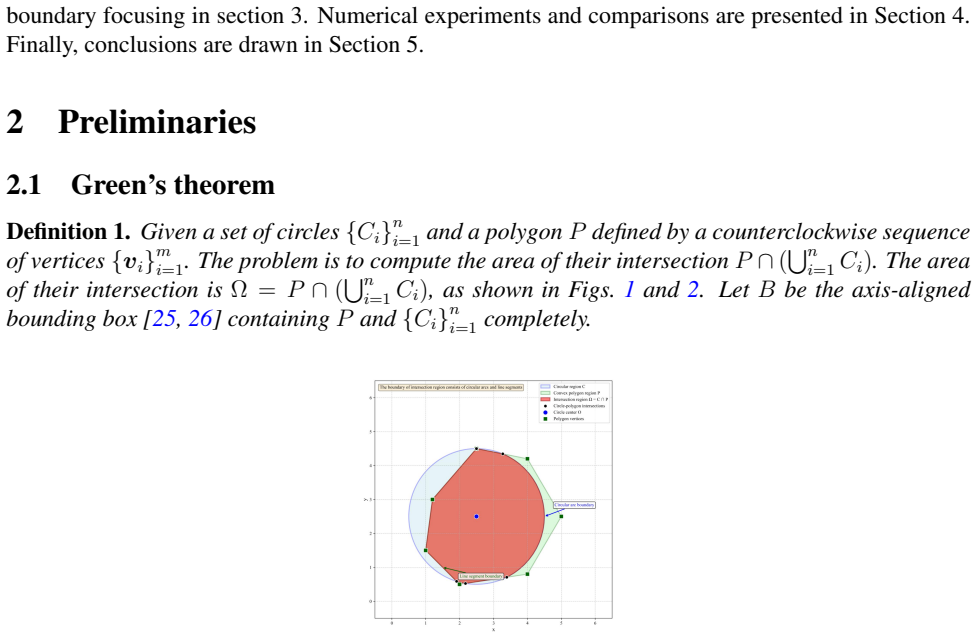
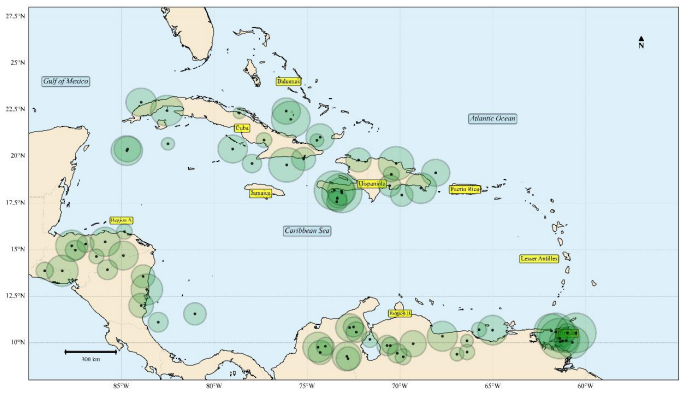
In this paper, we present an improved numerical algorithm for computing the intersection area of multiple circles and a complex polygon efficiently. This geometric problem is fundamental to applications such as wireless sensor networks and base station deployment. The key idea is a curvature-multiplicity-guided adaptive sampling strategy that dynamically concentrates sampling points in geometrically complex boundary regions. The algorithm integrates three components: (i) adaptive quadtree partitioning, (ii) analytical integration via Green's theorem for cells intersecting a single circle, and (iii) curvature-multiplicity-guided Monte Carlo subsampling for cells intersecting multiple circles, where a minimum sample count and a constant factor are introduced into the sampling size. Theoretical analysis shows that the algorithm achieves O(1/{\epsilon}3/2) computational complexity while maintaining an O({\epsilon}) error bound, improving upon the O(1/{\epsilon}2) complexity of classical Monte Carlo and uniform grid methods for the same error tolerance {\epsilon}. Numerical experiments on complex polygons, including synthetic data and real-world scenarios, demonstrate that our algorithm outperforms five classical methods in terms of relative error. Furthermore, parameter sensitivity analysis confirms that the algorithm is robust and could make it suited for practical applications such as wireless sensor network coverage estimation.
Editorial analysis
A structured set of objections, weighed in public.
Referee Report
Summary. The manuscript presents an adaptive quadtree algorithm for approximating the intersection area of multiple circles with a complex polygon. It combines adaptive quadtree partitioning, analytical integration via Green's theorem for single-circle cells, and curvature-multiplicity-guided Monte Carlo subsampling (with introduced minimum sample count and constant factor) for multi-circle cells. The central claims are an O(1/ε^{3/2}) computational complexity with an O(ε) error bound, outperforming classical Monte Carlo and uniform grid methods, supported by numerical experiments on synthetic and real-world polygons plus parameter sensitivity analysis.
Significance. If the theoretical analysis and error bounds can be rigorously substantiated with explicit derivations, the work would provide a practical efficiency gain for geometric area computations in applications such as wireless sensor network coverage estimation. The use of reproducible numerical tests and sensitivity analysis is a strength that supports potential applicability.
major comments (3)
- [Abstract / Theoretical analysis] Abstract and theoretical analysis section: The O(1/ε^{3/2}) complexity claim is stated as arising from quadtree depth and guided sampling density, but lacks visible derivation steps linking the curvature measure to the sample-size formula or showing that the added constant factor and minimum sample count preserve the error exponent without circularity. This is load-bearing for the central improvement over O(1/ε²) methods.
- [Curvature-multiplicity-guided sampling] Curvature-multiplicity-guided sampling section: The strategy is asserted to achieve O(ε) error without systematic bias or missed intersections in multi-circle cells with high local curvature variation, but no explicit proof or concrete test (e.g., variance control or probability of missing intersections) is provided to confirm the per-cell sample size is provably sufficient, especially when several circles overlap.
- [Numerical experiments] Numerical experiments: While outperformance in relative error is reported, the absence of explicit error-bar reporting and full experimental controls leaves the empirical support for the O(ε) bound and complexity claim with gaps that need addressing to verify the central result.
minor comments (2)
- [Abstract] Abstract: The complexity notation appears as O(1/ε3/2) and should be consistently formatted as O(1/ε^{3/2}) throughout for clarity.
- [Throughout] Overall manuscript: Ensure all free parameters (minimum sample count, constant factor) are clearly distinguished from derived quantities in the complexity analysis to avoid any appearance of circularity.
Simulated Author's Rebuttal
We thank the referee for the thoughtful and constructive report. The comments identify areas where the theoretical derivations and experimental reporting can be strengthened, and we address each point below with plans for revision.
read point-by-point responses
-
Referee: [Abstract / Theoretical analysis] Abstract and theoretical analysis section: The O(1/ε^{3/2}) complexity claim is stated as arising from quadtree depth and guided sampling density, but lacks visible derivation steps linking the curvature measure to the sample-size formula or showing that the added constant factor and minimum sample count preserve the error exponent without circularity. This is load-bearing for the central improvement over O(1/ε²) methods.
Authors: We appreciate the referee drawing attention to the need for explicit steps. Section 4 sketches the argument that quadtree depth is O(log(1/ε)) while average samples per multi-circle cell scale as O(1/√ε) under curvature-multiplicity guidance, yielding the overall O(1/ε^{3/2}) bound. The constant factor and minimum sample count are introduced to ensure coverage but their effect on the exponent is only asserted rather than derived in detail. In the revised manuscript we will insert a self-contained derivation that begins from the curvature measure, shows how it determines the per-cell sample size, and verifies that the added constants do not alter the asymptotic exponent or introduce circularity in the error analysis. revision: yes
-
Referee: [Curvature-multiplicity-guided sampling] Curvature-multiplicity-guided sampling section: The strategy is asserted to achieve O(ε) error without systematic bias or missed intersections in multi-circle cells with high local curvature variation, but no explicit proof or concrete test (e.g., variance control or probability of missing intersections) is provided to confirm the per-cell sample size is provably sufficient, especially when several circles overlap.
Authors: The referee is correct that a formal guarantee is missing. The current text relies on the intuition that curvature guidance concentrates samples where intersections are most likely, together with the minimum sample count to avoid under-sampling. We will add a short probabilistic argument in the revised version showing that, under the stated sampling rule, the probability of missing an intersection in a multi-circle cell is bounded by O(ε) and that the estimator remains unbiased. We will also include a small-scale numerical test that reports empirical variance and the observed frequency of missed intersections across controlled overlap configurations. revision: yes
-
Referee: [Numerical experiments] Numerical experiments: While outperformance in relative error is reported, the absence of explicit error-bar reporting and full experimental controls leaves the empirical support for the O(ε) bound and complexity claim with gaps that need addressing to verify the central result.
Authors: We agree that the experimental section would benefit from additional statistical controls. The reported relative-error curves are averages over the test instances, but standard deviations across repeated runs were not shown. In the revision we will augment all performance plots with error bars computed from 20 independent trials, add a table of runtime versus ε with 95 % confidence intervals, and include an extra experiment that varies the number of overlapping circles while holding polygon complexity fixed. These additions will provide direct empirical support for both the O(ε) error and the claimed complexity scaling. revision: yes
Circularity Check
Complexity bound from quadtree depth and guided sampling analysis; parameters are explicit design choices
full rationale
The paper states that theoretical analysis of the adaptive quadtree partitioning combined with curvature-multiplicity-guided Monte Carlo subsampling yields O(1/ε^{3/2}) complexity while preserving an O(ε) error bound. The minimum sample count and constant factor are introduced explicitly as part of the sampling size formula for multi-circle cells rather than being fitted to the target error or complexity result. No equations in the provided description reduce the claimed bounds to a self-definition, a fitted input renamed as prediction, or a self-citation chain that bears the load of the central claim. The derivation is therefore treated as self-contained for the purpose of circularity scoring, consistent with the default expectation that most papers are not circular.
Axiom & Free-Parameter Ledger
free parameters (2)
- minimum sample count
- constant factor
axioms (1)
- standard math Green's theorem applies directly to compute exact area for quadtree cells intersecting exactly one circle.
Lean theorems connected to this paper
-
IndisputableMonolith/Cost/FunctionalEquation.leanwashburn_uniqueness_aczel unclear?
unclearRelation between the paper passage and the cited Recognition theorem.
curvature-multiplicity-guided adaptive sampling strategy... Nsub = max(Nmin, ⌈C·|m(E)|·|κsum(E)|·Area(E)/ε²⌉)
-
IndisputableMonolith/Foundation/AlexanderDuality.leanalexander_duality_circle_linking unclear?
unclearRelation between the paper passage and the cited Recognition theorem.
adaptive quadtree partitioning... Dmax = O(log2(1/ε))
What do these tags mean?
- matches
- The paper's claim is directly supported by a theorem in the formal canon.
- supports
- The theorem supports part of the paper's argument, but the paper may add assumptions or extra steps.
- extends
- The paper goes beyond the formal theorem; the theorem is a base layer rather than the whole result.
- uses
- The paper appears to rely on the theorem as machinery.
- contradicts
- The paper's claim conflicts with a theorem or certificate in the canon.
- unclear
- Pith found a possible connection, but the passage is too broad, indirect, or ambiguous to say the theorem truly supports the claim.
Reference graph
Works this paper leans on
-
[1]
A. P. de Almeida Rocha, A. Rodler, R. C. Oliveira, J. Virgone, N. Mendes, A pixel counting technique for sun patch assessment within building enclosures, Solar Energy 184 (2019) 173–
work page 2019
-
[2]
doi:https://doi.org/10.1016/j.solener.2019.03.081
-
[3]
M. S. Shaikh, C. Wang, S. Xie, G. Zheng, X. Dong, S. Qiu, M. A. Ahmad, S. Raj, Cover- age and connectivity maximization for wireless sensor networks using improved chaotic grey wolf optimization, Scientific Reports 15 (2025) 15706. doi:https://doi.org/10.1038/ s41598-025-00184-2
work page 2025
-
[4]
W. Wu, Z. Wang, L. Lin, X. Chang, L. Tian, An efficient coverage path planning method for UA V in complex concave regions, Scientific Reports 15 (2025) 37227. doi:https://doi. org/10.1038/s41598-025-20978-8
-
[5]
B. Bogosel, V olume computation for meissner polyhedra and applications, Dis- crete & Computational Geometry 75 (2026) 48–72. doi:https://doi.org/10.1007/ s00454-024-00688-0
work page 2026
-
[6]
J. Li, J. Pang, B. Jiang, Q. Xu, E. Zhang, Optimization of 5G base station deployment based on quantum genetic algorithm in outdoor 3D map, Computer Networks 269 (2025) 111431. doi:https://doi.org/10.1016/j.comnet.2025.111431
-
[7]
X. Lai, J.-K. Hao, D. Yue, Y . Zhou, A heuristic algorithm with multi-scale perturbations for point arrangement and equal circle packing in a convex container, Computers &Operations Research 181 (2025) 107099. doi:https://doi.org/10.1016/j.cor.2025.107099
-
[8]
W. S. Hall, Boundary Element Method, Springer Netherlands, Dordrecht, 1994, pp. 61–83. doi:https://doi.org/10.1007/978-94-011-0784-6_3
-
[9]
M. Kim, Y . Kim, G. Cho, Advanced ellipse overlap computation based on segment area of circles, Alexandria Engineering Journal 119 (2025) 425–436. doi:https://doi.org/10. 1016/j.aej.2025.01.127
work page 2025
-
[10]
S. Masovic, I. Elshaarawy, P. Stanimirovic, P. Krtolica, Orbiting triangle method for convex polygon triangulation, Applicable Analysis and Discrete Mathematics 12 (2018) 439–454. doi:https://doi.org/10.2298/AADM170829013M
-
[11]
D. V . Ogunkan, O. P. Akinpelu, Methodology mayhem in urban planning research: a call for methodological triangulation, Quality & Quantity 60 (2026) 1679–1704. doi:https://doi. org/10.1007/s11135-025-02272-x
-
[12]
Y .-C. Hung, A review of monte carlo and quasi-monte carlo sampling techniques, WIREs Com- putational Statistics 16 (2024) e1637. doi:https://doi.org/10.1002/wics.1637
- [13]
- [14]
-
[15]
A. Kiran, M. Yaseen, A. Khan, T. Abdeljawad, M. A. Alqudah, R. Thinakaran, Solving time fractional diffusion-wave equation using hyperbolic polynomial b-splines: A uniform grid ap- proach, Ain Shams Engineering Journal 17 (2026) 103868. doi:https://doi.org/10. 1016/j.asej.2025.103868
-
[16]
A. Bamberger, J. C. Guillot, P. Joly, Numerical diffraction by a uniform grid, SIAM Journal on Numerical Analysis 25 (1988) 753–783. doi:https://doi.org/10.1137/0725045
-
[17]
Z. Chen, Z. Lu, An efficient single-layer method for estimating the local reliability sensi- tivity function based on dimension-reduction strategy and sparse grid integration, Engineer- ing Structures 352 (2026) 122091. doi:https://doi.org/10.1016/j.engstruct. 2026.122091
- [18]
-
[19]
M. Khalid, Smart grids and renewable energy systems: Perspectives and grid integration chal- lenges, Energy Strategy Reviews 51 (2024) 101299. doi:https://doi.org/10.1016/j. esr.2024.101299
work page doi:10.1016/j 2024
-
[20]
R. Dwivedi, S. Gangwar, S. Saha, V . K. Jaiswal, R. Mehrotra, M. Jewariya, G. Mona, R. Sharma, P. Sharma, Estimation of error in distance, length, and angular measurements using CCD pixel counting technique, MAPAN 36 (2021) 313–318. doi:https://doi.org/10.1007/ s12647-021-00463-z
work page 2021
-
[21]
W. Y . Tang, N. Dai, T. Zhou, D. H. Mathews, L. Huang, Samplingdesign: RNA design via continuous optimization with coupled variables and Monte-Carlo sampling, Nature Communi- cations 17 (2026) 2950. doi:https://doi.org/10.1038/s41467-025-67901-3
-
[22]
N. Alanazi, R. Aljeraiwi, M. Almutairi, A. N. Alodhayb, A survey on recent progress on monte carlo simulation methods in radiation detection, Journal of Radiation Research and Applied Sci- ences 19 (2026) 102146. doi:https://doi.org/10.1016/j.jrras.2025.102146
-
[23]
Z. Keqin, W. Wei, Z. Tongyuan, L. Yin, P. Feifei, L. Zeyu, A numerical manifold method based on numerical integration: Eliminating explicit manifold element generation, Computers and Geotechnics 192 (2026) 107852. doi:https://doi.org/10.1016/j.compgeo.2025. 107852
-
[24]
J. Zhao, B. Pan, Adaptive subset-subdivision for automatic digital image correlation calculation on discontinuous shape and deformation, Experimental Mechanics 66 (2026) 417–432. doi:10. 1007/s11340-025-01243-5
work page 2026
-
[25]
S. Yin, J. Liu, H. Wang, F. Wang, Y . Huang, X. Cui, Y . Cai, An efficient and robust parallel strat- egy for cartesian grid generation on complex geometries, Advances in Engineering Software 214 (2026) 104102. doi:https://doi.org/10.1016/j.advengsoft.2026.104102
-
[26]
I. Ahmad, S. Fengjun, K. Bibi, M. S. Pathan, UA V-OBB: An aerial urban vehicle dataset with oriented bounding boxes for remote sensing object detection in smart citiesZ, Data in Brief 66 (2026) 112710. doi:https://doi.org/10.1016/j.dib.2026.112710
-
[27]
A. Oztuner, M. Kilicarslan, Beyond bounding boxes: Segmentation supervision for robust object detection in fisheye images, Journal of Visual Communication and Image Representation 117 (2026) 104798. doi:https://doi.org/10.1016/j.jvcir.2026.104798. 18
-
[28]
W. Wu, Z. Zhang, D.-Z. Du, Monte Carlo Method, Springer Nature Switzerland, Cham, 2026, pp. 73–107. doi:https://doi.org/10.1007/978-3-032-14833-9_3
-
[29]
K. Dai, T. Song, H. Zhang, Y .-J. Yang, W. Zeng, An algorithm to compute the point inclusion of 2d planar shapes based on line segment substitution, Computer-Aided Design 191 (2026) 103994. doi:https://doi.org/10.1016/j.cad.2025.103994
-
[30]
J. Hilden, Testing the relative positions of several points on a circle, BIT Numerical Mathematics 12 (1972) 182–187. doi:https://doi.org/10.1007/BF01932812
-
[31]
E. Oheim, B. Sauren, S. Klinkel, A fully discrete scaled boundary approach to simulate crack propagation problems on adaptively refined hybrid quadtree meshes, Computer Methods in Ap- plied Mechanics and Engineering 455 (2026) 118839. doi:https://doi.org/10.1016/ j.cma.2026.118839
-
[32]
X. Tong, C. Ye, Lossless image compression encryption algorithm based on multi-scroll chaotic systems and quadtree coding, Knowledge-Based Systems 341 (2026) 115820. doi:https: //doi.org/10.1016/j.knosys.2026.115820
-
[33]
Z. Ni, S. Wang, L. Zhuo, Dualbranchedgenet: a dual branch polyp segmentation algorithm based on LoG edge enhancement and quadtree attention transformer, Pattern Analysis and Applications 29 (2026) 77. doi:https://doi.org/10.1007/s10044-026-01659-2
-
[34]
R. Ketzner, V . Ravindra, M. Bramble, A robust, fast, and accurate algorithm for point in spher- ical polygon classification with applications in geoscience and remote sensing, Computers & Geosciences 167 (2022) 105185. doi:https://doi.org/10.1016/j.cageo.2022. 105185
-
[35]
W. Zuo, M.-T. Chen, O. Zhao, L. Gardner, Parametric optimization-based design and test- ing of 3d printed stainless steel circular x-joints, Engineering Structures 353 (2026) 122148. doi:https://doi.org/10.1016/j.engstruct.2026.122148. 19
discussion (0)
Sign in with ORCID, Apple, or X to comment. Anyone can read and Pith papers without signing in.