End-to-End Simulation of 5G NR Integrated Access and Backhaul Networks for Remote Maritime Connectivity
Pith reviewed 2026-05-19 21:32 UTC · model grok-4.3
The pith
An ns-3 module now supports full end-to-end simulation of 5G IAB networks where vessels act as both access points and wireless relays for offshore connectivity.
A machine-rendered reading of the paper's core claim, the machinery that carries it, and where it could break.
Core claim
The authors present an ns-3 module for IAB featuring a complete end-to-end protocol stack including the backhaul adaptation protocol layer, flexible slot and control configurations, and multiplexing schemes based on time and frequency division. Through extensive system-level simulations in a custom maritime scenario, vessels with IAB-nodes act simultaneously as access points and relays, forming dynamic multi-hop networks that maintain connectivity via wireless backhaul to shore-based stations under various topologies and channel conditions.
What carries the argument
The ns-3 IAB module implementing the full 3GPP-compliant protocol stack with BAP layer for backhaul routing and flexible TDM/FDM resource allocation.
If this is right
- Vessels can maintain connectivity in remote maritime areas through multi-hop wireless backhaul.
- Different network topologies can be evaluated for offshore 5G deployments.
- Insights are provided for designing mmWave IAB networks in challenging channel conditions at sea.
- The module supports testing of simultaneous access and relay functions on the same nodes.
Where Pith is reading between the lines
- This simulation approach could be adapted to study IAB in other remote or challenging environments such as rural or mountainous regions.
- Validation against real-world sea trials would strengthen confidence in using the module for network planning.
- Dynamic vessel movements suggest that mobility management will be key for reliable offshore 5G service.
Load-bearing premise
The custom maritime scenario including vessel movements and channel conditions used in the simulations accurately reflects real-world offshore propagation and network dynamics.
What would settle it
Real-world measurements from vessels using actual 5G IAB equipment that show substantially different performance metrics, such as lower data rates or more frequent disconnections, compared to the simulation results.
Figures



read the original abstract
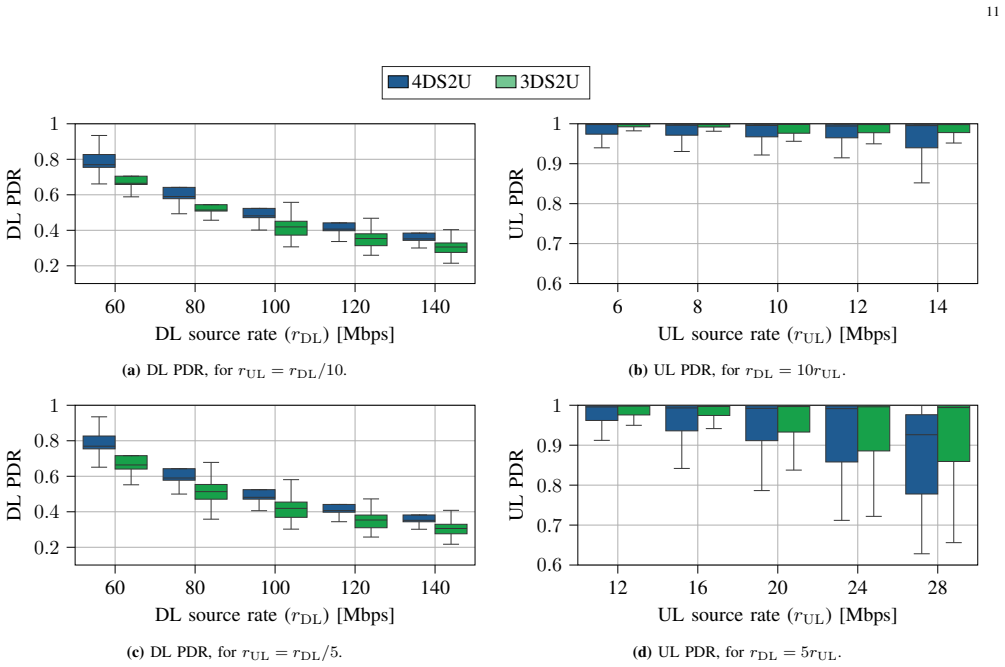
Millimeter wave (mmWave) 5th generation (5G) networks offer high data rates but face coverage challenges due to severe path loss and blockage. These problems motivate the use of Integrated Access and Backhaul (IAB) as a flexible wireless backhaul solution that extends connectivity to cell boundaries and unfibered areas, including maritime environments. This paper overviews the latest 3GPP specifications for IAB networks in Releases 16 through 18. Then, it presents an ns-3 module for IAB, featuring a complete end-to-end protocol stack, including the backhaul adaptation protocol (BAP) layer, flexible slot and control configurations, and multiplexing schemes based on both time and frequency division. We test the IAB module via extensive system-level simulations in a custom maritime scenario where vessels, equipped with IAB-nodes, can simultaneously act as access points and relays, forming dynamic multi-hop networks that maintain connectivity via wireless backhaul to shore-based stations. We evaluate different topologies and channel conditions, providing insights into the design and deployment of mmWave IAB networks in offshore environments.
Editorial analysis
A structured set of objections, weighed in public.
Referee Report
Summary. This paper overviews 3GPP IAB specifications from Releases 16-18 and presents an ns-3 module implementing a complete end-to-end IAB protocol stack, including the Backhaul Adaptation Protocol (BAP) layer, flexible slot and control configurations, and TDM/FDM multiplexing schemes. The module is evaluated via system-level simulations in a custom maritime scenario where vessels equipped with IAB nodes act as access points and relays to form dynamic multi-hop networks connected via wireless backhaul to shore stations, with assessments of different topologies and channel conditions to derive design and deployment insights for mmWave IAB in offshore environments.
Significance. If the ns-3 implementation faithfully follows the 3GPP specifications and the maritime simulations capture essential offshore propagation effects, the work would supply a practical open tool for end-to-end IAB performance studies in environments lacking fiber infrastructure. The inclusion of a full protocol stack with BAP and flexible multiplexing is a clear strength that supports realistic multi-hop evaluations. The lack of any reported validation against maritime measurements or standard sea-path models, however, constrains the reliability of the resulting insights for actual deployment planning.
major comments (2)
- [Evaluation] Evaluation section: the custom maritime scenario (vessel trajectories, multi-hop relay behavior, and mmWave channel conditions over water) is presented without calibration to empirical offshore datasets or standard models such as ITU-R P.1411 extensions for sea paths; because the central claims concern design insights for real maritime networks, this omission makes it impossible to determine whether the reported performance differences across topologies generalize beyond the authors' chosen parameters.
- [Evaluation] Simulation results (throughout the evaluation): no quantitative error analysis, confidence intervals, or sensitivity study to channel-model parameters is provided, so it is unclear whether the observed differences in throughput or connectivity under varying conditions are statistically robust or artifacts of the specific scenario parameterization.
minor comments (2)
- [Abstract] Abstract: the claim of 'extensive system-level simulations' is not accompanied by even a single headline quantitative result (e.g., average throughput or outage probability), which would improve the abstract's informativeness.
- [Module Description] Notation: the description of TDM versus FDM multiplexing would benefit from an explicit table comparing slot formats, control overhead, and achievable rates under each scheme.
Simulated Author's Rebuttal
Thank you for the detailed and constructive review. We appreciate the referee's positive assessment of the ns-3 IAB module and its potential utility for maritime connectivity studies. We will revise the manuscript to address the evaluation concerns by expanding the channel model justification and adding statistical analysis, while clearly noting limitations.
read point-by-point responses
-
Referee: [Evaluation] Evaluation section: the custom maritime scenario (vessel trajectories, multi-hop relay behavior, and mmWave channel conditions over water) is presented without calibration to empirical offshore datasets or standard models such as ITU-R P.1411 extensions for sea paths; because the central claims concern design insights for real maritime networks, this omission makes it impossible to determine whether the reported performance differences across topologies generalize beyond the authors' chosen parameters.
Authors: We agree that calibration to empirical offshore datasets would strengthen applicability. Our channel model draws from established mmWave maritime propagation studies, incorporating sea-surface reflection and atmospheric effects. In the revised manuscript, we will explicitly reference ITU-R P.1411 (and related sea-path extensions) to justify parameter choices, add a limitations subsection discussing the exploratory nature of the results, and clarify that the insights are intended to inform design rather than provide definitive real-world predictions. This will help readers assess generalizability. revision: partial
-
Referee: [Evaluation] Simulation results (throughout the evaluation): no quantitative error analysis, confidence intervals, or sensitivity study to channel-model parameters is provided, so it is unclear whether the observed differences in throughput or connectivity under varying conditions are statistically robust or artifacts of the specific scenario parameterization.
Authors: We acknowledge this limitation and will strengthen the results section. The revised version will report 95% confidence intervals derived from multiple simulation runs with independent random seeds for key metrics. We will also add a sensitivity analysis varying channel parameters (e.g., path-loss exponent, shadowing variance, and vessel mobility) to demonstrate that topology performance trends remain consistent. These additions will confirm the robustness of the observed differences. revision: yes
- Direct validation against non-public maritime measurement datasets is not possible, as such data are not available to the authors and fall outside the scope of this simulation paper.
Circularity Check
No circularity: simulation module and scenario results are independent of inputs
full rationale
The paper overviews 3GPP IAB specifications, implements an ns-3 module with BAP layer and TDM/FDM multiplexing, and evaluates it via system-level simulations in a described maritime scenario. No equations, derivations, or predictions are presented that reduce to fitted parameters or self-citations by construction; results follow directly from executing the module against the chosen topologies and channel models. The contribution is tool development plus simulation outputs, which remain self-contained without load-bearing self-referential steps.
Axiom & Free-Parameter Ledger
Reference graph
Works this paper leans on
-
[1]
Analysis of duplexing patterns in multi-hop mmWave integrated access and backhaul systems,
N. Tafintsevet al., “Analysis of duplexing patterns in multi-hop mmWave integrated access and backhaul systems,”IEEE Open Journal of the Communications Society, vol. 5, pp. 5392–5407, Aug. 2024
work page 2024
-
[2]
Towards 1 Gbps/UE in cellular systems: Understanding ultra-dense small cell deployments,
D. López-Pérez, M. Ding, H. Claussen, and A. H. Jafari, “Towards 1 Gbps/UE in cellular systems: Understanding ultra-dense small cell deployments,”IEEE Communications Surveys & Tutorials, vol. 17, no. 4, pp. 2078–2101, Fourthquarter 2015
work page 2078
-
[3]
NR; Study on integrated access and backhaul,
3GPP, “NR; Study on integrated access and backhaul,” TS 38.874, 2019
work page 2019
-
[4]
Integrated access and backhaul in 5G mmWave networks: Potential and challenges,
M. Poleseet al., “Integrated access and backhaul in 5G mmWave networks: Potential and challenges,”IEEE Communications Magazine, vol. 58, no. 3, pp. 62–68, Mar. 2020
work page 2020
-
[5]
A survey on integrated access and backhaul networks,
Y . Zhang, M. A. Kishk, and M.-S. Alouini, “A survey on integrated access and backhaul networks,”Frontiers in Communications and Net- works, vol. 2, pp. 1–17, Jun. 2021
work page 2021
-
[6]
Integrated access and backhaul in Millimeter-Wave cellular: Benefits and Challenges,
Y . Sadovayaet al., “Integrated access and backhaul in Millimeter-Wave cellular: Benefits and Challenges,”IEEE Communications Magazine, vol. 60, no. 9, pp. 81–86, Sep. 2022
work page 2022
-
[7]
Optimal resource allocation for O-RAN with integrated access and backhaul,
A. Topcu, S. A. R. Zaidi, and A. Q. Lawey, “Optimal resource allocation for O-RAN with integrated access and backhaul,”IEEE Open Journal of the Communications Society, pp. 10 061–10 078, Oct. 2025
work page 2025
-
[8]
Paving the way toward mobile IAB: Problems, solutions and challenges,
V . F. Monteiroet al., “Paving the way toward mobile IAB: Problems, solutions and challenges,”IEEE Open Journal of the Communications Society, vol. 3, pp. 2347–2379, Nov. 2022
work page 2022
-
[9]
TDD frame design for interference handling in mobile IAB networks,
V . F. Monteiroet al., “TDD frame design for interference handling in mobile IAB networks,” inIEEE Global Communications Conference, 2022
work page 2022
-
[10]
IAB-based railway communi- cation method for stable service provision,
M. Choi, B. Yoon, D. Kim, and D. Sung, “IAB-based railway communi- cation method for stable service provision,” in12th IEEE International Conference on Ubiquitous and Future Networks (ICUFN), 2021
work page 2021
-
[11]
Physical layer enhancement for next-generation railway communication systems,
Q. Li, J.-C. Sibel, M. Berbineau, I. Dayoub, F. Gallée, and H. Bonneville, “Physical layer enhancement for next-generation railway communication systems,”IEEE Access, vol. 10, pp. 83 152–83 175, Jul. 2022
work page 2022
-
[12]
S. Horsmanheimo, L. Tuomimäki, A. Gentili, J. Scholliers, A. Sadam, and K. K. Kaare, “Maritime multi-hop communication over 5G net- works: An indoor testbed implementation and evaluation,” inIEEE 100th Vehicular Technology Conference (VTC2024-Fall), 2024. 13
work page 2024
-
[13]
5G for deployable and maritime communications,
G. Capela, W. Low, and L. Bastos, “5G for deployable and maritime communications,” inInternational Conference on Military Communica- tion and Information Systems (ICMCIS), 2021
work page 2021
-
[14]
5G cellular communication for maritime applications,
G. Rafiq, P. Bose, and P. Orten, “5G cellular communication for maritime applications,”IEEE Access, vol. 13, pp. 109 451–109 472, Jun. 2025
work page 2025
-
[15]
End-to-end simulation of integrated access and backhaul at mmWaves,
M. Polese, M. Giordani, A. Roy, S. Goyal, D. Castor, and M. Zorzi, “End-to-end simulation of integrated access and backhaul at mmWaves,” inIEEE 23rd International Workshop on Computer Aided Modeling and Design of Communication Links and Networks (CAMAD), 2018
work page 2018
-
[16]
Joint spectrum and power allocation in 5G integrated access and backhaul networks at mmWave band,
S. Zhang, X. Xu, M. Sun, X. Tao, and C. Liu, “Joint spectrum and power allocation in 5G integrated access and backhaul networks at mmWave band,” inIEEE 31st Annual International Symposium on Personal, Indoor and Mobile Radio Communications, 2020
work page 2020
-
[17]
J. Y . Lai, W.-H. Wu, and Y . T. Su, “Resource allocation and node placement in multi-hop heterogeneous integrated-access-and-backhaul networks,”IEEE Access, vol. 8, pp. 122 937–122 958, Jul. 2020
work page 2020
-
[18]
Resource manage- ment for 5G NR integrated access and backhaul: A semi-centralized approach,
M. Pagin, T. Zugno, M. Polese, and M. Zorzi, “Resource manage- ment for 5G NR integrated access and backhaul: A semi-centralized approach,”IEEE Transactions on Wireless Communications, vol. 21, no. 2, pp. 753–767, Feb. 2022
work page 2022
-
[19]
Y . Liu, A. Tang, and X. Wang, “Joint incentive and resource allo- cation design for user-provided network under 5G integrated access and backhaul networks,”IEEE Transactions on Network Science and Engineering, vol. 7, no. 2, pp. 673–685, Apr.–Jun. 2020
work page 2020
-
[20]
Millimeter wave integrated access and backhaul in 5G: Performance analysis and design insights,
C. Saha and H. S. Dhillon, “Millimeter wave integrated access and backhaul in 5G: Performance analysis and design insights,”IEEE Journal on Selected Areas in Communications, vol. 37, no. 12, pp. 2669– 2684, Dec. 2019
work page 2019
-
[21]
Deep Reinforcement Learning-Based Spectrum Allocation in Integrated Access and Backhaul Networks,
W. Lei, Y . Ye, and M. Xiao, “Deep Reinforcement Learning-Based Spectrum Allocation in Integrated Access and Backhaul Networks,” IEEE Transactions on Cognitive Communications and Networking, vol. 6, no. 3, pp. 970–979, Sep. 2020
work page 2020
-
[22]
Field trial on millimeter wave integrated access and backhaul,
T. Tianet al., “Field trial on millimeter wave integrated access and backhaul,” inIEEE 89th Vehicular Technology Conference (VTC2019- Spring), 2019
work page 2019
-
[23]
J.-H. Kwon, B. Lim, and Y .-C. Ko, “Resource allocation and system design of out-band based integrated access and backhaul network at mmWave band,”IEEE Transactions on Vehicular Technology, vol. 71, no. 6, pp. 6503–6517, June 2022
work page 2022
-
[24]
H. Alghafari and M. S. Haghighi, “Decentralized joint resource allo- cation and path selection in multi-hop integrated access backhaul 5G networks,”Computer Networks, vol. 207, p. 108837, Apr. 2022
work page 2022
-
[25]
Joint schedul- ing and throughput maximization in self-backhauled millimeter wave cellular networks,
C. Fang, C. Madapatha, B. Makki, and T. Svensson, “Joint schedul- ing and throughput maximization in self-backhauled millimeter wave cellular networks,” in17th IEEE International Symposium on Wireless Communication Systems (ISWCS), 2021
work page 2021
-
[26]
Dis- tributed path selection strategies for integrated access and backhaul at mmWaves,
M. Polese, M. Giordani, A. Roy, D. Castor, and M. Zorzi, “Dis- tributed path selection strategies for integrated access and backhaul at mmWaves,” inIEEE Global Communications Conference (GLOBE- COM), 2018
work page 2018
-
[27]
Inves- tigation of performance in integrated access and backhaul networks,
M. N. Islam, N. Abedini, G. Hampel, S. Subramanian, and J. Li, “Inves- tigation of performance in integrated access and backhaul networks,” in IEEE Conference on Computer Communications Workshops (INFOCOM WKSHPS), 2018
work page 2018
-
[28]
I. Bor-Yaliniz, M. Salem, G. Senerath, and H. Yanikomeroglu, “Is 5G ready for drones: A look into contemporary and prospective wireless networks from a standardization perspective,”IEEE Wireless Communi- cations, vol. 26, no. 1, pp. 18–27, Feb. 2019
work page 2019
-
[29]
A framework for 5G networks with in- band full-duplex enabled drone-mounted base-stations,
L. Zhang and N. Ansari, “A framework for 5G networks with in- band full-duplex enabled drone-mounted base-stations,”IEEE Wireless Communications, vol. 26, no. 5, pp. 121–127, Oct. 2019
work page 2019
-
[30]
Flexible and reliable UA V-assisted backhaul operation in 5G mmWave cellular networks,
M. Gapeyenko, V . Petrov, D. Moltchanov, S. Andreev, N. Himayat, and Y . Koucheryavy, “Flexible and reliable UA V-assisted backhaul operation in 5G mmWave cellular networks,”IEEE Journal on Selected Areas in Communications, vol. 36, no. 11, pp. 2486–2496, Nov. 2018
work page 2018
-
[31]
On integrated access and backhaul networks: Cur- rent status and potentials,
C. Madapathaet al., “On integrated access and backhaul networks: Cur- rent status and potentials,”IEEE Open Journal of the Communications Society, vol. 1, pp. 1374–1389, Sep. 2020
work page 2020
-
[32]
Study on new radio access technology: Radio access architecture and interfaces,
3GPP, “Study on new radio access technology: Radio access architecture and interfaces,” TR 38.801, 2017
work page 2017
-
[33]
5G; NR; Backhaul Adaptation Protocol (BAP) Specification,
——, “5G; NR; Backhaul Adaptation Protocol (BAP) Specification,” TS 38.340, 2020
work page 2020
-
[34]
Release 17 Description; Summary of Rel-17 Work Items,
——, “Release 17 Description; Summary of Rel-17 Work Items,” TR 21.917, 2023
work page 2023
-
[35]
NR; Physical layer procedures for control,
——, “NR; Physical layer procedures for control,” TR 38.213, 2024
work page 2024
-
[36]
NR; Integrated access and backhaul radio transmission and reception,
——, “NR; Integrated access and backhaul radio transmission and reception,” TR 38.174, 2024
work page 2024
-
[37]
TSG RAN WG1 Meeting #99: RAN1 agreements for Rel-16 IAB,
——, “TSG RAN WG1 Meeting #99: RAN1 agreements for Rel-16 IAB,” R1-1913600, 2024
work page 2024
-
[38]
An overview of 5G advanced evolution in 3GPP release 18,
X. Lin, “An overview of 5G advanced evolution in 3GPP release 18,” IEEE Communications Standards Magazine, vol. 6, no. 3, pp. 77–83, Sep. 2022
work page 2022
-
[39]
Shaping a smarter electromagnetic landscape: IAB, NCR, and RIS in 5G standard and future 6G,
C.-K. Wen, L.-S. Tsai, A. Shojaeifard, P.-K. Liao, K.-K. Wong, and C.- B. Chae, “Shaping a smarter electromagnetic landscape: IAB, NCR, and RIS in 5G standard and future 6G,”IEEE Communications Standards Magazine, vol. 8, no. 1, pp. 72–78, Mar. 2024
work page 2024
-
[40]
Study on Architecture Enhancements for Vehicle-Mounted Re- lays,
3GPP, “Study on Architecture Enhancements for Vehicle-Mounted Re- lays,” TR 23.700, 2022
work page 2022
-
[41]
End-to-End Simulation of 5G mmWave Net- works,
M. Mezzavillaet al., “End-to-End Simulation of 5G mmWave Net- works,”IEEE Communications Surveys Tutorials, vol. 20, no. 3, pp. 2237–2263, Third quarter 2018
work page 2018
-
[42]
Study on Integrated Access and Backhaul for NR,
3GPP, “Study on Integrated Access and Backhaul for NR,” RP-171880, 2017
work page 2017
-
[43]
——, “Digital cellular telecommunications system (Phase 2+) (GSM); Universal Mobile Telecommunications System (UMTS); LTE; 5G; Mo- bile radio interface Layer 3 specification; Core network protocols; Stage 3,” TS 24.008, 2021
work page 2021
-
[44]
An LTE module for the ns-3 network simulator
G. Piro, N. Baldo, and M. Miozzo, “An LTE module for the ns-3 network simulator.” inSimuTools, 2011, pp. 415–422
work page 2011
-
[45]
NR; NR and NG-RAN Overall Description; Stage 2,
3GPP, “NR; NR and NG-RAN Overall Description; Stage 2,” TS 38.300, 2024
work page 2024
-
[46]
Novel maritime channel models for millimeter radiowaves,
N. Mehrnia and M. K. Ozdemir, “Novel maritime channel models for millimeter radiowaves,” in24th IEEE International Conference on Software, Telecommunications and Computer Networks (SoftCOM), 2016
work page 2016
-
[47]
Study on channel model for frequencies from 0.5 to 100 GHz,
3GPP, “Study on channel model for frequencies from 0.5 to 100 GHz,” 2020
work page 2020
-
[48]
Path loss estimation of 5G millimeter wave propagation channel–literature survey,
M. Brata and I. Zakia, “Path loss estimation of 5G millimeter wave propagation channel–literature survey,” in7th IEEE International Con- ference on Wireless and Telematics (ICWT), 2021
work page 2021
-
[49]
Implementation of a spatial channel model for ns-3,
T. Zugno, M. Polese, N. Patriciello, B. Bojovi ´c, S. Lagen, and M. Zorzi, “Implementation of a spatial channel model for ns-3,” inACM Workshop on ns-3 (WNS3), 2020
work page 2020
-
[50]
Buoy- to-ship experimental measurements over sea at 5.8 GHz near urban environments,
J. Reyes-Guerrero, M. Bruno, L. A. Mariscal, and A. Medouri, “Buoy- to-ship experimental measurements over sea at 5.8 GHz near urban environments,” in11th IEEE Mediterranean Microwave Symposium (MMS), 2011
work page 2011
-
[51]
Near sea-surface mobile radiowave propagation at 5 GHz: measurements and modeling,
L. Yee Hui, F. Dong, and Y . S. Meng, “Near sea-surface mobile radiowave propagation at 5 GHz: measurements and modeling,”Ra- dioengineering, vol. 23, no. 3, pp. 824–830, Sep. 2014
work page 2014
-
[52]
High- capacity, long-range, over ocean microwave link using the evaporation duct,
G. S. Woods, A. Ruxton, C. Huddlestone-Holmes, and G. Gigan, “High- capacity, long-range, over ocean microwave link using the evaporation duct,”IEEE Journal of Oceanic Engineering, vol. 34, no. 3, pp. 323– 330, Jul. 2009
work page 2009
-
[53]
How much is the precipitation amount over the tropical coastal region?
S.-Y . Ogino, M. D. Yamanaka, S. Mori, and J. Matsumoto, “How much is the precipitation amount over the tropical coastal region?”Journal of Climate, vol. 29, no. 3, pp. 1231–1236, Feb. 2016
work page 2016
-
[54]
P.838-3. Specific attenuation model for rain for use in prediction methods,
ITU-R, “P.838-3. Specific attenuation model for rain for use in prediction methods,” 2005
work page 2005
-
[55]
P.837-7. Characteristics of precipitation for propagation mod- elling,
——, “P.837-7. Characteristics of precipitation for propagation mod- elling,” 2017
work page 2017
discussion (0)
Sign in with ORCID, Apple, or X to comment. Anyone can read and Pith papers without signing in.