Navigating Transitions: Envisioning Conversational User Interfaces to Support International Students
Pith reviewed 2026-05-20 15:20 UTC · model grok-4.3
The pith
Participatory workshops show international students envisioning conversational interfaces to address uncertainty, loneliness, and cultural misunderstandings during study abroad.
A machine-rendered reading of the paper's core claim, the machinery that carries it, and where it could break.
Core claim
International students who took part in participatory design workshops shared their perspectives on studying abroad and proposed concrete features for conversational user interfaces to support their transitions. These features focus on reducing uncertainty about daily practical matters, alleviating loneliness, and handling misunderstandings tied to cultural differences. The work derives design implications from these proposals to guide future CUI development for student well-being.
What carries the argument
Participatory design workshops in which international students directly envision and propose features for conversational user interfaces to ease their adjustment challenges.
If this is right
- CUIs could deliver timely, on-demand assistance with navigating unfamiliar systems and daily logistics to lower uncertainty.
- Built-in social matching or conversation prompts might reduce isolation by helping students form connections.
- Responses attuned to cultural contexts could decrease miscommunications and increase confidence in interactions.
- The identified needs point to a practical set of priorities for building supportive chat tools within university settings.
Where Pith is reading between the lines
- The same workshop format could be used to explore CUI support for other groups undergoing major transitions, such as new professionals or recent immigrants.
- Building and testing simple prototypes of the suggested features with users would provide direct feedback on which ideas prove most helpful in practice.
- Universities could pilot these interfaces alongside existing counseling or orientation programs to measure real-world effects on student adjustment.
Load-bearing premise
The needs and feature ideas expressed by the small group of workshop participants reflect those of international students more broadly.
What would settle it
A larger-scale study repeating the workshops with a wider and more varied group of international students that yields substantially different needs or rejects the proposed features would show the current design implications do not hold up.
Figures
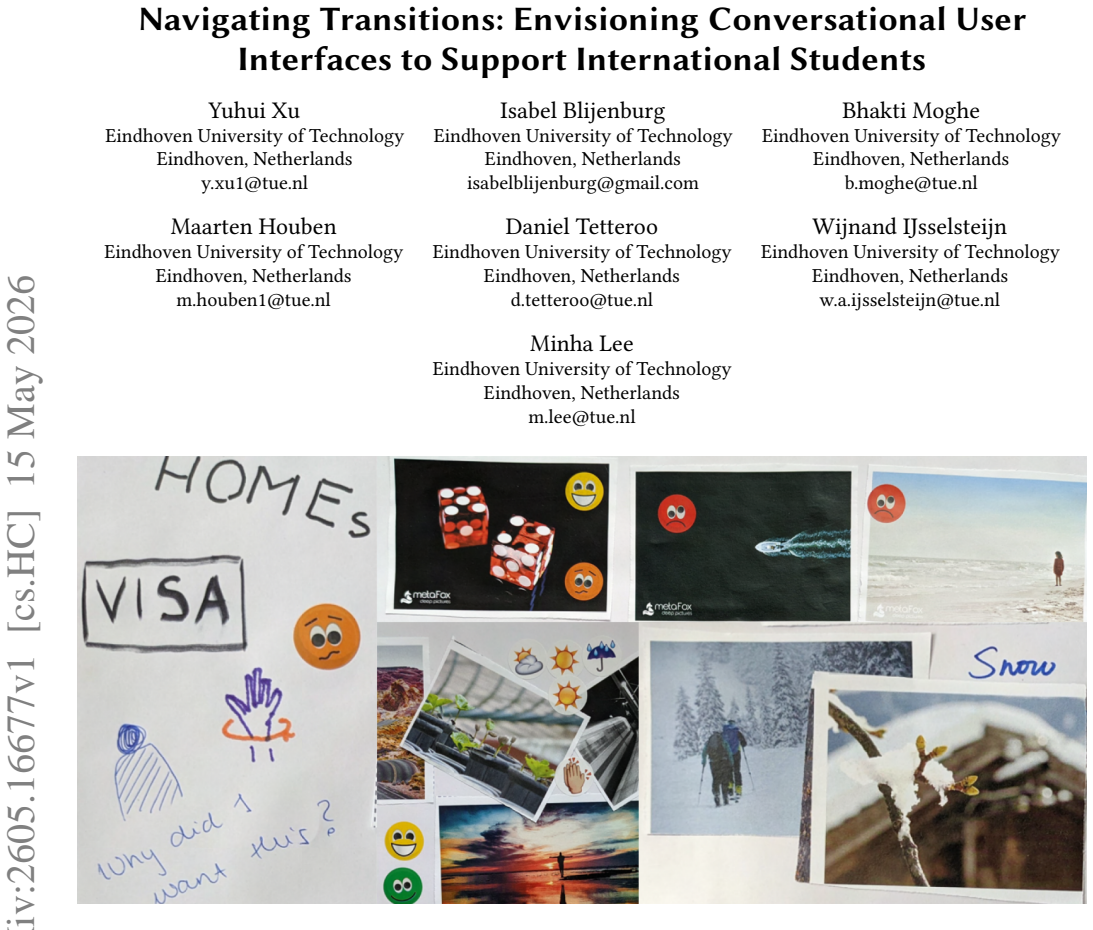


read the original abstract
International students face struggles when adapting to the host country. They are more susceptible to mental health problems than domestic students. While Conversational User Interfaces (CUIs) are increasingly researched and implemented, research on how they may help international university students is still scarce. Thus, we conducted participatory design workshops with international students who shared their perspectives and struggles of studying abroad, in which they also envisioned CUIs as aids to support their transitions. Participants proposed features of a CUI to address uncertainty, loneliness, and misunderstandings of cultural differences. Our paper reveals international students' needs and provides design implications for CUIs to support their well-being.
Editorial analysis
A structured set of objections, weighed in public.
Referee Report
Summary. The manuscript reports results from participatory design workshops in which international students discussed adaptation challenges (uncertainty, loneliness, cultural misunderstandings) and envisioned CUI features to address them. From these sessions the authors extract student needs and derive design implications for CUIs intended to support international students' well-being during transition to the host country.
Significance. If the workshop findings prove robust, the work fills a documented gap in HCI research on CUIs for a high-risk population. The design implications could usefully inform development of culturally sensitive, supportive conversational agents in educational settings, linking qualitative user insights to concrete interface recommendations.
major comments (2)
- [Methods] Methods section: the description of the participatory design workshops supplies neither participant count, recruitment method, demographic spread (home countries, years in host country), nor the analysis procedure (e.g., thematic analysis steps or saturation criterion). Because the central claim—that the proposed features and design implications are useful for the broader population—rests directly on these workshop outputs, the absence of this information prevents evaluation of transferability.
- [Discussion] Discussion / Design Implications section: the leap from the specific workshop proposals to population-level design implications is not accompanied by explicit discussion of limitations or boundary conditions. Without such qualification the claim that the features address 'international students' needs' in general remains under-supported.
minor comments (2)
- [Abstract] Abstract: participant numbers and a brief statement of analysis approach are missing; adding one sentence would allow readers to gauge scope immediately.
- [Appendix] Figure captions or workshop protocol appendix: if visual materials or session scripts exist, they should be referenced so readers can understand the exact prompts given to participants.
Simulated Author's Rebuttal
We thank the referee for the constructive feedback. We address each major comment below and have revised the manuscript to improve clarity and rigor.
read point-by-point responses
-
Referee: [Methods] Methods section: the description of the participatory design workshops supplies neither participant count, recruitment method, demographic spread (home countries, years in host country), nor the analysis procedure (e.g., thematic analysis steps or saturation criterion). Because the central claim—that the proposed features and design implications are useful for the broader population—rests directly on these workshop outputs, the absence of this information prevents evaluation of transferability.
Authors: We agree that the original Methods section omitted key details required to assess transferability. In the revised manuscript we have expanded this section to report the participant count, recruitment approach (via university international offices and targeted social media), demographic characteristics (home countries and time in host country), and the full analysis procedure, including the thematic analysis steps and criterion for saturation. revision: yes
-
Referee: [Discussion] Discussion / Design Implications section: the leap from the specific workshop proposals to population-level design implications is not accompanied by explicit discussion of limitations or boundary conditions. Without such qualification the claim that the features address 'international students' needs' in general remains under-supported.
Authors: We accept this criticism. The revised Discussion now contains an explicit subsection on limitations and boundary conditions. It qualifies the scope of the findings, notes the exploratory character of the workshops, and reframes the design implications as context-sensitive suggestions rather than general claims applicable to all international students. revision: yes
Circularity Check
No significant circularity in qualitative participatory design study
full rationale
The paper conducts participatory design workshops with international students to elicit struggles and envisioned CUI features addressing uncertainty, loneliness, and cultural misunderstandings, then derives design implications directly from those participant outputs. This is a standard qualitative reporting chain with no equations, fitted parameters, self-definitional loops, or load-bearing self-citations that reduce claims to their own inputs by construction. The central claims rest on thematic synthesis of workshop data rather than any imported uniqueness theorems or ansatzes, making the derivation self-contained against external benchmarks of qualitative HCI research.
Axiom & Free-Parameter Ledger
axioms (1)
- domain assumption Participatory design workshops with a modest number of international students can generate representative insights into the needs of the broader population.
Reference graph
Works this paper leans on
-
[1]
Nadia Abbas, Asbjørn Følstad, and Cato A Bjørkli. 2023. Chatbots as Part of Digital Government Service Provision–A User Perspective. InChatbot Research and Design: 6th International Workshop, CONVERSATIONS 2022, Amsterdam, The Netherlands, November 22–23, 2022, Revised Selected Papers. Springer, Springer, Cham, 66–82
work page 2023
-
[2]
Arfan Ahmed, Nashva Ali, Sarah Aziz, Alaa A Abd-alrazaq, Asmaa Hassan, Mohamed Khalifa, Bushra Elhusein, Maram Ahmed, Mohamed Ali Siddig Ahmed, and Mowafa Househ. 2021. A review of mobile chatbot apps for anxiety and depression and their self-care features.Computer Methods and Programs in Biomedicine Update1 (2021), 100012. doi:10.1016/j.cmpbup.2021.100012
-
[3]
Pius L D Ang and Pranee Liamputtong. 2008. "Out of the Circle": international students and the use of university counselling services.Australian Journal of Adult Learning48, 1 (2008)
work page 2008
-
[4]
Sophie Arkoudis, Kim Watty, Chi Baik, Xin Yu, Helen Borland, Shanton Chang, Ian Lang, Josephine Lang, and Amanda Pearce. 2013. Finding common ground: enhancing interaction between domestic and international students in higher education.Teaching in Higher Education18, 3 (4 2013), 222–235. doi:10.1080/ 13562517.2012.719156
-
[5]
Iqra Basharat and Subhan Shahid. 2024. AI-enabled chatbots healthcare systems: an ethical perspective on trust and reliability.Journal of Health Organization and Management(July 2024). doi:10.1108/JHOM-10-2023-0302
-
[6]
John W. Berry. 2006. Acculturative Stress. InHandbook of Multicultural Per- spectives on Stress and Coping, P.T.P. Wong and L.C.J. Wong (Eds.). Springer US, Boston, MA, 287–298. doi:10.1007/0-387-26238-5{_}12
-
[7]
J W Berry, Uichol Kim, Thomas Minde, and Doris Mok. 1987. Comparative Studies of Acculturative Stress.International migration review21, 3 (1987), 491–511
work page 1987
-
[8]
2020.Social Integration: Exploring the ‘Gap’ between Dutch Students and International Students
Tess Beukema, Nienke de Haan, Teie van der Hoek, Rachel Lau, Danial Ridzuan, and Sebastiaan Manders. 2020.Social Integration: Exploring the ‘Gap’ between Dutch Students and International Students. Technical Report. Groninger Studen- tenbond (GSb)
work page 2020
-
[9]
Haifa Binsahl, Shanton Chang, and Rachelle Bosua. 2015. Identity and belonging: Saudi female international students and their use of social networking sites. Crossings: Journal of Migration & Culture6, 1 (2015), 81–102. doi:10.1386/cjmc.6. 1.81_1
-
[10]
Brunsting, Corinne Zachry, Jintong Liu, Rhonda Bryant, Xuanyu Fang, Siyu Wu, and Zhengda Luo
Nelson C. Brunsting, Corinne Zachry, Jintong Liu, Rhonda Bryant, Xuanyu Fang, Siyu Wu, and Zhengda Luo. 2021. Sources of Perceived Social Support, Social-Emotional Experiences, and Psychological Well-Being of International Students.The Journal of Experimental Education89, 1 (1 2021), 95–111. doi:10. 1080/00220973.2019.1639598
-
[11]
Pablo Chavajay. 2013. Perceived Social Support among International Students at a U.S. University.Psychological Reports112, 2 (4 2013), 667–677. doi:10.2466/17. 21.PR0.112.2.667-677
work page doi:10.2466/17 2013
-
[12]
Zhifa Chen, Yichen Lu, Mika P Nieminen, and Andrés Lucero. 2020. Creating a chatbot for and with migrants: Chatbot personality drives co-design activities. InProceedings of the 2020 acm designing interactive systems conference. 219–230
work page 2020
-
[13]
Victoria Clarke, Virginia Braun, and Nikki Hayfield. 2015. Thematic analysis. Qualitative psychology: A practical guide to research methods3 (2015), 222–248
work page 2015
-
[14]
Madonna G Constantine, Mai Kindaichi, Sumie Okazaki, Kathy A Gainor, and Amanda L Baden. 2005. A qualitative investigation of the cultural adjustment experiences of Asian international college women.Cultural Diversity and Ethnic Minority Psychology11, 2 (2005), 162. doi:doi/10.1037/1099-9809.11.2.162
-
[15]
Constantine, Sumie Okazaki, and Shawn O
Madonna G. Constantine, Sumie Okazaki, and Shawn O. Utsey. 2004. Self- Concealment, Social Self-Efficacy, Acculturative Stress, and Depression in African, Asian, and Latin American International College Students.American Journal of Orthopsychiatry74, 3 (7 2004), 230–241. doi:10.1037/0002-9432.74.3.230
-
[16]
Reuben Crasto, Lance Dias, Dominic Miranda, and Deepali Kayande. 2021. Care- Bot: a mental health ChatBot. In2021 2nd international conference for emerging technology (INCET). IEEE, 1–5
work page 2021
-
[17]
Lisa J. Crockett, Maria I. Iturbide, Rosalie A. Torres Stone, Meredith McGinley, Marcela Raffaelli, and Gustavo Carlo. 2007. Acculturative stress, social support, and coping: Relations to psychological adjustment among Mexican American college students.Cultural Diversity and Ethnic Minority Psychology13, 4 (2007), 347–355. doi:10.1037/1099-9809.13.4.347
-
[18]
Nicola Curtin, Abigail J. Stewart, and Joan M. Ostrove. 2013. Fostering Academic Self-Concept: Advisor Support and Sense of Belonging Among International and Domestic Graduate Students.American Educational Research Journal50, 1 (2 2013), 108–137. doi:10.3102/0002831212446662
-
[19]
Claudia Daudén Roquet, Nikki Theofanopoulou, Jaimie L Freeman, Jessica Schlei- der, James J Gross, Katie Davis, Ellen Townsend, and Petr Slovak. 2022. Exploring Situated & Embodied Support for Youth’s Mental Health: Design Opportunities for Interactive Tangible Device. InProceedings of the 2022 CHI Conference on Human Factors in Computing Systems. 1–16
work page 2022
-
[20]
Johan Oswin De Nieva, Jose Andres Joaquin, Chaste Bernard Tan, Ruzel Khyvin Marc Te, and Ethel Ong. 2020. Investigating students’ use of a mental health chatbot to alleviate academic stress. In6th International ACM In-Cooperation HCI and UX Conference. 1–10
work page 2020
-
[21]
Kerstin Denecke, Sayan Vaaheesan, and Aaganya Arulnathan. 2021. A Mental Health Chatbot for Regulating Emotions (SERMO) - Concept and Usability Test. IEEE Transactions on Emerging Topics in Computing9, 3 (7 2021), 1170–1182. doi:10.1109/TETC.2020.2974478
-
[22]
Varshaa Dhanasekar, Yenugu Preethi, S Vishali, Praveen Joe IR, et al. 2021. A chatbot to promote students mental health through emotion recognition. In2021 Third International Conference on Inventive Research in Computing Applications (ICIRCA). IEEE, 1412–1416
work page 2021
-
[23]
Serena Di Gaetano and Pietro Diliberto. 2018. Chatbots and conversational interfaces: Three domains of use. InFifth International Workshop on Cultures of Participation in the Digital Age, Castiglione della Pescaia, Italy, Vol. 2101. 62–70
work page 2018
-
[24]
Hall.Lie Groups, Lie Algebras, and Representations: An Elementary Introduction
Massimiliano Dibitonto, Katarzyna Leszczynska, Federica Tazzi, and Carlo M. Medaglia. 2018. Chatbot in a Campus Environment: Design of LiSA, a Virtual Assistant to Help Students in Their University Life. 103–116. doi:10.1007/978-3- 319-91250-9{_}9
-
[25]
Susana Eisenchlas and Sue Trevaskes. 2007. Developing intercultural commu- nication skills through intergroup interaction.Intercultural Education18, 5 (12 2007), 413–425. doi:10.1080/14675980701685271
-
[26]
Katrin E Fabian, Katherine T Foster, Lydia Chwastiak, Morgan Turner, and Bradley H Wagenaar. 2023. Adapting a transdiagnostic digital mental health inter- vention for use among immigrant and refugee youth in Seattle: a human-centered design approach.Translational Behavioral Medicine13, 11 (2023), 867–875
work page 2023
-
[27]
Kathleen Kara Fitzpatrick, Alison Darcy, and Molly Vierhile. 2017. Delivering Cognitive Behavior Therapy to Young Adults With Symptoms of Depression and Anxiety Using a Fully Automated Conversational Agent (Woebot): A Randomized Controlled Trial.JMIR Mental Health4, 2 (6 2017), e19. doi:10.2196/mental.7785
-
[28]
Helen Forbes-Mewett and Anne-Maree Sawyer. 2016. International Students and Mental Health.Journal of International Students6, 3 (7 2016), 661–677. doi:10.32674/jis.v6i3.348
-
[29]
Marisa Franco, Yi-Shi Hsiao, Philip B. Gnilka, and Jeffrey S. Ashby. 2019. Accultur- ative stress, social support, and career outcome expectations among international students.International Journal for Educational and Vocational Guidance19, 2 (7 2019), 275–291. doi:10.1007/s10775-018-9380-7
-
[30]
Xanthe Glaw, Kerry Inder, Ashley Kable, and Michael Hazelton. 2017. Visual methodologies in qualitative research: Autophotography and photo elicitation applied to mental health research.International journal of qualitative methods16, 1 (2017), 1609406917748215
work page 2017
-
[31]
Xuesong Han, Xuemei Han, Qianlai Luo, Selby Jacobs, and Michel Jean-Baptiste
- [32]
-
[33]
Jeongyun Heo and Jiyoon Lee. 2019. CiSA: An inclusive chatbot service for international students and academics. InHCI International 2019–Late Breaking Papers: 21st HCI International Conference, HCII 2019, Orlando, FL, USA, July 26–31, 2019, Proceedings 21. 153–167
work page 2019
-
[34]
Ella R Kahu and Catherine Picton. 2020. Using photo elicitation to understand first-year student experiences: Student metaphors of life, university and learn- ing.Active Learning in Higher Education23, 1 (3 2020), 35–47. doi:10.1177/ 1469787420908384
work page 2020
-
[35]
Nigar G. Khawaja and Helen M. Stallman. 2011. Understanding the Coping Strategies of International Students: A Qualitative Approach.Australian Journal of Guidance and Counselling21, 2 (12 2011), 203–224. doi:10.1375/ajgc.21.2.203
-
[36]
Nomisha Kurian. 2025. AI’s empathy gap: The risks of conversational Artificial Intelligence for young children’s well-being and key ethical considerations for early childhood education and care.Contemporary Issues in Early Childhood26, 1 (2025), 132–139
work page 2025
-
[37]
Emily G Lattie, Rachel Kornfield, Kathryn E Ringland, Renwen Zhang, Nathan Winquist, and Madhu Reddy. 2020. Designing mental health technologies that support the social ecosystem of college students. InProceedings of the 2020 CHI Conference on Human Factors in Computing Systems. 1–15
work page 2020
-
[39]
Minha Lee, Sander Ackermans, Nena van As, Hanwen Chang, Enzo Lucas, and Wijnand IJsselsteijn. 2019. Caring for Vincent: A Chatbot for Self-compassion. In Proceedings of the 2019 CHI Conference on Human Factors in Computing Systems. ACM, New York, NY, USA, 1–13. doi:10.1145/3290605.3300932 CUI ’26, July 21–24, 2026, Bremen, Germany Xu et al
-
[40]
Minha Lee, Lily Frank, Femke Beute, Yvonne De Kort, and Wijnand IJsselsteijn
-
[41]
Bots mind the social-technical gap. InProceedings of 15th European con- ference on computer-supported cooperative work-exploratory papers. European Society for Socially Embedded Technologies (EUSSET)
-
[42]
Pamela Leong. 2015. Coming to America: Assessing the patterns of acculturation, friendship, formation, and the academic experiences of international students at a US college.Journal of International Students(2015). doi:10.32674/jis.v5i4.408
-
[43]
Irene Lopatovska, Olivia Turpin, Jessika Davis, Ellen Connell, Chris Denney, Hilda Fournier, Archana Ravi, Ji Hee Yoon, and Eesha Parasnis. 2022. Capturing Teens’ Voice in Designing Supportive Agents. InProceedings of the 4th Conference on Conversational User Interfaces. 1–12
work page 2022
-
[44]
Simon Marginson. 2014. Student self-formation in international education. Journal of studies in international education18, 1 (2014), 6–22. doi:10.1177/ 1028315313513036
work page 2014
-
[45]
Elspeth McKay and Jenny Martin. 2010. Mental health and wellbeing: Converging HCI with human informatics in higher education.Issues in informing science and information technology7, 3 (2010), 339–351
work page 2010
-
[46]
J.L. Menzies and R. Baron. 2014. International postgraduate student transition experiences: the importance of student societies and friends.Innovations in Education and Teaching International51, 1 (1 2014), 84–94. doi:10.1080/14703297. 2013.771972
-
[47]
Dan W. Meyrowitsch, Andreas K. Jensen, Jane B. Sørensen, and Tibor V. Varga
-
[48]
Frontiers | AI chatbots and (mis)information in public health: impact on vulnerable communities. (2023). doi:10.3389/fpubh.2023.1226776
-
[49]
Adam Miner, Amanda Chow, Sarah Adler, Ilia Zaitsev, Paul Tero, Alison Darcy, and Andreas Paepcke. 2016. Conversational Agents and Mental Health. InPro- ceedings of the Fourth International Conference on Human Agent Interaction. ACM, New York, NY, USA, 123–130. doi:10.1145/2974804.2974820
-
[50]
Ranjita Misra, Melanee Crist, and Christopher J. Burant. 2003. Relationships Among Life Stress, Social Support, Academic Stressors, and Reactions to Stressors of International Students in the United States.International Journal of Stress Management10, 2 (2003), 137–157. doi:10.1037/1072-5245.10.2.137
-
[51]
Sakurako Chako Mori. 2000. Addressing the mental health concerns of inter- national students.Journal of counseling & development78, 2 (2000), 137–144. doi:10.1002/j.1556-6676.2000.tb02571.x
-
[52]
Amirul Mukminin. 2019. Acculturative Experiences Among Indonesian Graduate Students in Dutch Higher Education.Journal of International Students9, 2 (5 2019), 488–510. doi:10.32674/jis.v0i0.265
-
[53]
Rosiana Natalie, Chien Wen Yuan, and Hao Chuan Wang. 2018. Understanding information seeking behavior among international students for adaptation. In Proceedings of the Sixth International Symposium of Chinese CHI. 148–151
work page 2018
-
[54]
Andy S. J. Ong and Colleen Ward. 2005. The Construction and Validation of a Social Support Measure for Sojourners.Journal of Cross-Cultural Psychology36, 6 (11 2005), 637–661. doi:10.1177/0022022105280508
-
[55]
Simon Ozer. 2015. Predictors of international students’ psychological and so- ciocultural adjustment to the context of reception while studying at Aarhus University, Denmark.Scandinavian Journal of Psychology56, 6 (12 2015), 717–725. doi:10.1111/sjop.12258
-
[56]
Helen Pain. 2012. A literature review to evaluate the choice and use of visual methods,.International Journal of Qualitative Methods11, 4 (2012), 303–319
work page 2012
-
[57]
Luc Pauwels. 2015. ‘Participatory’ visual research revisited: A critical- constructive assessment of epistemological, methodological and social activist tenets.Ethnography16, 1 (2015), 95–117
work page 2015
-
[58]
Paul B Pedersen. 1991. Counseling international students.The counseling psy- chologist19, 1 (1991), 10–58
work page 1991
-
[59]
Juanan Pereira and Óscar Díaz. 2021. Struggling to keep tabs on capstone projects: a chatbot to tackle student procrastination.ACM Transactions on Computing Education (TOCE)22, 1 (2021), 1–22
work page 2021
-
[60]
Kavanaugh, Adria Baker, and Nada Al-Timimi
Senel Poyrazli, Philip R. Kavanaugh, Adria Baker, and Nada Al-Timimi. 2004. So- cial Support and Demographic Correlates of Acculturative Stress in International Students.Journal of College Counseling7, 1 (3 2004), 73–82. doi:10.1002/j.2161- 1882.2004.tb00261.x
-
[61]
Bart Rienties, Simon Beausaert, Therese Grohnert, Susan Niemantsverdriet, and Piet Kommers. 2012. Understanding academic performance of international students: the role of ethnicity, academic and social integration.Higher Education 63, 6 (6 2012), 685–700. doi:10.1007/s10734-011-9468-1
-
[62]
Jean Russell, Garry Thomson, and Doreen Rosenthal. 2008. International student use of university health and counselling services.Higher Education56, 1 (7 2008), 59–75. doi:10.1007/s10734-007-9089-x
-
[63]
Dina Sabie, Cansu Ekmekcioglu, and Syed Ishtiaque Ahmed. 2022. A decade of international migration research in HCI: Overview, challenges, ethics, impact, and future directions.ACM Transactions on Computer-Human Interaction (TOCHI) 29, 4 (2022), 1–35
work page 2022
-
[64]
David L. Sam and John W. Berry. 2010. Acculturation: When Individuals and Groups of Different Cultural Backgrounds Meet.Perspectives on Psychological Science5, 4 (7 2010), 472–481. doi:10.1177/1745691610373075
-
[65]
Sanders and Pieter Jan Stappers
Elizabeth B.-N. Sanders and Pieter Jan Stappers. 2020.Convivial Toolbox: Genera- tive Research for the Front End of Design(5 ed.). BIS Publishers. 15–35 pages
work page 2020
-
[66]
2016.Role of International Students’ Organization in the Accul- turation of International Students
Santosh Sharma. 2016.Role of International Students’ Organization in the Accul- turation of International Students. Ph. D. Dissertation. Macquarie University
work page 2016
-
[67]
Marita Skjuve, Asbjørn Følstad, Knut Inge Fostervold, and Petter Bae Brandtzaeg
- [68]
-
[69]
Iskra Smiljanic. 2017. The Role of Attachment, Travel Experiences and English Proficiency in International Students’ Acculturative Stress and Depressive Symp- toms.Journal of International Students7, 2 (4 2017), 188–203. doi:10.32674/jis. v7i2.322
-
[70]
Seda Sümer, Senel Poyrazli, and Kamini Grahame. 2008. Predictors of Depression and Anxiety Among International Students.Journal of Counseling & Development 86, 4 (10 2008), 429–437. doi:10.1002/j.1556-6678.2008.tb00531.x
-
[71]
Raymond HC Teske Jr and Bardin H Nelson. 1974. Acculturation and assimilation: A clarification.American Ethnologist1, 2 (1974), 351–367
work page 1974
-
[72]
Victor Thomas, Joseph M Ssendikaddiwa, Martin Mroz, Karen Lockyer, Karin Kosarzova, and Carolyn Hanna. 2018. Leveraging Common Ground: Improving International and Domestic Students’ Interaction Through Mutual Engagement. Journal of International Students8, 3 (7 2018), 1386–1397. doi:10.32674/jis.v8i3.61
-
[73]
Arnold Van Gennep. 2019.The rites of passage. University of Chicago press
work page 2019
-
[74]
1975.Loneliness: The experience of emotional and social isolation
Robert Weiss. 1975.Loneliness: The experience of emotional and social isolation. MIT press
work page 1975
-
[75]
Christine J Yeh and Mayuko Inose. 2003. International students’ reported English fluency, social support satisfaction, and social connectedness as predictors of acculturative stress.Counselling Psychology Quarterly16, 1 (3 2003), 15–28. doi:10.1080/0951507031000114058
-
[76]
Dong Whi Yoo and Munmun De Choudhury. 2019. Designing dashboard for campus stakeholders to support college student mental health. InProceedings of the 13th EAI International Conference on Pervasive Computing Technologies for Healthcare. 61–70
work page 2019
-
[77]
Yue Zhang. 2012.An Examination of Acculturative Stress, Perceived Social Sup- port and Depression Among Chinese International Students. Ph. D. Dissertation. Syracuse University
work page 2012
-
[78]
Xiang Zhou, Anne Q. Zhou, and Xiaoning Sun. 2021. Prevalence of common mental concerns and service utilization among international students studying in the U.S.Counselling Psychology Quarterly(2 2021), 1–21. doi:10.1080/09515070. 2021.1875400
discussion (0)
Sign in with ORCID, Apple, or X to comment. Anyone can read and Pith papers without signing in.