Analyzing the role of tensile and hybrid fractures on the max-imum relief topography
Pith reviewed 2026-05-20 15:11 UTC · model grok-4.3
The pith
The Mohr-Coulomb law overestimates maximum escarpment height compared to the modified Griffith criterion by amounts similar to those from seismic activity or different destabilization processes.
A machine-rendered reading of the paper's core claim, the machinery that carries it, and where it could break.
Core claim
When the modified Griffith criterion is used instead of the Mohr-Coulomb law, the predicted maximum escarpment height is lower. The difference in maximum relief estimates between these two rupture criteria is of the same order as differences caused by geological phenomena such as seismic activity or destabilization processes like tilting versus landslide.
What carries the argument
The modified Griffith criterion with variable rock traction, which describes shear, tensile, and hybrid fractures in a single equation and is applied to model slope stability at the scale of mountain ranges.
If this is right
- Maximum relief topography thresholds depend on the choice of fracture criterion including tensile modes.
- The Mohr-Coulomb law overestimates escarpment heights relative to the Griffith approach.
- Predicted differences are comparable in scale to effects of seismic activity or process variations.
- Application to Carrara marbles provides a concrete case for the theoretical framework.
Where Pith is reading between the lines
- Models of landscape evolution might need to incorporate hybrid fracture modes for better accuracy at large scales.
- Testing the criterion on other rock types could reveal how general the overestimation is.
- Field observations of fracture types in natural escarpments could validate the scale application.
Load-bearing premise
The assumption that the Griffith criterion with variable rock traction can be applied at all scales from the laboratory to the mountain range.
What would settle it
Direct comparison of observed maximum escarpment heights in a region with known rock tensile strength against model predictions using both the Mohr-Coulomb law and the modified Griffith criterion.
Figures
read the original abstract
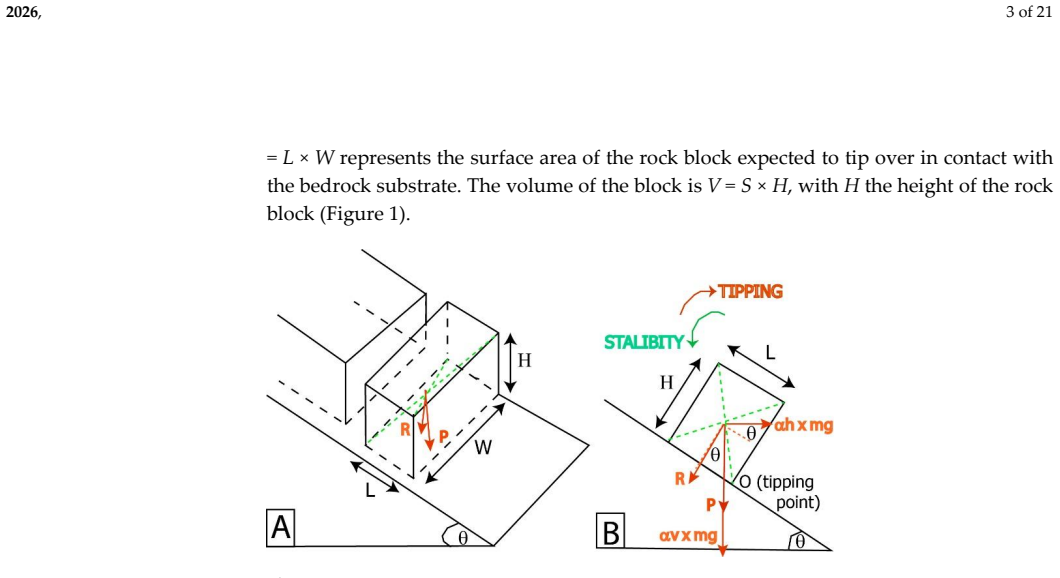
Slope stability description through mechanical laws has important implication for Earth morphology understanding and risk assessment. Previous researches have showed that shear, tensile, and hybrid fractures can be observed experimentally and in the field, but their descriptions by a single equation is still an open debate. Fracture envelope able to describe contemporaneously these three fracture modes differ signif-icantly from the Mohr-Coulomb law. Despite the need to apply such a law at all scales, from the laboratory to the mountain range, the fracture criterion that characterizes all types of fractures is rarely used in geotechnical engineering and geological investiga-tions. In order to analyze the stability thresholds of large-scale relief, the current work examines the effects of considering the Griffith criterion with a variable rock traction instead of the Mohr-Coulomb law using a modelling approach. The difference esti-mated on maximum relief using these two different rupture criterions could be of the same order than the one caused by geological phenomena, such as with or without seismic activity, or from the one caused by the destabilization processes (tilting vs. landslide). When compared to the modified Griffith criterion, the Mohr-Coulomb law tends to overestimate the maximum escarpment height. The results are examined in relation to the Carrara marbles, which serve as a case study for the theoretical frame-work.
Editorial analysis
A structured set of objections, weighed in public.
Referee Report
Summary. The manuscript uses a modeling approach to compare the Mohr-Coulomb law against the modified Griffith criterion (with variable rock traction) for determining maximum relief and escarpment heights in slope stability. It concludes that Mohr-Coulomb overestimates maximum escarpment height relative to modified Griffith, with the magnitude of this difference comparable to that arising from geological factors such as seismic activity or tilting versus landslide processes. Results are discussed in relation to the Carrara marbles as a case study for applying the criterion at mountain-range scales.
Significance. If validated, the quantitative demonstration that tensile/hybrid fracture modes can produce relief differences on the order of seismic or destabilization effects would strengthen the case for using comprehensive fracture envelopes in geomorphological modeling and hazard assessment. The work correctly identifies the under-use of such criteria in large-scale applications and provides a direct comparison that could inform revised stability thresholds.
major comments (2)
- [Case Study] The central claim that the relief difference between criteria is comparable to geological phenomena (seismic activity, tilting vs. landslide) rests on direct application of the modified Griffith envelope at kilometer scales. The Carrara marbles case study is invoked only for qualitative context and does not include a quantitative comparison of model-predicted versus observed maximum relief under field heterogeneity and stress gradients (Case Study section).
- [Modeling Approach] The modeling comparison assumes the laboratory-derived variable traction in the modified Griffith criterion remains predictive at mountain-range scales without additional terms for time-dependent processes or heterogeneity. No explicit check or sensitivity test is reported to confirm that the overestimation result is robust once these field-scale factors are included (Modeling Approach section).
minor comments (2)
- [Abstract] Abstract contains hyphenation artifacts ('max-imum', 'signif-icantly') that should be corrected for clarity.
- [Abstract] The abstract would benefit from a brief statement of the specific modeling technique (analytical, numerical) and the exact rock-property values or ranges used in the variable-traction implementation.
Simulated Author's Rebuttal
We thank the referee for the constructive and detailed comments, which help clarify the scope and limitations of our modeling study. We address each major comment below and indicate planned revisions to the manuscript.
read point-by-point responses
-
Referee: [Case Study] The central claim that the relief difference between criteria is comparable to geological phenomena (seismic activity, tilting vs. landslide) rests on direct application of the modified Griffith envelope at kilometer scales. The Carrara marbles case study is invoked only for qualitative context and does not include a quantitative comparison of model-predicted versus observed maximum relief under field heterogeneity and stress gradients (Case Study section).
Authors: The central claim is grounded in the modeling results, which show that the difference in maximum escarpment height between the Mohr-Coulomb law and the modified Griffith criterion is on the same order as variations arising from seismic activity or tilting versus landslide processes. This is a direct outcome of applying the two envelopes under the same boundary conditions at large scales. The Carrara marbles example is presented as a qualitative illustration of how the modified Griffith framework might be applied to a real mountain-range setting, not as a quantitative validation against field observations. We agree that a direct quantitative comparison of model predictions with observed relief, incorporating field heterogeneity and stress gradients, would strengthen the work. However, obtaining the necessary high-resolution field data for such a comparison lies outside the current scope of this modeling paper. We will revise the Case Study section to more explicitly state the illustrative purpose of the example and to note the absence of quantitative field validation as a limitation. revision: partial
-
Referee: [Modeling Approach] The modeling comparison assumes the laboratory-derived variable traction in the modified Griffith criterion remains predictive at mountain-range scales without additional terms for time-dependent processes or heterogeneity. No explicit check or sensitivity test is reported to confirm that the overestimation result is robust once these field-scale factors are included (Modeling Approach section).
Authors: The modeling comparison is intentionally simplified to isolate the effect of switching from the Mohr-Coulomb law to the modified Griffith criterion with variable traction. The laboratory-derived parameters are used as a first-order approximation to demonstrate the potential magnitude of the difference at large scales. We acknowledge that time-dependent processes and spatial heterogeneity are not explicitly modeled and that no dedicated sensitivity tests for these factors were performed. The overestimation result is therefore presented under the stated assumptions. We will expand the Modeling Approach section to discuss these assumptions more thoroughly, highlight the first-order nature of the comparison, and add a brief sensitivity discussion on how heterogeneity or time-dependent weakening might modulate the reported difference. revision: yes
Circularity Check
Direct modeling comparison of established criteria shows no circular derivation
full rationale
The paper conducts a modeling comparison of maximum relief using the Mohr-Coulomb law versus the modified Griffith criterion with variable rock traction. No equations or steps are shown that reduce the estimated difference in escarpment height to a fitted parameter, self-referential definition, or load-bearing self-citation chain. The central claim follows directly from applying the two known criteria to the stability thresholds, making the derivation self-contained. The scale-bridging assumption is a modeling choice but does not create circularity within the paper's own chain.
Axiom & Free-Parameter Ledger
Lean theorems connected to this paper
-
IndisputableMonolith/Cost/FunctionalEquation.leanwashburn_uniqueness_aczel unclear?
unclearRelation between the paper passage and the cited Recognition theorem.
When compared to the modified Griffith criterion, the Mohr-Coulomb law tends to overestimate the maximum escarpment height... Griffith criterion with a variable rock traction
-
IndisputableMonolith/Foundation/AlphaCoordinateFixation.leanJ_uniquely_calibrated_via_higher_derivative unclear?
unclearRelation between the paper passage and the cited Recognition theorem.
The difference estimated on maximum relief using these two different rupture criterions could be of the same order than the one caused by geological phenomena
What do these tags mean?
- matches
- The paper's claim is directly supported by a theorem in the formal canon.
- supports
- The theorem supports part of the paper's argument, but the paper may add assumptions or extra steps.
- extends
- The paper goes beyond the formal theorem; the theorem is a base layer rather than the whole result.
- uses
- The paper appears to rely on the theorem as machinery.
- contradicts
- The paper's claim conflicts with a theorem or certificate in the canon.
- unclear
- Pith found a possible connection, but the passage is too broad, indirect, or ambiguous to say the theorem truly supports the claim.
Reference graph
Works this paper leans on
-
[1]
F., Tectonic Forcing of Late Cenozoic Climate
Raymo R.E., Ruddiman W. F., Tectonic Forcing of Late Cenozoic Climate. Nature 1992, v.359, n.6391, p.117–122
work page 1992
-
[2]
Pinter, N., Brandon, M., How Erosion Builds Mountains. Scientific American 2005, Sp. 15. 74 -81. 10.1038/scientificameri- can0705-74sp
-
[3]
Giant Quaternary landslides in the evolution of La Palma and El Hierro, Canary Islands
Carracedo, J.C., Day, S.J., Guillou, H., Pérez Torrado, F.J. Giant Quaternary landslides in the evolution of La Palma and El Hierro, Canary Islands. J. Volcanol. Geotherm. Res. 1999, 94, 169–190
work page 1999
-
[4]
Landslides in Valles Marineris (Mars): a possible role of basal lubrication by sub -surface ice
De Blasio, F.V. Landslides in Valles Marineris (Mars): a possible role of basal lubrication by sub -surface ice. Planetary and Space Science 2011a, 59, 1384–1392
-
[5]
The aureole of Olympus Mons (Mars) as the compound deposit of submarine landslides
De Blasio, F.V. The aureole of Olympus Mons (Mars) as the compound deposit of submarine landslides. Earth Planet. Sci. Lett. 2011b, 312, 126–139
-
[6]
Gargani J., Relative sea level and abrupt mass unloading in Barbados during the Holocene. Geomorphology 2022b, 108353
-
[7]
Lenz, J.; Yousuf, A.; Schindewolf, M.; Von Werner, M.; Hartsch, K.; Singh, M.J.; Schmidt, J. Parameterization for EROSION- 3D Model under Simulated Rainfall Conditions in Lower Shivaliks of India. Geosciences 2018, 8,
work page 2018
-
[8]
https://doi.org/10.3390/geosciences8110396
-
[9]
Stetler, L.D. Impacts of Material Engineering Properties on Slope Wash and Stability in Fine -Grained Bedrock Slopes at Fossil-Bearing Sites, Badlands National Park, South Dakota, USA. Geosciences 2018, 8, 267. https://doi.org/10.3390/geosci- ences8070267
- [10]
-
[11]
Luffman, I.; Nandi, A.; Luffman, B. Comparison of Geometric and Volumetric Methods to a 3D Solid Model for Measure- ment of Gully Erosion and Sediment Yield. Geosciences 2018, 8, 86. https://doi.org/10.3390/geosciences8030086
-
[12]
Estimation of Soil Erosion in Nepal Using a RUSLE Modeling and Geospatial Tool
Koirala, P.; Thakuri, S.; Joshi, S.; Chauhan, R. Estimation of Soil Erosion in Nepal Using a RUSLE Modeling and Geospatial Tool. Geosciences 2019, 9, 147. https://doi.org/10.3390/geosciences9040147
-
[13]
Senanayake IP, Hancock GR, Coulthard TJ. A Review of Process -Based Landform Evolution Models for Evaluating the Erosional Stability of Constructed Post-Mining Landscapes. Earth 2026, 7(1):19. https://doi.org/10.3390/earth7010019
-
[14]
Advanced GIS -Based RUSLE Modeling for Soil Erosion Estimation in the Toplica River Basin, Serbia
Đorđević, M.; Đokić, M.; Manić, M.; Vesković, J.; Dragović, R.; Smičiklas, I.; Dragović, S.; Onjia, A. Advanced GIS -Based RUSLE Modeling for Soil Erosion Estimation in the Toplica River Basin, Serbia. Geosciences 2026, 16, 83. https://doi.org/10.3390/geosciences16020083
-
[15]
Les Alpes Apuanes: le paléoenglacement exceptionnel d’une moyenne montagne méditerranéenne
Jaurand E. Les Alpes Apuanes: le paléoenglacement exceptionnel d’une moyenne montagne méditerranéenne. In Les glaciers dispa- rus de l’Apennin. Editions de la Sorbonne, 1998. https://doi.org/10.4000/books.psorbonne.31428
- [16]
-
[17]
Jouannic G., Gargani J., F. Costard, G. Ori, C. Marmo, F. Schmidt, A. Lucas. Morphological and mechanical characterization of gullies in a periglaci al environment: The case of the Russell crater dune (Mars). Planetary and Space Science 2012, v.71, p.38-54
work page 2012
-
[18]
Pasquon K., J. Gargani, M. Massé, S. Conway, Present-day formation and seasonal evolution of linear dune gullies on Mars. Icarus 2016, 274, 195-210.*
work page 2016
-
[19]
Pasquon K., Gargani J., Nachon M., Conway S., Massé M., Jouannic G., Balme M., Costard F., Vincendon M. Are the differ- ent gully morphologies due to different formation processes on the Kaiser dune field on Mars? Geological Society of London Special publication 2018, vol.467, 13 pages
work page 2018
-
[20]
Pasquon K., J. Gargani, M. Massé, M. Vincendon, S. Conway, A. Séjourné, V. Jomelli, M. Balme, S. Lopez, A. Guimpier. Present-day development of gully-channel sinuosity by carbon dioxide gas supported flows on Mars. Icarus 2019, 329, 296- 313
work page 2019
-
[21]
Volkwein, A., Schellenberg, K., Labiouse, V., Agliardi, F., Berger, F., Bourrier, F., Dorren, L. K. A., Gerber, W., and Ja- boyedoff, M.: Rockfall characterisation and structural protection – a review, Nat. Hazards Earth Syst. Sci. 2011, 11, 2617–
work page 2011
-
[22]
https://doi.org/10.5194/nhess-11-2617-2011 2026, 18 of 21
-
[23]
Pérez-Rey P., Muñiz -Menéndez M., González J., Vagnon F., Walton G., Alejano L.R., Laboratory physical modelling of block toppling instability by means of tilt tests, Engineering Geology 2021, v.282, 105994
work page 2021
-
[24]
Journal of Rock Mechanics and Geotechnical Engineering 2024, v.16, p.112-122
Jin L., Dong H., Ye F., Wei Y., Liu J., Wang C., Investigation of the block toppling evolution of a layered model slope by centrifuge test and discrete element modeling. Journal of Rock Mechanics and Geotechnical Engineering 2024, v.16, p.112-122
work page 2024
-
[25]
Stability Analysis Approach to Block Toppling in Rock Slopes Under Seismic Loads
Fan K, Liu C, Sun C. Stability Analysis Approach to Block Toppling in Rock Slopes Under Seismic Loads. Applied Sciences 2026, 16(1):22. https://doi.org/10.3390/app16010022
-
[26]
Lagain, A., S. Bouley, D. Baratoux, C. Marmo, F. Costard, O. Delaa, A. Pio Rossi, M. Minin, G. Benedix, M. Ciocco, B. Bedos, A. Guimpier, E. Dehouck, D. Loizeau, A. Bouquety, J. Zhao, A. Vialatte, M. Cormau, E. Le Conte des Floris, F. Schmidt, P. Thollot, J. Champion, M. Martinot, J. Gargani, P. Beck, J. Boisson, N. Paulien, A. Séjourné, K. Pasquon, N. Ch...
work page 2021
-
[27]
Kaspar, M.; Latal, C.; Pittino, G.; Reinprecht, V. Degradation and Decay of Rocks: Linking Wetting –Drying and Slake Du- rability Tests for Climate-Sensitive Maintenance. Geotechnics 2025, 5, 84. https://doi.org/10.3390/geotechnics5040084
-
[28]
C.R.Palevol 2016, v.15, p.379-391
Gargani J., Abdessadok S., Tudryn A., Chapon Sao C., Dambricourt Malassé A., Gaillard C., Moigne A -M., Singh M., Bhardaj V., Karir B., Geology and Geomorphology of Masol paleonto-archeological site, Late Pliocene, Chandigarh, Siwalik Frontal Range, NW India. C.R.Palevol 2016, v.15, p.379-391
work page 2016
-
[29]
Jiménez López, L.Á.; Sánchez Núñez, J.M.; Pola, A.; Escamilla Casas, J.C.; Sereno, H.I.; Rodríguez Contreras, P.; Serrano Flores, M.E. Hydrothermally Altered Rocks and Their Implications for Debris Flow Generation in the Monarch Butterfly Biosphere Reserve, Mexico. GeoHazards 2025, 6, 62. https://doi.org/10.3390/geohazards6040062
-
[30]
Forecasting giant, catastrophic slope collapse: lessons from Vajont, Northern Italy
Kilburn, C.R.J., Petley, D.N. Forecasting giant, catastrophic slope collapse: lessons from Vajont, Northern Italy. Geomorphol- ogy 2003, 54, 21–32
work page 2003
-
[31]
Kafle, J., Pokhrel, P., Khattri, K.B., Kattel, P., Tuladhar, B.M. , Pudasainia, S.P. Landslide generated tsunami and particle transport in mountain lakes and reservoirs. Annals of Glaciology 2016, 57 (71), 232 –244. https://doi.org/10.3189/2016AoG71A034
-
[32]
Geomorphology 2020, 370, 107354
Gargani J., Modelling the mobility and dynamics of a large Tahitian landslide using runout distance. Geomorphology 2020, 370, 107354
work page 2020
-
[33]
Gargani J., Isostatic Adjustment, Vertical Motion Rate Variation and Potential Detection of Past Abrupt Mass Unloading. Geosciences 2022a, 12(8), 302
-
[34]
Landslide Risk Associated with Glacier Tourism in the Mt
Sapkota L, Liu Q, Khanal NR, Gurung B, Luo Y. Landslide Risk Associated with Glacier Tourism in the Mt. Everest Region (Sagarmatha National Park), High-Mountain Nepal. Earth 2026, 7(2):43. https://doi.org/10.3390/earth7020043
-
[35]
Geomorphology 1994, 10, 265–284
Keefer, D.K., The importance of earthquake -induced landslides to long -term slope erosion and slope -failure hazards in seismically active regions. Geomorphology 1994, 10, 265–284
work page 1994
-
[36]
Valles Marineris landslides: evidence for a strength limit to Martian relief? Earth Planet
Bigot-Cornier, F., Montgomery, D.R. Valles Marineris landslides: evidence for a strength limit to Martian relief? Earth Planet. Sci. Lett. 2007, 260, 179–186
work page 2007
-
[37]
Deciphering the effect of climate change on landsliding activity: a review
Crozier, M.J. Deciphering the effect of climate change on landsliding activity: a review. Geomorphology 2010, 124, 260–267
work page 2010
-
[38]
Rainfall thresholds for the possible occurrence of landslides in Italy
Brunetti, M.T., Peruccacci, S., Rossi, M., Luciani, S., Valigi, D., Guzzetti, F. Rainfall thresholds for the possible occurrence of landslides in Italy. Nat. Hazards Earth Syst. Sci. 2010, 10, 447–458
work page 2010
-
[39]
Transient motion of the largest landslide on earth, modu- lated by hydrological forces
Aslan, G.; De Michele, M.; Raucoules, D.; Bernardie, S.; Cakir, Z. Transient motion of the largest landslide on earth, modu- lated by hydrological forces. Sci. Rep. 2021, 11, 10407
work page 2021
-
[40]
Melgar, M.; Ramírez -Cevallos, N.; Chunga, K.; Toulkeridis, T. Rain - and Seismic-Triggered Mass Movements in Coastal Ecuador—A Case Study of the “El Florón” Landslide in Portoviejo. Earth 2025, 6, 156. https://doi.org/10.3390/earth6040156
-
[41]
Wang L, Zhang J, Huang X, Tan G. Study on the Dynamic Stability and Spectral Characteristics of a Toppling Dangerous Rock Mass under Seismic Excitation. Sustainability 2023, 15(21):15397. https://doi.org/10.3390/su152115397
-
[42]
Geotechnical Study of Raspadalica Cliff Rockfall, Croatia
Udovič D, Kordić B, Arbanas Ž. Geotechnical Study of Raspadalica Cliff Rockfall, Croatia. Applied Sciences 2022, 12(13):6532. https://doi.org/10.3390/app12136532
-
[43]
Rodriguez-Losada, J.A.; Hernandez -Gutérrez, L.E.; Olalla, C.; Perucho, A.; Serrano, A.; Eff -Darwich, A. Geomechanical parameters of intact rocks and rock masses from the Canary Islands: Implications on their flank stability. J. Volcanol. Geo- therm. Res. 2009, 182, 67–75
work page 2009
-
[44]
Alomari, E.; Ng, K.; Khatri, L. An Expanded Wing Crack Model for Fracture and Mechanical Behavior of Sandstone Under Triaxial Compression. Materials 2024, 17, 5973. https://doi.org/10.3390/ma17235973
-
[45]
Fredlund, D. G., Krahn, J. Comparison of slope stability methods of analysis. Canadian Geotechnical Journal 1977, 14(3), 429–
work page 1977
-
[46]
https://doi.org/10.1139/t77-045
-
[47]
Zhu, D. Y., Lee, C. F., Jiang, H. D., Generalized framework of limit equilibrium methods for slope stability analysis. Géotech- nique 2003, 53(4), 377–395
work page 2003
-
[48]
Editions Eyrolles, Paris, 548 pages, 2000
Philipponnat G., Hubert B., Fondations et ouvrages en terre. Editions Eyrolles, Paris, 548 pages, 2000. 2026, 19 of 21
work page 2000
-
[49]
An Analytical Solution for Block T oppling Failure of Rock Slopes during an Earthquake
Guo S, Qi S, Yang G, Zhang S, Saroglou C. An Analytical Solution for Block T oppling Failure of Rock Slopes during an Earthquake. Applied Sciences 2017, 7(10):1008. https://doi.org/10.3390/app7101008
-
[50]
Sun Z, Qiu S, Yan S, Wang Z. A Numerical Method for Evaluating the Collapse of Hig h-Steep Scarp Slopes Based on the Bonded Block Model –Discrete Fracture Network Model. Sustainability 2023, 15(21):15672. https://doi.org/10.3390/su152115672
-
[51]
Li, Z.; Li, H.; Zhang, Q.; Wang, J.; Meng, C.; Fan, X.; Zhao, P. A Modified Nonlinear Mohr –Coulomb Failure Criterion for Rocks Under High -Temperature and High -Pressure Conditions. Appl. Sci. 2025, 15, 8048. https://doi.org/10.3390/app15148048
-
[52]
Carlini, M., Viola, G., Mattila, J., and Castellucci, L.: The role of mechanical stratigraphy on the refraction of strike -slip faults, Solid Earth 2019, 10, 343–356, https://doi.org/10.5194/se-10-343-2019
-
[53]
Mc Cormick C.A., Rutter E.H., An experimental study of the transition from tensile failure to shear failure in Carrara marble and Solnhofen limestone: Does “hybrid failure” exist? Tectonophysics 2022, v.844, 229623, https://doi.org/10.1016/j.tecto.2022.229623
-
[54]
Journal of Geophysical Research Solid Earth 2021, 126, e2021JB022471
Li Y., Ghassemi A., Rock failure envelope and behavior using the confined Brazilian test. Journal of Geophysical Research Solid Earth 2021, 126, e2021JB022471
work page 2021
-
[55]
Scientific reports 2019, v.9, p.1-9
Lan H., Cheng J., Macciotta R., Universal confined tensile strength of intact rock. Scientific reports 2019, v.9, p.1-9
work page 2019
-
[56]
Gargani J., Influence of Relative Sea-Level Rise, Meteoric Water Infiltration and Rock Weathering on Giant Volcanic Land- slides. Geosciences 2023, 13, 4, 113
work page 2023
-
[57]
Luo, L.; Ma, W.; Zhang, Z.; Zhuang, Y.; Zhang, Y.; Yang, J.; Cao, X.; Liang, S.; Mu, Y. Freeze/Thaw -Induced Deformation Monitoring and Assessment of the Slope in Permafrost Based on Terrestrial Laser Scanner and GNSS. Remote Sens- ing 2017, 9, 198. https://doi.org/10.3390/rs9030198
-
[58]
Hou, J.; Zhang, P.; Gao, N.; Yan, W.; Yu, Q. Freeze –Thaw-Induced Degradation Mechanisms and Slope Stability of Filled Fractured Rock Masses in Cold Region Open-Pit Mines. Appl. Sci. 2025, 15, 7429. https://doi.org/10.3390/app15137429
-
[59]
Ca uses and mobility of large volcanic landslides: application to Tenerife, Canary Islands
Hürlimann, M., Garcia-Piera, J.O., Ledesma, A. Ca uses and mobility of large volcanic landslides: application to Tenerife, Canary Islands. J. Volcanol. Geotherm. Res. 2000, 103, 121–134
work page 2000
-
[60]
Ramsey J.M., Chester F.M., Hybrid fracture and transition from extension fracture to shear fracture. Nature 2004, v.428, p.63-66
work page 2004
-
[61]
Ratschbacher, L., Frisch, W., Neubauer, F., Schmid, S., Neugebauer, J., Extension in compressional orogenic belts: The East- ern Alps. Geology 1989. 7613217. 404-407. 10.1130/0091-7613(1989)017<0404:EICOBT>2.3.CO;2
-
[62]
Bulletin de la Société Géologique de France 2010, 181 (6): 503 –530
Rangin C., Le Pichon X., Hamon Y., Loget N., Crespy A., Gravity tectonics in the SE Basin (Provence, France) imaged from seismic reflection data. Bulletin de la Société Géologique de France 2010, 181 (6): 503 –530. https://doi.org/10.2113/gssgfbull.181.6.503
-
[63]
Bellier O., Cushing E.M., Sébrier M., Thirty years of paleoseismic research in metropolitan France. Comptes Rendus. Géos- cience 2021, Seismicity in France, v.353, p.339-380. doi: 10.5802/crgeos.102
-
[64]
Journal of Geophysical Research: Solid Earth 2025
Orrego, S., Biggs, J., Wimpenny, S., Maghsoudi, Y., Range‐Parallel Extension of the Andes in the 2020 Mw 5.7 Humahuaca Earthquake. Journal of Geophysical Research: Solid Earth 2025. 130. 10.1029/2025JB032208
-
[65]
Cambridge University Press, 502 pages, 1990
Price N.J., Cosgrove J.W., Analysis of geological structures. Cambridge University Press, 502 pages, 1990
work page 1990
-
[66]
Nkanyane, F.; Sengani, F.; Rapholo, M.T.D.; Skrzypkowski, K.; Zagórski, K.; Zagórska, A.; Rokita, T. The Effects of Strata Orientation and Water Presence on the Stability of Engineered Slopes Using DIPS and FLACSlope: A Case Study of Tubatse and Fetakgomo Engineered Road Slopes. Appl. Sci. 2024, 14, 9838. https://doi.org/10.3390/app14219838
-
[67]
Li, T.; Ran, W.; Wei, K.; Guo, J.; Chen, S.; Li, X.; Chen, M.; Pei, X. Influence Mechanism of Water Level Variation on Defor- mation of Steep and Toppling Bedding Rock Slope. Water 2024, 16, 2706. https://doi.org/10.3390/w16192706
-
[68]
Gabbianelli, G.; Perrone, D.; Brunesi, E.; Monteiro, R. Seismic Acceleration and Displacement Demand Profiles of Non - Structural Elements in Hospital Buildings. Buildings 2020, 10, 243. https://doi.org/10.3390/buildings10120243
-
[69]
Aringoli, D.; Farabollini, P.; Pambianchi, G.; Materazzi, M.; Bufalini, M.; Fuffa, E.; Gentilucci, M.; Scalella, G. Geomorpho- logical Hazard in Active T ectonics Area: Study Cases from Sibillini Mountains Thrust System (Central Apen- nines). Land 2021, 10, 510. https://doi.org/10.3390/land10050510
-
[70]
Seismotectonics, Active Deformation, and Structure of the Crust
Kassaras, I.; Gan as, A.; Pace, P. Special Issue: “Seismotectonics, Active Deformation, and Structure of the Crust”. Geosci- ences 2023, 13, 73. https://doi.org/10.3390/geosciences13030073
-
[71]
Xu, H.; Zhang, L.; Shi, C. Destabilization Mechanism and Stability Study of Collapsible Loess Canal Slopes in Cold and Arid Regions. Appl. Sci. 2024, 14, 4518. https://doi.org/10.3390/app14114518
-
[72]
Stabilizing and Destabilizing Breaching Flow Slides
Alhaddad, S.; Weij, D.; van Rhee, C.; Keetels, G. Stabilizing and Destabilizing Breaching Flow Slides. J. Mar. Sci. Eng. 2023, 11, 560. https://doi.org/10.3390/jmse11030560
-
[73]
Goodman, R.E.; Bray, J.W. Toppling of rock slopes. In Boulder CO, Proceedings of the Specialty Conference on Rock Engineering for Foundations and Slopes; American Society of Civil Engineers: New York, NY, USA, 1976; pp. 201–234
work page 1976
-
[74]
Probabilistic rainfall thresholds for triggering debris flows in a human-modified landscape
Giannecchini, R., Galanti, Y., D'Amato Avanzi, G., Barsanti, M. Probabilistic rainfall thresholds for triggering debris flows in a human-modified landscape. Geomorphology 2015. 257. 10.1016/j.geomorph.2015.12.012
-
[75]
Human-Induced Hazardous Debris Flows in Carrara Marble Basins (Tuscany, Italy)
Baroni, C., B ruschi, G., Ribolini, A. Human-Induced Hazardous Debris Flows in Carrara Marble Basins (Tuscany, Italy). Earth Surface Processes and Landforms 2010. 25. 93 - 103. 10.1002/(SICI)1096-9837(200001)25:1<93::AID-ESP53>3.0.CO;2-0. 2026, 20 of 21
-
[76]
Paglia G, Santucci G, Buccolini M, Miccadei E. Assessment of Potential Landslide Scenarios Using Morphometry, Geomor- phological Constraints, and Run -Out Analysis: A Case Study from Central Apennines (Italy). Land 2025, 14(11):2109. https://doi.org/10.3390/land14112109
-
[77]
Cui S, Wang H, Pei X, Luo L, Zeng B, Jiang T. Research on Deformation Evolution of a Large Toppling Based on Compre- hensive Remote Sensing Interpretation and Real -Time Monitoring. Remote Sensing 2023, 15(23):5596. https://doi.org/10.3390/rs15235596
-
[78]
Ibrahim A, Wageeh A, Hamouda MA, Ahmed A, Gad A. Impact of LULC Classification Methods on Runoff Simulation in an Arid Mountainous Watershed Using Remote Sensing and Mac hine Learning. Earth 2026, 7(1):26. https://doi.org/10.3390/earth7010026
-
[79]
Handwerger, A. L., A. W. Rempel, R. M. Skarbek, Submarine landslides triggered by destabilization of high -saturation hydrate anomalies, Geochem. Geophys. Geosyst. 2017, 18, 2429–2445, doi:10.1002/2016GC006706
-
[80]
Ben-Yehoshua, D.; Erlingsson, S.; Sæmundsson, Þ.; Hermanns, R.L.; Magnússon, E.; Askew, R.A.; Helgason, J. The Desta- bilizing Effect of Glacial Unloading on a Large Volcanic Slop e Instability in Southeast Iceland. GeoHazards 2025, 6, 1. https://doi.org/10.3390/geohazards6010001
discussion (0)
Sign in with ORCID, Apple, or X to comment. Anyone can read and Pith papers without signing in.