Codes and designs in multivariate Q-polynomial association schemes
Pith reviewed 2026-06-30 18:48 UTC · model grok-4.3
The pith
Delsarte bounds on codes of given degree and designs of given strength extend to weakly metric multivariate Q-polynomial association schemes.
A machine-rendered reading of the paper's core claim, the machinery that carries it, and where it could break.
Core claim
In weakly metric multivariate Q-polynomial association schemes, upper bounds hold for the size of codes of given degree and for codes with a given number of distances, with meeting codes characterized by identification of annihilators with the degree Wilson polynomial or distance Wilson polynomial. Two analogues of the Rao bound apply to designs of given strength; degree-tight or distance-tight designs meeting either bound satisfy a Lloyd-like condition on the suitable analogue of the Wilson polynomial. The formal duality between codes and designs is realized explicitly through self-dual translation schemes.
What carries the argument
The degree Wilson polynomial and distance Wilson polynomial, which identify annihilators that characterize codes attaining the bounds and impose conditions on tight designs.
If this is right
- Upper bounds limit the size of codes of given degree.
- Upper bounds limit the size of codes with a given number of pairwise distances.
- Codes meeting either bound are characterized by annihilator identification with the Wilson polynomial.
- Two Rao-type bounds limit the size of designs of given strength.
- Tight designs imply a Lloyd-like condition on the Wilson polynomial analogue, and self-dual translation schemes make code-design duality concrete.
Where Pith is reading between the lines
- The same polynomial conditions may organize bounds for ordered orthogonal arrays and mixed-level arrays under Lee distance.
- The explicit duality in self-dual schemes suggests that known tight designs could produce perfect codes in the multivariate setting.
- The framework supplies a uniform way to compare classical Delsarte bounds with their multivariate extensions.
Load-bearing premise
The multivariate Q-polynomial association scheme must be weakly metric.
What would settle it
A code in a weakly metric multivariate Q-polynomial association scheme whose size exceeds the stated upper bound without its annihilator matching the relevant Wilson polynomial.
Figures

read the original abstract
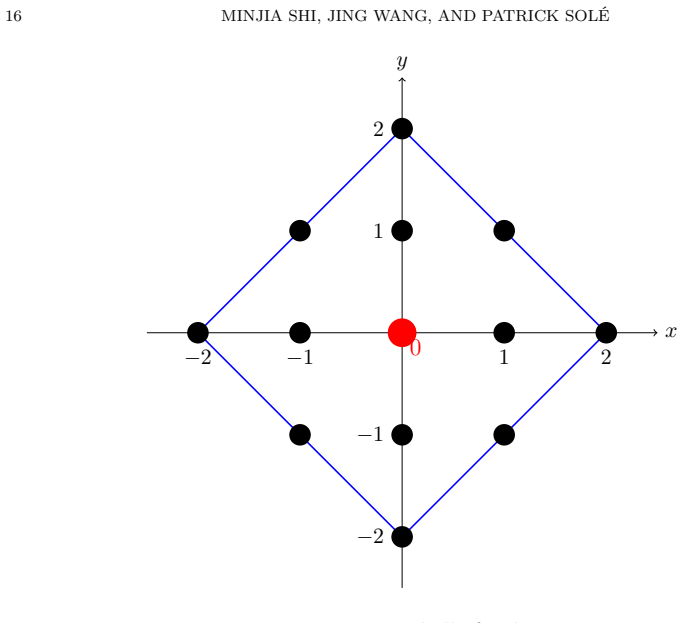
We generalize the fundamental bounds of Delsarte thesis (1973) on codes of given degree and designs of given strength in the new setting of Bannai et al. (2025). We assume the scheme is weakly metric in the sense of (Sol\'e, 1989). We give upper bounds on the size of codes of given degree, and also on the size of codes with a given number of pairwise distances. Codes meeting these bounds are characterized by the identification of suitable annihilators with the degree (resp. distance) Wilson polynomial. We give two analogues of the Rao bound on the size of designs with given strength. Designs meeting that bound we call degree tight designs or distance tight design depending on the bound met. In both cases, the existence of a tight design implies a Lloyd-like condition on a suitable analogue of the Wilson polynomial. Applications to the Lee distance, mixed level orthogonal arrays, ordered orthogonal arrays, and more are given. The formal duality between codes and designs, connecting perfect codes and tight designs, is made concrete in self-dual translation schemes.
Editorial analysis
A structured set of objections, weighed in public.
Referee Report
Summary. The manuscript generalizes Delsarte's 1973 bounds on the size of codes of given degree and designs of given strength to the setting of multivariate Q-polynomial association schemes (Bannai et al. 2025). Under the standing assumption that the scheme is weakly metric (Solé 1989), it derives upper bounds on codes with a prescribed degree or a prescribed number of pairwise distances; equality cases are characterized by the annihilator polynomial coinciding with the appropriate degree or distance Wilson polynomial. Two Rao-type bounds are obtained for designs, with equality cases (degree-tight or distance-tight designs) implying a Lloyd-type condition on the corresponding Wilson polynomial. Applications are given to the Lee metric, mixed-level orthogonal arrays, ordered orthogonal arrays, and the code-design duality is illustrated explicitly in self-dual translation schemes.
Significance. If the derivations hold, the work supplies a coherent extension of the classical Delsarte theory to a multivariate Q-polynomial framework, furnishing explicit bounds and equality characterizations that may be applied to several families of combinatorial objects not covered by the univariate theory. The concrete realization of the formal duality between perfect codes and tight designs in self-dual schemes is a clear strength. The paper does not claim machine-checked proofs or parameter-free derivations, but the explicit reduction to Wilson polynomials and the Lloyd-type conditions provide falsifiable predictions that can be checked in concrete schemes.
minor comments (3)
- [§2.3] §2.3: the transition from the univariate to the multivariate annihilator is stated without an explicit formula relating the two; adding the precise relation between the degree Wilson polynomial and its univariate counterpart would clarify the generalization.
- [Applications] The applications section lists several families (Lee distance, mixed-level OAs) but does not include a single numerical table comparing the new bounds with known tables or with the classical Delsarte bounds; such a comparison would strengthen the claim of utility.
- Notation: the symbols for the multivariate P- and Q-polynomials are introduced without a consolidated table; a short notation table would aid readability.
Simulated Author's Rebuttal
We thank the referee for their positive and accurate summary of the manuscript, as well as for the favorable significance assessment and recommendation of minor revision. No major comments appear in the report.
Circularity Check
Minor self-citation to explicit assumption; central generalization independent
full rationale
The paper explicitly assumes the scheme is weakly metric per Solé (1989) and generalizes Delsarte (1973) bounds in the Bannai et al. (2025) setting. No equations or derivations reduce the new bounds, annihilator identifications, or tight design characterizations to fitted parameters, self-definitions, or unverified self-citations. The self-citation is limited to an assumption and is not load-bearing for the claimed results on codes of given degree, Rao-type bounds, or formal duality. Derivation chain remains self-contained against the cited external frameworks.
Axiom & Free-Parameter Ledger
axioms (1)
- domain assumption The association scheme is weakly metric in the sense of Solé (1989).
Reference graph
Works this paper leans on
-
[1]
Abiad, A.L
A. Abiad, A.L. Gavrilyuk, A.P. Khramova, I. Ponomarenko, A linear programming bound for sum-rank metric codes, IEEE Transactions on Information Theory,71(1), 317-329, 2025
2025
-
[2]
Bannai, H
E. Bannai, H. Kurihara, D. Zhao, Y. Zhu, MultivariateP- and/orQ-polynomial association schemes, Journal of Combinatorial Theory, Series A,213(3), 106025, 2025
2025
-
[3]
Bannai, T
E. Bannai, T. Ito,Algebraic Combinatorics I: association schemes, Benjamin Cummings, Menlo Park, 1984. CODES AND DESIGNS IN MULTIV ARIATEQ-POLYNOMIAL ASSOCIATION SCHEMES 25
1984
-
[4]
Bailey,Association schemes, Cambridge studies in Adv
R. Bailey,Association schemes, Cambridge studies in Adv. Math. 84, Cambridge University Press, Cambridge, 2009
2009
-
[5]
A. Barg, P. Purkayastha, Bounds on ordered codes and orthogonal arrays, 2007 IEEE International Symposium on Information Theory, 331-335, 2007
2007
- [6]
-
[7]
Bernard, N
P.-A. Bernard, N. Crampé, L. Poulain d’Andecy, L. Vinet, M. Zaimi, BivariateP-polynomial association schemes, Algebraic combinatorics,7(2), 361-382, 2024
2024
-
[8]
Bernard, N
P.-A. Bernard, N. Crampé, L. Vinet, M. Zaimia, X.H. Zhang,m-Distance-regular graphs and their relation to multivariateP-polynomial association schemes, Discrete Mathematics,347, 114179, 2024
2024
-
[9]
Brouwer, A.M
A.E. Brouwer, A.M. Cohen, A. Neumaier,Distance-Regular Graphs, Springer, (MATHE3, volume 18), Berlin, 1989
1989
-
[10]
Chvatal,Linear Programming, Freeman, 1983
V. Chvatal,Linear Programming, Freeman, 1983
1983
-
[11]
Delsarte, Four Fundamental parameters of a code and their combinatorial significance, Infor- mation and Control,23, 407-438, 1973
P. Delsarte, Four Fundamental parameters of a code and their combinatorial significance, Infor- mation and Control,23, 407-438, 1973
1973
-
[12]
Delsarte,An Algebraic Approach to the Association Schemes of Coding Theory, Philips Research Reports Supplement,10, 1973
P. Delsarte,An Algebraic Approach to the Association Schemes of Coding Theory, Philips Research Reports Supplement,10, 1973
1973
-
[13]
Delsarte, Bilinear forms over a finite field, with applications to coding theory, Journal of Com- binatorial Theory, Series A,25(3), 226-241, 1978
P. Delsarte, Bilinear forms over a finite field, with applications to coding theory, Journal of Com- binatorial Theory, Series A,25(3), 226-241, 1978
1978
-
[14]
Etzion,Perfect codes and related structures, World Scientific, 2022
T. Etzion,Perfect codes and related structures, World Scientific, 2022
2022
-
[15]
Golomb, L.R
S.W. Golomb, L.R. Welch, Perfect codes in the Lee metric and the packing of polyominoes, SIAM Journal on Applied Mathematics,18(2), 302-317, 1970
1970
- [16]
-
[17]
Duality of translation association schemes coming from certain actions
D.S. Kim, H.K. Kim, Duality of translation association schemes coming from certain actions, arXiv:1108.4947, 2011
work page internal anchor Pith review Pith/arXiv arXiv 2011
-
[18]
Martin, Designs in product association schemes, Designs, Codes and Cryptography,16(3), 271-289, 1999
W.J. Martin, Designs in product association schemes, Designs, Codes and Cryptography,16(3), 271-289, 1999
1999
-
[19]
Martin, D.R
W.J. Martin, D.R. Stinson, Association schemes for ordered orthogonal arrays and (T, M, S)-nets, Canadian Journal of Mathematics,51(2), 326-346, 1999
1999
-
[20]
MacWilliams, N.J.A
F.J. MacWilliams, N.J.A. Sloane,The theory of error-correcting codes, North-Holland, Amster- dam, 1977
1977
- [21]
-
[22]
Solé, On the parameters of codes for the Lee and modular distance, Discrete Mathematics 89, 185-194, 1991
P. Solé, On the parameters of codes for the Lee and modular distance, Discrete Mathematics 89, 185-194, 1991
1991
-
[23]
Solé, A Lloyd Theorem in Weakly Metric Association Schemes, European Journal of Combina- torics,10(2), 189-196, 1989
P. Solé, A Lloyd Theorem in Weakly Metric Association Schemes, European Journal of Combina- torics,10(2), 189-196, 1989
1989
-
[24]
Solé, The Lee association scheme
P. Solé, The Lee association scheme. Springer Lect. Not. 311, 45–55, Springer-Verlag, Berlin Heidelberg, 1986
1986
-
[25]
M. Shi, J. Wang, P. Solé, Perfect codes in weakly metric association schemes, arxiv:2601.12818, 2026
work page internal anchor Pith review Pith/arXiv arXiv 2026
-
[26]
Xu,Common zeros in polynomials of several variables and higher dimensional quadrature, Pitman Res
Y. Xu,Common zeros in polynomials of several variables and higher dimensional quadrature, Pitman Res. Not. in Math 312, Longman, 1994
1994
-
[27]
V. A. Zinoviev and T. Ericson. Fourier invariant pairs of partitions of finite abelian groups and association schemes. Problems Inform. Transmission, 45:221–231, 2009. 26 MINJIA SHI, JING W ANG, AND PATRICK SOLÉ Key Laboratory of Intelligent Computing Signal Processing, Ministry of Education, School of Mathematical Sciences, Anhui University, Hefei 230601...
2009
discussion (0)
Sign in with ORCID, Apple, or X to comment. Anyone can read and Pith papers without signing in.