Shafranov shift and finite β effects on Alfv\'en Eigenmodes and microinstabilities in global electromagnetic gyrokinetic simulations
Pith reviewed 2026-05-20 14:30 UTC · model grok-4.3
The pith
Shafranov shift from energetic particle pressure stabilizes toroidal Alfvén eigenmodes by up to 90 percent in growth rate.
A machine-rendered reading of the paper's core claim, the machinery that carries it, and where it could break.
Core claim
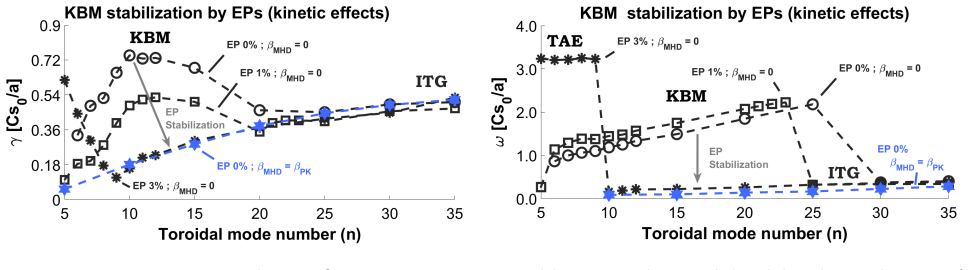
Shafranov shift effects are a function of the toroidal mode number, that they are mainly stabilizing, and stronger at longer wavelengths, impacting TAEs the most with a 90% reduction in growth rate for cases which consistently account for the EP pressure in the MHD equilibrium. Leading to a law of diminishing returns for the TAE growth rate as a function of EP fraction. With Shafranov shift asymptotically pushing the ITG frequency up and the TAE frequency down, while KBMs are strongly damped by both EPs and Shafranov shift effects.
What carries the argument
The Shafranov shift arising from finite plasma beta and energetic particle pressure in the MHD equilibrium, incorporated stepwise from ideal-MHD electrostatic models to full electromagnetic kinetic multi-species gyrokinetic simulations.
If this is right
- TAE growth rates follow a law of diminishing returns as energetic particle fraction increases due to the stabilizing Shafranov shift.
- Shafranov shift asymptotically increases ITG frequencies while decreasing TAE frequencies.
- Kinetic ballooning modes experience strong damping from both energetic particles and the Shafranov shift.
- Linear TAE stabilization by the shift does not change nonlinear saturation levels but reduces the associated heat and particle fluxes.
- ITG saturation levels and fluxes remain largely unaffected by the inclusion of the Shafranov shift.
Where Pith is reading between the lines
- High-beta reactor scenarios with substantial energetic particle populations may see lower TAE-driven transport than models without equilibrium shift predict.
- The stronger effect at long wavelengths suggests that global mode stability in future devices will be particularly sensitive to accurate equilibrium modeling.
- Extending the approach to self-consistent nonlinear equilibrium evolution could uncover additional feedback loops between instabilities and the Shafranov shift.
Load-bearing premise
A stable MHD equilibrium exists and the systematic increase in model realism from electrostatic adiabatic-electron beta-zero cases to full kinetic electromagnetic multi-species captures the dominant self-consistent contributions without missing important nonlinear or non-local couplings.
What would settle it
A side-by-side comparison of TAE linear growth rates in equilibria that include versus exclude energetic particle pressure in the Shafranov shift calculation, for a range of low toroidal mode numbers.
Figures




read the original abstract
Future nuclear fusion reactors will have to confine plasma with strong kinetic gradients and small fractions of fusion-born energetic particles (EP) that are ~100 times hotter than the thermal ions. In our analysis, we assume the existence of a stable MHD equilibrium and study the unstable plasma perturbations. In this electromagnetic, kinetic, multi-scale, self-organizing system, all species contribute both to the Shafranov shift (equilibrium effect) and to the plasma $\beta$ (plasma response). Nonetheless, due to the high complexity of the problem, many works neglect these effects. We use the global, gyrokinetic code ORB5 to study the plasma stability. Starting from an electrostatic, thermal plasma with adiabatic electrons in a $\beta = 0$ ideal-MHD equilibrium, we systematically increase the realism of our models. And study the linear stability and nonlinear fluxes of Toroidal Alfv\'en Eigenmodes (TAE), and the Ion Temperature Gradient (ITG), and Kinetic Ballooning Modes (KBM) microinstabilities as they arise. Linearly, we find that Shafranov shift effects are a function of the toroidal mode number, that they are mainly stabilizing, and stronger at longer wavelengths, impacting TAEs the most with a 90% reduction in growth rate for cases which consistently account for the EP pressure in the MHD equilibrium. Leading to a law of diminishing returns for the TAE growth rate as a function of EP fraction. We find that with Shafranov shift asymptotically pushes the ITG frequency up and the TAE frequency down. Furthermore, we show that KBMs are strongly damped by both EPs (kinetic) and Shafranov shift (equilibrium) effects. Nonlinearly we find that the linear TAE stabilization does not effect the saturation levels. Nonetheless, the heat and particle fluxes carried by the TAE, are reduced by the Shafranov shift. While, the ITG fluxes and saturation levels are unaffected by the Shafranov shift.
Editorial analysis
A structured set of objections, weighed in public.
Referee Report
Summary. The manuscript uses global electromagnetic gyrokinetic simulations with the ORB5 code to study Shafranov shift and finite-β effects on Toroidal Alfvén Eigenmodes (TAEs), Ion Temperature Gradient (ITG) modes, and Kinetic Ballooning Modes (KBMs) in the presence of energetic particles (EPs). Starting from an electrostatic adiabatic-electron β=0 ideal-MHD equilibrium and progressively incorporating electromagnetic, kinetic, and multi-species effects with consistent EP pressure in the MHD equilibrium, the authors report that Shafranov shift effects are mode-number dependent and primarily stabilizing, strongest at long wavelengths, yielding up to a 90% TAE growth-rate reduction and a law of diminishing returns with EP fraction. The shift also shifts frequencies (ITG up, TAE down), damps KBMs, and reduces nonlinear TAE fluxes without altering saturation levels or ITG fluxes.
Significance. If the central results hold after addressing isolation of effects, the work is significant for fusion plasma stability predictions. It demonstrates the importance of self-consistent EP contributions to equilibrium in global simulations, provides a systematic comparison of model realism levels, and identifies stabilizing mechanisms that could influence EP-driven instability thresholds and transport in reactor scenarios. The stepwise model escalation and nonlinear flux results add practical value.
major comments (2)
- [Abstract] Abstract: The 90% TAE growth-rate reduction and stabilization attributed specifically to Shafranov shift effects when EP pressure is included in the MHD equilibrium cannot be cleanly separated from concurrent changes in total plasma β. Adding EP pressure augments both the shift and β (as noted in the abstract), yet no control comparisons holding total β or other equilibrium quantities fixed are indicated. This leaves open the possibility that observed stabilization arises from β-driven or profile-driven effects rather than the shift alone.
- [Linear stability analysis] Linear stability results: The 'law of diminishing returns' for TAE growth rate versus EP fraction is presented as a key outcome but appears observational from the scanned cases. Without a quantitative fit, error bars, or theoretical derivation showing it is not a post-hoc description of the data, the claim risks being under-supported for the central conclusion.
minor comments (2)
- [Abstract] The abstract and summary statements would benefit from explicit mention of the number of toroidal modes scanned and the range of EP fractions used to support quantitative claims such as the 90% reduction.
- [Methods] Convergence tests, grid resolution, and time-step details for the global ORB5 runs are essential to substantiate the reported growth rates and flux changes but are not referenced in the provided summary.
Simulated Author's Rebuttal
We thank the referee for their thorough review and constructive comments on our manuscript. We address the major comments point by point below, indicating planned revisions where appropriate to improve clarity and support for the claims.
read point-by-point responses
-
Referee: [Abstract] Abstract: The 90% TAE growth-rate reduction and stabilization attributed specifically to Shafranov shift effects when EP pressure is included in the MHD equilibrium cannot be cleanly separated from concurrent changes in total plasma β. Adding EP pressure augments both the shift and β (as noted in the abstract), yet no control comparisons holding total β or other equilibrium quantities fixed are indicated. This leaves open the possibility that observed stabilization arises from β-driven or profile-driven effects rather than the shift alone.
Authors: We acknowledge that incorporating EP pressure into the MHD equilibrium simultaneously modifies the Shafranov shift and increases the total plasma β. Our methodology employs a systematic escalation of model realism, beginning from an electrostatic adiabatic-electron case in a β=0 ideal-MHD equilibrium and progressively including electromagnetic, kinetic, and multi-species effects. The additional stabilization is observed specifically upon consistent inclusion of EP pressure in the equilibrium. While dedicated control simulations holding total β fixed were not performed (as this would require non-standard adjustments to the equilibrium construction), we will revise the abstract and discussion sections to explicitly note the coupled nature of these equilibrium changes and clarify that the reported stabilization reflects the net effect of the self-consistent EP contribution rather than the shift in isolation. revision: yes
-
Referee: [Linear stability analysis] Linear stability results: The 'law of diminishing returns' for TAE growth rate versus EP fraction is presented as a key outcome but appears observational from the scanned cases. Without a quantitative fit, error bars, or theoretical derivation showing it is not a post-hoc description of the data, the claim risks being under-supported for the central conclusion.
Authors: The observed trend of diminishing returns in TAE growth rate with increasing EP fraction is drawn directly from the parameter scans presented in the linear stability analysis. To provide stronger quantitative support, we will add a fitted curve to the growth-rate data versus EP fraction in the revised manuscript, including available error estimates from the simulations. A complete theoretical derivation lies beyond the numerical focus of this study; however, we will include references to relevant analytic expectations for EP-driven Alfvén modes to contextualize the trend. revision: yes
Circularity Check
No circularity: results are direct outputs of forward gyrokinetic simulations
full rationale
The paper derives its claims on Shafranov shift stabilization and TAE growth-rate trends exclusively from numerical simulations performed with the external ORB5 code on an input MHD equilibrium. No equation or result reduces to its own inputs by construction, no parameter is fitted and then relabeled as a prediction, and no load-bearing step relies on a self-citation chain. The 'law of diminishing returns' is an observed trend across scanned EP fractions rather than a tautological fit, and the systematic increase in model realism is a controlled numerical experiment rather than a self-referential definition. The analysis is therefore self-contained against the simulation framework and external MHD equilibria.
Axiom & Free-Parameter Ledger
axioms (2)
- domain assumption Existence of a stable MHD equilibrium
- domain assumption Adiabatic electrons and β=0 ideal-MHD starting equilibrium
Reference graph
Works this paper leans on
-
[1]
H., Grad, and H., Rubin, 1958,Conference on the Peaceful Uses of Atomic Energy2190-197
work page 1958
- [2]
- [3]
- [4]
-
[5]
Coppi, B., Ferreira, A., Mark, J. K., and Ramos, J. J., 1979,Nucl. Fusion,19, 715
work page 1979
-
[6]
Troyon, F., et al, 1984,Plasma Phys. Control. Fusion,26, 209
work page 1984
- [7]
-
[8]
Coppi, B., Rosenbluth, M. N., and Sagdeev, R. Z., 1967,Phys. Fluids,10, 582
work page 1967
-
[9]
Guzdar, P. N., Chen, L., Tang, W. M., and Rutherford, P. H, 1983,Phys. Fluids,26
work page 1983
-
[10]
Kim, J. Y., Horton, W., Dong, J. Q., 1993,Phys. Fluids B: Plasma Phys.,54030–4039
work page 1993
-
[11]
Tang, W. M., Connor, J. W., and Hastie, R. J., 1980,Nucl. Fusion,20, 1439
work page 1980
-
[12]
Drummond, W. E., and Rosenbluth, M. N., 1962,Phys. Fluids,5, 1507-1513
work page 1962
- [13]
- [14]
-
[15]
Ishizawa, A., et al 2019,Phys. Rev. Lett.,123, 025003
work page 2019
- [16]
-
[17]
Chen, L., and Zonca, F., 2016,Rev. Mod. Phys.88015008
work page 2016
- [18]
-
[19]
Lanti, E., et al, 2020,Comput. Phys. Commun.251107072
work page 2020
-
[20]
Ohana, N., et al, 2021,Comput. Phys. Commun.262107208
work page 2021
-
[21]
Mishchenko, A., et al, 2023,Plasma Phys. Control. Fusion65064001
work page 2023
- [22]
- [23]
-
[24]
Di Giannatale, G., et al 2025,Plasma Phys. Control. Fusion67085003
work page 2025
-
[25]
Mishchenko A et al 2019Comput. Phys. Commun.238194
-
[26]
Cole, M. D. J., Mishchenko, A., Bottino, A., & Chang, C. S. 2021,Phys. Plasmas,28
work page 2021
-
[27]
Biancalani, A., et al 2021Plasma Phys. Control. Fusion63065009
-
[28]
Hayward-Schneider, T., Lauber, P., Bottino, A., & Mishchenko, A., 2022,Nucl. Fusion62112007
work page 2022
- [29]
- [30]
- [31]
-
[32]
Vlad G., et al 2025,Rev. Mod. Phys.9
work page 2025
-
[33]
Dimits A. M. et al 2000Phys. Plasmas7969
-
[34]
L¨ utjens, H., Bondeson, A., and Sauter, O., 1996,Comput. Phys. Commun.97219
work page 1996
- [35]
- [36]
-
[37]
Niiro, M., et al 2023Plasma Phys. Control. Fusion65065004
-
[38]
Lewandowski, J. L. V., and Persson, M., 1995,Plasma Phys. Control. Fusion371199
work page 1995
-
[39]
Marinoni A., Sauter, O., and Coda, S, 2021,Rev. Mod. Phys.56
work page 2021
- [40]
-
[41]
Porcelli, F., 1991,Phys. Rev. Lett.,66, 425
work page 1991
- [42]
- [43]
- [44]
- [45]
discussion (0)
Sign in with ORCID, Apple, or X to comment. Anyone can read and Pith papers without signing in.