Rooted bicubic planar maps via Dyck paths
Pith reviewed 2026-05-19 22:31 UTC · model grok-4.3
The pith
Rooted bicubic planar maps on 2n vertices correspond bijectively to Dyck paths of semilength 3n with colored ascents of length divisible by 3.
A machine-rendered reading of the paper's core claim, the machinery that carries it, and where it could break.
Core claim
We provide a combinatorial proof of Tutte's decomposition of rooted bicubic planar maps into 3-connected components. We establish an explicit bijection between rooted bicubic planar maps on 2n vertices and Dyck paths of semilength 3n with ascents of length divisible by 3, where each 3j-ascent is colored using one of g_j colors corresponding to the rooted 3-connected bicubic maps on 2j vertices. Our bijection gives a constructive method for assembling all rooted bicubic planar maps from their 3-connected building blocks. We also give a simple proof that every 3-connected bicubic planar map on 2n vertices with n ≥ 4 can be obtained from a smaller primitive map through just two insertion 4 or 6
What carries the argument
The explicit bijection mapping each map to a Dyck path whose ascents of length 3j are colored by choices of 3-connected maps on 2j vertices.
Load-bearing premise
The numbers of rooted 3-connected bicubic maps must be available independently so that the coloring of ascents does not rely on the maps being enumerated.
What would settle it
For n=3 or n=4, count the colored Dyck paths of semilength 9 or 12 and verify whether the total matches the known number of rooted bicubic planar maps on 6 or 8 vertices.
Figures
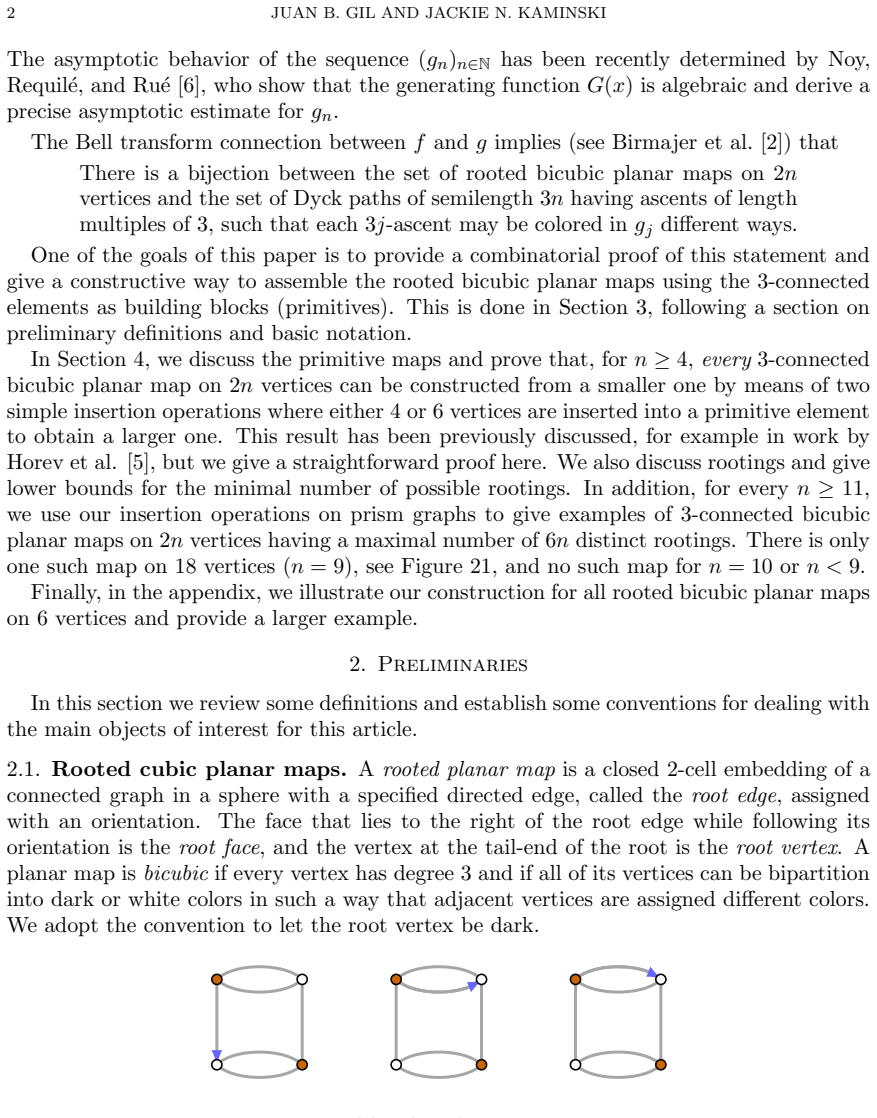









read the original abstract
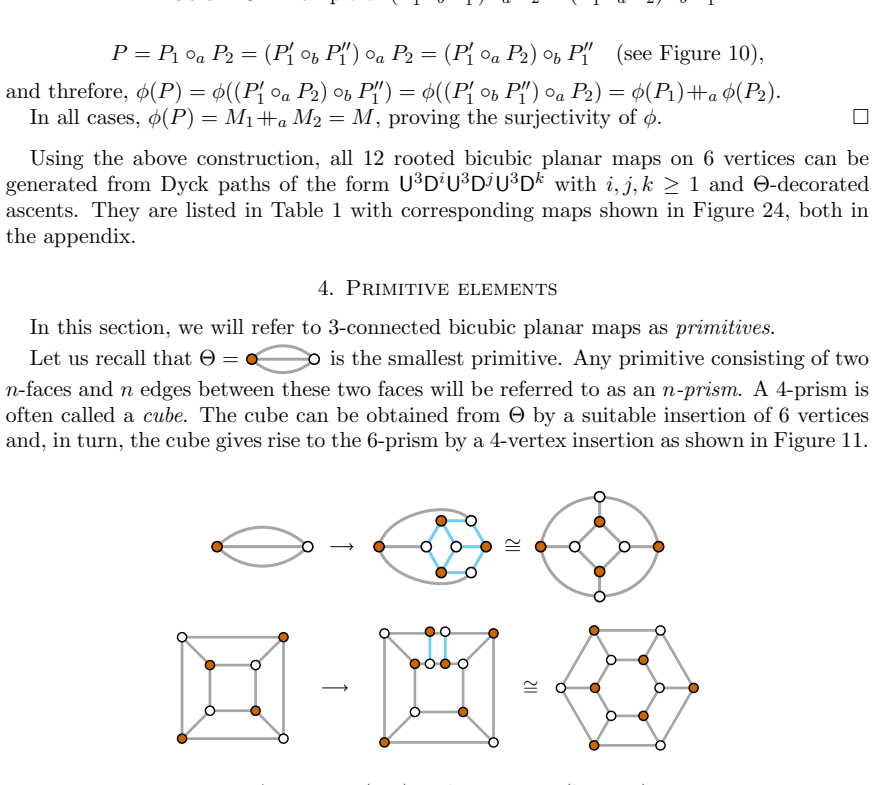
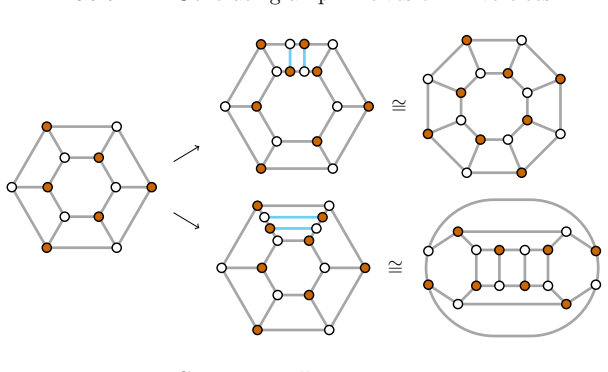
We provide a combinatorial proof of Tutte's decomposition of rooted bicubic planar maps into 3-connected components. Motivated by the framework of Bell transformations, we establish an explicit bijection between rooted bicubic planar maps on $2n$ vertices and Dyck paths of semilength $3n$ with ascents of length divisible by 3, where each $3j$-ascent is colored using one of $g_j$ colors corresponding to the rooted 3-connected bicubic maps on $2j$ vertices. Our bijection gives a constructive method for assembling all rooted bicubic planar maps from their 3-connected building blocks. We give a simple proof for the fact that every 3-connected bicubic planar map on $2n$ vertices with $n \geq 4$ can be obtained from a smaller primitive map through just two insertion operations that add either 4 or 6 vertices. Finally, we briefly discuss rootings of 3-connected bicubic maps, providing lower bounds on the minimal number of rootings and showing that prism graphs can be used in combination with our insertion operations to generate maps with the maximum of $6n$ distinct rootings for all $n \geq 11$.
Editorial analysis
A structured set of objections, weighed in public.
Referee Report
Summary. The manuscript claims to give a combinatorial proof of Tutte's decomposition of rooted bicubic planar maps into 3-connected components. It constructs an explicit bijection between rooted bicubic planar maps on 2n vertices and Dyck paths of semilength 3n whose ascents have lengths divisible by 3, with each 3j-ascent colored by one of g_j colors corresponding to the rooted 3-connected bicubic maps on 2j vertices. The paper also supplies a recursive construction showing that every 3-connected bicubic map on 2n vertices (n≥4) arises from a smaller primitive map by one of two insertion operations adding 4 or 6 vertices, and it gives lower bounds on the number of distinct rootings together with a construction achieving the maximum of 6n rootings for n≥11 using prism graphs.
Significance. If the bijection is established without circularity, the result would supply a constructive combinatorial proof of the decomposition that assembles all maps from their 3-connected blocks, extending the Bell-transformations framework. The explicit two-insertion recursion for the 3-connected case and the concrete bounds on rootings (including the prism-graph construction) are genuine strengths that could support further enumerative work and generating-function derivations.
major comments (2)
- [Bijection and coloring step] The central bijection (described after the abstract and in the section introducing the Dyck-path encoding) colors each 3j-ascent with one of g_j colors, where g_j counts rooted 3-connected bicubic maps on 2j vertices. The manuscript must explicitly demonstrate that the recursion for these g_j (via the two insertion operations adding 4 or 6 vertices) is derived and solved independently of the full Dyck-path decomposition; otherwise the argument that the bijection proves Tutte's decomposition becomes circular.
- [Recursive construction for 3-connected maps] Section on the recursive construction for 3-connected maps: the claim that every 3-connected bicubic map on 2n vertices (n≥4) is obtained from a smaller primitive map by exactly two insertion operations is load-bearing for the independence of g_j. The base cases (n=4 and the primitive maps) and the verification that this recursion does not presuppose the global Dyck-path bijection need to be stated with explicit small-n checks.
minor comments (2)
- [Abstract] The abstract refers to 'Bell transformations' without a one-sentence reminder or citation; a brief parenthetical gloss would help readers outside the immediate subfield.
- [Bijection definition] Notation for ascent blocks and the coloring function could be illustrated with a small explicit example (e.g., n=4 or n=5) to make the bijection easier to follow on first reading.
Simulated Author's Rebuttal
We thank the referee for the careful reading of the manuscript and for highlighting the importance of establishing the independence of the recursive enumeration from the Dyck-path bijection. We address each major comment below and will incorporate clarifications and explicit verifications in a revised version.
read point-by-point responses
-
Referee: [Bijection and coloring step] The central bijection (described after the abstract and in the section introducing the Dyck-path encoding) colors each 3j-ascent with one of g_j colors, where g_j counts rooted 3-connected bicubic maps on 2j vertices. The manuscript must explicitly demonstrate that the recursion for these g_j (via the two insertion operations adding 4 or 6 vertices) is derived and solved independently of the full Dyck-path decomposition; otherwise the argument that the bijection proves Tutte's decomposition becomes circular.
Authors: The recursive construction and the resulting enumeration of g_j are developed entirely within the section on 3-connected maps, using only direct combinatorial arguments on the maps themselves: every 3-connected bicubic map on 2n vertices (n≥4) is shown to arise from a unique smaller primitive map by one of the two specified insertions. This decomposition is proved by case analysis on the structure of the map (e.g., location of the root edge and the faces incident to it) without any reference to Dyck paths or the global bijection. The numbers g_j are therefore obtained as the solution to this self-contained recurrence with explicit base cases. The bijection is introduced only afterward and simply uses these independently computed g_j as the palette of colors for the 3j-ascents. We will add a short clarifying paragraph at the beginning of the bijection section that explicitly states the logical order and independence of the two parts. revision: yes
-
Referee: [Recursive construction for 3-connected maps] Section on the recursive construction for 3-connected maps: the claim that every 3-connected bicubic map on 2n vertices (n≥4) is obtained from a smaller primitive map by exactly two insertion operations is load-bearing for the independence of g_j. The base cases (n=4 and the primitive maps) and the verification that this recursion does not presuppose the global Dyck-path bijection need to be stated with explicit small-n checks.
Authors: We agree that explicit small-n verification will make the independence transparent. In the revised manuscript we will insert a new subsection (or short appendix) that lists all rooted 3-connected bicubic maps for n=4,5,6,7 together with the unique predecessor map and the insertion type used in each case. For n=4 the single primitive map is exhibited directly; for n=5 and n=6 we enumerate the maps obtained by each insertion and confirm that the resulting collection is exhaustive and matches the known small values of g_n. These checks are performed by hand on the maps and make no use of the Dyck-path encoding, thereby confirming that the recursion stands on its own. revision: yes
Circularity Check
No significant circularity: independent recursion for 3-connected blocks
full rationale
The paper supplies an explicit bijection that assembles full rooted bicubic maps from 3-connected blocks whose counts g_j are obtained via a separate, self-contained recursive construction (two insertion operations adding 4 or 6 vertices, proved directly for n≥4). This recursion is presented as an independent fact about primitive 3-connected maps and is not derived by restricting the Dyck-path decomposition being proved. The bijection therefore uses g_j as externally supplied combinatorial data rather than re-deriving it from the same mapping. No self-definitional loop, fitted prediction, or load-bearing self-citation appears in the given derivation chain.
Axiom & Free-Parameter Ledger
axioms (1)
- domain assumption Every rooted bicubic planar map admits a unique decomposition into 3-connected components along cut vertices or edges.
Reference graph
Works this paper leans on
- [1]
-
[2]
D. Birmajer, J. Gil, P. McNamara, and M. Weiner, Enumeration of colored Dyck paths via partial Bell polynomials,Lattice Path Combinatorics and Applications, G.E. Andrews, C. Krattenthaler, A. Krinik (Eds.), Springer, 2019, 155–165
work page 2019
-
[3]
V. Batagelj, An inductive definition of the class of 3-connected quadrangulations of the plane,Discrete Math.78(1989), 45–53
work page 1989
-
[4]
D. Birmajer, J. Gil, and M. Weiner, A family of Bell transformations,Discrete Math.342(2019), 38–54
work page 2019
- [5]
-
[6]
M. Noy, C. Requil´ e and J. Ru´ e,C. R. Math. Acad. Sci. Paris362(2024), 143–158
work page 2024
-
[7]
(2025), The On-Line Encyclopedia of Integer Sequences, Published electronically athttps://oeis.org/
OEIS Foundation Inc. (2025), The On-Line Encyclopedia of Integer Sequences, Published electronically athttps://oeis.org/
work page 2025
-
[8]
W. T. Tutte, A census of planar maps,Canad. J. Math.15(1963), 249–271. Email address:jgil@psu.edu Email address:jnk15@psu.edu Penn State Altoona, 3000 Ivyside Park, Altoona, PA 16601
work page 1963
discussion (0)
Sign in with ORCID, Apple, or X to comment. Anyone can read and Pith papers without signing in.