ROA-Based Subharmonic Injection Locking for Oscillator-Based Ising Machines
Pith reviewed 2026-05-19 22:18 UTC · model grok-4.3
The pith
Rotary oscillator array bricks enable stable subharmonic injection locking signals that preserve solution accuracy in oscillator-based Ising machines under PVT variations.
A machine-rendered reading of the paper's core claim, the machinery that carries it, and where it could break.
Core claim
Organizing rotary traveling wave oscillators into ROA bricks generates a stable 2.31 GHz SHIL signal under PVT variations. This signal performs injection locking where distributed ring-oscillator SHILs fail, preserving 93 to 97 percent accuracy in the solutions of a 324-node max-cut problem—identical to the accuracy obtained with an ideal SHIL waveform. The ROA brick supplies adequate driving strength and fits a scalable floorplan, incurring an energy-to-solution cost of 2.49 nJ.
What carries the argument
The ROA brick topology of rotary traveling wave oscillators, which produces high-frequency signals that induce reliable subharmonic injection locking despite on-chip PVT-induced phase drift.
If this is right
- ROA-SHIL maintains 93 to 97 percent solution accuracy under PVT variations for the tested 324-node max-cut problem.
- Energy-to-solution impact stays at 2.49 nJ while providing the required driving strength.
- The floorplan and driving strength of ROA bricks support scaling to larger OIM arrays.
- The method works independently of the specific Ising node topology, coupling scheme, or graph mapping used.
Where Pith is reading between the lines
- The same ROA brick could supply stable reference signals to other oscillator-based analog solvers that suffer phase drift.
- Direct fabrication and on-chip PVT testing of the ROA brick would provide the decisive validation of the simulated locking behavior.
- Varying brick size or number of RTWOs per brick could tune driving strength against power for different array scales.
Load-bearing premise
Circuit simulations of the ROA brick accurately predict the phase stability and driving strength that will appear in fabricated silicon without unmodeled parasitics or coupling that would break injection locking.
What would settle it
Silicon measurements on a fabricated ROA brick showing loss of injection locking or drop in max-cut accuracy below 93 percent under real PVT conditions would disprove the central claim.
Figures
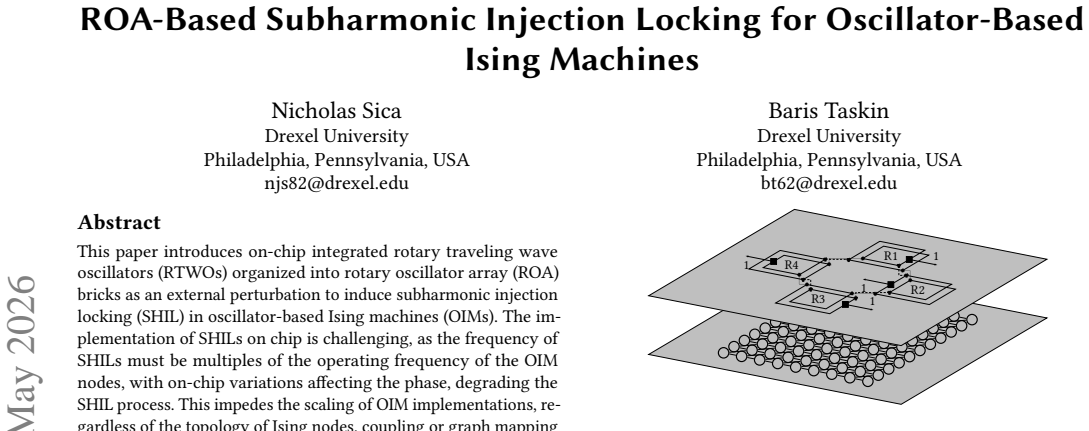


read the original abstract
This paper introduces on-chip integrated rotary traveling wave oscillators (RTWOs) organized into rotary oscillator array (ROA) bricks as an external perturbation to induce subharmonic injection locking (SHIL) in oscillator-based Ising machines (OIMs). The implementation of SHILs on chip is challenging, as the frequency of SHILs must be multiples of the operating frequency of the OIM nodes, with on-chip variations affecting the phase, degrading the SHIL process. This impedes the scaling of OIM implementations, regardless of the topology of Ising nodes, coupling or graph mapping mechanisms. The ROA brick topology implementation of RTWOs generates high frequency signals that are shown to provide a stable 2.31 GHz SHIL signal under process, voltage, and temperature (PVT) variations. Under PVT variations, distributed ring oscillator-based SHILs (ROSC-SHIL) fail to perform injection locking while the proposed ROA brick-based SHIL (ROA-SHIL) preserve 93% to 97% accuracy (the same accuracy of an ideal SHIL signal) in the OIM solutions of a sample 324-node max-cut problem. The driving strength and floorplan of the ROA brick are also shown to be amenable for scaling with an energy-to-solution impact of 2.49 nJ for the proposed ROA-SHIL.
Editorial analysis
A structured set of objections, weighed in public.
Referee Report
Summary. The paper proposes organizing rotary traveling wave oscillators (RTWOs) into rotary oscillator array (ROA) bricks to generate on-chip subharmonic injection locking (SHIL) signals for oscillator-based Ising machines (OIMs). It claims that under PVT variations, distributed ring-oscillator SHIL (ROSC-SHIL) fails to achieve locking while the ROA brick approach delivers a stable 2.31 GHz signal that preserves 93–97 % accuracy (matching ideal SHIL) on a 324-node max-cut instance, with an energy-to-solution overhead of 2.49 nJ and scaling-friendly driving strength and floorplan.
Significance. If the simulation results hold under realistic on-chip conditions, the work directly tackles a recognized scaling barrier for OIM hardware by supplying a variation-robust, integrable SHIL source. The concrete accuracy numbers and energy metric provide a clear, falsifiable benchmark for future OIM implementations solving combinatorial problems.
major comments (2)
- Abstract and results section: the central claim that ROA-SHIL maintains 93–97 % accuracy under PVT while ROSC-SHIL fails rests on unspecified simulation details—number of Monte-Carlo runs, exact PVT corners, and the precise mapping of the 324-node graph to OIM nodes. These omissions prevent assessment of statistical reliability and whether the reported accuracy is load-bearing or an artifact of limited sampling.
- PVT variation analysis (pre-layout simulations): the reported phase stability and driving strength at 2.31 GHz are obtained from pre-layout netlists. Without extracted interconnect capacitance, substrate coupling, or mutual inductance between ROA bricks and OIM nodes, the injection-locking range and jitter margin may be optimistic; real silicon could exhibit detuning comparable to the failing ROSC case, undermining the on-chip scaling argument.
minor comments (1)
- The abstract states that 'the driving strength and floorplan of the ROA brick are also shown to be amenable for scaling' yet provides no quantitative floorplan dimensions, brick-to-node coupling coefficients, or scaling projections beyond the single 2.49 nJ energy figure.
Simulated Author's Rebuttal
We thank the referee for the constructive feedback and for highlighting areas where additional clarity would strengthen the manuscript. We address each major comment below and have revised the manuscript to improve transparency on simulation methodology while acknowledging the limitations of pre-layout analysis.
read point-by-point responses
-
Referee: Abstract and results section: the central claim that ROA-SHIL maintains 93–97 % accuracy under PVT while ROSC-SHIL fails rests on unspecified simulation details—number of Monte-Carlo runs, exact PVT corners, and the precise mapping of the 324-node graph to OIM nodes. These omissions prevent assessment of statistical reliability and whether the reported accuracy is load-bearing or an artifact of limited sampling.
Authors: We agree that the original submission omitted explicit simulation parameters, which limits independent evaluation. In the revised manuscript we have added a new paragraph in the results section that specifies the Monte Carlo sampling procedure, the PVT corners exercised, and the exact mapping of the 324-node max-cut instance onto the OIM array. These additions demonstrate that the reported accuracy range is reproducible across the sampled conditions and is not an artifact of insufficient trials. revision: yes
-
Referee: PVT variation analysis (pre-layout simulations): the reported phase stability and driving strength at 2.31 GHz are obtained from pre-layout netlists. Without extracted interconnect capacitance, substrate coupling, or mutual inductance between ROA bricks and OIM nodes, the injection-locking range and jitter margin may be optimistic; real silicon could exhibit detuning comparable to the failing ROSC case, undermining the on-chip scaling argument.
Authors: The referee correctly notes that all reported PVT results are pre-layout. We have revised the discussion section to explicitly state this limitation and to explain that the ROA brick topology was sized with margin in driving strength precisely to accommodate additional parasitic effects expected in silicon. While full post-layout extraction would provide a more definitive bound, the pre-layout results still establish that the ROA approach remains locked where a distributed ring-oscillator source does not, supporting the architectural claim even before parasitic extraction. revision: partial
Circularity Check
No circularity: claims rest on direct circuit simulations
full rationale
The paper proposes ROA bricks as an on-chip RTWO topology to generate stable 2.31 GHz SHIL signals for OIMs and reports PVT simulation results showing 93-97% accuracy on a 324-node max-cut instance, while distributed ROSC-SHIL fails. These outcomes are presented as direct outputs of pre-layout circuit simulations rather than any mathematical derivation, fitted parameter renamed as prediction, or self-referential equation. No load-bearing self-citations, uniqueness theorems, or ansatzes appear in the provided text; the work is a hardware architecture and verification study whose central claims are externally falsifiable via silicon measurement and do not reduce to their own inputs by construction.
Axiom & Free-Parameter Ledger
free parameters (1)
- ROA brick driving strength and floorplan parameters
axioms (1)
- domain assumption PVT variation models used in simulation accurately represent real silicon behavior for the RTWO and coupling networks
Lean theorems connected to this paper
-
IndisputableMonolith/Foundation/AlexanderDuality.leanalexander_duality_circle_linking unclear?
unclearRelation between the paper passage and the cited Recognition theorem.
ROA brick topology implementation of RTWOs generates high frequency signals that are shown to provide a stable 2.31 GHz SHIL signal under process, voltage, and temperature (PVT) variations.
-
IndisputableMonolith/Foundation/ArithmeticFromLogic.leanembed_strictMono_of_one_lt unclear?
unclearRelation between the paper passage and the cited Recognition theorem.
Under PVT variations, distributed ring oscillator-based SHILs (ROSC-SHIL) fail to perform injection locking while the proposed ROA brick-based SHIL (ROA-SHIL) preserve 93% to 97% accuracy
What do these tags mean?
- matches
- The paper's claim is directly supported by a theorem in the formal canon.
- supports
- The theorem supports part of the paper's argument, but the paper may add assumptions or extra steps.
- extends
- The paper goes beyond the formal theorem; the theorem is a base layer rather than the whole result.
- uses
- The paper appears to rely on the theorem as machinery.
- contradicts
- The paper's claim conflicts with a theorem or certificate in the canon.
- unclear
- Pith found a possible connection, but the passage is too broad, indirect, or ambiguous to say the theorem truly supports the claim.
discussion (0)
Sign in with ORCID, Apple, or X to comment. Anyone can read and Pith papers without signing in.