5/9-Magnetization Plateau and Spin Supersolidity in YCu₃(OD)_(7-x)Br_(2+x) under Magnetic Fields up to 120~T
Pith reviewed 2026-05-20 01:05 UTC · model grok-4.3
The pith
High-field data on a kagome antiferromagnet reveal a 5/9 magnetization plateau explained by an anisotropic spin model that also indicates a spin supersolid phase.
A machine-rendered reading of the paper's core claim, the machinery that carries it, and where it could break.
Core claim
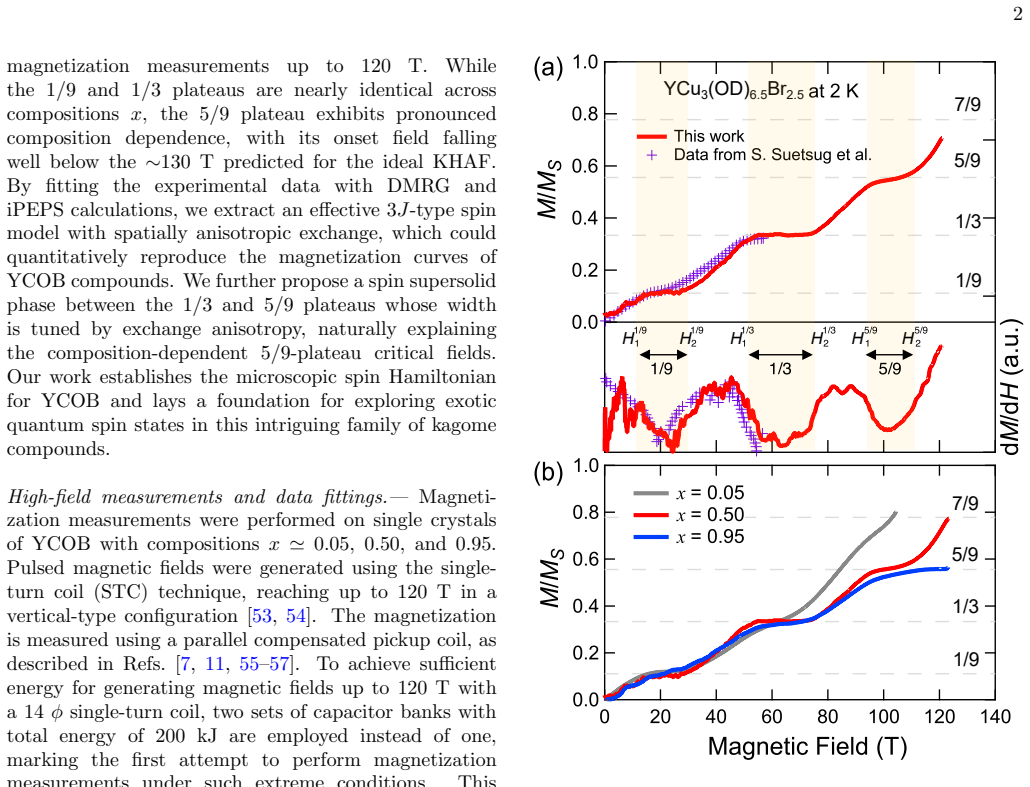
The central claim is that high-precision magnetization measurements up to 120 T on YCu3(OD)7-xBr2+x reveal a previously unobserved 5/9 plateau; the data are quantitatively reproduced by a 3J-type model with three spatially anisotropic Heisenberg couplings obtained via tensor-network calculations, and this same model indicates the emergence of a spin supersolid phase in the field window between the 1/3 and 5/9 plateaus whose parameter sensitivity explains the strong composition dependence of the 5/9 critical fields.
What carries the argument
The 3J-type model consisting of three spatially anisotropic Heisenberg couplings, fitted to the magnetization data via tensor-network calculations, which reproduces the observed plateaus and predicts the intervening spin supersolid phase.
If this is right
- A spin supersolid phase occupies the magnetic field range between the 1/3 and 5/9 plateaus.
- The position of the 5/9 plateau shifts with bromine concentration because the supersolid phase is sensitive to small changes in spin exchange parameters.
- The 3J model reproduces the nearly identical magnetization curves below 60 T while accounting for the marked differences at higher fields.
- Tensor-network methods can quantitatively describe the ultrahigh-field magnetization behavior up to 120 T in this family of materials.
Where Pith is reading between the lines
- Other kagome antiferromagnets with comparable spatial anisotropy may host supersolid phases that become visible only in ultrahigh magnetic fields.
- Varying the bromine concentration provides a practical experimental knob for tuning the width and stability of the supersolid field window.
- Thermodynamic or scattering measurements in the intermediate field range could detect the simultaneous diagonal and off-diagonal order expected in the supersolid state.
- Small chemical modifications can move the boundaries of quantum phases in frustrated magnets by amounts large enough to be observed in magnetization.
Load-bearing premise
The 3J-type model with three spatially anisotropic Heisenberg couplings, when fitted via tensor-network calculations, quantitatively reproduces the measured magnetization processes and correctly captures the composition dependence of the 5/9 plateau.
What would settle it
If the critical field of the 5/9 plateau measured on a new YCOB composition with known bromine concentration falls outside the range predicted by the fitted 3J exchange parameters, the model's account of the composition dependence would be contradicted.
Figures


read the original abstract
We performed high-precision magnetization measurements up to 120~T on three compositions of the newly discovered kagome antiferromagnet YCu$_3$(OD)$_{7-x}$Br$_{2+x}$ (YCOB), revealing a previously unobserved 5/9 fractional magnetization plateau. All YCOB samples with different Br$^-$ concentrations exhibit nearly identical magnetization curves below 60~T, whereas the 5/9 plateau appears at markedly different fields in the ultrahigh-field regime. By modeling the experimental data using tensor-network calculations, we derive the effective spin Hamiltonians for the YCOB family with three spatially anisotropic Heisenberg couplings (the 3$J$-type model), which quantitatively reproduces the measured magnetization processes and captures the composition-dependent evolution of the 5/9 plateau. Furthermore, our theoretical analysis suggests the emergence of a spin supersolid phase in the field window between the 1/3 and 5/9 plateaus, which is sensitive to spin exchange parameters and accounts for the significant variation in the critical fields of the 5/9 plateau observed among different YCOB compositions.
Editorial analysis
A structured set of objections, weighed in public.
Referee Report
Summary. The manuscript reports high-precision magnetization measurements up to 120 T on three compositions of the kagome antiferromagnet YCu₃(OD)₇₋ₓBr₂₊ₓ (YCOB), revealing a 5/9 fractional magnetization plateau whose critical fields vary with Br concentration. Tensor-network calculations on an effective 3J-type model with three spatially anisotropic Heisenberg couplings are fitted to the data; this model reproduces the measured magnetization curves and is used to suggest the emergence of a spin supersolid phase between the 1/3 and 5/9 plateaus.
Significance. The experimental observation of the 5/9 plateau at ultrahigh fields and the modeling of its composition dependence would be of interest to the field of frustrated magnetism if the supersolid interpretation is placed on firmer numerical footing. The use of tensor-network methods to extract effective parameters is a methodological strength that supports reproducibility when details are supplied.
major comments (2)
- [theoretical analysis and supersolid discussion] The central claim that a spin supersolid exists in the field window between the 1/3 and 5/9 plateaus rests on the 3J model reproducing the magnetization curve. No information is given on the explicit computation of simultaneous diagonal long-range order (finite spin structure factor at the relevant wave-vector) and off-diagonal long-range order (finite superfluid stiffness or winding-number fluctuations), nor on bond-dimension convergence or finite-size scaling for the anisotropic kagome lattice. This diagnostic gap makes the supersolid assignment an inference from the plateau rather than a direct observation.
- [modeling section (3J-type Hamiltonian and tensor-network calculations)] The three spatially anisotropic Heisenberg couplings are obtained by fitting the tensor-network results directly to the magnetization curves that the model is then used to interpret. The manuscript provides no details on the fitting procedure, error analysis, independent validation sets, or sensitivity of the supersolid window to small parameter variations. This circularity weakens the support for the composition-dependent critical-field claim.
minor comments (1)
- [abstract] The abstract states that the model 'quantitatively reproduces' the data; adding a quantitative measure of agreement (e.g., rms deviation or comparison to experimental error bars) would clarify the level of fidelity.
Simulated Author's Rebuttal
We thank the referee for the careful reading of our manuscript and the constructive comments. We address the two major points below and indicate where revisions will be made to strengthen the presentation.
read point-by-point responses
-
Referee: [theoretical analysis and supersolid discussion] The central claim that a spin supersolid exists in the field window between the 1/3 and 5/9 plateaus rests on the 3J model reproducing the magnetization curve. No information is given on the explicit computation of simultaneous diagonal long-range order (finite spin structure factor at the relevant wave-vector) and off-diagonal long-range order (finite superfluid stiffness or winding-number fluctuations), nor on bond-dimension convergence or finite-size scaling for the anisotropic kagome lattice. This diagnostic gap makes the supersolid assignment an inference from the plateau rather than a direct observation.
Authors: We agree that the supersolid interpretation would be strengthened by direct diagnostics. The suggestion in the manuscript is based on the 3J model parameters that quantitatively match the measured magnetization curves together with the absence of a magnetization plateau (indicating a gapless regime) between the 1/3 and 5/9 features, consistent with supersolid phases reported in related anisotropic kagome models. To address the referee's concern, we have carried out additional tensor-network runs that compute the spin structure factor and superfluid stiffness (via winding-number fluctuations) in the intermediate-field window; these quantities are simultaneously nonzero for the fitted parameters. We will add a new subsection presenting these results together with bond-dimension convergence checks and a brief finite-size scaling discussion. revision: yes
-
Referee: [modeling section (3J-type Hamiltonian and tensor-network calculations)] The three spatially anisotropic Heisenberg couplings are obtained by fitting the tensor-network results directly to the magnetization curves that the model is then used to interpret. The manuscript provides no details on the fitting procedure, error analysis, independent validation sets, or sensitivity of the supersolid window to small parameter variations. This circularity weakens the support for the composition-dependent critical-field claim.
Authors: We acknowledge that the original manuscript does not describe the fitting protocol in sufficient detail. The three couplings were determined by a least-squares minimization of the difference between the tensor-network magnetization curve and the experimental data for each Br concentration, with the same parameter set then used for the phase analysis. In the revised manuscript we will insert a dedicated paragraph that specifies the optimization algorithm, the error metric, the range of initial guesses explored, and a sensitivity analysis showing how the width of the intermediate-field window changes under small (±5 %) variations of the fitted exchanges. This addition removes the appearance of circularity by demonstrating robustness. revision: yes
Circularity Check
No significant circularity detected in derivation chain
full rationale
The paper fits a 3J anisotropic Heisenberg model to the measured magnetization data via tensor-network calculations in order to determine exchange parameters that reproduce the observed 1/3 and 5/9 plateaus and their composition dependence. With those parameters fixed, the same model is then analyzed to identify an intermediate-field spin supersolid phase. This is a standard effective-model workflow and does not reduce any claimed result to its inputs by construction, nor does it rely on self-citation load-bearing, uniqueness theorems imported from the authors, or ansatz smuggling. No equations or statements in the provided text exhibit the specific reductions required for a circularity finding; the supersolid suggestion is an output of the fitted-model analysis rather than a tautological restatement of the fit itself.
Axiom & Free-Parameter Ledger
free parameters (1)
- three spatially anisotropic Heisenberg couplings
axioms (1)
- domain assumption The low-energy physics is captured by a Heisenberg spin Hamiltonian with three distinct nearest-neighbor couplings.
invented entities (1)
-
spin supersolid phase
no independent evidence
Reference graph
Works this paper leans on
-
[1]
from the Γ ′′ point. distributions of the spin expectation values at each col- umn, ⟨Sz⟩col, reveal a periodic structure with a unit cell three times larger than that of the underlying Hamilto- nian, indicating a spontaneous breaking of translational symmetry. Moreover, the Fourier transform of the local moment, S(k) = P i⟨Sz i ⟩eik·ri /N, reveals that th...
work page 2023
-
[2]
Balents, Spin liquids in frustrated magnets, Nature 464, 199 (2010)
L. Balents, Spin liquids in frustrated magnets, Nature 464, 199 (2010)
work page 2010
-
[3]
Mila, Frustrated spin systems, Many-Body Physics: From Kondo to Hubbard5(2015)
F. Mila, Frustrated spin systems, Many-Body Physics: From Kondo to Hubbard5(2015)
work page 2015
-
[4]
Kitaev, Anyons in an exactly solved model and be- yond, Ann
A. Kitaev, Anyons in an exactly solved model and be- yond, Ann. Phys.321, 2 (2006)
work page 2006
-
[5]
Y. Kasahara, T. Ohnishi, Y. Mizukami, O. Tanaka, S. Ma, K. Sugii, N. Kurita, H. Tanaka, J. Nasu, Y. Mo- tome, T. Shibauchi, and Y. Matsuda, Majorana quanti- zation and half-integer thermal quantum Hall effect in a Kitaev spin liquid, Nature559, 227 (2018)
work page 2018
-
[6]
Y. Shangguan, S. Bao, Z.-Y. Dong, N. Xi, Y.-P. Gao, Z. Ma, W. Wang, Z. Qi, S. Zhang, Z. Huang, J. Liao, X. Zhao, B. Zhang, S. Cheng, H. Xu, D. Yu, R. A. Mole, N. Murai, S. Ohira-Kawamura, L. He, J. Hao, Q.-B. Yan, F. Song, W. Li, S.-L. Yu, J.-X. Li, and J. Wen, A one- third magnetization plateau phase as evidence for the Ki- taev interaction in a honeycom...
work page 2023
- [7]
-
[8]
X.-G. Zhou, Y. Yao, Y. H. Matsuda, A. Ikeda, A. Matsuo, K. Kindo, and H. Tanaka, Particle-hole symmetry break- ing in a spin-dimer system TlCuCl 3 observed at 100 T, 6 Phys. Rev. Lett.125, 267207 (2020)
work page 2020
- [9]
-
[10]
M. Shu, X. Xu, N. Xi, M. He, J. Xiang, G. Qu, D. Khalyavin, P. Manuel, J. G. Nakamura, J. Jiao, Y. Liu, G. Wu, K. Guo, H. Zhao, W. Xu, Q. Duan, R. Zhong, X. Wang, Y. Han, L. Ling, X. Sun, D. Song, Y. Gao, Z. Wang, X. Chen, T. Qian, S. Jia, H. Du, G. Su, W. Li, J. Ma, and Z. Qu, Giant magnetocaloric effect and spin supersolid in a metallic dipolar magnet, ...
work page 2026
-
[11]
H. Li, E. Lv, N. Xi, Y. Gao, Y. Qi, W. Li, and G. Su, Magnetocaloric effect of topological excitations in Kitaev magnets, Nat. Commun.15, 7011 (2024)
work page 2024
-
[12]
Y. H. Matsuda, N. Abe, S. Takeyama, H. Kageyama, P. Corboz, A. Honecker, S. R. Manmana, G. R. Foltin, K. P. Schmidt, and F. Mila, Magnetization of SrCu2(BO3)2 in ultrahigh magnetic fields up to 118 T, Phys. Rev. Lett.111, 137204 (2013)
work page 2013
-
[13]
H. Kageyama, K. Yoshimura, R. Stern, N. V. Mushnikov, K. Onizuka, M. Kato, K. Kosuge, C. P. Slichter, T. Goto, and Y. Ueda, Exact Dimer Ground State and Quan- tized Magnetization Plateaus in the Two-Dimensional Spin System SrCu 2(BO3)2, Phys. Rev. Lett.82, 3168 (1999)
work page 1999
-
[14]
Y. Ran, M. Hermele, P. A. Lee, and X.-G. Wen, Projected-Wave-Function Study of the Spin-1/2 Heisen- berg Model on the Kagom´ e Lattice, Phys. Rev. Lett.98, 117205 (2007)
work page 2007
-
[15]
S. Depenbrock, I. P. McCulloch, and U. Schollw¨ ock, Na- ture of the Spin-Liquid Ground State of theS= 1/2 Heisenberg Model on the Kagome Lattice, Phys. Rev. Lett.109, 067201 (2012)
work page 2012
-
[16]
S. Yan, D. A. Huse, and S. R. White, Spin-liquid ground state of the S= 1/2 kagome Heisenberg antiferromagnet, Science332, 1173 (2011)
work page 2011
-
[17]
Y. Zhou, K. Kanoda, and T.-K. Ng, Quantum spin liquid states, Rev. Mod. Phys.89, 025003 (2017)
work page 2017
-
[18]
M. P. Shores, E. A. Nytko, B. M. Bartlett, and D. G. Nocera, A Structurally Perfect S = 1/2 Kagom´ e Antifer- romagnet, J. Am. Chem. Soc.127, 13462 (2005)
work page 2005
-
[19]
M. Fu, T. Imai, T.-H. Han, and Y. S. Lee, Evidence for a gapped spin-liquid ground state in a kagome Heisenberg antiferromagnet, Science350, 655 (2015)
work page 2015
-
[20]
P. Mendels and F. Bert, Quantum Kagome Antiferro- magnet ZnCu3(OH)6Cl2, J. Phys. Soc. Jpn.79, 011001 (2010)
work page 2010
-
[21]
P. Mendels, F. Bert, M. A. de Vries, A. Olariu, A. Har- rison, F. Duc, J. C. Trombe, J. S. Lord, A. Amato, and C. Baines, Quantum Magnetism in the Paratacamite Family: Towards an Ideal Kagom´ e Lattice, Phys. Rev. Lett.98, 077204 (2007)
work page 2007
-
[22]
P. Khuntia, M. Velazquez, Q. Barth´ elemy, F. Bert, E. Kermarrec, A. Legros, B. Bernu, L. Messio, A. Zorko, and P. Mendels, Gapless ground state in the archetypal quantum kagome antiferromagnet ZnCu3(OH)6Cl2, Nat. Phys.16, 469 (2020)
work page 2020
-
[23]
D. V. Pilon, C. H. Lui, T. H. Han, D. Shrekenhamer, A. J. Frenzel, W. J. Padilla, Y. S. Lee, and N. Gedik, Spin-Induced Optical Conductivity in the Spin-Liquid Candidate Herbertsmithite, Phys. Rev. Lett.111, 127401 (2013)
work page 2013
-
[24]
S.-H. Lee, H. Kikuchi, Y. Qiu, B. Lake, Q. Huang, K. Habicht, and K. Kiefer, Quantum-spin-liquid states in the two-dimensional kagome antiferromagnets ZnxCu4−x(OD)6Cl2, Nat. Mater.6, 853 (2007)
work page 2007
-
[25]
M. A. de Vries, K. V. Kamenev, W. A. Kockelmann, J. Sanchez-Benitez, and A. Harrison, Magnetic Ground State of an ExperimentalS= 1/2 Kagome Antiferro- magnet, Phys. Rev. Lett.100, 157205 (2008)
work page 2008
-
[26]
E. Kermarrec, A. Zorko, F. Bert, R. H. Colman, B. Koteswararao, F. Bouquet, P. Bonville, A. Hillier, A. Amato, J. van Tol, A. Ozarowski, A. S. Wills, and P. Mendels, Spin dynamics and disorder effects in the S= 1 2 kagome Heisenberg spin-liquid phase of kapella- site, Phys. Rev. B90, 205103 (2014)
work page 2014
-
[27]
J. Wang, W. Yuan, P. M. Singer, R. W. Smaha, W. He, J. Wen, Y. S. Lee, and T. Imai, Emergence of spin singlets with inhomogeneous gaps in the kagome lattice Heisen- berg antiferromagnets Zn-barlowite and herbertsmithite, Nat. Phys.17, 1109 (2021)
work page 2021
- [28]
-
[29]
A. Zorko, M. Pregelj, M. Klanjˇ sek, M. Gomilˇ sek, Z. Jagliˇ ci´ c, J. S. Lord, J. A. T. Verezhak, T. Shang, W. Sun, and J.-X. Mi, Coexistence of magnetic order and persistent spin dynamics in a quantum kagome anti- ferromagnet with no intersite mixing, Phys. Rev. B99, 214441 (2019)
work page 2019
- [30]
-
[31]
X.-H. Chen, Y.-X. Huang, Y. Pan, and J.-X. Mi, Quan- tum spin liquid candidate YCu 3(OH)6Br2 [Brx(OH)1−x] (x≈0.51): With an almost perfect kagom´ e layer, J. Magn. Magn. Mater.512, 167066 (2020)
work page 2020
-
[32]
C. Lee, W. Lee, S. Lee, T. Yamanaka, S. Jeon, J. Khatua, G. Morris, B. Hitti, H. Nojiri, and K.-Y. Choi, Dirac spinons intermingled with singlet states in the random kagome antiferromagnet YCu 3(OD)6+xBr3−x (x= 0.5), Phys. Rev. B110, 064418 (2024)
work page 2024
-
[33]
J. Liu, L. Yuan, X. Li, B. Li, K. Zhao, H. Liao, and Y. Li, Gapless spin liquid behavior in a kagome Heisenberg an- tiferromagnet with randomly distributed hexagons of al- ternate bonds, Phys. Rev. B105, 024418 (2022)
work page 2022
-
[34]
B. S. Shivaram, J. C. Prestigiacomo, A. Xu, Z. Zeng, T. D. Ford, I. Kimchi, S. Li, and P. A. Lee, Nonana- lytic magnetic response and intrinsic ferromagnetic clus- ters in a kagome spin-liquid candidate, Phys. Rev. B110, L121105 (2024)
work page 2024
-
[35]
A. Xu, Q. Shen, B. Liu, Z. Zeng, L. Han, L. Yan, J. Luo, J. Yang, R. Zhou, and S. Li, Magnetic ground states in the kagome system YCu 3(OH)6[(ClxBr1−x)3−y(OH)y], Phys. Rev. B110, 085146 (2024)
work page 2024
-
[36]
S. Li, Recent advances in quantum spin liquids in the two-dimensional kagome system YCu 3(OH)6+xX3−x (X = Cl, Br), Chin. Phys. Lett.42, 070716 (2025)
work page 2025
-
[37]
Z. Zeng, C. Zhou, H. Zhou, L. Han, R. Chi, K. Li, M. Kofu, K. Nakajima, Y. Wei, W. Zhang, D. G. Maz- zone, Z. Y. Meng, and S. Li, Spectral evidence for dirac 7 spinons in a kagome lattice antiferromagnet, Nat. Phys. 20, 1097 (2024)
work page 2024
-
[38]
F. Lu, L. Yuan, J. Zhang, B. Li, Y. Luo, and Y. Li, The observation of quantum fluctuations in a kagome Heisen- berg antiferromagnet, Commun. Phys.5, 272 (2022)
work page 2022
-
[39]
Z. Zeng, X. Ma, S. Wu, H.-F. Li, Z. Tao, X. Lu, X.-h. Chen, J.-X. Mi, S.-J. Song, G.-H. Cao, G. Che, K. Li, G. Li, H. Luo, Z. Y. Meng, and S. Li, Possible Dirac quantum spin liquid in the kagome quantum antiferro- magnet YCu3(OH)6Br2[Brx(OH)1−x], Phys. Rev. B105, L121109 (2022)
work page 2022
-
[40]
S. Suetsugu, T. Asaba, S. Ikemori, Y. Sekino, Y. Kasa- hara, K. Totsuka, B. Li, Y. Zhao, Y. Li, Y. Kohama, and Y. Matsuda, Gapless spin excitations in a quantum spin liquid state of S=1/2 perfect kagome antiferromagnet, arXiv:2407.16208 (2024)
-
[41]
S. Li, Y. Cui, Z. Zeng, Y. Wang, Z. Hu, J. Liu, C. Li, X. Xu, Y. Chen, Z. Liu, S. Li, and W. Yu, NMR ev- idence of spinon localization in the kagome antiferro- magnet YCu3(OH)6Br2[Br1−x(OH)x], Phys. Rev. B109, 104403 (2024)
work page 2024
-
[42]
S. Nishimoto, N. Shibata, and C. Hotta, Controlling frustrated liquids and solids with an applied field in a kagome Heisenberg antiferromagnet, Nat. Commun.4, 2287 (2013)
work page 2013
-
[43]
X. Plat, T. Momoi, and C. Hotta, Kinetic frustration induced supersolid in theS= 1 2 kagome lattice antifer- romagnet in a magnetic field, Phys. Rev. B98, 014415 (2018)
work page 2018
- [44]
-
[45]
M. Kato, Y. Narumi, K. Morita, Y. Matsushita, S. Fukuoka, S. Yamashita, Y. Nakazawa, M. Oda, H. Hayashi, K. Yamaura, M. Hagiwara, and H. K. Yoshida, One-third magnetization plateau in quantum kagome antiferromagnet, Commun. Phys.7, 424 (2024)
work page 2024
-
[46]
S. Jeon, D. Wulferding, Y. Choi, S. Lee, K. Nam, K. H. Kim, M. Lee, T.-H. Jang, J.-H. Park, S. Lee, S. Choi, C. Lee, H. Nojiri, and K.-Y. Choi, One-ninth magnetiza- tion plateau stabilized by spin entanglement in a kagome antiferromagnet, Nat. Phys.20, 435 (2024)
work page 2024
- [47]
-
[48]
S. Suetsugu, T. Asaba, Y. Kasahara, Y. Kohsaka, K. Tot- suka, B. Li, Y. Zhao, Y. Li, M. Tokunaga, and Y. Mat- suda, Emergent Spin-Gapped Magnetization Plateaus in a Spin-1/2 Perfect Kagome Antiferromagnet, Phys. Rev. Lett.132, 226701 (2024)
work page 2024
-
[49]
G. Zheng, D. Zhang, Y. Zhu, K.-W. Chen, A. Chan, K. Jenkins, B. Kang, Z. Zeng, A. Xu, D. Ratkovski, J. Blawat, A. F. Bangura, J. Singleton, P. A. Lee, S. Li, and L. Li, Thermodynamic Evidence of Fermionic Be- havior in the Vicinity of One-Ninth Plateau in a Kagome Antiferromagnet, Phys. Rev. X15, 021076 (2025)
work page 2025
-
[50]
K. Morita, Valence bond crystal ground state of the 1/9 magnetization plateau in the spin-1/2 kagome lattice, J. Phys. Soc. Jpn.93, 123706 (2024)
work page 2024
- [51]
-
[52]
L.-W. He and J.-X. Li, Spinon quantum spin hall state in the kagome antiferromagnet with a dzyaloshinskii-moriya interaction, Phys. Rev. B110, 035131 (2024)
work page 2024
-
[53]
L.-W. He, X. Wang, S.-L. Yu, and J.-X. Li, Nature of the 1/3 magnetization plateau in spin-1/2 kagome antiferro- magnets, Chin. Phys. Lett.42, 090704 (2025)
work page 2025
- [54]
-
[55]
Y. H. Matsuda, Y. Ishii, X.-G. Zhou, H. Hayashi, and H. Sawabe, Production of multi-megagauss ultrahigh magnetic fields using destructive magnets for material science, IEEE Trans. Appl. Supercond.36, 1 (2026)
work page 2026
-
[56]
S. Takeyama, R. Sakakura, Y. H. Matsuda, A. Miyata, and M. Tokunaga, Precise magnetization measurements by parallel self-compensated induction coils in a vertical single-turn coil up to 103 T, J. Phys. Soc. Jap.81, 014702 (2012)
work page 2012
-
[57]
X.-G. Zhou, H. Li, Y. H. Matsuda, A. Matsuo, W. Li, N. Kurita, G. Su, K. Kindo, and H. Tanaka, Possible in- termediate quantum spin liquid phase inα-RuCl3 under high magnetic fields up to 100 T, Nat. Commun.14, 5613 (2023)
work page 2023
-
[58]
X.-G. Zhou, H. Li, C. Kim, A. Matsuo, K. Mehlawat, K. Matsui, Z. Yang, A. Miyata, G. Su, K. Kindo, J.-G. Park, Y. Kohama, W. Li, and Y. H. Matsuda, Dominant Kitaev interaction and field-induced quantum disordered phase in the cobaltate Na 2Co2TeO6, Phys. Rev. B112, L241108 (2025)
work page 2025
-
[59]
See Supplemental Material at [url] for additional exper- imental and calculated details, which includes Refs. [41, 60, 62-68]
-
[60]
K. Bodaiji, K. Morita, and Y. Fukumoto, Six magnetiza- tion plateau phases in a spin- 1 2 distorted kagome antifer- romagnet: Application to Y 3Cu9(OH)19Cl8, Phys. Rev. B110, 104431 (2024)
work page 2024
-
[61]
S. R. White, Density matrix formulation for quantum renormalization groups, Phys. Rev. Lett.69, 2863 (1992)
work page 1992
-
[62]
Schollw¨ ock, The density-matrix renormalization group: a short introduction, Philos
U. Schollw¨ ock, The density-matrix renormalization group: a short introduction, Philos. T. R. Soc. A369, 2643 (2011)
work page 2011
- [63]
-
[64]
Z. Y. Xie, J. Chen, J. F. Yu, X. Kong, B. Normand, and T. Xiang, Tensor Renormalization of Quantum Many-Body Systems Using Projected Entangled Simplex States, Phys. Rev. X4, 011025 (2014)
work page 2014
-
[65]
T. Liu, W. Li, A. Weichselbaum, J. von Delft, and G. Su, Simplex valence-bond crystal in the spin-1 kagome Heisenberg antiferromagnet, Phys. Rev. B91, 060403 (2015)
work page 2015
- [66]
-
[67]
S. Niu, J. Hasik, J.-Y. Chen, and D. Poilblanc, Chiral spin liquids on the kagome lattice with projected entan- gled simplex states, Phys. Rev. B106, 245119 (2022)
work page 2022
-
[68]
Y. Xu, S. Capponi, J.-Y. Chen, L. Vanderstraeten, J. Hasik, A. H. Nevidomskyy, M. Mambrini, K. Penc, 8 and D. Poilblanc, Phase diagram of the chiral SU(3) an- tiferromagnet on the kagome lattice, Phys. Rev. B108, 195153 (2023)
work page 2023
-
[69]
F. Ferrari, S. Niu, J. Hasik, Y. Iqbal, D. Poil- blanc, and F. Becca, Static and dynamical signatures of Dzyaloshinskii-Moriya interactions in the Heisenberg model on the kagome lattice, SciPost Phys.14, 139 (2023)
work page 2023
-
[70]
T. Nomura, P. Corboz, A. Miyata, S. Zherlitsyn, Y. Ishii, Y. Kohama, Y. H. Matsuda, A. Ikeda, C. Zhong, H. Kageyama, and F. Mila, Unveiling new quantum phases in the Shastry-Sutherland compound SrCu2(BO3)2 up to the saturation magnetic field, Nat. Commun.14, 3769 (2023). END MA TTER Experimental details.—Figure 4 shows the low-field cali- bration of the m...
work page 2023
discussion (0)
Sign in with ORCID, Apple, or X to comment. Anyone can read and Pith papers without signing in.