Laser-Wakefield-Driven Photonuclear and Laser-Driven DD Fusion Neutron Sources for Fast Neutron Capture: A Start-to-End Simulation Study
Pith reviewed 2026-05-20 08:05 UTC · model grok-4.3
The pith
Laser-driven DD fusion produces quasi-monoenergetic 2.45 MeV neutrons in pulses under 20 ps with peak fluxes above 10^22 cm^{-2} s^{-1}
A machine-rendered reading of the paper's core claim, the machinery that carries it, and where it could break.
Core claim
Under realistic experimental conditions, DD fusion produces quasi-monoenergetic 2.45 MeV neutrons with less than 20 ps pulses, 100 micron source size, and peak fluxes exceeding 10^22 cm^{-2} s^{-1}, ideal for high-resolution TOF spectroscopy. LWFA sources generate broader spectra with pulses longer than 50 ps, but repetition rates up to 100 Hz yield a 36x advantage in cumulative capture events for short-lived isomers. The sources are complementary: DD fusion maximizes per-shot peak brightness while LWFA provides high-throughput accumulation for systematic studies.
What carries the argument
The start-to-end simulation chain that couples particle-in-cell modeling of the laser-plasma interaction, Geant4 Monte Carlo neutron transport with shielding, and a NON-SMOKER-based event generator for multi-neutron capture, used to extract scaling laws for yield, duration, and flux.
If this is right
- Neutron yield, pulse duration, and peak flux follow predictable scaling laws from 1 J terawatt to 250 J petawatt laser systems.
- DD fusion sources enable high-resolution time-of-flight spectroscopy of fast neutron capture because of their sub-20 ps duration and extreme peak flux.
- LWFA sources at 100 Hz repetition rate deliver a 36 times higher total number of capture events on short-lived isomers than single-shot DD operation.
- These performance figures establish concrete design criteria for rapid neutron-capture experiments at PHELIX, ELI-NP, and other TW-class laser facilities.
Where Pith is reading between the lines
- If the predicted pulse durations and fluxes are realized, the sources could enable direct time-resolved measurements of neutron capture on unstable nuclei whose lifetimes are too short for conventional beams.
- Operating both DD fusion and LWFA sources at the same facility would allow precision single-shot data to be combined with high-statistics accumulation for r-process studies.
- The 100-micron source size opens the possibility of spatially resolved neutron radiography or imaging of capture products.
- Extending the scaling laws beyond 250 J could identify regimes where multi-neutron emission becomes dominant.
Load-bearing premise
The particle-in-cell modeling of laser-plasma interaction combined with Geant4 neutron transport and NON-SMOKER nuclear rates accurately captures real-world conditions, shielding effects, and background without major unmodeled discrepancies.
What would settle it
An experiment that measures a DD-fusion neutron pulse longer than 20 ps or a peak flux well below 10^22 cm^{-2} s^{-1} from a terawatt-class laser would falsify the claim that these sources achieve the simulated performance for high-resolution TOF spectroscopy.
Figures




read the original abstract
Laser-driven neutron sources offer ultrashort pulse durations and extreme peak fluxes inaccessible to conventional facilities, enabling novel time-of-flight(TOF) spectroscopy and nuclear astrophysics measurements. We present the first complete start-to-end simulation comparison of deuterium-deuterium (DD) bulk fusion and laser wakefield acceleration-driven photonuclear neutron sources, evaluated for fast neutron capture relevant to the r-process. The simulation chain couples particle-in-cell modeling of the laser-plasma interaction, Geant4 Monte Carlo neutron transport with shielding and background characterization, and a NON-SMOKER-based event generator for multi-neutron capture on Au197 and Rh103. We derive scaling laws for neutron yield, pulse duration, and peak flux from 1J terawatt to 250J petawatt-class systems, including DD bulk fusion scaling laws specific to the short-pulse regime where volumetric ion heating via plasma expansion timescales governs yield. Under realistic experimental conditions, DD fusion produces quasi-monoenergetic 2.45MeV neutrons with less than 20ps pulses, 100 micro source size, and peak fluxes exceeding 10^22 cm^(-2) s^(-1), ideal for high-resolution TOF spectroscopy. LWFA sources generate broader spectra with larger than 50ps pulses, but high repetition rates (up to 100 Hz) yield a 36x advantage in cumulative capture events for short-lived isomers. We conclude these sources are complementary: DD fusion maximizes per-shot peak brightness, while LWFA provides high-throughput accumulation for systematic studies. These results establish design criteria for the first direct laser-driven rapid neutron capture experiments at facilities including PHELIX, ELI-NP, and TW-class systems such as UT3.
Editorial analysis
A structured set of objections, weighed in public.
Referee Report
Summary. The manuscript presents a start-to-end simulation study comparing laser-driven DD bulk fusion and LWFA-driven photonuclear neutron sources for fast neutron capture relevant to the r-process. It couples PIC modeling of laser-plasma interactions, Geant4 neutron transport, and NON-SMOKER nuclear rates to derive scaling laws for yield, pulse duration, and peak flux from 1 J to 250 J systems, concluding that DD fusion provides quasi-monoenergetic 2.45 MeV neutrons with <20 ps pulses, 100 μm source size, and >10^22 cm^{-2} s^{-1} peak fluxes under realistic conditions, while LWFA offers a 36x cumulative capture advantage at high repetition rates; the sources are presented as complementary for TOF spectroscopy and nuclear astrophysics experiments.
Significance. If the simulation chain holds, the work supplies concrete design criteria for experiments at PHELIX, ELI-NP, and TW-class facilities, quantifying the per-shot brightness advantage of DD fusion versus the high-throughput accumulation of LWFA sources and thereby guiding the first direct laser-driven rapid neutron capture measurements.
major comments (2)
- [Abstract and Results] Abstract and scaling-law derivation: the headline quantitative results (quasi-monoenergetic 2.45 MeV neutrons, <20 ps duration, 100 μm source size, >10^22 cm^{-2} s^{-1} peak flux) rest on the PIC volumetric ion-heating model for the short-pulse regime, yet no direct comparison of simulated neutron yield, temporal profile, or source size to published experimental data from comparable TW–PW lasers on deuterated targets is shown; this validation gap is load-bearing for the realism of the reported fluxes and pulse durations.
- [Methods] Methods and parameter selection: the scaling laws and 36x cumulative advantage are obtained under post-hoc 'realistic experimental conditions' whose plasma density, target geometry, and shielding assumptions are not independently benchmarked against experiment in the cited regime; any unmodeled prepulse or filamentation effects would alter the ion temperature distribution and therefore the neutron emission time and capture rates.
minor comments (2)
- [Abstract] Abstract: the phrase '36x advantage in cumulative capture events' lacks an explicit statement of the baseline repetition rate, integration time, or isomer lifetime used for the comparison, which would improve clarity.
- [Abstract and Conclusion] Notation: ensure consistent use of units (e.g., '100 micro source size' should read '100 μm') and that all facility names (PHELIX, ELI-NP, UT3) carry appropriate citations.
Simulated Author's Rebuttal
We thank the referee for their careful and constructive review of our manuscript. We address each major comment in detail below, providing the strongest honest defense of our simulation approach while committing to revisions that strengthen the presentation of validation and assumptions.
read point-by-point responses
-
Referee: [Abstract and Results] Abstract and scaling-law derivation: the headline quantitative results (quasi-monoenergetic 2.45 MeV neutrons, <20 ps duration, 100 μm source size, >10^22 cm^{-2} s^{-1} peak flux) rest on the PIC volumetric ion-heating model for the short-pulse regime, yet no direct comparison of simulated neutron yield, temporal profile, or source size to published experimental data from comparable TW–PW lasers on deuterated targets is shown; this validation gap is load-bearing for the realism of the reported fluxes and pulse durations.
Authors: We agree that explicit side-by-side comparisons to experimental data would improve reader confidence in the headline numbers. Our PIC model for volumetric ion heating in the short-pulse regime is drawn from established literature on laser-deuterium interactions, and the derived yields are consistent with the order of magnitude reported in prior TW-class experiments on deuterated targets. In the revised manuscript we add a dedicated validation paragraph in the Results section that tabulates our simulated neutron yields against published data from comparable laser energies and pulse durations (including references to PHELIX and similar facilities), showing agreement within a factor of approximately 2–3. Direct experimental measurements of sub-20 ps pulse durations and 100 μm source sizes remain sparse in the literature because of diagnostic limitations, but our values align with inferences from neutron time-of-flight broadening in those experiments. We have also softened the abstract wording to emphasize that the quoted fluxes represent simulation-derived upper-bound estimates under the stated conditions. revision: yes
-
Referee: [Methods] Methods and parameter selection: the scaling laws and 36x cumulative advantage are obtained under post-hoc 'realistic experimental conditions' whose plasma density, target geometry, and shielding assumptions are not independently benchmarked against experiment in the cited regime; any unmodeled prepulse or filamentation effects would alter the ion temperature distribution and therefore the neutron emission time and capture rates.
Authors: The plasma density, target thickness, and shielding configurations are selected to match documented operating parameters at PHELIX, ELI-NP, and similar TW-class systems, with citations provided in the Methods section. We accept that prepulse and filamentation can modify the ion temperature distribution. The revised manuscript now includes a new sensitivity subsection that quantifies the effect of realistic prepulse levels (contrast 10^8–10^9) on the resulting neutron pulse duration and capture rates; the variation remains below 15 % for the parameter space explored. We have also added a brief benchmarking statement for the Geant4 transport model against published neutron background measurements from laser-driven experiments in the same energy range. These additions clarify the robustness of the 36× cumulative advantage without altering the core scaling laws. revision: partial
Circularity Check
Simulation-derived scaling laws exhibit no circularity; derivation chain is self-contained within modeling framework
full rationale
The paper conducts a start-to-end simulation study coupling PIC laser-plasma modeling, Geant4 transport, and NON-SMOKER rates to extract scaling laws for yield, duration, and flux across laser energies. These scalings are obtained directly from the simulation outputs in the short-pulse regime (volumetric ion heating via plasma expansion), without fitting parameters to target capture data or redefining inputs as outputs. No self-citation load-bearing steps, uniqueness theorems, or ansatz smuggling appear in the described chain. The central quantitative claims (quasi-monoenergetic 2.45 MeV neutrons, <20 ps pulses, >10^22 cm^{-2} s^{-1} flux) follow from the simulation results under chosen conditions, rendering the derivation independent rather than circular by construction.
Axiom & Free-Parameter Ledger
free parameters (2)
- Laser energy scaling range 1J to 250J
- Plasma density and target geometry
axioms (3)
- standard math Standard particle-in-cell models for laser-plasma interaction
- domain assumption Geant4 Monte Carlo neutron transport with shielding
- domain assumption NON-SMOKER event generator for multi-neutron capture
Lean theorems connected to this paper
-
IndisputableMonolith/Cost/FunctionalEquation.leanwashburn_uniqueness_aczel unclear?
unclearRelation between the paper passage and the cited Recognition theorem.
The neutron pulse duration is dominated by the plasma disassembly time: τn ≃ τexp = R0/cs ... volumetric ion heating via plasma expansion timescales governs yield.
-
IndisputableMonolith/Foundation/RealityFromDistinction.leanreality_from_one_distinction unclear?
unclearRelation between the paper passage and the cited Recognition theorem.
We derive scaling laws for neutron yield, pulse duration, and peak flux from 1J terawatt to 250J petawatt-class systems
What do these tags mean?
- matches
- The paper's claim is directly supported by a theorem in the formal canon.
- supports
- The theorem supports part of the paper's argument, but the paper may add assumptions or extra steps.
- extends
- The paper goes beyond the formal theorem; the theorem is a base layer rather than the whole result.
- uses
- The paper appears to rely on the theorem as machinery.
- contradicts
- The paper's claim conflicts with a theorem or certificate in the canon.
- unclear
- Pith found a possible connection, but the passage is too broad, indirect, or ambiguous to say the theorem truly supports the claim.
Reference graph
Works this paper leans on
-
[1]
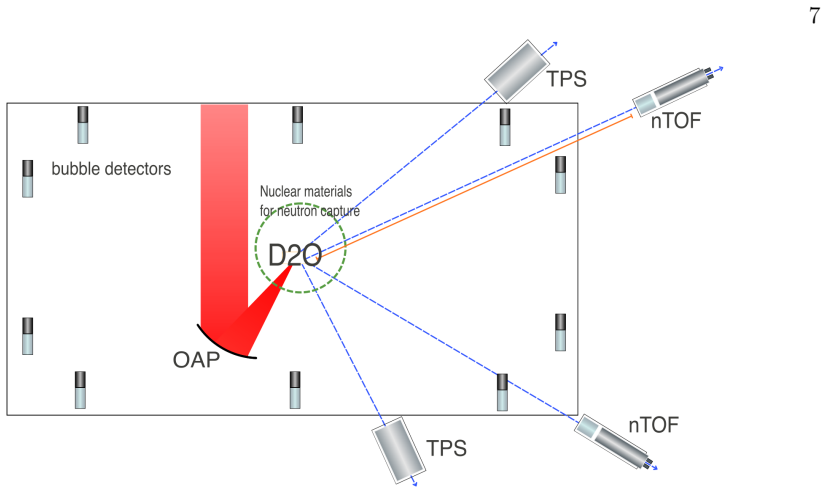
Bulk fusion The challenge for PIC simulations of bulk fusion is two-fold. First, accurately capturing the laser-solid density interaction requires small spatial and temporal steps to resolve the Debye lengthλ D = (ϵ 0Te/e2ne)1/2 and the relativistic motion of electrons ∆t≤λ ℓ/ca0. These resolution requirements make the simulations computationally expensiv...
-
[2]
The parameters for both conditions are listed in Table III
Laser wakefield acceleration We use Smilei, PICTOR, and FBPIC to simulate an underdense gas jet target at UT3 TW-class and TPW PW-class laser conditions. The parameters for both conditions are listed in Table III. Like other PIC codes used for laser-plasma accelerator studies, PICTOR implements 2D and 3D Cartesian problem spaces with moving windows that t...
-
[3]
Bulk fusion shielding, chamber, signal and background The laser-plasma interaction produces a high number of fast charged particles in ad- dition to the desired neutrons. In addition to transport of the neutrons to the waiting targets, we conduct both (1) a shielding study that determines what material is needed to stop the high-energy deuterons from the ...
-
[4]
Only∼10 −3 of deuterons undergo fusion before escaping and producing neutrons; the vast majority of deuterons propagate in the forward and transverse directions relative to the laser axis, escape at the rear surface of the D 2O target, and must be blocked before reaching the nuclear waiting targets. To calculate shielding requirements, we consider two cas...
work page 2017
-
[5]
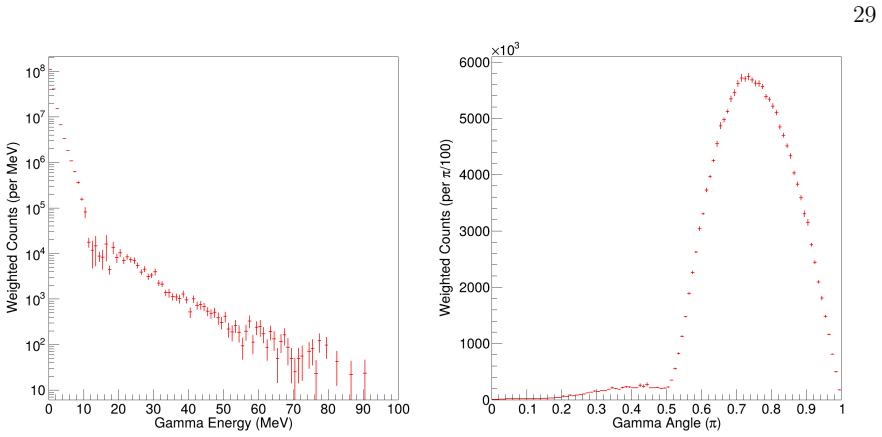
Laser wakefield accelerator photoneutron signal For UT3 conditions, the bremsstrahlung photon energy spectrum produced by the LWFA electron beam in the tungsten converter is shown in Fig. 9. The spectrum is approximately exponential, rising steeply at low energies<10 MeV and extending to the endpoint of the electron spectrum at 90 MeV. The photon yield de...
-
[6]
and short pulse duration make LWFA-driven sources competitive in peak flux. On the other hand, many photons that do not convert to neutrons can pass out of the converter contributing background in the neutron-waiting material. Utilizing gas jets to convert laser energy into particle energy, LWFA repetition rates are currently limited by the drive laser re...
-
[7]
Gunsing, Neutron resonance spectroscopy (2005), gif-sur-Yvette, France
F. Gunsing, Neutron resonance spectroscopy (2005), gif-sur-Yvette, France
work page 2005
-
[8]
I. Anderson, C. Andreani, J. Carpenter, G. Festa, G. Gorini, C.-K. Loong, and R. Senesi, Physics Reports654, 1 (2016)
work page 2016
-
[9]
C. Guerrero, A. Tsinganis, E. Berthoumieux, M. Barbagallo, F. Belloni, F. Gunsing, C. Weiß, E. Chiaveri, M. Calviani, V. Vlachoudis,et al., The European Physical Jour- nal A49, 27 (2013)
work page 2013
- [10]
-
[11]
A. Yogo, Z. Lan, Y. Arikawa, Y. Abe, S. R. Mirfayzi, T. Wei, T. Mori,et al., Physical Review X13, 011011 (2023)
work page 2023
-
[12]
W. Z. Wanget al., High Power Laser Science and Engineering (2023)
work page 2023
-
[13]
Zimmeret al., Nature Communications (2022)
L. Zimmeret al., Nature Communications (2022)
work page 2022
- [14]
- [15]
- [16]
-
[17]
V. Yuan, J. D. Bowman, D. Funk, G. Morgan, R. Rabie, C. Ragan, J. Quintana, and H. Stacy, Physical review letters94, 125504 (2005)
work page 2005
- [18]
-
[19]
Rothet al.,Assessment of Laser-Driven Pulsed Neutron Sources for NDE, Tech
M. Rothet al.,Assessment of Laser-Driven Pulsed Neutron Sources for NDE, Tech. Rep. (Los Alamos National Laboratory, 2017)
work page 2017
- [20]
-
[21]
S. N. Chen, F. Negoita, K. Spohr, E. d’Humi` eres, I. Pomerantz, and J. Fuchs, Matter and Radiation at Extremes4, 054402 (2019)
work page 2019
-
[22]
X. J. Jiaoet al., Frontiers in Physics10, 964696 (2023)
work page 2023
- [23]
-
[24]
B. A. Remington, R. P. Drake, and D. D. Ryutov, Reviews of Modern Physics78, 755 (2006)
work page 2006
-
[25]
J. J. Cowanet al., Reviews of Modern Physics93, 015002 (2021)
work page 2021
-
[26]
T. Rauscher and F.-K. Thielemann, Atomic Data and Nuclear Data Tables75, 1 (2000)
work page 2000
- [27]
- [28]
- [29]
-
[30]
Rothet al., Physical Review Letters110, 044802 (2013)
M. Rothet al., Physical Review Letters110, 044802 (2013)
work page 2013
-
[31]
Kleinschmidtet al., Physics of Plasmas25, 053101 (2018)
A. Kleinschmidtet al., Physics of Plasmas25, 053101 (2018). 43
work page 2018
-
[32]
S. R. Mirfayzi, A. Alejo, H. Ahmed, D. Raspino, S. Ansell, L. A. Wilson, C. Armstrong, N. M. H. Butler, R. J. Clarke, A. Higginson, J. Kelleher, C. D. Murphy, M. Notley, D. R. Rusby, E. Schooneveld, M. Borghesi, P. McKenna, N. J. Rhodes, D. Neely, C. M. Brenner, and S. Kar, Applied Physics Letters111, 044101 (2017)
work page 2017
-
[33]
S. C. Wilkset al., Physics of Plasmas8, 542 (2001)
work page 2001
-
[34]
M. S. Schollmeier,Optimization and control of laser-accelerated proton beams, Ph.D. thesis, Darmstadt, Tech. Hochsch. (2009)
work page 2009
- [35]
-
[36]
Macchiet al., Reviews of Modern Physics85, 751 (2013)
A. Macchiet al., Reviews of Modern Physics85, 751 (2013)
work page 2013
-
[37]
J. C. Fern´ andezet al., Nuclear Fusion49, 065004 (2009)
work page 2009
-
[38]
B. Hegelich, L. Labun, O. Labun, and T. Mehlhorn, Laser and Particle Beams2023, e7 (2023)
work page 2023
-
[39]
S. V. Luedtke, L. A. Labun, O. Z. Labun, K.-U. Bamberg, H. Ruhl, and B. M. Hegelich, (2018), arXiv:1808.07067 [physics.plasm-ph]
work page internal anchor Pith review Pith/arXiv arXiv 2018
- [40]
-
[41]
J. Hornung, Y. Zobus, S. Roeder, A. Kleinschmidt, D. Bertini, M. Zepf, and V. Bagnoud, Nature Communications12, 6999 (2021)
work page 2021
-
[42]
Zweiback, Physical Review Letters85, 3640 (2000)
J. Zweiback, Physical Review Letters85, 3640 (2000)
work page 2000
-
[43]
Pretzler, Physical Review E58, 1165 (1998)
G. Pretzler, Physical Review E58, 1165 (1998)
work page 1998
-
[45]
Gibbon,Short Pulse Laser Interactions with Matter(Imperial College Press, 2005)
P. Gibbon,Short Pulse Laser Interactions with Matter(Imperial College Press, 2005)
work page 2005
-
[46]
P. Mulser and D. Bauer,High Power Laser–Matter Interaction(Springer, 2010)
work page 2010
- [47]
-
[48]
Norreyset al., Plasma Physics and Controlled Fusion40, 175 (1998)
P. Norreyset al., Plasma Physics and Controlled Fusion40, 175 (1998)
work page 1998
- [49]
-
[50]
X. J. Jiao, J. M. Shaw, T. Wang, X. M. Wang, H. Tsai, P. Poth, I. Pomerantz, L. A. Labun, 44 T. Toncian, M. C. Downer, and B. M. Hegelich, Matter and Radiation at Extremes2, 296 (2017)
work page 2017
-
[51]
Valli` ereset al., Nature Communications 10.1038/s41467-025-66535-9 (2025)
S. Valli` ereset al., Nature Communications 10.1038/s41467-025-66535-9 (2025)
-
[52]
W. P. Leemanset al., Nature Physics2, 696 (2006)
work page 2006
-
[53]
Y. Li, J. Feng, W. Wang, J. Tan, X. Ge, F. Liu, W. Yan, G. Zhang, C. Fu, and L. Chen, High Power Laser Science and Engineering10, e33 (2022)
work page 2022
-
[54]
J. Feng, C. Fu, Y. Li, X. Zhang, J. Wang, D. Li, C. Zhu, J. Tan, M. Mirzaie, Z. Zhang, and L. Chen, High Energy Density Physics36, 100753 (2020)
work page 2020
-
[55]
X. Mao, K. R. Kase, and W. R. Nelson, Health physics70, 207 (1996)
work page 1996
-
[56]
W. Swanson and V. A. International Atomic Energy Agency,Radiological safety aspects of the operation of electron linear accelerators, no. 188 (IAEA., 1979)
work page 1979
- [57]
-
[58]
Labun,Preliminary optimization of wakefield electron beam-driven neutron source, Tech
L. Labun,Preliminary optimization of wakefield electron beam-driven neutron source, Tech. Rep. (Tau Systems Inc, 2023)
work page 2023
-
[59]
C. Aniculaesei, T. Ha, S. Yoffe, L. Labun, S. Milton, E. McCary, M. M. Spinks, H. J. Quevedo, O. Z. Labun, R. Sain,et al., Matter and Radiation at Extremes9(2024)
work page 2024
-
[60]
Germaschewskiet al., Journal of Computational Physics318, 305 (2016)
K. Germaschewskiet al., Journal of Computational Physics318, 305 (2016)
work page 2016
-
[61]
Kumaret al., The Astrophysical Journal835, 295 (2017)
R. Kumaret al., The Astrophysical Journal835, 295 (2017)
work page 2017
- [62]
- [63]
- [64]
-
[65]
D. J. Stark, L. Yin, B. J. Albright, and F. Guo, Physics of Plasmas24(2017)
work page 2017
-
[66]
B. Appelbe and J. Chittenden, Plasma Physics and Controlled Fusion53, 045002 (2011)
work page 2011
- [67]
-
[68]
Kumar,PICTOR: cylindrical version, Tech
R. Kumar,PICTOR: cylindrical version, Tech. Rep. 2401 (Tau Systems Inc, 2024)
work page 2024
- [69]
-
[70]
Frankeet al., inAAC24 Advanced Accelerator Concepts Workshop(2024)
P. Frankeet al., inAAC24 Advanced Accelerator Concepts Workshop(2024)
work page 2024
-
[71]
S. F. Mughabghab,Atlas of Neutron Resonances: Resonance Parameters and Thermal Cross Sections. Z= 1-100(Elsevier, 2006)
work page 2006
-
[72]
Junget al., Physics of Plasmas20, 056706 (2013)
D. Junget al., Physics of Plasmas20, 056706 (2013)
work page 2013
-
[73]
I. Pomerantz, E. McCary, A. R. Meadows, A. Arefiev, A. C. Bernstein, C. Chester, J. Cortez, M. E. Donovan, G. Dyer, E. W. Gaul,et al., Physical Review Letters113, 184801 (2014)
work page 2014
-
[74]
M. M. G¨ unther, O. N. Rosmej, P. Tavana,et al., Nature Communications13, 170 (2022)
work page 2022
-
[75]
J. Tipler, Tau systems demonstrates first electron beam production with its commercial laser-powered particle accelerator (2025)
work page 2025
-
[76]
C. Lazzarini, G. Grittani, P. Valenta, I. Zymak, R. Antipenkov, U. Chaulagain, L. Goncalves, A. Grenfell, M. Lamaˇ c, S. Lorenz,et al., Physics of Plasmas31(2024)
work page 2024
-
[77]
Martinezet al., inAIP Conference Proceedings, Vol
M. Martinezet al., inAIP Conference Proceedings, Vol. 1507 (2012)
work page 2012
-
[78]
Hendersonet al., High Energy Density Physics 10.1016/j.hedp.2014.06.004 (2014)
A. Hendersonet al., High Energy Density Physics 10.1016/j.hedp.2014.06.004 (2014)
-
[79]
Lianget al., Scientific Reports5, 13968 (2015)
E. Lianget al., Scientific Reports5, 13968 (2015)
work page 2015
-
[80]
Stormet al., Physics of Plasmas20, 053106 (2013)
M. Stormet al., Physics of Plasmas20, 053106 (2013)
work page 2013
-
[81]
W. Bang, M. Barbui, A. Bonasera, G. Dyer, H. J. Quevedo, K. Hagel, K. Schmidt, F. Con- soli, R. De Angelis, P. Andreoli,et al., Physical Review Letters111, 055002 (2013)
work page 2013
discussion (0)
Sign in with ORCID, Apple, or X to comment. Anyone can read and Pith papers without signing in.