Targeted maximum likelihood estimation of vaccine effectiveness and immune correlates in test-negative design studies with missing data
Pith reviewed 2026-05-22 08:10 UTC · model grok-4.3
The pith
A targeted maximum likelihood estimator provides valid causal inference for vaccine effectiveness in test-negative designs with missing exposure data.
A machine-rendered reading of the paper's core claim, the machinery that carries it, and where it could break.
Core claim
Under causal and missing at random assumptions, the targeted maximum likelihood estimation approach involving a semiparametric logistic regression model produces an efficient, asymptotically linear estimator that provides flexible, data-driven confounding control and valid causal inference when analyzing TND studies with missing exposure variable data.
What carries the argument
Targeted maximum likelihood estimation with a semiparametric logistic regression model that targets the causal conditional risk ratio of symptomatic disease in the healthcare-seeking population.
If this is right
- The method yields efficient and asymptotically linear estimators for the targeted causal parameter.
- Flexible, data-driven control for confounding is achieved beyond basic adjustments for healthcare-seeking behavior.
- Valid causal inference holds for TND studies using two-phase sampling designs with missing exposure data.
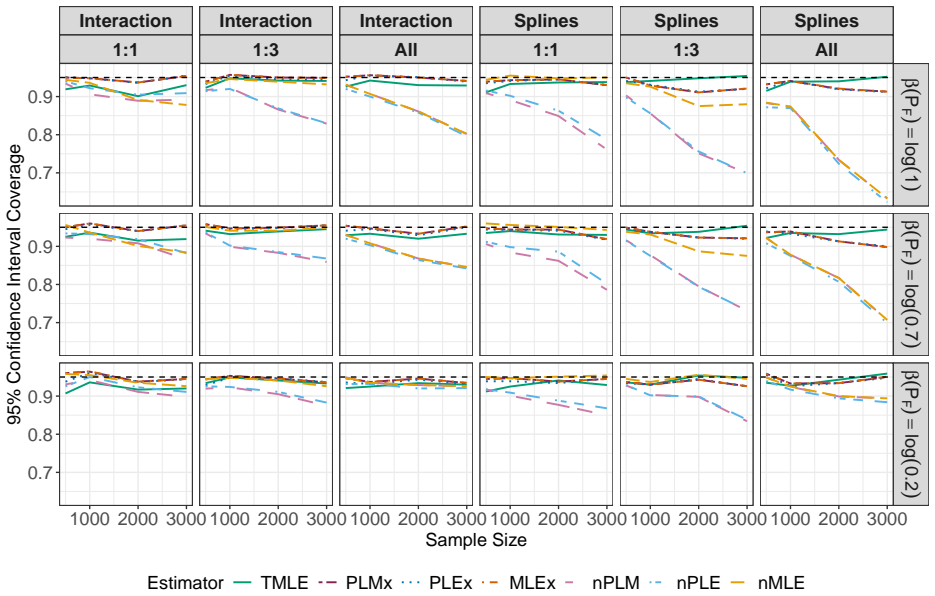
- Finite sample performance is demonstrated via plasmode simulations based on immune correlates studies.
Where Pith is reading between the lines
- Analysts could apply this estimator to other observational vaccine studies with similar missing data patterns to improve inference accuracy.
- Policy decisions on vaccine recommendations might incorporate more data from incomplete records if this method is adopted widely.
- Future work could test the method's robustness when the missing at random assumption is mildly violated through sensitivity analyses.
Load-bearing premise
The method requires that missing exposure data occur at random given the observed variables and that the causal assumptions needed to identify the risk ratio are satisfied.
What would settle it
Generating data from a TND study where missingness depends on unobserved factors and checking whether the estimator shows bias or incorrect coverage would falsify the validity claim if systematic errors appear.
Figures




read the original abstract
The test-negative design (TND) is a resource-efficient observational study design that can assess vaccine effectiveness and exposure-proximal immune correlates of disease. The TND enrolls symptomatic individuals seeking diagnostic testing and compares case status by an exposure variable, such as vaccination status or immune marker level, that is measured at testing. While the TND reduces confounding by healthcare-seeking behavior, other sources of confounding may remain. TND studies may also have missing data in the exposure variable due to incomplete records or two-phase sampling designs. We present a targeted maximum likelihood estimation approach involving a semiparametric logistic regression model that targets a causal conditional risk ratio of symptomatic disease in the healthcare-seeking population. Under causal and missing at random assumptions, our method produces an efficient, asymptotically linear estimator that provides flexible, data-driven confounding control and valid causal inference when analyzing TND studies with missing exposure variable data. We evaluate our method's finite sample properties using plasmode simulations of a two-phase TND immune correlates study. We also apply our method to assess COVID-19 vaccine effectiveness and antibody marker correlates of COVID-19 from TND study cohorts derived from the Moderna Coronavirus Efficacy phase 3 trial.
Editorial analysis
A structured set of objections, weighed in public.
Referee Report
Summary. The manuscript develops a targeted maximum likelihood estimator (TMLE) for vaccine effectiveness and immune correlates in test-negative design (TND) studies that feature missing exposure data. It specifies a semiparametric logistic regression model that targets the causal conditional risk ratio of symptomatic disease in the healthcare-seeking population, incorporates a missingness indicator into the efficient influence function, and claims that the resulting estimator is asymptotically linear and efficient under standard causal and missing-at-random assumptions. Finite-sample behavior is examined via plasmode simulations of a two-phase TND immune-correlates study, and the method is illustrated on COVID-19 vaccine effectiveness and antibody-marker data derived from the Moderna phase-3 trial.
Significance. If the derivations hold, the work supplies a practical, semiparametric tool for valid causal inference in TND studies that routinely encounter incomplete exposure records or two-phase sampling. The explicit use of the efficient influence function to handle missingness, together with the plasmode simulation design and the Moderna application, provides reproducible evidence of finite-sample performance and real-data utility that is uncommon in this literature.
minor comments (3)
- [theoretical development section] The abstract and introduction state that the estimator is asymptotically linear and efficient under the stated assumptions, yet the manuscript does not display the explicit form of the efficient influence function that incorporates the missingness indicator (presumably in the theoretical development section). Adding this expression would allow readers to verify the rate conditions on the nuisance estimators directly.
- [simulation section] In the plasmode simulation description, the number of Monte Carlo replicates, the specific sample sizes for the two-phase design, and the exact missingness mechanism should be stated more precisely so that the reported coverage and bias results can be reproduced.
- [application section] The application to the Moderna trial data would benefit from a brief sensitivity analysis that varies the missing-at-random assumption or the choice of nuisance estimators, even if only as a supplementary table.
Simulated Author's Rebuttal
We thank the referee for the positive and constructive review, which highlights the practical value of the TMLE approach for TND studies with missing exposure data. We appreciate the recommendation for minor revision and will address all points raised.
Circularity Check
No significant circularity
full rationale
The paper applies standard TMLE to a TND study with missing exposure data by specifying a semiparametric logistic regression that targets the conditional risk ratio and augments the efficient influence function with the missingness mechanism. This construction follows directly from existing TMLE theory once the causal and MAR assumptions are stated; the resulting estimator is asymptotically linear and efficient under standard rate conditions on the nuisance functions. No step reduces a claimed prediction or uniqueness result to a fitted parameter or to a self-citation whose content is itself defined by the present work. The plasmode simulations and Moderna application are external checks rather than definitional tautologies, leaving the derivation self-contained.
Axiom & Free-Parameter Ledger
free parameters (1)
- nuisance parameters in semiparametric logistic regression
axioms (2)
- domain assumption Missing at random (MAR) for the exposure variable
- domain assumption Causal assumptions sufficient to identify the conditional risk ratio
Lean theorems connected to this paper
-
IndisputableMonolith/Foundation/RealityFromDistinction.leanreality_from_one_distinction unclear?
unclearRelation between the paper passage and the cited Recognition theorem.
targeted maximum likelihood estimation approach involving a semiparametric logistic regression model that targets a causal conditional risk ratio... efficient, asymptotically linear estimator
-
IndisputableMonolith/Cost/FunctionalEquation.leanwashburn_uniqueness_aczel unclear?
unclearRelation between the paper passage and the cited Recognition theorem.
partially linear logistic regression model... logit{P(A=1|D=1,Y=y,X=x)}=y β(P)^T f(x) + h_P(x)
What do these tags mean?
- matches
- The paper's claim is directly supported by a theorem in the formal canon.
- supports
- The theorem supports part of the paper's argument, but the paper may add assumptions or extra steps.
- extends
- The paper goes beyond the formal theorem; the theorem is a base layer rather than the whole result.
- uses
- The paper appears to rely on the theorem as machinery.
- contradicts
- The paper's claim conflicts with a theorem or certificate in the canon.
- unclear
- Pith found a possible connection, but the passage is too broad, indirect, or ambiguous to say the theorem truly supports the claim.
Reference graph
Works this paper leans on
-
[1]
Broome CV, Facklam RR, Fraser DW. Pneumococcal disease after pneumococcal vaccination: an alternative method to estimate the efficacy of pneumococcal vaccine. The New England Journal of Medicine. 1980;303(10):549-52
work page 1980
-
[2]
Chua H, Feng S, Lewnard JA, Sullivan SG, Blyth CC, Lipsitch M, et al. The Use of Test- negative Controls to Monitor Vaccine Effectiveness: A Systematic Review of Methodology. Epidemiology. 2020;31(1):43-64
work page 2020
-
[3]
Patel MK, Bergeri I, Bresee JS, Cowling BJ, Crowcroft NS, Fahmy K, et al. Evaluation of post-introduction COVID-19 vaccine effectiveness: Summary of interim guidance of the World Health Organization. Vaccine. 2021;39(30):4013-24
work page 2021
-
[4]
Chang S, Liu H, Wu J, Xiao W, Chen S, Qiu S, et al. Effectiveness of BNT162b2 and mRNA- 1273 Vaccines against COVID-19 Infection: A Meta-Analysis of Test-Negative Design Studies. Vaccines. 2022;10(3):469
work page 2022
-
[5]
Tsang TK, Sullivan SG, Huang X, Wang C, Wang Y, Nealon J, et al. Prior infections and effectiveness of SARS-CoV-2 vaccine in test-negative studies: a systematic review and meta- analysis. American Journal of Epidemiology. 2024;193(12):1868-81
work page 2024
-
[6]
The test-negative design for estimating influenza vaccine effective- ness
Jackson ML, Nelson JC. The test-negative design for estimating influenza vaccine effective- ness. Vaccine. 2013;31(17):2165-8
work page 2013
-
[7]
Sullivan SG, Tchetgen Tchetgen EJ, Cowling BJ. Theoretical Basis of the Test-Negative Study Design for Assessment of Influenza Vaccine Effectiveness. American Journal of Epi- demiology. 2016;184(5):345-53
work page 2016
-
[8]
Clemens JD, Shapiro ED. Resolving the Pneumococcal Vaccine Controversy: Are There Alternatives to Randomized Clinical Trials? Reviews of Infectious Diseases. 1984;6(5):589- 600. 26
work page 1984
-
[9]
Immune correlates analysis using vaccinees from test negative designs
Follmann DA, Dodd L. Immune correlates analysis using vaccinees from test negative designs. Biostatistics. 2022;23(2):507-21
work page 2022
-
[10]
Sumner KM, Yadav R, Noble EK, Sandford R, Joshi D, Tartof SY, et al. Anti–SARS-CoV-2 Antibody Levels Associated With COVID-19 Protection in Outpatients Tested for SARS- CoV-2, US Flu Vaccine Effectiveness Network, October 2021–June 2022. The Journal of Infectious Diseases. 2024;230(1):45-54
work page 2021
-
[11]
Zhang Z, Boyer CB, Lipsitch M. Use of the test-negative design to estimate the protective effect of a scalar immune measure: A simulation analysis. medRxiv. 2024:2024-11
work page 2024
-
[12]
Middleton CE, Larremore DB. Statistical methods for estimating the protective effects of im- mune markers using test-negative designs. American Journal of Epidemiology. 2025:kwaf280
work page 2025
-
[13]
Follmann D, Dang L, Chu E, Fintzi J, Janes H, Gilbert PB, et al. A Test-Negative Design for Immune Correlates Approximates a Traditional Exposure Proximal Design but Requires Far Fewer Blood Samples. The Journal of Infectious Diseases. 2025:jiaf572
work page 2025
-
[14]
Im- mune correlates analysis of the mRNA-1273 COVID-19 vaccine efficacy clinical trial
Gilbert PB, Montefiori DC, McDermott AB, Fong Y, Benkeser D, Deng W, et al. Im- mune correlates analysis of the mRNA-1273 COVID-19 vaccine efficacy clinical trial. Science. 2022;375(6576):43-50
work page 2022
-
[15]
Immune correlates analysis of a phase 3 trial of the AZD1222 (ChAdOx1 nCoV-19) vaccine
Benkeser D, Fong Y, Janes HE, Kelly EJ, Hirsch I, Sproule S, et al. Immune correlates analysis of a phase 3 trial of the AZD1222 (ChAdOx1 nCoV-19) vaccine. npj Vaccines. 2023;8(1):1-13
work page 2023
-
[16]
Immune correlates analysis of the ENSEMBLE single Ad26.COV2.S dose vaccine efficacy clinical trial
Fong Y, McDermott AB, Benkeser D, Roels S, Stieh DJ, Vandebosch A, et al. Immune correlates analysis of the ENSEMBLE single Ad26.COV2.S dose vaccine efficacy clinical trial. Nature Microbiology. 2022;7(12):1996-2010
work page 2022
-
[17]
Immune correlates anal- ysis of the PREVENT-19 COVID-19 vaccine efficacy clinical trial
Fong Y, Huang Y, Benkeser D, Carpp LN, ´A˜ nez G, Woo W, et al. Immune correlates anal- ysis of the PREVENT-19 COVID-19 vaccine efficacy clinical trial. Nature Communications. 2023;14(1):331
work page 2023
-
[18]
Humoral and cellular immune memory to four COVID-19 vaccines
Zhang Z, Mateus J, Coelho CH, Dan JM, Moderbacher CR, G´ alvez RI, et al. Humoral and cellular immune memory to four COVID-19 vaccines. Cell. 2022;185(14):2434-51.e17
work page 2022
-
[19]
Hertoghs N, Roels S, Br¨ uckner M, Sadoff J, Banbury BL, Akers NK, et al. Vaccine-induced T cell responses correlate with reduced risk of severe COVID-19 in a placebo-controlled efficacy trial. eBioMedicine. 2025;117:105809
work page 2025
-
[20]
Krause PR, Arora N, Dowling W, Mu˜ noz-Fontela C, Funnell S, Gaspar R, et al. Making more COVID-19 vaccines available to address global needs: Considerations and a framework for their evaluation. Vaccine. 2022;40(40):5749-51
work page 2022
-
[21]
Temporal Confounding in the Test-Negative Design
Dean NE, Halloran ME, Longini IM Jr. Temporal Confounding in the Test-Negative Design. American Journal of Epidemiology. 2020;189(11):1402-7
work page 2020
-
[22]
Bond HS, Sullivan SG, Cowling BJ. Regression approaches in the test-negative study design for assessment of influenza vaccine effectiveness. Epidemiology and Infection. 2016;144(8):1601-11
work page 2016
-
[23]
Effectiveness of Covid-19 Vaccines in Ambulatory and Inpatient Care Settings
Thompson MG, Stenehjem E, Grannis S, Ball SW, Naleway AL, Ong TC, et al. Effectiveness of Covid-19 Vaccines in Ambulatory and Inpatient Care Settings. New England Journal of Medicine. 2021;385(15):1355-71. 27
work page 2021
-
[24]
Lopez Bernal J, Andrews N, Gower C, Robertson C, Stowe J, Tessier E, et al. Effectiveness of the Pfizer-BioNTech and Oxford-AstraZeneca vaccines on COVID-19 related symptoms, hospital admissions, and mortality in older adults in England: test negative case-control study. BMJ (Clinical research ed). 2021;373:n1088
work page 2021
-
[25]
Chung H, He S, Nasreen S, Sundaram ME, Buchan SA, Wilson SE, et al. Effectiveness of BNT162b2 and mRNA-1273 covid-19 vaccines against symptomatic SARS-CoV-2 infec- tion and severe covid-19 outcomes in Ontario, Canada: test negative design study. BMJ. 2021;374:n1943
work page 2021
-
[26]
Ranzani OT, Silva AAB, Peres IT, Antunes BBP, Gonzaga-da Silva TW, Soranz DR, et al. Vaccine effectiveness of ChAdOx1 nCoV-19 against COVID-19 in a socially vulnerable com- munity in Rio de Janeiro, Brazil: a test-negative design study. Clinical Microbiology and Infection. 2022;28(5):736.e1-736.e4
work page 2022
-
[27]
Effectiveness of mRNA Covid-19 Vaccine among U.S
Pilishvili T, Gierke R, Fleming-Dutra KE, Farrar JL, Mohr NM, Talan DA, et al. Effectiveness of mRNA Covid-19 Vaccine among U.S. Health Care Personnel. The New England Journal of Medicine. 2021;385(25):e90
work page 2021
-
[28]
Rothman KJ, Greenland S. Modern epidemiology. 2nd ed. Philadelphia, PA: Lippincott- Raven; 1998
work page 1998
-
[29]
Why Match? Investigating Matched Case-Control Study Designs with Causal Effect Estimation
Rose S, van der Laan MJ. Why Match? Investigating Matched Case-Control Study Designs with Causal Effect Estimation. The International Journal of Biostatistics. 2009;5(1)
work page 2009
-
[30]
Jiang C, Talbot D, Carazo S, Schnitzer ME. A Double Machine Learning Approach for the Evaluation of COVID-19 Vaccine Effectiveness Under the Test-Negative Design: Analysis of Qu´ ebec Administrative Data. Statistics in Medicine. 2025;44(5):e70025
work page 2025
-
[31]
Tenforde MW, Olson SM, Self WH, Talbot HK, Lindsell CJ, Steingrub JS, et al. Effectiveness of Pfizer-BioNTech and Moderna Vaccines Against COVID-19 Among Hospitalized Adults Aged≥65 Years - United States, January-March 2021. MMWR Morbidity and mortality weekly report. 2021;70(18):674-9
work page 2021
-
[32]
Olson SM, Newhams MM, Halasa NB, Price AM, Boom JA, Sahni LC, et al. Effectiveness of Pfizer-BioNTech mRNA Vaccination Against COVID-19 Hospitalization Among Persons Aged 12-18 Years - United States, June-September 2021. MMWR Morbidity and mortality weekly report. 2021;70(42):1483-8
work page 2021
-
[33]
Ranzani OT, Hitchings MDT, Dorion M, D’Agostini TL, Paula RCd, Paula OFPd, et al. Effectiveness of the CoronaVac vaccine in older adults during a gamma variant associated epidemic of covid-19 in Brazil: test negative case-control study. BMJ. 2021;374:n2015
work page 2021
-
[34]
Models and Methods for Missing Data
Tsiatis AA. Models and Methods for Missing Data. In: Semiparametric Theory and Missing Data. New York, NY: Springer; 2006. p. 137-50
work page 2006
-
[35]
A two stage design for the study of the relationship between a rare exposure and a rare disease
White JE. A two stage design for the study of the relationship between a rare exposure and a rare disease. American Journal of Epidemiology. 1982;115(1):119-28
work page 1982
-
[36]
Using the Whole Cohort in the Analysis of Case-Cohort Data
Breslow NE, Lumley T, Ballantyne CM, Chambless LE, Kulich M. Using the Whole Cohort in the Analysis of Case-Cohort Data. American Journal of Epidemiology. 2009;169(11):1398-405. 28
work page 2009
-
[37]
A controlled effects approach to assessing immune correlates of protection
Gilbert PB, Fong Y, Kenny A, Carone M. A controlled effects approach to assessing immune correlates of protection. Biostatistics. 2022:kxac024
work page 2022
-
[38]
Kenny A, Duijn Jv, Dintwe O, Heptinstall J, Burnham R, Sawant S, et al. Immune correlates analysis of the Imbokodo (HVTN 705/HPX2008) efficacy trial of a mosaic HIV-1 vaccine regimen evaluated in Southern African people assigned female sex at birth: a two-phase case-control study. eBioMedicine. 2024;108
work page 2024
-
[39]
Targeted Maximum Likelihood Learning
van der Laan MJ, Rubin D. Targeted Maximum Likelihood Learning. The International Journal of Biostatistics. 2006;2(1)
work page 2006
-
[40]
Targeted Learning: Causal Inference for Observational and Ex- perimental Data
van der Laan MJ, Rose S. Targeted Learning: Causal Inference for Observational and Ex- perimental Data. Springer Series in Statistics. New York, NY: Springer; 2011
work page 2011
-
[41]
Kang JDY, Schafer JL. Demystifying Double Robustness: A Comparison of Alternative Strategies for Estimating a Population Mean from Incomplete Data. Statistical Science. 2007;22(4):523-39
work page 2007
-
[42]
The Relative Performance of Targeted Maximum Likelihood Estimators
Porter KE, Gruber S, van der Laan MJ, Sekhon JS. The Relative Performance of Targeted Maximum Likelihood Estimators. The International Journal of Biostatistics. 2011;7(1)
work page 2011
-
[43]
van der Laan L, Gilbert PB. Semiparametric logistic regression for inference on rela- tive vaccine efficacy in case-only studies with informative missingness. arXiv preprint arXiv:230311462. 2025
work page 2025
-
[44]
Efficacy of the mRNA-1273 SARS-CoV-2 Vaccine at Completion of Blinded Phase
El Sahly HM, Baden LR, Essink B, Doblecki-Lewis S, Martin JM, Anderson EJ, et al. Efficacy of the mRNA-1273 SARS-CoV-2 Vaccine at Completion of Blinded Phase. New England Journal of Medicine. 2021;385(19):1774-85
work page 2021
-
[45]
Shi M, An Q, Ainslie KEC, Haber M, Orenstein WA. A comparison of the test-negative and the traditional case-control study designs for estimation of influenza vaccine effectiveness under nonrandom vaccination. BMC infectious diseases. 2017;17(1):757
work page 2017
-
[46]
Theo- retical Framework for Retrospective Studies of the Effectiveness of SARS-CoV-2 Vaccines
Lewnard JA, Patel MM, Jewell NP, Verani JR, Kobayashi M, Tenforde MW, et al. Theo- retical Framework for Retrospective Studies of the Effectiveness of SARS-CoV-2 Vaccines. Epidemiology (Cambridge, Mass). 2021;32(4):508
work page 2021
-
[47]
Berkson’s bias, selection bias, and missing data
Westreich D. Berkson’s bias, selection bias, and missing data. Epidemiology (Cambridge, Mass). 2012;23(1):159-64
work page 2012
-
[48]
Schnitzer ME. Estimands and Estimation of COVID-19 Vaccine Effectiveness Under the Test-Negative Design: Connections to Causal Inference. Epidemiology (Cambridge, Mass). 2022;33(3):325-33
work page 2022
-
[49]
Doll MK, Pettigrew SM, Ma J, Verma A. Effects of Confounding Bias in Coronavirus Dis- ease 2019 (COVID-19) and Influenza Vaccine Effectiveness Test-Negative Designs Due to Correlated Influenza and COVID-19 Vaccination Behaviors. Clinical Infectious Diseases: An Official Publication of the Infectious Diseases Society of America. 2022;75(1):e564-71
work page 2019
-
[50]
Payne AB, Ciesla AA, Rowley EAK, Weber ZA, Reese SE, Ong TC, et al. Impact of ac- counting for correlation between COVID-19 and influenza vaccination in a COVID-19 vaccine effectiveness evaluation using a test-negative design. Vaccine. 2023;41(51):7581-6. 29
work page 2023
-
[51]
Robins MAH James M. Causal Inference: What If. Boca Raton: CRC Press; 2024
work page 2024
-
[52]
Causal Inference Using Potential Outcomes
Rubin DB. Causal Inference Using Potential Outcomes. Journal of the American Statistical Association. 2005;100(469):322-31
work page 2005
-
[53]
Toward Causal Inference With Interference
Hudgens MG, Halloran ME. Toward Causal Inference With Interference. Journal of the American Statistical Association. 2008;103(482):832-42
work page 2008
-
[54]
Cox DR. Planning of experiments. Planning of experiments. Oxford, England: Wiley; 1958. Pages: 308
work page 1958
-
[55]
Randomization Analysis of Experimental Data: The Fisher Randomization Test Comment
Rubin DB. Randomization Analysis of Experimental Data: The Fisher Randomization Test Comment. Journal of the American Statistical Association. 1980;75(371):591-3
work page 1980
-
[56]
Social Networks and Causal Inference
VanderWeele TJ, An W. Social Networks and Causal Inference. In: Morgan SL, editor. Handbook of Causal Analysis for Social Research. Dordrecht: Springer Netherlands; 2013. p. 353-74. Series Title: Handbooks of Sociology and Social Research
work page 2013
-
[57]
On doubly robust estimation in a semi- parametric odds ratio model
Tchetgen Tchetgen EJ, Robins JM, Rotnitzky A. On doubly robust estimation in a semi- parametric odds ratio model. Biometrika. 2010;97(1):171-80
work page 2010
-
[58]
Readings in Targeted Maximum Likelihood Estimation
van der Laan M, Rose S, Gruber S. Readings in Targeted Maximum Likelihood Estimation. UC Berkeley Division of Biostatistics Working Paper Series. 2009 Sep. Available from:https: //biostats.bepress.com/ucbbiostat/paper254
work page 2009
-
[59]
Generalized Additive Models: Some Applications
Hastie T, Tibshirani R. Generalized Additive Models: Some Applications. Journal of the American Statistical Association. 1987;82(398):371-86
work page 1987
-
[60]
Multivariate Adaptive Regression Splines
Friedman JH. Multivariate Adaptive Regression Splines. The Annals of Statistics. 1991;19(1):1-67
work page 1991
-
[61]
The Highly Adaptive Lasso Estimator
Benkeser D, van der Laan M. The Highly Adaptive Lasso Estimator. In: 2016 IEEE Inter- national Conference on Data Science and Advanced Analytics (DSAA); 2016. p. 689-96
work page 2016
-
[62]
van der Laan MJ, Polley EC, Hubbard AE. Super learner. Statistical Applications in Genetics and Molecular Biology. 2007;6:Article25
work page 2007
-
[63]
van der Laan M, Dudoit S. Unified Cross-Validation Methodology For Selection Among Estimators and a General Cross-Validated Adaptive Epsilon-Net Estimator: Finite Sample Oracle Inequalities and Examples. UC Berkeley Division of Biostatistics Working Paper Series. 2003 Nov. Available from:https://biostats.bepress.com/ucbbiostat/paper130
work page 2003
-
[64]
Asymptotics of cross-validated risk estimation in estimator selection and performance assessment
Dudoit S, van der Laan MJ. Asymptotics of cross-validated risk estimation in estimator selection and performance assessment. Statistical Methodology. 2005;2(2):131-54
work page 2005
-
[65]
Oracle inequalities for multi-fold cross validation
van der Vaart AW, Dudoit S, Laan MJVD. Oracle inequalities for multi-fold cross validation. Statistics & Decisions. 2006;24(3):351-71
work page 2006
-
[66]
Efficient and adaptive estimation for semiparametric models
Bickel PJ. Efficient and adaptive estimation for semiparametric models. vol. 4 of Johns Hopkins series in the mathematical sciences. Baltimore: Johns Hopkins University Press; 1993
work page 1993
-
[67]
On Asymptotically Efficient Estimation in Semiparametric Models
Schick A. On Asymptotically Efficient Estimation in Semiparametric Models. The Annals of Statistics. 1986;14(3):1139-51. 30
work page 1986
-
[68]
Dou- ble/debiased machine learning for treatment and structural parameters
Chernozhukov V, Chetverikov D, Demirer M, Duflo E, Hansen C, Newey W, et al. Dou- ble/debiased machine learning for treatment and structural parameters. The Econometrics Journal. 2018;21(1):C1-C68
work page 2018
-
[69]
Regression Shrinkage and Selection via the Lasso
Tibshirani R. Regression Shrinkage and Selection via the Lasso. Journal of the Royal Statis- tical Society Series B (Methodological). 1996;58(1):267-88
work page 1996
-
[70]
R: A Language and Environment for Statistical Computing
R Core Team. R: A Language and Environment for Statistical Computing. Vienna, Austria: R Foundation for Statistical Computing; 2024. Available from:https://www.R-project.org/
work page 2024
-
[71]
van der Laan L. causalglm: Interpretable and robust causal inference for heterogeneous treat- ment effects using generalized linear models with targeted machine-learning.; 2024. Available from:https://github.com/tlverse/causalglm
work page 2024
-
[72]
sl3: Modern Super Learning with Pipelines
Coyle J, Hejazi N, Malenica I, Sofrygin O, Phillips R. sl3: Modern Super Learning with Pipelines. Zenodo; 2021
work page 2021
-
[73]
nnls: The Lawson-Hanson Algorithm for Non- Negative Least Squares (NNLS); 2024
Mullen KM, Stokkum IHMv, Mullen K. nnls: The Lawson-Hanson Algorithm for Non- Negative Least Squares (NNLS); 2024
work page 2024
-
[74]
‘hal9001‘: Scalable highly adaptive lasso regression in ‘R‘
Hejazi NS, Coyle JR, van der Laan MJ. ‘hal9001‘: Scalable highly adaptive lasso regression in ‘R‘. Journal of Open Source Software. 2020;5(53):2526
work page 2020
-
[75]
hal9001: Scalable highly adaptive lasso regression in R
Hejazi NS, Coyle JR, van der Laan MJ. hal9001: Scalable highly adaptive lasso regression in R. Zenodo; 2020
work page 2020
-
[76]
Franklin JM, Schneeweiss S, Polinski JM, Rassen JA. Plasmode simulation for the evalu- ation of pharmacoepidemiologic methods in complex healthcare databases. Computational statistics & data analysis. 2014;72:219-26
work page 2014
-
[77]
Statistical plasmode simulations–Potentials, challenges and recommendations
Schreck N, Slynko A, Saadati M, Benner A. Statistical plasmode simulations–Potentials, challenges and recommendations. Statistics in Medicine. 2024;43(9):1804-25
work page 2024
-
[78]
Gilbert PB, Yu X, Rotnitzky A. Optimal auxiliary-covariate-based two-phase sampling design for semiparametric efficient estimation of a mean or mean difference, with application to clinical trials. Statistics in Medicine. 2014;33(6):901-17
work page 2014
-
[79]
Breslow NE, Holubkov R. Weighted likelihood, pseudo-likelihood and maximum likelihood methods for logistic regression analysis of two-stage data. Statistics in Medicine. 1997;16(1- 3):103-16
work page 1997
-
[80]
Haneuse S, Saegusa T, Lumley T. osDesign: An R Package for the Analysis, Evaluation, and Design of Two-Phase and Case-Control Studies. Journal of Statistical Software. 2011;43:1-29
work page 2011
discussion (0)
Sign in with ORCID, Apple, or X to comment. Anyone can read and Pith papers without signing in.