GDP-Driven Structural and Dynamical Heterogeneity in the Synchronization of Chaotic Macroeconomic Networks
Pith reviewed 2026-05-22 08:21 UTC · model grok-4.3
The pith
Global business cycle synchronization is fragile because strong integration produces only temporary coordination broken by structural and dynamical disparities.
A machine-rendered reading of the paper's core claim, the machinery that carries it, and where it could break.
Core claim
In a network of chaotic macroeconomic systems with variables for savings, GDP, and foreign capital inflows, coupling via a GDP-dependent fitness probability generates both structural and dynamical heterogeneity; under this setup, heterogeneous networks exhibit on-off intermittency with power-law scaling of laminar phase durations, while mean-field approximations capture the dynamics accurately only in homogeneous or fully connected cases.
What carries the argument
The fitness-based probability that depends on potential GDP and determines both the network connections and the interaction strength among the chaotic oscillators at each node.
Load-bearing premise
The premise that macroeconomic variables behave as coupled chaotic oscillators whose interactions are governed by a fitness probability depending on potential GDP directly produces the reported intermittency and synchronization patterns.
What would settle it
Collecting historical GDP series from many countries, identifying intervals of synchronized business cycles, and testing whether the distribution of their durations follows a power law would confirm or refute the intermittency prediction.
Figures




read the original abstract
We investigate the emergence of synchronization in a network of coupled chaotic macroeconomic systems. Each node represents an economy characterized by three key variables savings, gross domestic product (GDP), and foreign capital inflows. These economies interact or are connected through a fitness-based probability that depends on the potential GDP of each node. This formulation allows both structural heterogeneity, arising from uneven network connectivity, and dynamical heterogeneity, due to differences in local parameters, to be explored within a unified framework. Using both numerical simulations and a mean-field approximation, by varying the coupling strength and the degree of heterogeneity of both network topology and dynamical behavior of the nodes, we analyze synchronization transitions. Our results show that the mean-field approach accurately captures the collective dynamics in homogeneous and fully connected networks even with heterogeneity within the intrinsic dynamic of the nodes but fails when strong heterogeneity in the structure of the network is introduced. In heterogeneous networks, the system exhibits partial synchronization and on--off intermittency, where coherent phases of global synchronization alternate with abrupt desynchronization bursts. The distribution of laminar phase durations follows a power-law scaling, consistent with theoretical predictions for intermittent synchronization. From an economic perspective, these results suggest that global business cycle synchronization is inherently fragile: strong integration can promote temporary coordination among economies, but structural and dynamical disparities inevitably lead to intermittent breakdowns of collective behavior.
Editorial analysis
A structured set of objections, weighed in public.
Referee Report
Summary. The manuscript models economies as nodes in a network of coupled chaotic oscillators with state variables for savings, GDP, and foreign capital inflows. Links are generated by a fitness probability proportional to potential GDP, introducing both structural heterogeneity (uneven connectivity) and dynamical heterogeneity (local parameter variation). Numerical simulations and a mean-field approximation are used to study synchronization as coupling strength and heterogeneity are varied. The central results are that mean-field theory holds for homogeneous or fully connected cases but breaks down under strong structural heterogeneity, where the system instead shows partial synchronization interrupted by on-off intermittency whose laminar-phase durations obey power-law statistics. The authors interpret this as evidence that global business-cycle synchronization is inherently fragile.
Significance. If the modeling assumptions are accepted, the work supplies a concrete dynamical-systems mechanism for the observed intermittency of global economic coordination and yields a specific, testable prediction in the form of power-law laminar-phase statistics. The unified treatment of structural and dynamical heterogeneity together with the direct comparison of simulations against mean-field theory constitutes a technical strength. The results could inform discussions of globalization and macroeconomic stability, provided the chaotic-oscillator representation of macro variables can be justified.
major comments (3)
- [Modeling framework] Modeling framework: the decision to represent savings, GDP, and foreign capital inflows as chaotic oscillators whose interactions are governed by a fitness probability depending on potential GDP simultaneously fixes both the heterogeneous topology and the source of local parameter variation that produces the reported on-off intermittency. This modeling premise is load-bearing for the fragility claim; without robustness checks against alternative (non-chaotic or differently coupled) dynamics, the intermittency and power-law scaling may be artifacts of the chosen oscillator family rather than generic consequences of integration plus disparity.
- [Results section on mean-field approximation] Results section on mean-field approximation: the text states that the mean-field description accurately captures collective dynamics only for homogeneous or fully connected networks and fails under strong structural heterogeneity, yet the economic conclusion that disparities 'inevitably lead to intermittent breakdowns' is drawn directly from the heterogeneous-network simulations. This creates an analytical gap; the manuscript should clarify how the simulation-based intermittency generalizes or what additional analytical support can be provided for the heterogeneous case.
- [Simulation and statistical analysis] Simulation and statistical analysis: the abstract and results report power-law scaling of laminar phases and the fragility conclusion, but supply no explicit equations for the local chaotic maps, no numerical values or ranges for coupling strength and heterogeneity parameters, and no description of the synchronization-detection threshold or data-exclusion rules. These omissions make independent verification of the power-law exponent and the robustness of the intermittency claim difficult.
minor comments (2)
- [Figures] Figure captions should explicitly state the heterogeneity parameters and number of realizations used for each panel so that the transition from mean-field agreement to failure can be reproduced.
- [Notation] Notation for the fitness probability and the local oscillator parameters should be introduced once and used consistently in both the text and any supplementary material.
Simulated Author's Rebuttal
We thank the referee for their thorough review and valuable suggestions. We have carefully considered each comment and provide point-by-point responses below. Where appropriate, we have revised the manuscript to address the concerns raised.
read point-by-point responses
-
Referee: [Modeling framework] Modeling framework: the decision to represent savings, GDP, and foreign capital inflows as chaotic oscillators whose interactions are governed by a fitness probability depending on potential GDP simultaneously fixes both the heterogeneous topology and the source of local parameter variation that produces the reported on-off intermittency. This modeling premise is load-bearing for the fragility claim; without robustness checks against alternative (non-chaotic or differently coupled) dynamics, the intermittency and power-law scaling may be artifacts of the chosen oscillator family rather than generic consequences of integration plus disparity.
Authors: We acknowledge the referee's concern regarding the specificity of the chaotic oscillator model. Our framework is designed to capture the nonlinear and irregular nature of macroeconomic time series, which chaotic maps are well-suited to represent. The structural heterogeneity is introduced via the fitness model based on potential GDP, which is independent of the local dynamics. While we have not performed exhaustive robustness checks with non-chaotic dynamics in the current version, similar intermittent synchronization has been reported in various coupled oscillator systems in the literature. We will add a discussion section addressing the potential generality of the results and note the limitations of the current modeling choice. This will clarify that the fragility conclusion is tied to the presence of chaos and heterogeneity but is not claimed to be universal without further investigation. revision: partial
-
Referee: [Results section on mean-field approximation] Results section on mean-field approximation: the text states that the mean-field description accurately captures collective dynamics only for homogeneous or fully connected networks and fails under strong structural heterogeneity, yet the economic conclusion that disparities 'inevitably lead to intermittent breakdowns' is drawn directly from the heterogeneous-network simulations. This creates an analytical gap; the manuscript should clarify how the simulation-based intermittency generalizes or what additional analytical support can be provided for the heterogeneous case.
Authors: We agree that there is a distinction between the mean-field results and the heterogeneous simulations. The manuscript intends to show that mean-field works well only in the homogeneous limit, while in heterogeneous networks, simulations reveal the partial synchronization and intermittency. To address the analytical gap, we will revise the text to explicitly state that the intermittency is a numerical observation supported by the power-law statistics, and that a full analytical treatment for arbitrary heterogeneous topologies remains an open challenge in the field. We will also include a brief comparison with existing analytical results for simpler heterogeneous networks to provide additional support. revision: yes
-
Referee: [Simulation and statistical analysis] Simulation and statistical analysis: the abstract and results report power-law scaling of laminar phases and the fragility conclusion, but supply no explicit equations for the local chaotic maps, no numerical values or ranges for coupling strength and heterogeneity parameters, and no description of the synchronization-detection threshold or data-exclusion rules. These omissions make independent verification of the power-law exponent and the robustness of the intermittency claim difficult.
Authors: We apologize for these omissions, which were due to space constraints in the initial submission. In the revised manuscript, we will add a dedicated Methods section that includes: (1) the explicit equations for the local chaotic maps used for savings, GDP, and capital inflows; (2) the specific ranges and values for the coupling strength and heterogeneity parameters; (3) the definition of the synchronization order parameter and the threshold used to identify laminar phases; and (4) the criteria for data exclusion, such as discarding initial transients. This will enable independent verification and strengthen the statistical analysis section. revision: yes
Circularity Check
No circularity: results emerge from explicit simulations of an independently specified model
full rationale
The paper defines a network of chaotic oscillators whose topology is generated by a fitness rule proportional to potential GDP and whose local parameters are allowed to vary; it then runs direct numerical simulations and compares them to a mean-field approximation. The reported on-off intermittency, power-law laminar phases, and partial synchronization are outputs of those simulations under controlled heterogeneity, not quantities that are fitted or defined in terms of the target economic claim. No step reduces the fragility conclusion to a self-referential fit, a self-citation chain, or an ansatz smuggled from prior work by the same authors. The modeling choices are explicit premises whose consequences are tested rather than presupposed.
Axiom & Free-Parameter Ledger
free parameters (2)
- coupling strength
- degree of heterogeneity
axioms (2)
- domain assumption Macroeconomic variables (savings, GDP, foreign capital inflows) evolve according to chaotic dynamics that can be coupled through a fitness probability based on potential GDP.
- domain assumption Mean-field approximation is valid for homogeneous and fully connected networks but fails under strong structural heterogeneity.
Lean theorems connected to this paper
-
IndisputableMonolith/Cost/FunctionalEquation.leanwashburn_uniqueness_aczel unclear?
unclearRelation between the paper passage and the cited Recognition theorem.
The term P_jk(d_j, d_k) ... defined by the fitness function P_jk(d_j, d_k) = δ d_j d_k / (1 + δ d_j d_k)
-
IndisputableMonolith/Foundation/ArrowOfTime.leanz_monotone_absolute unclear?
unclearRelation between the paper passage and the cited Recognition theorem.
the distribution of laminar phase durations follows a power-law scaling ... P(τ) ∼ τ^{-3/2}
-
IndisputableMonolith/Foundation/RealityFromDistinction.leanreality_from_one_distinction unclear?
unclearRelation between the paper passage and the cited Recognition theorem.
global business cycle synchronization is inherently fragile: strong integration can promote temporary coordination ... but structural and dynamical disparities inevitably lead to intermittent breakdowns
What do these tags mean?
- matches
- The paper's claim is directly supported by a theorem in the formal canon.
- supports
- The theorem supports part of the paper's argument, but the paper may add assumptions or extra steps.
- extends
- The paper goes beyond the formal theorem; the theorem is a base layer rather than the whole result.
- uses
- The paper appears to rely on the theorem as machinery.
- contradicts
- The paper's claim conflicts with a theorem or certificate in the canon.
- unclear
- Pith found a possible connection, but the passage is too broad, indirect, or ambiguous to say the theorem truly supports the claim.
Reference graph
Works this paper leans on
-
[1]
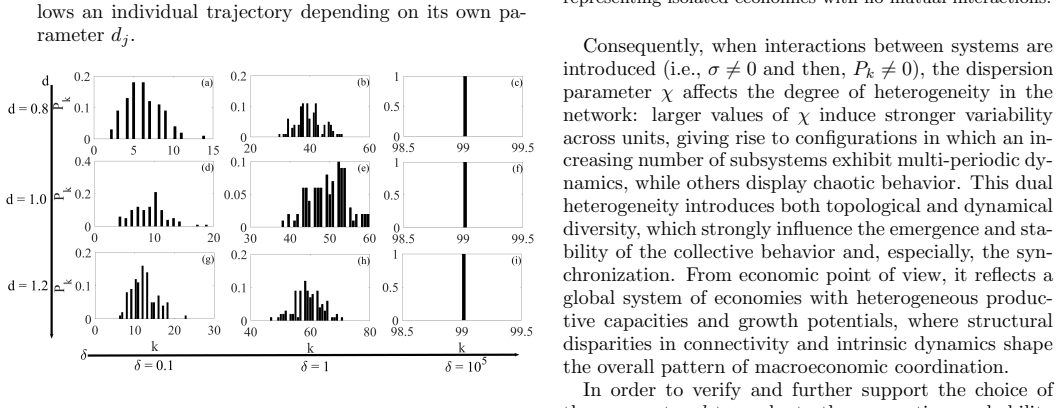
We fo- cus here on the caseδ→+∞andd j =dfor allj
Homogeneous mean-field (HMF) approximation: δ→+∞ To gain analytical insight into the collective dynam- ics of the system, we first examine the idealized limit of a fully connected and homogeneous network. We fo- cus here on the caseδ→+∞andd j =dfor allj. This configuration allows for a mean-field approximation using theHomogeneous Mean-Field Theory[31, 32...
-
[2]
Limit of the homogeneous mean-field approximation The objective of this subsection is to examine the limits of the homogeneous mean-field (HMF) model presented in Sec. III B. To this end, we consider a heterogeneous network structure by adjusting the fitness parameterδ, which controls the connection density and thus modu- lates the network topology. In co...
-
[3]
Homogeneous mean-field approximation in the fully connected heterogeneous economic network We now examine the case of a fully connected net- work (δ= 10 5, as in Fig. 5), in which all economies are uniformly connected and heterogeneity arises solely from their intrinsic dynamics, without any structural asym- metry in connectivity. The main goal here is to...
-
[4]
Reconstruction, Resilience and Recovery of Socio-Economic Networks
Heterogeneous mean-field approximationδ→1 Here we focus on the case of a structurally and dynami- cally heterogeneous network in which the fitness parame- ter satisfiesδ > δ c, ensuring that the system remains con- nected but exhibits nontrivial degree variability. In this regime, the connection probability between two nodesj andkcan be approximated asP j...
-
[5]
D. J. Watts and S. H. Strogatz, nature393, 440 (1998)
work page 1998
-
[6]
A.-L. Barab´ asi and E. Bonabeau, Scientific American 288, 60 (2003)
work page 2003
-
[7]
P. ERDdS and A. R&wi, Publ. math. debrecen6, 18 17 FIG. 20: Synchronization transitions in a heterogeneous net- work forδ= 35×10 −3, composed of nonidentical oscillators, as a function of the coupling strengthσ. Top row (a–c): aver- age order parameterR. Bottom row (d–f): average synchro- nization error⟨e⟩. The values of ¯dare the same as those used in Fi...
work page 1959
-
[8]
A. W. Rives and T. Galitski, Proceedings of the national Academy of sciences100, 1128 (2003)
work page 2003
- [9]
-
[10]
T. Njougouo, T. Carletti, A. Reina, and E. Tuci, in Italian Workshop on Artificial Life and Evolutionary Computation (Springer, 2023), pp. 339–351
work page 2023
-
[11]
B. V. Meylahn and C. Searle, Network Science12, 339 (2024)
work page 2024
-
[12]
B. K. Bera, S. Majhi, D. Ghosh, and M. Perc, Euro- physics Letters118, 10001 (2017)
work page 2017
-
[13]
G. R. Simo, T. Njougouo, R. Aristides, P. Louodop, R. Tchitnga, and H. A. Cerdeira, Physical Review E103, 062304 (2021)
work page 2021
- [14]
-
[15]
M. P´ erez-Ortiz, P. Manescu, F. Caccioli, D. Fern´ andez- Reyes, P. Nachev, and J. Shawe-Taylor, Scientific Re- ports12, 7692 (2022)
work page 2022
-
[16]
G. Cencetti, D. A. Contreras, M. Mancastroppa, and A. Barrat, Physical Review Letters130, 247401 (2023)
work page 2023
- [17]
-
[18]
L. Arola-Fern´ andez, S. Faci-L´ azaro, P. S. Skardal, E.-C. Boghiu, J. G´ omez-Garde˜ nes, and A. Arenas, Communi- cations Physics5, 264 (2022)
work page 2022
-
[19]
T. Njougouo, G. R. Simo, P. Louodop, H. Fotsin, and P. K. Talla, Chaos, Solitons & Fractals139, 110082 (2020)
work page 2020
-
[20]
T. Njougouo, V. Camargo, P. Louodop, F. Fagundes Fer- reira, P. K. Talla, and H. A. Cerdeira, Chaos: An Inter- disciplinary Journal of Nonlinear Science30(2020)
work page 2020
- [21]
-
[22]
F. Schweitzer, G. Fagiolo, D. Sornette, F. Vega-Redondo, A. Vespignani, and D. R. White, science325, 422 (2009)
work page 2009
-
[23]
S. Battiston, J. D. Farmer, A. Flache, D. Garlaschelli, A. G. Haldane, H. Heesterbeek, C. Hommes, C. Jaeger, R. May, and M. Scheffer, Science351, 818 (2016)
work page 2016
-
[24]
A. G. Haldane and R. M. May, Nature469, 351 (2011)
work page 2011
-
[25]
D. Acemoglu, V. M. Carvalho, A. Ozdaglar, and A. Tahbaz-Salehi, Econometrica80, 1977 (2012)
work page 1977
-
[26]
G. Fagiolo, J. Reyes, and S. Schiavo, Journal of Evolu- tionary Economics20, 479 (2010)
work page 2010
-
[27]
M. Bardoscia, P. Barucca, S. Battiston, F. Caccioli, G. Cimini, D. Garlaschelli, F. Saracco, T. Squartini, and G. Caldarelli, Nature Reviews Physics3, 490 (2021)
work page 2021
-
[28]
Bouali, International Journal of Bifurcation and Chaos 9, 745 (1999)
S. Bouali, International Journal of Bifurcation and Chaos 9, 745 (1999)
work page 1999
-
[29]
C. Colon and M. Ghil, Chaos: An Interdisciplinary Jour- nal of Nonlinear Science27(2017)
work page 2017
-
[30]
V. E. Camargo, A. S. Amaral, A. F. Crepaldi, and F. F. Ferreira, Chaos: An Interdisciplinary Journal of Nonlin- ear Science32(2022)
work page 2022
-
[31]
D. Garlaschelli and M. I. Loffredo, Physical Review Let- ters93, 188701 (2004)
work page 2004
-
[32]
A. Wolf, J. B. Swift, H. L. Swinney, and J. A. Vastano, Physica D: nonlinear phenomena16, 285 (1985)
work page 1985
-
[33]
Fiedler, Czechoslovak mathematical journal23, 298 (1973)
M. Fiedler, Czechoslovak mathematical journal23, 298 (1973)
work page 1973
-
[34]
M. O. Jackson and A. Wolinsky, A strategic model of social and economic networks (Springer, 2003)
work page 2003
-
[35]
E. Montbri´ o and D. Paz´ o, Physical Review Letters125, 248101 (2020)
work page 2020
-
[36]
R. E. Mirollo and S. H. Strogatz, Journal of Statistical Physics60, 245 (1990)
work page 1990
-
[37]
Y. Kuramoto and D. Battogtokh, arXiv preprint cond- mat/0210694 (2002)
-
[38]
M. G. Rosenblum, A. S. Pikovsky, and J. Kurths, Phys- ical Review Letters76, 1804 (1996)
work page 1996
-
[39]
Imbs, Review of economics and statistics86, 723 (2004)
J. Imbs, Review of economics and statistics86, 723 (2004)
work page 2004
-
[40]
A. Pikovsky, M. Rosenblum, and J. Kurths, Cambridge university press12(2001)
work page 2001
- [41]
- [42]
-
[43]
S. Boccaletti, J. Kurths, G. Osipov, D. L. Valladares, and C. Zhou, Physics Reports366, 1 (2002)
work page 2002
- [44]
-
[45]
A. A. Koronovskii, O. I. Moskalenko, and A. O. Selskii, Physical Review E109, 064217 (2024)
work page 2024
-
[46]
E. Caprioglio and L. Berthouze, Frontiers in Network Physiology4, 1436046 (2024)
work page 2024
-
[47]
G. Caldarelli, A. Capocci, P. De Los Rios, and M. A. Munoz, Physical review letters89, 258702 (2002)
work page 2002
-
[48]
M. Bogun´ a, R. Pastor-Satorras, and A. Vespignani, Phys- ical review letters90, 028701 (2003)
work page 2003
-
[49]
S. Battiston, D. D. Gatti, M. Gallegati, B. Greenwald, and J. E. Stiglitz, Journal of economic dynamics and con- trol36, 1121 (2012)
work page 2012
discussion (0)
Sign in with ORCID, Apple, or X to comment. Anyone can read and Pith papers without signing in.