Continuous coherent spin-frequency metrology in storage rings via resonant beam-driven detection
Pith reviewed 2026-05-25 05:11 UTC · model grok-4.3
The pith
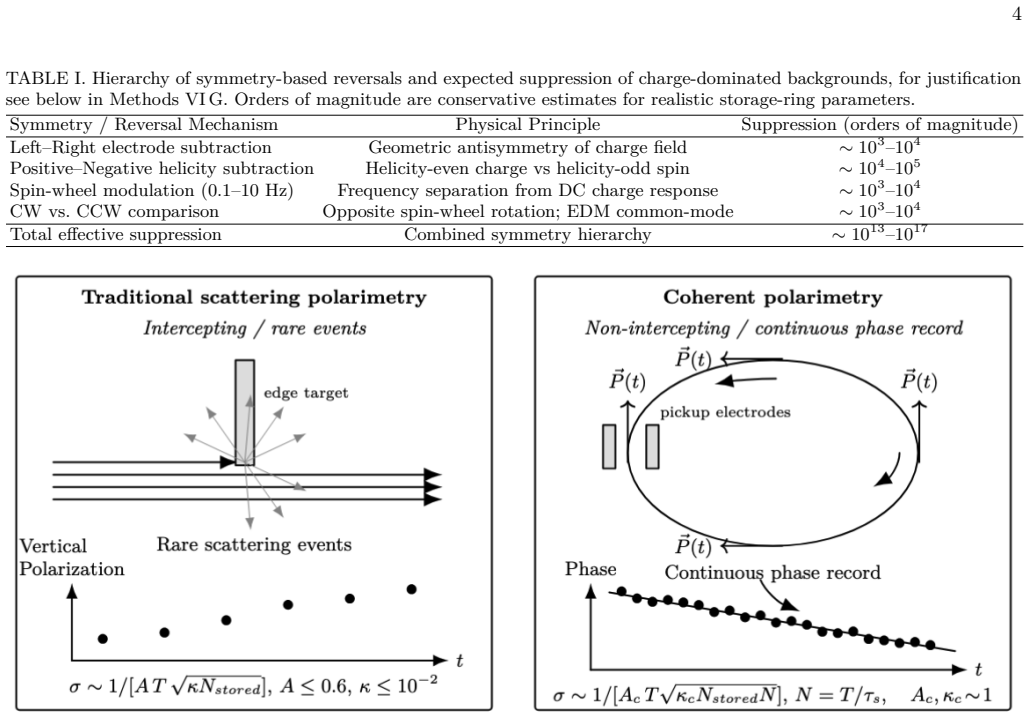
Spin polarization in storage rings generates detectable phase modulation on a high-Q resonator for continuous non-destructive readout.
A machine-rendered reading of the paper's core claim, the machinery that carries it, and where it could break.
Core claim
Spin-dependent electromagnetic fields generated by a polarized relativistic beam establish a differential signal on pickup electrodes that is transduced into narrowband phase modulation of a high-Q resonator; with spin-wheel operation providing the phase reference and background rejection via reversal and demodulation, this yields continuous coherent tracking of spin evolution.
What carries the argument
Resonant beam-driven detection, in which polarized-beam fields modulate a high-Q resonator while geometric symmetry, helicity reversal, and synchronous demodulation reject charge backgrounds.
If this is right
- Continuous monitoring replaces discrete scattering samples and removes the associated efficiency loss.
- Slope-based estimation achieves T to the minus three-halves statistical scaling.
- Usable spin coherence times can reach values approaching 10^5 s with existing accelerator technology.
- Storage-ring EDM searches gain sensitivity approaching the Standard Model expectation.
Where Pith is reading between the lines
- The same resonator architecture might be repurposed for other collective observables in rings beyond spin.
- Phase-coherent readout could reduce certain classes of systematic error that arise from intermittent sampling.
- If coherence times near 10^5 s are realized, the method opens a route to precision tests of fundamental symmetries that were previously statistics-limited.
Load-bearing premise
The spin-dependent fields from the polarized beam produce a usable phase modulation on the resonator while the readout process itself does not introduce enough decoherence to prevent long coherence times.
What would settle it
Failure to observe a phase modulation signal that scales with beam polarization after background subtraction, or measured decoherence rates that prevent coherence times from reaching even 10^4 s under the proposed lattice and cooling conditions.
Figures


read the original abstract
Precision measurements in storage rings are increasingly limited by the ability to monitor collective spin dynamics coherently over long time scales. Existing polarimetry techniques rely on destructive scattering processes that preclude continuous, non-intercepting tracking of spin evolution and constrain both statistical sensitivity and systematic control. Here we introduce a non-destructive, phase-coherent polarimetry method in which the stored beam polarization is treated as a continuous dynamical observable rather than a quantity inferred from scattering events. Spin-dependent electromagnetic fields generated by a polarized relativistic beam establish a symmetry-selected differential signal on pickup electrodes. This signal is transduced into a narrowband phase modulation of a high-Q resonator interrogated with a coherent probe, while dominant charge-induced backgrounds are rejected through geometric symmetry, helicity reversal, and synchronous demodulation. Controlled spin precession (spin-wheel operation) provides a stable phase reference enabling phase-coherent detection of slow spin evolution. Combined with optimized lattice symmetry and beam cooling, this approach can substantially extend the usable spin coherence time, with values approaching 10^5 s appearing realistic within existing accelerator technology. The resulting readout supports optimal slope-based estimation with T^{-3/2} statistical scaling while eliminating the efficiency penalties inherent to scattering-based polarimetry. For storage-ring EDM experiments, this combination enables sensitivity approaching the level expected within the Standard Model. More broadly, the method establishes a general phase-coherent architecture for collective spin measurements in storage rings, adapting resonant sensing concepts from axion dark-matter searches to charged-particle precision experiments.
Editorial analysis
A structured set of objections, weighed in public.
Referee Report
Summary. The manuscript proposes a non-destructive polarimetry method for storage rings in which polarized-beam spin-dependent electromagnetic fields induce a symmetry-selected differential signal on pickup electrodes. This signal is transduced into narrowband phase modulation on a high-Q resonator, with charge backgrounds rejected via geometric symmetry, helicity reversal, and synchronous demodulation. Controlled spin precession provides a phase reference, and the approach is claimed to enable spin coherence times approaching 10^5 s (with optimized lattice symmetry and beam cooling), T^{-3/2} statistical scaling, and EDM sensitivity at Standard Model levels while eliminating scattering-based efficiency penalties.
Significance. If the transduction and background-rejection steps can be realized at the required levels without introducing decoherence, the method would enable continuous coherent spin-frequency metrology in storage rings. This would remove a key limitation of existing destructive polarimetry, supporting longer integration times and improved statistical sensitivity for EDM and related precision experiments. The adaptation of resonant-sensing techniques from axion searches constitutes a potentially useful cross-field transfer.
major comments (1)
- [Abstract] Abstract: the central claims that coherence times approaching 10^5 s are realistic within existing accelerator technology and that the readout supports T^{-3/2} scaling with Standard Model-level EDM sensitivity rest on the unquantified assumption that spin-dependent fields produce detectable narrowband phase modulation while charge backgrounds are rejected to levels that preserve the claimed coherence without added decoherence. No estimates of differential field amplitudes, electrode coupling, modulation depth, post-demodulation noise floors, or beam back-action are provided, rendering the feasibility assertions unsupported.
Simulated Author's Rebuttal
We thank the referee for the detailed review and the recognition of the method's potential. We address the single major comment below and have revised the manuscript to strengthen the quantitative support for the feasibility claims.
read point-by-point responses
-
Referee: [Abstract] Abstract: the central claims that coherence times approaching 10^5 s are realistic within existing accelerator technology and that the readout supports T^{-3/2} scaling with Standard Model-level EDM sensitivity rest on the unquantified assumption that spin-dependent fields produce detectable narrowband phase modulation while charge backgrounds are rejected to levels that preserve the claimed coherence without added decoherence. No estimates of differential field amplitudes, electrode coupling, modulation depth, post-demodulation noise floors, or beam back-action are provided, rendering the feasibility assertions unsupported.
Authors: We agree that the abstract presents the central claims without accompanying quantitative estimates, which leaves the feasibility assertions insufficiently supported on their own. In the revised manuscript we have added a new subsection (Section 3.2) that supplies order-of-magnitude estimates for the spin-dependent differential field amplitudes at the pickup electrodes, the geometric coupling factor to the high-Q resonator, the resulting phase-modulation depth, the post-demodulation noise floor after synchronous detection, and an upper bound on beam back-action. These calculations show that the narrowband signal remains detectable while the symmetry-based rejection and helicity reversal keep residual charge backgrounds below the level that would induce measurable decoherence. The T^{-3/2} statistical scaling is derived explicitly from the phase-coherent slope estimator in Section 4.2 and does not rely on additional assumptions beyond the continuous readout. We have also inserted a brief reference to these estimates into the abstract itself. revision: yes
Circularity Check
No circularity: proposal introduces new detection architecture without self-referential derivations
full rationale
The manuscript is a methodological proposal for resonant beam-driven polarimetry. No equations, fitted parameters, or performance claims (e.g., 10^5 s coherence, T^{-3/2} scaling) are shown to reduce by construction to inputs via self-definition, fitted-input prediction, or load-bearing self-citation. The text adapts external concepts from axion searches and accelerator technology; the central transduction and background-rejection steps remain forward-looking feasibility statements rather than closed derivations. This is the normal non-circular outcome for an instrumentation proposal.
Axiom & Free-Parameter Ledger
Reference graph
Works this paper leans on
-
[1]
RF system
Resonator design point and bandwidth The pickup electrodes (PE) are located at room tem- perature and act purely as broadband field sensors for the beam-induced electromagnetic signal. Each electrode plate is capacitively coupled to the readout chain, and the signals from the left and right plates are combined in a hybrid subtractor that forms their diffe...
-
[2]
Gaussian form factor The LC resonator responds to the Fourier component of the periodic bunch-train voltage waveform in a narrow band aroundω0 = 2πf0. For an rms bunch lengthσz and Gaussian longitudinal profile, the bunch form factor at angular frequencyωis F(ω) = exp [ −(ωσt)2 2 ] , σ t = σz βc.(62) Forσz = 0.994m andβ≃0.6,σt≃5.52ns andF(ω0)≃ 0.82atf 0 =...
-
[3]
Transverse ensemble averaging and betatron enhancement The instantaneous spin-induced field at the pickup electrodes depends on the transverse displacement of in- dividual particles executing betatron oscillations. While the beam centroid remains approximately centered be- tween the pickup plates, individual particles oscillate about the equilibrium orbit...
-
[4]
The same fac- tor applies to the spin-wheel sidebandsω0±Ωsw for Ω sw≪ω0
Bunch-train scaling For a uniformly distributed train ofNb bunches, the complex Fourier component nearω0 adds coherently, ˜Vtrain(ω0)≃NbF(ω0)˜V1,δ(ω0),(67) so the effective enhancement factor per direction is NbF≃66for the baseline parameters. The same fac- tor applies to the spin-wheel sidebandsω0±Ωsw for Ω sw≪ω0. The LC resonator does not measure the in...
-
[5]
Line-charge scale Modeling the bunch as a relativistic line charge with linear densityλ≃Npe/Leff, the transverse electric field at distanceris Ech(r)∼ λ 2πε0r≃ Npe 2πε0rL eff .(73) For representative parameters this yieldsEch∼17V/m, manyordersofmagnitudelargerthanthespin-dependent field. In principle, increasing the number of pickup-electrode stations can...
-
[6]
inde- pendent samples
Leakage from charge pickup: centroid offset and helicity rejection The bunch charge produces a large common-mode sig- nal on the pickup electrodes. For a centered beam this signalisidenticalonthetwoplatesandisrejectedbyleft– right subtraction. The dominant residual arises from a finite beam centroid offsetδx≡⟨x⟩relative to the elec- trode midpoint at tran...
-
[7]
spin-projection-noise-limited
General slope-estimation result (with explicit sampling time) Consider a time series sampled uniformly at timestk = kτs over a total durationT≃Nτs, modeled as xk =x 0 +bt k +nk,(87) wherebis the slope (units:1/sifxis a phase), and the noise samples are independent with E[nk] = 0,Var(n k) =σ2 x.(88) Hereσx is theper-sample rmsofx(e.g. radians ifxis a phase...
-
[8]
utilization× analyzing-power
Comparison with scattering polarimetry Scattering polarimetry: event-counting statistics.A conventional scattering polarimeter infers polarization from an asymmetry in detected scattering events [30]. For a given time gate (or fill) in whichNdet events are recorded and the effective analyzing power isA, a stan- dard estimator is ˆP= 1 A N+−N− N+ +N− ,(92)...
-
[9]
Muong−2as a contrasting regime (finite lifetime) Potential muong−2experimental sensitivity at 28GeV. A closely analogous situation occurs in the muong−2 experiments, where the measurement is intrinsically lim- ited to∼1/Tscaling because the muons decay, so that each fill provides effectively only a single polarization- precession estimate over the lifetim...
-
[10]
As a result, it typically provides at most one effective polarization (or spin-angle) estimate per fill (or per short gate)
The common storage-ring regime: one effective estimate per fill The common storage-ring regime: one effective esti- mate per fill.In many practical storage-ring operating modes, scattering polarimetry is intercepting and there- fore depletes the stored beam. As a result, it typically provides at most one effective polarization (or spin-angle) estimate per...
-
[11]
independent samples
Multiple pickups, SQL, and the meaning of “independent samples” Two-resonator readout and the SQL.With two spa- tially separated resonators interrogating the same stored bunch, the measured phases may be written asϕ1,2(t) = ϕspin(t)+n 1,2(t), whereϕspin is the common spin-induced phase (including the intrinsic spin-projection fluctuations of the stored en...
-
[12]
spin wheel
Comparison to axion dark matter search sensitivities and estimation of thermal noise sources It is instructive to contrast the phase-noise floor of co- herent storage-ring polarimetry with that achieved in ax- ion dark-matter searches employing resonant probing. In axion haloscopes, the dominant noise arises from vacuum and thermal fluctuations of the cav...
-
[13]
A. D. Ludlow, M. M. Boyd, J. Ye, E. Peik, and P. O. Schmidt, Optical atomic clocks, Rev. Mod. Phys.87, 637 (2015)
2015
-
[14]
D. F. Jackson Kimball, A. O. Sushkov, and D. Budker, Precessing ferromagnetic needle magnetometer, Phys. Rev. Lett.116, 190801 (2016)
2016
-
[15]
X. Ni, Z. Zou, R. Lecamwasam, A. Vinante, D. Budker, P. K. Lam, T. Wang, and J. Gong, Microscopic theory of a precessing ferromagnet for ultrasensitive magnetom- etry, Phys. Rev. Res.7, 043120 (2025)
2025
-
[16]
S. M. Kay,Fundamentals of Statistical Signal Processing, Volume I: Estimation Theory(Prentice Hall, 1993)
1993
-
[17]
S. Schmitt, T. Gefen, F. M. Stürner, T. Unden, G. Wolff, C. Müller, J. Scheuer, B. Naydenov, M. Markham, S. Pezzagna, J. Meijer, I. Schwarz, M. Plenio, A. Retzker, L. P. McGuinness, and F. Jelezko, Submillihertz magnetic spectroscopy performed with a nanoscale quantum sensor, Science356, 832 (2017), https://www.science.org/doi/pdf/10.1126/science.aam5532
-
[18]
Omarov, H
Z. Omarov, H. Davoudiasl, S. Hacıömeroğlu, V. Lebe- dev, W. M. Morse, Y. K. Semertzidis, A. J. Silenko, E. J. Stephenson, and R. Suleiman, Comprehensive symmetric-hybrid ring design for a proton edm experi- ment at below10 −29 e·cm, Phys. Rev. D105, 032001 (2022)
2022
-
[19]
F. J. M. Farley, K. Jungmann, J. P. Miller, W. M. Morse, Y. F. Orlov, B. L. Roberts, Y. K. Semertzidis, A. Silenko, and E. J. Stephenson, New method of measuring electric dipole moments in storage rings, Phys. Rev. Lett.93, 052001 (2004)
2004
-
[20]
Jeong, E
H. Jeong, E. Won, Y. K. Semertzidis, E. J. Stephen- son, and S. Park, An implementation of spin-dependent hadron elastic scattering in GEANT4, J. Korean Phys. Soc.80, 437 (2022)
2022
-
[21]
Y.Huang, H.Wang, R.A.Rimmer, S.Wang,andJ.Guo, Ultrafast harmonic rf kicker design and beam dynamics analysis for an energy recovery linac based electron cir- culator cooler ring, Phys. Rev. Accel. Beams19, 084201 (2016)
2016
-
[22]
Cameron, A
P. Cameron, A. Luccio, T. Shea, N. Tsoupas, and D. Goldberg, Squids, snakes and polarimeters: a new technique for measuring the magnetic moments of po- larized beams, inAIP Conference Proceedings, Vol. 390 (American Institute of Physics, 1997) pp. 306–315
1997
-
[23]
Cameron, M
P. Cameron, M. Blaskiewicz, Y. S. Derbenev, D. Gold- berg, A. Luccio, F. Mariam, T. Shea, M. Syphers, and N. Tsoupas,Absolute Calibration and Beam Background of the Squid Polarimeter, Tech. Rep. (Brookhaven Na- tional Laboratory (BNL), Upton, NY (United States), 1996)
1996
-
[24]
Blaskiewicz, P
M. Blaskiewicz, P. Cameron, and T. Shea,Absolute cali- bration and beam background of the Squid Polarimeter, Tech. Rep. (Brookhaven National Lab.(BNL), Upton, NY (United States); Lawrence Berkeley ..., 1996)
1996
-
[25]
Y. S. Derbenev, Radio-frequency polarimetry, inAIP Conference Proceedings, Vol. 421 (American Institute of Physics, 1998) pp. 191–199
1998
-
[26]
Roberts,Resonant Magnetometry and Polarimetry, Tech
B. Roberts,Resonant Magnetometry and Polarimetry, Tech. Rep. DE-SC0017120 (DOE Nuclear Physics SBIR, 2021)
2021
-
[27]
Omarovet al., Speeding axion haloscope experiments using heterodyne-variance-based detection with a power meter, Physical Review D107, 103005 (2023)
Z. Omarovet al., Speeding axion haloscope experiments using heterodyne-variance-based detection with a power meter, Physical Review D107, 103005 (2023)
2023
-
[28]
Davoudiasl and Y
H. Davoudiasl and Y. K. Semertzidis, Cosmic axions re- vealed via amplified modulation of the ellipticity of a laser, Phys. Rev. D113, 032012 (2026)
2026
-
[29]
Koop, Asymmetric Energy Colliding Ion Beams in the EDM Storage Ring, in4th International Particle Accel- erator Conference(2013) p
I. Koop, Asymmetric Energy Colliding Ion Beams in the EDM Storage Ring, in4th International Particle Accel- erator Conference(2013) p. TUPWO040
2013
-
[30]
I. A. Koop, Colliding or co-rotating ion beams in stor- age rings for EDM search, Phys. Scripta T166, 014034 (2015)
2015
-
[31]
D. C. Rife and R. R. Boorstyn, Single tone parameter estimation from discrete-time observations, IEEE Trans- actions on Information Theory20, 591 (1974)
1974
-
[32]
B. G. Quinn, Threshold behavior of the maximum likeli- hood estimator of frequency, IEEE Transactions on Sig- nal Processing42, 3291 (1994)
1994
-
[33]
S. A. Tretter, Estimating the frequency of a noisy sinu- soid by linear regression, IEEE Transactions on Informa- tion Theory31, 832 (1985)
1985
-
[34]
Boashash, Estimating and interpreting the instanta- neous frequency of a signal
B. Boashash, Estimating and interpreting the instanta- neous frequency of a signal. I. fundamentals, Proceedings of the IEEE80, 520 (1992)
1992
-
[35]
Guidoboniet al.(JEDI), How to Reach a Thousand- Second in-Plane Polarization Lifetime with 0.97-GeV/c Deuterons in a Storage Ring, Phys
G. Guidoboniet al.(JEDI), How to Reach a Thousand- Second in-Plane Polarization Lifetime with 0.97-GeV/c Deuterons in a Storage Ring, Phys. Rev. Lett.117, 054801 (2016)
2016
-
[36]
E. L. Hahn, Spin echoes, Phys. Rev.80(1950)
1950
-
[37]
P. W. Graham and S. Rajendran, New observables for direct detection of axion dark matter, Phys. Rev. D88, 035023 (2013)
2013
-
[38]
P. W. Graham, S. Hacıömeroğlu, D. E. Kaplan, Z. Omarov, S. Rajendran, and Y. K. Semertzidis, Storage ring probes of dark matter and dark energy, Phys. Rev. D103, 055010 (2021)
2021
- [39]
- [40]
-
[41]
Collins, Phase-Locked Loop (PLL) Fundamentals, Analog Dialogue (2018)
I. Collins, Phase-Locked Loop (PLL) Fundamentals, Analog Dialogue (2018)
2018
-
[42]
O.KimandY.K.Semertzidis,Newmethodofprobingan oscillating EDM induced by axionlike dark matter using an rf Wien filter in storage rings, Physical Review D104, 096006 (2021)
2021
-
[43]
H. Davoudiasl and Y. K. Semertzidis, Cosmic axions revealed via amplified modulation of ellipticity of laser (caramel) (2025), arXiv:2506.24022 [hep-ph]
-
[44]
Gerberding, C
O. Gerberding, C. Diekmann, I. Bykov, J. J. E. Delgado, M. Steger,et al., Readout for intersatellite laser interfer- ometry: Measuring low frequency phase fluctuations of hf signals with microradian precision, Physical Review D 91, 042003 (2015)
2015
-
[45]
Gerberding, B
O. Gerberding, B. Sheard, and G. Heinzel, A phasemeter for laser heterodyne interferometry in space, Review of Scientific Instruments84, 074501 (2013)
2013
-
[46]
Tinto and S
M. Tinto and S. V. Dhurandhar, Time-delay interferom- etry, Living Reviews in Relativity17, 6 (2014)
2014
-
[47]
D. W. Allan, Statistics of atomic frequency standards, 32 Proceedings of the IEEE54, 221 (1966)
1966
-
[48]
Bovet, R
C. Bovet, R. Gouiran, I. Gumowski, and K. Reich,A Selection of Formulae and Data Useful for the Design of A.G. Synchrotrons, Tech. Rep. CERN-MPS-SI-Int-DL- 70-4 (CERN, Geneva, 1970)
1970
-
[49]
Ammendola, A
R. Ammendola, A. Apponi, G. Benato, M. Betti, R. Biondi, P. Bos, G. Cavoto, M. Cadeddu, A. Casale, O. Castellano, E. Celasco, L. Cecchini, M. Chirico, W. Chung, A. Cocco, A. Colijn, B. Corcione, N. D’Ambrosio, M. D’Incecco, G. De Bellis, M. De Deo, N. de Groot, A. Esposito, M. Farino, S. Farinon, A. Ferella, L. Ferro, L. Ficcadenti, G. Galbato Muscio, S. ...
-
[50]
G. W. Bennettet al., Statistical equations and methods applied to the precision muon(g−2)experiment at BNL, Nuclear Instruments and Methods in Physics Research Section A579, 1096 (2007)
2007
-
[51]
D. J. Wineland, J. J. Bollinger, W. M. Itano, and D. J. Heinzen, Squeezed atomic states and projection noise in spectroscopy, Phys. Rev. A50, 67 (1994)
1994
-
[52]
Hostenet al., Measurement noise 100 times lower than the quantum-projection limit using entangled atoms, Na- ture529, 505 (2016)
O. Hostenet al., Measurement noise 100 times lower than the quantum-projection limit using entangled atoms, Na- ture529, 505 (2016)
2016
discussion (0)
Sign in with ORCID, Apple, or X to comment. Anyone can read and Pith papers without signing in.