Field evolution of the magnetic structure and spin Hamiltonian in Cs₂RuO₄
Pith reviewed 2026-05-25 03:28 UTC · model grok-4.3
The pith
Neutron diffraction confirms the predicted field evolution of the magnetic structure in Cs₂RuO₄ while SU(3) spin-wave analysis fixes the parameters of its minimal spin Hamiltonian.
A machine-rendered reading of the paper's core claim, the machinery that carries it, and where it could break.
Core claim
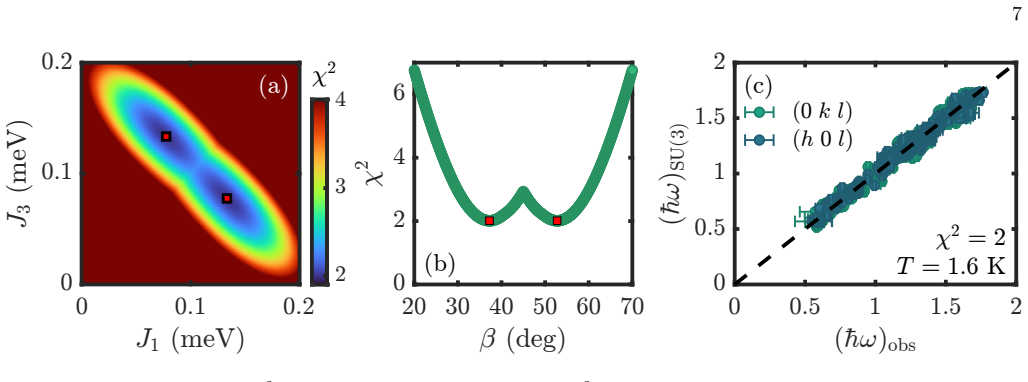
We quantitatively confirm the predicted field evolution of the magnetic structure using neutron diffraction. Furthermore, analysis of the excitation spectrum within an SU(3) spin-wave framework resolves previously undetermined parameters of the minimal spin Hamiltonian and lifts the associated degeneracies.
What carries the argument
The SU(3) spin-wave framework applied to the measured excitation spectrum, which resolves the numerical values and removes degeneracies in the minimal spin Hamiltonian that incorporates frustration between alternating single-ion anisotropy planes.
If this is right
- The spin Hamiltonian is now fully parameterized, allowing direct calculation of the field-temperature phase diagram.
- The spin-flop-like transition and the quantum critical point inside the ordered phase are experimentally supported.
- Frustration between alternating single-ion anisotropy planes is established as the dominant mechanism governing the field evolution.
- The excitation spectrum is reproduced without extra terms, confirming the minimal model suffices for this material.
Where Pith is reading between the lines
- The now-complete Hamiltonian can be used to forecast the response of related layered ruthenates that share similar anisotropy patterns.
- Application of the same SU(3) framework at finite temperature could identify additional crossovers not captured by zero-field data alone.
- If the model remains accurate, small changes in anisotropy strength in chemically substituted variants should shift the location of the internal quantum critical point in a predictable way.
Load-bearing premise
The minimal spin Hamiltonian together with the SU(3) spin-wave framework is sufficient to describe the measured excitation spectrum without requiring additional interaction terms or corrections beyond those already identified.
What would settle it
Detection of additional spectral branches or intensity patterns in the excitation spectrum that cannot be reproduced by the fitted minimal Hamiltonian parameters within experimental resolution.
Figures


read the original abstract
We report neutron diffraction under applied magnetic fields and complementary zero-field neutron spectroscopy measurements on Cs$_2$RuO$_4$. Previous work [Phys. Rev. B. 112, 134436 (2025)] identified a spin-flop-like transition accompanied by a quantum critical point within the ordered phase, attributed to strong frustration between alternating single-ion anisotropy planes. Here, we quantitatively confirm the predicted field evolution of the magnetic structure using neutron diffraction. Furthermore, analysis of the excitation spectrum within an SU(3) spin-wave framework resolves previously undetermined parameters of the minimal spin Hamiltonian and lifts the associated degeneracies.
Editorial analysis
A structured set of objections, weighed in public.
Referee Report
Summary. The paper reports neutron diffraction under applied magnetic fields and zero-field neutron spectroscopy on Cs₂RuO₄. It claims to quantitatively confirm the predicted field evolution of the magnetic structure (from prior work) and, via SU(3) spin-wave analysis of the excitation spectrum, to resolve previously undetermined parameters of the minimal spin Hamiltonian while lifting associated degeneracies.
Significance. If the central claims hold, the work supplies quantitative experimental validation of a frustration-driven field-induced transition and determines key Hamiltonian parameters in a material near a quantum critical point; this would be a useful contribution to the study of competing anisotropies and spin-wave descriptions in frustrated magnets.
major comments (1)
- [Abstract] Abstract: the claim that the SU(3) spin-wave analysis resolves the undetermined parameters and lifts degeneracies rests on the premise that the minimal spin Hamiltonian (with only terms identified in the prior work) plus linear SU(3) spin-wave theory fully accounts for all observed modes; no independent test or benchmark against possible additional terms (e.g., further-neighbor exchange or higher-order anisotropy) is indicated, which is load-bearing near the frustration-driven QCP where small omitted interactions can shift positions and intensities enough to produce apparently good but non-unique fits.
Simulated Author's Rebuttal
We thank the referee for the detailed and constructive report. We address the single major comment below, acknowledging the importance of validating the minimal Hamiltonian near the QCP.
read point-by-point responses
-
Referee: [Abstract] Abstract: the claim that the SU(3) spin-wave analysis resolves the undetermined parameters and lifts degeneracies rests on the premise that the minimal spin Hamiltonian (with only terms identified in the prior work) plus linear SU(3) spin-wave theory fully accounts for all observed modes; no independent test or benchmark against possible additional terms (e.g., further-neighbor exchange or higher-order anisotropy) is indicated, which is load-bearing near the frustration-driven QCP where small omitted interactions can shift positions and intensities enough to produce apparently good but non-unique fits.
Authors: We agree this is a substantive point: the resolution of parameters is performed within the minimal Hamiltonian established by the prior work, and the manuscript does not explicitly benchmark against additional interactions. The excellent quantitative agreement between the predicted field evolution (from the minimal model) and the new diffraction data provides supporting evidence for sufficiency, but we accept that an explicit statement is warranted. We will revise the abstract to qualify the claim as holding within the minimal model, and add a short paragraph in the discussion section noting that further-neighbor or higher-order terms remain possible but are not required by the current data set; we will also state that a full exploration of extended models lies beyond the present scope. revision: partial
Circularity Check
No significant circularity; claims rest on new experimental data
full rationale
The paper reports new neutron diffraction data to quantitatively confirm the field evolution of the magnetic structure and new zero-field spectroscopy data analyzed in an SU(3) spin-wave framework to resolve Hamiltonian parameters. These steps rely on independent measurements rather than reducing to self-definitions, fitted inputs renamed as predictions, or load-bearing self-citations whose validity is unverified. The cited prior work supplies context for the minimal model and its predicted transition, but the present claims are externally benchmarked against fresh diffraction and spectroscopic observations. No derivation chain collapses to its inputs by construction.
Axiom & Free-Parameter Ledger
free parameters (1)
- undetermined parameters of the minimal spin Hamiltonian
axioms (1)
- domain assumption The SU(3) spin-wave framework accurately captures the excitation spectrum of Cs2RuO4
Reference graph
Works this paper leans on
-
[1]
Domain treatment Due to a high-temperature hexagonal-to-orthorhombic structuralphasetransitionduringcrystalgrowth[20], the sample contains three crystallographic domains sharing theaaxis and rotated by approximately60◦with respect to each other. Since|b|/|c|≈ √ 3, the structure remains 20 22 240 2 4I(a.u.) #103 (301)(b)A 14 16 18 (312 12)(c)B 0 2 4 (312!1...
-
[2]
To this end, 315 nuclear Bragg peaks were collected as rocking curves counting 1 s per point
Nuclear refinement Now that the domain treatment and mass ratios are established, the nuclear structure was refined at 15 K, aboveT N, to determine the atomic positions and the overall scale factor required for subsequent magnetic re- finements. To this end, 315 nuclear Bragg peaks were collected as rocking curves counting 1 s per point. A baseline backgr...
-
[3]
Order parameter evolution The ZF magnetic propagation vectork= (0 0.5 0.5)
-
[4]
A baseline background was subtracted using intensities measured at 15 K, aboveTN
was tracked as a function of applied field up to 6 T by monitoring the intensities of three magnetic Bragg peaks on D23 and Zebra, with counting times of 20 and 90 s per field, respectively. A baseline background was subtracted using intensities measured at 15 K, aboveTN. The resulting field dependences are shown in Fig. 4. The three reflections, (0 0.5 1...
-
[5]
Magnetic structure refinement framework Magnetic structures are described within the propagation-vector formalism, following the proce- dure outlined in Ref. [13]. Themagneticmomentonionjinunitcellnatposition Rn can be expressed as a Fourier expansion, mn,j = ∑ k A(k) j e−ik·Rn,(3) wherekis the magnetic propagation vector defining the periodicity of the m...
-
[6]
Integrated intensities were corrected for the Lorentz factor
Vicinity of QCP (4.25 T) The magnetic structure at 4.25 T was determined from 27 magnetic reflections collected as rocking curves with a counting time of 20 s/point. Integrated intensities were corrected for the Lorentz factor. Of all irreps compati- ble with the propagation vector,Γ 2 again provided the best fit. A good agreement with the data was achiev...
-
[7]
As at 4.25 T,Γ 2 provided the best fit among all compatible irreps
Spin-flop phase (6 T) The magnetic structure at 6 T was determined from 30 magnetic reflections collected and corrected for the Lorentz factor. As at 4.25 T,Γ 2 provided the best fit among all compatible irreps. A minimal one-parameter solution using only refined coefficientC 3 = 1.73(2)µB FIG. 6. Schematic overview of the magnetic structures at µ0H= (a) ...
- [8]
- [9]
- [10]
- [11]
-
[12]
T. Ono, H. Tanaka, H. Aruga Katori, F. Ishikawa, H. Mi- tamura, and T. Goto, Magnetization plateau in the frus- trated quantum spin systemCs2CuBr4, Phys. Rev. B67, 104431 (2003)
work page 2003
-
[13]
N. A. Fortune, S. T. Hannahs, Y. Yoshida, T. E. Sher- line, T. Ono, H. Tanaka, and Y. Takano, Cascade of magnetic-field-induced quantum phase transitions in a spin- 1 2 triangular-lattice antiferromagnet, Phys. Rev. Lett.102, 257201 (2009)
work page 2009
-
[14]
M. Kenzelmann, R. Coldea, D. A. Tennant, D. Visser, M. Hofmann, P. Smeibidl, and Z. Tylczynski, Order- to-disorder transition in theXY-like quantum magnet Cs2CoCl4 inducedbynoncommutingappliedfields,Phys. Rev. B65, 144432 (2002)
work page 2002
-
[15]
O. Breunig, M. Garst, E. Sela, B. Buldmann, P. Becker, L. Bohatý, R. Müller, and T. Lorenz, Spin-1 2 XXZ chain systemCs 2CoCl4 in a transverse magnetic field, Phys. Rev. Lett.111, 187202 (2013). 9
work page 2013
-
[16]
O. Breunig, M. Garst, A. Rosch, E. Sela, B. Buldmann, P. Becker, L. Bohatý, R. Müller, and T. Lorenz, Low- temperature ordered phases of the spin-1 2 XXZ chain sys- temCs 2CoCl4, Phys. Rev. B91, 024423 (2015)
work page 2015
-
[17]
K. Y. Povarov, L. Facheris, S. Velja, D. Blosser, Z. Yan, S. Gvasaliya, and A. Zheludev, Magnetization plateaux cascade in the frustrated quantum antiferro- magnetCs 2CoBr4, Phys. Rev. Res.2, 043384 (2020)
work page 2020
-
[18]
L. Facheris, K. Y. Povarov, S. D. Nabi, D. G. Mazzone, J. Lass, B. Roessli, E. Ressouche, Z. Yan, S. Gvasaliya, and A. Zheludev, Spin density wave versus fractional magnetization plateau in a triangular antiferromagnet, Phys. Rev. Lett.129, 087201 (2022)
work page 2022
-
[19]
L. Facheris, S. D. Nabi, A. Glezer Moshe, U. Nagel, T. Rõ om, K. Y. Povarov, J. R. Stewart, Z. Yan, and A. Zhe- ludev, Confinement of fractional excitations in a triangu- lar lattice antiferromagnet, Phys. Rev. Lett.130, 256702 (2023)
work page 2023
-
[20]
L. Facheris, S. D. Nabi, K. Y. Povarov, Z. Yan, A. G. Moshe, U. Nagel, T. Rõ om, A. Podlesnyak, E. Ressouche, K. Beauvois, J. R. Stewart, P. Manuel, D. Khalyavin, F. Orlandi, and A. Zheludev, Magnetic field induced phases and spin Hamiltonian inCs2CoBr4, Phys. Rev. B109, 104433 (2024)
work page 2024
-
[21]
S. D. Nabi, L. Facheris, V. Romerio, V. Kocsis, K. Y. Povarov, D. Sheptyakov, J. Lass, D. G. Mazzone, H. Kikuchi, T. Masuda, S. A. Barnett, D. R. Allan, Z. Yan, S. Gvasaliya, and A. Zheludev, Magnetic phase diagram and spin hamiltonian of antiferromagnet cs2coi4 (2026), arXiv:2603.08237 [cond-mat.str-el]
-
[22]
S. D. Nabi, M. Zhu, K. Y. Povarov, D. G. Mazzone, J. Lass, Y. Wu, Z. Yan, S. Gvasaliya, and A. Zhe- ludev, Spin-flop-like transition as quantum critical point inCs 2RuO4, Phys. Rev. B112, 134436 (2025)
work page 2025
-
[23]
J. Rodríguez-Carvajal, Recent advances in magnetic structure determination by neutron powder diffraction, Physica B: Condensed Matter192, 55 (1993)
work page 1993
-
[24]
J. Lass, H. Jacobsen, K. M. L. Krighaar, D. Graf, F. Groitl, F. Herzog, M. Yamada, C. Kägi, R. A. Müller, R. Bürge, M. Schild, M. S. Lehmann, A. Bollhalder, P. Keller, M. Bartkowiak, U. Filges, U. Greuter, G. Thei- del, H. M. Rønnow, C. Niedermayer, and D. G. Mazzone, Commissioning of the novel Continuous Angle Multi- energy Analysis spectrometer at the P...
work page 2023
-
[25]
J. Lass, H. Jacobsen, D. G. Mazzone, and K. Lefmann, MJOLNIR: A software package for multiplexing neutron spectrometers, SoftwareX12, 100600 (2020)
work page 2020
-
[26]
D. Dahlbom, H. Zhang, C. Miles, S. Quinn, A. Niraula, B. Thipe, M. Wilson, S. Matin, H. Mankad, S. Hahn, D. Pajerowski, S. Johnston, Z. Wang, H. Lane, Y. W. Li, X. Bai, M. Mourigal, C. D. Batista, and K. Bar- ros, Sunny.jl: A Julia package for spin dynamics (2025), arXiv:2501.13095 [quant-ph]
-
[27]
E. H. P. Cordfunke, R. R. Laan, and E. F. Westrum Jr., The thermochemical and thermophysical properties of Cs2RuO4 andCs 2MnO4 at temperatures from 5 K to 1000 K, ChemInform23(2010)
work page 2010
-
[28]
A. J. C. Wilson and V. Geist, International Tables for Crystallography. Volume C: Mathematical, Physical and Chemical Tables., Crystal Research and Technology28, 110 (1993)
work page 1993
-
[29]
B. E. Prasad, S. Sadhukhan, T. C. Hansen, C. Felser, S. Kanungo, and M. Jansen, Synthesis, crystal and mag- netic structure of the spin-chain compoundAg 2RuO4, Phys. Rev. Mater.4, 024418 (2020)
work page 2020
-
[30]
K. M. Mogare, D. Sheptyakov, R. Bircher, H. U. Güdel, and M. Jansen, Neutron diffraction study of the magnetic structure ofNa 2RuO4, The European Physical Journal B - Condensed Matter and Complex Systems52, 371 (2006)
work page 2006
discussion (0)
Sign in with ORCID, Apple, or X to comment. Anyone can read and Pith papers without signing in.