Energy-Efficient THz Sensing with Hybrid THz/VLC Communication Under Human Blockage Effects
Pith reviewed 2026-05-25 04:00 UTC · model grok-4.3
The pith
Hybrid THz/VLC indoor system maintains reliable coverage and high energy efficiency by routing users to VLC access points under blockages.
A machine-rendered reading of the paper's core claim, the machinery that carries it, and where it could break.
Core claim
The central claim is that optimal power allocation between the THz sensing and THz communication access points, accounting for monostatic sensing metrics under human blockages, followed by mixed-integer linear programming minimization of total network power through selective activation of VLC access points, allows all users to maintain reliable coverage while attaining high energy efficiency; without blockages the majority of users connect to the THz communication link, whereas blockages cause the majority to be served by the VLC links.
What carries the argument
Mixed-integer linear programming optimization that selects active VLC communication access points and assigns their transmit powers, after power allocation between the THz sensing and THz communication access points is set using monostatic sensing metrics under blockages.
If this is right
- Without blockages most users remain connected to the THz communication access point.
- With blockages the majority of users are served by the VLC access points.
- All users maintain reliable coverage in both scenarios.
- The network achieves high energy efficiency overall.
- Average energy efficiency, spectral efficiency, sensing rate, and communication rate are reported as performance metrics.
- pith_inferences
Where Pith is reading between the lines
- The same optimization structure could be tested in multi-room layouts to see whether VLC activation still dominates under realistic mobility.
- Extending the framework to include user mobility tracking might reveal how quickly the mixed-integer program must be re-solved to keep coverage.
- The approach suggests that hybrid optical-radio systems can reduce total power by treating VLC as a low-power fallback rather than a permanent parallel layer.
- Validating the sensing metrics against measured human blockage traces would tighten the link between the model and deployment outcomes.
- keywords
Load-bearing premise
The monostatic sensing performance metrics under human blockages can be accurately evaluated and the mixed-integer linear program will produce the claimed energy-efficiency gains when applied to real channel conditions.
What would settle it
A physical indoor testbed measurement showing that the achieved energy efficiency falls below the simulated values when actual human movement patterns replace the blockage model, or that coverage drops for some users despite the optimization, would falsify the central claim.
Figures


read the original abstract
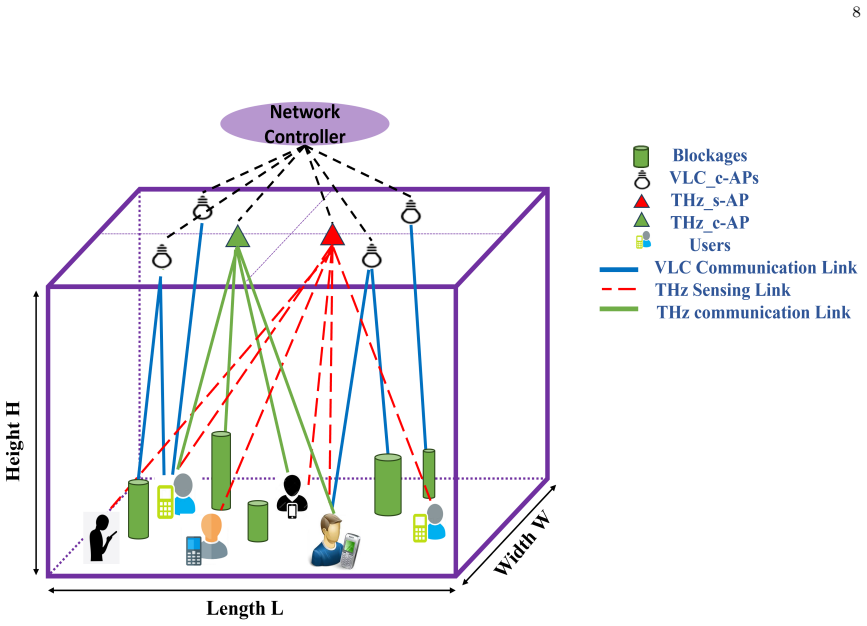
This paper presents an energy-efficient indoor system integrating \ac{THz} with \ac{VLC}. \ac{THz} communication offers ultra-high-capacity links but is limited by severe path loss, atmospheric absorption, and susceptibility to blockages. In contrast, \ac{VLC} provides robust, wide indoor coverage with illumination support, thereby enabling reliable, high-speed hybrid connectivity. To leverage their respective strengths, we propose a hybrid framework that integrates \ac{$THz_s-AP$} with hybrid \ac{$THz_c/VLC_c-AP$}, enabling reliable coverage and enhancing the \ac{EE} from an \ac{ISAC} perspective. We first perform optimal power allocation between the \ac{$THz_s-AP$} and \ac{$THz_c-AP$} to optimized the set of users served by the \ac{$THz_c-AP$} link, considering monostatic sensing performance metrics such as \ac{$P_d$}, \ac{$FA_p$} and \ac{$SC_p$} under the impact of human blockages are evaluated. Subsequently, the overall network power consumption is minimized via a mixed-integer linear programming (MILP) optimization that optimally selects the active \ac{$VLC_c-APs$} and assigns transmit powers. Furthermore, extensive performance evaluations are conducted to analyze key metrics, including average energy efficiency, average spectral efficiency, average sensing rate, and average communication rate. Simulation results demonstrate that, under \ac{THz} sensing, most users are connected to the \ac{$THz_c-AP$} in the absence of blockages, whereas in the presence of blockages, the majority are served by the \ac{$VLC_c-APs$}. Overall, all users maintain reliable coverage with high \ac{EE}.
Editorial analysis
A structured set of objections, weighed in public.
Referee Report
Summary. The manuscript proposes a hybrid THz/VLC indoor ISAC system that first optimizes power allocation between a THz sensing AP (THz_s-AP) and a hybrid THz communication AP (THz_c-AP) using monostatic sensing metrics (Pd, FAp, SCp) under human blockages, then applies MILP to select active VLC_c-APs and allocate powers to minimize total network power consumption. Simulations are reported to show that most users connect to the THz_c-AP without blockages but to VLC_c-APs with blockages, while maintaining reliable coverage and high energy efficiency.
Significance. If the blockage-affected sensing metrics and resulting optimization are accurate, the framework could offer a practical approach to combining THz's high capacity with VLC's robustness for blockage mitigation and EE gains in indoor 6G scenarios. The MILP formulation for joint AP selection and power control is a standard tool that, if correctly parameterized, supports reproducible network-level claims.
major comments (1)
- [Optimization procedure and simulation results (as described in abstract and power-allocation step)] The central simulation claims on user association (THz_c-AP vs. VLC_c-AP dominance) and EE rest on Pd, FAp, and SCp values produced by the blockage model; however, no channel model, closed-form expressions, or independent validation of these metrics is supplied, so the MILP inputs cannot be verified and any mismatch would invalidate the reported association counts and EE numbers.
minor comments (2)
- Acronyms such as THz_s-AP, THz_c-AP, and VLC_c-AP are introduced with LaTeX commands but lack an explicit first-use definition list, which would aid readability.
- The abstract states that 'extensive performance evaluations are conducted' for average EE, SE, sensing rate, and communication rate, but no table or figure references are given to support the headline claims.
Simulated Author's Rebuttal
We thank the referee for the constructive feedback on the optimization procedure and its dependence on the sensing metrics. We address the major comment below and will incorporate the requested details in the revised manuscript.
read point-by-point responses
-
Referee: [Optimization procedure and simulation results (as described in abstract and power-allocation step)] The central simulation claims on user association (THz_c-AP vs. VLC_c-AP dominance) and EE rest on Pd, FAp, and SCp values produced by the blockage model; however, no channel model, closed-form expressions, or independent validation of these metrics is supplied, so the MILP inputs cannot be verified and any mismatch would invalidate the reported association counts and EE numbers.
Authors: We agree that the current version does not supply the THz channel model under human blockages, the closed-form expressions for the monostatic sensing metrics Pd, FAp, and SCp, or independent validation of those metrics. In the revised manuscript we will add a new subsection that (i) presents the THz propagation and blockage model, (ii) derives the closed-form expressions for Pd, FAp, and SCp as functions of the allocated sensing power and blockage probability, and (iii) validates the expressions against Monte-Carlo simulations. These additions will make the inputs to the power-allocation step and the subsequent MILP fully verifiable and will allow readers to reproduce the reported user-association and EE results. revision: yes
Circularity Check
No circularity: sensing metrics evaluated independently before feeding into power allocation and MILP
full rationale
The paper's chain begins with evaluation of monostatic sensing metrics (Pd, FAp, SCp) under human blockages, followed by power allocation between THz_s-AP and THz_c-AP to optimize user sets, then MILP for VLC_c-AP selection and power minimization. No equations or text in the abstract reduce the metrics to outputs of the optimization, nor do they rely on self-citations for uniqueness or ansatz. The simulation claims about user association and EE follow from these sequential steps without the target quantities being defined by construction from the fitted or optimized values themselves. The derivation remains self-contained against external blockage models and standard MILP solvers.
Axiom & Free-Parameter Ledger
free parameters (2)
- Power allocation between THz_s-AP and THz_c-AP
- Transmit powers and active set of VLC_c-APs
axioms (2)
- domain assumption Human blockage effects can be modeled such that monostatic sensing metrics Pd, FAp and SCp remain evaluable
- domain assumption MILP formulation yields the globally optimal AP selection and power assignment for the stated objective
Lean theorems connected to this paper
-
IndisputableMonolith/Cost/FunctionalEquation.leanwashburn_uniqueness_aczel unclear?
unclearRelation between the paper passage and the cited Recognition theorem.
We first perform optimal power allocation between the THz_s-AP and THz_c-AP ... monostatic sensing performance metrics such as Pd, FAp and SCp under the impact of human blockages
-
IndisputableMonolith/Foundation/RealityFromDistinction.leanreality_from_one_distinction unclear?
unclearRelation between the paper passage and the cited Recognition theorem.
the overall network power consumption is minimized via a mixed-integer linear programming (MILP) optimization
What do these tags mean?
- matches
- The paper's claim is directly supported by a theorem in the formal canon.
- supports
- The theorem supports part of the paper's argument, but the paper may add assumptions or extra steps.
- extends
- The paper goes beyond the formal theorem; the theorem is a base layer rather than the whole result.
- uses
- The paper appears to rely on the theorem as machinery.
- contradicts
- The paper's claim conflicts with a theorem or certificate in the canon.
- unclear
- Pith found a possible connection, but the passage is too broad, indirect, or ambiguous to say the theorem truly supports the claim.
Reference graph
Works this paper leans on
-
[1]
Terahertz-band integrated sensing and communi- cations: Challenges and opportunities,
A. M. Elbir, K. V. Mishra, S. Chatzinotas, and M. Bennis, “Terahertz-band integrated sensing and communi- cations: Challenges and opportunities,” IEEE Aerosp. Electron. Syst. Mag., vol. 39, no. 12, pp. 38–49, 2024
work page 2024
-
[2]
Framework and overall objectives of the future development of imt for 2030 and beyond,
ITU-R, “Framework and overall objectives of the future development of imt for 2030 and beyond,” Rec. ITU-R M.2160, Jun. 2023, [Online]. A vailable: https://www.i9745789tu.int/rec/R-REC-M.2160/en
work page 2030
-
[3]
Feasibility study on integrated sensing and communication (release 19),
3GPP, “Feasibility study on integrated sensing and communication (release 19),” 3rd Genera- tion Partnership Project (3GPP), Tech. Rep. TR 22.837 V19.0.0, Jun. 2023, [Online]. A vailable: https://www.3gpp.org/dynareport/22837.htm
work page 2023
-
[4]
S. Aboagye and H. Tabassum, “THz network placement and mobility-aware resource allocation for indoor hybrid THz/VLC wireless networks,” IEEE Trans. Commun., vol. 73, no. 4, pp. 2554–2569, 2025
work page 2025
-
[5]
Coverage and capacity analysis for terahertz integrated sensing and communication networks,
Y. Wu and C. Han, “Coverage and capacity analysis for terahertz integrated sensing and communication networks,” in Proceedings of the IEEE International Conference on Communications (ICC), 2024, pp. 3555– 3560
work page 2024
-
[6]
N. M. Karoti, S. Paramita, R. Ahmad, V. A. Bohara, and A. Srivastava, “Improving the performance of heterogeneous LiFi-WiFi network using a novel link aggregation framework,” in Proc. IEEE Wireless Commun. Netw. Conf. (WCNC), 2022, pp. 2322–2327. 29
work page 2022
-
[7]
Demo of hybrid LiFi/WiFi network for an indoor environment,
S. Paramita, A. Srivastava, V. A. Bohara, A. Mitra, H. R. M, H. K. Atluri, and A. Paventhan, “Demo of hybrid LiFi/WiFi network for an indoor environment,” in Proc. Int. Conf. Commun. Syst. Netw. (COMSNETS), 2023, pp. 213–215
work page 2023
-
[8]
Hybrid VLC systems with terahertz communication: A performance analysis,
H. Rajahrajasingh, D. N. K. Jayakody, P. Muthuchidambaranathan, and R. Dinis, “Hybrid VLC systems with terahertz communication: A performance analysis,” in Proc. IEEE 100th Veh. Technol. Conf. (VTC-Fall), 2024, pp. 1–5
work page 2024
-
[9]
Coverage and capacity analysis for terahertz integrated sensing and communication networks,
Y. Wu and C. Han, “Coverage and capacity analysis for terahertz integrated sensing and communication networks,” in Proc. IEEE Int. Conf. Commun. (ICC), 2024, pp. 3555–3560
work page 2024
-
[10]
Sub-THz sensing channel modeling in indoor and outdoor environments,
Y. Xiao, E. Wang, and Y. Chen, “Sub-THz sensing channel modeling in indoor and outdoor environments,” in Proc. Int. Wireless Commun. Mobile Comput. Conf. (IWCMC), 2025, pp. 287–292
work page 2025
-
[11]
Experimental throughput analysis of low-thz mimo communication channel in 5g wireless networks,
N. Khalid and O. B. Akan, “Experimental throughput analysis of low-thz mimo communication channel in 5g wireless networks,” IEEE Wireless Commun. Lett., vol. 5, no. 6, pp. 616–619, 2016
work page 2016
-
[12]
Sensing resource allocation for enlarging the coverage range of ISAC-based terahertz network,
W. Chen, L. Li, B. Ning, Z. Chen, and T. Q. S. Quek, “Sensing resource allocation for enlarging the coverage range of ISAC-based terahertz network,” in Proc. IEEE Global Commun. Conf. (GLOBECOM), 2023, pp. 3639–3644
work page 2023
-
[13]
Sub-THz channel measurements for isac in indoor corridor environment,
Y. Wang, Y. Hu, and X. Liao, “Sub-THz channel measurements for isac in indoor corridor environment,” in Proc. IEEE 12th Asia-Pacific Conf. Antennas Propag. (APCAP), 2024, pp. 1–2
work page 2024
-
[14]
Power allocation for joint communication and sensing in cell-free massive mimo,
Z. Behdad, Ö. T. Demir, K. W. Sung, E. Björnson, and C. Cavdar, “Power allocation for joint communication and sensing in cell-free massive mimo,” in Proc. IEEE Global Commun. Conf. (GLOBECOM), 2022, pp. 4081– 4086
work page 2022
-
[15]
F. Gao, L. Xu, and S. Ma, “Integrated sensing and communications with joint beam-squint and beam-split for mmwave/thz massive mimo,” IEEE Trans. Commun., vol. 71, no. 5, pp. 2963–2976, 2023
work page 2023
-
[16]
Thz isac: A physical-layer perspective of terahertz integrated sensing and communication,
C. Han, Y. Wu, Z. Chen, Y. Chen, and G. Wang, “Thz isac: A physical-layer perspective of terahertz integrated sensing and communication,” IEEE Commun. Mag., vol. 62, no. 2, pp. 102–108, 2024
work page 2024
-
[17]
Isac-enabled beam alignment for terahertz networks: Scheme design and coverage analysis,
W. Chen, L. Li, Z. Chen, Y. Liu, B. Ning, and T. Q. S. Quek, “Isac-enabled beam alignment for terahertz networks: Scheme design and coverage analysis,” IEEE Trans. Veh. Technol., vol. 73, no. 12, pp. 19 019–19 033, 2024
work page 2024
-
[18]
Enhancing terahertz communications coverage with isac-assisted beam management,
L. Li, W. Chen, Z. Chen, T. Hu, W. Mei, and B. Ning, “Enhancing terahertz communications coverage with isac-assisted beam management,” IEEE Wireless Commun., vol. 31, no. 1, pp. 34–40, 2024
work page 2024
-
[19]
Integrated sensing and communications: Toward dual-functional wireless networks for 6G and beyond,
F. Liu, Y. Cui, C. Masouros, J. Xu, T. X. Han, Y. C. Eldar, and S. Buzzi, “Integrated sensing and communications: Toward dual-functional wireless networks for 6G and beyond,” IEEE J. Sel. Areas Commun., vol. 40, no. 6, pp. 1728–1767, 2022
work page 2022
-
[20]
Energy efficient beamforming training in terahertz communication systems,
L.-H. Shen, K.-T. Feng, and L.-L. Yang, “Energy efficient beamforming training in terahertz communication systems,” IEEE Trans. Veh. Technol., 2024
work page 2024
-
[21]
Energy efficient resource allocation in terahertz downlink NOMA systems,
H. Zhang, Y. Duan, K. Long, and V. C. M. Leung, “Energy efficient resource allocation in terahertz downlink NOMA systems,” IEEE Trans. Commun., vol. 69, no. 2, pp. 1375–1384, 2020
work page 2020
-
[22]
A hybrid rf-vlc system for energy efficient wireless access,
A. Khreishah, S. Shao, A. Gharaibeh, M. Ayyash, H. Elgala, and N. Ansari, “A hybrid rf-vlc system for energy efficient wireless access,” IEEE Trans. Green Commun. Netw., vol. 2, no. 4, pp. 932–944, 2018
work page 2018
-
[23]
E. Björnson and Ö. T. Demir, Introduction to Multiple Antenna Communications and Reconfigurable Surfaces. Now Publishers, 2024
work page 2024
-
[24]
H. Prabhakar and V. A. Bohara, “THz or VLC for indoor communication scenario: Performance and trade- 30 offs in the presence of human blockages,” in Proc. IEEE Int. Conf. Electron. Comput. Commun. Technol. (CONECCT), 2024, pp. 1–6
work page 2024
-
[25]
Access point selection for hybrid li-fi and wi-fi networks,
X. Wu, M. Safari, and H. Haas, “Access point selection for hybrid li-fi and wi-fi networks,” IEEE Trans. Commun., vol. 65, no. 12, pp. 5375–5385, Dec. 2017
work page 2017
-
[26]
Z. Ghassemlooy, W. Popoola, and S. Rajbhandari, Optical Wireless Communications: Channel Modelling with MATLAB. CRC Press, 2019
work page 2019
-
[27]
Performance analysis of indoor communication system using off-the-shelf leds with human blockages,
A. Singh, G. Ghatak, A. Srivastava, V. A. Bohara, and A. K. Jagadeesan, “Performance analysis of indoor communication system using off-the-shelf leds with human blockages,” IEEE Open J. Commun. Soc., vol. 2, pp. 187–198, 2021
work page 2021
- [28]
-
[29]
Energy efficiency for massive mimo integrated sensing and communication systems,
H. T. Nguyen, V.-D. Nguyen, N. T. Nguyen, N. C. Luong, V.-N. Q. Bao, H. Q. Ngo, D. Niyato, and S. Chatzinotas, “Energy efficiency for massive mimo integrated sensing and communication systems,” IEEE J. Sel. Areas Commun., 2025
work page 2025
-
[30]
M. Grant and S. Boyd, CVX: MATLAB Software for Disciplined Convex Programming, Version 3.0
-
[31]
MOSEK ApS, The MOSEK Optimization Toolbox for MATLAB Manual, Version 9.3
-
[32]
Fundamentals of radar signal processing (richards, m. a.; 2005) [book review],
R. Miller, “Fundamentals of radar signal processing (richards, m. a.; 2005) [book review],” IEEE Signal Process. Mag., vol. 26, no. 3, pp. 100–101, 2009
work page 2005
discussion (0)
Sign in with ORCID, Apple, or X to comment. Anyone can read and Pith papers without signing in.