A unified approach to Penner, Ptolemy, and Casey's theorems in several dimensions
Pith reviewed 2026-05-25 02:42 UTC · model grok-4.3
The pith
Penner's theorem on horocycles, Ptolemy's theorem, and Casey's theorem all follow from one Gram-matrix calculation on lightlike, timelike, and spacelike vectors in the Lorentzian model of hyperbolic space.
A machine-rendered reading of the paper's core claim, the machinery that carries it, and where it could break.
Core claim
All three theorems are derived from a common Gram-matrix calculation applied to lightlike, timelike, and spacelike vectors in the Lorentzian model of hyperbolic space, providing proofs and full converses in several dimensions.
What carries the argument
Gram matrix of lightlike, timelike, and spacelike vectors in the Lorentzian model that represent the geometric objects of each theorem.
If this is right
- Each theorem holds with a full converse in hyperbolic space of arbitrary dimension.
- Casey's theorem in the plane takes a new form involving three geometric alternatives.
- The distance and length relations of the theorems appear directly as entries or determinants of the Gram matrix.
- Separate classical proofs for each theorem can be replaced by one shared matrix calculation.
Where Pith is reading between the lines
- The vector representation may allow similar unified derivations for other classical theorems involving lengths or tangents in spaces of constant curvature.
- The method could be used to generate computational checks of the theorems by constructing explicit vector sets in high-dimensional Lorentzian space.
- The three-alternative form of Casey's theorem suggests that related planar theorems might admit multiple geometric realizations not previously catalogued.
Load-bearing premise
The geometric objects in each theorem correspond exactly to lightlike, timelike, or spacelike vectors whose Gram matrix encodes the stated relations.
What would settle it
A configuration of horocycles, circles, or tangent segments in hyperbolic space whose corresponding vectors produce a Gram matrix that fails to recover the distance or length equality claimed by one of the three theorems.
Figures
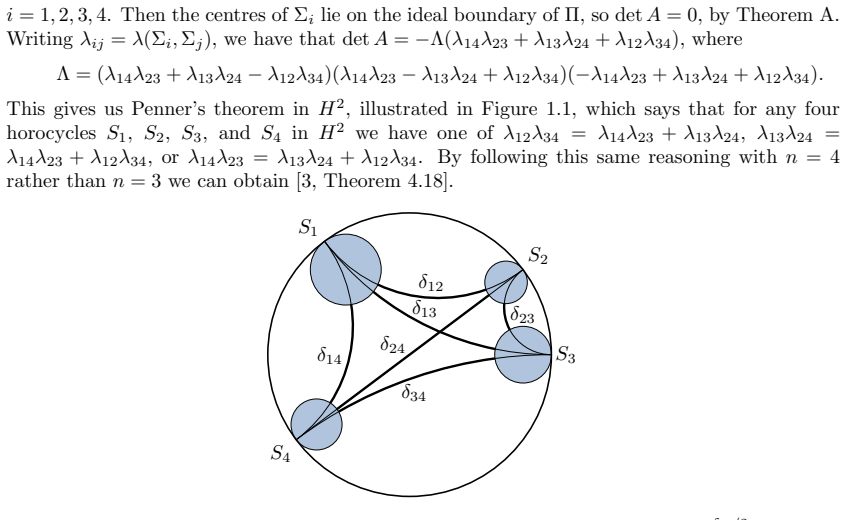


read the original abstract
We prove Penner's theorem on horocycles and theorems of Ptolemy and Casey, all with full converses, in hyperbolic space of several dimensions. Recently Waddle observed that the equations underpinning these three theorems are related, and it is this viewpoint that we advance, using the Lorentzian model of hyperbolic space. We show that all three theorems can be derived from a common Gram-matrix calculation applied to lightlike, timelike, and spacelike vectors. Remarkably, our approach gives a version of Casey's theorem in the plane with a full converse, involving three geometric alternatives, which to our knowledge has not previously been recorded.
Editorial analysis
A structured set of objections, weighed in public.
Referee Report
Summary. The paper claims to prove Penner's theorem on horocycles, Ptolemy's theorem, and Casey's theorem (all with full converses) in hyperbolic space of arbitrary dimension by deriving them from a single Gram-matrix calculation in the Lorentzian model. Lightlike, timelike, and spacelike vectors are assigned to the relevant geometric objects (horocycles, circles, tangent segments), and the stated relations (including three alternatives in the planar Casey case) are recovered directly from the Gram entries or determinants.
Significance. If the derivations hold, the work supplies a clean, dimension-independent unification of three classical theorems via standard Lorentz-model tools with no free parameters or ad-hoc assumptions. It also records a new planar Casey variant with a complete converse and three geometric alternatives. These features constitute a genuine strengthening of the literature on hyperbolic-geometry identities and could support further generalizations.
minor comments (2)
- A brief table or diagram summarizing the vector-to-object assignments for Penner, Ptolemy, and Casey would improve readability for readers less familiar with the Lorentz model.
- The higher-dimensional statements of Ptolemy and Penner would benefit from an explicit remark confirming that no additional curvature or dimension-dependent hypotheses are required beyond the Gram-matrix identity.
Simulated Author's Rebuttal
We thank the referee for their positive summary, significance assessment, and recommendation to accept the manuscript. The report accurately captures the paper's contributions.
Circularity Check
No significant circularity; derivation is self-contained
full rationale
The paper constructs explicit vector assignments in the Lorentz model for each geometric object (horocycles as lightlike vectors, circles as timelike or spacelike), then computes Gram matrix entries or determinants directly from the Minkowski inner product to recover Penner, Ptolemy, and Casey relations (including converses and the three planar Casey alternatives). No parameters are fitted to data and then renamed as predictions; no self-citation chain is invoked as the sole justification for a uniqueness claim or ansatz; the Lorentz model and Gram-matrix algebra are standard external tools applied to the stated correspondences. The central claim therefore does not reduce to its inputs by construction.
Axiom & Free-Parameter Ledger
axioms (1)
- domain assumption The Lorentzian model faithfully represents n-dimensional hyperbolic space and allows lightlike, timelike, and spacelike vectors to encode the relevant geometric objects.
Lean theorems connected to this paper
-
IndisputableMonolith/Foundation/RealityFromDistinction.leanreality_from_one_distinction (spacetime-emergence certificate) echoes?
echoesECHOES: this paper passage has the same mathematical shape or conceptual pattern as the Recognition theorem, but is not a direct formal dependency.
We show that all three theorems can be derived from a common Gram-matrix calculation applied to lightlike, timelike, and spacelike vectors.
What do these tags mean?
- matches
- The paper's claim is directly supported by a theorem in the formal canon.
- supports
- The theorem supports part of the paper's argument, but the paper may add assumptions or extra steps.
- extends
- The paper goes beyond the formal theorem; the theorem is a base layer rather than the whole result.
- uses
- The paper appears to rely on the theorem as machinery.
- contradicts
- The paper's claim conflicts with a theorem or certificate in the canon.
- unclear
- Pith found a possible connection, but the passage is too broad, indirect, or ambiguous to say the theorem truly supports the claim.
Reference graph
Works this paper leans on
-
[1]
N. V. Abrosimov and V. V. Aseev,Generalizations of Casey’s theorem for higher dimensions, Lobachevskii J. Math.39(2018), no. 1, 1–12
work page 2018
-
[2]
N. V. Abrosimov and L. A. Mikaiylova,Casey’s theorem in hyperbolic geometry, Sib. `Elektron. Mat. Izv.12 (2015), 354–360
work page 2015
-
[3]
A. Felikson, O. Karpenkov, K. Serhiyenko, and P. Tumarkin, 3D Farey graph, lambda lengths andSL 2-tilings, Geom. Dedicata219(2025), Article 33
work page 2025
-
[4]
R. J. Gregorac,Feuerbach’s relation and Ptolemy’s theorem inR n, Geom. Dedicata60(1996), no. 1, 65–88
work page 1996
-
[5]
H. Maehara and H. Martini,Bipartite sets of spheres and Casey-type theorems, Results Math.74(2019), no. 1, Paper No. 47, 20
work page 2019
-
[6]
R. C. Penner,The decorated Teichm¨ uller space of punctured surfaces, Comm. Math. Phys.113(1987), no. 2, 299–339
work page 1987
-
[7]
,Lambda lengths:Lecture notes from CTQM Master Class taught at Aarhus University in August
-
[8]
https://www.ctqm.au.dk/research/MCS/lambdalengths.pdf
-
[9]
J. G. Ratcliffe,Foundations of hyperbolic manifolds, 3rd ed., Graduate Texts in Mathematics, vol. 149, Springer, Cham, 2019
work page 2019
-
[10]
J. E. Valentine,An analogue of Ptolemy’s theorem in spherical geometry, Amer. Math. Monthly77(1970), 47–51
work page 1970
- [11]
-
[12]
Waddle,Ptolemy’s equation and kin, Math Intelligencer
K. Waddle,Ptolemy’s equation and kin, Math Intelligencer. (2025). 9
work page 2025
discussion (0)
Sign in with ORCID, Apple, or X to comment. Anyone can read and Pith papers without signing in.