The two-stream instability generation around Moon: Effect of Interplanetary Magnetic Field during Solar Wind - Lunar Plasma Interaction
Pith reviewed 2026-05-25 02:32 UTC · model grok-4.3
The pith
The inclusion of the interplanetary magnetic field modifies the dispersion relation of the two-stream instability in solar wind-lunar plasma interactions.
A machine-rendered reading of the paper's core claim, the machinery that carries it, and where it could break.
Core claim
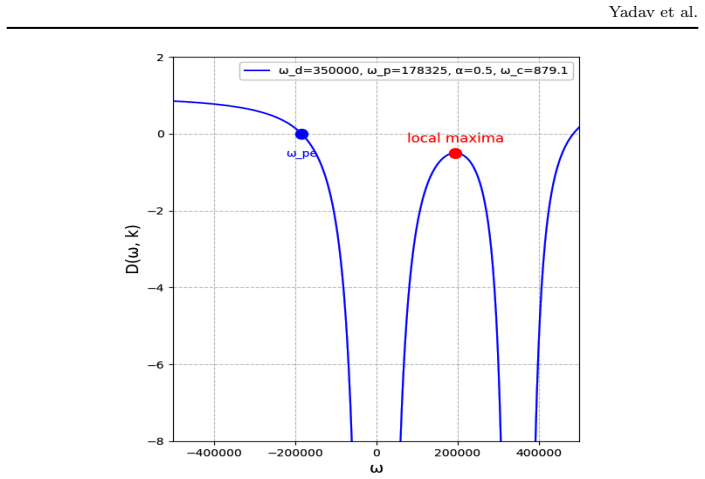
The inclusion of IMF in the solar wind lunar plasma interaction modifies the dispersion relation of the TSI and an angular cyclotron frequency term appears in the denominator of the leading term and hence leads to the change in the parameters such as the instability growth rate as now it depends on the solar wind electron velocity, solar wind and the lunar electron plasma density, and the IMF magnitude. It is observed that the growth rate increases fast with the increase in the magnetic field initially but the increase slows down on further increasing the magnetic field thereby smoothening the top. From the particle in cell (PIC) simulations, it is observed that during the solar wind IMF -
What carries the argument
Modified two-stream instability dispersion relation incorporating an angular cyclotron frequency term from the IMF.
If this is right
- The instability growth rate depends on solar wind electron velocity, plasma densities, and IMF magnitude.
- Growth rate increases rapidly with initial increases in magnetic field strength but then plateaus.
- Non-energetic lunar electrons form a shield around solar wind electrons in vortices.
- Some lunar electrons align their motion with the incoming solar wind.
- The interaction can transition into non-linear physical processes in the lunar plasma environment.
Where Pith is reading between the lines
- The cyclotron term effect could be relevant for plasma instabilities at other airless bodies with solar wind interactions.
- Changes in growth rate might affect the development of turbulence or wave activity in the lunar wake region.
- Varying the IMF direction in models could show anisotropic effects on the instability.
Load-bearing premise
The derivation starts from a specific unperturbed dispersion relation for TSI without IMF, and the modification by the cyclotron term holds for the chosen plasma parameters and geometry.
What would settle it
A direct comparison of the predicted growth rate dependence on IMF magnitude with observed plasma wave data from lunar orbiters, or a simulation without the cyclotron term showing unchanged growth rates, would test the claim.
Figures




read the original abstract
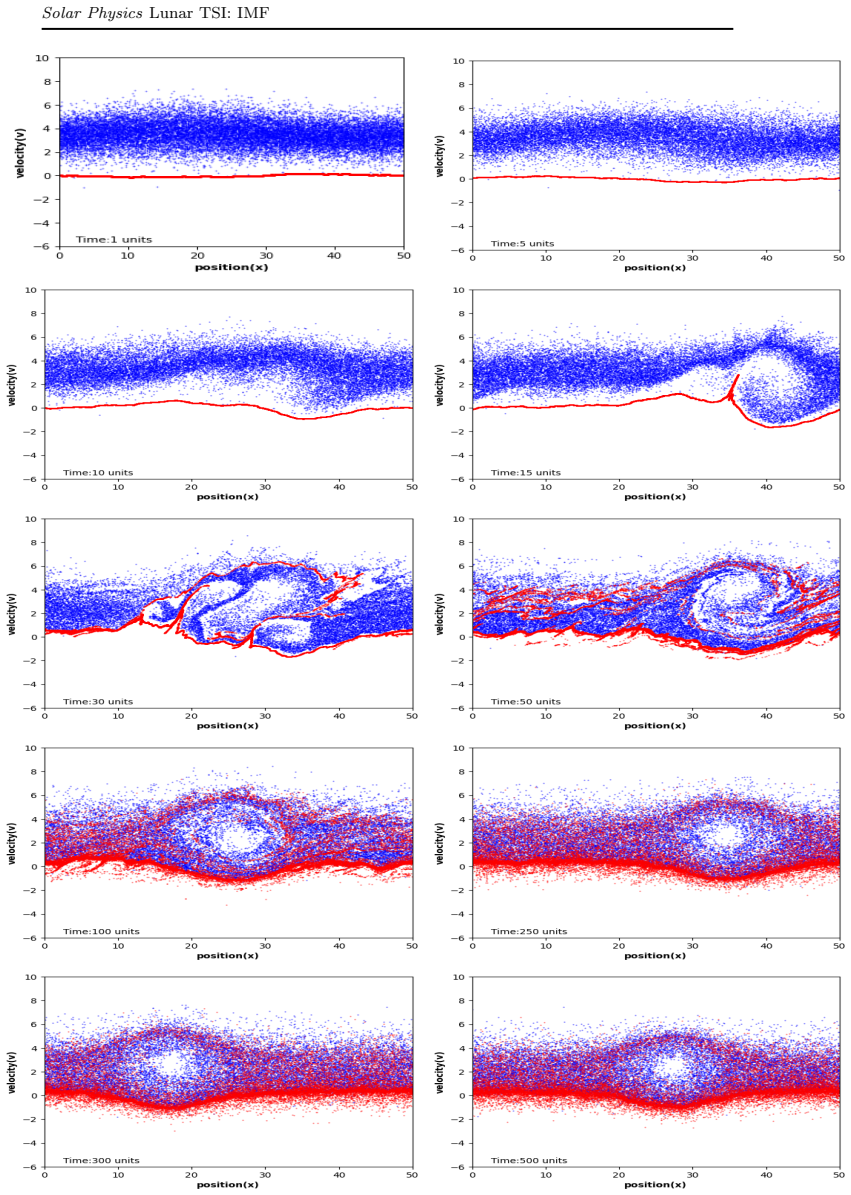
The relative motion of two interpenetrating streams of charged particles usually leads to the generation of two stream instability (TSI) and eventually result in the onset of non-linear plasma processes such as the turbulence or the plasma waves. A natural example of such an event is the solar wind interaction with the lunar electron plasma where the interplanetary magnetic field (IMF) is embedded within the solar wind. The inclusion of IMF in the solar wind lunar plasma interaction modifies the dispersion relation of the TSI and an angular cyclotron frequency term appears in the denominator of the leading term and hence leads to the change in the parameters such as the instability growth rate as now it depends on the solar wind electron velocity, solar wind and the lunar electron plasma density, and the IMF magnitude. It is observed that the growth rate increases fast with the increase in the magnetic field initially but the increase slows down on further increasing the magnetic field thereby smoothening the top. From the particle in cell (PIC) simulations, it is observed that during the solar wind IMF interaction with lunar plasma, the non-energetic background electrons make a shield around the solar wind electrons in the vortices formed. It is further observed that those lunar electrons which are not participating either in the vortices formation or in the shielding of solar wind electrons, start moving in the direction of the incoming solar wind. These observations indicate this interaction is capable in getting converted into a non-linear physical process in the lunar plasma environment.
Editorial analysis
A structured set of objections, weighed in public.
Referee Report
Summary. The paper examines the solar wind-lunar plasma interaction and claims that embedding the interplanetary magnetic field (IMF) modifies the two-stream instability (TSI) dispersion relation by inserting an angular cyclotron frequency term into the denominator of the leading term. This modification is asserted to alter the instability growth rate, which now depends on solar wind electron velocity, solar wind and lunar electron densities, and IMF magnitude. The growth rate is reported to rise rapidly with increasing |B| initially before slowing and flattening. PIC simulations are said to reveal that non-energetic lunar background electrons form a shield around solar wind electrons within vortices, while some lunar electrons stream in the solar wind direction, indicating potential conversion to nonlinear processes.
Significance. A rigorously derived and validated modification of the TSI dispersion relation under lunar-relevant parameters would be of interest for plasma astrophysics and lunar environment modeling, particularly if accompanied by quantitative growth-rate comparisons and falsifiable predictions from the PIC runs. The described shielding behavior in vortices could also motivate follow-up studies on wave-particle interactions. At present, however, the absence of any explicit dispersion relation, derivation steps, parameter values, or error estimates prevents assessment of whether these results extend existing TSI theory or merely restate known magnetized-stream effects.
major comments (1)
- [Abstract] Abstract: The central claim that IMF inclusion 'modifies the dispersion relation of the TSI and an angular cyclotron frequency term appears in the denominator of the leading term' is stated without the unperturbed starting dispersion relation (standard unmagnetized two-stream form 1 − ∑ ω_pj²/(ω − k·v_j)² = 0 or equivalent) or the algebraic steps from the linearized magnetized Vlasov response that place ω_c exactly in that location. Because this term placement is load-bearing for the asserted change in growth-rate dependence on velocity, densities, and |B|, the claim cannot be verified from the given text.
minor comments (2)
- [Abstract] Abstract: No numerical values, ranges, or error estimates are supplied for the growth-rate dependence on solar wind velocity, densities, or IMF magnitude, nor is any quantitative comparison between the modified analytic growth rate and the PIC results presented.
- [Abstract] Abstract: The PIC observations of shielding and electron streaming are described qualitatively; the manuscript should specify simulation parameters (grid resolution, particle count per cell, time step, box size) and any diagnostic metrics used to quantify the shielding effect.
Simulated Author's Rebuttal
We thank the referee for their careful reading of our manuscript and for highlighting the need for greater clarity on the dispersion relation. We address the single major comment below and will incorporate the requested elements in the revised version to strengthen the presentation.
read point-by-point responses
-
Referee: [Abstract] Abstract: The central claim that IMF inclusion 'modifies the dispersion relation of the TSI and an angular cyclotron frequency term appears in the denominator of the leading term' is stated without the unperturbed starting dispersion relation (standard unmagnetized two-stream form 1 − ∑ ω_pj²/(ω − k·v_j)² = 0 or equivalent) or the algebraic steps from the linearized magnetized Vlasov response that place ω_c exactly in that location. Because this term placement is load-bearing for the asserted change in growth-rate dependence on velocity, densities, and |B|, the claim cannot be verified from the given text.
Authors: We agree that the abstract presents the key result without the supporting baseline relation or derivation steps, which limits immediate verification. The unperturbed TSI relation is the standard form 1 − ∑_j ω_pj² / (ω − k · v_j)² = 0. Linearization of the magnetized Vlasov equation for electrons in the IMF introduces the cyclotron term ω_c such that the denominator of the leading contribution becomes (ω − k · v)^2 − ω_c² (or the appropriate magnetized equivalent), placing ω_c exactly as described. In the revised manuscript we will (i) quote the unperturbed relation explicitly in the abstract or opening paragraph, (ii) outline the principal algebraic steps from the magnetized response function, and (iii) add a short theory subsection that shows how the growth rate then depends on solar-wind velocity, densities, and |B|. These additions will also include representative parameter values used in the analytic and PIC portions, allowing direct comparison with existing TSI literature. revision: yes
Circularity Check
No circularity: modified TSI dispersion presented as derived result without reduction to inputs
full rationale
The abstract states that IMF inclusion modifies the TSI dispersion relation by inserting an angular cyclotron frequency term in the denominator of the leading term, altering growth-rate dependence on velocities, densities, and |B|. No equations, fitting procedures, or self-citations are shown. The claim is framed as a first-principles modification from plasma physics applied to the solar-wind/lunar geometry, with PIC observations offered as independent support. No step reduces by construction to a fitted parameter, renamed input, or self-citation chain; the derivation chain is therefore self-contained against external benchmarks.
Axiom & Free-Parameter Ledger
Reference graph
Works this paper leans on
-
[1]
Ambili, K.M., and Choudhary, R.K.: 2022, Monthly Notices of the Royal AStronomical Society 510(03), 3291-3300. doi:10.1093/mnras/stab3734
-
[2]
Daniele, and Wurz, Peter: 2009, Current Science 96(4), 526-532
Barabash, Stas, Bhardwaj, Anil, Wieser, Martin, Sridharan, R., Kurian, Thomas, Varier, Subha, Vijayakumar, E., Abhirami, Veena, Raghavendra, K.V., Mohankumar S.V., Dhanya, M.B., Thampi, Satheesh, Kazushi, Asamura, Andersson, Herman, Yoshifumi, Futaana, Holmstrom, Mats, Lundin, Rickard, Svensson, Johan, Karlsson, Stefan, Piazza, R. Daniele, and Wurz, Peter...
-
[3]
Barabash, Stas: 2012, Earth, Planets and Space 64(2), 57-59. doi:10.5047/eps.2012.01.005
-
[4]
Bhardwaj, Anil, Dhanya, M.B., Alok, Abhinaw, Barabash, Stas, Wieser, Martin, Futaana, Yoshifumi, Wurz, Peter, Vorburger, Audrey, Holmstrom, Mats, Lue, Charles, harada, Yuki, and Kazushi, Asamura: 2015, Geoscience Letters 02(10), 1-15. doi:10.1186/s40562-015-0027-y
-
[5]
Chakraborty, Mehul, Yadav, Vipin K., and Kumar, Rajneesh: 2022, in Proc. URSI Regional Conference on Radio Science (URSI-RCRS 2022), 509-512, doi:10.23919/URSI-RCRS56822.2022.10118524
-
[6]
Chakraborty, Mehul, Yadav, Vipin K., and Kumar, Rajneesh: 2023, Advances in Space research 71(6), 2954-2966. doi:10.1016/j.asr.2022.11.050
-
[7]
Chen, Francis F.: 2016, in Introduction to Plasma Physics and Controlled Fusion , Third Edition, Springer Cham Heidelberg New York Dordrecht London. doi:10.1007/978-3-319-22309-4
-
[8]
Choudhary, R.K., Ambili, K.M., Choudhury, S., Dhanya, M.B., and Bhardwaj, Anil: 2016, Geophysical Research Letters 43(19), 10,025-10,033. doi:10.1002/2016GL070612
-
[9]
and Nazer, M.: 2020, Current Science 118(02), 210-218
Choudhary, R.K., Bindu, K.R., Harshit, K., Karkara, R., Ambili, K.M., Pant, T.K., Shenoy, D., Kumar, C., Reddy, N.H.K., Rajendran, T.K. and Nazer, M.: 2020, Current Science 118(02), 210-218
work page 2020
-
[10]
and Thampi, R.S.: 2013, Geophysical Research Letters 40(12), 2913-2917
Dhanya, M.B., Bhardwaj, A., Futaana, Y., Fatemi, S., Holmström, M., Barabash, S., Wieser, M., Wurz, P., Alok, A. and Thampi, R.S.: 2013, Geophysical Research Letters 40(12), 2913-2917. doi:10.1002/grl.50617
-
[11]
Fatemi, Shahab, Lue, Charles, Holmström, Mats, Poppe, Andrew R., Wieser, Martin, Barabash, Stas and Delory, Gregory T.: 2015, Journal of Geophysical Research: Space Physics 120(6), 4719-4735. doi:10.1002/2015JA021027
-
[12]
Freeman, J.W.: 1976, Geophysical Research Letters 3(11), 693-696. doi:10.1029/GL003i011p00693
-
[13]
Gosling, John T.: 2007, L. -A. McFadden, P. R. Weissman & T. V. Johnson, (eds.), in Encyclopedia of the Solar System: ``The Solar Wind'' 31, 99-116. doi:10.1016/B978-012088589-3/50009-8
-
[14]
Halekas, J.S., Brain, D.A., Lin, R.P., and Mitchell, D.L., : 2008, Advances in Space research 41(8), 1319-1324. doi:10.1016/j.asr.2007.04.003
-
[15]
doi:10.1016/j.icarus.2010.08.012
Hood, Lon L., : 2011, Icarus 211(2), 1109-1128. doi:10.1016/j.icarus.2010.08.012
-
[16]
Kivelson, M.G. and Russell, C.T.: 1995, in Introduction to Space Physics , Cambridge University Press, Cambridge, UK. doi:10.1017/9781139878296
-
[17]
Liu, Terry Z., Angelopoulos, Vassilis, An, Xin and Madanian, Hadi: 2024, Journal of Geophysical Research: Space Physics 129(12), e2024JA033217. doi:10.1002/2024JA033217
-
[18]
Luhmann, J.: 1995, in Introduction to Space Physics , Plasma Interactions with Unmagnetized Bodies, Kivelson, M.G. and Russell, C.T. (Eds.), 203-226, University Press, Cambridge, UK. doi:10.1017/9781139878296.009
-
[19]
Mocz, P.: 2020, Create your own plasma pic simulation (with python), Princeton University, USA
work page 2020
-
[20]
Springer, Dordrecht., Dyer, E.R., Roederer, J.G., Hundhausen, A.J
Ness, Norman F.: 1972, in The Interplanetary Medium. Springer, Dordrecht., Dyer, E.R., Roederer, J.G., Hundhausen, A.J. (Eds.), 159-205, doi:10.1007/978-94-010-3128-8\_8
-
[21]
T.: 2001, Geophysical Monograph: Space Weather 125, 73-89
Russell, C. T.: 2001, Geophysical Monograph: Space Weather 125, 73-89
work page 2001
-
[22]
Schwenn, R.: 1990, in Physics of the Inner Heliosphere I: Large-scale Phenomena, XI, 282, 99-181, Springer-Verlag Berlin Heidelberg New York. doi:10.1007/978-3-642-75361-9
-
[23]
Stern, A.: 1999, Reviews of Geophysics 37(04), 453-491. doi:10.1029/1999RG900005
-
[24]
Temerin, M. and Kintner, P.M.: 1989, Tsurutani, B.T., Oya, Hiroshi, (Eds.), Review of Ionospheric Turbulence 53, 65-80. doi:10.1029/GM053p0065
-
[25]
and Sabry, R.: 2021, Physics of Fluids 36(03), 037145
Tolba, R.E., Moslem, W.M. and Sabry, R.: 2021, Physics of Fluids 36(03), 037145. doi:10.1063/5.0198213
-
[26]
Tsugawa, Y., Katoh, Y., Terada, N., Ono, T., Tsunakawa, H., Takahashi, F., Shibuya, H., Shimizu, H., Matsushima, M., Saito, Y., Yokota, S. and Nishino, M. N.: 2012, Geophysical Research Letters 39(16), L16101. doi:10.1029/2012GL052818
- [27]
-
[28]
C.: 1968, Physics of Fluids 11(5), 969
Whang, Y. C.: 1968, Physics of Fluids 11(5), 969. doi:10.1063/1.1692068
-
[29]
Withers, P., Stubbs, T., and Mazarico, E.: 2021, Advances in Space research 67(12), 4099-4109. doi:10.1016/j.asr.2021.02.029
-
[30]
Plasma Waves beyond the Solar System
Yadav, Vipin K., Bhardwaj, Anil: 2018, Raneesh, B., K., Nandakumar, James, Jemy, & Nair, Anju K., (Eds.), in Plasma and Fusion Science: From Fundamental Research to Technological Applications, "Plasma Waves beyond the Solar System", January, 2018, Apple Academic Press, USA, 31, 231-241. E-BookISBN: 978-1-315-36594-7; ISBN: 978-1-77188-453-2
work page 2018
-
[31]
Yadav, Vipin K.: 2020 in Proc. URSI Regional Conference on Radio Science (URSI-RCRS 2020), 527-530, doi:10.23919/URSIRCRS49211.2020.9113523
-
[32]
Yadav, Vipin K., Chakraborty, Mehul, Agarwal, Mahima, Kumar, Rajneesh: 2024, in Proc. URSI Regional Conference on Radio Science (URSI-RCRS 2024), 1-4, doi:10.46620/URSI\_RSRC24/0039KVI5957
-
[33]
Yadav, Vipin K., Agarwal, Mahima, Chakraborty, Mehul, and Kumar, Rajneesh: 2024, Physics of Plasmas 31(8), 082102. doi:doi:10.1063/5.0201367
discussion (0)
Sign in with ORCID, Apple, or X to comment. Anyone can read and Pith papers without signing in.