Trajectory-Oriented Optimization Via Adaptive Thompson Sampling And Grid Refinement: A Tutorial With The ADAPTIVE\_TS Package
Pith reviewed 2026-05-25 02:17 UTC · model grok-4.3
The pith
Adaptive Thompson sampling with grid refinement calibrates stochastic simulators by matching trajectories to data without replicate assumptions.
A machine-rendered reading of the paper's core claim, the machinery that carries it, and where it could break.
Core claim
Trajectory-oriented optimization implemented through adaptive Thompson sampling and grid refinement in the adaptive_ts package enables reliable calibration of stochastic simulators by focusing on trajectory errors against observed data, without requiring assumptions on the stochastic behavior of simulator replicates.
What carries the argument
The adaptive_ts package, which applies adaptive Thompson sampling combined with grid refinement to perform trajectory matching within a Bayesian optimization framework.
If this is right
- Enables calibration of epidemiological simulators for real-time decision support during outbreaks.
- Extends to any stochastic simulator where replicate outputs vary but trajectory shapes can be compared directly to data.
- Reduces the need for custom error modeling in model validation workflows.
- Provides open-source access with examples that lower the barrier for applying the technique.
Where Pith is reading between the lines
- The tutorial format may encourage adoption in fields beyond epidemiology that rely on stochastic models.
- Combining this with other optimization libraries could create hybrid calibration pipelines.
- Success in trajectory matching might reveal when simulator structure itself needs revision rather than parameter tuning.
Load-bearing premise
Adaptive Thompson sampling combined with grid refinement can reliably match trajectories in stochastic simulators without needing assumptions about replicate behavior or error structures.
What would settle it
A demonstration that the adaptive_ts method produces incorrect or unstable trajectory matches on a known stochastic simulator test case where the true input parameters are recoverable by other means.
Figures
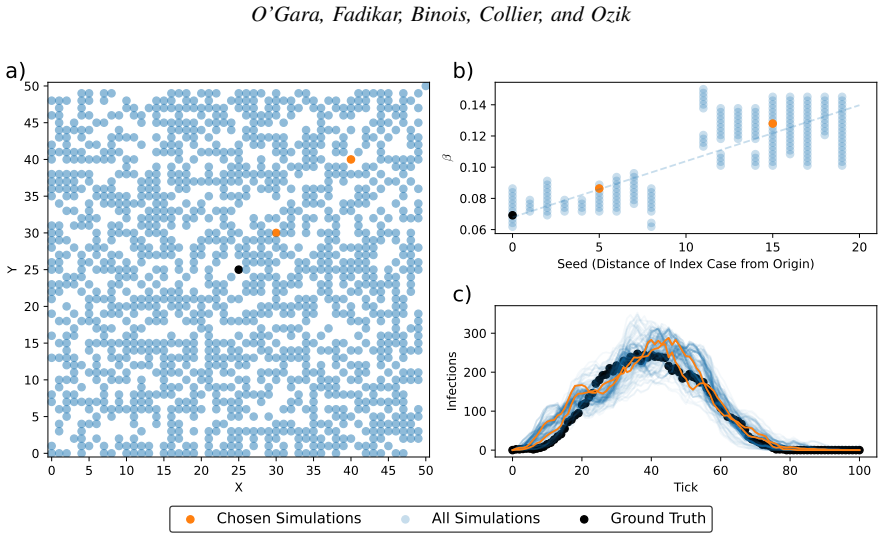


read the original abstract
Stochastic simulators are increasingly used to expand the frontier of scientific knowledge and inform decision-making across real-world contexts. Simulator calibration, a process by which internal model inputs are tuned to match some external criteria, usually in the form of observed data, is a key step in model design and validation. Epidemiological simulators present an especially compelling use case, as evidenced by the recent COVID-19 pandemic. Among several calibration paradigms, trajectory-oriented optimization is an emerging approach that does not require assumptions on the stochastic behavior of the simulator replicates and is particularly effective at identifying trajectories through the lens of errors between the simulator and observed data, especially when combined with Bayesian optimization. We present a tutorial on trajectory-oriented optimization with \texttt{adaptive\_ts}, an open-source Python package. We also provide a series of worked examples on an accompanying webpage.
Editorial analysis
A structured set of objections, weighed in public.
Referee Report
Summary. The manuscript is a tutorial on trajectory-oriented optimization for calibrating stochastic simulators, implemented via adaptive Thompson sampling combined with grid refinement in the open-source Python package adaptive_ts. It positions the approach as particularly suitable for epidemiological models by focusing on trajectory matching through errors between simulator outputs and observed data, without requiring assumptions on replicate stochasticity, and includes worked examples with reference to an accompanying webpage for further illustrations.
Significance. If the package and tutorial function as described, the work provides a practical, accessible resource for applying Bayesian optimization techniques to simulator calibration in computational statistics and related fields. It could lower barriers for users working with stochastic models by supplying open-source code and examples, though its impact depends on the package's robustness and adoption rather than novel theoretical advances.
minor comments (3)
- [Abstract] Abstract: the statement that trajectory-oriented optimization 'does not require assumptions on the stochastic behavior of the simulator replicates' is presented without a supporting citation or brief justification; adding a reference to relevant prior literature would improve context for readers.
- The manuscript references 'a series of worked examples on an accompanying webpage' but does not provide sufficient in-text description or links to ensure standalone reproducibility; consider adding a dedicated section or table summarizing the examples and their key outputs.
- As a tutorial, the paper would benefit from a brief comparison (e.g., in a table) of adaptive_ts features against existing packages for Bayesian optimization or simulator calibration to clarify its positioning.
Simulated Author's Rebuttal
We thank the referee for their review of our manuscript and for recommending minor revision. The report summarizes the work but does not raise any specific major comments.
Circularity Check
No significant circularity
full rationale
This manuscript is a software tutorial introducing the adaptive_ts Python package for trajectory-oriented optimization. It contains no derivation chain, fitted parameters presented as predictions, self-referential equations, or load-bearing self-citations that reduce claims to their own inputs. The description of trajectory-oriented optimization as requiring no assumptions on simulator replicates is presented as background context rather than a result derived or proven within the paper. The work is self-contained as an instructional document with worked examples and does not advance a mathematical or empirical claim that could exhibit circularity.
Axiom & Free-Parameter Ledger
Reference graph
Works this paper leans on
-
[1]
Analyzing Stochastic Computer Models , author=. Statistical Science , volume=. 2022 , publisher=
work page 2022
-
[2]
Reiker, Theresa and Golumbeanu, Monica and Shattock, Andrew and Burgert, Lydia and Smith, Thomas A and Filippi, Sarah and Cameron, Ewan and Penny, Melissa A , journal=. Emulator-based. 2021 , publisher=
work page 2021
-
[3]
2023 Winter Simulation Conference (WSC) , pages=
Trajectory-oriented optimization of stochastic epidemiological models , author=. 2023 Winter Simulation Conference (WSC) , pages=. 2023 , organization=
work page 2023
-
[4]
Fadikar, Arindam and Stevens, Abby and Binois, Mickael and Collier, Nicholson and Ozik, Jonathan , journal=. Adaptive Grid-Based
-
[5]
A population data-driven workflow for
Ozik, Jonathan and Wozniak, Justin M and Collier, Nicholson and Macal, Charles M and Binois, Micka. A population data-driven workflow for. The International Journal of High Performance Computing Applications , volume=. 2021 , publisher=
work page 2021
- [6]
-
[7]
Journal of the Royal Statistical Society: Series B (Statistical Methodology) , volume=
Bayesian calibration of computer models , author=. Journal of the Royal Statistical Society: Series B (Statistical Methodology) , volume=. 2001 , publisher=
work page 2001
-
[8]
Mitigation strategies for pandemic influenza in the
Germann, Timothy C and Kadau, Kai and Longini Jr, Ira M and Macken, Catherine A , journal=. Mitigation strategies for pandemic influenza in the. 2006 , publisher=
work page 2006
-
[9]
Modelling disease outbreaks in realistic urban social networks , author=. Nature , volume=. 2004 , publisher=
work page 2004
-
[10]
Special report: The simulations driving the world's response to
Adam, David , journal=. Special report: The simulations driving the world's response to. 2020 , publisher=
work page 2020
-
[11]
Distributed model exploration with
Collier, Nicholson and Wozniak, Justin M and Fadikar, Arindam and Stevens, Abby and Ozik, Jonathan , booktitle=. Distributed model exploration with. 2024 , organization=
work page 2024
-
[12]
Distributed agent-based simulation with
Collier, Nicholson and Ozik, Jonathan , booktitle=. Distributed agent-based simulation with. 2022 , organization=
work page 2022
-
[13]
Automation and Collaboration in Complex Epidemiological Workflows with
Ozik, Jonathan and Collier, Nicholson and Fadikar, Arindam and Wozniak, Justin and Hayot-Sasson, Valerie and Conroy, Kyle and Chard, Kyle and Wentz, Jacqueline and Acquesta, Erin and Ray, Jaideep , booktitle=. Automation and Collaboration in Complex Epidemiological Workflows with
-
[14]
Infectious diseases of humans: dynamics and control , author=. 1991 , publisher=
work page 1991
- [15]
-
[16]
Proceedings of the National Academy of Sciences , volume=
Inference for nonlinear dynamical systems , author=. Proceedings of the National Academy of Sciences , volume=. 2006 , publisher=
work page 2006
-
[17]
A portfolio approach to massively parallel
Binois, Mickael and Collier, Nicholson and Ozik, Jonathan , journal=. A portfolio approach to massively parallel
-
[18]
Sisson, Scott A and Fan, Yanan and Tanaka, Mark M , journal=. Sequential. 2007 , publisher=
work page 2007
- [19]
-
[20]
IEEE transactions on neural networks and learning systems , volume=
BayesFlow: Learning complex stochastic models with invertible neural networks , author=. IEEE transactions on neural networks and learning systems , volume=. 2020 , publisher=
work page 2020
-
[21]
Aylett-Bullock, Joseph and Cuesta-Lazaro, Carolina and Quera-Bofarull, Arnau and Icaza-Lizaola, Miguel and Sedgewick, Aidan and Truong, Henry and Curran, Aoife and Elliott, Edward and Caulfield, Tristan and Fong, Kevin and others , journal=. June:. 2021 , publisher=
work page 2021
- [22]
-
[23]
O’Gara, David and Binois, Micka. hetgpy: Heteroskedastic. Journal of Open Source Software , volume=
-
[24]
On the likelihood that one unknown probability exceeds another in view of the evidence of two samples , author=. Biometrika , volume=. 1933 , publisher=
work page 1933
-
[25]
2025 Winter Simulation Conference (WSC) , pages=
Developing and deploying a use-inspired metapopulation modeling framework for detailed tracking of stratified health outcomes , author=. 2025 Winter Simulation Conference (WSC) , pages=. 2025 , organization=
work page 2025
-
[26]
Improving policy-oriented agent-based modeling with history matching: A case study , author=. Epidemics , pages=. 2025 , publisher=
work page 2025
-
[27]
Report 9: Impact of non-pharmaceutical interventions (NPIs) to reduce
Ferguson, Neil M and Laydon, Daniel and Nedjati-Gilani, Gemma and Imai, Natsuko and Ainslie, Kylie and Baguelin, Marc and Bhatia, Sangeeta and Boonyasiri, Adhiratha and Cucunub. Report 9: Impact of non-pharmaceutical interventions (NPIs) to reduce. 2020 , publisher=
work page 2020
-
[28]
Kerr, Cliff C and Mistry, Dina and Stuart, Robyn M and Rosenfeld, Katherine and Hart, Gregory R and N. Controlling. Nature communications , volume=. 2021 , publisher=
work page 2021
-
[29]
Gardner, Jacob and Pleiss, Geoff and Weinberger, Kilian Q and Bindel, David and Wilson, Andrew G , journal=
-
[30]
Advances in neural information processing systems , volume=
Pytorch: An imperative style, high-performance deep learning library , author=. Advances in neural information processing systems , volume=
-
[31]
Balandat, Maximilian and Karrer, Brian and Jiang, Daniel and Daulton, Samuel and Letham, Ben and Wilson, Andrew G and Bakshy, Eytan , journal=
-
[32]
Extreme-scale dynamic exploration of a distributed agent-based model with the
Ozik, Jonathan and Collier, Nicholson T and Wozniak, Justin M and Macal, Charles M and An, Gary , journal=. Extreme-scale dynamic exploration of a distributed agent-based model with the. 2018 , publisher=
work page 2018
-
[33]
and Haaland, Benjamin and Lu, Siyuan and Hwang, Youngdeok , title =
Sun, Furong and Gramacy, Robert B. and Haaland, Benjamin and Lu, Siyuan and Hwang, Youngdeok , title =. Statistical Analysis and Data Mining: The ASA Data Science Journal , volume =
-
[34]
Andrianakis, Ioannis and Vernon, Ian R and McCreesh, Nicky and McKinley, Trevelyan J and Oakley, Jeremy E and Nsubuga, Rebecca N and Goldstein, Michael and White, Richard G , journal=. Bayesian history matching of complex infectious disease models using emulation: a tutorial and a case study on. 2015 , publisher=
work page 2015
-
[35]
Vernon, Ian and Goldstein, Michael and Bower, Richard , journal=. Galaxy formation:. 2014 , publisher=
work page 2014
-
[36]
Vernon, Ian and Goldstein, Michael and Bower, Richard G , journal =. Galaxy formation: a
-
[37]
Journal of Machine Learning Research , volume=
Normalizing flows for probabilistic modeling and inference , author=. Journal of Machine Learning Research , volume=
-
[38]
doi:10.5281/zenodo.4296287 , url =
Conor Durkan and Artur Bekasov and Iain Murray and George Papamakarios , title =. doi:10.5281/zenodo.4296287 , url =
-
[39]
Advances in neural information processing systems , volume=
Masked autoregressive flow for density estimation , author=. Advances in neural information processing systems , volume=
-
[40]
Proceedings of the National Academy of Sciences , volume=
The frontier of simulation-based inference , author=. Proceedings of the National Academy of Sciences , volume=. 2020 , publisher=
work page 2020
-
[41]
A comparison of three methods for selecting values of input variables in the analysis of output from a computer code , author=. Technometrics , volume=. 2000 , publisher=
work page 2000
-
[42]
Bonilla, Edwin V and Chai, Kian and Williams, Christopher , journal=. Multi-task
-
[43]
Accurate predictions on small data with a tabular foundation model , author=. Nature , volume=. 2025 , publisher=
work page 2025
-
[44]
Recent advances in optimization and modeling of contemporary problems , publisher =
Frazier, Peter I , year =. Recent advances in optimization and modeling of contemporary problems , publisher =
-
[45]
Experiences in developing a distributed agent-based modeling toolkit with
Collier, Nicholson T and Ozik, Jonathan and Tatara, Eric R , booktitle=. Experiences in developing a distributed agent-based modeling toolkit with. 2020 , organization=
work page 2020
-
[46]
O'Gara, David and Kasman, Matt and Haslam, Matthew D and Hammond, Ross A , journal=. Start from the End: A Framework for Computational Policy Exploration to Inform Effective and Geospatially Consistent Interventions applied to
-
[47]
Journal of Global Optimization , volume=
Voronoi candidates for Bayesian optimization , author=. Journal of Global Optimization , volume=. 2026 , publisher=
work page 2026
-
[48]
SIAM/ASA Journal on Uncertainty Quantification , volume=
Calibrating a stochastic, agent-based model using quantile-based emulation , author=. SIAM/ASA Journal on Uncertainty Quantification , volume=. 2018 , publisher=
work page 2018
-
[49]
Statistics in medicine , volume=
Bayesian calibration of stochastic agent based model via random forest , author=. Statistics in medicine , volume=. 2025 , publisher=
work page 2025
-
[50]
Journal of the American Statistical Association , volume=
Computer model calibration using high-dimensional output , author=. Journal of the American Statistical Association , volume=. 2008 , publisher=
work page 2008
-
[51]
Bayesian optimization allowing for common random numbers , author=. Operations Research , volume=. 2022 , publisher=
work page 2022
-
[52]
ACM Transactions on Modeling and Computer Simulation (TOMACS) , volume=
The effects of common random numbers on stochastic kriging metamodels , author=. ACM Transactions on Modeling and Computer Simulation (TOMACS) , volume=. 2012 , publisher=
work page 2012
-
[53]
Pinder, Thomas and Dodd, Daniel , journal=
-
[54]
Healthy Chicago Zones , howpublished =
-
[55]
2018 winter simulation conference (WSC) , pages=
Chisim: An agent-based simulation model of social interactions in a large urban area , author=. 2018 winter simulation conference (WSC) , pages=. 2018 , organization=
work page 2018
-
[56]
doi:10.32614/CRAN.package.MetaRVM , abstract =
Fadikar, A , month = dec, year =. doi:10.32614/CRAN.package.MetaRVM , abstract =
-
[57]
O'Gara, David and Fadikar, Arindam and Binois, Micka\"
-
[58]
" write newline "" before.all 'output.state := FUNCTION article output.bibitem format.authors "author" output.check author format.key output output.year.check new.block format.title "title" output.check new.block crossref missing format.jour.vol output format.article.crossref output.nonnull format.pages output if new.block note output fin.entry format.ann...
discussion (0)
Sign in with ORCID, Apple, or X to comment. Anyone can read and Pith papers without signing in.