SDNator is Not Another SDN Controller: Enabling Extensible Data-Driven Control in Cyber-Physical Systems
Pith reviewed 2026-05-25 02:28 UTC · model grok-4.3
The pith
SDNator enables extensible data-driven control in cyber-physical systems by letting applications define controller workflows as data consumers and producers.
A machine-rendered reading of the paper's core claim, the machinery that carries it, and where it could break.
Core claim
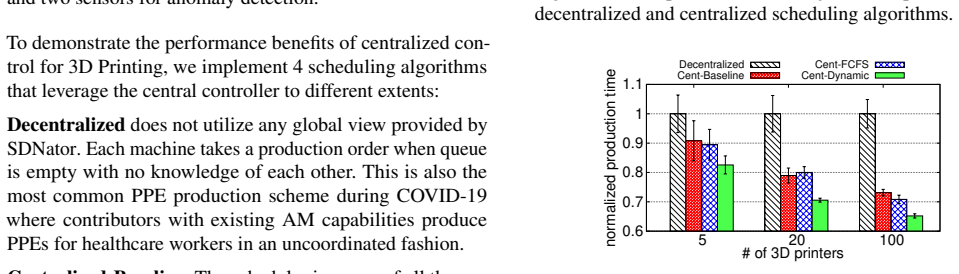
SDNator embraces an application- and data-driven design where applications function as data consumers and producers to collectively define the workflows of the controller. It incorporates two data store backends to support both event-driven and data-driven programming patterns. Benchmarks show high scalability with performance comparable to existing controllers. Case studies integrate applications from manufacturing and networking domains, including the first digital-twin-equipped central controller for additive manufacturing fleets that shortens production time, improves reliability during anomalies, and optimizes plans for urgent requests.
What carries the argument
The application- and data-driven design in which applications act as data consumers and producers to define controller workflows.
If this is right
- Applications from different domains can be integrated to build specialized controllers without redesigning the core system.
- SDNator-based scheduling shortens production time and improves reliability compared to decentralized approaches when anomalies occur.
- Production plans can be flexibly adjusted and optimized for urgent requests such as sudden demand spikes.
- The framework maintains performance levels comparable to established controllers while adding extensibility for varied CPS scenarios.
Where Pith is reading between the lines
- The data exchange model could support real-time adaptive control in additional CPS domains such as autonomous vehicles or large-scale IoT deployments.
- Open availability of the framework might enable community development of new applications that extend its use across more industries.
- Machine learning components could be added as data-producing applications to introduce predictive elements into the control workflows.
Load-bearing premise
No existing frameworks can offer domain-agnostic, easily extensible support for data-driven CPS applications.
What would settle it
A demonstration that an existing framework already achieves domain-agnostic extensibility for data-driven CPS applications across manufacturing, networking, and similar domains with comparable scalability.
Figures




read the original abstract
An SDN-like centralized control architecture is increasingly popular and has been widely explored in cyber-physical systems (CPS) such as manufacturing, internet-of-things, and autonomous vehicle systems for higher flexibility, programmability and scalability. However, no existing frameworks can offer domain-agnostic, easily extensible support for data-driven CPS applications. In this work, we design, implement, and open-source \textit{SDNator}, the first framework to enable extensible, data-driven control in CPS. SDNator embraces an application- and data-driven design where applications function as data consumers and producers to collectively define the workflows of the controller. SDNator also incorporates two data store backends to support both event-driven and data-driven programming patterns. Benchmarks show that SDNator is highly scalable, and delivers comparable performance to Ryu, a widely used SDN controller. Moreover, we demonstrate the capabilities and usability of SDNator through our case studies of manufacturing and networking systems. By integrating applications from respective domains, we build different ``controllers'' for different scenarios. Most notably, we leverage SDNator to implement the first digital-twin-equipped central controller for additive manufacturing fleets. We show through extensive and realistic simulations that SDNator-based scheduling can (1) significantly shorten production time and improve reliability in the presence of anomalies compared to decentralized approaches, and (2) flexibly adjust and optimize production plans upon urgent requests such as producing Personal Protective Equipment during the COVID-19 pandemic.
Editorial analysis
A structured set of objections, weighed in public.
Referee Report
Summary. The paper presents SDNator, an open-source SDN controller framework for cyber-physical systems (CPS) such as manufacturing and IoT. It claims to be the first to support extensible data-driven control by treating applications as both data consumers and producers that collectively define controller workflows, using dual event-driven and data-driven store backends. The work reports benchmarks showing scalability and performance comparable to Ryu, plus case studies including a digital-twin-equipped controller for additive manufacturing fleets that yields shorter production times and better reliability than decentralized approaches under anomalies and urgent requests.
Significance. If the novelty claim holds and the architecture demonstrably enables new data-driven CPS workflows beyond existing SDN platforms, the framework could offer a reusable platform for programmable control in manufacturing and autonomous systems. The open-sourcing and concrete digital-twin case study are strengths that would aid reproducibility and adoption if the experimental claims are substantiated.
major comments (3)
- [Abstract and §1] Abstract and §1: The claim that 'no existing frameworks can offer domain-agnostic, easily extensible support for data-driven CPS applications' is used to motivate both the architecture and the 'first' designation, yet the manuscript provides no comparison table, citations, or analysis showing why Ryu, ONOS, or domain-specific CPS controllers fail these criteria; this is load-bearing for the central novelty argument.
- [Evaluation] Evaluation section: The benchmarks against Ryu and the manufacturing simulations claim scalability, comparable performance, and improvements in production time/reliability, but supply no details on measurement methodology, statistical significance, simulation parameters, anomaly models, or validation against physical systems, preventing assessment of the results.
- [Case studies] Case studies section: The digital-twin-equipped controller for additive manufacturing fleets is presented as a notable contribution, but without explicit differentiation from prior digital-twin work in CPS or manufacturing literature, the uniqueness of the SDNator-based implementation cannot be evaluated.
minor comments (2)
- [Abstract] Abstract: The transition sentence beginning 'Moreover,' disrupts paragraph flow and could be rephrased for clarity.
- [Evaluation] Figures and tables: Results would benefit from additional tables comparing SDNator features against prior controllers and from error bars or confidence intervals on the reported performance numbers.
Simulated Author's Rebuttal
We thank the referee for their thorough review and constructive suggestions. We address each of the major comments below, agreeing that revisions are needed to strengthen the paper's claims and clarity.
read point-by-point responses
-
Referee: [Abstract and §1] Abstract and §1: The claim that 'no existing frameworks can offer domain-agnostic, easily extensible support for data-driven CPS applications' is used to motivate both the architecture and the 'first' designation, yet the manuscript provides no comparison table, citations, or analysis showing why Ryu, ONOS, or domain-specific CPS controllers fail these criteria; this is load-bearing for the central novelty argument.
Authors: We agree that the central novelty claim requires stronger substantiation through explicit comparison. In the revised version, we will add a dedicated subsection or table in the introduction that compares SDNator against Ryu, ONOS, and domain-specific CPS controllers from the literature. This will include citations and analysis of why existing frameworks do not provide the same level of domain-agnostic extensibility for data-driven applications, particularly the dual role of applications as data producers and consumers with dual backends. revision: yes
-
Referee: [Evaluation] Evaluation section: The benchmarks against Ryu and the manufacturing simulations claim scalability, comparable performance, and improvements in production time/reliability, but supply no details on measurement methodology, statistical significance, simulation parameters, anomaly models, or validation against physical systems, preventing assessment of the results.
Authors: We acknowledge the need for greater transparency in the evaluation. We will revise the Evaluation section to provide detailed descriptions of the measurement methodology, including how performance metrics were collected, any statistical tests for significance, specific simulation parameters, the models used for anomalies, and any steps taken toward validation. This will enable readers to better assess the reported results on scalability and improvements. revision: yes
-
Referee: [Case studies] Case studies section: The digital-twin-equipped controller for additive manufacturing fleets is presented as a notable contribution, but without explicit differentiation from prior digital-twin work in CPS or manufacturing literature, the uniqueness of the SDNator-based implementation cannot be evaluated.
Authors: We will enhance the Case studies section by adding citations to prior digital-twin research in CPS and manufacturing. We will explicitly differentiate SDNator's contribution by emphasizing how its extensible data-driven architecture allows for novel integration of digital twins into centralized control workflows, which prior works do not address in the same domain-agnostic manner. revision: yes
Circularity Check
No significant circularity; implementation claims rest on external comparison rather than self-referential reduction.
full rationale
The paper asserts that 'no existing frameworks can offer domain-agnostic, easily extensible support for data-driven CPS applications' to position SDNator as 'the first framework,' but this is a standalone novelty claim without supporting citations, equations, or derivations in the provided text. No self-citations, fitted parameters, or mathematical steps are present that reduce any result to its own inputs by construction. The architecture (applications as data consumers/producers, dual data store backends) is presented as a design choice justified by the domain gap, with performance validated against the external Ryu controller. This is a standard implementation paper whose central claims do not loop back to themselves; any weakness lies in the unverified premise (a correctness/evidence issue) rather than circularity per the enumerated patterns.
Axiom & Free-Parameter Ledger
Reference graph
Works this paper leans on
- [1]
-
[2]
https://hadoop.apache.org/docs/r2.7.1/ hadoop-yarn/hadoop-yarn-site/YARN.html
Apache hadoop nextgen mapreduce (yarn). https://hadoop.apache.org/docs/r2.7.1/ hadoop-yarn/hadoop-yarn-site/YARN.html
- [3]
-
[4]
Apache spark™ - unified analytics engine for big data. https://spark.apache.org/
-
[5]
https:// ptolemy.berkeley.edu/projects/cps/
Cyber-physical systems - a concept map. https:// ptolemy.berkeley.edu/projects/cps/
-
[6]
Database index - wikipedia. https://en.wikipedia. org/wiki/Database_index
- [7]
-
[8]
Global interpreter lock - wikipedia. https://en. wikipedia.org/wiki/Global_interpreter_lock
-
[9]
grpc – a high-performance, open source universal rpc framework. https://grpc.io/
-
[10]
Mininet: An instant virtual network on your laptop (or other pc). http://mininet.org/
-
[11]
The most popular database for modern apps | mongodb. https://www.mongodb.com/
- [12]
-
[13]
Openconfig | vendor-neutral, model-driven network management designed by users. http://www. openconfig.net/
-
[14]
https://github.com/openconfig/gnmi
openconfig/gnmi: grpc network management interface. https://github.com/openconfig/gnmi
-
[15]
https://github.com/p4lang/ behavioral-model
p4lang/behavioral-model: The reference p4 soft- ware switch. https://github.com/p4lang/ behavioral-model
-
[16]
https://github.com/ p4lang/p4runtime
p4lang/p4runtime: Specification documents for the p4runtime control-plane api. https://github.com/ p4lang/p4runtime
-
[17]
https://p4.org/ p4-spec/docs/P4-16-v1.0.0-spec.html
P4~16~ language specification. https://p4.org/ p4-spec/docs/P4-16-v1.0.0-spec.html
-
[18]
Professional 3d printing made accessible | ultimaker. https://ultimaker.com/
- [19]
- [20]
-
[21]
https:// rxpy.readthedocs.io/en/latest/
The reactive extensions for python (rxpy). https:// rxpy.readthedocs.io/en/latest/
- [22]
- [23]
- [24]
- [25]
- [26]
-
[27]
https://en.wikipedia.org/ wiki/SYN_flood
Syn flood - wikipedia. https://en.wikipedia.org/ wiki/SYN_flood
-
[28]
https:// redis.io/topics/pipelining
Using pipelining to speedup redis queries. https:// redis.io/topics/pipelining
-
[29]
Manos Antonakakis, Tim April, Michael Bailey, Matt Bernhard, Elie Bursztein, Jaime Cochran, Zakir Du- rumeric, J. Alex Halderman, Luca Invernizzi, Michalis Kallitsis, Deepak Kumar, Chaz Lever, Zane Ma, Joshua Mason, Damian Menscher, Chad Seaman, Nick Sullivan, Kurt Thomas, and Yi Zhou. Understanding the mirai botnet. In 26th USENIX Security Symposium (USE...
-
[30]
A cen- tralized framework for system-level control and man- agement of additive manufacturing fleets
Efe C Balta, Dawn M Tilbury, and Kira Barton. A cen- tralized framework for system-level control and man- agement of additive manufacturing fleets. In 2018 IEEE 14th International Conference on Automation Sci- ence and Engineering (CASE) , pages 1071–1078. IEEE, 2018
work page 2018
-
[31]
Efe C Balta, Dawn M Tilbury, and Kira Barton. A dig- ital twin framework for performance monitoring and anomaly detection in fused deposition modeling. In 2019 IEEE 15th International Conference on Automa- tion Science and Engineering (CASE) , pages 823–829. IEEE, 2019
work page 2019
-
[32]
BBC. Coronavirus: Can we 3d-print our way out of the ppe shortage? https://www.bbc.com/news/ health-52201696, April 2020
work page 2020
-
[33]
P4: Programming protocol-independent packet processors
Pat Bosshart, Dan Daly, Glen Gibb, Martin Izzard, Nick McKeown, Jennifer Rexford, Cole Schlesinger, Dan Talayco, Amin Vahdat, George Varghese, et al. P4: Programming protocol-independent packet processors. ACM SIGCOMM Computer Communication Review , 44(3):87–95, 2014. 14
work page 2014
-
[34]
Elasticon; an elastic dis- tributed sdn controller
Advait Dixit, Fang Hao, Sarit Mukherjee, TV Lakshman, and Ramana Rao Kompella. Elasticon; an elastic dis- tributed sdn controller. In 2014 ACM/IEEE Symposium on Architectures for Networking and Communications Systems (ANCS), pages 17–27. IEEE, 2014
work page 2014
-
[35]
Sonata: Query-driven streaming network telemetry
Arpit Gupta, Rob Harrison, Marco Canini, Nick Feam- ster, Jennifer Rexford, and Walter Willinger. Sonata: Query-driven streaming network telemetry. In Proceed- ings of the 2018 Conference of the ACM Special Interest Group on Data Communication, pages 357–371. ACM, 2018
work page 2018
- [36]
-
[37]
Sd-cps: software-defined cyber-physical systems
Pradeeban Kathiravelu, Peter Van Roy, and Luís Veiga. Sd-cps: software-defined cyber-physical systems. tam- ing the challenges of cps with workflows at the edge. Cluster Computing, 22(3):661–677, 2019
work page 2019
-
[38]
Intrusion detection system: A comprehensive review
Hung-Jen Liao, Chun-Hung Richard Lin, Ying-Chih Lin, and Kuang-Yuan Tung. Intrusion detection system: A comprehensive review. Journal of Network and Com- puter Applications, 36(1):16–24, 2013
work page 2013
-
[39]
A west-east bridge based sdn inter-domain testbed
Pingping Lin, Jun Bi, Stephen Wolff, Yangyang Wang, Anmin Xu, Ze Chen, Hongyu Hu, and Yikai Lin. A west-east bridge based sdn inter-domain testbed. IEEE Communications Magazine, 53(2):190–197, 2015
work page 2015
-
[40]
Add: Application and data- driven controller design
Yikai Lin, Yuru Shao, Xiao Zhu, Junpeng Guo, Kira Barton, and Z Morley Mao. Add: Application and data- driven controller design. In Proceedings of the 2019 ACM Symposium on SDN Research, pages 84–90. ACM, 2019
work page 2019
-
[41]
J. Liu, Y . Li, M. Chen, W. Dong, and D. Jin. Software- defined internet of things for smart urban sensing. IEEE Communications Magazine, 53(9):55–63, 2015
work page 2015
-
[42]
K. Liu, J. K. Y . Ng, V . C. S. Lee, S. H. Son, and I. Stoj- menovic. Cooperative data scheduling in hybrid vehicu- lar ad hoc networks: Vanet as a software defined network. IEEE/ACM Transactions on Networking , 24(3):1759– 1773, 2016
work page 2016
-
[43]
A software-defined framework for the integrated management of smart man- ufacturing systems
Felipe Lopez, Yuru Shao, Z Morley Mao, James Moyne, Kira Barton, and Dawn Tilbury. A software-defined framework for the integrated management of smart man- ufacturing systems. Manufacturing Letters, 15:18–21, 2018
work page 2018
-
[44]
Openflow: enabling inno- vation in campus networks
Nick McKeown, Tom Anderson, Hari Balakrishnan, Guru Parulkar, Larry Peterson, Jennifer Rexford, Scott Shenker, and Jonathan Turner. Openflow: enabling inno- vation in campus networks. ACM SIGCOMM Computer Communication Review, 38(2):69–74, 2008
work page 2008
-
[45]
Opendaylight: Towards a model-driven sdn controller architecture
Jan Medved, Robert Varga, Anton Tkacik, and Ken Gray. Opendaylight: Towards a model-driven sdn controller architecture. In Proceeding of IEEE International Sym- posium on a World of Wireless, Mobile and Multimedia Networks 2014, pages 1–6. IEEE, 2014
work page 2014
-
[46]
Kitsune: An ensemble of autoencoders for online network intrusion detection
Yisroel Mirsky, Tomer Doitshman, Yuval Elovici, and Asaf Shabtai. Kitsune: An ensemble of autoencoders for online network intrusion detection. In NDSS. The Internet Society, 2018
work page 2018
-
[47]
Inferring internet denial-of-service activity
David Moore, Colleen Shannon, Douglas J Brown, Ge- offrey M V oelker, and Stefan Savage. Inferring internet denial-of-service activity. ACM Transactions on Com- puter Systems (TOCS), 24(2):115–139, 2006
work page 2006
-
[48]
Softmow: Recursive and reconfig- urable cellular wan architecture
Mehrdad Moradi, Wenfei Wu, Li Erran Li, and Zhuo- qing Morley Mao. Softmow: Recursive and reconfig- urable cellular wan architecture. In Proceedings of the 10th ACM International on Conference on emerging Net- working Experiments and Technologies, pages 377–390. ACM, 2014
work page 2014
-
[49]
Ford and gm are racing to build coronavirus ventilators, but their efforts may be too late
The Washington Post. Ford and gm are racing to build coronavirus ventilators, but their efforts may be too late. https://www. washingtonpost.com/business/2020/04/04/ ventilators-coronavirus-ford-gm/ , April 2020
work page 2020
-
[50]
Yassine Qamsane, Chien-Ying Chen, Efe C Balta, Bin- Chou Kao, Sibin Mohan, James Moyne, Dawn Tilbury, and Kira Barton. A unified digital twin framework for real-time monitoring and evaluation of smart manufac- turing systems. In 2019 IEEE 15th International Confer- ence on Automation Science and Engineering (CASE) , pages 1394–1401. IEEE, 2019
work page 2019
-
[51]
Survey on sdn based network intrusion detection system using machine learning approaches
Nasrin Sultana, Naveen Chilamkurti, Wei Peng, and Rabei Alhadad. Survey on sdn based network intrusion detection system using machine learning approaches. Peer-to-Peer Networking and Applications, 12(2):493– 501, 2019
work page 2019
-
[52]
Ioflow: A software-defined storage architecture
Eno Thereska, Hitesh Ballani, Greg O’Shea, Thomas Karagiannis, Antony Rowstron, Tom Talpey, Richard Black, and Timothy Zhu. Ioflow: A software-defined storage architecture. In Proceedings of the Twenty- F ourth ACM Symposium on Operating Systems Prin- ciples, SOSP ’13, page 182–196, New York, NY , USA,
-
[53]
Association for Computing Machinery. 15
discussion (0)
Sign in with ORCID, Apple, or X to comment. Anyone can read and Pith papers without signing in.