Sharp Convergence Rates and Optimal Weights for Cimmino's Reflection Algorithm
Pith reviewed 2026-06-30 12:52 UTC · model grok-4.3
The pith
For two equations, unit weights are the unique choice minimizing Cimmino contraction to |cos θ| set only by the normals' angle.
A machine-rendered reading of the paper's core claim, the machinery that carries it, and where it could break.
Core claim
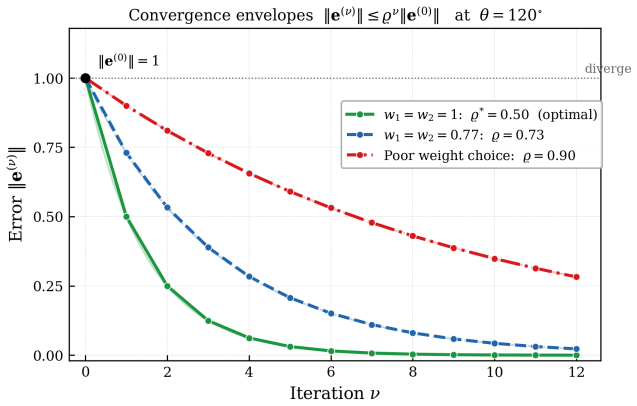
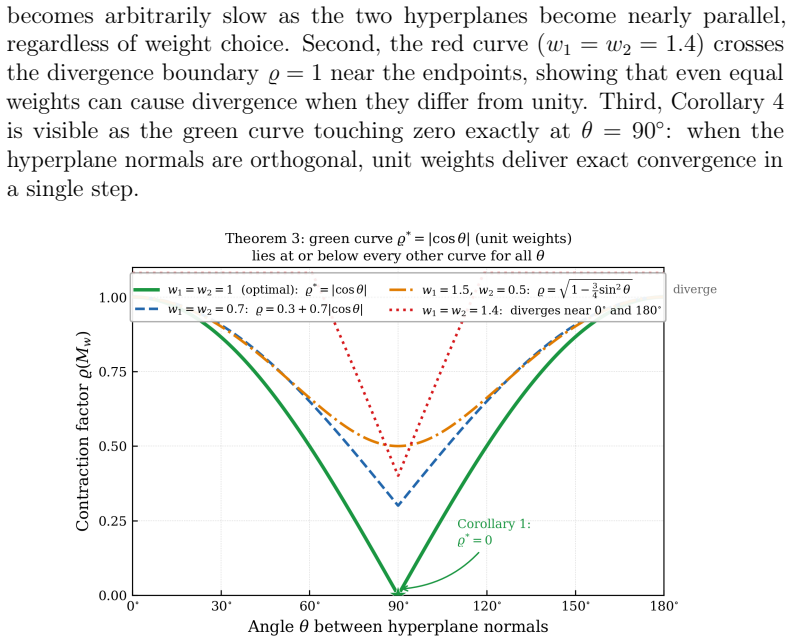
The standard unit weights w1^*=w2^*=1 are globally optimal over all positive weight pairs, uniquely achieving the minimum contraction factor sprad^*=|cos θ| -- a quantity determined solely by the geometry of the hyperplane normals.
What carries the argument
The error-propagation matrix M_w = I - A^T D_w A whose spectral radius governs the contraction rate of the weighted reflection iteration.
If this is right
- The minimal contraction rate equals exactly |cos θ| when the weights are unity.
- The single parameter θ controls both the best achievable speed and the optimal weight choice.
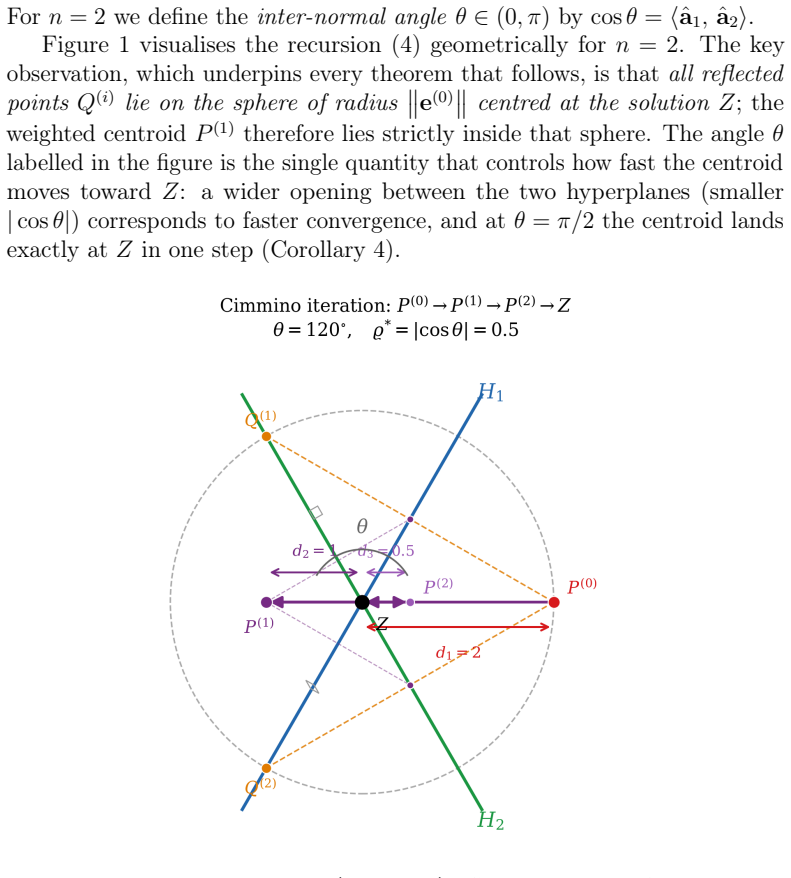
- Convergence occurs in one step whenever θ equals π/2.
- An exact expression for the spectral rate extends to systems with any number of equations.
Where Pith is reading between the lines
- In dimensions higher than two the same geometric quantity may still bound the rate if the normals satisfy a suitable uniformity condition.
- Practical codes could safely default to unit weights without a separate optimization step.
- The optimality argument might carry over to other row-action reflection schemes that share the same normal-angle geometry.
Load-bearing premise
The weighted iteration can be written exactly as a linear map on the error whose contraction is given by the spectral radius of M_w.
What would settle it
For a fixed angle θ between two normals, compute the spectral radius of M_w over a dense grid of positive weight pairs and check whether any pair produces a value smaller than |cos θ|.
Figures
read the original abstract
In this paper, Cimmino's classical reflection algorithm for solving the $n\times n$ nonsingular linear system $A\bx=\bb$ is analysed through the lens of spectral theory. Reformulating the weighted iteration as $\e^{(\nu+1)}=M_w\,\e^{(\nu)}$, where $M_w = I - A^\top D_w A$, the error is shown to contract by the spectral radius $\sprad(M_w)$ at every step, with a sharp, asymptotically tight bound. For $n=2$, a closed-form expression for the contraction factor is derived, \[ \sprad(M_w) \;=\; |1-\mu| + \tfrac{1}{2}\sqrt{(w_1-w_2)^2 + 4w_1w_2\cos^2\!\theta}, \] where $\mu=(w_1+w_2)/2$ and $\theta$ denotes the angle between the hyperplane normals. A central result of this paper is that the standard unit weights $w_1^*=w_2^*=1$ are \emph{globally optimal} over all positive weight pairs, uniquely achieving the minimum contraction factor $\sprad^*=|\cos\theta|$ -- a quantity determined solely by the geometry of the hyperplane normals. The inter-normal angle $\theta$ thus emerges as the single diagnostic parameter governing both convergence speed and weight selection. Extensions to a single-step convergence criterion at $\theta=\pi/2$ and to an exact spectral rate for general~$n$ are also established.
Editorial analysis
A structured set of objections, weighed in public.
Referee Report
Summary. The paper analyzes Cimmino's classical reflection algorithm for nonsingular linear systems Ax=b via spectral theory. It reformulates the weighted iteration as the error recurrence e^(ν+1)=M_w e^ν with M_w=I-A^T D_w A, derives the closed-form spectral radius for n=2 as |1-μ| + (1/2)√[(w1-w2)^2 + 4 w1 w2 cos²θ] (μ=(w1+w2)/2, θ the angle between normals), proves that the unit weights w1=w2=1 are uniquely optimal and achieve the sharp contraction factor |cos θ|, and establishes extensions including single-step convergence at θ=π/2 together with an exact spectral rate for general n.
Significance. If the algebraic minimization and eigenvalue verification hold, the work supplies sharp, geometry-only convergence rates for a classical projection method and identifies the inter-normal angle θ as the sole diagnostic parameter. The explicit global optimality of the standard weights (confirmed by direct spectral-radius minimization and eigenvalue recovery of ±cos θ) and the parameter-free character of the bound constitute a concrete advance for understanding and tuning iterative solvers in numerical linear algebra.
minor comments (2)
- [Abstract] Abstract, formula for sprad(M_w): the definition of μ is given inline but would benefit from a parenthetical restatement immediately after the expression for immediate readability.
- The manuscript would be strengthened by a short remark contrasting the new n=2 optimality result with prior convergence analyses of Cimmino's method that appear in the literature.
Simulated Author's Rebuttal
We thank the referee for the careful reading and the positive assessment of the manuscript. The report correctly identifies the central results on the optimality of unit weights for n=2 and the role of the inter-normal angle heta.
Circularity Check
No significant circularity; derivation is algebraic minimization of explicit spectral-radius formula
full rationale
The paper reformulates the weighted Cimmino iteration as the linear map e^(ν+1)=M_w e^(ν) with M_w=I-A^T D_w A, derives an explicit closed-form expression for sprad(M_w) when n=2, and then algebraically minimizes that expression over positive weights w1,w2. The minimum is attained at the standard weights w1=w2=1 with value |cos θ|. This is a direct calculus exercise on the given formula; no parameter is fitted to data and then re-used as a prediction, no self-citation supplies a load-bearing uniqueness theorem, and the claimed optimality is obtained by explicit differentiation or completion of the square rather than by construction or renaming. The argument is therefore self-contained against external benchmarks and receives score 0.
Axiom & Free-Parameter Ledger
axioms (1)
- domain assumption The error after one weighted reflection step satisfies e^(ν+1) = M_w e^(ν) exactly, with M_w = I - A^T D_w A.
Reference graph
Works this paper leans on
-
[1]
Cimmino, Approximate computation of the solutions of systems of linear equations,Rend
G. Cimmino, Approximate computation of the solutions of systems of linear equations,Rend. Accad. Sci. Fis. Mat. Napoli(4) 89 (2022) 65–72; English translation by M. Benzi of the original (1938)
2022
-
[2]
Guida, C
M. Guida, C. Sbordone, The reflection method for the numerical solution of linear systems,SIAM Rev.65 (4) (2023) 1137–1151
2023
-
[3]
Kaczmarz, Approximate solution of systems of linear equations,Bull
S. Kaczmarz, Approximate solution of systems of linear equations,Bull. Int. Acad. Polonaise Sci. Lett. Ser. A35 (1937) 355–357
1937
-
[4]
Benzi, Gianfranco Cimmino’s contributions to numerical mathematics, Rend
M. Benzi, Gianfranco Cimmino’s contributions to numerical mathematics, Rend. Accad. Sci. Fis. Mat. Napoli(4) 89 (2022) 73–98
2022
-
[5]
Strohmer, R
T. Strohmer, R. Vershynin, A randomized Kaczmarz algorithm with exponential convergence,J. Fourier Anal. Appl.15 (2) (2009) 262–278
2009
-
[6]
Aharoni, Y
R. Aharoni, Y. Censor, Block-iterative projection methods for parallel computation of solutions to convex feasibility problems,Linear Algebra Appl.120 (1989) 165–175
1989
-
[7]
Censor, M
Y. Censor, M. D. Altschuler, W. D. Powlis, On the use of Cimmino’s simultaneous projection method for computing a solution of the inverse problem in radiation therapy treatment planning,Inverse Problems4 (1988) 607–623
1988
-
[8]
F. S. Torun, M. Manguoglu, C. Aykanat, A novel partitioning method for accelerating the block Cimmino algorithm,SIAM J. Sci. Comput.40 (2018) C827–C850
2018
-
[9]
Needell, J
D. Needell, J. A. Tropp, Paved with good intentions: Analysis of a randomized block Kaczmarz method,Linear Algebra Appl.441 (2014) 199–221. 9
2014
discussion (0)
Sign in with ORCID, Apple, or X to comment. Anyone can read and Pith papers without signing in.