Impact of non-equilibrium radiation in a high-enthalpy inductively coupled plasma wind tunnel
Pith reviewed 2026-06-29 23:47 UTC · model grok-4.3
The pith
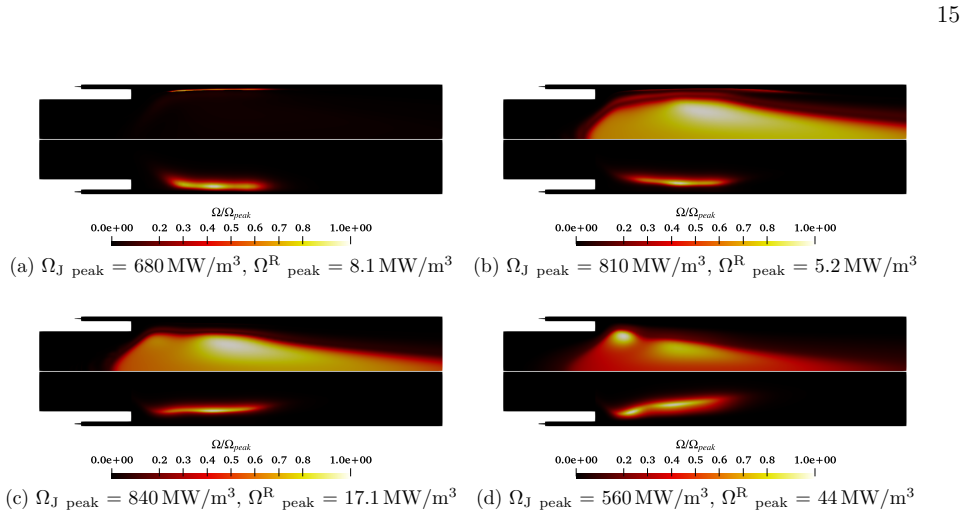
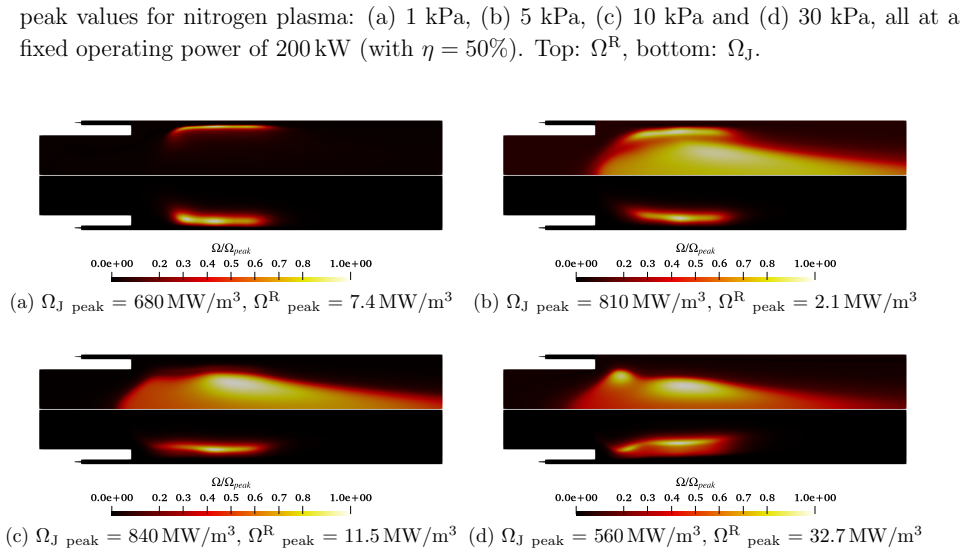
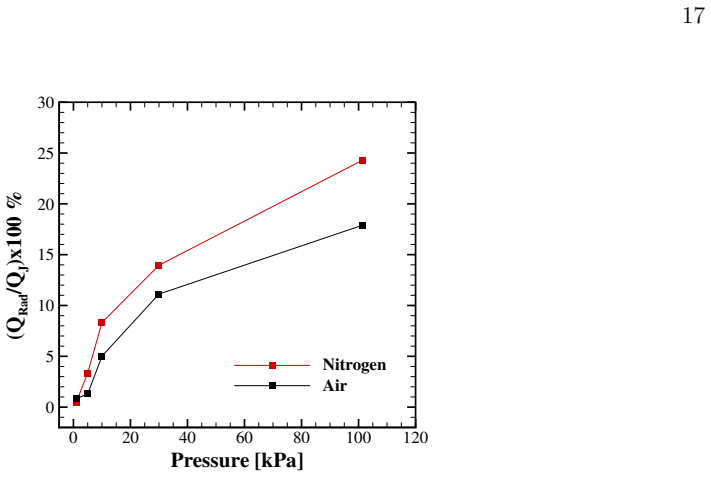
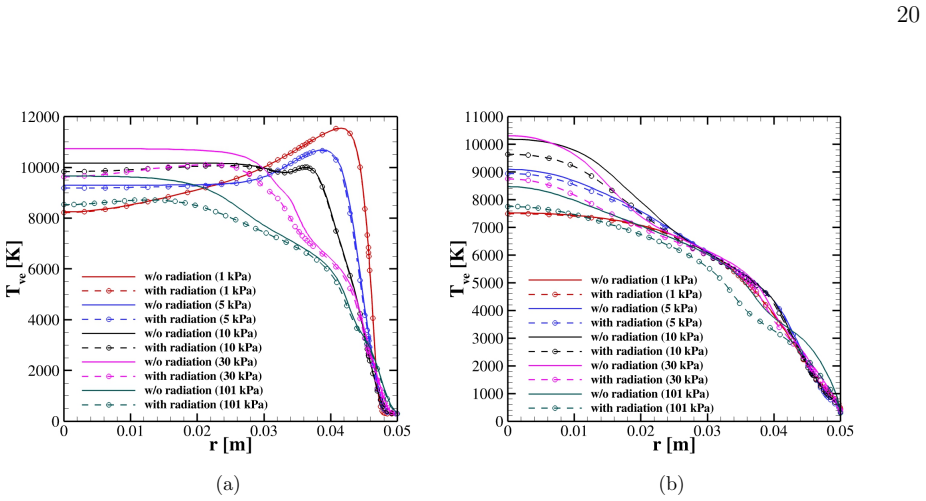
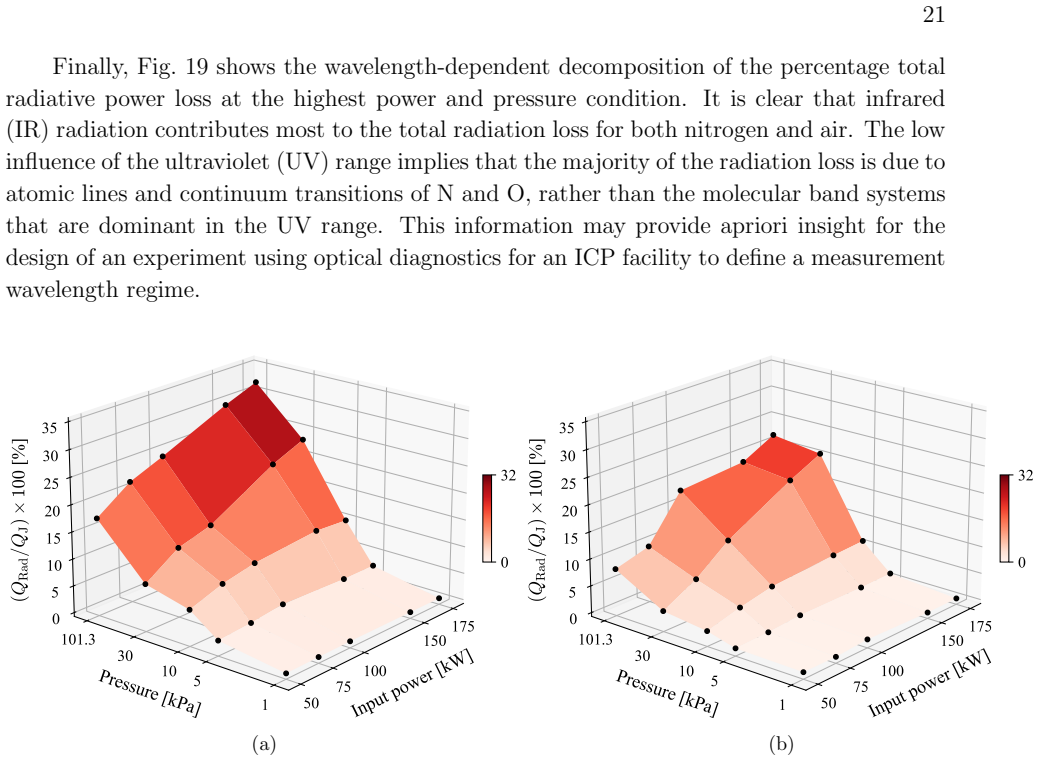
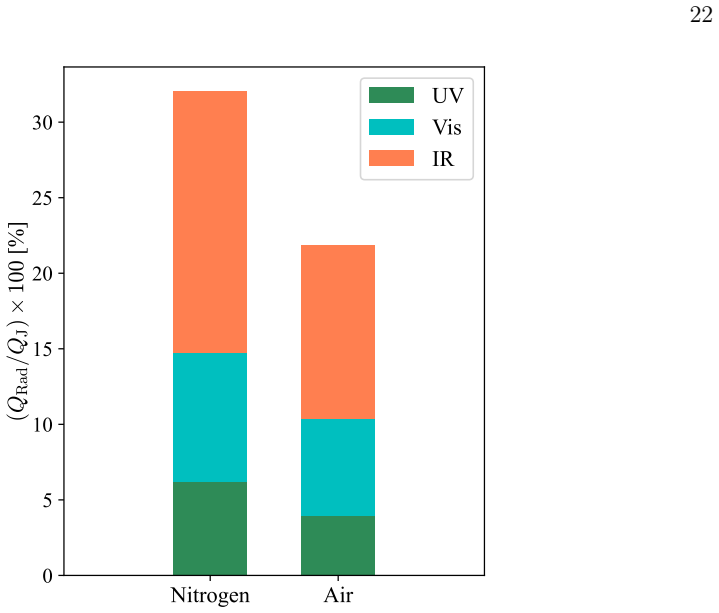
Radiative losses reach up to 32% of input power at atmospheric pressure in nitrogen plasmas inside high-enthalpy ICP wind tunnels.
A machine-rendered reading of the paper's core claim, the machinery that carries it, and where it could break.
Core claim
The authors establish that radiative losses account for up to 32% of input power for nitrogen plasmas and 22% for air plasmas at atmospheric pressure, causing substantial reductions in core plasma temperatures, while the facility operates predominantly in an optically thin regime across the full range of pressures and powers considered.
What carries the argument
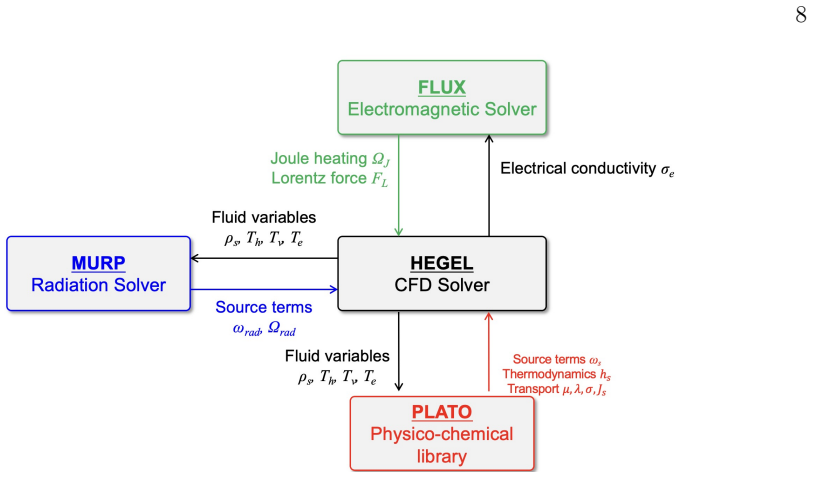
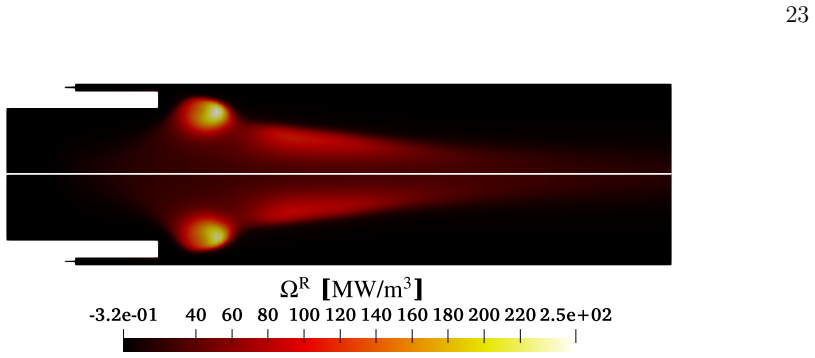
A loosely coupled multi-physics framework that self-consistently couples a magnetohydrodynamic plasma solver with a spectral radiative transport solver to compute radiative cooling without relying on optically thin or empirical approximations.
If this is right
- Pressure-power maps of radiative loss fraction provide direct guidance for when radiation must be included in facility modeling.
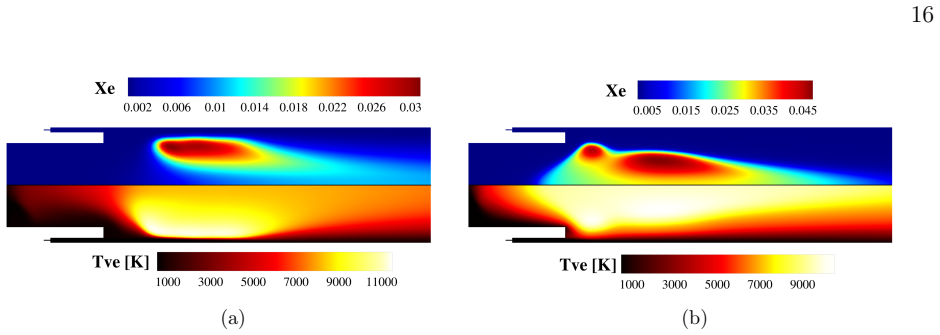
- Nitrogen plasmas exhibit systematically higher radiative losses than air plasmas because of greater concentrations of radiatively active species and higher electron densities.
- Core temperatures are substantially lower once radiation is accounted for, altering predicted heat fluxes to test articles.
- The optically thin regime holds even at the highest power and pressure, so simplified radiation models remain usable under most operating conditions.
Where Pith is reading between the lines
- Comparable radiative loss fractions are likely in other ICP or arc-heated facilities once they reach similar pressure and power-density levels.
- Incorporating radiation feedback into flow-field predictions could change inferred enthalpy and velocity distributions in the test section.
- Extending the same framework to time-dependent or fully coupled simulations would test whether radiative cooling alters the stability of the inductive discharge.
Load-bearing premise
The loosely coupled MHD-plus-radiative-transport model produces quantitatively accurate fractions of radiative loss without requiring full two-way coupling or direct experimental validation at the Plasmatron X conditions.
What would settle it
Direct measurement of core plasma temperature or total radiated power in the Plasmatron X at 101 kPa and 350 kW, compared against the simulation results with and without the radiation module.
Figures
read the original abstract
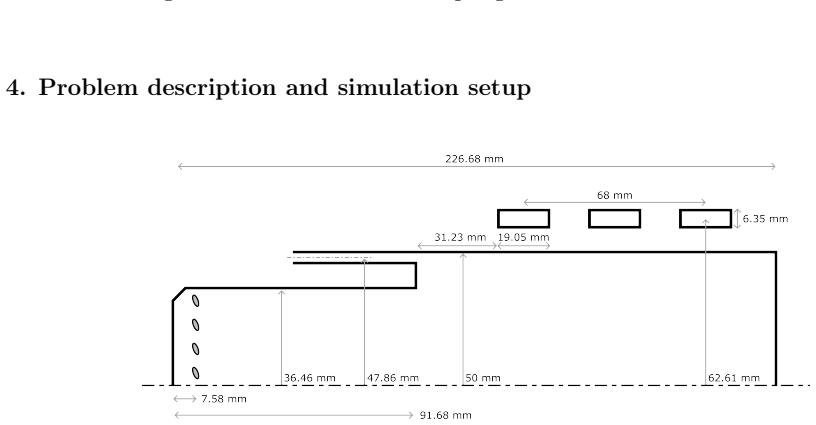
High-power inductively coupled plasma (ICP) wind tunnels are widely used to reproduce high-enthalpy environments relevant to atmospheric entry and hypersonic testing. Despite their importance, radiative heat transfer in ICP facilities is commonly neglected or modeled using simplified optically thin assumptions, and the impact of non-equilibrium radiation on plasma dynamics remains poorly quantified. In this work, a loosely coupled, multi-physics framework is developed to systematically investigate radiative cooling effects in the 350 kW Plasmatron X facility at the University of Illinois Urbana-Champaign. The approach self-consistently couples a magnetohydrodynamic plasma framework with a spectral radiative transport solver, eliminating the need for optically thin or empirical models. Simulations are performed for nitrogen and air plasmas over a wide range of operating pressures (1-101 kPa) and powers (100-350 kW). The results reveal a strong pressure dependence of radiative losses, with radiation contributing negligibly at low pressures, but becoming a dominant energy sink at elevated pressures. At atmospheric pressure, radiative losses account for up to approximately 32% and 22% of the input power for nitrogen and air plasmas, respectively, leading to substantial reductions in core plasma temperatures. Nitrogen plasmas consistently exhibit higher radiative losses than air as a result of increased concentrations of radiatively active species and higher electron number densities. Pressure-power maps of radiative heat loss relative to input power are constructed to quantify combined operating effects and to provide guidance for facility operation and modeling fidelity. Finally, an assessment of self-absorption demonstrates that the Plasmatron X torch operates predominantly in an optically thin regime, even at the highest power and pressure conditions considered.
Editorial analysis
A structured set of objections, weighed in public.
Referee Report
Summary. The manuscript develops a loosely coupled multi-physics framework that combines an MHD plasma solver with a spectral radiative transport solver to quantify non-equilibrium radiative cooling in the 350 kW Plasmatron X ICP wind tunnel. Simulations for nitrogen and air plasmas across 1–101 kPa and 100–350 kW show negligible radiative losses at low pressure but up to ~32 % (N₂) and ~22 % (air) of input power at atmospheric pressure, producing substantial core-temperature reductions; the facility is reported to remain optically thin even at the highest conditions, and pressure–power maps are provided for operational guidance.
Significance. If the quantitative loss fractions prove accurate, the work supplies concrete, facility-specific guidance on when radiation must be retained in high-enthalpy ICP modeling and quantifies the N₂–air difference arising from radiatively active species and electron density; the pressure–power maps would be directly useful for both experiment design and code validation in atmospheric-entry testing.
major comments (2)
- [Abstract / Results] Abstract and Results: the central quantitative claims (radiative losses = 32 % N₂ / 22 % air of input power at 101 kPa) are obtained from a single-pass, loosely coupled MHD + spectral RT calculation without iteration of the radiative sink back into the plasma state. Because radiative cooling lowers temperature and therefore emission, the reported fractions are sensitive to this missing feedback; no convergence test with respect to coupling iterations is shown.
- [Results / Methods] Results / Methods: no mesh-convergence data, grid-resolution study, or uncertainty quantification is supplied for the loss percentages, and no direct comparison to experimental temperature or power-balance measurements for Plasmatron X conditions is presented to anchor the numerical values.
minor comments (2)
- [Abstract] Reconcile the abstract phrasing “self-consistently couples” with the body description of a “loosely coupled” single-pass procedure.
- [Methods] Specify the spectral discretization (number of lines/bands, wavelength grid) and the atomic/molecular databases employed in the radiative transport solver.
Simulated Author's Rebuttal
We thank the referee for the constructive comments on our manuscript describing the loosely coupled MHD-radiative framework for the Plasmatron X facility. We address each major comment below.
read point-by-point responses
-
Referee: [Abstract / Results] Abstract and Results: the central quantitative claims (radiative losses = 32 % N₂ / 22 % air of input power at 101 kPa) are obtained from a single-pass, loosely coupled MHD + spectral RT calculation without iteration of the radiative sink back into the plasma state. Because radiative cooling lowers temperature and therefore emission, the reported fractions are sensitive to this missing feedback; no convergence test with respect to coupling iterations is shown.
Authors: We agree that the reported loss fractions are obtained from a single-pass, loosely coupled calculation in which the radiative sink is not fed back into the MHD solution. This is an inherent feature of the current framework, and the referee correctly notes that the absence of iteration means the values (particularly at 101 kPa) represent an upper-bound estimate, since radiative cooling would lower temperature and emission. The optically thin regime identified in the work mitigates some of the feedback on transport properties, but does not eliminate the temperature effect. We will revise the manuscript to explicitly state this limitation, quantify its expected direction, and indicate that iterative coupling remains a topic for subsequent study. revision: partial
-
Referee: [Results / Methods] Results / Methods: no mesh-convergence data, grid-resolution study, or uncertainty quantification is supplied for the loss percentages, and no direct comparison to experimental temperature or power-balance measurements for Plasmatron X conditions is presented to anchor the numerical values.
Authors: A dedicated mesh-convergence study and uncertainty quantification for the radiative loss percentages were not included in the original submission. The computational grids were chosen on the basis of prior validation of the MHD solver for similar ICP configurations, with resolution sufficient to capture core temperature and velocity profiles. We will add a grid-convergence appendix in the revised manuscript that reports changes in temperature, power balance, and radiative loss fraction under successive refinements. With respect to experimental anchoring, detailed temperature and power-balance measurements matching the exact simulated pressures and powers are not available in the published literature for Plasmatron X. The present work is therefore positioned as a modeling study to inform facility operation and future validation experiments; we will make this scope explicit in the revised text. revision: partial
Circularity Check
No significant circularity; results from direct numerical solution of governing equations
full rationale
The paper computes radiative loss fractions (32% N2, 22% air at 101 kPa) as direct outputs of a loosely coupled MHD + spectral RT simulation across parameter sweeps. No equations or steps reduce predictions to fitted parameters by construction, no self-definitional loops appear, and no load-bearing self-citations are invoked to justify uniqueness or ansatzes. The derivation chain consists of standard physical models solved numerically; reported percentages are simulation results, not tautological renamings or forced fits. This is the expected non-finding for a computational physics study.
Axiom & Free-Parameter Ledger
axioms (1)
- domain assumption Magnetohydrodynamic equations coupled to spectral radiative transport accurately describe the non-equilibrium plasma state in the facility
Reference graph
Works this paper leans on
-
[1]
Thermal plasmas: Fundamentals and Applications,
Boulos, M., “Thermal plasmas: Fundamentals and Applications,”Plenum, Vol. 1, 1994, pp. 163. 25
1994
-
[2]
Flow and temperature fields in the fire-ball of an inductively coupled plasma,
Boulos, M. I., “Flow and temperature fields in the fire-ball of an inductively coupled plasma,”IEEE Trans. Plasma Sci., Vol. 4, No. 1, 1976, pp. 28–39
1976
-
[3]
Parametric study of the flow and temperature fields in an inductively coupled rf plasma torch,
Mostaghimi, J., Proulx, P., and Boulos, M. I., “Parametric study of the flow and temperature fields in an inductively coupled rf plasma torch,”Plasma Chem. Plasma Process., Vol. 4, No. 3, 1984, pp. 199–217
1984
-
[4]
An analysis of the computer modeling of the flow and temperature fields in an inductively coupled plasma,
Mostaghimi, J., Proulx, P., and Boulos, M. I., “An analysis of the computer modeling of the flow and temperature fields in an inductively coupled plasma,”Numer. Heat Transf., Vol. 8, No. 2, 1985, pp. 187–201
1985
-
[5]
Heating of powders in an rf inductively coupled plasma under dense loading conditions,
Proulx, P., Mostaghimi, J., and Boulos, M. I., “Heating of powders in an rf inductively coupled plasma under dense loading conditions,”Plasma Chem. Plasma Process., Vol. 7, 1987, pp. 29–52
1987
-
[6]
Effect of frequency on local thermodynamic equilibrium conditions in an inductively coupled argon plasma at atmospheric pressure,
Mostaghimi, J. and Boulos, M. I., “Effect of frequency on local thermodynamic equilibrium conditions in an inductively coupled argon plasma at atmospheric pressure,”J. Appl. Phys., Vol. 68, No. 6, 1990, pp. 2643–2648
1990
-
[7]
Modeling of RF plasma torch with a metallic tube inserted for reactant injection,
Chen, X. and Pfender, E., “Modeling of RF plasma torch with a metallic tube inserted for reactant injection,”Plasma Chem. Plasma Process., Vol. 11, No. 1, 1991, pp. 103–128
1991
-
[8]
Efficient computational model for inductive plasma flows,
Abeele, D. V. and Degrez, G., “Efficient computational model for inductive plasma flows,”AIAA J., Vol. 38, No. 2, 2000, pp. 234–242
2000
-
[9]
Simulation of subsonic and supersonic flows in inductive plasmatrons,
Utyuzhnikov, S., Konyukhov, A., Rudenko, D., Vasil’evskii, S., Kolesnikov, A., and Chazot, O., “Simulation of subsonic and supersonic flows in inductive plasmatrons,”AIAA J., Vol. 42, No. 9, 2004, pp. 1871–1877
2004
-
[10]
Nonequilibrium hypersonic aerothermodynamics,
Park, C., “Nonequilibrium hypersonic aerothermodynamics,” 1989
1989
-
[11]
Review of chemical-kinetic problems of future NASA missions. I-Earth entries,
Park, C., “Review of chemical-kinetic problems of future NASA missions. I-Earth entries,”J. Thermophys. Heat Transf., Vol. 7, No. 3, 1993, pp. 385–398
1993
-
[12]
Chemical-kinetic parameters of hyperbolic earth entry,
Park, C., Jaffe, R. L., and Partridge, H., “Chemical-kinetic parameters of hyperbolic earth entry,”J. Thermophys. Heat Transf., Vol. 15, No. 1, 2001, pp. 76–90
2001
-
[13]
A two-temperature model of the inductively coupled rf plasma,
Mostaghimi, J., Proulx, P., and Boulos, M. I., “A two-temperature model of the inductively coupled rf plasma,”J. Appl. Phys., Vol. 61, No. 5, 1987, pp. 1753–1760
1987
-
[14]
Two-dimensional electromagnetic field effects in induction plasma modeling,
Mostaghimi, J. and Boulos, M. I., “Two-dimensional electromagnetic field effects in induction plasma modeling,”Plasma Chem. Plasma Process., Vol. 9, No. 1, 1989, pp. 25–44
1989
-
[15]
Modeling of non-equilibrium argon–oxygen induction plasmas under atmospheric pressure,
Atsuchi, N., Shigeta, M., and Watanabe, T., “Modeling of non-equilibrium argon–oxygen induction plasmas under atmospheric pressure,”Int. J. Heat Mass Transf., Vol. 49, No. 5-6, 2006, pp. 1073– 1082
2006
-
[16]
Analysis of chemical nonequilibrium and elemental demixing in plasmatron facility,
Panesi, M., Rini, P., Degrez, G., and Chazot, O., “Analysis of chemical nonequilibrium and elemental demixing in plasmatron facility,”J. Thermophys. Heat Transf., Vol. 21, No. 1, 2007, pp. 57–66
2007
-
[17]
Analysis of non-equilibrium phenomena in inductively coupled plasma generators,
Zhang, W., Lani, A., and Panesi, M., “Analysis of non-equilibrium phenomena in inductively coupled plasma generators,”Phys. Plasmas, Vol. 23, No. 7, 2016, pp. 073512
2016
-
[18]
Investigation of non-equilibrium phenomena in nitrogen RF inductively coupled plasma discharges: a state-to-state approach,
Kumar, S., Munaf` o, A., Jo, S. M., and Panesi, M., “Investigation of non-equilibrium phenomena in nitrogen RF inductively coupled plasma discharges: a state-to-state approach,”J. Phys. D: Appl. Phys., Vol. 58, No. 2, 2024, pp. 025204
2024
-
[19]
Numerical analysis of three-dimensional magnetohydrodynamic effects in an inductively coupled plasma wind tunnel,
Kumar, S., Munaf` o, A., Bodony, D. J., and Panesi, M., “Numerical analysis of three-dimensional magnetohydrodynamic effects in an inductively coupled plasma wind tunnel,”J. Phys. D: Appl. Phys., Vol. 58, No. 34, 2025, pp. 345208
2025
-
[20]
Flow and temperature fields in the fire-ball of an inductively coupled plasma,
Boulos, M., “Flow and temperature fields in the fire-ball of an inductively coupled plasma,”IEEE Trans. Plasma Sci., Vol. 4, No. 1, 1976, pp. 28–39
1976
-
[21]
Temperature profiles and energy balances for an inductively coupled plasma torch,
Miller, R. C. and Ayen, R. J., “Temperature profiles and energy balances for an inductively coupled plasma torch,”J. Appl. Phys., Vol. 40, No. 13, 1969, pp. 5260–5273
1969
-
[22]
G.,Nonequilibrium behavior in a flowing, atmospheric pressure plasma, Stanford University, 1991
Owano, T. G.,Nonequilibrium behavior in a flowing, atmospheric pressure plasma, Stanford University, 1991
1991
-
[23]
Measurement of emission and absorption of radiation by an argon plasma,
Evans, D. L. and Tankin, R., “Measurement of emission and absorption of radiation by an argon plasma,” Phys. Fluids, Vol. 10, No. 6, 1967, pp. 1137–1144
1967
-
[24]
Measurements of the radiation source strength in argon at 26 temperatures between 5000 and 10 000 K,
Owano, T., Gordon, M., and Kruger, C., “Measurements of the radiation source strength in argon at 26 temperatures between 5000 and 10 000 K,”Phys. Fluids B, Vol. 2, No. 12, 1990, pp. 3184–3190
1990
-
[25]
A fitting formula for radiative cooling based on non-local thermodynamic equilibrium population from weakly-ionized air plasma,
Ogino, Y., Nagano, A., Ishihara, T., and Ohnishi, N., “A fitting formula for radiative cooling based on non-local thermodynamic equilibrium population from weakly-ionized air plasma,”J. Phys.: Conf. Ser., Vol. 454, IOP Publishing, 2013, p. 012080
2013
-
[26]
Physics and technology of low- temperature plasma,
Dresvin, S. V., Donskoi, A. V., God’dfarb, V., and Klubnikin, V., “Physics and technology of low- temperature plasma,” 1972
1972
-
[27]
Experimental investigation of transport properties of low-temperature plasma by means of electric arc,
Asinovsky, E., Kirillin, A., Pakhomov, E., and Shabashov, V., “Experimental investigation of transport properties of low-temperature plasma by means of electric arc,”Proc. IEEE, Vol. 59, No. 4, 1971, pp. 592–601
1971
-
[28]
Air transport coefficients from electric arc measurements,
Devoto, R., Bauder, U., Cailleteau, J., and Shires, E., “Air transport coefficients from electric arc measurements,”Phys. Fluids, Vol. 21, No. 4, 1978, pp. 552–558
1978
-
[29]
Direct coupling of the NEQAIR radiation and DPLR CFD codes,
Palmer, G. E., White, T., and Pace, A., “Direct coupling of the NEQAIR radiation and DPLR CFD codes,”J. Spacecr. Rockets, Vol. 48, No. 5, 2011, pp. 836–845
2011
-
[30]
Flow-radiation coupling in CO 2 hypersonic wakes using reduced-order non-Boltzmann models,
Sahai, A., Johnston, C. O., Lopez, B., and Panesi, M., “Flow-radiation coupling in CO 2 hypersonic wakes using reduced-order non-Boltzmann models,”Phys. Rev. Fluids, Vol. 4, No. 9, 2019, pp. 093401
2019
-
[31]
Radiation coupling with the fun3d unstructured-grid cfd code,
Wood, W., “Radiation coupling with the fun3d unstructured-grid cfd code,”AIAA Paper 2012-2741
2012
-
[32]
Multi-Fidelity Modeling Framework for Radiative Transfer in Hypersonic Atmospheric Entry,
Jo, S. M., Kumar, S., Le Maout, V., Munaf` o, A., and Panesi, M., “Multi-Fidelity Modeling Framework for Radiative Transfer in Hypersonic Atmospheric Entry,”AIAA Paper 2023-1730
2023
-
[33]
Radiative viscous-shock-layer analysis of Fire, Apollo, and PAET flight data,
Balakrishnan, A., Park, C., and Green, M., “Radiative viscous-shock-layer analysis of Fire, Apollo, and PAET flight data,”AIAA Paper 1985-1064
1985
-
[34]
Comparison of coupled radiative flow solutions with project fire II flight data,
Olynick, D. R., Henline, W., Chambers, L. H., and Candler, G., “Comparison of coupled radiative flow solutions with project fire II flight data,”J. Thermophys. Heat Transf., Vol. 9, No. 4, 1995, pp. 586–594
1995
-
[35]
Development of a nonequilibrium radiative heating prediction method for coupled flowfield solutions,
Hartung, L. C., “Development of a nonequilibrium radiative heating prediction method for coupled flowfield solutions,”J. Thermophys. Heat Transf., Vol. 6, No. 4, 1992, pp. 618–625
1992
-
[36]
Electronic-state-resolved analysis of high-enthalpy air plasma flows,
Jo, S. M., Kwon, O. J., and Kim, J. G., “Electronic-state-resolved analysis of high-enthalpy air plasma flows,”Phys. Rev. E, Vol. 100, No. 3, 2019, pp. 033203
2019
-
[37]
Examination of Coupled Continnum Fluid Dynamics and Radiation in Hypersonic Simulations,
Feldick, A., Modest, M., Levin, D., Gnoffo, P., and Johnston, C., “Examination of Coupled Continnum Fluid Dynamics and Radiation in Hypersonic Simulations,”AIAA Paper 2009-475
2009
-
[38]
Fire II flight experiment analysis by means of a collisional-radiative model,
Panesi, M., Magin, T., Bourdon, A., Bultel, A., and Chazot, O., “Fire II flight experiment analysis by means of a collisional-radiative model,”J. Thermophys. Heat Transf., Vol. 23, No. 2, 2009, pp. 236– 248
2009
-
[39]
Thermodynamic and transport properties for inductive plasma modeling,
Bottin, B., Abeele, D. V., Carbonaro, M., Degrez, G., and Sarma, G. S., “Thermodynamic and transport properties for inductive plasma modeling,”J. Thermophys. Heat Transf., Vol. 13, No. 3, 1999, pp. 343– 350
1999
-
[40]
A computational model for nanosecond pulse laser-plasma interactions,
Munaf` o, A., Alberti, A., Pantano, C., Freund, J. B., and Panesi, M., “A computational model for nanosecond pulse laser-plasma interactions,”J. Comput. Phys., Vol. 406, 2020, pp. 109190
2020
-
[41]
and Kruger, C
Mitchner, M. and Kruger, C. H.,Partially Ionized Gases, John Wiley & Sons, 1973
1973
-
[42]
A.,Conservation equations and physical models for hypersonic air flows in thermal and chemical nonequilibrium, Vol
Gnoffo, P. A.,Conservation equations and physical models for hypersonic air flows in thermal and chemical nonequilibrium, Vol. 2867, National Aeronautics and Space Administration, 1989
1989
-
[43]
Plato: A High-Fidelity Library for Multicomponent Gases and Plasmas,
Munaf` o, A. and Panesi, M., “Plato: A High-Fidelity Library for Multicomponent Gases and Plasmas,” J. Thermophys. Heat Transf., 2025, pp. 1–21
2025
-
[44]
Multi-group reductions of LTE air plasma radiative transfer in cylindrical geometries,
Scoggins, J. B., Magin, T., Wray, A. A., and Mansour, N., “Multi-group reductions of LTE air plasma radiative transfer in cylindrical geometries,”AIAA Paper 2013-3142
2013
-
[45]
Stagnation-point heating of Fire II with a non-Boltzmann radiation model,
Jo, S. M., Kwon, O. J., and Kim, J. G., “Stagnation-point heating of Fire II with a non-Boltzmann radiation model,”Int. J. Heat Mass Transf., Vol. 153, 2020, pp. 119566
2020
-
[46]
Temperature determination in a shock tube using hydroxyl radical A-X band emission,
Jo, S. M., Shim, H., Park, G., Kwon, O. J., and Kim, J. G., “Temperature determination in a shock tube using hydroxyl radical A-X band emission,”Phys. Fluids, Vol. 31, No. 2, 02 2019, 026109
2019
-
[47]
Advanced methods for calculating radiation transport in ablation-product contaminated boundary layers,
Nicolet, W. E., “Advanced methods for calculating radiation transport in ablation-product contaminated boundary layers,” Tech. rep., CR-1656, NASA, 1970. 27
1970
-
[48]
Optical diagnostics and radiative emission of air plasmas,
Laux, C. O., “Optical diagnostics and radiative emission of air plasmas,” Tech. rep., Report T-288, Stanford, CA, 1993
1993
-
[49]
Y.,Radiation Code SPRADIAN07 and its Application, Ph.D
Hyun, S. Y.,Radiation Code SPRADIAN07 and its Application, Ph.D. thesis, Korea Advanced Institute of Science and Technology, 2009
2009
-
[50]
Contributions of diatomic molecular electronic systems to heated air radiation,
Chauveau, S., Perrin, M.-Y., Rivi` ere, P., and Soufiani, A., “Contributions of diatomic molecular electronic systems to heated air radiation,”J. Quant. Spectrosc. Radiat. Transfer, Vol. 72, No. 4, 2002, pp. 503–530
2002
-
[51]
Franck–Condon Factors, r-Centroids, Electronic Transition Moments, and Einstein Coefficients for Many Nitrogen and Oxygen Band Systems,
Gilmore, F. R., Laher, R. R., and Espy, P. J., “Franck–Condon Factors, r-Centroids, Electronic Transition Moments, and Einstein Coefficients for Many Nitrogen and Oxygen Band Systems,”J. Phys. Chem. Ref. Data, Vol. 21, No. 5, 09 1992, pp. 1005–1107
1992
-
[52]
Finite-volume method for radiation heat transfer,
Chai, J. and Patankar, S., “Finite-volume method for radiation heat transfer,”Advances in Numer. Heat Transf., CRC Press, 2018, pp. 109–141
2018
-
[53]
Solution of radiative heat transfer in 2-D geometries by a modified finite-volume method based on a cell vertex scheme using unstructured triangular meshes,
Asllanaj, F., Feldheim, V., and Lybaert, P., “Solution of radiative heat transfer in 2-D geometries by a modified finite-volume method based on a cell vertex scheme using unstructured triangular meshes,” Numer. Heat Transf., Part B: Fundamentals, Vol. 51, No. 2, 2007, pp. 97–119
2007
-
[54]
A generalized minimal residual algorithm for solving nonsymmetric linear systems,
SAAD, Y., “A generalized minimal residual algorithm for solving nonsymmetric linear systems,”SIAM J. Sci. Stat. Comput, Vol. 7, 1985, pp. 417–424
1985
-
[55]
Hegel: a high-fidelity flexible software for hypersonics and plasma simulations,
Munaf` o, A., Kumar, S., Jo, S. M., and Panesi, M., “Hegel: a high-fidelity flexible software for hypersonics and plasma simulations,”AIAA Paper 2024-0449
2024
-
[56]
Self-consistent magneto- hydrodynamic modeling of ICP discharges,
Kumar, S., Munaf` o, A., Le Maout, V., Mansour, N., and Panesi, M., “Self-consistent magneto- hydrodynamic modeling of ICP discharges,”AIAA Paper 2022-1619
2022
-
[57]
Modeling instrumented test articles for Plasmatron X aerothermal environment,
Oruganti, S., Kumar, S., Le Maout, V., Capponi, L., Munaf` o, A., Bodony, D. J., Panesi, M., Panerai, F., Mansour, N., and Fraile Izquierdo, S., “Modeling instrumented test articles for Plasmatron X aerothermal environment,”AIAA Paper 2023-3327
2023
-
[58]
Lateral skin effect in a flat conductor,
Belevitch, V., “Lateral skin effect in a flat conductor,”Philips tech Rev, Vol. 32, No. 6, 1971, pp. 221–231
1971
-
[59]
Demonstration of the lateral AC skin effect using a pickup coil,
Blackwell, A. E., Rotunno, A. P., and Aubin, S., “Demonstration of the lateral AC skin effect using a pickup coil,”Am. J. Phys., Vol. 88, No. 8, 2020, pp. 676–684
2020
-
[60]
The inductively coupled RF (radio frequency) plasma,
Boulos, M. I., “The inductively coupled RF (radio frequency) plasma,”Pure Appl. Chem., Vol. 57, No. 9, 1985, pp. 1321–1352
1985
-
[61]
The induction arc: a state of the art review,
Eckert, H. U., “The induction arc: a state of the art review,”High Temp. Sci., Vol. 6, 1974, pp. 99–133
1974
-
[62]
V.,An Efficient Computational Model for Inductively Coupled Air Plasma Flows Under Thermal and Chemical Non-Equilibrium, Ph.D
Abeele, D. V.,An Efficient Computational Model for Inductively Coupled Air Plasma Flows Under Thermal and Chemical Non-Equilibrium, Ph.D. thesis, Univesit´ e Libre de Bruxelles, Bruxelles, Belgium, 2000
2000
-
[63]
Radiative energy loss in a two-temperature argon plasma,
Wilbers, A., Beulens, J., and Schram, D., “Radiative energy loss in a two-temperature argon plasma,” J. Quant. Spectrosc. Radiat. Transf., Vol. 46, No. 5, 1991, pp. 385–392
1991
-
[64]
Comparative analysis of reduced-order spectral models and grouping strategies for non-equilibrium radiation,
Sahai, A., Johnston, C. O., Lopez, B., and Panesi, M., “Comparative analysis of reduced-order spectral models and grouping strategies for non-equilibrium radiation,”J. Quant. Spectrosc. Radiat. Transf., Vol. 242, 2020, pp. 106752
2020
discussion (0)
Sign in with ORCID, Apple, or X to comment. Anyone can read and Pith papers without signing in.