AI-Powered Sustainable Finance: An Integrative Taxonomy and Framework of AI Applications for Sustainable Investment Decision-Making
Pith reviewed 2026-06-29 19:08 UTC · model grok-4.3
The pith
A taxonomy of AI methods organizes their use in ESG analysis and investment decisions.
A machine-rendered reading of the paper's core claim, the machinery that carries it, and where it could break.
Core claim
By synthesizing findings from the recent literature, the review produces an AI Taxonomy that places machine learning paradigms, natural language processing techniques, and optimization algorithms into categories based on their underlying methods and their documented effects on ESG financial processes; the taxonomy is then used to construct a framework of AI-powered sustainable finance that identifies technological applications capable of overcoming ESG data barriers.
What carries the argument
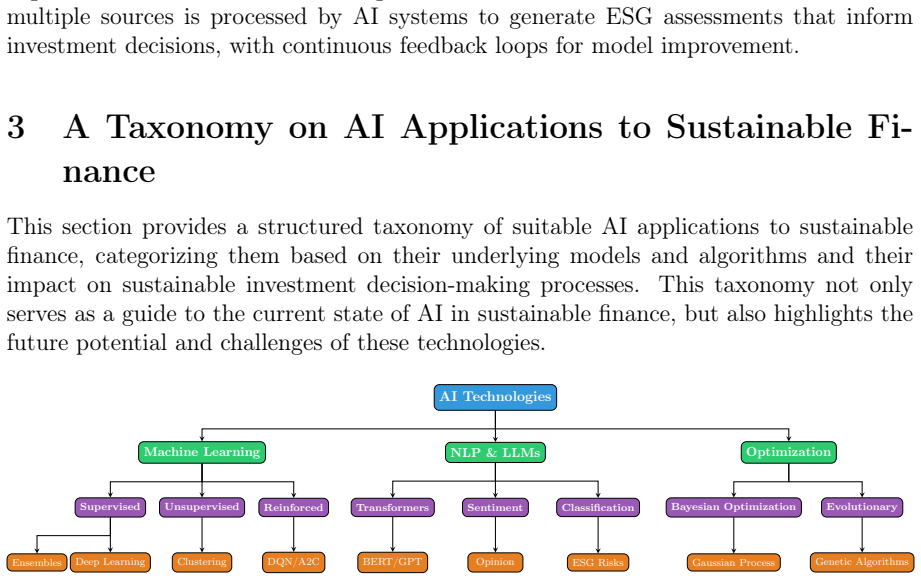
The AI Taxonomy that groups supervised, unsupervised, reinforcement learning, natural language processing, and optimization methods according to their algorithms and their documented impact on ESG financial processes.
If this is right
- Supervised learning can be applied to predict ESG scores from available data.
- Natural language processing can detect controversies in sustainability reports or news.
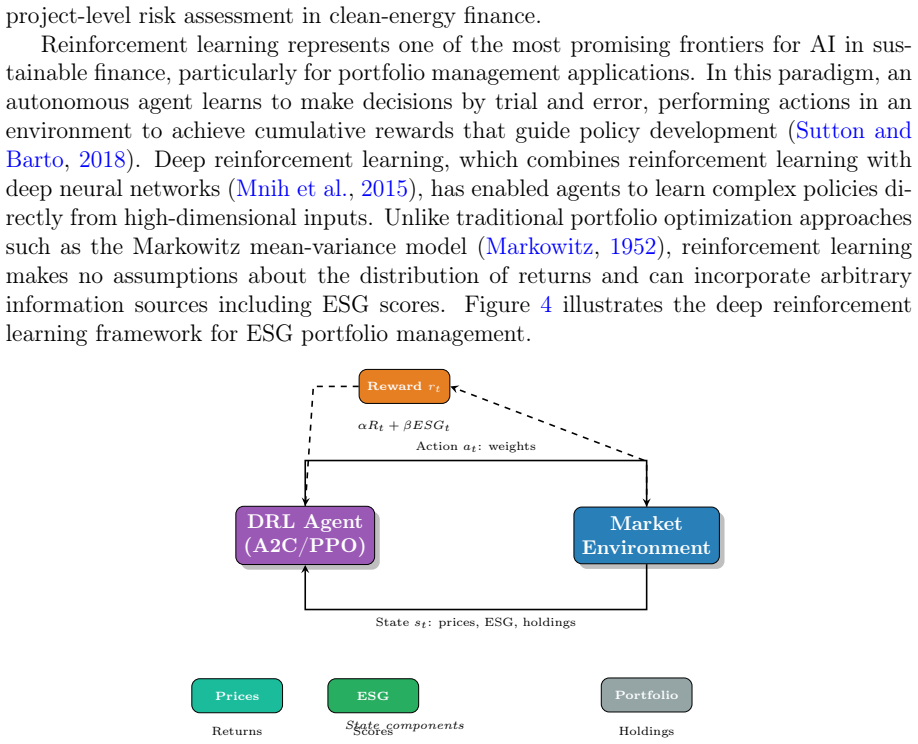
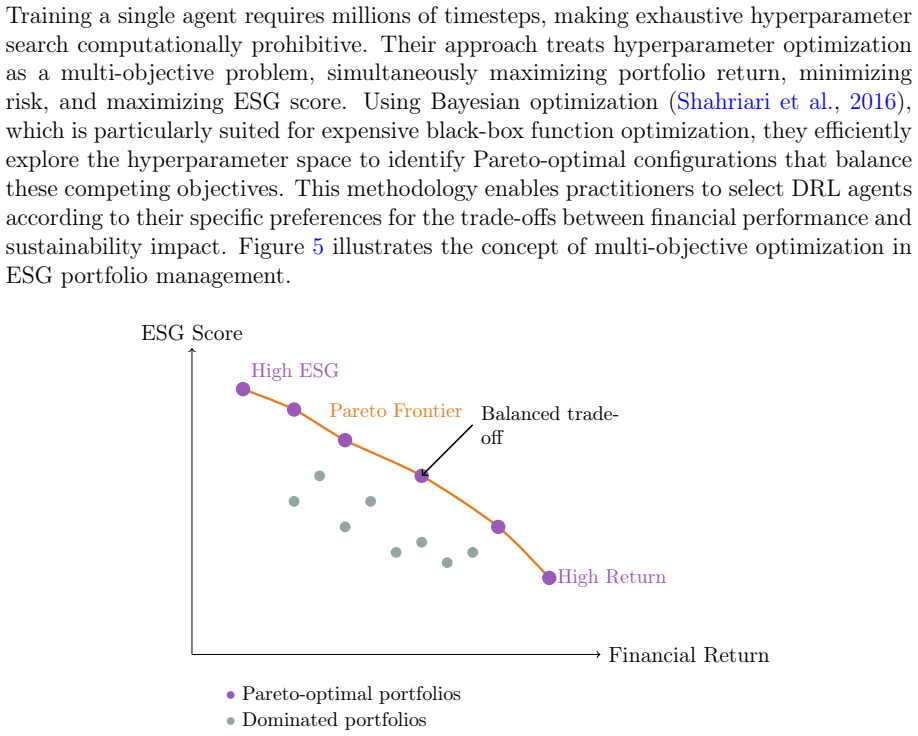
- Optimization algorithms can support portfolio management that incorporates ESG constraints.
- Unsupervised and reinforcement learning can assist in analyzing unstructured ESG information.
- The resulting framework supplies practitioners with a menu of AI tools matched to specific ESG process bottlenecks.
Where Pith is reading between the lines
- Practitioners could test the taxonomy by mapping their current ESG tools onto its categories and measuring whether the mapping reveals previously unused methods.
- Regulators might use the framework to set minimum data-quality standards that AI applications must meet before they are accepted in sustainable-finance reporting.
- Future empirical work could compare portfolios built with and without the taxonomy-guided AI choices to quantify any reduction in ESG data uncertainty.
Load-bearing premise
Synthesizing findings from recent literature is enough to produce a comprehensive taxonomy and an actionable framework that reliably identifies applications capable of overcoming ESG data barriers.
What would settle it
An audit of investment teams that applies the taxonomy and framework yet still encounters the same ESG data gaps or fails to improve decision outcomes relative to teams using no taxonomy.
Figures

read the original abstract
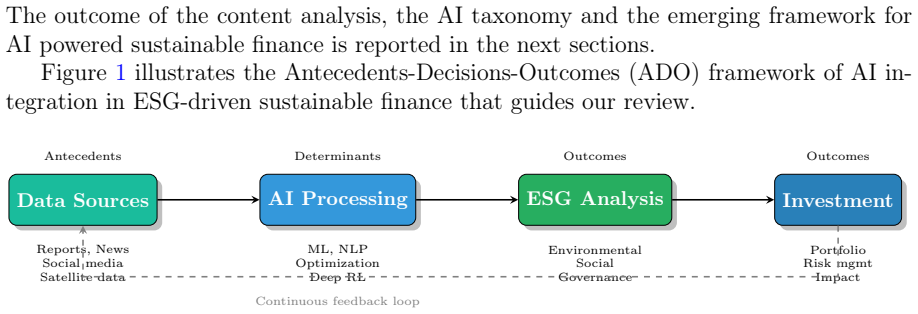
The integration of Artificial Intelligence into sustainable finance represents a transformative paradigm shift in how Environmental, Social, and Governance factors are analyzed, predicted, and incorporated into investment decisions. This review provides a comprehensive taxonomy of AI approaches applicable to sustainable investment decision-making, categorizing methodologies based on their underlying algorithms and their impact on ESG-related financial processes. The proposed AI Taxonomy includes machine learning paradigms -- including supervised, unsupervised, and reinforcement learning -- as well as natural language processing techniques and optimization algorithms, examining their specific applications in ESG score prediction, controversy detection, portfolio management, and sustainability report analysis. By synthesizing findings from the recent literature, a framework emerges on AI-powered sustainable finance that identifies technological applications to overcome ESG data barriers.
Editorial analysis
A structured set of objections, weighed in public.
Referee Report
Summary. The manuscript claims that AI integration into sustainable finance constitutes a transformative paradigm shift for analyzing, predicting, and incorporating ESG factors into investment decisions. It offers a taxonomy of AI methods—supervised, unsupervised, and reinforcement learning, plus NLP and optimization algorithms—applied to ESG score prediction, controversy detection, portfolio management, and sustainability report analysis. By synthesizing recent literature, the paper asserts that an integrative framework emerges that identifies specific technological applications capable of overcoming ESG data barriers (inconsistency, scarcity, lack of standardization).
Significance. If the taxonomy proves comprehensive and the framework supplies actionable, literature-grounded mappings, the work could serve as a useful organizing reference for researchers and practitioners entering AI-enabled sustainable finance. The integrative scope across multiple AI paradigms is a positive feature of a review paper. However, because the manuscript contains no new derivations, datasets, or empirical tests, its significance rests entirely on the rigor and completeness of the literature synthesis rather than on falsifiable predictions or reproducible results.
major comments (2)
- [Abstract] Abstract: The claim that the framework 'identifies technological applications to overcome ESG data barriers' is load-bearing for the paper's contribution, yet no section supplies a systematic review protocol, explicit search string, inclusion/exclusion criteria, or any quantitative before/after metrics linking specific techniques to barrier reduction. The synthesis therefore remains classificatory.
- [Framework emergence section] Framework emergence section: No falsifiable mapping is provided from individual AI methods (e.g., reinforcement learning or NLP) to measurable reductions in ESG data inconsistency or scarcity; the argument therefore does not demonstrate that the listed applications reliably overcome the stated barriers.
minor comments (1)
- [Abstract] The abstract and introduction would benefit from an explicit statement of the review methodology (or its absence) so readers can assess the completeness of the taxonomy.
Simulated Author's Rebuttal
We thank the referee for the constructive feedback highlighting the scope and claims of our literature synthesis. We address each major comment below and indicate planned revisions where appropriate.
read point-by-point responses
-
Referee: [Abstract] Abstract: The claim that the framework 'identifies technological applications to overcome ESG data barriers' is load-bearing for the paper's contribution, yet no section supplies a systematic review protocol, explicit search string, inclusion/exclusion criteria, or any quantitative before/after metrics linking specific techniques to barrier reduction. The synthesis therefore remains classificatory.
Authors: We agree that the manuscript is a narrative review and does not include a formal systematic review protocol, search strings, or quantitative metrics of barrier reduction. The framework is constructed by organizing applications described across the cited literature as targeting ESG data challenges. We will revise the abstract to state that the framework synthesizes literature on AI applications proposed or used to address ESG data barriers, rather than asserting that it identifies applications proven to overcome them. This adjustment aligns the claim with the classificatory nature of the work. revision: partial
-
Referee: [Framework emergence section] Framework emergence section: No falsifiable mapping is provided from individual AI methods (e.g., reinforcement learning or NLP) to measurable reductions in ESG data inconsistency or scarcity; the argument therefore does not demonstrate that the listed applications reliably overcome the stated barriers.
Authors: As a review paper without new empirical tests, the manuscript does not provide falsifiable mappings or quantitative demonstrations of barrier reduction; the mappings reflect how the synthesized literature describes the application of these methods to ESG processes. We will add an explicit limitations paragraph noting that while the literature indicates potential for addressing data inconsistency and scarcity, rigorous empirical validation of reliable barrier reduction remains an open research need. revision: partial
Circularity Check
No circularity: literature synthesis without reduction to inputs or self-citations
full rationale
The paper is a review that constructs a taxonomy by grouping ML/NLP/optimization methods drawn from existing literature and asserts that a framework emerges from this synthesis. No equations, fitted parameters, predictions, or uniqueness theorems are present. No load-bearing step reduces by construction to a self-citation, ansatz, or renamed input; the central claim remains a classificatory summary whose evidentiary strength is separate from circularity. The derivation chain is therefore self-contained as a descriptive synthesis.
Axiom & Free-Parameter Ledger
axioms (1)
- domain assumption Recent literature on AI for ESG analysis is sufficiently complete and unbiased to allow construction of a comprehensive taxonomy.
Reference graph
Works this paper leans on
-
[1]
Agosto, A., Cerchiello, P., and Giudici, P. (2025). Bayesian learning models to measure the relative impact of ESG factors on credit ratings. International Journal of Data Science and Analytics , 20(2):357--368
2025
-
[2]
Agosto, A., Giudici, P., and Tanda, A. (2023). How to combine ESG scores? a proposal based on credit rating prediction. Corporate Social Responsibility and Environmental Management , 30(6):3222--3230
2023
-
[3]
Al-Sartawi, A. M. A., Hussainey, K., and Razzaque, A. (2022). The role of artificial intelligence in sustainable finance. Journal of Sustainable Finance & Investment , pages 1--6
2022
-
[4]
Al-Sartawi, A. M. A. M., Abd Wahab, M. H., and Hussainey, K., editors (2024). Global Economic Revolutions: Big Data Governance and Business Analytics for Sustainability , Communications in Computer and Information Science, Cham. Springer Nature Switzerland
2024
-
[5]
Asif, M., Searcy, C., and Castka, P. (2023). ESG and Industry 5.0 : The role of technologies in enhancing ESG disclosure. Technological Forecasting and Social Change , 195:122806
2023
-
[6]
Bang, J., Ryu, D., and Yu, J. (2023). ESG controversies and investor trading behavior in the Korean market. Finance Research Letters , 54:103750
2023
-
[7]
Annual economic report 2023
Bank for International Settlements (2023). Annual economic report 2023. Technical report, Bank for International Settlements, Basel
2023
-
[8]
Battiston, S., Mandel, A., Monasterolo, I., Sch \"u tze, F., and Visentin, G. (2017). A climate stress-test of the financial system. Nature Climate Change , 7(4):283--288
2017
-
[9]
Ben Jabeur, S., Khalfaoui, R., and Ben Arfi, W. (2021). The effect of green energy, global environmental indexes, and stock markets in predicting oil price crashes: Evidence from explainable machine learning. Journal of Environmental Management , 298:113511
2021
-
[10]
F., and Rigobon, R
Berg, F., K \"o lbel, J. F., and Rigobon, R. (2022). Aggregate confusion: The divergence of ESG ratings. Review of Finance , 26(6):1315--1344
2022
-
[11]
A., Kraus, M., Leippold, M., and Webersinke, N
Bingler, J. A., Kraus, M., Leippold, M., and Webersinke, N. (2022). Cheap talk and cherry-picking: What ClimateBert has to say on corporate climate risk disclosures. Finance Research Letters , 47:102776
2022
-
[12]
Bishop, C. M. (2006). Pattern Recognition and Machine Learning . Springer
2006
-
[13]
and Henri, J.-F
Boiral, O. and Henri, J.-F. (2017). Is sustainability performance comparable? A study of GRI reports of mining organizations. Business & Society , 56(2):283--317
2017
-
[14]
and Kacperczyk, M
Bolton, P. and Kacperczyk, M. (2021). Do investors care about carbon risk? Journal of Financial Economics , 142(2):517--549
2021
-
[15]
Burnaev, E., Mironov, E., Shpilman, A., Mironenko, M., and Katalevsky, D. (2023). Practical AI cases for solving ESG challenges. Sustainability , 15(17):12731
2023
-
[16]
Camilleri, M. A. (2015). Environmental, social and governance disclosures in Europe . Sustainability Accounting, Management and Policy Journal , 6(2):224--242
2015
-
[17]
Campiglio, E., Deyris, J., Romelli, D., and Scalisi, G. (2025). Warning words in a warming world: Central bank communication and climate change. European Economic Review , 178:105101
2025
-
[18]
K., Durand, R., Levine, D
Chatterji, A. K., Durand, R., Levine, D. I., and Touboul, S. (2016). Do ratings of firms converge? Implications for managers, investors and strategy researchers. Strategic Management Journal , 37(8):1597--1614
2016
-
[19]
K., Levine, D
Chatterji, A. K., Levine, D. I., and Toffel, M. W. (2009). How well do social ratings actually measure corporate social responsibility? Journal of Economics & Management Strategy , 18(1):125--169
2009
-
[20]
and King, T
Citterio, A. and King, T. (2023). The role of environmental, social, and governance ( ESG ) in predicting bank financial distress. Finance Research Letters , 51:103411
2023
-
[21]
Cooper, H. M. (1988). Organizing knowledge syntheses: A taxonomy of literature reviews. Knowledge in Society , 1(1):104--126
1988
-
[22]
D'Amato, V., D'Ecclesia, R., and Levantesi, S. (2021). Fundamental ratios as predictors of ESG scores: A machine learning approach. Decisions in Economics and Finance , 44(2):1087--1110
2021
-
[23]
Day, M.-Y., Yang, C.-Y., and Ni, Y. (2023). Portfolio dynamic trading strategies using deep reinforcement learning. Soft Computing , 27(15-16):8715--8730
2023
-
[24]
C., and Coronado-Vaca, M
de-la Rica-Escudero, A., Garrido-Merch \'a n, E. C., and Coronado-Vaca, M. (2025). Explainable post hoc portfolio management financial policy of a deep reinforcement learning agent. PLOS ONE , 20(1):e0315528
2025
-
[25]
De Lucia, C., Pazienza, P., and Bartlett, M. (2020). Does good ESG lead to better financial performances by firms? machine learning and logistic regression models of public enterprises in Europe . Sustainability , 12(13):5317
2020
-
[26]
Devlin, J., Chang, M.-W., Lee, K., and Toutanova, K. (2019). BERT : Pre-training of deep bidirectional transformers for language understanding. In Proceedings of the 2019 Conference of the North American Chapter of the Association for Computational Linguistics: Human Language Technologies , pages 4171--4186
2019
-
[27]
G., Ioannou, I., and Serafeim, G
Eccles, R. G., Ioannou, I., and Serafeim, G. (2014). The impact of corporate sustainability on organizational processes and performance. Management Science , 60(11):2835--2857
2014
-
[28]
R., and Iannario, M
Elbouknify, I., Machado, M. R., and Iannario, M. (2026). Designing green artificial intelligence ( Green AI ) models for finance: A novel approach for sustainable and responsible adoption. Financial Innovation , 12(1):96
2026
-
[29]
u ksel, S., Din c er, H., G \
Eti, S., Y \"u ksel, S., Din c er, H., G \"o kalp, Y., Y ld z, H., Erg \"u n, E., and Acar, M. (2026). Machine learning-enhanced fuzzy framework for prioritizing financial risk management techniques in renewable energy projects. Financial Innovation , 12(1):85
2026
-
[30]
Friede, G., Busch, T., and Bassen, A. (2015). ESG and financial performance: Aggregated evidence from more than 2000 empirical studies. Journal of Sustainable Finance & Investment , 5(4):210--233
2015
-
[31]
Garc \' a Garc \' a, F., Gankova-Ivanova, T., Gonz \'a lez-Bueno, J., Oliver-Muncharaz, J., and Tamosiuniene, R. (2022). What is the cost of maximizing ESG performance in the portfolio selection strategy? the case of the dow jones index average stocks. Entrepreneurship and Sustainability Issues , 9(4):178--192
2022
-
[32]
C., Gonz \'a lez-Barthe, C., and Coronado Vaca, M
Garrido-Merch \'a n, E. C., Gonz \'a lez-Barthe, C., and Coronado Vaca, M. (2023a). Fine-tuning ClimateBert transformer with ClimaText for the disclosure analysis of climate-related financial risks. arXiv preprint arXiv:2303.13373
-
[33]
C., Gonz \'a lez Piris, G., and Coronado Vaca, M
Garrido-Merch \'a n, E. C., Gonz \'a lez Piris, G., and Coronado Vaca, M. (2023b). Bayesian optimization of ESG (environmental social governance) financial investments. Environmental Research Communications , 5(5):055003
-
[34]
C., Mora-Figueroa, S., and Coronado-Vaca, M
Garrido-Merch \'a n, E. C., Mora-Figueroa, S., and Coronado-Vaca, M. (2024). Multi-objective Bayesian optimization of deep reinforcement learning for environmental, social, and governance ( ESG ) financial portfolio management. Intelligent Systems in Accounting, Finance and Management , 31(4):e1576
2024
-
[35]
C., Mora-Figueroa-Cruz-Guzm \'a n, S., and Coronado-Vaca, M
Garrido-Merch \'a n, E. C., Mora-Figueroa-Cruz-Guzm \'a n, S., and Coronado-Vaca, M. (2023c). Deep reinforcement learning for ESG financial portfolio management. arXiv preprint arXiv:2307.09631
-
[36]
L., Koch, A., and Starks, L
Gillan, S. L., Koch, A., and Starks, L. T. (2021). Firms and social responsibility: A review of ESG and CSR research in corporate finance. Journal of Corporate Finance , 66:101889
2021
-
[37]
Global sustainable investment review 2020
Global Sustainable Investment Alliance (2021). Global sustainable investment review 2020. Technical report, Global Sustainable Investment Alliance
2021
-
[38]
Global sustainable investment review 2022
Global Sustainable Investment Alliance (2022). Global sustainable investment review 2022. Technical report, GSIA
2022
-
[39]
W., Kumar, S., Lim, W
Goodell, J. W., Kumar, S., Lim, W. M., and Pattnaik, D. (2021). Artificial intelligence and machine learning in finance: Identifying foundations, themes, and research clusters from bibliometric analysis. Journal of Behavioral and Experimental Finance , 32:100577
2021
-
[40]
Goodfellow, I., Bengio, Y., and Courville, A. (2016). Deep Learning . MIT Press
2016
-
[41]
a state of the art review of large generative ai models
Gozalo-Brizuela, R. and Garrido-Merch \'a n, E. C. (2023). ChatGPT is not all you need. a state of the art review of large generative AI models. arXiv preprint arXiv:2301.04655
-
[42]
Gupta, A., Chadha, A., and Tewari, V. (2024). A natural language processing model on BERT and YAKE technique for keyword extraction on sustainability reports. IEEE Access
2024
-
[43]
and Yan, H
Gupta, S. and Yan, H. (2025). Using large language models to estimate novel risk: Impact on volatility. Journal of Portfolio Management , 51(7)
2025
-
[44]
Hastie, T., Tibshirani, R., and Friedman, J. (2009). The Elements of Statistical Learning . Springer
2009
-
[45]
Jaiswal, R., Gupta, S., and Tiwari, A. K. (2024). Decoding mood of the twitterverse on ESG investing: Opinion mining and key themes using machine learning. Management Research Review , 47(8):1221--1252
2024
-
[46]
James, G., Witten, D., Hastie, T., Tibshirani, R., and Taylor, J. (2023). An Introduction to Statistical Learning . Springer, 2nd edition
2023
-
[47]
Kazakov, A., Denisova, S., Barsola, I., Kalugina, E., Molchanova, I., Egorov, I., Kosterina, A., Tereshchenko, E., Shutikhina, L., Doroshchenko, I., Sotiriadi, N., and Budennyy, S. (2023). ESGify : Automated classification of environmental, social and corporate governance risks. Doklady Mathematics , 108(Suppl 2):S529--S540
2023
-
[48]
F., Heeb, F., Paetzold, F., and Busch, T
K \"o lbel, J. F., Heeb, F., Paetzold, F., and Busch, T. (2020). Can sustainable investing save the world? R eviewing the mechanisms of investor impact. Organization & Environment , 33(4):554--574
2020
-
[49]
LeCun, Y., Bengio, Y., and Hinton, G. (2015). Deep learning. Nature , 521(7553):436--444
2015
-
[50]
H., Park, H., Kim, J
Lee, H., Lee, S. H., Park, H., Kim, J. H., and Jung, H. S. (2024). ESG2PreEM : Automated ESG grade assessment framework using pre-trained ensemble models. Heliyon , 10(4):e26404
2024
-
[51]
Lheureux, Y. (2023). Predictive insights: Leveraging Twitter sentiments and machine learning for environmental, social and governance controversy prediction. Journal of Computational Social Science , 7:23--44
2023
-
[52]
Liao, C.-F. (2025). ESG disclosure frequency and its association with market performance: Evidence from Taiwan . Sustainability , 17(17):7812
2025
-
[53]
M., Yap, S.-F., and Makkar, M
Lim, W. M., Yap, S.-F., and Makkar, M. (2021). Home sharing in marketing and tourism at a tipping point: What do we know, how do we know, and where should we be heading? Journal of Business Research , 122:534--566
2021
- [54]
-
[55]
and McDonald, B
Loughran, T. and McDonald, B. (2016). Textual analysis in accounting and finance: A survey. Journal of Accounting Research , 54(4):1187--1230
2016
-
[56]
Lundberg, S. M. and Lee, S.-I. (2017). A unified approach to interpreting model predictions. In Advances in Neural Information Processing Systems , volume 30, pages 4766--4777
2017
-
[57]
Lyon, T. P. and Montgomery, A. W. (2015). The means and end of greenwash. Organization & Environment , 28(2):223--249
2015
-
[58]
Malik, M., Mamun, K., and Osman, S. M. I. (2025). Does corruption control enhance ESG -induced firm value? insights from machine learning analysis. Finance Research Letters , 72:106572
2025
-
[59]
and Omlin, C
Maree, C. and Omlin, C. W. (2022). Balancing profit, risk, and sustainability for portfolio management. In 2022 IEEE Symposium on Computational Intelligence for Financial Engineering and Economics (CIFEr) , pages 1--8. IEEE
2022
-
[60]
Markowitz, H. (1952). Portfolio selection. The Journal of Finance , 7(1):77--91
1952
-
[61]
L., and Hernandez-Perlines, F
Martin-Melero, I., Gomez-Martinez, R., Medrano-Garcia, M. L., and Hernandez-Perlines, F. (2025). Comparison of sectorial and financial data for ESG scoring of mutual funds with machine learning. Financial Innovation , 11(1):84
2025
-
[62]
McMahan, B., Moore, E., Ramage, D., Hampson, S., and Aguera y Arcas, B. (2017). Communication-efficient learning of deep networks from decentralized data. In Proceedings of the 20th International Conference on Artificial Intelligence and Statistics , pages 1273--1282
2017
-
[63]
H., and Chai, J
Meng, T., Yahya, M. H., and Chai, J. (2022). Deep learning model for stock excess return prediction based on nonlinear random matrix and ESG factor. Mathematical Problems in Engineering , 2022:5239493
2022
-
[64]
A., Veness, J., Bellemare, M
Mnih, V., Kavukcuoglu, K., Silver, D., Rusu, A. A., Veness, J., Bellemare, M. G., Graves, A., Riedmiller, M., Fidjeland, A. K., Ostrovski, G., Petersen, S., Beattie, C., Sadik, A., Antonoglou, I., King, H., Kumaran, D., Wierstra, D., Legg, S., and Hassabis, D. (2015). Human-level control through deep reinforcement learning. Nature , 518(7540):529--533
2015
-
[65]
Molitor, D., Raghupathi, V., and Saharia, A. (2023). Identifying key issues in climate change litigation: A machine learning text analytic approach. Sustainability , 15(23):16530
2023
-
[66]
Developing sustainable finance definitions and taxonomies
OECD (2020). Developing sustainable finance definitions and taxonomies. Technical report, OECD Publishing, Paris
2020
-
[67]
Pankratz, N., Bauer, R., and Derwall, J. (2023). Climate change, firm performance, and investor surprises. Management Science , 69(12):7352--7398
2023
-
[68]
and Benito, G
Paul, J. and Benito, G. R. G. (2018). A review of research on outward foreign direct investment from emerging countries, including China : what do we know, how do we know and where should we be heading? Asia Pacific Business Review , 24(1):90--115
2018
-
[69]
and Criado, A
Paul, J. and Criado, A. R. (2020). The art of writing literature review: What do we know and what do we need to know? International Business Review , 29(4):101717
2020
-
[70]
M., O'Cass, A., Hao, A
Paul, J., Lim, W. M., O'Cass, A., Hao, A. W., and Bresciani, S. (2021). Scientific procedures and rationales for systematic literature reviews ( SPAR-4-SLR ). International Journal of Consumer Studies , 45(4):O1--O16
2021
-
[71]
Pikatza-Gorrotxategi, N., Borregan-Alvarado, J., and Alvarez-Meaza, I. (2024). News and ESG investment criteria: What's behind it? Social Network Analysis and Mining , 14(1):47
2024
-
[72]
Porter, M. E. and van der Linde, C. (1995). Toward a new conception of the environment-competitiveness relationship. Journal of Economic Perspectives , 9(4):97--118
1995
-
[73]
Rajan, R. G. and Zingales, L. (2003). The great reversals: the politics of financial development in the twentieth century. Journal of Financial Economics , 69(1):5--50
2003
-
[74]
and Aracil, E
Redondo, H. and Aracil, E. (2024). Climate-related credit risk: Rethinking the credit risk framework. Global Policy , 15(S1):21--33
2024
-
[75]
T., Singh, S., and Guestrin, C
Ribeiro, M. T., Singh, S., and Guestrin, C. (2016). `` Why should I trust you?'': Explaining the predictions of any classifier. In Proceedings of the 22nd ACM SIGKDD International Conference on Knowledge Discovery and Data Mining , pages 1135--1144
2016
-
[76]
and Norvig, P
Russell, S. and Norvig, P. (2010). Artificial Intelligence: A Modern Approach . Prentice Hall, 3rd edition
2010
-
[77]
Schoenmaker, D. (2017). Investing for the common good: A sustainable finance framework. Technical report, Bruegel, Brussels
2017
-
[78]
and Schramade, W
Schoenmaker, D. and Schramade, W. (2019). Investing for long-term value creation. Journal of Sustainable Finance & Investment , 9(4):356--377
2019
-
[79]
Schulman, J., Wolski, F., Dhariwal, P., Radford, A., and Klimov, O. (2017). Proximal policy optimization algorithms. arXiv preprint arXiv:1707.06347
work page internal anchor Pith review Pith/arXiv arXiv 2017
-
[80]
Seles, B. M. R. P., de Sousa Jabbour, A. B. L., Jabbour, C. J. C., and de Camargo Fiorini, P. (2018). Business opportunities and challenges as the two sides of the climate change: Corporate responses and potential implications for big data management towards a low carbon society. Journal of Cleaner Production , 189:763--774
2018
discussion (0)
Sign in with ORCID, Apple, or X to comment. Anyone can read and Pith papers without signing in.