Response of a dipolar BEC to Laguerre-Gaussian beam driven STIRAP
Pith reviewed 2026-06-29 19:15 UTC · model grok-4.3
The pith
STIRAP with a Laguerre-Gaussian beam transfers orbital angular momentum to dipolar BECs, nucleating stable vortices only in the superfluid phase while behavior varies in droplet and supersolid phases.
A machine-rendered reading of the paper's core claim, the machinery that carries it, and where it could break.
Core claim
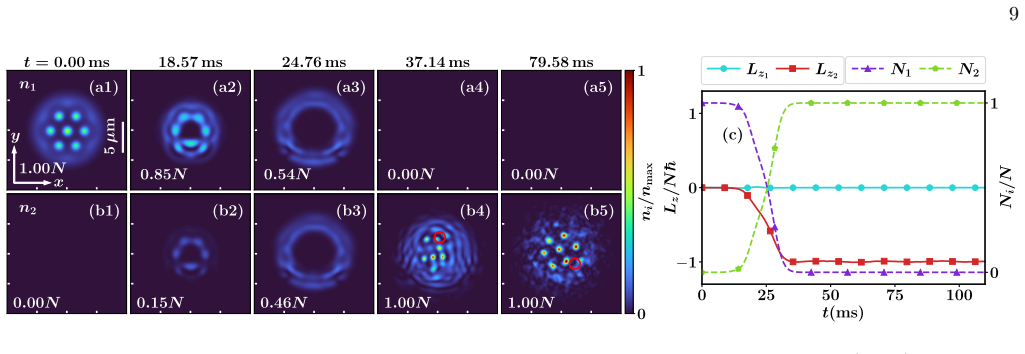
The amount of angular momentum transferred from the optical field to the dipolar condensate, along with the nucleation and persistence of vortices, depends strongly on the underlying phases of the dipolar BEC. In the superfluid, STIRAP achieves a near-complete population transfer and nucleates a long-lived quantized vortex. In the droplet phase the vortex remains pinned but angular momentum is partially retained and oscillatory with droplet fragmentation. In the supersolid phase perpendicular magnetic field orientation leads to vortex delocalization and exit from the condensate with vanishing average angular momentum, while alignment along the beam restores efficient transfer and stabilizes
What carries the argument
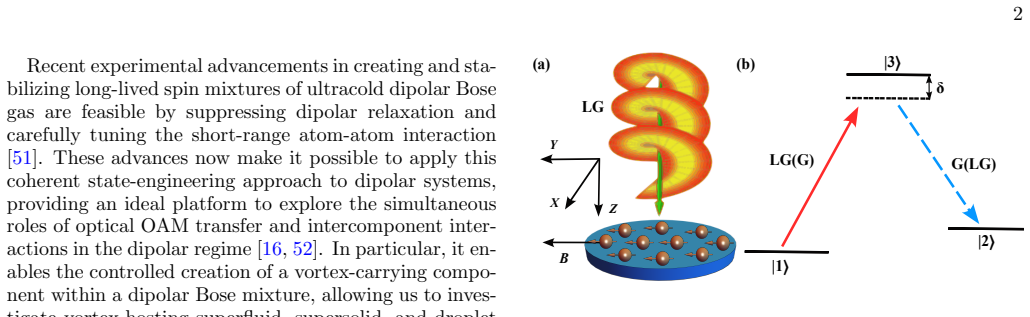
Co-propagating Gaussian and Laguerre-Gaussian beams driving STIRAP in a quasi-two-dimensional trapped dipolar condensate whose phases arise from the interplay of contact and dipole-dipole interactions.
If this is right
- Near-complete population transfer and a long-lived vortex form in the superfluid phase.
- Angular momentum transfer becomes partial and oscillatory with accompanying droplet fragmentation in the droplet phase.
- Vortex delocalization occurs and average angular momentum vanishes in the supersolid phase when the magnetic field is perpendicular to the beam.
- Efficient angular momentum transfer and vortex stabilization are restored in the supersolid phase when the magnetic field is aligned with the beam.
Where Pith is reading between the lines
- Magnetic field orientation acts as an external control parameter to select between vortex retention and expulsion in supersolid condensates.
- The phase dependence suggests optical angular momentum transfer could selectively address different quantum phases within the same sample.
- Similar beam-driven STIRAP protocols may apply to other long-range interacting quantum fluids for controlled vortex creation.
Load-bearing premise
The quasi-two-dimensional model with tunable interactions and numerical propagation of the coupled Gross-Pitaevskii equations fully captures the coherent STIRAP dynamics without significant decoherence or losses.
What would settle it
An experiment that applies the STIRAP sequence to a superfluid dipolar condensate and measures whether the final angular momentum per particle equals the orbital angular momentum quantum of the Laguerre-Gaussian beam.
Figures



read the original abstract
Coherent light-matter coupling via STIRAP can offer a versatile route to nucleate quantized vortices in Bose-Einstein condensates through the orbital angular momentum transfer from a vortex beam, yet its efficacy in dipolar condensates remains an open question. Can the orbital angular momentum of a Laguerre-Gaussian beam be coherently transferred to a dipolar BEC via STIRAP? We investigate this for a quasi-two-dimensional trapped dipolar condensate using co-propagating Gaussian and Laguerre-Gaussian laser beams. The interplay between long-range dipole-dipole interactions and short-range contact interactions enables access to three interaction-driven phases: superfluid, droplet, and supersolid. We find that the amount of angular momentum transferred from the optical field to the dipolar condensate, along with the nucleation and persistence of vortices, depends strongly on the underlying phases of the dipolar BEC. In the superfluid, STIRAP achieves a near-complete population transfer and nucleates a long-lived quantized vortex, reflecting efficient transfer of angular momentum to the condensate. In the droplet phase, although the vortex remains pinned within the density profile, the angular momentum is partially retained and oscillatory, accompanied by droplet fragmentation and recombination. In the supersolid phase, when the external magnetic field is oriented perpendicular to the LG beam's propagation direction, the emergence of a modulated density distribution along with a slight reduction in inter-droplet coherence leads to vortex delocalization and eventually exits from the condensate along the field direction, yielding a vanishing average angular momentum. However, reorienting the magnetic polarization along the beam propagation direction restores efficient angular momentum transfer and stabilizes the vortex within the supersolid phase.
Editorial analysis
A structured set of objections, weighed in public.
Referee Report
Summary. The manuscript numerically investigates coherent angular-momentum transfer from a co-propagating Laguerre-Gaussian beam to a quasi-2D trapped dipolar BEC via STIRAP. It reports that the efficiency of population transfer, nucleation, and persistence of quantized vortices depend on the interaction-driven phase (superfluid, droplet, supersolid), with additional dependence on the orientation of the external magnetic field relative to the beam propagation direction in the supersolid regime.
Significance. If the reported phase-dependent behaviors are robust, the work provides a concrete demonstration that long-range dipolar interactions can be used to control the outcome of orbital-angular-momentum transfer in a coherent optical process. The distinction between vortex stabilization in the superfluid, oscillatory retention in the droplet phase, and orientation-dependent delocalization in the supersolid phase supplies falsifiable predictions that could guide future experiments with magnetic atoms or polar molecules.
major comments (2)
- [Numerical Methods] § Numerical Methods (assumed §3 or equivalent): the manuscript must specify the spatial grid, time-stepping scheme, and convergence tests (norm conservation, energy drift) used for the coupled Gross-Pitaevskii propagation; without these, the claimed near-complete transfer efficiencies and long-lived vortex persistence cannot be independently verified.
- [Supersolid phase discussion] Supersolid-phase results (text following Eq. for the dipolar potential): the statement that the vortex 'exits from the condensate along the field direction' when B is perpendicular requires a quantitative measure (e.g., integrated angular momentum per droplet or coherence function) to distinguish delocalization from numerical artifact or simple expansion.
minor comments (2)
- [Abstract / Introduction] The abstract and introduction should cite the specific values of the dipole-dipole and contact interaction strengths (in units of the trap frequency) that realize each phase.
- [Figures] Figure captions for the density and phase plots should list the exact magnetic-field orientation angle and the STIRAP pulse parameters used in each panel.
Simulated Author's Rebuttal
We thank the referee for the positive assessment of our manuscript and the constructive comments. We address each major comment below.
read point-by-point responses
-
Referee: [Numerical Methods] § Numerical Methods (assumed §3 or equivalent): the manuscript must specify the spatial grid, time-stepping scheme, and convergence tests (norm conservation, energy drift) used for the coupled Gross-Pitaevskii propagation; without these, the claimed near-complete transfer efficiencies and long-lived vortex persistence cannot be independently verified.
Authors: We agree that these numerical details are necessary for independent verification. In the revised manuscript we will add an explicit paragraph in the Numerical Methods section specifying the spatial grid (512 × 512 points over a 20 μm domain), the split-step Fourier time-stepping scheme with Δt = 0.001 (dimensionless), and convergence diagnostics showing norm conservation to 10^{-8} and energy drift below 0.1 % throughout the propagation. revision: yes
-
Referee: [Supersolid phase discussion] Supersolid-phase results (text following Eq. for the dipolar potential): the statement that the vortex 'exits from the condensate along the field direction' when B is perpendicular requires a quantitative measure (e.g., integrated angular momentum per droplet or coherence function) to distinguish delocalization from numerical artifact or simple expansion.
Authors: We accept the referee’s point that a quantitative diagnostic is required. In the revised manuscript we will supplement the supersolid discussion with the time evolution of the integrated angular momentum and the inter-droplet coherence function, thereby providing a clear, falsifiable distinction between physical delocalization and possible numerical effects. revision: yes
Circularity Check
No significant circularity; results from direct numerical integration
full rationale
The paper's central results follow from numerical propagation of the coupled Gross-Pitaevskii equations in a quasi-2D dipolar condensate under STIRAP driving by Gaussian and Laguerre-Gaussian beams. No derivation chain, fitted parameters renamed as predictions, or load-bearing self-citations are present; the reported phase-dependent vortex nucleation and angular-momentum transfer are direct outputs of the time-dependent simulation for the three interaction-driven phases. The model assumptions (tunable contact + dipole-dipole interactions, lossless coherent dynamics) are stated explicitly and do not reduce to the target observables by construction.
Axiom & Free-Parameter Ledger
Reference graph
Works this paper leans on
-
[1]
H. Zeng, W. Zhang, and F. Lin, Phys. Rev. A52, 2155 (1995)
1995
-
[2]
B. W. Shore, Adv. Opt. Photon.9, 563 (2017)
2017
-
[3]
Nandi, R
G. Nandi, R. Walser, and W. P. Schleich, Phys. Rev. A 69, 063606 (2004)
2004
-
[4]
M. F. Andersen, C. Ryu, P. Clad´ e, V. Natarajan, A. Vaziri, K. Helmerson, and W. D. Phillips, Phys. Rev. Lett.97, 170406 (2006)
2006
-
[5]
Chen, K.-Y
H.-R. Chen, K.-Y. Lin, P.-K. Chen, N.-C. Chiu, J.-B. Wang, C.-A. Chen, P. Huang, S.-K. Yip, Y. Kawaguchi, and Y.-J. Lin, Phys. Rev. Lett.121, 113204 (2018)
2018
-
[6]
K. Mukherjee, S. Bandyopadhyay, D. Angom, A. M. Mar- tin, and S. Majumder, Atoms9, 10.3390/atoms9010014 (2021)
-
[7]
P. K. Mondal, B. Deb, and S. Majumder, Phys. Rev. A 89, 063418 (2014)
2014
-
[8]
Y. Shin, M. Saba, M. Vengalattore, T. A. Pasquini, C. Sanner, A. E. Leanhardt, M. Prentiss, D. E. Pritchard, and W. Ketterle, Phys. Rev. Lett.93, 160406 (2004)
2004
-
[9]
A. L. Fetter and A. A. Svidzinsky, Journal of Physics: Condensed Matter13, R135–R194 (2001)
2001
-
[10]
Srinivasan, Pramana66, 3 (2006)
R. Srinivasan, Pramana66, 3 (2006)
2006
-
[11]
Abo-Shaeer, C
J. Abo-Shaeer, C. Raman, J. Vogels, and W. Ketterle, Science (New York, N.Y.)292, 476 (2001)
2001
-
[12]
S. Das, K. Mukherjee, and S. Majumder, Phys. Rev. A 106, 023306 (2022). 13
2022
-
[13]
Pastukhov, Phys
V. Pastukhov, Phys. Rev. A95, 023614 (2017)
2017
-
[14]
R. N. Bisset, L. A. P. n. Ardila, and L. Santos, Phys. Rev. Lett.126, 025301 (2021)
2021
-
[15]
Casotti, E
E. Casotti, E. Poli, L. Klaus, A. Litvinov, C. Ulm, C. Politi, M. J. Mark, T. Bland, and F. Ferlaino, Na- ture635, 327 (2024)
2024
-
[16]
Klaus, T
L. Klaus, T. Bland, E. Poli, C. Politi, G. Lamporesi, E. Casotti, R. N. Bisset, M. J. Mark, and F. Ferlaino, Nature Physics18, 1453 (2022)
2022
-
[17]
Semeghini, G
G. Semeghini, G. Ferioli, L. Masi, C. Mazzinghi, L. Wol- swijk, F. Minardi, M. Modugno, G. Modugno, M. Ingus- cio, and M. Fattori, Phys. Rev. Lett.120, 235301 (2018)
2018
-
[18]
A. R. P. Lima and A. Pelster, Phys. Rev. A86, 063609 (2012)
2012
-
[19]
Boudjemˆ aa, Journal of Physics B: Atomic, Molecular and Optical Physics48, 035302 (2015)
A. Boudjemˆ aa, Journal of Physics B: Atomic, Molecular and Optical Physics48, 035302 (2015)
2015
-
[20]
Liu, A.-C
Z.-Y. Liu, A.-C. Ji, and Q. Sun, Phys. Rev. Res.6, 013014 (2024)
2024
-
[21]
B. Mohamed, H. Ahmed, and M. Atika, Generalized stability conditions for binary bose mixtures (2023), arXiv:2308.13608 [quant-ph]
-
[22]
S. S. Adusumalli, K. Senapati, S. Singh, and A. Khan, Physics Letters A516, 129638 (2024)
2024
-
[23]
Zhang and L
F. Zhang and L. Yin, Chinese Physics Letters42, 010302 (2025)
2025
-
[24]
D. S. Petrov, Phys. Rev. Lett.115, 155302 (2015)
2015
-
[25]
Liu and J
X. Liu and J. Zeng, Chaos, Solitons & Fractals160, 112240 (2022)
2022
-
[26]
Boudjemˆ aa, Scientific Reports11, 21765 (2021)
A. Boudjemˆ aa, Scientific Reports11, 21765 (2021)
2021
-
[27]
N. M. Hugenholtz and D. Pines, Phys. Rev.116, 489 (1959)
1959
-
[28]
Halder, K
S. Halder, K. Mukherjee, S. I. Mistakidis, S. Das, P. G. Kevrekidis, P. K. Panigrahi, S. Majumder, and H. R. Sadeghpour, Phys. Rev. Res.4, 043124 (2022)
2022
-
[29]
Halder, S
S. Halder, S. Das, and S. Majumder, Phys. Rev. A109, 063321 (2024)
2024
-
[30]
Halder, S
S. Halder, S. Das, and S. Majumder, Phys. Rev. A107, 063303 (2023)
2023
-
[31]
H. S. Ghosh, S. Halder, S. Das, and S. Majumder, Phys. Rev. A110, 033322 (2024)
2024
-
[32]
Sabari, R
S. Sabari, R. Kishor Kumar, and L. Tomio, Journal of Physics: Conference Series2894, 012015 (2024)
2024
-
[33]
G. Li, Z. Zhao, X. Jiang, Z. Chen, B. Liu, B. A. Malomed, and Y. Li, Phys. Rev. Lett.133, 053804 (2024)
2024
-
[34]
Y. Deng, J. Cheng, H. Jing, C.-P. Sun, and S. Yi, Phys. Rev. Lett.108, 125301 (2012)
2012
-
[35]
Saboo, S
A. Saboo, S. Halder, M. Thudiyangal, and S. Majumder, New Journal of Physics27, 043019 (2025)
2025
-
[36]
Alexandrescu, E
A. Alexandrescu, E. Di Fabrizio, and D. Cojoc, Journal of Optics B: Quantum and Semiclassical Optics7, 87 (2005)
2005
-
[37]
Mukherjee, S
K. Mukherjee, S. Majumder, P. Mondal, and B. Deb, Journal of Physics B: Atomic, Molecular and Optical Physics51(2018)
2018
-
[38]
Bhowmik, N
A. Bhowmik, N. N. Dutta, and S. Majumder, Phys. Rev. A97, 022511 (2018)
2018
-
[39]
P. K. Mondal, B. Deb, and S. Majumder, Phys. Rev. A 92, 043603 (2015)
2015
-
[40]
Bhowmik, P
A. Bhowmik, P. K. Mondal, S. Majumder, and B. Deb, Phys. Rev. A93, 063852 (2016)
2016
-
[41]
Bhowmik, N
A. Bhowmik, N. N. Dutta, and S. Das, The European Physical Journal D76, 139 (2022)
2022
-
[42]
Araoka, T
F. Araoka, T. Verbiest, K. Clays, and A. Persoons, Phys. Rev. A71, 055401 (2005)
2005
-
[43]
S. Das, A. Bhowmik, K. Mukherjee, and S. Majumder, Journal of Physics B: Atomic, Molecular and Optical Physics53, 025302 (2020)
2020
-
[44]
Bhowmik and S
A. Bhowmik and S. Majumder, Journal of Physics Com- munications2, 125001 (2018)
2018
-
[45]
Bhowmik, P
A. Bhowmik, P. K. Mondal, S. Majumder, and B. Deb, Journal of Physics B: Atomic, Molecular and Optical Physics51, 135003 (2018)
2018
-
[46]
Mukherjee, S
K. Mukherjee, S. Majumder, P. K. Mondal, and B. Deb, Journal of Physics B: Atomic, Molecular and Optical Physics51, 015004 (2017)
2017
-
[47]
Zhang, X
Y. Zhang, X. Su, H. Chen, Y. Hong, J. Li, and L. Wen, Results in Physics54, 107067 (2023)
2023
-
[48]
Cappellaro, T
A. Cappellaro, T. Macr` ı, G. F. Bertacco, and L. Salas- nich, Scientific Reports7, 13358 (2017)
2017
-
[49]
Marzlin, W
K.-P. Marzlin, W. Zhang, and E. M. Wright, Phys. Rev. Lett.79, 4728 (1997)
1997
-
[50]
Saboo, S
A. Saboo, S. Halder, S. Das, and S. Majumder, Phys. Rev. A110, 033325 (2024)
2024
-
[51]
Lecomte, A
M. Lecomte, A. Journeaux, J. Veschambre, J. Dalibard, and R. Lopes, Phys. Rev. Lett.134, 013402 (2025)
2025
-
[52]
Sabari, R
S. Sabari, R. Kishor Kumar, and L. Tomio, Phys. Rev. A109, 023313 (2024)
2024
-
[53]
Ghosh Dastidar, S
M. Ghosh Dastidar, S. Das, K. Mukherjee, and S. Ma- jumder, Physics Letters A421, 127776 (2022)
2022
-
[54]
R. Nath, P. Pedri, and L. Santos, Phys. Rev. Lett.102, 050401 (2009)
2009
-
[55]
Raghunandan, C
M. Raghunandan, C. Mishra, K. Lakomy, P. Pedri, L. Santos, and R. Nath, Phys. Rev. A92, 013637 (2015)
2015
-
[56]
Properties of 2D and Quasi-2D Dipolar Bosons with Non-zero Tilt Angles at T=0
P. Shen and K. F. Quader, Properties of 2d and quasi-2d dipolar bosons with non-zero tilt angles at t=0 (2018), arXiv:1810.03092 [cond-mat.quant-gas]
work page internal anchor Pith review Pith/arXiv arXiv 2018
-
[57]
Pedri and L
P. Pedri and L. Santos, Phys. Rev. Lett.95, 200404 (2005)
2005
-
[58]
Ticknor, R
C. Ticknor, R. M. Wilson, and J. L. Bohn, Phys. Rev. Lett.106, 065301 (2011)
2011
-
[59]
Klawunn and L
M. Klawunn and L. Santos, Phys. Rev. A80, 013611 (2009)
2009
-
[60]
U. R. Fischer, Phys. Rev. A73, 031602(R) (2006)
2006
-
[61]
Crank and P
J. Crank and P. Nicolson, Advances in Computational Mathematics6, 207 (1947)
1947
-
[62]
Muruganandam and S
P. Muruganandam and S. Adhikari, Computer Physics Communications180, 1888–1912 (2009)
1912
-
[63]
B¨ ottcher, J.-N
F. B¨ ottcher, J.-N. Schmidt, M. Wenzel, J. Hertkorn, M. Guo, T. Langen, and T. Pfau, Phys. Rev. X9, 011051 (2019)
2019
-
[64]
Ferrier-Barbut, H
I. Ferrier-Barbut, H. Kadau, M. Schmitt, M. Wenzel, and T. Pfau, Phys. Rev. Lett.116, 215301 (2016)
2016
-
[65]
Chomaz, D
L. Chomaz, D. Petter, P. Ilzh¨ ofer, G. Natale, A. Traut- mann, C. Politi, G. Durastante, R. M. W. van Bijnen, A. Patscheider, M. Sohmen, M. J. Mark, and F. Ferlaino, Phys. Rev. X9, 021012 (2019)
2019
-
[66]
Tanzi, S
L. Tanzi, S. M. Roccuzzo, E. Lucioni, F. Fam` a, A. Fioretti, C. Gabbanini, G. Modugno, A. Recati, and S. Stringari, Nature574, 382 (2019)
2019
-
[67]
Mukherjee, T
K. Mukherjee, T. A. Cardinale, L. Chergui, P. St¨ urmer, and S. M. Reimann, The European Physical Journal Spe- cial Topics232, 3417 (2023)
2023
-
[69]
R. M. W. van Bijnen, N. G. Parker, S. J. J. M. F. Kokkel- mans, A. M. Martin, and D. H. J. O’Dell, Phys. Rev. A 82, 033612 (2010). 14
2010
-
[70]
Giovanazzi, P
S. Giovanazzi, P. Pedri, L. Santos, A. Griesmaier, M. Fat- tori, T. Koch, J. Stuhler, and T. Pfau, Phys. Rev. A74, 013621 (2006)
2006
-
[71]
Wenzel, F
M. Wenzel, F. B¨ ottcher, T. Langen, I. Ferrier-Barbut, and T. Pfau, Phys. Rev. A96, 053630 (2017)
2017
-
[72]
F. Pang, H. He, Y. Zhang, and C. Qu, Phys. Rev. A112, 033309 (2025)
2025
-
[73]
H. He, F. Pang, Y. Zhang, and C. Qu, Phys. Rev. Res. 7, 013219 (2025)
2025
-
[74]
Qu, C.-H
C. Qu, C.-H. Li, Y. P. Chen, and S. Stringari, Phys. Rev. A108, 053316 (2023)
2023
-
[75]
Kasamatsu, M
K. Kasamatsu, M. Tsubota, and M. Ueda, Phys. Rev. A 69, 043621 (2004)
2004
-
[76]
Halder, H
S. Halder, H. S. Ghosh, A. Saboo, A. M. Martin, and S. Majumder, Phys. Rev. A111, 023301 (2025)
2025
-
[77]
Cidrim, F
A. Cidrim, F. E. A. dos Santos, E. A. L. Henn, and T. Macr` ı, Phys. Rev. A98, 023618 (2018)
2018
-
[78]
J. M. Escart´ ın, F. Ancilotto, M. Barranco, and M. Pi, Phys. Rev. B105, 024511 (2022)
2022
-
[79]
V. Øvereng, A. Baggaley, and L. Angheluta, Topologi- cal interactions in vortex-wave collisions in bose-einstein condensates (2025), arXiv:2510.01973 [cond-mat.quant- gas]
-
[80]
J. C. Smith, D. Baillie, and P. B. Blakie, Phys. Rev. Lett. 126, 025302 (2021)
2021
-
[81]
Zhang, T
Y.-C. Zhang, T. Pohl, and F. Maucher, Phys. Rev. Res. 6, 023023 (2024)
2024
discussion (0)
Sign in with ORCID, Apple, or X to comment. Anyone can read and Pith papers without signing in.