Crisis, Disengagement, and Structural Realignment: A Threshold Model of Radical-Party Support
Pith reviewed 2026-06-30 14:37 UTC · model grok-4.3
The pith
Durable realignment in radical-party support requires structural threshold-crossing rather than temporary crisis shocks.
A machine-rendered reading of the paper's core claim, the machinery that carries it, and where it could break.
Core claim
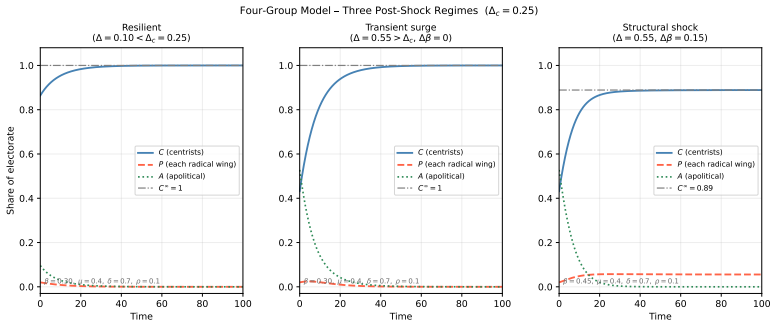
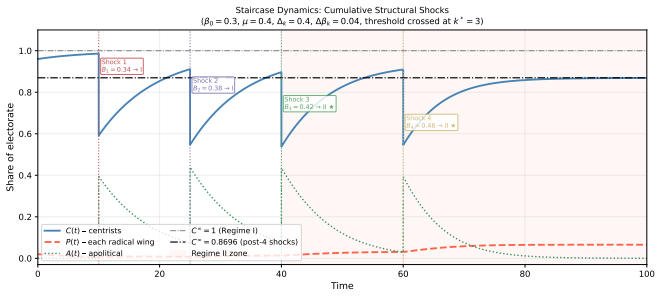
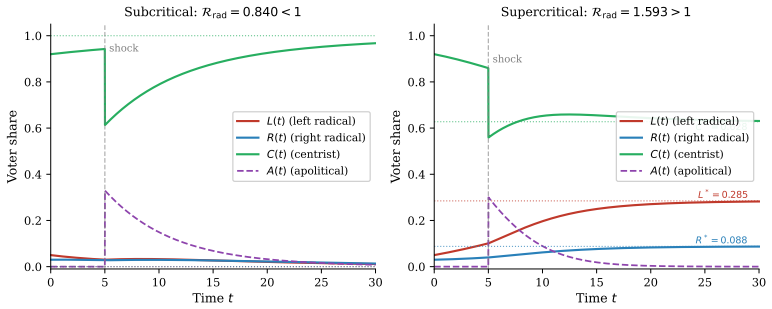
In the threshold model with a crisis-induced disengagement compartment on a conserved population, state shocks alter the current state but cannot move the long-run attractor determined by the Perron-Frobenius threshold; durable realignment requires structural shocks that cross this threshold, and cumulative structural shifts can lead to staircase realignment.
What carries the argument
The Perron-Frobenius threshold in the baseline model, which classifies global behavior and fixes the long-run attractor, together with the added disengagement compartment that separates transient state shocks from parameter-altering structural shocks.
If this is right
- State shocks affect only transients and leave the long-run attractor unchanged.
- Durable realignment occurs only through structural threshold-crossing.
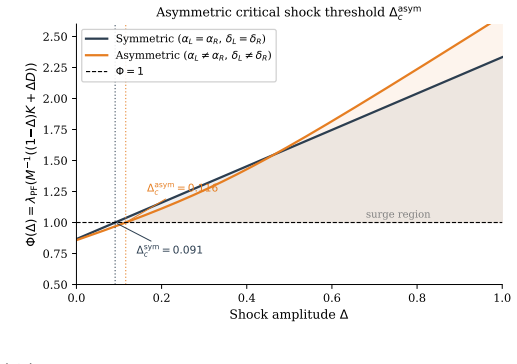
- A critical shock amplitude bounds the size needed for mobilisation to affect the attractor.
- Cumulative structural shifts produce staircase realignment over repeated crises.
Where Pith is reading between the lines
- The same state-versus-structural distinction could be tested in other voting or opinion threshold models.
- Policy interventions would need to target lasting parameter changes rather than crisis response alone.
- The mobilisation-window bound suggests a testable time limit on crisis-driven recruitment in election data.
Load-bearing premise
The population remains conserved and the disengagement compartment fully captures crisis effects without further unmodeled dynamics.
What would settle it
Observation of a lasting realignment after a pure state shock with no parameter change, or no realignment after a structural shock that crosses the identified threshold.
Figures
read the original abstract
When does a crisis-induced surge in radical-party support fade away, and when does it become a durable realignment? We address this in a mathematical sociology threshold model on a conserved population. The baseline admits a global classification through a Perron--Frobenius threshold. Adding a crisis-induced disengagement compartment, we separate state shocks (which alter the current state) from structural shocks (which alter parameters). State shocks affect transients but cannot move the long-run attractor; durable realignment requires structural threshold-crossing. We derive a critical shock amplitude and a finite mobilisation-window bound, and show that cumulative structural shifts can produce staircase realignment. A stylised illustration uses German federal elections, 2013--2025.
Editorial analysis
A structured set of objections, weighed in public.
Referee Report
Summary. The paper develops a threshold model of radical-party support on a conserved population, classified globally via the Perron-Frobenius eigenvalue. It augments the baseline with a crisis-induced disengagement compartment that is claimed to separate state shocks (altering only the current state vector) from structural shocks (altering parameters such as thresholds). The central results are that state shocks affect only transients and cannot shift the long-run attractor, while durable realignment requires structural threshold crossing; the authors derive a critical shock amplitude, a finite mobilisation-window bound, and conditions for staircase realignment under cumulative structural shifts. A stylised empirical illustration is provided using German federal election data 2013–2025.
Significance. If the state-versus-structural distinction is rigorously established, the framework supplies a mathematically precise criterion for distinguishing transient crisis effects from permanent political realignments. The Perron-Frobenius classification and the explicit derivations of critical amplitudes and bounds constitute a clear, falsifiable contribution to mathematical sociology that could guide empirical tests of crisis persistence.
major comments (2)
- [model extension section (after baseline Perron-Frobenius setup)] The separation of state shocks from structural shocks rests on the claim that the disengagement compartment modifies only the state vector while leaving the interaction structure, threshold values, and transition matrix unchanged. The manuscript must demonstrate this invariance explicitly (e.g., by showing that the Perron-Frobenius threshold and the associated eigenvector remain identical before and after compartment addition) rather than asserting it from the modeling choice alone; otherwise the central claim that state shocks cannot move the long-run attractor is not secured.
- [model definition and compartment addition] The conserved-population assumption is load-bearing for the attractor analysis. If crisis-induced disengagement effectively removes agents from the interaction graph (rather than merely relocating them within a fixed total), the relevant subgraph and renormalized thresholds change, converting the purported state shock into a structural one. This possibility must be ruled out or quantified.
minor comments (2)
- [empirical illustration] The stylised German-election illustration should report the precise parameter values chosen for thresholds and the mobilisation window, together with a sensitivity check showing that the qualitative staircase pattern survives modest variation in those values.
- [model equations] Notation for the disengagement compartment and its transition rates should be introduced with an explicit diagram or matrix block to avoid ambiguity when comparing the augmented and baseline systems.
Simulated Author's Rebuttal
We are grateful to the referee for the thorough review and the recommendation for major revision. The comments focus on two key aspects of the model: the explicit invariance of the Perron-Frobenius structure under compartment addition and the implications of the conserved-population assumption. We provide point-by-point responses below and will incorporate clarifications and proofs in the revised version.
read point-by-point responses
-
Referee: [model extension section (after baseline Perron-Frobenius setup)] The separation of state shocks from structural shocks rests on the claim that the disengagement compartment modifies only the state vector while leaving the interaction structure, threshold values, and transition matrix unchanged. The manuscript must demonstrate this invariance explicitly (e.g., by showing that the Perron-Frobenius threshold and the associated eigenvector remain identical before and after compartment addition) rather than asserting it from the modeling choice alone; otherwise the central claim that state shocks cannot move the long-run attractor is not secured.
Authors: We acknowledge that the manuscript asserts the invariance based on the modeling choice without an explicit proof. To address this, we will revise the model extension section to include a formal demonstration. Specifically, we will show that the augmented system matrix has the same Perron-Frobenius eigenvalue as the baseline because the disengagement compartment is modeled as a state with no outgoing transitions to other compartments that would alter the core interaction rates or thresholds. The eigenvector corresponding to the active population will be shown to be identical up to normalization. This addition will secure the claim that state shocks, which only change the initial distribution including the disengaged fraction, cannot alter the long-run attractor. revision: yes
-
Referee: [model definition and compartment addition] The conserved-population assumption is load-bearing for the attractor analysis. If crisis-induced disengagement effectively removes agents from the interaction graph (rather than merely relocating them within a fixed total), the relevant subgraph and renormalized thresholds change, converting the purported state shock into a structural one. This possibility must be ruled out or quantified.
Authors: The model explicitly assumes a conserved population of fixed size, with disengagement representing a relocation to a non-interacting state within the same total N. Thresholds are defined as proportions of the total population, and the transition matrix is constructed such that disengaged agents do not participate in interactions but the normalization remains over N. However, we recognize that if the interaction graph is interpreted as only among active agents, renormalization could occur. In the revision, we will add a quantification showing under what conditions the distinction holds (i.e., when the disengagement rate does not effectively alter the subgraph structure), and include a note on this as a modeling assumption. revision: partial
Circularity Check
State-vs-structural shock distinction and attractor invariance are imposed by compartment definition
specific steps
-
self definitional
[Abstract]
"Adding a crisis-induced disengagement compartment, we separate state shocks (which alter the current state) from structural shocks (which alter parameters). State shocks affect transients but cannot move the long-run attractor; durable realignment requires structural threshold-crossing."
The asserted invariance (state shocks cannot move the attractor) is equivalent to the definitional premise that the compartment alters only the current state vector without modifying the interaction structure, thresholds, or transition matrix. No independent verification of this invariance is shown; the separation is imposed by the modeling choice itself.
full rationale
The paper's central claim—that state shocks affect only transients while durable realignment requires structural threshold-crossing—follows directly from the definitional choice to add a disengagement compartment that modifies only the state vector while leaving the Perron-Frobenius threshold and transition structure unchanged. This matches the self-definitional pattern: the result is true by construction of how the shocks are categorized rather than derived from an independent dynamical analysis that could falsify the invariance. The baseline Perron-Frobenius classification itself appears external and non-circular, but the load-bearing separation of shock types reduces to the modeling premise.
Axiom & Free-Parameter Ledger
axioms (2)
- domain assumption Population is conserved
- standard math Perron-Frobenius threshold governs global classification
Reference graph
Works this paper leans on
-
[1]
, Lorenz-Spreen, P
baumann2020 APACrefauthors Baumann, F. , Lorenz-Spreen, P. , Sokolov, I M. \ Starnini, M. APACrefauthors \ 2020 . Modeling echo chambers and polarization dynamics in social networks Modeling echo chambers and polarization dynamics in social networks . Physical Review Letters 124 048301
2020
-
[2]
branstetter2026 APACrefauthors Branstetter, R. , Chian, S. , Cromp, J. , He, W L. , Lee, C M. , Liu, M. Volkening, A. APACrefauthors \ 2026 . How time and pollster history affect U.S. \ election forecasts under a compartmental modeling approach How time and pollster history affect U.S. \ election forecasts under a compartmental modeling approach . SIAM Jo...
-
[3]
APACrefauthors \ 2004
dalton2004 APACrefauthors Dalton, R J. APACrefauthors \ 2004 . Democratic Challenges, Democratic Choices Democratic challenges, democratic choices . Oxford University Press
2004
-
[4]
, Neau, D
deffuant2000 APACrefauthors Deffuant, G. , Neau, D. , Amblard, F. \ Weisbuch, G. APACrefauthors \ 2000 . Mixing beliefs among interacting agents Mixing beliefs among interacting agents . Advances in Complex Systems 3 87--98
2000
-
[5]
, Heesterbeek, J A P
diekmann1990 APACrefauthors Diekmann, O. , Heesterbeek, J A P. \ Metz, J A J. APACrefauthors \ 1990 . On the definition and the computation of the basic reproduction ratio R_0 in models for infectious diseases in heterogeneous populations On the definition and the computation of the basic reproduction ratio R_0 in models for infectious diseases in heterog...
1990
-
[6]
APACrefauthors \ 2013
eurobarometer2013 APACrefauthors European Commission . APACrefauthors \ 2013 . Standard Eurobarometer 80. Autumn 2013. Public Opinion in the European Union . Standard Eurobarometer 80. Autumn 2013. public opinion in the European Union . Survey conducted by TNS Opinion & Social for the European Commission . APACrefURL https://europa.eu/eurobarometer/survey...
2013
-
[7]
flache2017 APACrefauthors Flache, A. , M \"a s, M. , Feliciani, T. , Chattoe-Brown, E. , Deffuant, G. , Huet, S. \ Lorenz, J. APACrefauthors \ 2017 . Models of Social Influence: Towards the Next Frontiers Models of social influence: Towards the next frontiers . Journal of Artificial Societies and Social Simulation 20 4 2 . APACrefDOI doi:10.18564/jasss.35...
-
[8]
gles2021 APACrefauthors GLES . APACrefauthors \ 2023 . GLES Cross-Section 2021, Pre- and Post-Election. GLES cross-section 2021, pre- and post-election. GESIS, Cologne. ZA7702 Data file Version 2.1.0 . APACrefDOI doi:10.4232/1.14170 APACrefDOI
-
[9]
APACrefauthors \ 1978
granovetter1978 APACrefauthors Granovetter, M. APACrefauthors \ 1978 . Threshold models of collective behavior Threshold models of collective behavior . American Journal of Sociology 83 6 1420--1443
1978
-
[10]
, Luo, Z
grillo2024 APACrefauthors Grillo, E. , Luo, Z. , Nalepa, M. \ Prato, C. APACrefauthors \ 2024 . Theories of democratic backsliding Theories of democratic backsliding . Annual Review of Political Science 27 381--400
2024
-
[11]
\ Kaufman, R
haggard2021 APACrefauthors Haggard, S. \ Kaufman, R. APACrefauthors \ 2021 . Backsliding: Democratic Regress in the Contemporary World Backsliding: Democratic regress in the contemporary world . Cambridge University Press
2021
-
[12]
\ Krause, U
hegselmann2002 APACrefauthors Hegselmann, R. \ Krause, U. APACrefauthors \ 2002 . Opinion dynamics and bounded confidence: models, analysis, and simulation Opinion dynamics and bounded confidence: models, analysis, and simulation . Journal of Artificial Societies and Social Simulation 5 3
2002
-
[13]
hobolt2016 APACrefauthors Hobolt, S B. \ Tilley, J. APACrefauthors \ 2016 . Fleeing the Centre: The Rise of Challenger Parties in the Aftermath of the Euro Crisis Fleeing the centre: The rise of challenger parties in the aftermath of the euro crisis . West European Politics 39 5 971--991 . APACrefDOI doi:10.1080/01402382.2016.1181871 APACrefDOI
-
[14]
diep2024 APACrefauthors Kaufman, M. , Kaufman, S. \ Diep, H T. APACrefauthors \ 2025 . Application of the Three-Group Model to the 2024 US Elections Application of the three-group model to the 2024 US elections . Entropy 27 9 935 . APACrefDOI doi:10.3390/e27090935 APACrefDOI
-
[15]
, Grande, E
kriesi2008 APACrefauthors Kriesi, H. , Grande, E. , Lachat, R. , Dolezal, M. , Bornschier, S. \ Frey, T. APACrefauthors \ 2008 . West European Politics in the Age of Globalization West European politics in the age of globalization . Cambridge University Press
2008
-
[16]
\ Ziblatt, D
levitsky2018 APACrefauthors Levitsky, S. \ Ziblatt, D. APACrefauthors \ 2018 . How Democracies Die How democracies die . Crown Publishers
2018
-
[17]
APACrefauthors \ 2007
lorenz2007 APACrefauthors Lorenz, J. APACrefauthors \ 2007 . Continuous opinion dynamics under bounded confidence: A survey Continuous opinion dynamics under bounded confidence: A survey . International Journal of Modern Physics C 18 1819--1838
2007
-
[18]
APACrefauthors \ 1991
macy1991 APACrefauthors Macy, M W. APACrefauthors \ 1991 . Chains of cooperation: Threshold effects in collective action Chains of cooperation: Threshold effects in collective action . American Sociological Review 56 6 730--747
1991
-
[19]
APACrefauthors \ 2019
mudde2019 APACrefauthors Mudde, C. APACrefauthors \ 2019 . The Far Right Today The far right today . Polity
2019
-
[20]
\ Inglehart, R
norris2019 APACrefauthors Norris, P. \ Inglehart, R. APACrefauthors \ 2019 . Cultural Backlash: Trump , Brexit , and Authoritarian Populism Cultural backlash: Trump , Brexit , and authoritarian populism . Cambridge University Press
2019
-
[21]
APACrefauthors \ 2001
perko2001 APACrefauthors Perko, L. APACrefauthors \ 2001 . Differential Equations and Dynamical Systems Differential equations and dynamical systems \ ( 3 \ ). Springer
2001
-
[22]
APACrefauthors \ 2013
bundeswahlleiter2013 APACrefauthors The Federal Returning Officer . APACrefauthors \ 2013 . Bundestag Election 2013: Germany , Final Result. Bundestag election 2013: Germany , final result. Official election results . APACrefURL https://www.bundeswahlleiterin.de/en/bundestagswahlen/2013/ergebnisse/bund-99.html APACrefURL Accessed 2026-04-12
2013
-
[23]
APACrefauthors \ 2017
bundeswahlleiter2017 APACrefauthors The Federal Returning Officer . APACrefauthors \ 2017 . Bundestag Election 2017: Germany , Final Result. Bundestag election 2017: Germany , final result. Official election results . APACrefURL https://www.bundeswahlleiterin.de/en/bundestagswahlen/2017/ergebnisse/bund-99.html APACrefURL Accessed 2026-04-12
2017
-
[24]
APACrefauthors \ 2021
bundeswahlleiter2021 APACrefauthors The Federal Returning Officer . APACrefauthors \ 2021 . 2021 Bundestag Election: Final Result. 2021 bundestag election: Final result. Official election results . APACrefURL https://www.bundeswahlleiterin.de/en/info/presse/mitteilungen/bundestagswahl-2021/52_21_endgueltiges-ergebnis.html APACrefURL Accessed 2026-04-12
2021
-
[25]
APACrefauthors \ 2025
bundeswahlleiter2025 APACrefauthors The Federal Returning Officer . APACrefauthors \ 2025 . 2025 Bundestag Election: Final Result. 2025 bundestag election: Final result. Official election results . APACrefURL https://www.bundeswahlleiterin.de/en/info/presse/mitteilungen/bundestagswahl-2025/29_25_endgueltiges-ergebnis.html APACrefURL Accessed 2026-04-12
2025
-
[26]
\ Montero, J R
torcal2006 APACrefauthors Torcal, M. \ Montero, J R. APACrefauthors \ ( ). \ 2006 . Political Disaffection in Contemporary Democracies: Social Capital, Institutions, and Politics Political disaffection in contemporary democracies: Social capital, institutions, and politics . Routledge
2006
-
[27]
\ Watmough, J
vandendriessche2002 APACrefauthors van den Driessche, P. \ Watmough, J. APACrefauthors \ 2002 . Reproduction numbers and sub-threshold endemic equilibria for compartmental models of disease transmission Reproduction numbers and sub-threshold endemic equilibria for compartmental models of disease transmission . Mathematical Biosciences 180 29--48
2002
-
[28]
, Linder, D F
volkening2020 APACrefauthors Volkening, A. , Linder, D F. , Porter, M A. \ Rempala, G A. APACrefauthors \ 2020 . Forecasting elections using compartmental models of infection Forecasting elections using compartmental models of infection . SIAM Review 62 4 837--865
2020
-
[29]
yang2020 APACrefauthors Yang, V C. , Abrams, D M. , Kernell, G. \ Motter, A E. APACrefauthors \ 2020 . Why Are U.S. Parties So Polarized? A ``Satisficing'' Dynamical Model Why are U.S. parties so polarized? A ``satisficing'' dynamical model . SIAM Review 62 3 646--657 . APACrefDOI doi:10.1137/19M1254246 APACrefDOI
discussion (0)
Sign in with ORCID, Apple, or X to comment. Anyone can read and Pith papers without signing in.