The Role of Whistler and Ion Cyclotron Waves in Particle Escape from Mirror Modes in the Intracluster Medium
Pith reviewed 2026-06-29 20:04 UTC · model grok-4.3
The pith
Secondary whistler and ion-cyclotron waves scatter particles out of mirror modes in the intracluster medium.
A machine-rendered reading of the paper's core claim, the machinery that carries it, and where it could break.
Core claim
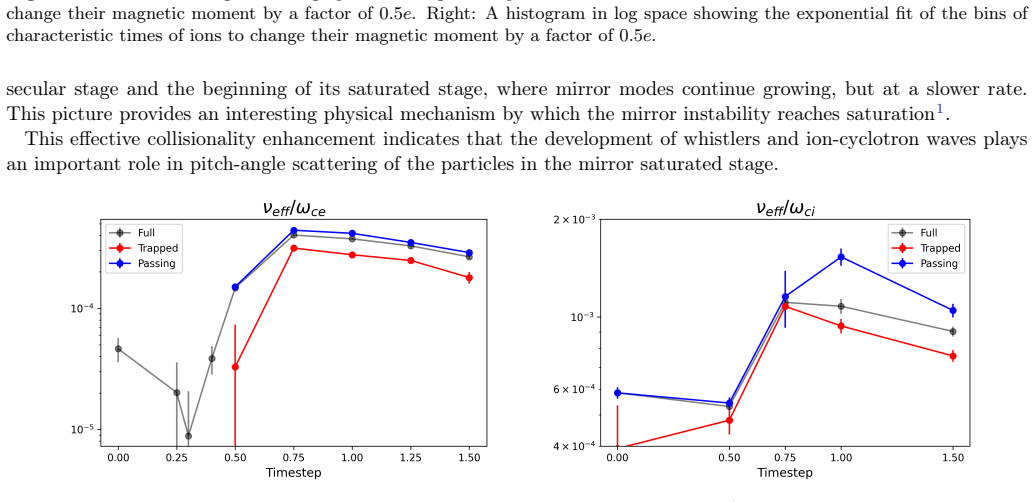
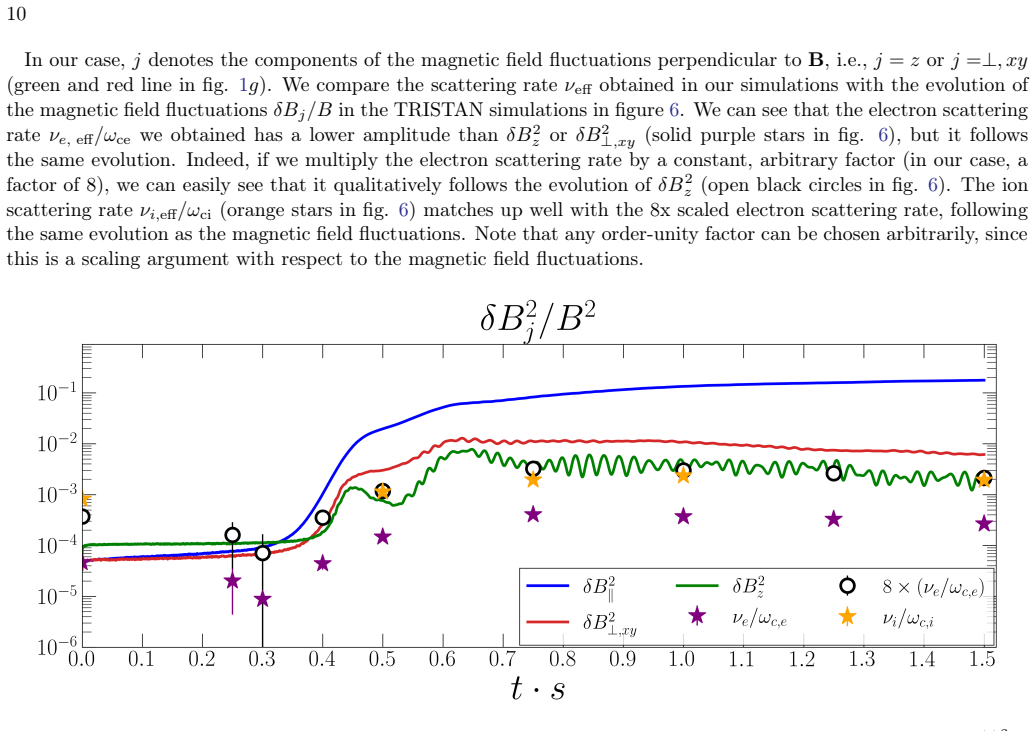
Secondary whistlers and IC waves enhance trapped particle escape from mirror modes; scattering rates and wave amplitudes follow the proportionality expected from quasilinear theory, with significant correlation between scattering rates and secondary instability excitation.
What carries the argument
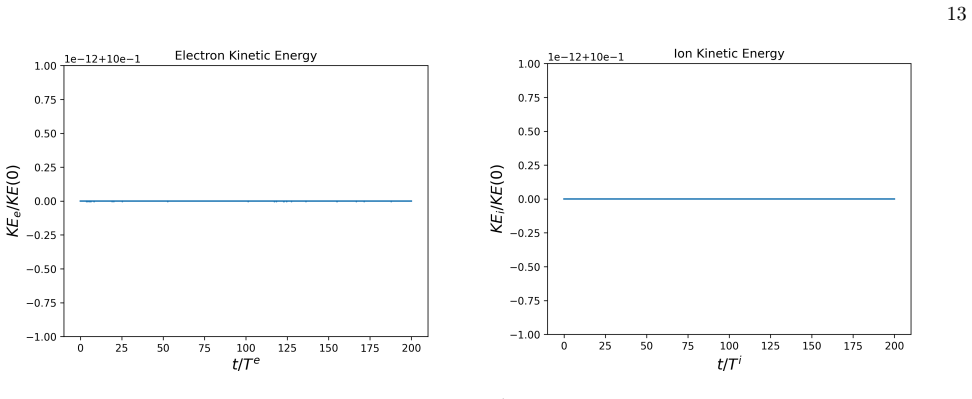
Test-particle trajectories integrated through the static electromagnetic field snapshot taken from a prior particle-in-cell simulation of the nonlinear mirror instability.
Load-bearing premise
The electromagnetic field configuration taken from the original simulation can be treated as unchanging while test particles move through it over the timescales of interest.
What would settle it
A fully self-consistent kinetic simulation in which particles back-react on the waves shows no increase in escape rates and no correlation between scattering and secondary wave amplitudes.
Figures
read the original abstract
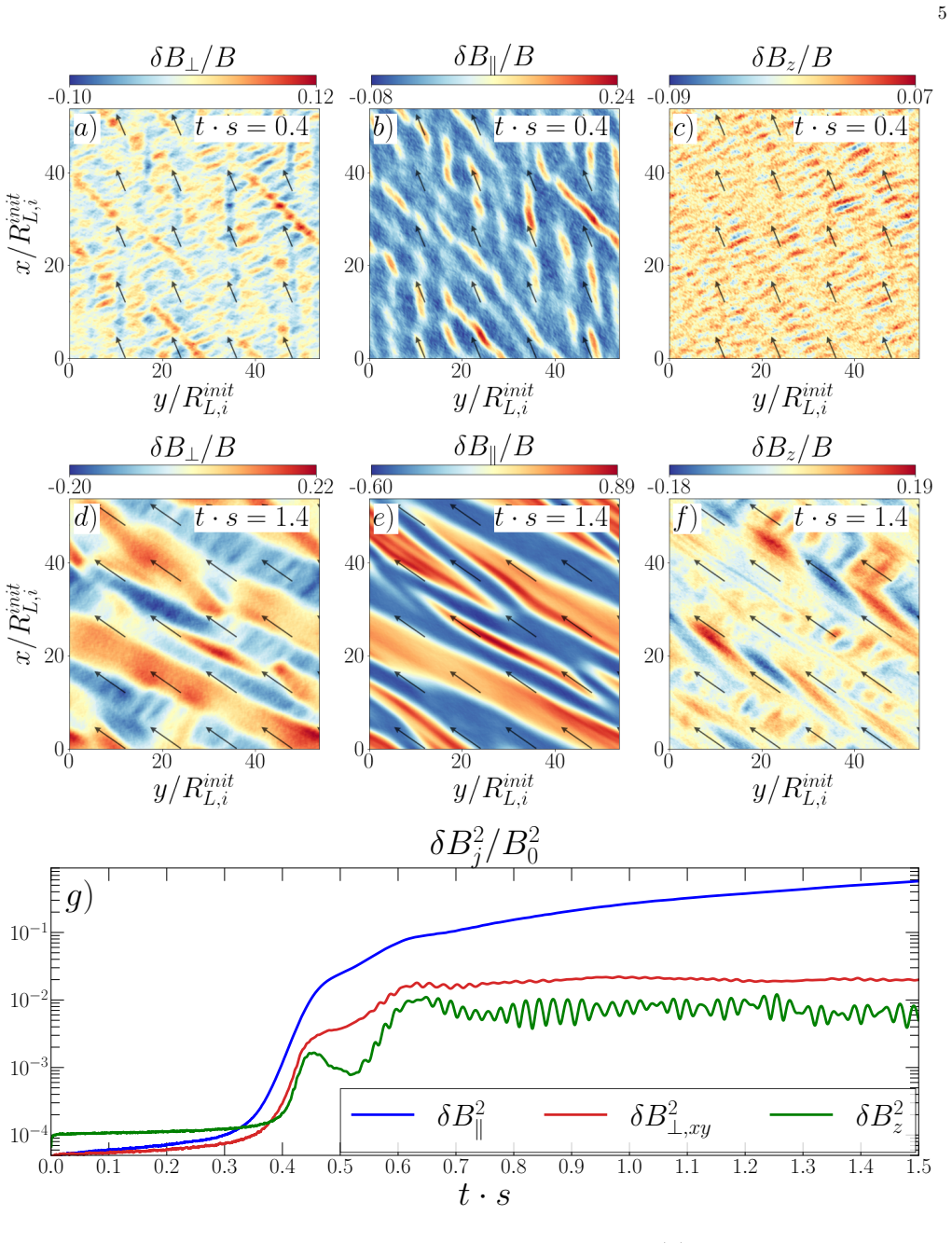
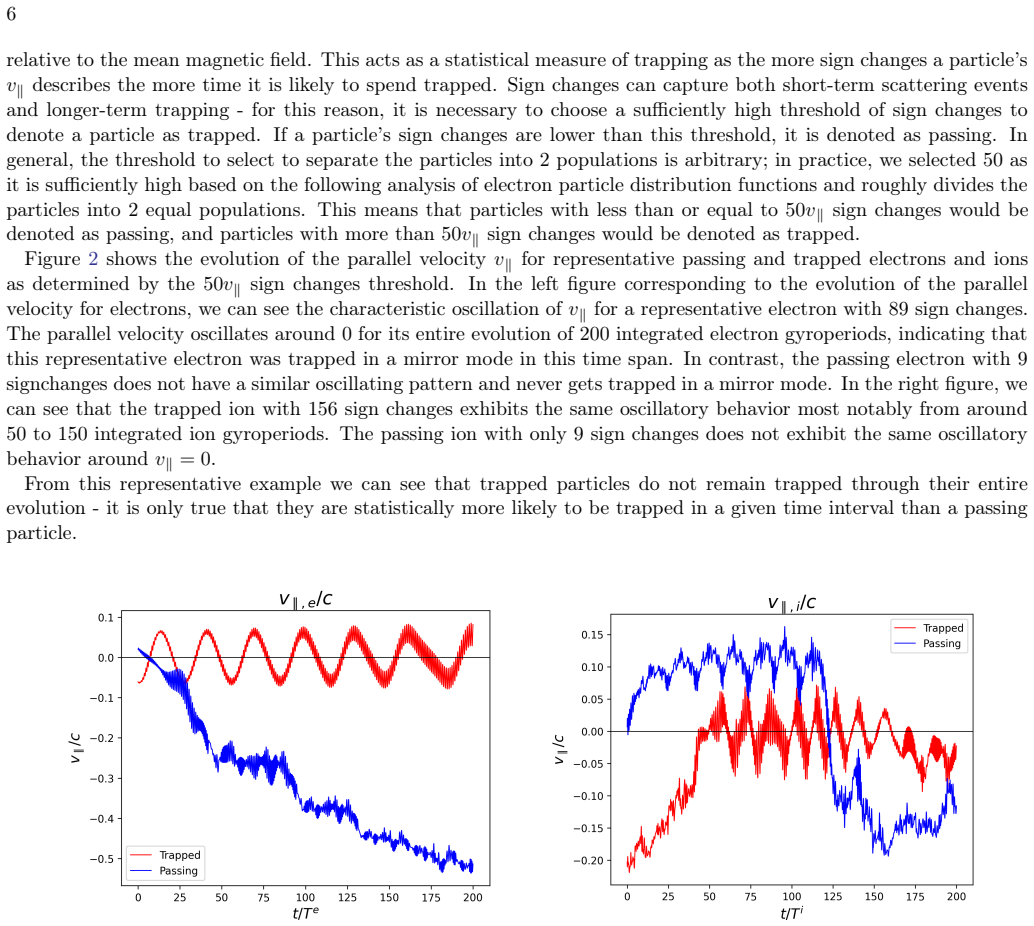
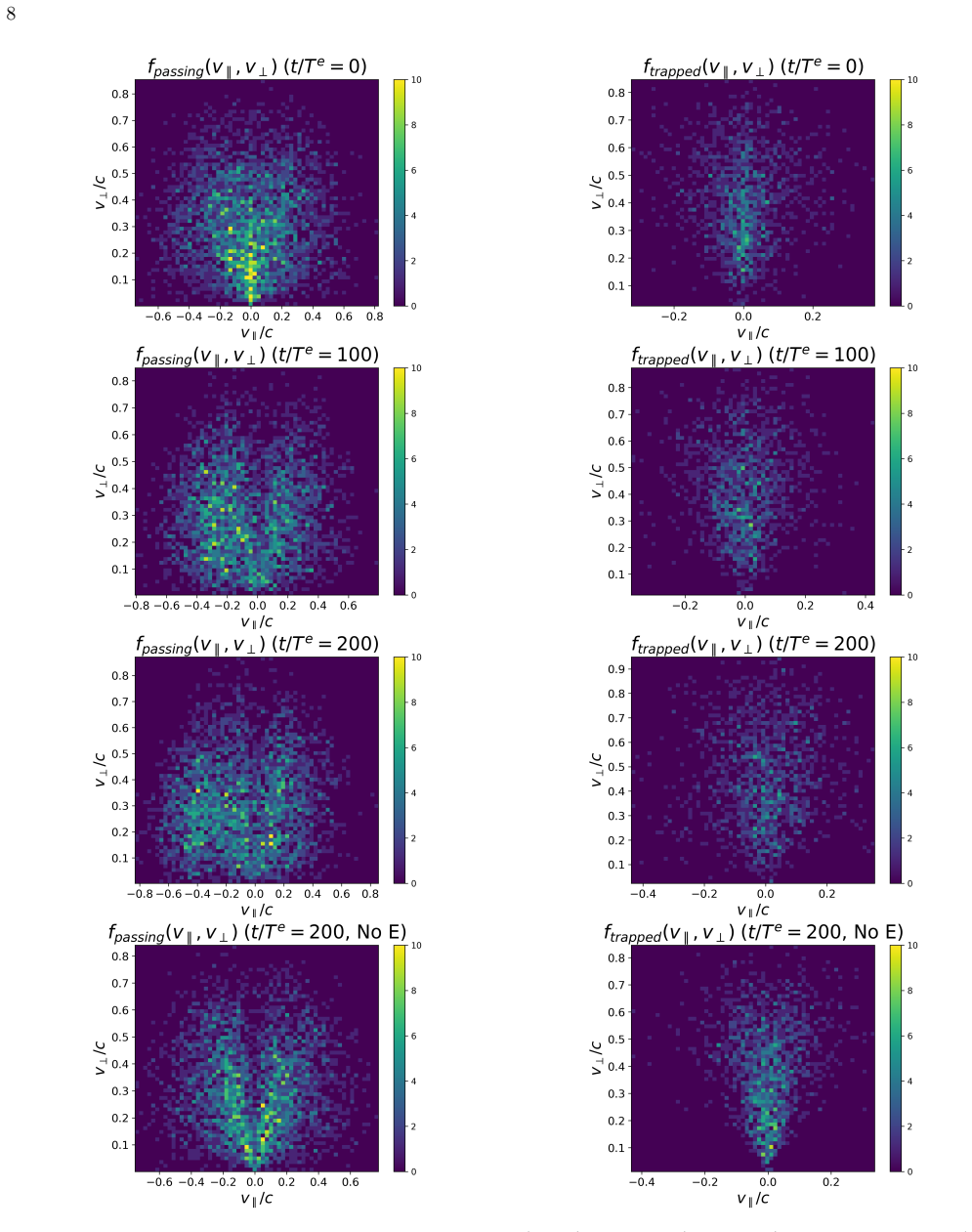
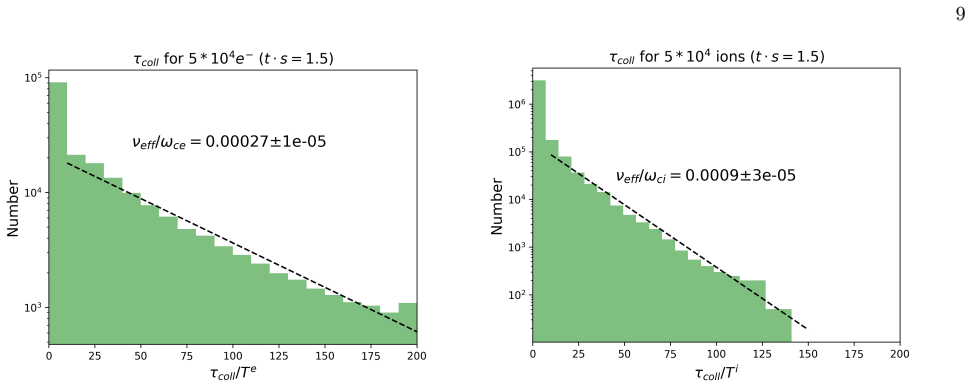
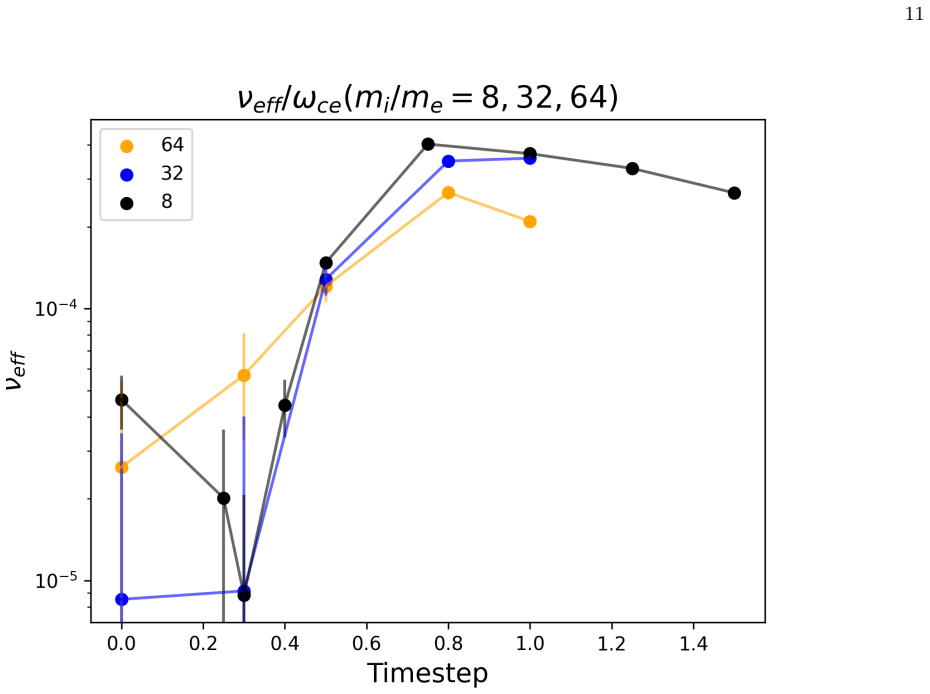
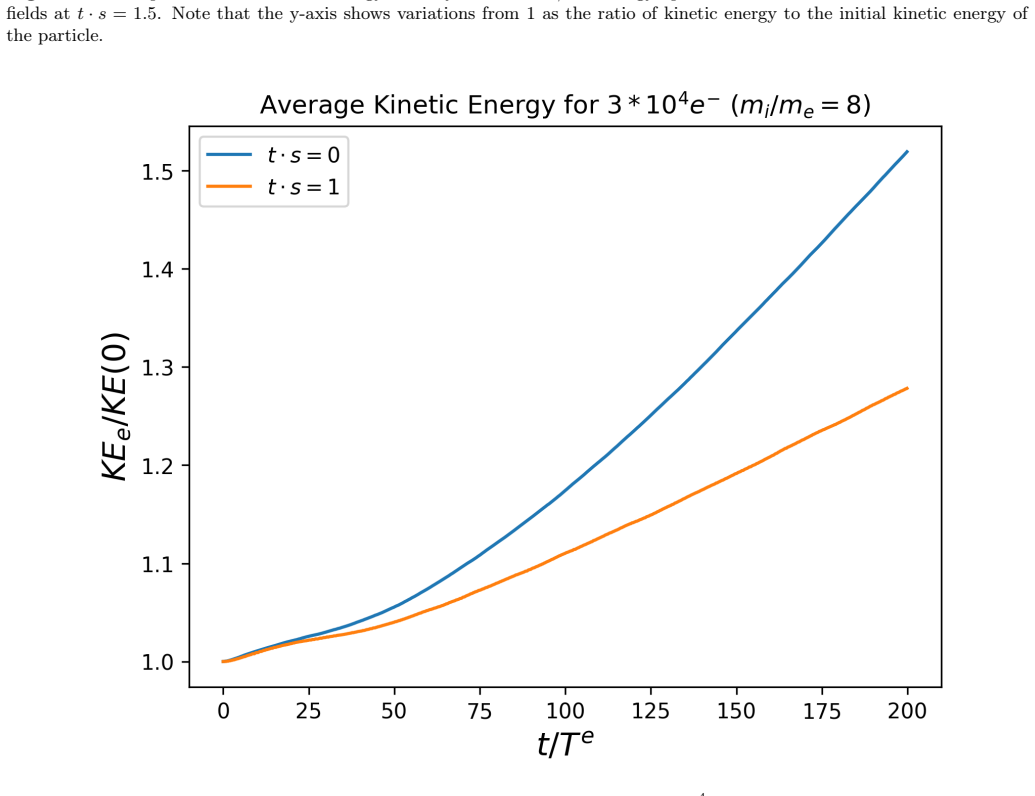
Electron and ion-cyclotron waves are well known to exist in solar system plasmas but their existence and importance in galaxy clusters is an open question. Guided by numerical simulations, (Ley et al. (2024)) argued that whistlers (electron-cyclotron) and ion-cyclotron (IC) waves are generated by trapped particles in mirror modes in the nonlinear stages of the mirror instability under ICM conditions. Building on this work, we construct a novel particle propagation simulation of the ICM plasma based on the static electromagnetic field configuration from the fully kinetic particle-in-cell (PIC) simulation of the nonlinear mirror instability by (Ley et al. (2024)). We study how the trapping rate of particles is related to the secondary waves driven by mirror modes. We observe that secondary whistlers and IC waves enhance trapped particle escape from mirror modes. We measure the particle-wave scattering rate by whistlers and IC waves, demonstrate that the scattering rates and wave amplitudes follow the proportionality relation expected from quasilinear theory, and show the existence of a significant correlation between scattering rates and the excitation of secondary instabilities.
Editorial analysis
A structured set of objections, weighed in public.
Referee Report
Summary. The manuscript describes a test-particle propagation simulation that integrates particle trajectories in a static electromagnetic field snapshot taken from the authors' prior fully kinetic PIC simulation of the nonlinear mirror instability (Ley et al. 2024). The central claims are that secondary whistler and ion-cyclotron waves enhance the escape of particles trapped in mirror modes, that the measured scattering rates obey the amplitude proportionality expected from quasilinear theory, and that scattering rates show significant correlation with the excitation of these secondary instabilities.
Significance. If the frozen-field results hold, the work would provide concrete evidence that secondary wave-particle scattering facilitates particle transport out of mirror modes under ICM conditions, with direct implications for cosmic-ray propagation and plasma heating models in galaxy clusters. The methodological step of coupling a PIC-derived field configuration with subsequent test-particle tracing is a clear strength and offers a reproducible bridge between fully kinetic and test-particle regimes.
major comments (3)
- [Simulation setup] Simulation setup (particle propagation method): The central claims on enhanced escape, quasilinear proportionality of scattering rates, and correlation with secondary instability excitation all rest on the assumption that the static EM field snapshot (including the secondary whistlers and IC waves) remains a valid background over the particle escape timescales. Because the waves are driven by the trapped population, any back-reaction or wave evolution would alter both the instantaneous scattering operator and the long-term escape statistics. The manuscript provides no estimate of the timescale separation between particle transit times and wave growth/decay times, leaving the validity of the frozen-field approximation unquantified.
- [Results section on scattering rates] Results on scattering rates and correlation: The assertion that scattering rates follow the quasilinear proportionality to wave amplitude and exhibit significant correlation with secondary instability excitation is load-bearing for the main conclusion, yet the manuscript does not report the precise definition of the scattering-rate diagnostic, the statistical error analysis, or the quantitative figures supporting the claimed proportionality and correlation strength.
- [Discussion or validation subsection] Comparison to self-consistent evolution: No test is presented that compares the test-particle escape statistics obtained in the frozen snapshot against a run in which the fields are allowed to evolve self-consistently (even at reduced resolution) or against an estimate of the back-reaction timescale. This omission directly affects the robustness of the claim that secondary waves enhance escape.
minor comments (2)
- [Abstract] The abstract and introduction would benefit from an explicit statement of the particle species (electrons vs. ions) for which the scattering rates are reported, as the whistler and IC waves act on different populations.
- [Methods] Notation for the scattering rate (e.g., whether it is a pitch-angle diffusion coefficient D_{\mu\mu} or a mean-free-path estimate) should be defined once at first use and used consistently in all figures and equations.
Simulated Author's Rebuttal
We thank the referee for their careful and constructive review of our manuscript. We respond point-by-point to the major comments below, indicating where revisions will be made to address the concerns raised.
read point-by-point responses
-
Referee: [Simulation setup] Simulation setup (particle propagation method): The central claims on enhanced escape, quasilinear proportionality of scattering rates, and correlation with secondary instability excitation all rest on the assumption that the static EM field snapshot (including the secondary whistlers and IC waves) remains a valid background over the particle escape timescales. Because the waves are driven by the trapped population, any back-reaction or wave evolution would alter both the instantaneous scattering operator and the long-term escape statistics. The manuscript provides no estimate of the timescale separation between particle transit times and wave growth/decay times, leaving the validity of the frozen-field approximation unquantified.
Authors: We agree that an explicit estimate of the timescale separation would strengthen the justification for the frozen-field approximation. In the revised manuscript we will add a quantitative comparison between typical particle transit times across mirror-mode structures (computed from the test-particle trajectories) and the growth/decay timescales of the secondary whistler and ion-cyclotron waves as measured in the original PIC simulation of Ley et al. (2024). revision: yes
-
Referee: [Results section on scattering rates] Results on scattering rates and correlation: The assertion that scattering rates follow the quasilinear proportionality to wave amplitude and exhibit significant correlation with secondary instability excitation is load-bearing for the main conclusion, yet the manuscript does not report the precise definition of the scattering-rate diagnostic, the statistical error analysis, or the quantitative figures supporting the claimed proportionality and correlation strength.
Authors: We accept that the scattering-rate analysis requires additional detail for reproducibility and rigor. The revised manuscript will include the exact definition of the scattering-rate diagnostic, a description of the statistical procedure (including how errors are estimated), and quantitative results such as the fitted proportionality constant, Pearson correlation coefficient, and associated uncertainties or significance levels. revision: yes
-
Referee: [Discussion or validation subsection] Comparison to self-consistent evolution: No test is presented that compares the test-particle escape statistics obtained in the frozen snapshot against a run in which the fields are allowed to evolve self-consistently (even at reduced resolution) or against an estimate of the back-reaction timescale. This omission directly affects the robustness of the claim that secondary waves enhance escape.
Authors: A fully self-consistent comparison at the resolution needed to capture both mirror modes and secondary waves is computationally prohibitive within the scope of this study. We will, however, add an order-of-magnitude estimate of the back-reaction timescale based on the wave energy density and trapped-particle density present in the snapshot. This estimate will be placed in the discussion to address the robustness of the frozen-field results. revision: partial
Circularity Check
No significant circularity; new test-particle tracing is independent of prior simulation output
full rationale
The paper takes electromagnetic fields from Ley et al. (2024) as a fixed background and performs a separate particle-propagation integration to measure escape rates, scattering rates, and their correlation with wave amplitudes. These measurements are computed outputs of the new tracing step rather than algebraic identities or statistical fits forced by the input fields. Self-citation to overlapping-author prior work is present but supplies only the background snapshot; the central claims about quasilinear proportionality and escape enhancement are generated by the independent propagation analysis and do not reduce to the cited simulation by construction. No self-definitional, fitted-input, or uniqueness-theorem patterns appear.
Axiom & Free-Parameter Ledger
Reference graph
Works this paper leans on
-
[1]
Boris, J. P. 1970, Proceeding of Fourth Conference on Numerical Simulations of Plasmas Chandrasekhar, S., Kaufman, A., & Watson, K. 1958, Annals of Physics, 5, 1, doi: https://doi.org/10.1016/0003-4916(58)90002-2 14 Chen, F. 1984, Introduction to Plasma Physics and Controlled Fusion, Introduction to Plasma Physics and Controlled Fusion No. 1 (Springer). h...
-
[2]
http://www.jstor.org/stable/99870 Fabian, A. C., & Nulsen, P. E. J. 1977, Monthly Notices of the Royal Astronomical Society, 180, 479, doi: 10.1093/mnras/180.3.479 Hellinger, P., & Matsumoto, H. 2000, Journal of Geophysical Research: Space Physics, 105, 10519, doi: https://doi.org/10.1029/1999JA000297 Jiang, W., Verscharen, D., Li, H., Wang, C., & Klein, ...
discussion (0)
Sign in with ORCID, Apple, or X to comment. Anyone can read and Pith papers without signing in.