Same Signal, Different Story: Demystifying Receiver Effects in Wi-Fi Channel State Information
Pith reviewed 2026-06-29 15:50 UTC · model grok-4.3
The pith
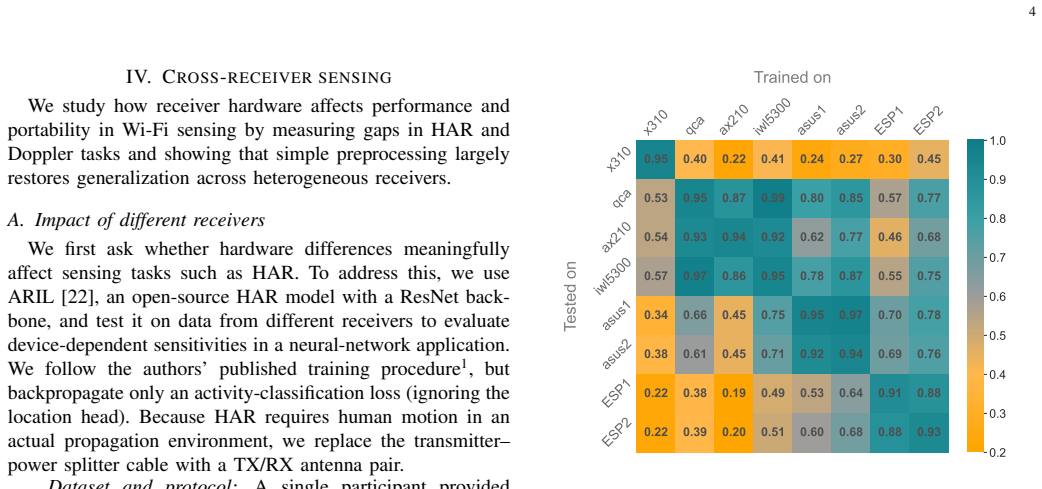
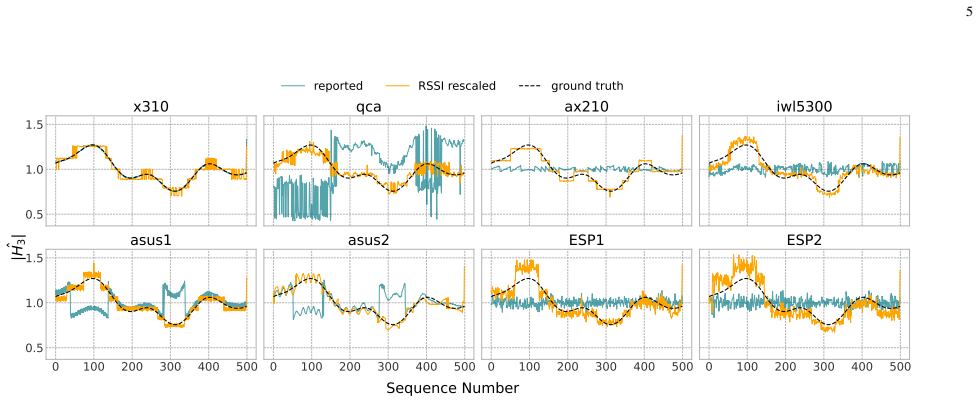
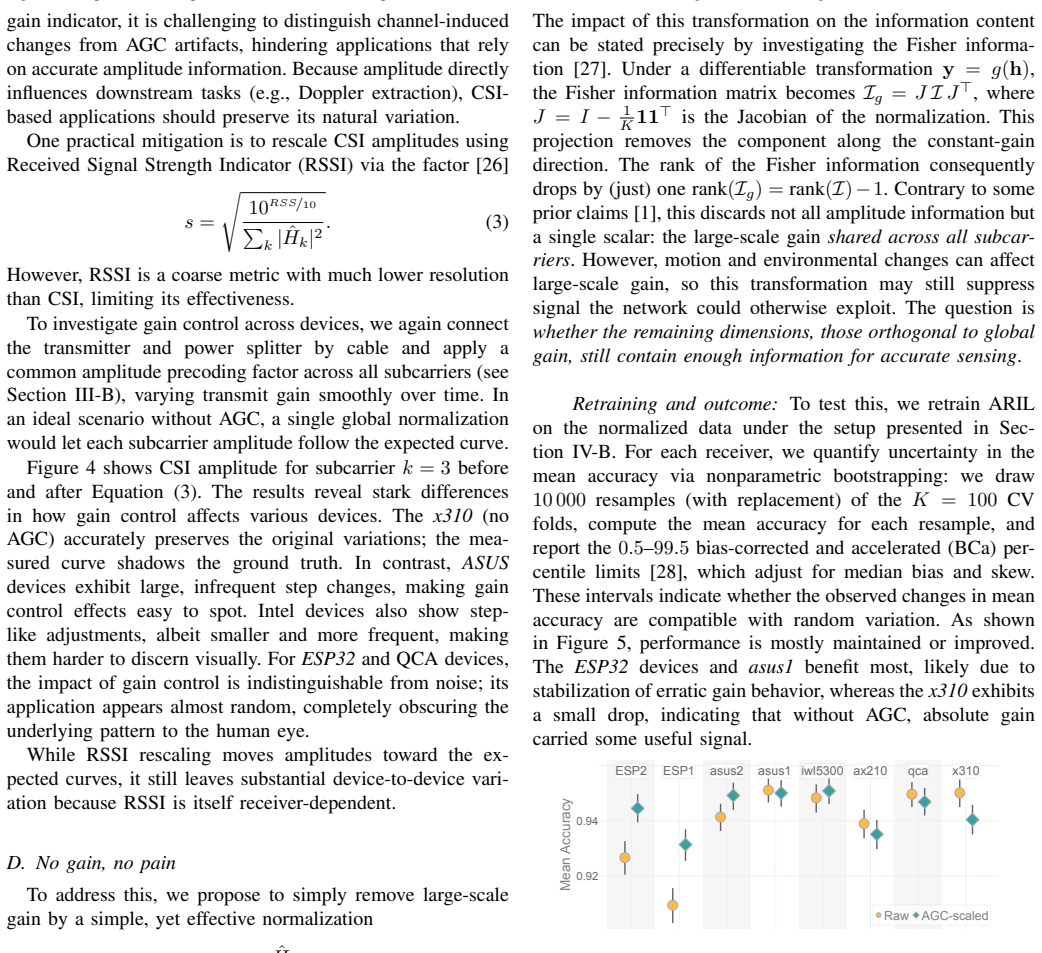
Receiver effects in Wi-Fi CSI arise mainly from Automatic Gain Control and subcarrier nonlinearities, but a simple gain-alignment step recovers up to 75% of lost cross-device accuracy in sensing models.
A machine-rendered reading of the paper's core claim, the machinery that carries it, and where it could break.
Core claim
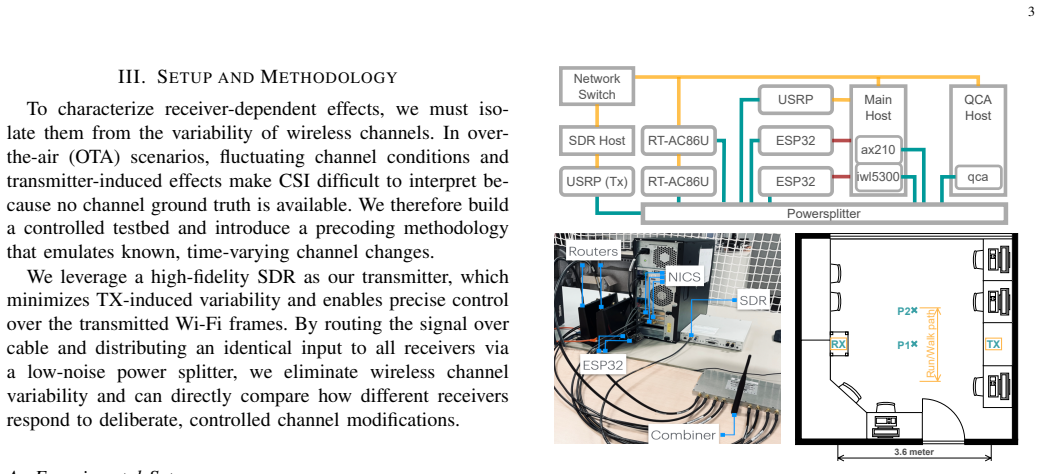
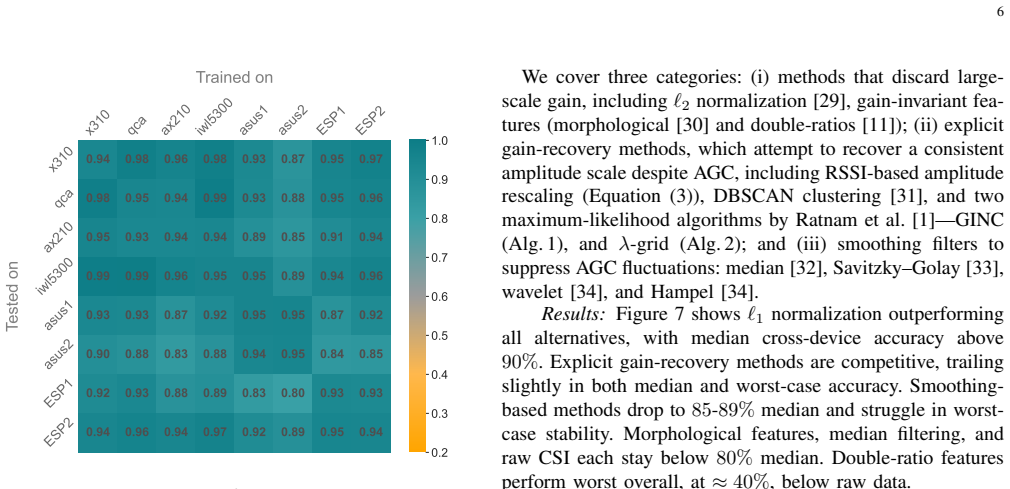
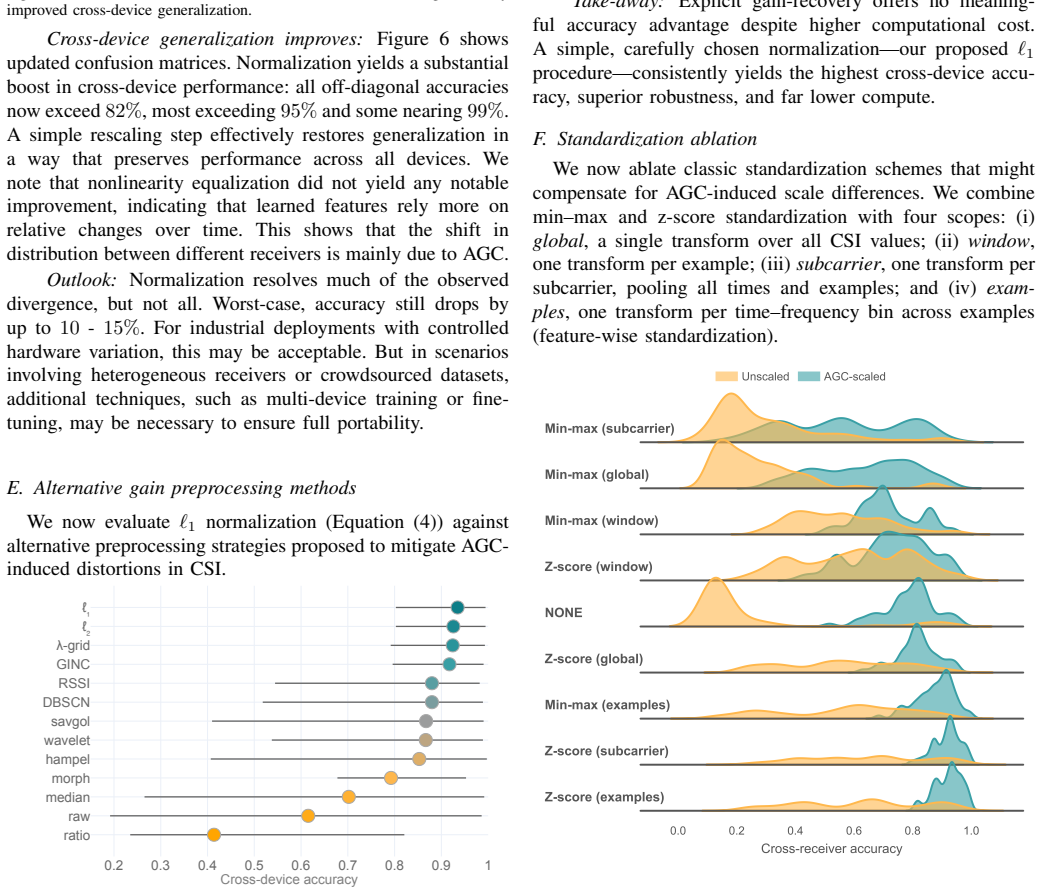
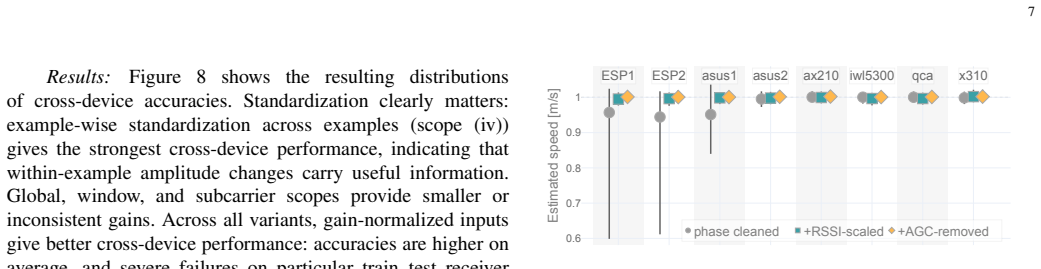
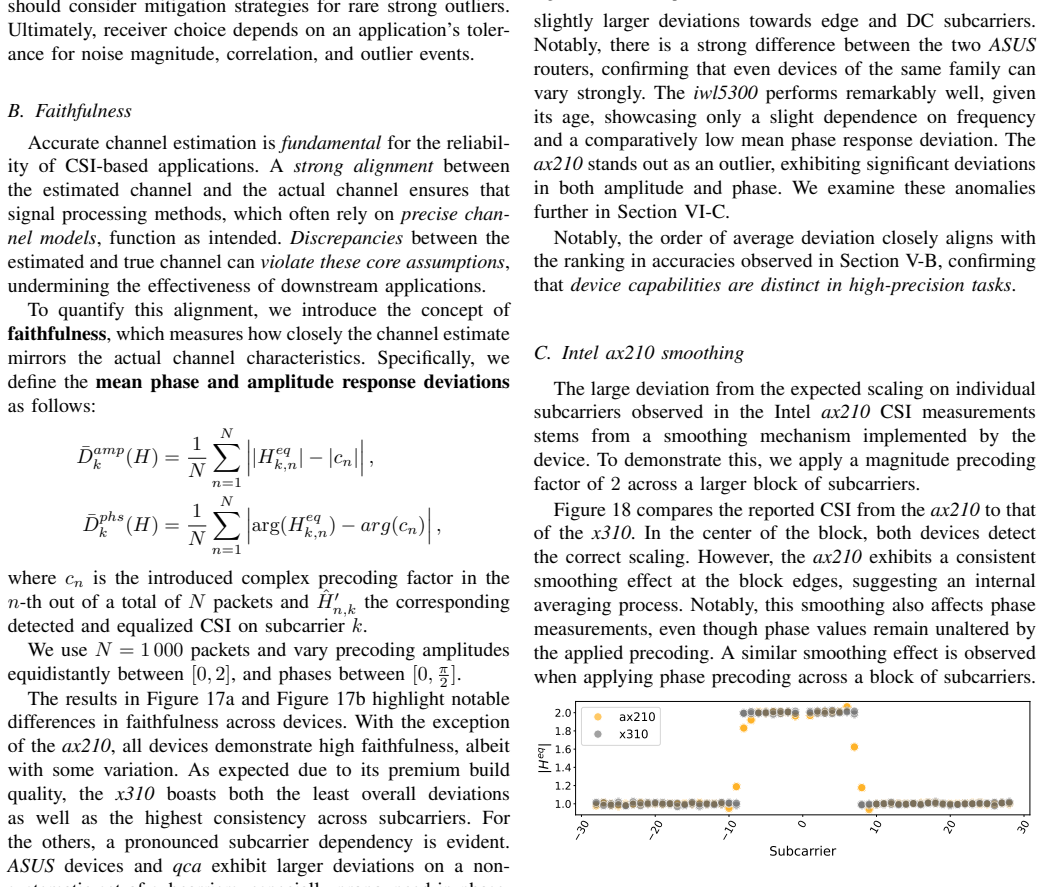
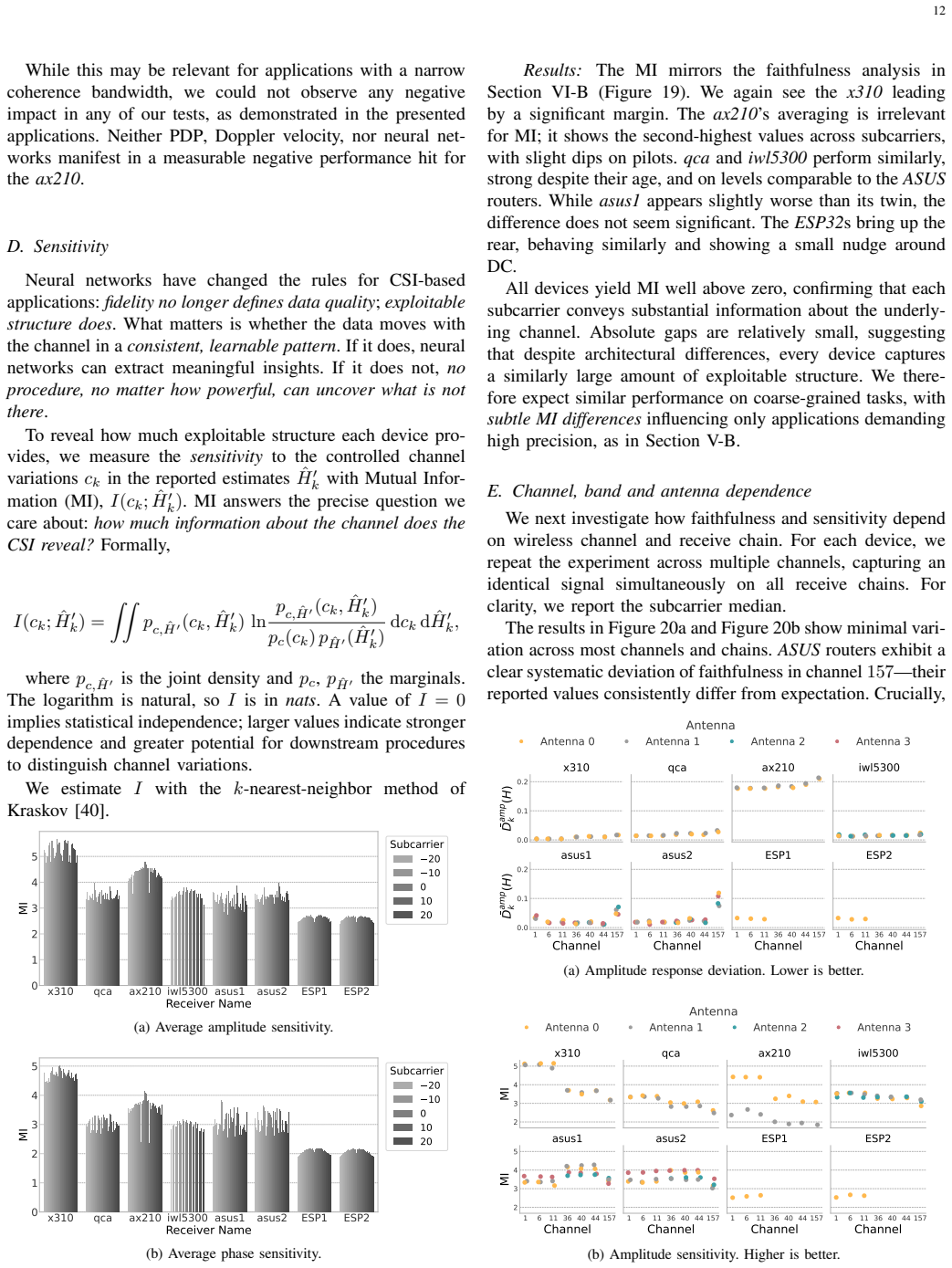
Using a unified experimental setup delivering precisely precoded signals simultaneously to multiple receivers, the authors isolate receiver-specific variability in CSI. They find that dominant cross-device differences arise from Automatic Gain Control and consistent subcarrier nonlinearities. A simple gain-alignment preprocessing step recovers most of the lost accuracy (up to 75%) in cross-device Human Activity Recognition model deployments. Without preprocessing, model accuracy sharply drops, effectively breaking practical deployments. Additional analyses reveal measurable inherent differences in receiver faithfulness, sensitivity and noise.
What carries the argument
Gain-alignment preprocessing step that normalizes amplitude variations caused by Automatic Gain Control across receivers.
If this is right
- Without preprocessing, model accuracy sharply drops, effectively breaking practical deployments across different receivers.
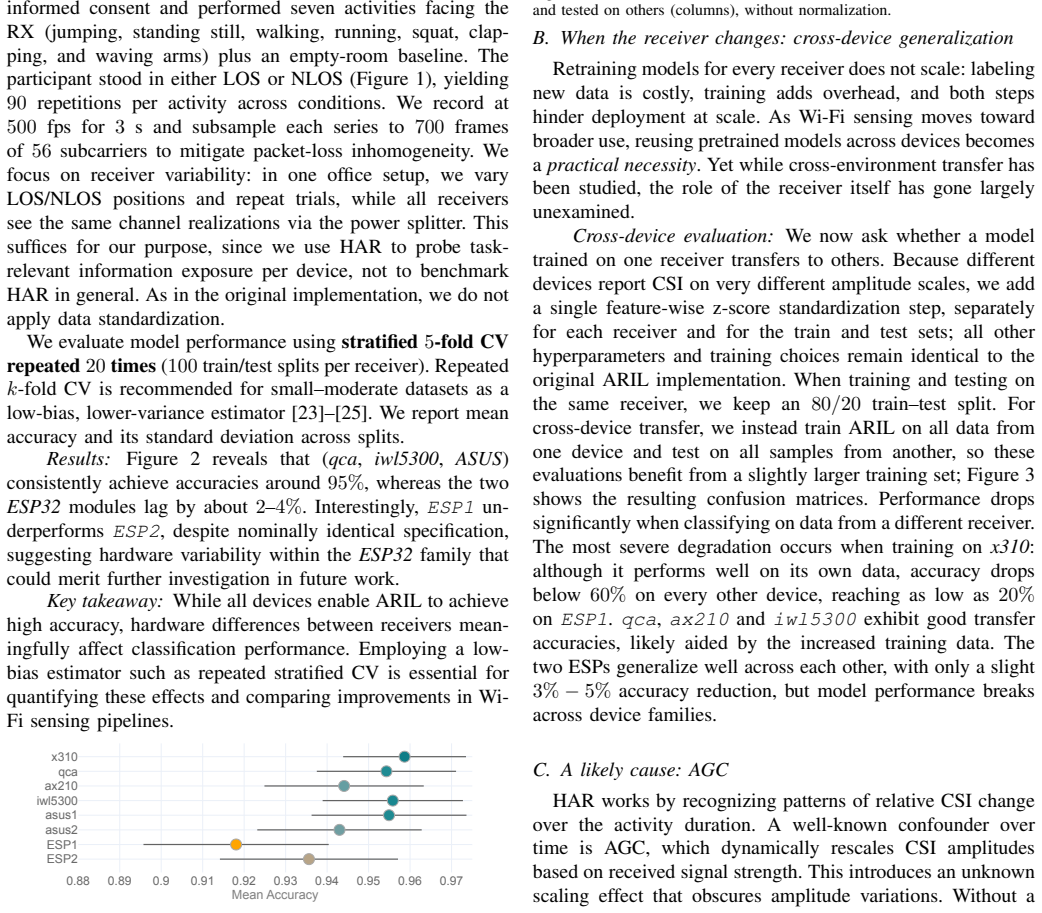
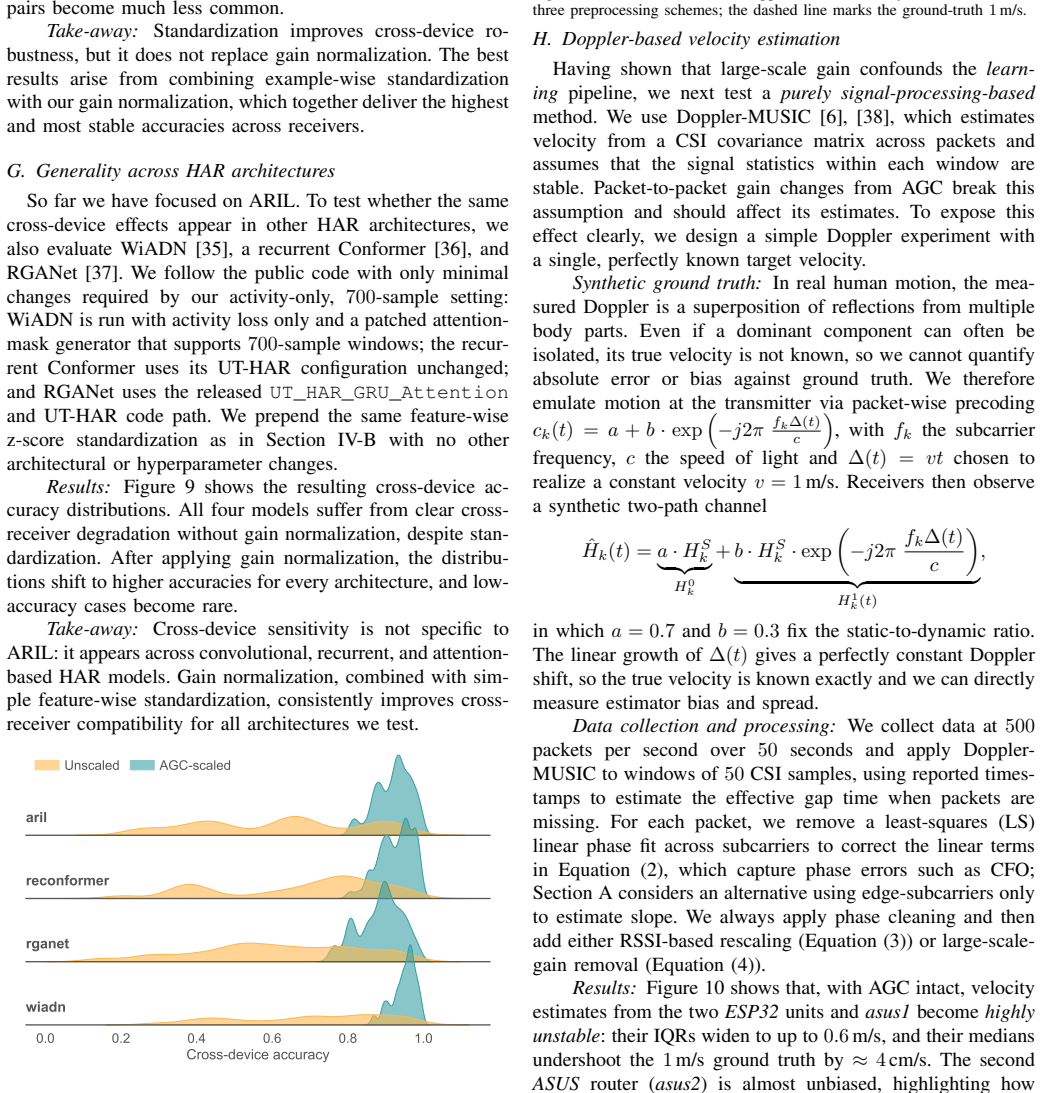
- Receiver-induced differences do not significantly affect robust sensing tasks such as Human Activity Recognition.
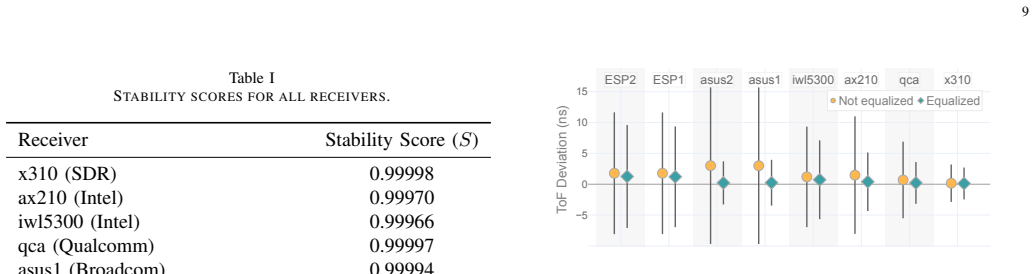
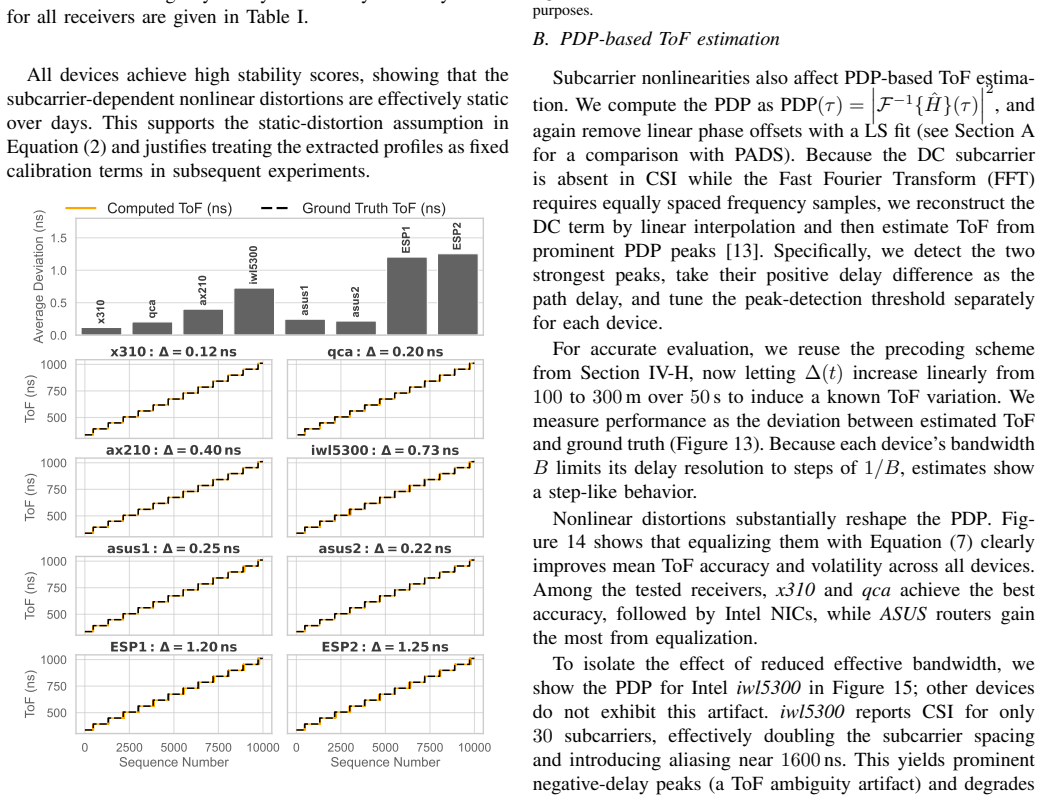
- Receiver effects become relevant in scenarios demanding high precision such as single-shot time of flight.
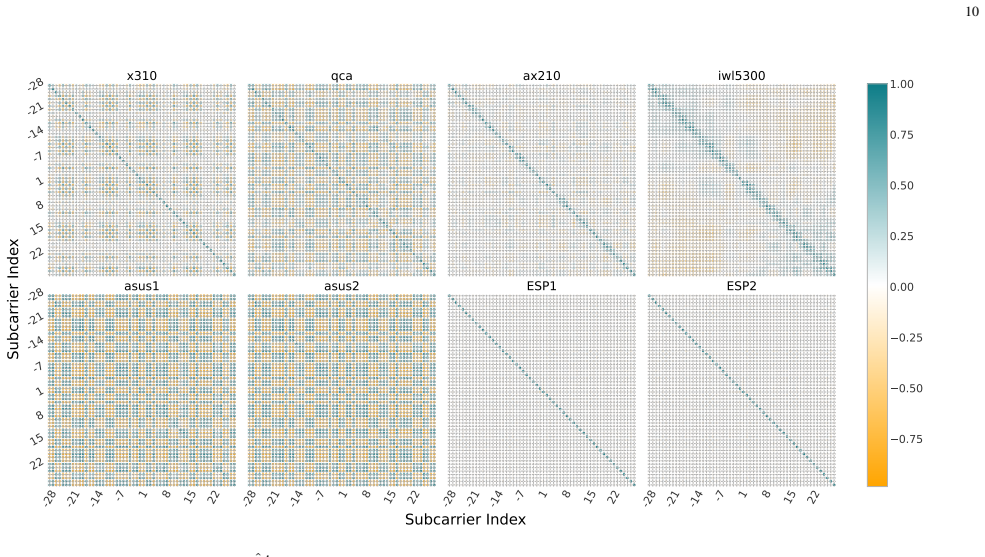
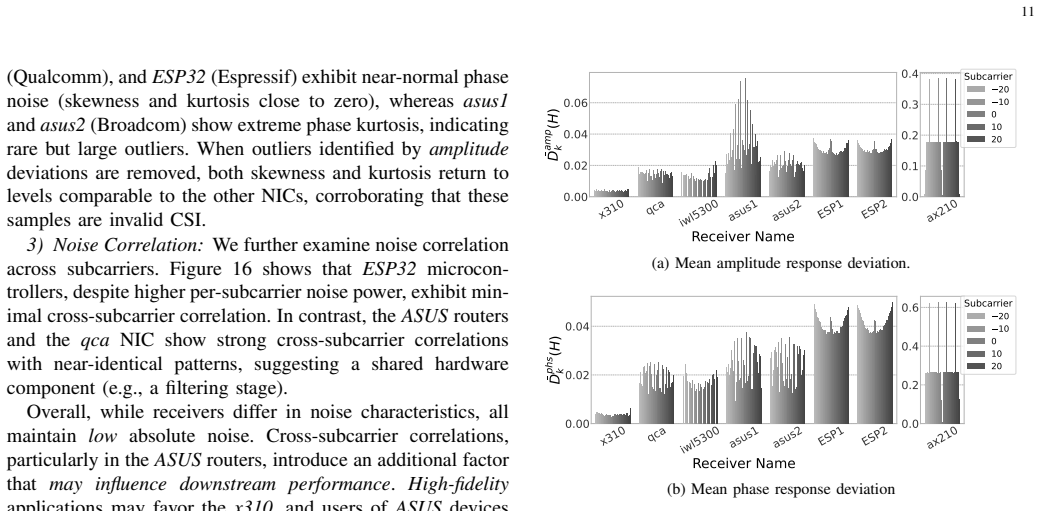
- Additional analyses reveal measurable inherent differences in receiver faithfulness, sensitivity and noise.
Where Pith is reading between the lines
- Future sensing pipelines could embed receiver calibration as a standard first step rather than retraining models per device.
- The same variability patterns may appear in other RF sensing domains where multiple receivers interpret the same transmission.
- Device manufacturers could publish receiver-specific correction tables to simplify cross-hardware model transfer.
Load-bearing premise
The unified experimental setup delivering precisely precoded signals simultaneously to multiple receivers successfully isolates receiver-specific variability without introducing confounding factors from the transmitter, channel, or environment.
What would settle it
Apply the gain-alignment preprocessing to a new pair of receivers in an independent environment and measure whether human activity recognition accuracy recovers by approximately 75 percent compared with the unaligned case.
Figures
read the original abstract
Wi-Fi sensing has emerged as a versatile tool for tasks such as localization, gesture recognition, and vital-sign monitoring, enabling applications from smart environments to personalized healthcare. However, sensing accuracy often significantly degrades when pretrained models are deployed across different commodity receivers. We present the first systematic comparison of Channel State Information (CSI) across diverse Commercial Off-The-Shelf Wi-Fi sensing platforms. Using a unified experimental setup delivering precisely precoded signals simultaneously to multiple receivers, we isolate receiver-specific variability. We find that dominant cross-device differences arise from Automatic Gain Control and consistent subcarrier nonlinearities. We propose a simple gain-alignment preprocessing step, recovering most of the lost accuracy (up to 75%) in cross-device Human Activity Recognition model deployments. Without preprocessing, model accuracy sharply drops-effectively breaking practical deployments. Additional analyses reveal measurable inherent differences in receiver faithfulness, sensitivity and noise. While these receiver-induced differences do not significantly affect robust sensing tasks such as Human Activity Recognition, they become relevant in scenarios demanding high precision (e.g., single-shot time of flight). Our findings demonstrate that cross-device variability in CSI is real but manageable, and we provide tools and guidelines for robust, hardware-agnostic Wi-Fi sensing.
Editorial analysis
A structured set of objections, weighed in public.
Referee Report
Summary. The paper presents the first systematic comparison of CSI across COTS Wi-Fi platforms using a unified setup that delivers precisely precoded signals simultaneously to multiple receivers. It attributes dominant cross-device differences to AGC and consistent subcarrier nonlinearities, proposes a simple gain-alignment preprocessing step that recovers up to 75% of lost accuracy in cross-device HAR deployments, and reports additional receiver differences in faithfulness, sensitivity, and noise that matter more for high-precision tasks than for robust sensing.
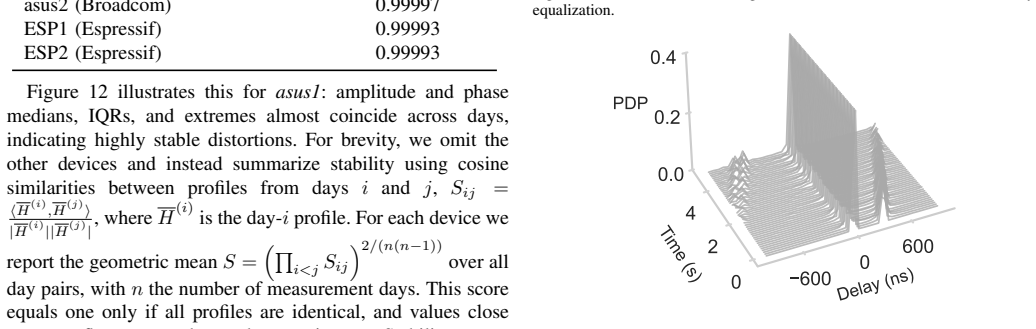
Significance. If the isolation of receiver effects holds, the work supplies concrete, actionable preprocessing guidance and quantitative recovery numbers that directly address a deployment barrier in Wi-Fi sensing. The direct experimental measurements (rather than fitted models) and the focus on commodity hardware make the findings immediately usable for practitioners.
major comments (2)
- [Experimental setup / abstract] Experimental setup (abstract and § on methodology): the central attribution of observed CSI differences to receiver AGC and nonlinearities, and the 75% recovery figure, rest on the premise that the unified precoded-signal delivery produces identical incident waveforms, path loss, and multipath at each receiver. No quantitative validation (e.g., raw I/Q power equality across receivers, reference-receiver swap test, or measured incident-field equality metric) is reported; without it, residual transmitter or spatial confounds cannot be ruled out at the precision needed to support the accuracy-recovery claim.
- [HAR cross-device results] Results on HAR accuracy recovery (section reporting cross-device experiments): the 75% figure is presented as the primary practical outcome, yet the manuscript supplies no statistical details (variance across trials, number of independent runs, confidence intervals, or ablation of the gain-alignment step alone) that would allow assessment of whether the recovery is robust or sensitive to the exact experimental conditions.
minor comments (2)
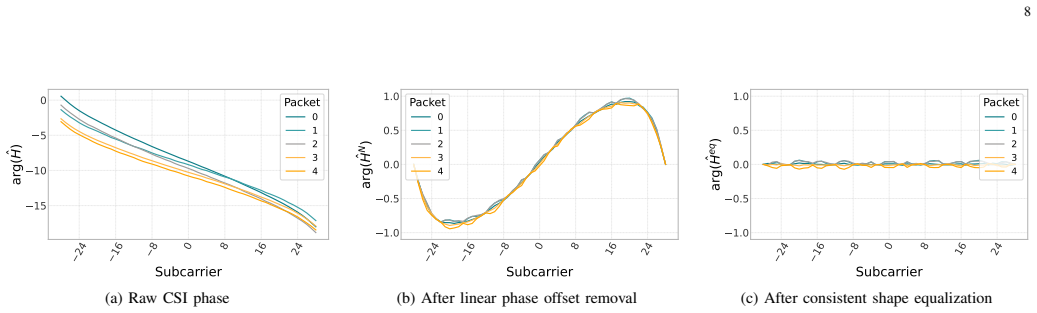
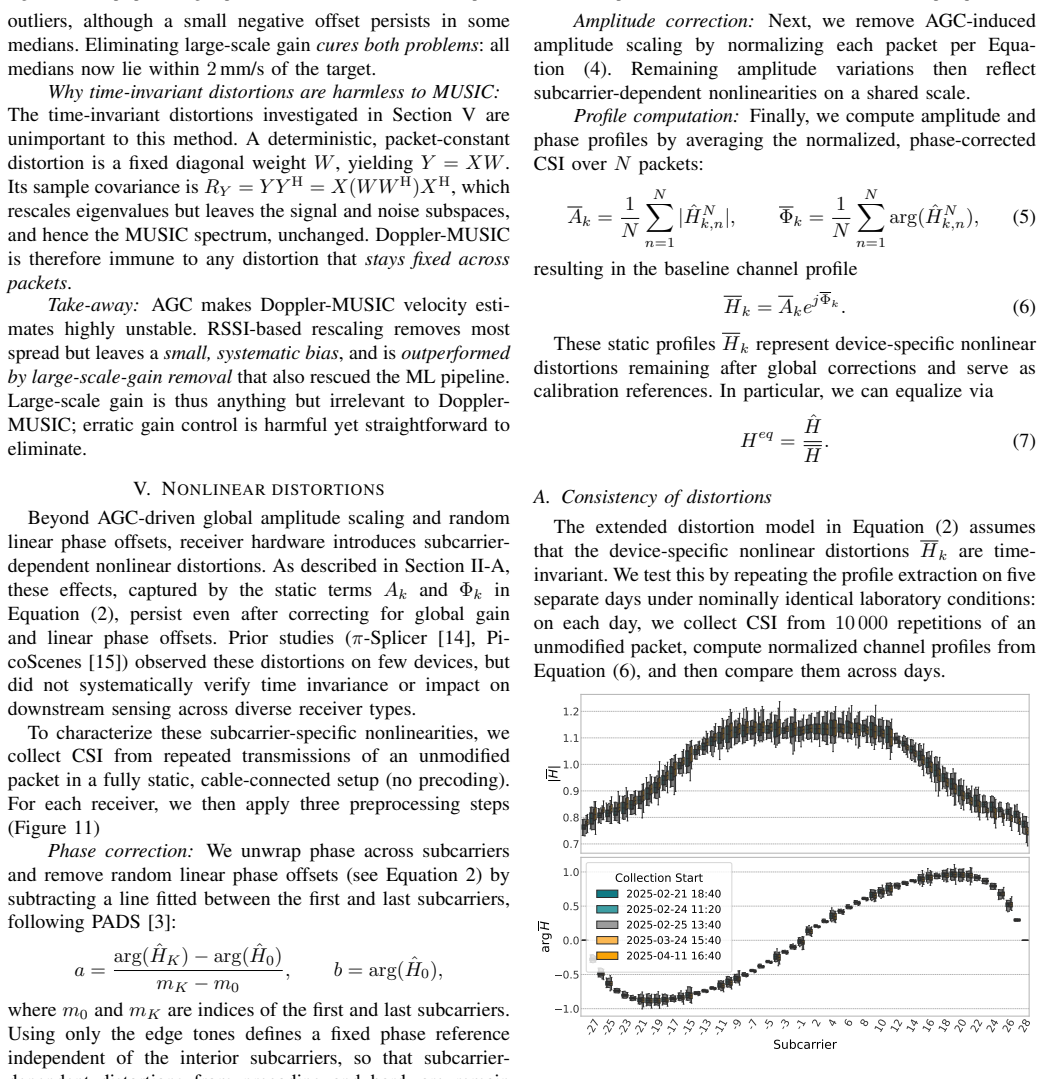
- [Results on subcarrier nonlinearities] Notation for subcarrier nonlinearities is introduced without an explicit equation or figure showing the measured deviation pattern across devices.
- [Abstract / discussion] The abstract states that receiver differences 'do not significantly affect robust sensing tasks' but does not define the threshold used for 'significant' or report the corresponding p-values or effect sizes.
Simulated Author's Rebuttal
We thank the referee for the constructive comments, which identify areas where additional validation and statistical reporting will strengthen the manuscript. We address each major comment below and will incorporate the suggested changes in the revision.
read point-by-point responses
-
Referee: Experimental setup (abstract and § on methodology): the central attribution of observed CSI differences to receiver AGC and nonlinearities, and the 75% recovery figure, rest on the premise that the unified precoded-signal delivery produces identical incident waveforms, path loss, and multipath at each receiver. No quantitative validation (e.g., raw I/Q power equality across receivers, reference-receiver swap test, or measured incident-field equality metric) is reported; without it, residual transmitter or spatial confounds cannot be ruled out at the precision needed to support the accuracy-recovery claim.
Authors: We agree that explicit quantitative validation of incident signal equality would strengthen the attribution. The unified setup was constructed to deliver identical precoded waveforms simultaneously (via calibrated cabling and a common transmitter), but direct metrics such as raw I/Q power equality and a receiver-swap test were not reported. In the revision we will add these measurements (incident-field equality metric and swap-test results) to rule out transmitter or spatial confounds at the required precision. revision: yes
-
Referee: Results on HAR accuracy recovery (section reporting cross-device experiments): the 75% figure is presented as the primary practical outcome, yet the manuscript supplies no statistical details (variance across trials, number of independent runs, confidence intervals, or ablation of the gain-alignment step alone) that would allow assessment of whether the recovery is robust or sensitive to the exact experimental conditions.
Authors: We acknowledge that the 75% recovery figure requires supporting statistical details for proper evaluation. The reported value derives from repeated trials, but variance, run counts, confidence intervals, and an isolated ablation of gain alignment were omitted. The revised manuscript will include these elements (e.g., 10 independent runs, standard deviation, 95% CI, and ablation results) to demonstrate robustness. revision: yes
Circularity Check
No significant circularity; empirical measurements only
full rationale
The paper contains no derivation chain, first-principles predictions, or fitted parameters presented as outputs. All central claims rest on direct experimental comparisons of CSI traces collected under a unified precoded-signal setup. The proposed gain-alignment step is a post-hoc preprocessing heuristic motivated by observed amplitude differences, not a quantity derived from or fitted to the same data in a self-referential loop. No self-citations, uniqueness theorems, or ansatzes are invoked to justify the isolation of receiver effects. The work is therefore self-contained against external benchmarks and receives the default non-finding.
Axiom & Free-Parameter Ledger
Reference graph
Works this paper leans on
-
[1]
Optimal preprocessing of wifi csi for sensing applications,
V . V . Ratnam, H. Chen, H.-H. Chang, A. Sehgal, and J. Zhang, “Optimal preprocessing of wifi csi for sensing applications,”IEEE Transactions on Wireless Communications, vol. 23, no. 9, pp. 10 820–10 833, 2024
2024
-
[2]
Wimonitor: Continuous long-term human vitality monitoring using commodity wi-fi devices,
X. Niu, S. Li, Y . Zhang, Z. Liu, D. Wu, R. C. Shah, C. Tanriover, H. Lu, and D. Zhang, “Wimonitor: Continuous long-term human vitality monitoring using commodity wi-fi devices,”Sensors, vol. 21, no. 3, p. 751, 2021
2021
-
[3]
Pads: Passive detection of moving targets with dynamic speed using phy layer information,
K. Qian, C. Wu, Z. Yang, Y . Liu, and Z. Zhou, “Pads: Passive detection of moving targets with dynamic speed using phy layer information,” in 2014 20th IEEE International Conference on Parallel and Distributed Systems (ICPADS). Piscataway, NJ, USA: IEEE, 2014, pp. 1–8
2014
-
[4]
On phase offsets of 802.11 ac commodity wifi,
A. Zubow, P. Gawłowicz, and F. Dressler, “On phase offsets of 802.11 ac commodity wifi,” in2021 16th Annual Conference on Wireless On- demand Network Systems and Services (WONS), IEEE. Klosters, Switzerland: IEEE, 2021, pp. 1–4
2021
-
[5]
Calibrating phase offsets for commodity wifi,
D. Zhang, Y . Hu, Y . Chen, and B. Zeng, “Calibrating phase offsets for commodity wifi,”IEEE Systems Journal, vol. 14, no. 1, pp. 661–664, 2019
2019
-
[6]
Indotrack: Device-free indoor human tracking with commodity wi- fi,
X. Li, D. Zhang, Q. Lv, J. Xiong, S. Li, Y . Zhang, and H. Mei, “Indotrack: Device-free indoor human tracking with commodity wi- fi,”Proceedings of the ACM on Interactive, Mobile, Wearable and Ubiquitous Technologies, vol. 1, no. 3, pp. 1–22, 2017
2017
-
[7]
Wi-drone: wi-fi-based 6-dof tracking for indoor drone flight control,
G. Chi, Z. Yang, J. Xu, C. Wu, J. Zhang, J. Liang, and Y . Liu, “Wi-drone: wi-fi-based 6-dof tracking for indoor drone flight control,” inProceedings of the 20th Annual International Conference on Mobile Systems, Applications and Services, ser. MobiSys ’22. New York, NY , USA: Association for Computing Machinery, 2022, p. 56–68. [Online]. Available: https...
-
[8]
Residual carrier frequency offset estimation and compensation for commodity wifi,
Y . Chen, X. Su, Y . Hu, and B. Zeng, “Residual carrier frequency offset estimation and compensation for commodity wifi,”IEEE Transactions on Mobile Computing, vol. 19, no. 12, pp. 2891–2902, 2019
2019
-
[9]
On the precise phase recovery for physical-layer authentication in dynamic channels,
H. V ogt, C. Li, A. Sezgin, and C. Zenger, “On the precise phase recovery for physical-layer authentication in dynamic channels,” in2019 IEEE International Workshop on Information Forensics and Security (WIFS). Piscataway, NJ, USA: IEEE, 2019, pp. 1–6
2019
-
[10]
Decimeter ranging with channel state information,
N. Tadayon, M. T. Rahman, S. Han, S. Valaee, and W. Yu, “Decimeter ranging with channel state information,”IEEE Transactions on Wireless Communications, vol. 18, no. 7, pp. 3453–3468, 2019
2019
-
[11]
Enabling wifi sensing on new-generation wifi cards,
E. Yi, F. Zhang, J. Xiong, K. Niu, Z. Yao, and D. Zhang, “Enabling wifi sensing on new-generation wifi cards,”Proceedings of the ACM on Interactive, Mobile, Wearable and Ubiquitous Technologies, vol. 7, no. 4, Jan. 2024. [Online]. Available: https://doi.org/10.1145/3633807
-
[12]
Kalman filter based mimo csi phase recovery for cots wifi devices,
C. Li, J. Brauer, A. Sezgin, and C. Zenger, “Kalman filter based mimo csi phase recovery for cots wifi devices,” inICASSP 2021 - 2021 IEEE International Conference on Acoustics, Speech and Signal Processing (ICASSP). 2711 Pierre Place, College Station, Texas 77845, USA: IEEE, 2021, pp. 4820–4824. 14
2021
-
[13]
Precise power delay profiling with commodity wifi,
Y . Xie, Z. Li, and M. Li, “Precise power delay profiling with commodity wifi,” inProceedings of the 21st Annual International Conference on Mobile Computing and Networking, ser. MobiCom ’15. New York, NY , USA: ACM, 2015, p. 53–64. [Online]. Available: http://doi.acm.org/10.1145/2789168.2790124
-
[14]
π-splicer: Perceiving accurate csi phases with commodity wifi devices,
H. Zhu, Y . Zhuo, Q. Liu, and S. Chang, “π-splicer: Perceiving accurate csi phases with commodity wifi devices,”IEEE Transactions on Mobile Computing, vol. 17, no. 9, pp. 2155–2165, 2018
2018
-
[15]
Eliminating the barriers: Demystifying wi-fi baseband design and introducing the picoscenes wi-fi sensing platform,
Z. Jiang, T. H. Luan, X. Ren, D. Lv, H. Hao, J. Wang, K. Zhao, W. Xi, Y . Xu, and R. Li, “Eliminating the barriers: Demystifying wi-fi baseband design and introducing the picoscenes wi-fi sensing platform,”IEEE Internet of Things Journal, vol. 9, no. 6, pp. 4476–4496, 2021
2021
-
[16]
Tool release: Gathering 802.11n traces with channel state information,
D. Halperin, W. Hu, A. Sheth, and D. Wetherall, “Tool release: Gathering 802.11n traces with channel state information,”ACM SIGCOMM CCR, vol. 41, no. 1, p. 53, Jan. 2011
2011
-
[17]
Lightweight and Standalone IoT Based WiFi Sensing for Active Repositioning and Mobility ,
S. M. Hernandez and E. Bulut, “ Lightweight and Standalone IoT Based WiFi Sensing for Active Repositioning and Mobility ,” in2020 IEEE 21st International Symposium on ”A World of Wireless, Mobile and Multimedia Networks” (WoWMoM). Los Alamitos, CA, USA: IEEE Computer Society, Sep. 2020, pp. 277–286. [Online]. Available: https: //doi.ieeecomputersociety.or...
-
[18]
Tse and P
D. Tse and P. Viswanath,Fundamentals of wireless communication. USA: Cambridge University Press, 2005
2005
-
[19]
Sensing in bistatic isac systems with clock asynchronism: A signal processing perspective,
K. Wu, J. Pegoraro, F. Meneghello, J. A. Zhang, J. O. Lacruz, J. Widmer, F. Restuccia, M. Rossi, X. Huang, D. Zhang, G. Caire, and Y . J. Guo, “Sensing in bistatic isac systems with clock asynchronism: A signal processing perspective,”IEEE Signal Processing Magazine, vol. 41, no. 5, pp. 31–43, 2024
2024
-
[20]
Free your csi: A channel state information extraction platform for modern wi-fi chipsets,
F. Gringoli, M. Schulz, J. Link, and M. Hollick, “Free your csi: A channel state information extraction platform for modern wi-fi chipsets,” inProceedings of the 13th International Workshop on Wireless Network Testbeds, Experimental Evaluation & Characterization, ser. WiNTECH ’19. New York, NY , USA: Association for Computing Machinery, 2019, p. 21–28. [O...
-
[21]
Identifying a new non-linear csi phase measurement error with commodity wifi devices,
Y . Zhuo, H. Zhu, and H. Xue, “Identifying a new non-linear csi phase measurement error with commodity wifi devices,” in2016 IEEE 22nd International Conference on Parallel and Distributed Systems (ICPADS). Piscataway, NJ, USA: IEEE, 2016, pp. 72–79
2016
-
[22]
Joint activity recognition and indoor localization with wifi fingerprints,
F. Wang, J. Feng, Y . Zhao, X. Zhang, S. Zhang, and J. Han, “Joint activity recognition and indoor localization with wifi fingerprints,”IEEE Access, vol. 7, pp. 80 058–80 068, 2019
2019
-
[23]
Don’t lose samples to estimation,
I. Tsamardinos, “Don’t lose samples to estimation,”Patterns, vol. 3, no. 12, p. 100612, 2022. [Online]. Available: https: //www.sciencedirect.com/science/article/pii/S2666389922002379
2022
-
[24]
No unbiased estimator of the variance of k-fold cross-validation,
Y . Bengio and Y . Grandvalet, “No unbiased estimator of the variance of k-fold cross-validation,” inAdvances in Neural Information Processing Systems, S. Thrun, L. Saul, and B. Sch ¨olkopf, Eds., vol. 16. Cambridge, MA, USA: MIT Press, 2003. [Online]. Available: https://proceedings.neurips.cc/paper files/paper/ 2003/file/e82c4b19b8151ddc25d4d93baf7b908f-...
2003
-
[25]
Estimating classification error rate: Repeated cross-validation, repeated hold-out and bootstrap,
J. Kim, “Estimating classification error rate: Repeated cross-validation, repeated hold-out and bootstrap,”Computational Statistics & Data Analysis, vol. 53, no. 11, pp. 3735–3745, 2009. [Online]. Available: https://www.sciencedirect.com/science/article/pii/S0167947309001601
2009
-
[26]
Crisloc: Reconstructable csi fingerprinting for indoor smartphone localization,
Z. Gao, Y . Gao, S. Wang, D. Li, and Y . Xu, “Crisloc: Reconstructable csi fingerprinting for indoor smartphone localization,”IEEE Internet of Things Journal, vol. 8, no. 5, pp. 3422–3437, 2020
2020
-
[27]
E. L. Lehmann and G. Casella,Theory of Point Estimation, 2nd ed., ser. Springer Texts in Statistics. New York, NY: Springer Science & Business Media, 2006, vol. 57
2006
-
[28]
Better bootstrap confidence intervals,
B. Efron, “Better bootstrap confidence intervals,”Journal of the American Statistical Association, vol. 82, no. 397, pp. 171–185, 1987. [Online]. Available: http://www.jstor.org/stable/2289144
-
[29]
Gaussian models for csi fingerprinting in practical indoor environment identification,
J. M. Rocamora, I. W.-H. Ho, and M.-W. Mak, “Gaussian models for csi fingerprinting in practical indoor environment identification,” inPro- ceedings of the IEEE Global Communications Conference (GLOBECOM 2020). Piscataway, NJ, USA: Institute of Electrical and Electronics Engineers (IEEE), 2020, pp. 1–6
2020
-
[30]
Device-free target following with deep spatial and temporal structures of csi,
C.-L. Chen, C.-H. Ko, S.-H. Wu, H.-S. Tseng, and R. Y . Chang, “Device-free target following with deep spatial and temporal structures of csi,”J. Signal Process. Syst., vol. 95, no. 11, p. 1327–1340, Jun
-
[31]
Available: https://doi.org/10.1007/s11265-023-01862-y
[Online]. Available: https://doi.org/10.1007/s11265-023-01862-y
-
[32]
Wiphone: Smartphone- based respiration monitoring using ambient reflected wifi signals,
J. Liu, Y . Zeng, T. Gu, L. Wang, and D. Zhang, “Wiphone: Smartphone- based respiration monitoring using ambient reflected wifi signals,”Pro- ceedings of the ACM on Interactive, Mobile, Wearable and Ubiquitous Technologies, vol. 5, no. 1, pp. 1–19, 2021
2021
-
[33]
A robust sign language recognition system with multiple wi-fi devices,
J. Shang and J. Wu, “A robust sign language recognition system with multiple wi-fi devices,” inProceedings of the Workshop on Mobility in the Evolving Internet Architecture, ser. MobiArch ’17. New York, NY , USA: Association for Computing Machinery, 2017, pp. 19–24. [Online]. Available: https://doi.org/10.1145/3097620.3097624
-
[34]
Fullbreathe: Full human respiration detection exploiting complementarity of csi phase and amplitude of wifi signals,
Y . Zeng, D. Wu, R. Gao, T. Gu, and D. Zhang, “Fullbreathe: Full human respiration detection exploiting complementarity of csi phase and amplitude of wifi signals,”Proceedings of the ACM on Interactive, Mobile, Wearable and Ubiquitous Technologies, vol. 2, no. 3, pp. 1–19, 2018
2018
-
[35]
Wi-sleep: Contactless sleep monitoring via wifi signals,
X. Liu, J. Cao, S. Tang, and J. Wen, “Wi-sleep: Contactless sleep monitoring via wifi signals,” inProceedings of the 35th IEEE Real-Time Systems Symposium (RTSS). Piscataway, NJ, USA: IEEE Computer Society, 2014, pp. 346–355
2014
-
[36]
Wiadn: Asymmetrical dual-task attention network for wifi sensing,
J. Zhou, X. Liao, Z. Gao, Q. Li, and C. Zheng, “Wiadn: Asymmetrical dual-task attention network for wifi sensing,”IEEE Internet of Things Journal, vol. 11, no. 24, pp. 39 435–39 447, 2024
2024
-
[37]
Recurrent conformer for wifi activity recog- nition,
M. Shang and X. Hong, “Recurrent conformer for wifi activity recog- nition,”IEEE/CAA Journal of Automatica Sinica, vol. 10, no. 6, pp. 1491–1493, 2023
2023
-
[38]
Rganet: A human activity recognition model for extracting temporal and spatial features from wifi channel state information,
J. Hu, F. Ge, X. Cao, and Z. Yang, “Rganet: A human activity recognition model for extracting temporal and spatial features from wifi channel state information,”Sensors, no. 3, 2025. [Online]. Available: https://www.mdpi.com/1424-8220/25/3/918
2025
-
[39]
Physical-layer privacy via randomized beam- forming against adversarial wi-fi sensing: Analysis, implementation, and evaluation,
M. Cominelli, S. Shahcheraghi, J. Link, M. Hollick, F. Cerutti, F. Gringoli, and A. Asadi, “Physical-layer privacy via randomized beam- forming against adversarial wi-fi sensing: Analysis, implementation, and evaluation,”IEEE Transactions on Wireless Communications, vol. 23, no. 12, pp. 19 603–19 617, 2024
2024
-
[40]
Csi phase fingerprinting for indoor localization with a deep learning approach,
X. Wang, L. Gao, and S. Mao, “Csi phase fingerprinting for indoor localization with a deep learning approach,”IEEE Internet of Things Journal, vol. 3, no. 6, pp. 1113–1123, 2016
2016
-
[41]
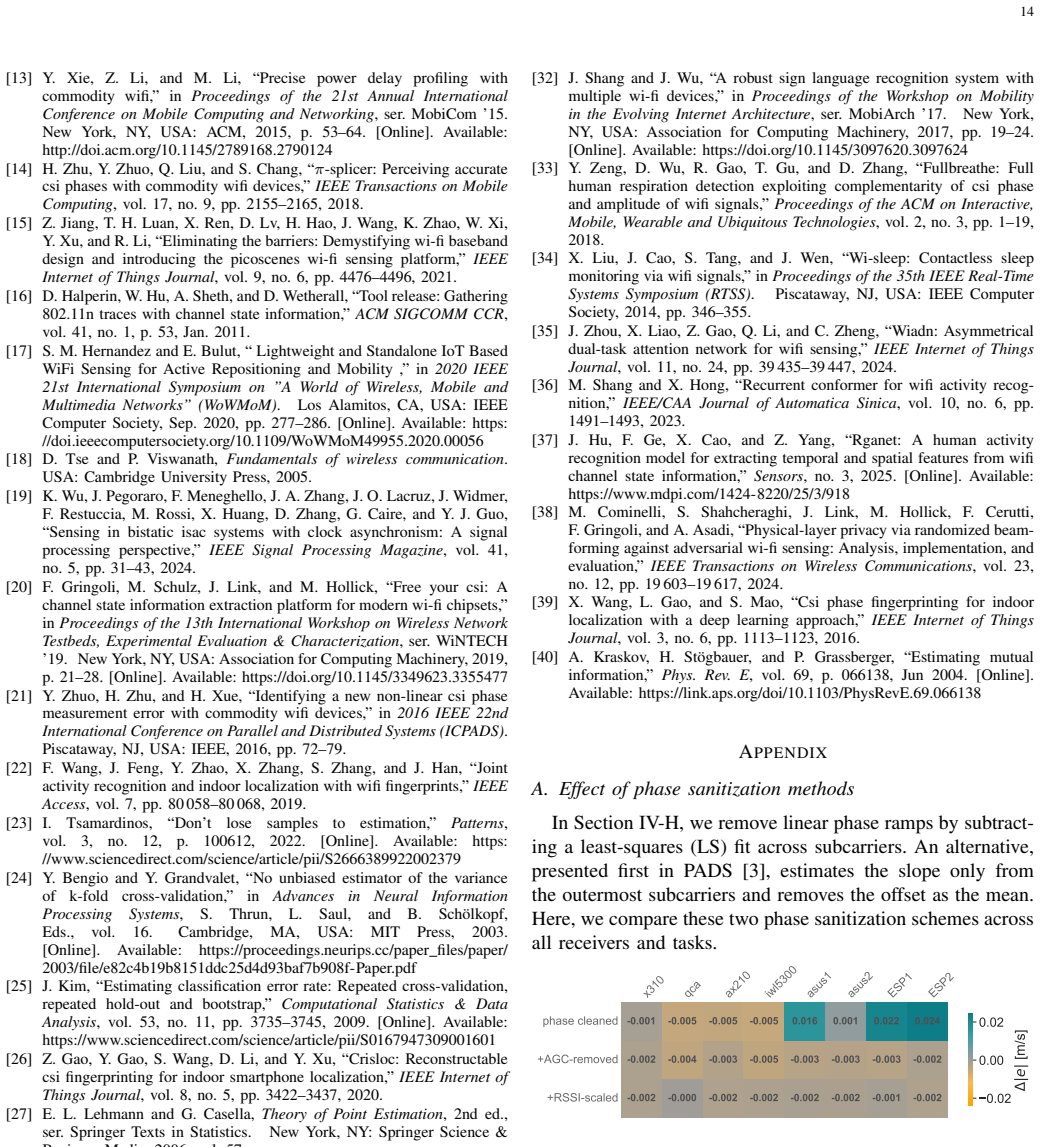
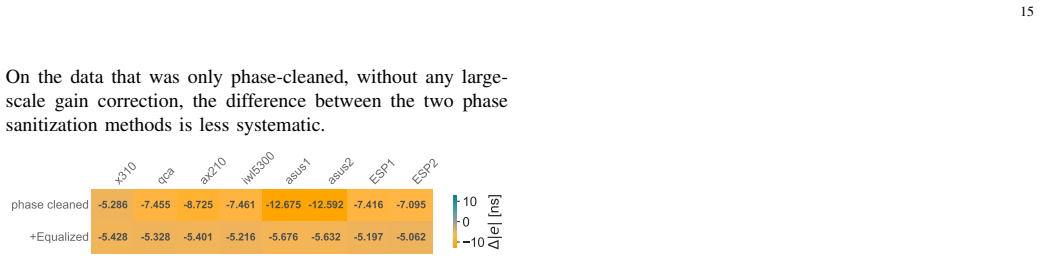
A. Kraskov, H. St ¨ogbauer, and P. Grassberger, “Estimating mutual information,”Phys. Rev. E, vol. 69, p. 066138, Jun 2004. [Online]. Available: https://link.aps.org/doi/10.1103/PhysRevE.69.066138 APPENDIX A. Effect of phase sanitization methods In Section IV-H, we remove linear phase ramps by subtract- ing a least-squares (LS) fit across subcarriers. An ...
discussion (0)
Sign in with ORCID, Apple, or X to comment. Anyone can read and Pith papers without signing in.