On the LEO Satellite Constellation Design for North Atlantic Coverage
Pith reviewed 2026-06-29 15:40 UTC · model grok-4.3
The pith
A Walker Delta constellation of 64 satellites at 1000 km altitude provides continuous coverage above 55°N for minimum elevation angles below 20°.
A machine-rendered reading of the paper's core claim, the machinery that carries it, and where it could break.
Core claim
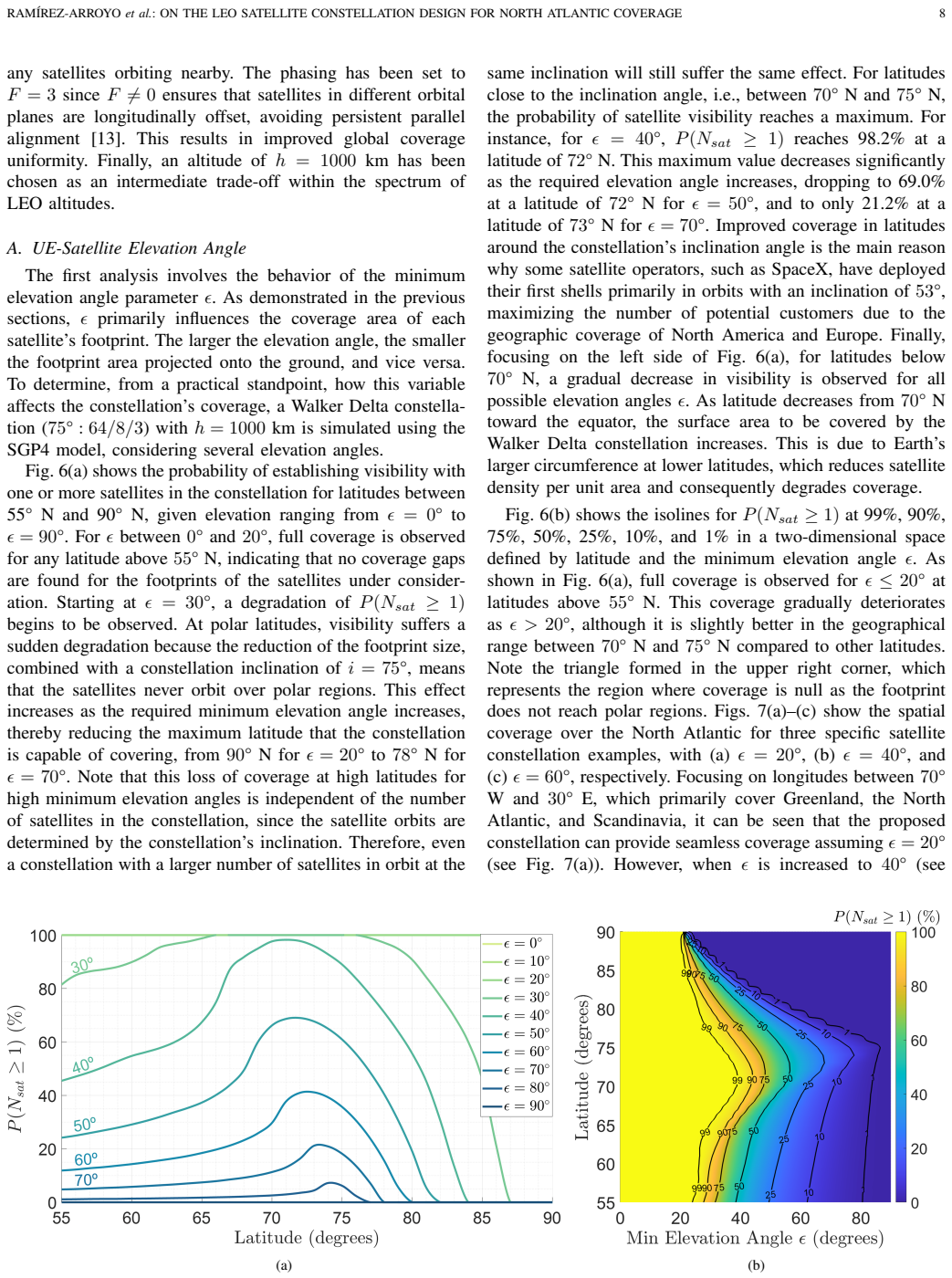
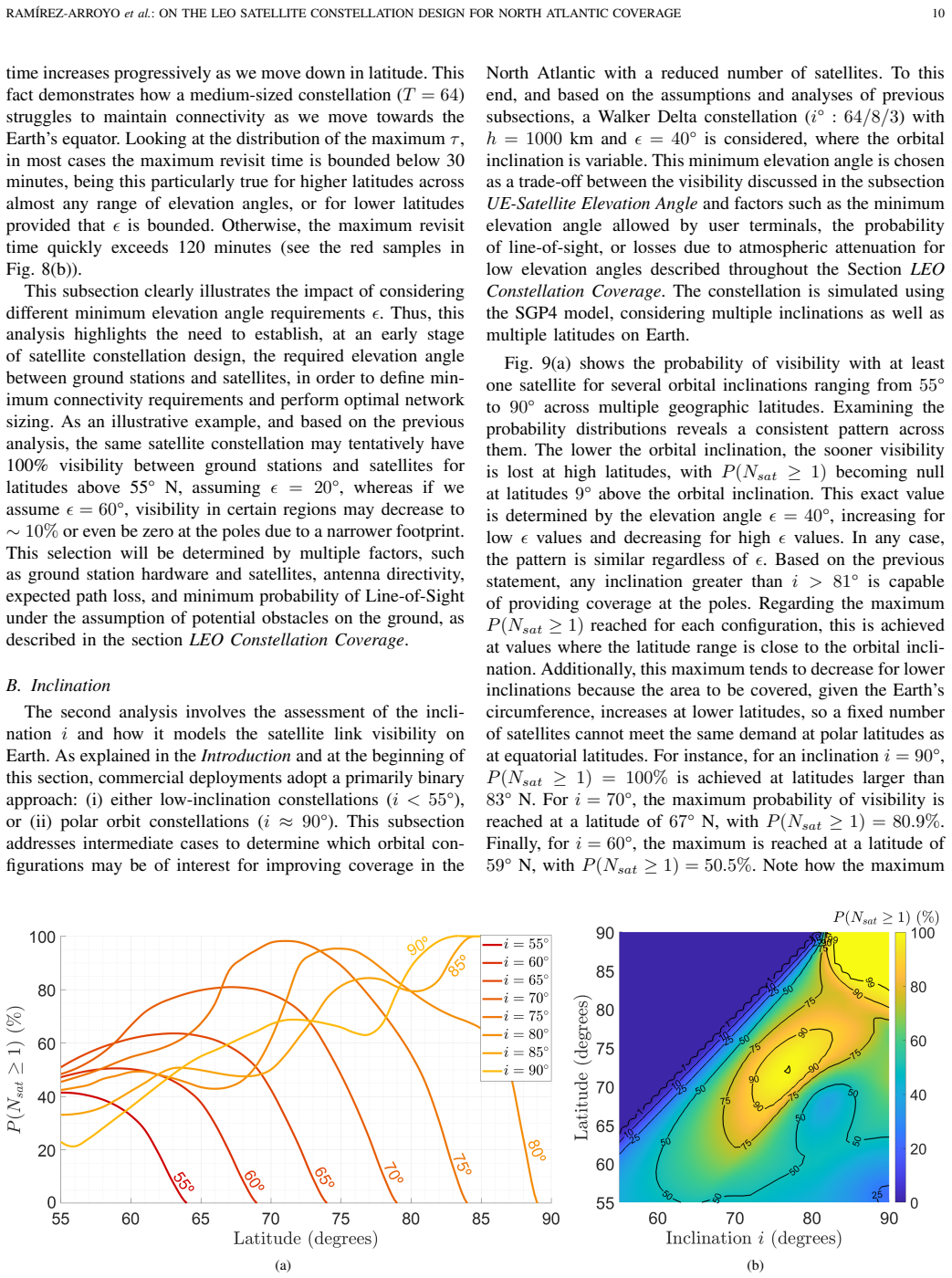
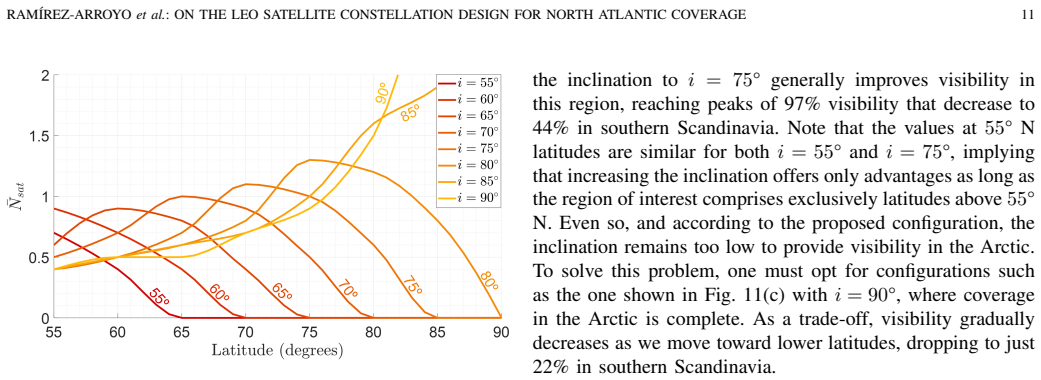
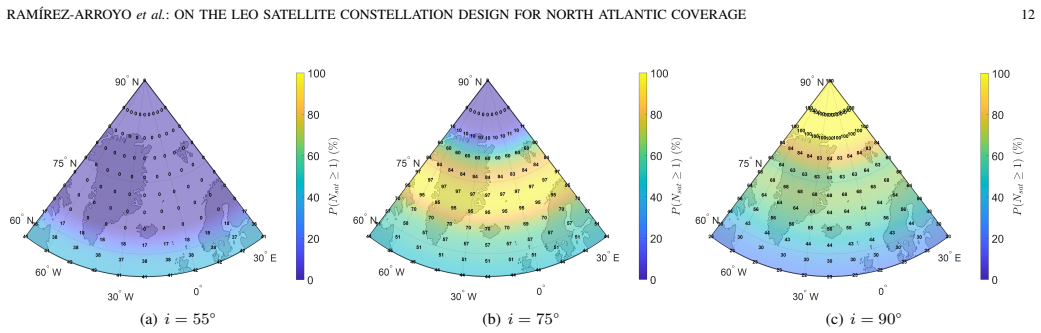
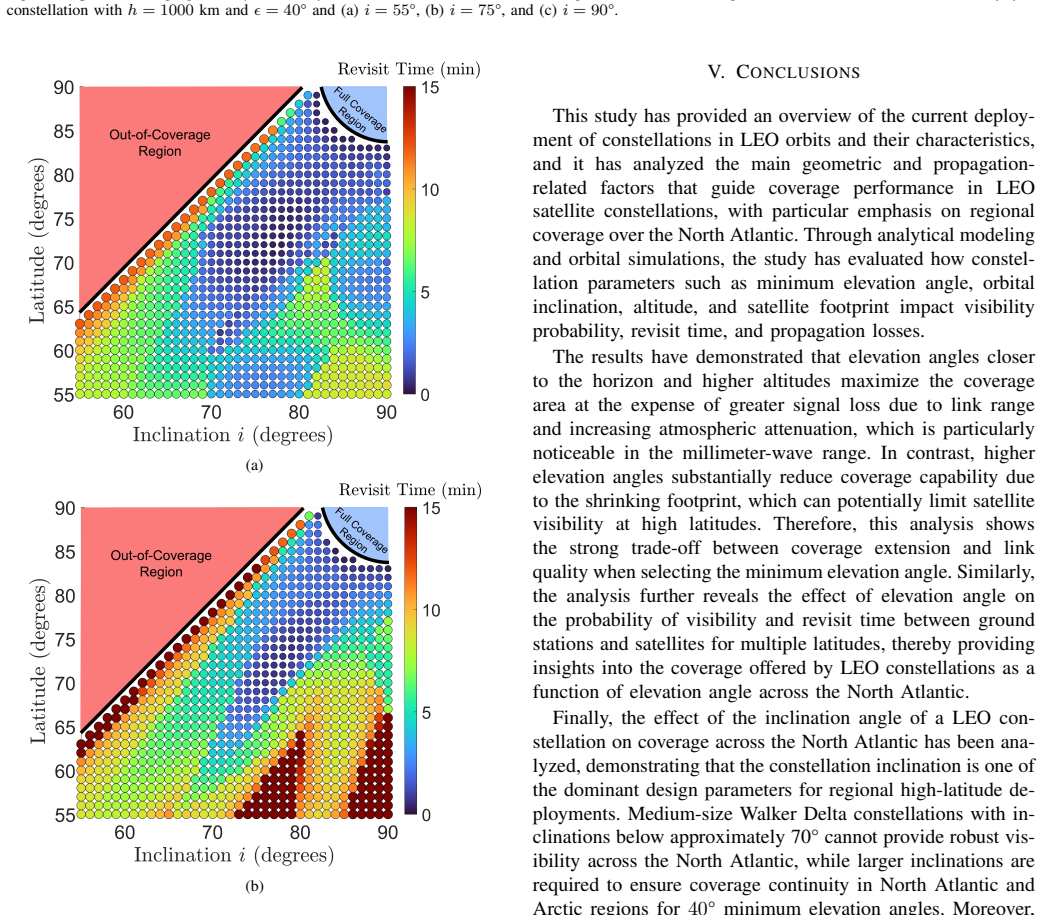
The paper establishes that orbital parameters in a Walker Delta constellation must be tuned specifically for high-latitude regional coverage: a configuration of 64 satellites at 1000 km altitude achieves continuous coverage above 55°N when the minimum elevation angle is kept below 20°, while larger elevation angles cause coverage probability to degrade sharply. Inclinations exceeding approximately 70° are required to maintain robust coverage with constellations of this size. The work derives these relationships by simulating the effects of inclination, altitude, and footprint size on visibility, revisit time, path loss, and continuity over the target area.
What carries the argument
Walker Delta constellation whose inclination, altitude, and satellite count determine visibility probability, revisit time, path loss, and coverage continuity over the North Atlantic.
If this is right
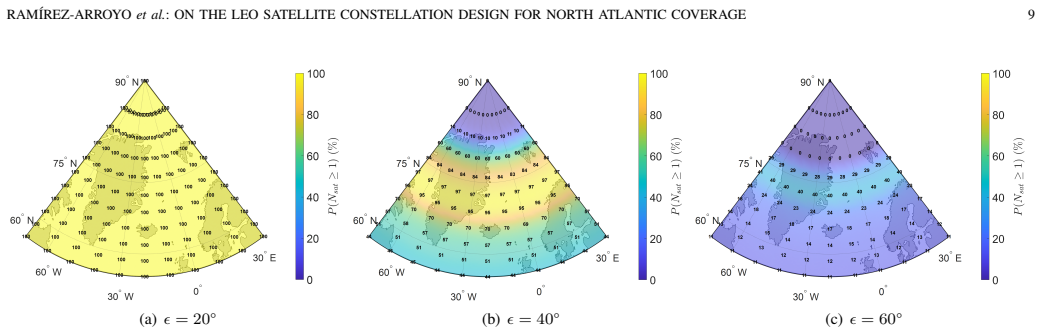
- A 64-satellite constellation at 1000 km provides continuous coverage above 55°N for minimum elevations below 20°.
- Coverage probability degrades drastically for elevation angles larger than 20°.
- Inclinations above 70° are needed for robust North Atlantic coverage with medium-size constellations.
- The results offer practical guidelines for designing constellations targeting maritime, aviation, and Arctic connectivity.
Where Pith is reading between the lines
- These design rules could extend to other high-latitude maritime routes beyond the North Atlantic.
- Adjusting for real-world factors like interference might require larger constellations or different altitudes.
- The emphasis on elevation angle suggests trade-offs with user terminal capabilities in practical deployments.
Load-bearing premise
The simulation models for visibility probability, revisit time, path loss, and coverage continuity accurately capture real propagation and orbital dynamics over the North Atlantic without unmodeled effects such as weather, terrain, or interference.
What would settle it
Field measurements of coverage continuity using a 64-satellite Walker Delta constellation at 1000 km altitude showing gaps above 55°N even at elevation angles below 20°.
Figures
read the original abstract
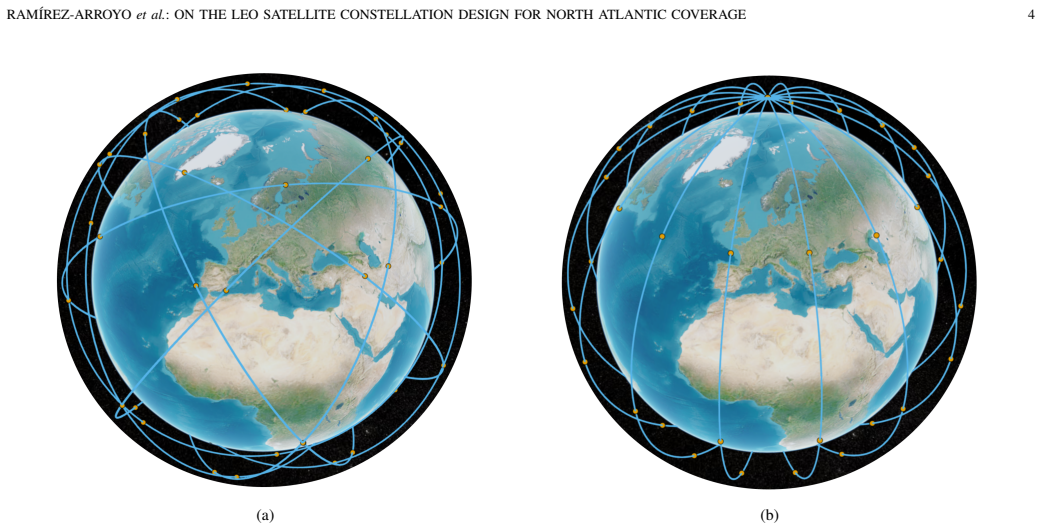
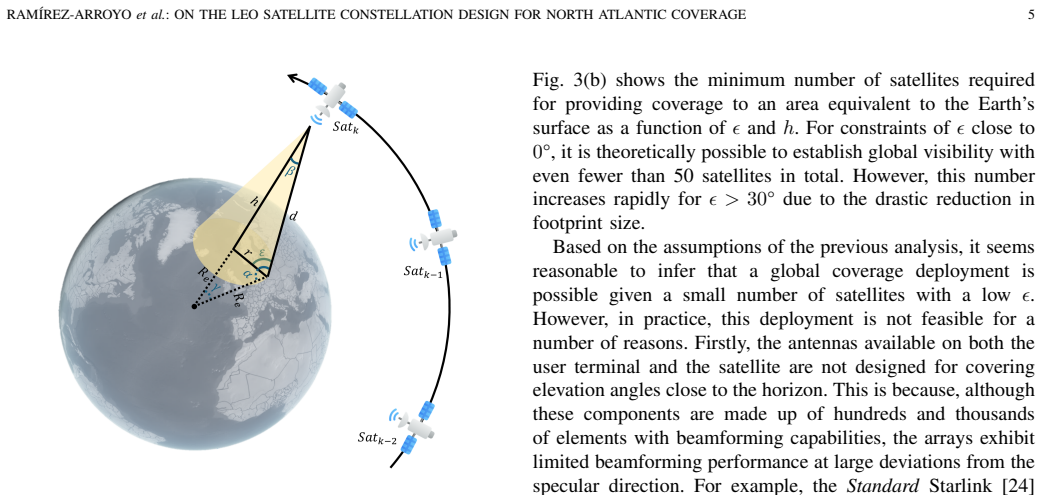
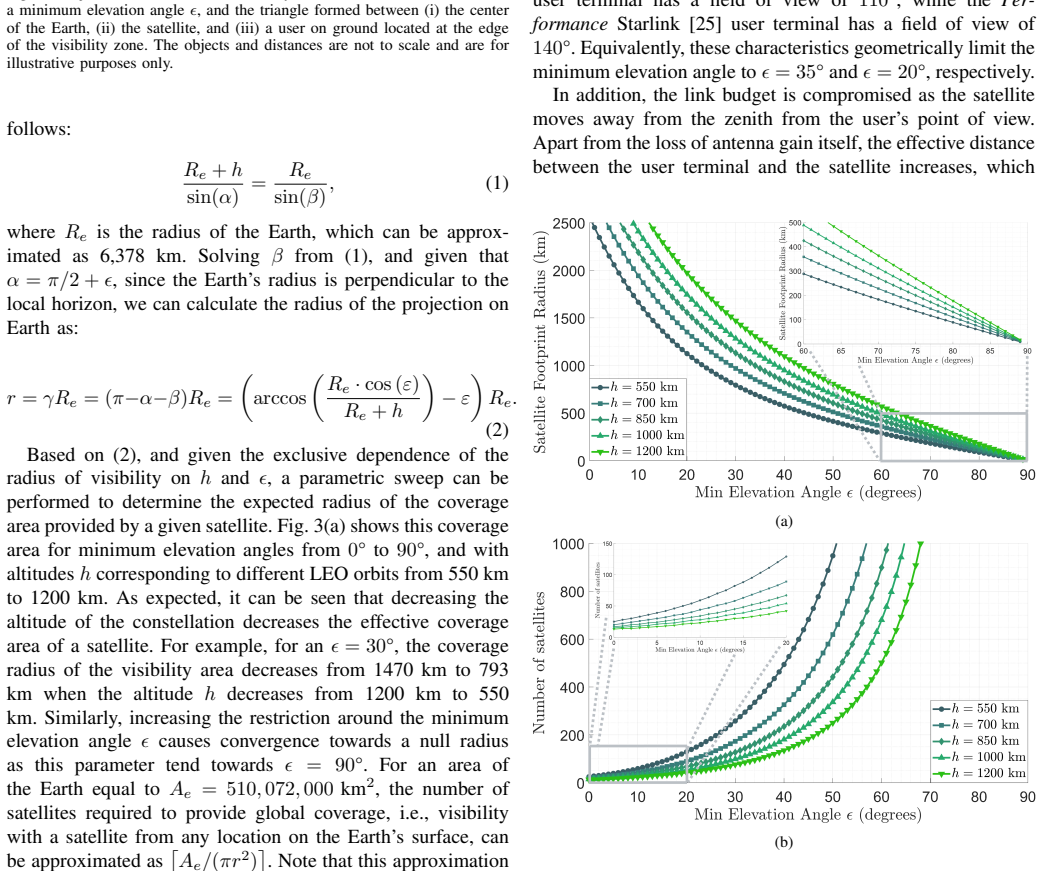
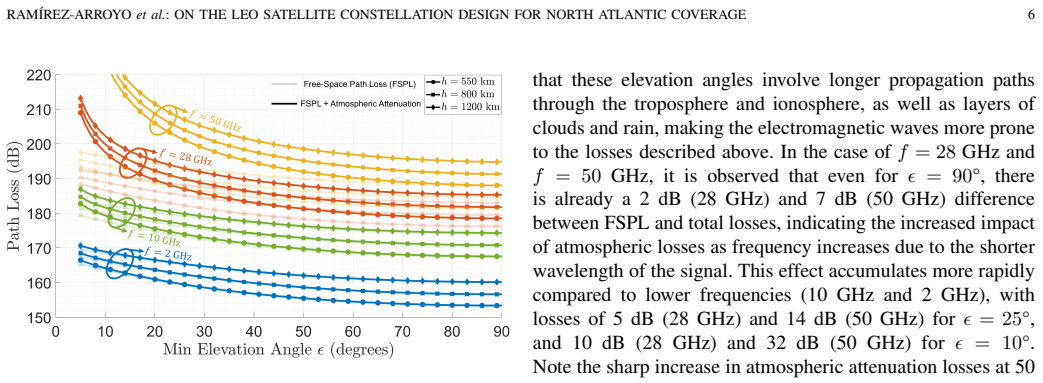
Low Earth Orbit (LEO) satellite constellations are emerging as a key component of non-terrestrial networks due to their low-latency and high-capacity communication capabilities. However, satellites in these orbits are characterized by a small coverage footprint and high orbital velocity compared to those in higher orbits. This results in constantly changing and dynamic constellations that require smart design of orbital parameters to ensure continuous coverage. Existing constellation deployments are typically optimized either for low- and mid-latitude regions or for full polar coverage, leaving high-latitude regional scenarios such as the North Atlantic insufficiently explored. This work provides insights into the key characteristics associated with the deployment of satellites in LEO for North Atlantic coverage. Therefore, we investigate how constellation inclination, minimum elevation angle, altitude, and satellite footprint jointly affect visibility probability, revisit time, path loss, and coverage continuity. Results show that the minimum elevation angle is a critical design parameter since a Walker Delta constellation with 64 satellites at 1000 km altitude can provide continuous coverage above 55{\deg}N for elevations below 20{\deg}, whereas coverage probability degrades drastically for larger elevation angles. Similarly, inclinations above approximately 70{\deg} are required to achieve robust North Atlantic coverage with medium-size constellations. Thus, these results provide practical guidelines on how a satellite constellation should be designed to achieve an efficient deployment with a focus on coverage over the North Atlantic, targeting maritime, aviation, and Arctic connectivity scenarios.
Editorial analysis
A structured set of objections, weighed in public.
Referee Report
Summary. The manuscript examines LEO satellite constellation design for North Atlantic coverage, analyzing the effects of inclination, minimum elevation angle, altitude, and satellite footprint on visibility probability, revisit time, path loss, and coverage continuity through simulations. Key findings indicate that a Walker Delta constellation with 64 satellites at 1000 km altitude achieves continuous coverage above 55°N for elevation angles below 20°, with significant degradation at higher angles, and that inclinations exceeding approximately 70° are necessary for robust coverage using medium-sized constellations.
Significance. If the simulation results are validated, this work supplies practical guidelines for LEO constellation parameters targeting high-latitude maritime and Arctic scenarios, addressing a gap relative to existing low/mid-latitude or full-polar designs.
major comments (2)
- [Simulation methodology] Simulation methodology (implicit in results presentation): visibility probability, revisit time, path loss, and coverage continuity are obtained from forward orbital-geometry simulations, yet the manuscript supplies no validation against independent propagators, no explicit perturbation model (J2, drag, third-body), and no sensitivity study to North-Atlantic factors such as sea-surface multipath or ionospheric scintillation. These omissions are load-bearing for the reported 20° elevation and 70° inclination thresholds.
- [Results] Results section: the claim that a 64-satellite Walker Delta at 1000 km yields continuous coverage above 55°N for elevations <20° is stated without the number of Monte-Carlo realizations, sampling strategy, or convergence diagnostics, preventing assessment of whether the continuity result is statistically robust or sensitive to small changes in the visibility model.
minor comments (2)
- [Abstract] Abstract and results: the phrase 'elevations below 20°' should be clarified as 'minimum elevation angle' and consistently distinguished from the elevation threshold used in the visibility criterion.
- [Methods] Notation: 'satellite footprint' is used without an explicit formula or reference to the Earth-central-angle calculation; add the governing expression.
Simulated Author's Rebuttal
We thank the referee for the constructive comments on our manuscript. We address each major comment below with clarifications on our simulation approach and agree to incorporate additional details in the revised version to improve transparency.
read point-by-point responses
-
Referee: [Simulation methodology] Simulation methodology (implicit in results presentation): visibility probability, revisit time, path loss, and coverage continuity are obtained from forward orbital-geometry simulations, yet the manuscript supplies no validation against independent propagators, no explicit perturbation model (J2, drag, third-body), and no sensitivity study to North-Atlantic factors such as sea-surface multipath or ionospheric scintillation. These omissions are load-bearing for the reported 20° elevation and 70° inclination thresholds.
Authors: Our work focuses on geometric coverage analysis using standard two-body Keplerian orbital models, which is a standard first-order approach for constellation design studies. We agree that the assumptions should be stated explicitly. In the revision we will add a dedicated subsection on the simulation methodology that describes the orbital model, notes the absence of perturbations and environmental effects such as multipath or scintillation, and discusses the implications for the reported thresholds. This will clarify that the results provide initial design guidelines rather than high-fidelity operational predictions. revision: yes
-
Referee: [Results] Results section: the claim that a 64-satellite Walker Delta at 1000 km yields continuous coverage above 55°N for elevations <20° is stated without the number of Monte-Carlo realizations, sampling strategy, or convergence diagnostics, preventing assessment of whether the continuity result is statistically robust or sensitive to small changes in the visibility model.
Authors: The reported continuity results are obtained from deterministic forward simulations of the fixed Walker Delta constellation geometry over multiple orbital periods. Because the configuration is periodic and the model contains no stochastic elements, Monte-Carlo sampling over random initial conditions is not required; the coverage outcome is deterministic for the chosen parameters. We will revise the results section to specify the simulation duration, time sampling interval, and orbital period coverage to allow readers to evaluate the robustness of the continuity claim under the stated model. revision: yes
Circularity Check
No circularity; forward simulation of orbital geometry
full rationale
The paper computes coverage metrics (visibility probability, revisit time, path loss, coverage continuity) via direct simulation sweeps over constellation parameters (inclination, altitude, elevation angle, number of satellites) using standard orbital geometry. No equations fit parameters to a data subset and then rename the output as a prediction; no self-definitional relations where X is defined in terms of Y; no load-bearing self-citations or uniqueness theorems imported from prior author work. The central claims are outputs of the simulation model itself and remain independent of the reported results.
Axiom & Free-Parameter Ledger
free parameters (4)
- constellation size =
64
- altitude =
1000 km
- inclination threshold =
70 deg
- elevation threshold =
20 deg
axioms (1)
- standard math Standard Keplerian orbital mechanics and spherical-Earth coverage geometry govern visibility and revisit statistics
Reference graph
Works this paper leans on
-
[1]
Non-Terrestrial Networks for 6G: Integrated, Intelligent, and Ubiquitous Connectivity,
M. A. Jamshed, A. Kaushik, M. Dajer, A. Guidotti, F. Parzysz, E. La- gunas, M. Di Renzo, S. Chatzinotas, and O. A. Dobre, “Non-Terrestrial Networks for 6G: Integrated, Intelligent, and Ubiquitous Connectivity,” IEEE Communications Standards Magazine, vol. 9, no. 3, pp. 86–93, 2025
2025
-
[2]
Toward 6G Non-Terrestrial Networks,
G. Araniti, A. Iera, S. Pizzi, and F. Rinaldi, “Toward 6G Non-Terrestrial Networks,”IEEE Network, vol. 36, no. 1, pp. 113–120, 2022
2022
-
[3]
Modeling and Analysis of GEO Satellite Networks,
D.-H. Jung, H. Nam, J. Choi, and D. J. Love, “Modeling and Analysis of GEO Satellite Networks,”IEEE Transactions on Wireless Communi- cations, vol. 23, no. 11, pp. 16 757–16 770, 2024
2024
-
[4]
Broadband LEO Satellite Communications: Architectures and Key Technologies,
Y . Su, Y . Liu, Y . Zhou, J. Yuan, H. Cao, and J. Shi, “Broadband LEO Satellite Communications: Architectures and Key Technologies,”IEEE Wireless Communications, vol. 26, no. 2, pp. 55–61, 2019
2019
-
[5]
Leyva-Mayorga, B
I. Leyva-Mayorga, B. Soret, B. Matthiesen, M. Röper, D. Wübben, A. Dekorsy, and P. Popovski,Non-geostationary orbit constellation design for global connectivity. IET - Institution of Engineering and Technology, 2024, pp. 237–267
2024
-
[6]
LEO Small-Satellite Constellations for 5G and Beyond-5G Communications,
I. Leyva-Mayorga, B. Soret, M. Röper, D. Wübben, B. Matthiesen, A. Dekorsy, and P. Popovski, “LEO Small-Satellite Constellations for 5G and Beyond-5G Communications,”IEEE Access, vol. 8, pp. 184 955– 184 964, 2020
2020
-
[7]
Evolution of Non-Terrestrial Networks From 5G to 6G: A Survey,
M. M. Azari, S. Solanki, S. Chatzinotas, O. Kodheli, H. Sallouha, A. Colpaert, J. F. Mendoza Montoya, S. Pollin, A. Haqiqatnejad, A. Mostaani, E. Lagunas, and B. Ottersten, “Evolution of Non-Terrestrial Networks From 5G to 6G: A Survey,”IEEE Communications Surveys & Tutorials, vol. 24, no. 4, pp. 2633–2672, 2022
2022
-
[8]
An Updated Comparison of Four Low Earth Orbit Satellite Constellation Systems to Provide Global Broadband,
N. Pachler, I. del Portillo, E. F. Crawley, and B. G. Cameron, “An Updated Comparison of Four Low Earth Orbit Satellite Constellation Systems to Provide Global Broadband,” in2021 IEEE International Conference on Communications Workshops (ICC Workshops), 2021, pp. 1–7
2021
-
[9]
Modeling Uplink Coverage Perfor- mance in Hybrid Satellite-Terrestrial Networks,
B. A. Homssi and A. Al-Hourani, “Modeling Uplink Coverage Perfor- mance in Hybrid Satellite-Terrestrial Networks,”IEEE Communications Letters, vol. 25, no. 10, pp. 3239–3243, 2021
2021
-
[10]
Optimal Beamwidth and Altitude for Maximal Uplink Coverage in Satellite Networks,
B. Al Homssi and A. Al-Hourani, “Optimal Beamwidth and Altitude for Maximal Uplink Coverage in Satellite Networks,”IEEE Wireless Communications Letters, vol. 11, no. 4, pp. 771–775, 2022
2022
-
[11]
On Modeling Satellite-to-Ground Path- Loss in Urban Environments,
A. Al-Hourani and I. Guvenc, “On Modeling Satellite-to-Ground Path- Loss in Urban Environments,”IEEE Communications Letters, vol. 25, no. 3, pp. 696–700, 2021
2021
-
[12]
An Analytic Approach for Modeling the Coverage Per- formance of Dense Satellite Networks,
A. Al-Hourani, “An Analytic Approach for Modeling the Coverage Per- formance of Dense Satellite Networks,”IEEE Wireless Communications Letters, vol. 10, no. 4, pp. 897–901, 2021
2021
-
[13]
Phasing Parame- ter Analysis for Satellite Collision Avoidance in Starlink and Kuiper Constellations,
J. Liang, A. U. Chaudhry, and H. Yanikomeroglu, “Phasing Parame- ter Analysis for Satellite Collision Avoidance in Starlink and Kuiper Constellations,” in2021 IEEE 4th 5G World F orum (5GWF), 2021, pp. 493–498
2021
-
[14]
Impact of El- evation Angle on Multi-Beam LEO Satellite Communication Systems,
A. Fastenbauer, M. Kaneko, P. Svoboda, and M. Rupp, “Impact of El- evation Angle on Multi-Beam LEO Satellite Communication Systems,” IEEE Access, vol. 13, pp. 71 723–71 737, 2025
2025
-
[15]
Communication Constellation Design of Mini- mum Number of Satellites with Continuous Coverage and Inter-Satellite Link,
S. Jeon and S.-Y . Park, “Communication Constellation Design of Mini- mum Number of Satellites with Continuous Coverage and Inter-Satellite Link,” 2024
2024
-
[16]
On Delay Performance in Mega Satellite Networks with Inter-Satellite Links,
K. Dakic, C. C. Chan, B. A. Homssi, K. Sithamparanathan, and A. Al-Hourani, “On Delay Performance in Mega Satellite Networks with Inter-Satellite Links,” inGLOBECOM 2023 - 2023 IEEE Global Communications Conference, 2023, pp. 4896–4901
2023
-
[17]
Space Bureau Partially Grants SpaceX’s Applications to Add Frequencies and Additional Satellites to Upgrade the SpaceX Gen2 Starlink Constellation,
Federal Communications Commission, “Space Bureau Partially Grants SpaceX’s Applications to Add Frequencies and Additional Satellites to Upgrade the SpaceX Gen2 Starlink Constellation,” Federal Communi- cations Commission, Tech. Rep. DA 26-36, 2026
2026
-
[18]
WorldVu Satellites Limited Petition for Declaratory Ruling to Modify the U.S Market Access Grant for the OneWeb Ku-band and Ka-Band NGSO FSS System,
——, “WorldVu Satellites Limited Petition for Declaratory Ruling to Modify the U.S Market Access Grant for the OneWeb Ku-band and Ka-Band NGSO FSS System,” Federal Communications Commission, Tech. Rep. DA 22-970, 2022
2022
-
[19]
Iridium Constellation LLC Application for Modification of License to Authorize a Second-Generation NGSO MSS Constellation,
——, “Iridium Constellation LLC Application for Modification of License to Authorize a Second-Generation NGSO MSS Constellation,” Federal Communications Commission, Tech. Rep. DA 16-875, 2016
2016
-
[20]
Globalstar Licensee LLC Application for Modification of Non- Geostationary Mobile Satellite Service System Authorization,
——, “Globalstar Licensee LLC Application for Modification of Non- Geostationary Mobile Satellite Service System Authorization,” Federal Communications Commission, Tech. Rep. DA 24-825, 2024
2024
-
[21]
Kuiper Systems, LLC Application for Authority to Deploy and Operate a Ka-band Non-Geostationary Satellite Orbit System,
——, “Kuiper Systems, LLC Application for Authority to Deploy and Operate a Ka-band Non-Geostationary Satellite Orbit System,” Federal Communications Commission, Tech. Rep. FCC 20-102, 2020
2020
-
[22]
Reg- ulation (EU) 2023/588 Establishing the Union Secure Connectivity Programme for the Period 2023–2027,
European Parliament and the Council of the European Union, “Reg- ulation (EU) 2023/588 Establishing the Union Secure Connectivity Programme for the Period 2023–2027,” Official Journal of the European Union, Tech. Rep. Regulation (EU) 2023/588, 2023
2023
-
[23]
EUSPA Secure SATCOM: Market and User Technology Report,
European Union Agency for the Space Programme, “EUSPA Secure SATCOM: Market and User Technology Report,” European Union, Tech. Rep., 2023
2023
-
[24]
Starlink Standard Specifications,
SpaceX, “Starlink Standard Specifications,” https://starlink.com/ public-files/specification_sheet_standard.pdf, 2026, accessed: 2026-03- 11
2026
-
[25]
Starlink Performance Specifications,
——, “Starlink Performance Specifications,” https://starlink.com/ public-files/specification_sheet_performance.pdf, 2026, accessed: 2026- 03-11
2026
-
[26]
Implementation of a Channel Model for Non-Terrestrial Networks in ns-3,
M. Sandri, M. Pagin, M. Giordani, and M. Zorzi, “Implementation of a Channel Model for Non-Terrestrial Networks in ns-3,” inProceedings of the 2023 Workshop on Ns-3, ser. WNS3 ’23, New York, NY , USA, 2023, p. 28–34. [Online]. Available: https://doi.org/10.1145/3592149.3592158
-
[27]
A Note on a Simple Transmission Formula,
H. Friis, “A Note on a Simple Transmission Formula,”Proceedings of the IRE, vol. 34, no. 5, pp. 254–256, 1946
1946
-
[28]
Recommendation ITU-R P.618: Propagation data and prediction methods required for the design of Earth-space telecommunication systems,
International Telecommunication Union, “Recommendation ITU-R P.618: Propagation data and prediction methods required for the design of Earth-space telecommunication systems,” International Telecommu- nication Union, Recommendation ITU-R P.618, 2023
2023
-
[29]
Recommendation ITU-R P.676: Attenuation by atmospheric gases and related effects,
——, “Recommendation ITU-R P.676: Attenuation by atmospheric gases and related effects,” International Telecommunication Union, Recommendation ITU-R P.676, 2022
2022
-
[30]
Recommendation ITU-R P.834: Effects of tropospheric refraction on radiowave propagation,
——, “Recommendation ITU-R P.834: Effects of tropospheric refraction on radiowave propagation,” International Telecommunication Union, Recommendation ITU-R P.834, 2017
2017
-
[31]
Recommendation ITU-R P.531: Ionospheric propagation data and prediction methods required for the design of satellite networks and sys- tems,
——, “Recommendation ITU-R P.531: Ionospheric propagation data and prediction methods required for the design of satellite networks and sys- tems,” International Telecommunication Union, Recommendation ITU-R P.531, 2025
2025
-
[32]
Recommendation ITU-R P.836: Water vapour; surface density and total columnar content,
——, “Recommendation ITU-R P.836: Water vapour; surface density and total columnar content,” International Telecommunication Union, Recommendation ITU-R P.836, 2017
2017
-
[33]
Recommendation ITU-R P.837: Characteristics of precipitation for propagation modelling,
——, “Recommendation ITU-R P.837: Characteristics of precipitation for propagation modelling,” International Telecommunication Union, Recommendation ITU-R P.837, 2025
2025
-
[34]
Recommendation ITU-R P.840: Attenuation due to clouds and fog,
——, “Recommendation ITU-R P.840: Attenuation due to clouds and fog,” International Telecommunication Union, Recommendation ITU-R P.840, 2023
2023
-
[35]
Request for Deployment and Operating Authority for the SpaceX Gen2 NGSO Satellite System,
Federal Communications Commission, “Request for Deployment and Operating Authority for the SpaceX Gen2 NGSO Satellite System,” Federal Communications Commission, Tech. Rep. DA 24-1193, 2024
2024
-
[36]
Study on New Radio (NR) to Support Non-Terrestrial Networks,
3rd Generation Partnership Project (3GPP), “Study on New Radio (NR) to Support Non-Terrestrial Networks,” 3GPP, Technical Report TR 38.811, Jan. 2020, version 15.4.0, Release 15. [Online]. Available: https://www.3gpp.org/ftp/Specs/archive/38_series/38.811/38811-f40.zip
2020
-
[37]
OneWeb Non-Geostationary Satellite System V-Band Component: Phase 1 Modification to Authorized System, Technical Attachment A,
Federal Communications Commission, “OneWeb Non-Geostationary Satellite System V-Band Component: Phase 1 Modification to Authorized System, Technical Attachment A,” Federal Commu- nications Commission, Tech. Rep. SAT-MPL-20211104-00144, 2021. [Online]. Available: https://fcc.report/IBFS/SAT-MPL-20211104-00144/ 13337509.pdf
2021
-
[38]
An overview of the IRIDIUM (R) low Earth orbit (LEO) satellite system,
C. Fossa, R. Raines, G. Gunsch, and M. Temple, “An overview of the IRIDIUM (R) low Earth orbit (LEO) satellite system,” inProceedings of the IEEE 1998 National Aerospace and Electronics Conference. NAECON 1998. Celebrating 50 Years (Cat. No.98CH36185), 1998, pp. 152–159
1998
discussion (0)
Sign in with ORCID, Apple, or X to comment. Anyone can read and Pith papers without signing in.