Acoustic radiation force on a liquid particle in a standing surface acoustic wave field
Pith reviewed 2026-07-01 16:27 UTC · model grok-4.3
The pith
A theory calculates the acoustic radiation force on liquid particles in standing surface acoustic wave fields at any frequency.
A machine-rendered reading of the paper's core claim, the machinery that carries it, and where it could break.
Core claim
We develop a theory for the acoustic radiation force on a liquid particle in a 2D standing-wave field beyond the Rayleigh limit. The theory is valid for any frequency, includes the traveling-wave components due to the Rayleigh angle, and is thus applicable to a large class of surface acoustic wave applications. The analytical results are validated with respect to finite-element models. Using our analytical solution, we determine the parameter space for which Rayleigh-limit methods remain applicable. We propose a general form for the acoustophoretic contrast factor applicable to any wavelength of 1D standing-wave field. We show that the Rayleigh-angle effect can substantially weaken the acous
What carries the argument
Analytical expression for acoustic radiation force derived from the 2D standing-wave field model that includes Rayleigh-angle traveling-wave components.
If this is right
- The range of particle sizes, densities, and positions where the Gor'kov framework remains accurate depends on the Rayleigh angle.
- A single general expression for the acoustophoretic contrast factor works for standing-wave fields of any wavelength.
- Rayleigh-angle traveling components can reduce the net force by a substantial fraction compared with pure standing-wave assumptions.
- The acoustic force landscape undergoes a frequency-driven topological change that relocates stable particle positions.
Where Pith is reading between the lines
- Device designers could use the extended contrast factor to predict trapping locations without switching between different models at different frequencies.
- The same modeling steps might be applied to particles in other surface-wave geometries once the appropriate angle and boundary conditions are inserted.
- Adding viscous boundary layers on top of this inviscid theory would test how much the predicted force reduction persists in real liquids.
Load-bearing premise
The 2D standing-wave field model plus Rayleigh-angle traveling components fully captures the force without additional viscous or thermal losses that would need separate treatment.
What would settle it
Direct measurement of the force magnitude or equilibrium positions for a liquid particle at a wavelength comparable to its size that deviates from the analytical prediction while matching finite-element results.
Figures
read the original abstract
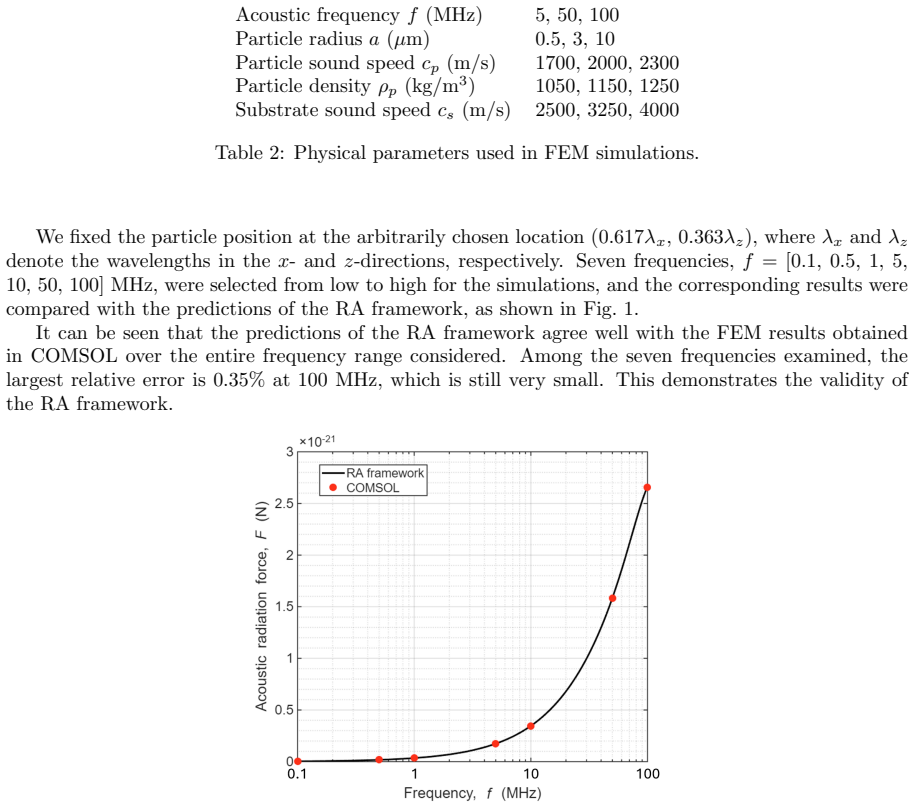
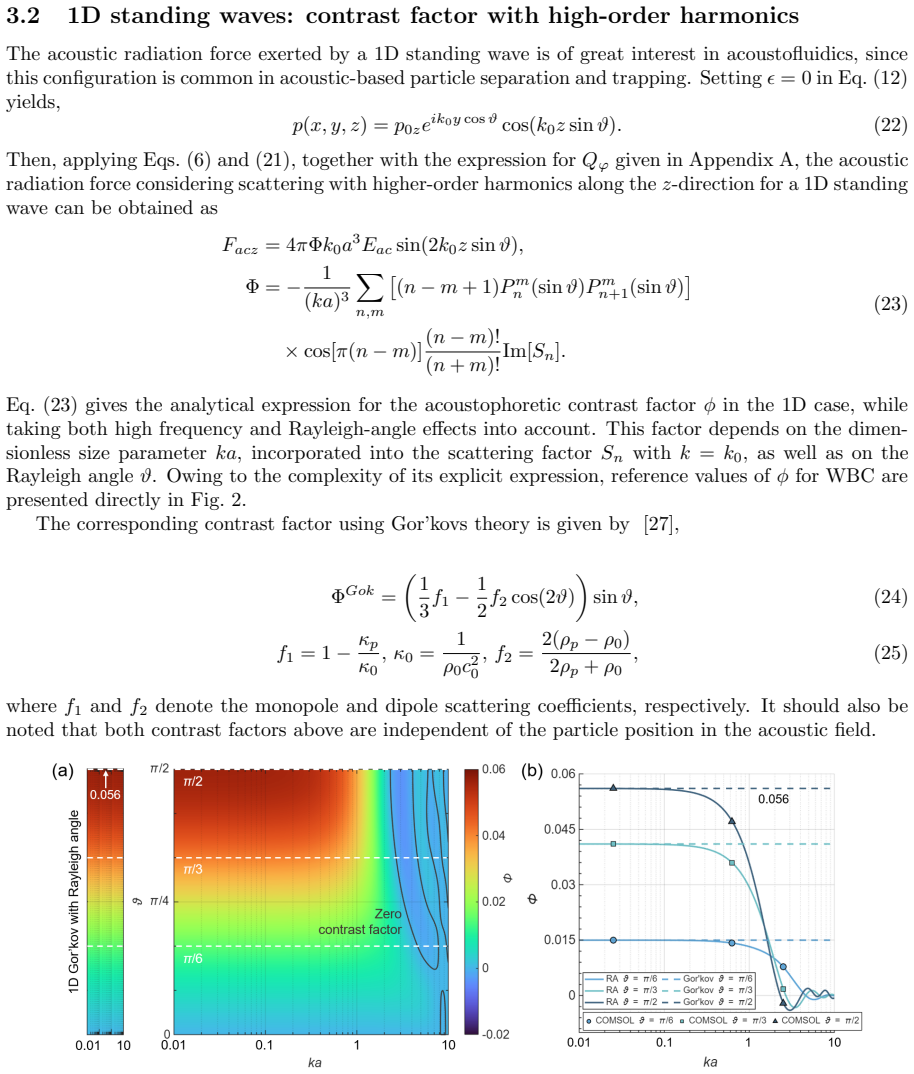
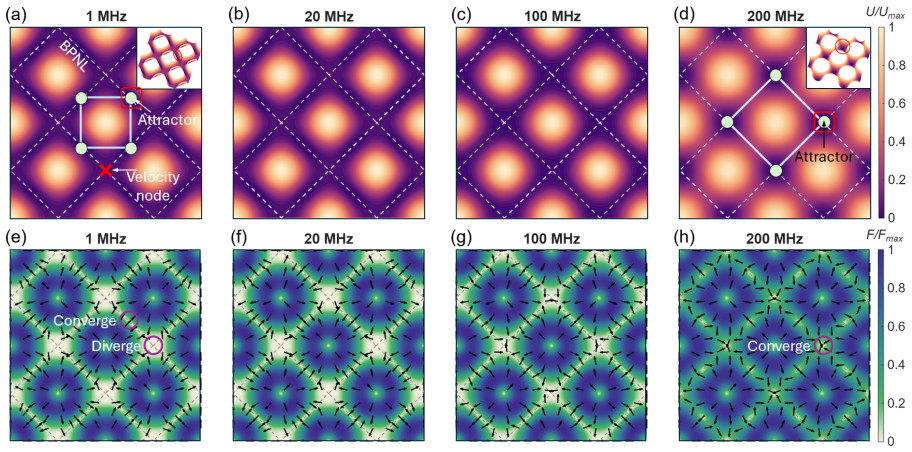
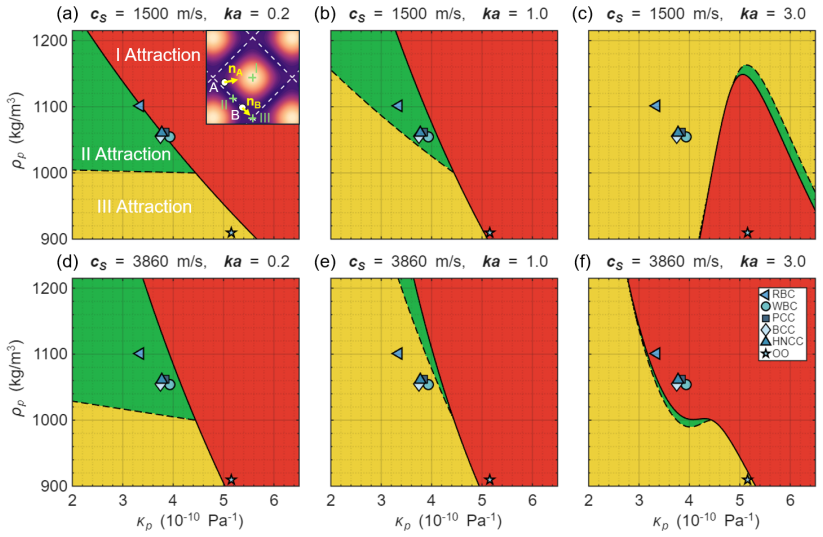
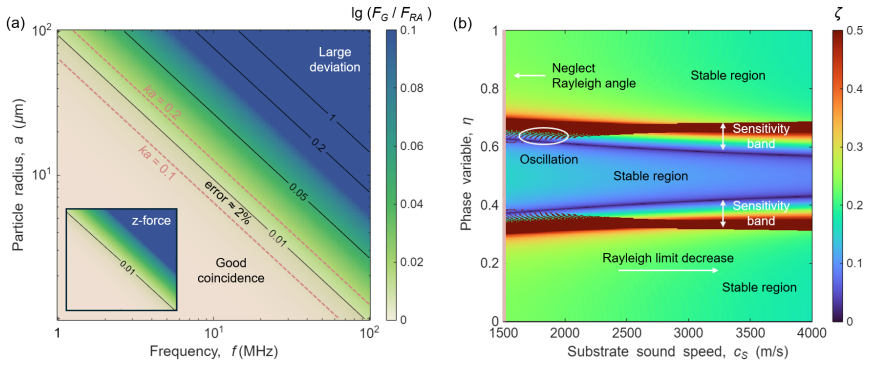
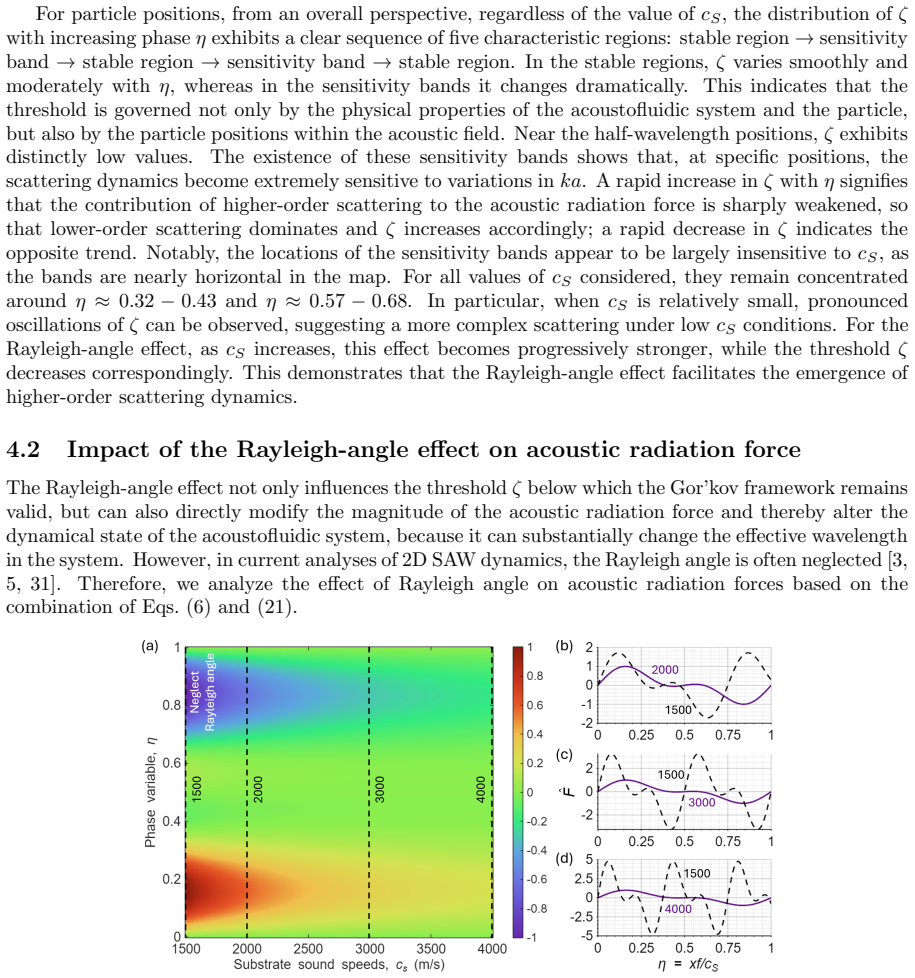
We develop a theory for the acoustic radiation force on a liquid particle in a 2D standing-wave field beyond the Rayleigh limit. The theory is valid for any frequency, includes the traveling-wave components due to the Rayleigh angle, and is thus applicable to a large class of surface acoustic wave applications. The analytical results are validated with respect to finite-element models. Using our analytical solution, we determine the parameter space for which Rayleigh-limit methods, such as the Gor'kov framework, remain applicable. This range is shown to depend on the particle properties, the Rayleigh angle, and even the particle position in the acoustic field. We propose a general form for the acoustophoretic contrast factor applicable to any wavelength of 1D standing-wave field, broadening the applicability of the classical Gor'kov framework. We show that the Rayleigh-angle effect can substantially weaken the acoustic radiation force, an effect that has been largely overlooked. We also confirm a frequency-dependent topological transition of the acoustic landscape that induces a switching of the field attractors and particle equilibrium points. These results advance the quantitative theory of acoustic forces, unveil previously unresolved dynamical features of acoustofluidic fields, and provide a theoretical foundation for SAW-based cell trapping, separation, and enrichment in acoustofluidics.
Editorial analysis
A structured set of objections, weighed in public.
Referee Report
Summary. The manuscript develops an analytical theory for the acoustic radiation force on a liquid particle in a 2D standing surface acoustic wave (SAW) field that extends beyond the Rayleigh limit to arbitrary frequencies. The derivation incorporates traveling-wave components arising from the Rayleigh angle. Analytical results are validated against finite-element simulations, the parameter space where Rayleigh-limit approximations (e.g., Gor'kov) remain valid is mapped (depending on particle properties, Rayleigh angle, and position), a generalized acoustophoretic contrast factor for 1D standing waves of arbitrary wavelength is proposed, the weakening of force due to Rayleigh-angle effects is quantified, and frequency-dependent topological transitions that switch field attractors and equilibrium points are identified. The work targets improved modeling for SAW-based cell trapping, separation, and enrichment.
Significance. If the central analytical results and their domain of applicability hold, the manuscript would constitute a useful extension of quantitative theory in acoustofluidics. It supplies closed-form expressions usable at shorter wavelengths than the classical Gor'kov framework, maps the practical limits of that framework, and draws attention to the previously under-examined Rayleigh-angle contribution that can substantially reduce force magnitude. The numerical validation and the identification of attractor-switching transitions supply concrete, testable predictions for device design. These elements would strengthen the theoretical foundation for a wide class of SAW applications without requiring new experimental data.
major comments (2)
- [Theory development (opening paragraphs of the model formulation)] Theory development (opening paragraphs of the model formulation): the assertion that the theory is valid for any frequency rests on the premise that an inviscid compressible 2D standing-wave field plus Rayleigh-angle traveling components fully captures the scattered field and resulting force. The subsequent validation is performed exclusively against FEM solutions of the identical inviscid equations; no comparison to viscous Navier-Stokes solutions or to experiment is reported. When the viscous penetration depth becomes comparable to particle radius or wavelength, omitted dissipation alters both the scattered field and the radiation force, directly limiting the "any frequency" claim.
- [Section on FEM validation and parameter-space mapping] Section on FEM validation and parameter-space mapping: because the FEM employs the same inviscid model, the reported agreement constitutes a consistency check rather than an independent test of the analytical expressions. This weakens the evidential support for the claimed domain of validity and for the proposed general contrast factor when viscous or thermal boundary-layer effects are non-negligible.
minor comments (2)
- [Notation for the generalized contrast factor] Notation for the generalized contrast factor: the transition from the classical Gor'kov expression to the new wavelength-dependent form should be shown explicitly in an equation or appendix so that the reduction in the long-wavelength limit is immediate.
- [Figure captions (force-field plots)] Figure captions (force-field plots): units and normalization of the plotted radiation force should be stated explicitly; the current captions leave the scaling ambiguous when comparing different Rayleigh angles.
Simulated Author's Rebuttal
We thank the referee for the constructive comments highlighting the scope of the inviscid approximation and the nature of the numerical validation. We address each major comment below, indicating revisions where appropriate to clarify assumptions and limitations.
read point-by-point responses
-
Referee: [Theory development (opening paragraphs of the model formulation)] Theory development (opening paragraphs of the model formulation): the assertion that the theory is valid for any frequency rests on the premise that an inviscid compressible 2D standing-wave field plus Rayleigh-angle traveling components fully captures the scattered field and resulting force. The subsequent validation is performed exclusively against FEM solutions of the identical inviscid equations; no comparison to viscous Navier-Stokes solutions or to experiment is reported. When the viscous penetration depth becomes comparable to particle radius or wavelength, omitted dissipation alters both the scattered field and the radiation force, directly limiting the "any frequency" claim.
Authors: We agree that the theory is developed strictly within the inviscid compressible 2D fluid model, and the statement of validity 'for any frequency' refers to arbitrary ka (beyond the Rayleigh limit) under this approximation. Viscous and thermal boundary-layer effects are omitted by design, as is standard in many analytical acoustofluidic derivations. We will revise the opening paragraphs of the model formulation and the abstract to explicitly qualify the inviscid assumption and to note the regime where viscous penetration depth becomes comparable to particle size or wavelength, thereby limiting applicability. No viscous simulations are added, as they would require a fundamentally different model. revision: yes
-
Referee: [Section on FEM validation and parameter-space mapping] Section on FEM validation and parameter-space mapping: because the FEM employs the same inviscid model, the reported agreement constitutes a consistency check rather than an independent test of the analytical expressions. This weakens the evidential support for the claimed domain of validity and for the proposed general contrast factor when viscous or thermal boundary-layer effects are non-negligible.
Authors: The referee correctly identifies that the FEM comparison is an internal consistency check within the inviscid equations rather than an independent validation against viscous or thermal effects. We will revise the relevant section to describe the comparison in these terms and to reiterate that the mapped domain of validity for the Rayleigh-limit approximations and the generalized contrast factor apply within the inviscid framework. The analytical expressions remain exact solutions of the inviscid problem, but we acknowledge the evidential limitation for regimes where dissipation matters. revision: yes
- Direct comparison against viscous Navier-Stokes solutions or experimental data, which lies outside the inviscid scope of the present work.
Circularity Check
No significant circularity; derivation self-contained against FEM benchmarks
full rationale
The paper presents an analytical derivation of the radiation force on a liquid particle in a 2D standing SAW field, extending beyond Rayleigh limit by incorporating traveling-wave components from the Rayleigh angle. Central results are obtained from scattering theory applied to the assumed inviscid compressible model and are cross-checked against independent finite-element solutions of the identical governing equations; the FEM serves as an external numerical benchmark rather than a fitted input. The proposed general contrast factor is obtained by direct substitution of the derived force expression into the 1D standing-wave limit, without reduction to any self-citation chain or parameter fit performed on the target data. No load-bearing step equates a claimed prediction to its own defining inputs by construction.
Axiom & Free-Parameter Ledger
axioms (1)
- domain assumption The acoustic field can be modeled as a 2D standing wave that includes traveling-wave components arising from the Rayleigh angle.
Reference graph
Works this paper leans on
-
[1]
Iso-acoustic focus- ing of cells for size-insensitive acousto-mechanical phenotyping.Nature communications, 7(1):11556, 2016
Per Augustsson, Jonas T Karlsen, Hao-Wei Su, Henrik Bruus, and Joel Voldman. Iso-acoustic focus- ing of cells for size-insensitive acousto-mechanical phenotyping.Nature communications, 7(1):11556, 2016
2016
-
[2]
Acoustofluidic particle dynamics: Beyond the rayleigh limit.The Journal of the Acoustical Society of America, 143(1):509–519, 2018
Thierry Baasch and J¨ urg Dual. Acoustofluidic particle dynamics: Beyond the rayleigh limit.The Journal of the Acoustical Society of America, 143(1):509–519, 2018. 16
2018
-
[3]
Acoustic tweezers for particle and fluid micromanipulation
Micha¨ el Baudoin and J-L Thomas. Acoustic tweezers for particle and fluid micromanipulation. Annual Review of Fluid Mechanics, 52(1):205–234, 2020
2020
-
[4]
Acoustofluidics 7: The acoustic radiation force on small particles.Lab on a Chip, 12(6):1014–1021, 2012
Henrik Bruus. Acoustofluidics 7: The acoustic radiation force on small particles.Lab on a Chip, 12(6):1014–1021, 2012
2012
-
[5]
Two-dimensional single-cell patterning with one cell per well driven by surface acoustic waves.Nature communications, 6(1):8686, 2015
David J Collins, Belinda Morahan, Jose Garcia-Bustos, Christian Doerig, Magdalena Plebanski, and Adrian Neild. Two-dimensional single-cell patterning with one cell per well driven by surface acoustic waves.Nature communications, 6(1):8686, 2015
2015
-
[6]
Ultrasound characterization of microbead and cell suspensions by speed of sound measure- ments of neutrally buoyant samples.Analytical chemistry, 89(17):8917–8923, 2017
Kevin W Cushing, Fabio Garofalo, Cecilia Magnusson, Lars Ekblad, Henrik Bruus, and Thomas Laurell. Ultrasound characterization of microbead and cell suspensions by speed of sound measure- ments of neutrally buoyant samples.Analytical chemistry, 89(17):8917–8923, 2017
2017
-
[7]
Zhichao Deng, Vijay V Kondalkar, Christian Cierpka, Hagen Schmidt, and J¨ org K¨ onig. From rect- angular to diamond shape: on the three-dimensional and size-dependent transformation of patterns formed by single particles trapped in microfluidic acoustic tweezers.Lab on a Chip, 23(9):2154–2160, 2023
2023
-
[8]
On-chip manipulation of single microparticles, cells, and organisms using surface acoustic waves.Proceedings of the National Academy of Sciences, 109(28):11105–11109, 2012
Xiaoyun Ding, Sz-Chin Steven Lin, Brian Kiraly, Hongjun Yue, Sixing Li, I-Kao Chiang, Jinjie Shi, Stephen J Benkovic, and Tony Jun Huang. On-chip manipulation of single microparticles, cells, and organisms using surface acoustic waves.Proceedings of the National Academy of Sciences, 109(28):11105–11109, 2012
2012
-
[9]
Cell separation using tilted-angle standing surface acoustic waves.Proceedings of the National Academy of Sciences, 111(36):12992–12997, 2014
Xiaoyun Ding, Zhangli Peng, Sz-Chin Steven Lin, Michela Geri, Sixing Li, Peng Li, Yuchao Chen, Ming Dao, Subra Suresh, and Tony Jun Huang. Cell separation using tilted-angle standing surface acoustic waves.Proceedings of the National Academy of Sciences, 111(36):12992–12997, 2014
2014
-
[10]
Acoustic radiation interparticle forces in a compressible fluid.Journal of Fluid Mechanics, 444:1–21, 2001
Alexander A Doinikov. Acoustic radiation interparticle forces in a compressible fluid.Journal of Fluid Mechanics, 444:1–21, 2001
2001
-
[11]
Dynamic simulation of hydrodynamically interacting particles.Journal of fluid mechanics, 180:21–49, 1987
Louis Durlofsky, John F Brady, and Georges Bossis. Dynamic simulation of hydrodynamically interacting particles.Journal of fluid mechanics, 180:21–49, 1987
1987
-
[12]
On the forces acting on a small particle in an acoustical field in an ideal fluid
Lev Petrovich Gor’kov. On the forces acting on a small particle in an acoustical field in an ideal fluid. 6:773–775, 1962
1962
-
[13]
Controlling cell–cell interactions using surface acoustic waves.Proceedings of the National Academy of Sciences, 112(1):43–48, 2015
Feng Guo, Peng Li, Jarrod B French, Zhangming Mao, Hong Zhao, Sixing Li, Nitesh Nama, James R Fick, Stephen J Benkovic, and Tony Jun Huang. Controlling cell–cell interactions using surface acoustic waves.Proceedings of the National Academy of Sciences, 112(1):43–48, 2015
2015
-
[14]
Three-dimensional manipulation of single cells using surface acoustic waves.Proceedings of the National Academy of Sciences, 113(6):1522–1527, 2016
Feng Guo, Zhangming Mao, Yuchao Chen, Zhiwei Xie, James P Lata, Peng Li, Liqiang Ren, Jiayang Liu, Jian Yang, Ming Dao, et al. Three-dimensional manipulation of single cells using surface acoustic waves.Proceedings of the National Academy of Sciences, 113(6):1522–1527, 2016
2016
-
[15]
Numerical simulation of acoustofluidic manipulation by radiation forces and acoustic streaming for complex particles.Lab on a Chip, 15(22):4302–4313, 2015
Philipp Hahn, Ivo Leibacher, Thierry Baasch, and Jurg Dual. Numerical simulation of acoustofluidic manipulation by radiation forces and acoustic streaming for complex particles.Lab on a Chip, 15(22):4302–4313, 2015
2015
-
[16]
On the acoustic radiation pressure on spheres.Proceedings of the Royal Society of London
Louis Vessot King. On the acoustic radiation pressure on spheres.Proceedings of the Royal Society of London. Series A-Mathematical and Physical Sciences, 147(861):212–240, 1934
1934
-
[17]
Acoustofluidics 8: Applications of acoustophoresis in continuous flow microsystems.Lab on a Chip, 12(7):1210–1223, 2012
Andreas Lenshof, Cecilia Magnusson, and Thomas Laurell. Acoustofluidics 8: Applications of acoustophoresis in continuous flow microsystems.Lab on a Chip, 12(7):1210–1223, 2012
2012
-
[18]
Applications of acoustofluidics in bioanalytical chemistry.Analytical chemistry, 91(1):757–767, 2018
Peng Li and Tony Jun Huang. Applications of acoustofluidics in bioanalytical chemistry.Analytical chemistry, 91(1):757–767, 2018
2018
-
[19]
The radiation force on a rigid sphere in standing surface acoustic waves.Journal of Applied Physics, 124(10), 2018
Shen Liang, Wang Chaohui, and Hu Qiao. The radiation force on a rigid sphere in standing surface acoustic waves.Journal of Applied Physics, 124(10), 2018
2018
-
[20]
Lipid nanovesicles by microfluidics: manipulation, synthesis, and drug delivery.Advanced Materials, 31(45):1804788, 2019
Chao Liu, Qiang Feng, and Jiashu Sun. Lipid nanovesicles by microfluidics: manipulation, synthesis, and drug delivery.Advanced Materials, 31(45):1804788, 2019. 17
2019
-
[21]
Acoustic enrich- ment of heterogeneous circulating tumor cells and clusters from metastatic prostate cancer patients
Cecilia Magnusson, Per Augustsson, Eva Undvall Anand, Andreas Lenshof, Andreas Josefsson, Karin Wel´ en, Anders Bjartell, Yvonne Ceder, Hans Lilja, and Thomas Laurell. Acoustic enrich- ment of heterogeneous circulating tumor cells and clusters from metastatic prostate cancer patients. Analytical Chemistry, 96(18):6914–6921, 2024
2024
-
[22]
Contrast factor for standing-wave radiation forces on spheres: Series expansion in powers of sphere radius.JASA Express Letters, 4(7), 2024
Philip L Marston. Contrast factor for standing-wave radiation forces on spheres: Series expansion in powers of sphere radius.JASA Express Letters, 4(7), 2024
2024
-
[23]
A numerical study of microparticle acoustophoresis driven by acoustic radiation forces and streaming-induced drag forces.Lab on a Chip, 12(22):4617–4627, 2012
Peter Barkholt Muller, Rune Barnkob, Mads Jakob Herring Jensen, and Henrik Bruus. A numerical study of microparticle acoustophoresis driven by acoustic radiation forces and streaming-induced drag forces.Lab on a Chip, 12(22):4617–4627, 2012
2012
-
[24]
Acoustic impedance matched buffers enable separation of bacteria from blood cells at high cell concentrations.Scientific reports, 8(1):9156, 2018
Pelle Ohlsson, Klara Petersson, Per Augustsson, and Thomas Laurell. Acoustic impedance matched buffers enable separation of bacteria from blood cells at high cell concentrations.Scientific reports, 8(1):9156, 2018
2018
-
[25]
Acoustic nanoparticle trapping is driven by synergy between acoustic and hydrodynamic interactions.Physical Review Letters, 135(18):187201, 2025
Alen Pavliˇ c and Thierry Baasch. Acoustic nanoparticle trapping is driven by synergy between acoustic and hydrodynamic interactions.Physical Review Letters, 135(18):187201, 2025
2025
-
[26]
Standing surface acoustic waves, and the mechanics of acoustic tweezer manipulation of eukaryotic cells.Journal of the Mechanics and Physics of Solids, 145:104134, 2020
Xiangjun Peng, Wei He, Fengxian Xin, Guy M Genin, and Tian Jian Lu. Standing surface acoustic waves, and the mechanics of acoustic tweezer manipulation of eukaryotic cells.Journal of the Mechanics and Physics of Solids, 145:104134, 2020
2020
-
[27]
Mechanical characterization of cells and microspheres sorted by acoustophoresis with in-line resistive pulse sensing.Physical Review Applied, 13(3):034058, 2020
Antoine Riaud, Wei Wang, Anh LP Thai, and Valerie Taly. Mechanical characterization of cells and microspheres sorted by acoustophoresis with in-line resistive pulse sensing.Physical Review Applied, 13(3):034058, 2020
2020
-
[28]
Acoustofluidics for biomedical applications.Nature Reviews Methods Primers, 2(1):30, 2022
Joseph Rufo, Feiyan Cai, James Friend, Martin Wiklund, and Tony Jun Huang. Acoustofluidics for biomedical applications.Nature Reviews Methods Primers, 2(1):30, 2022
2022
-
[29]
On the behavior of prolate spheroids in a standing surface acoustic wave field.Microfluidics and nanofluidics, 27(12):81, 2023
Sebastian Sachs, Hagen Schmidt, Christian Cierpka, and J¨ org K¨ onig. On the behavior of prolate spheroids in a standing surface acoustic wave field.Microfluidics and nanofluidics, 27(12):81, 2023
2023
-
[30]
Qian Shi, Thierry Baasch, Zhenhua Liu, Anna Fornell, Gabriel Werr, Laurent Barbe, and Maria Tenje. Effects of the choice of the continuous phase in droplet microfluidics on internal particle manipulation with acoustophoresis.The Journal of the Acoustical Society of America, 157(6):4262– 4272, 2025
2025
-
[31]
Particle patterning by ultrasonic standing waves in a rectangular cavity.Physical Review Applied, 11(5):054044, 2019
Glauber T Silva, Jos´ e H Lopes, Jos´ e P Le˜ ao-Neto, Madeleine K Nichols, and Bruce W Drinkwater. Particle patterning by ultrasonic standing waves in a rectangular cavity.Physical Review Applied, 11(5):054044, 2019
2019
-
[32]
Methodologies, technologies, and strategies for acoustic streaming-based acoustofluidics.Applied Physics Reviews, 10(1), 2023
Mercedes Stringer, Ziming Zeng, Xiaoyan Zhang, Yanyan Chai, Wen Li, Jikai Zhang, Huiling Ong, Dongfang Liang, Jing Dong, Yiming Li, et al. Methodologies, technologies, and strategies for acoustic streaming-based acoustofluidics.Applied Physics Reviews, 10(1), 2023
2023
-
[33]
Acoustoflu- idic separation of cells and particles.Microsystems & nanoengineering, 5(1):32, 2019
Mengxi Wu, Adem Ozcelik, Joseph Rufo, Zeyu Wang, Rui Fang, and Tony Jun Huang. Acoustoflu- idic separation of cells and particles.Microsystems & nanoengineering, 5(1):32, 2019
2019
-
[34]
Surface acoustic wave microfluidics.Annual review of fluid mechanics, 46(1):379–406, 2014
Leslie Y Yeo and James R Friend. Surface acoustic wave microfluidics.Annual review of fluid mechanics, 46(1):379–406, 2014
2014
-
[35]
Acoustic radiation pressure on a compressible sphere.Acoustica, 5:167–173, 1955
Kawashima Yosioka. Acoustic radiation pressure on a compressible sphere.Acoustica, 5:167–173, 1955. 18
1955
discussion (0)
Sign in with ORCID, Apple, or X to comment. Anyone can read and Pith papers without signing in.