REVIEW 3 major objections 1 minor 21 references
A Digital Twin Framework for Virtual Visuo-Haptic Teleoperation of Complex-Shaped Optical Microrobots
T0 review · 3 major / 1 minor · reviewed 2026-06-29 · grok-4.3
Pith's one-line read Haptic feedback in a digital twin setup cuts variability in microrobot cell-delivery tasks by over 50% and raises success from 30% to 80%.
desk verdict Simulation framework for haptic teleoperation of complex optical microrobots reports clear metric gains inside its own loop but provides no physical checks on the force model. read the letter →
The pith
A machine-rendered reading of the paper's core claim, the machinery that carries it, and where it could break.
The reading
What carries the argument
The Multi-Sphere Distributed Manipulation (MSDM) model combined with optical-force estimation from the Optical Tweezers Toolbox, which supplies the simulator-driven visuo-haptic feedback signals.
What would settle it
A side-by-side comparison of the forces rendered by the digital twin against direct experimental measurements of interaction forces on physical complex-shaped microrobots would test whether the model accuracy holds.
Extended reading notes
Core claim
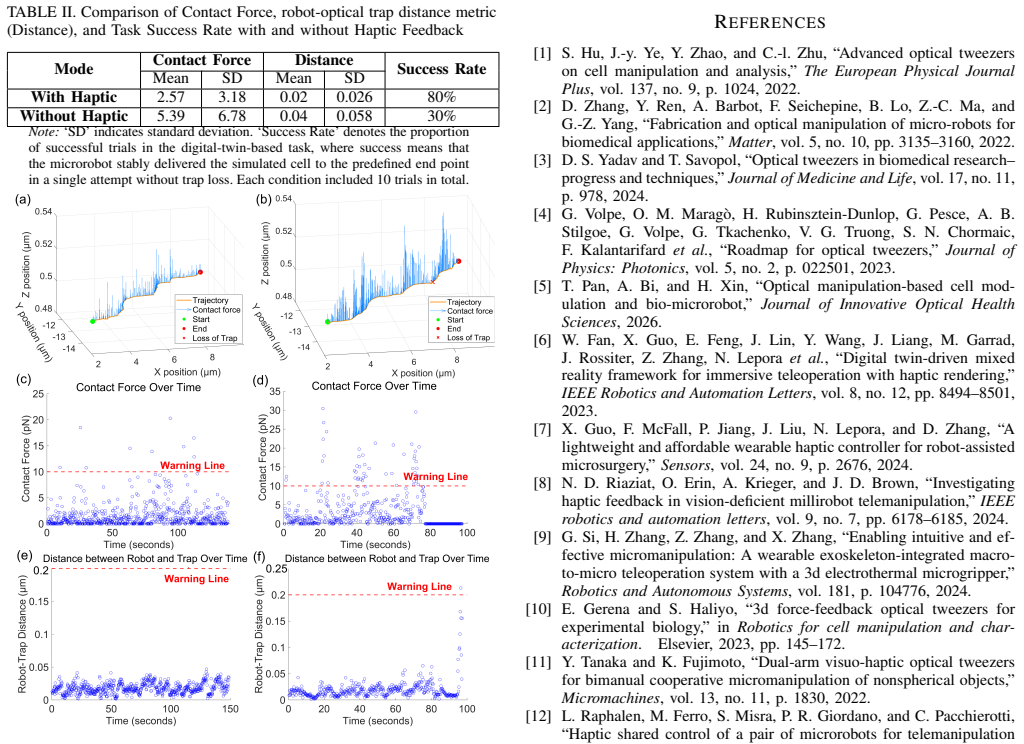
The digital twin framework integrates a digital twin environment, image-based pose and depth estimation, microrobot motion simulation, and model-based haptic rendering. Force modeling uses the Multi-Sphere Distributed Manipulation model together with optical-force estimation from the Optical Tweezers Toolbox. The framework reproduces representative microrobot motion trends and supplies haptic rendering numerically consistent with the fitted optical-force model. In simulated cell-delivery tasks haptic feedback reduced the standard deviations of the contact-force metric and the microrobot-to-trap-center distance metric by 53.2% and 55.2% respectively and improved task success from 30% to 80%.
Load-bearing premise
The Multi-Sphere Distributed Manipulation model combined with optical-force estimation produces force values sufficiently accurate for complex-shaped microrobots to support reliable haptic rendering.
Editorial extensions
If this is right
- The framework supplies a testbed for comparing different visuo-haptic teleoperation strategies on complex-shaped optical microrobots.
- Haptic rendering improves repeatability of contact forces and trap-center distances during multi-trap manipulation.
- The same modeling approach can convey trap-stability information to the operator without physical sensors attached to the microrobots.
- Simulator-driven feedback enables safe evaluation of control methods before hardware deployment in biomedical settings.
Reading between the lines
- If the force model remains accurate on physical hardware, the framework could serve as a training simulator for real cell-delivery procedures.
- The digital-twin structure might transfer to other micro-manipulation platforms that also lack direct force sensing.
- Extending the MSDM approximation to additional microrobot geometries would clarify its range of reliable use.
Editorial analysis
A structured set of objections, weighed in public.
Referee Report
Summary. The paper presents a digital twin framework for virtual visuo-haptic teleoperation of complex-shaped optical microrobots driven by optical tweezers. It integrates a ROS-connected bimanual system with image-based pose/depth estimation, microrobot motion simulation, and model-based haptic rendering that combines a Multi-Sphere Distributed Manipulation (MSDM) model with optical-force estimation from the Optical Tweezers Toolbox. The framework is reported to reproduce representative motion trends and to deliver haptic forces numerically consistent with the fitted optical-force model. In simulated cell-delivery tasks, haptic feedback is claimed to reduce the standard deviations of the contact-force and microrobot-to-trap-center distance metrics by 53.2% and 55.2%, respectively, while raising task success from 30% to 80%.
Significance. If the MSDM-plus-Optical-Tweezers-Toolbox force model proves accurate for non-spherical geometries, the framework would offer a useful simulation testbed for evaluating visuo-haptic strategies in optical-tweezers microrobotics. The reported quantitative improvements in a controlled simulation loop and the ROS integration constitute concrete, reproducible strengths. However, the simulation-only nature of all performance numbers and the absence of physical force calibration limit the immediate significance for real-world teleoperation.
major comments (3)
- [Abstract] Abstract: the statement that haptic rendering is 'numerically consistent with the fitted optical-force model' supplies no independent validation data, fitting residuals, or cross-validation procedure; because the same model parameters appear to generate both the simulated contact forces and the rendered haptic signals, the consistency may be tautological rather than an external check.
- [Abstract] Abstract (simulation results paragraph): the 53.2% and 55.2% reductions in standard deviation and the 30%→80% success-rate improvement are obtained inside a closed loop whose contact forces are produced by the identical MSDM + Optical Tweezers Toolbox model used for haptic rendering; without reported physical force measurements, error bars, or sensitivity analysis on complex geometries, these metrics cannot be distinguished from simulator artifacts.
- [Abstract] The central performance claims rest on the assumption that the MSDM model combined with the Optical Tweezers Toolbox yields sufficiently accurate forces for complex-shaped microrobots, yet the manuscript provides neither experimental calibration against physical measurements nor quantification of model error on non-spherical shapes.
minor comments (1)
- [Abstract] The abstract would be strengthened by stating the number of simulation trials, the statistical test used for the success-rate comparison, and any exclusion criteria applied to the data.
Simulated Author's Rebuttal
We thank the referee for the thorough and constructive review. The comments correctly identify that our evaluation is entirely simulation-based and that force consistency claims are internal to the model. We address each point below, clarifying the intended scope of the work as a digital-twin testbed rather than a physically validated system, and indicate textual revisions we will make.
read point-by-point responses
-
Referee: [Abstract] the statement that haptic rendering is 'numerically consistent with the fitted optical-force model' supplies no independent validation data, fitting residuals, or cross-validation procedure; because the same model parameters appear to generate both the simulated contact forces and the rendered haptic signals, the consistency may be tautological rather than an external check.
Authors: We agree the phrasing is imprecise and risks implying external validation. The rendered haptic forces are generated directly from the same MSDM + Optical Tweezers Toolbox model used in the simulator; the statement was meant only to confirm that the haptic pipeline introduces no additional numerical discrepancy. We will revise the abstract to state explicitly that haptic forces are computed from the identical model and that no independent experimental validation is provided. revision: yes
-
Referee: [Abstract] the 53.2% and 55.2% reductions in standard deviation and the 30%→80% success-rate improvement are obtained inside a closed loop whose contact forces are produced by the identical MSDM + Optical Tweezers Toolbox model used for haptic rendering; without reported physical force measurements, error bars, or sensitivity analysis on complex geometries, these metrics cannot be distinguished from simulator artifacts.
Authors: The referee is correct that all quantitative results derive from a closed simulation loop. This design isolates the effect of haptic feedback under controlled, repeatable conditions. We will add explicit language in the abstract and discussion sections stating that the reported metrics are simulation-only, that they reflect behavior under the chosen force model, and that physical experiments are required to assess real-world transfer. revision: yes
-
Referee: [Abstract] The central performance claims rest on the assumption that the MSDM model combined with the Optical Tweezers Toolbox yields sufficiently accurate forces for complex-shaped microrobots, yet the manuscript provides neither experimental calibration against physical measurements nor quantification of model error on non-spherical shapes.
Authors: We acknowledge that the manuscript relies on the existing MSDM and Optical Tweezers Toolbox models without new calibration data for non-spherical geometries. The framework is intentionally modular to allow substitution of improved force models. We will revise the abstract, methods, and limitations discussion to state this modeling assumption clearly and to list the absence of physical force calibration as a limitation of the current study. revision: partial
Circularity Check
No significant circularity; simulation results are internally consistent by design
full rationale
The paper presents an integrated digital-twin framework whose haptic rendering is deliberately driven by the same MSDM + Optical Tweezers Toolbox model used to generate the simulated physics. The reported performance deltas (53.2 % / 55.2 % std-dev reductions, 30 % → 80 % success) are obtained by comparing haptic-on versus haptic-off conditions inside that single consistent simulator; this is a standard controlled experiment rather than a derivation that reduces to its own fitted inputs. The phrase “numerically consistent with the fitted optical-force model” simply describes the intended implementation, not a claimed first-principles prediction. No self-citation load-bearing steps, uniqueness theorems, or ansatz smuggling appear in the supplied text, and the evaluation remains self-contained against its own simulation benchmark.
Assumptions & free parameters
Cite this review
Pith. "Pith review of A Digital Twin Framework for Virtual Visuo-Haptic Teleoperation of Complex-Shaped Optical Microrobots." pith.science (2026). https://pith.science/paper/FAY2B3DD
@misc{pith2026260528448,
  author       = {Pith},
  title        = {Pith review of: A Digital Twin Framework for Virtual Visuo-Haptic Teleoperation of Complex-Shaped Optical Microrobots},
  year         = {2026},
  howpublished = {\url{https://pith.science/paper/FAY2B3DD}},
  note         = {Machine review of arXiv:2605.28448}
}
read the original abstract
Optical tweezers (OT) provide piconewton-scale manipulation for delicate biomedical tasks, where visuo-haptic feedback can improve operator awareness by conveying interaction-force cues and trap-stability information. However, visuo-haptic teleoperation frameworks for complex-shaped optical microrobots remain underdeveloped, particularly in multi-trap manipulation scenarios. This paper presents a digital twin framework for virtual visuo-haptic teleoperation of complex-shaped OT-driven microrobots. The framework integrates a digital twin environment, image-based pose and depth estimation, microrobot motion simulation, and model-based haptic rendering within a Robot Operating System (ROS)-connected bimanual teleoperation system. For force modeling, we combine a Multi-Sphere Distributed Manipulation (MSDM) model with optical-force estimation from the Optical Tweezers Toolbox, enabling simulator-driven visuo-haptic feedback. The framework reproduces representative microrobot motion trends and provides haptic force rendering that is numerically consistent with the fitted optical-force model. In simulated cell-delivery tasks, haptic feedback reduced the standard deviations of the contact-force metric and the microrobot-to-trap-center distance metric by 53.2% and 55.2%, respectively, and improved task success from 30% to 80%. These results demonstrate the framework's effectiveness for evaluating visuo-haptic teleoperation strategies for complex-shaped optical microrobots.
Figures


Figures from the paper (3 more)


Reference graph
Works this paper leans on
-
[1]
Advanced optical tweezers on cell manipulation and analysis,
S. Hu, J.-y. Ye, Y . Zhao, and C.-l. Zhu, “Advanced optical tweezers on cell manipulation and analysis,”The European Physical Journal Plus, vol. 137, no. 9, p. 1024, 2022
2022
-
[2]
Fabrication and optical manipulation of micro-robots for biomedical applications,
D. Zhang, Y . Ren, A. Barbot, F. Seichepine, B. Lo, Z.-C. Ma, and G.-Z. Yang, “Fabrication and optical manipulation of micro-robots for biomedical applications,”Matter, vol. 5, no. 10, pp. 3135–3160, 2022
2022
-
[3]
Optical tweezers in biomedical research– progress and techniques,
D. S. Yadav and T. Savopol, “Optical tweezers in biomedical research– progress and techniques,”Journal of Medicine and Life, vol. 17, no. 11, p. 978, 2024
2024
-
[4]
Roadmap for optical tweezers,
G. V olpe, O. M. Marag `o, H. Rubinsztein-Dunlop, G. Pesce, A. B. Stilgoe, G. V olpe, G. Tkachenko, V . G. Truong, S. N. Chormaic, F. Kalantarifardet al., “Roadmap for optical tweezers,”Journal of Physics: Photonics, vol. 5, no. 2, p. 022501, 2023
2023
-
[5]
Optical manipulation-based cell mod- ulation and bio-microrobot,
T. Pan, A. Bi, and H. Xin, “Optical manipulation-based cell mod- ulation and bio-microrobot,”Journal of Innovative Optical Health Sciences, 2026
2026
-
[6]
Digital twin-driven mixed reality framework for immersive teleoperation with haptic rendering,
W. Fan, X. Guo, E. Feng, J. Lin, Y . Wang, J. Liang, M. Garrad, J. Rossiter, Z. Zhang, N. Leporaet al., “Digital twin-driven mixed reality framework for immersive teleoperation with haptic rendering,” IEEE Robotics and Automation Letters, vol. 8, no. 12, pp. 8494–8501, 2023
2023
-
[7]
A lightweight and affordable wearable haptic controller for robot-assisted microsurgery,
X. Guo, F. McFall, P. Jiang, J. Liu, N. Lepora, and D. Zhang, “A lightweight and affordable wearable haptic controller for robot-assisted microsurgery,”Sensors, vol. 24, no. 9, p. 2676, 2024
2024
-
[8]
Investigating haptic feedback in vision-deficient millirobot telemanipulation,
N. D. Riaziat, O. Erin, A. Krieger, and J. D. Brown, “Investigating haptic feedback in vision-deficient millirobot telemanipulation,”IEEE robotics and automation letters, vol. 9, no. 7, pp. 6178–6185, 2024
2024
Show all 21 references
-
[9]
Enabling intuitive and ef- fective micromanipulation: A wearable exoskeleton-integrated macro- to-micro teleoperation system with a 3d electrothermal microgripper,
G. Si, H. Zhang, Z. Zhang, and X. Zhang, “Enabling intuitive and ef- fective micromanipulation: A wearable exoskeleton-integrated macro- to-micro teleoperation system with a 3d electrothermal microgripper,” Robotics and Autonomous Systems, vol. 181, p. 104776, 2024
2024
-
[10]
3d force-feedback optical tweezers for experimental biology,
E. Gerena and S. Haliyo, “3d force-feedback optical tweezers for experimental biology,” inRobotics for cell manipulation and char- acterization. Elsevier, 2023, pp. 145–172
2023
-
[11]
Dual-arm visuo-haptic optical tweezers for bimanual cooperative micromanipulation of nonspherical objects,
Y . Tanaka and K. Fujimoto, “Dual-arm visuo-haptic optical tweezers for bimanual cooperative micromanipulation of nonspherical objects,” Micromachines, vol. 13, no. 11, p. 1830, 2022
2022
-
[12]
Haptic shared control of a pair of microrobots for telemanipulation using constrained optimization,
L. Raphalen, M. Ferro, S. Misra, P. R. Giordano, and C. Pacchierotti, “Haptic shared control of a pair of microrobots for telemanipulation using constrained optimization,” in2025 IEEE/RSJ International Con- ference on Intelligent Robots and Systems (IROS). IEEE, 2025, pp. 17 3...
2025
-
[13]
Digital twin: Mitigating unpredictable, un- desirable emergent behavior in complex systems,
M. Grieves and J. Vickers, “Digital twin: Mitigating unpredictable, un- desirable emergent behavior in complex systems,” inTransdisciplinary perspectives on complex systems: New findings and approaches. Springer, 2016, pp. 85–113
2016
-
[14]
Interactive ot gym: A reinforcement learning- based interactive optical tweezer (ot)-driven microrobotics simulation platform,
Z. Tan and D. Zhang, “Interactive ot gym: A reinforcement learning- based interactive optical tweezer (ot)-driven microrobotics simulation platform,” in2025 IEEE International Conference on Robotics and Automation (ICRA). IEEE, 2025, pp. 1–7
2025
-
[15]
Physics-informed machine learning for efficient sim-to-real data augmentation in micro-object pose esti- mation,
Z. Tan, L. Wei, and D. Zhang, “Physics-informed machine learning for efficient sim-to-real data augmentation in micro-object pose esti- mation,”arXiv preprint arXiv:2511.16494, 2025
2025
-
[16]
Dig- ital twin of a magnetic medical microrobot with stochastic model predictive controller boosted by machine learning in cyber-physical healthcare systems,
H. Keshmiri Neghab, M. Jamshidi, and H. Keshmiri Neghab, “Dig- ital twin of a magnetic medical microrobot with stochastic model predictive controller boosted by machine learning in cyber-physical healthcare systems,”Information, vol. 13, no. 7, p. 321, 2022
2022
-
[17]
Real-time teleoperation of magnetic force-driven microrobots with 3d haptic force feedback for micro-navigation and micro-transportation,
J. Lee, X. Zhang, C. H. Park, and M. J. Kim, “Real-time teleoperation of magnetic force-driven microrobots with 3d haptic force feedback for micro-navigation and micro-transportation,”IEEE Robotics and Automation Letters, vol. 6, no. 2, pp. 1769–1776, 2021
2021
-
[18]
Optical tweezers computational toolbox,
T. A. Nieminen, V . L. Loke, A. B. Stilgoe, G. Kn¨oner, A. M. Bra´nczyk, N. R. Heckenberg, and H. Rubinsztein-Dunlop, “Optical tweezers computational toolbox,”Journal of Optics A: Pure and Applied Optics, vol. 9, no. 8, p. S196, 2007
2007
-
[19]
Distributed force control for microrobot manipulation via planar multi-spot optical tweezer,
D. Zhang, A. Barbot, B. Lo, and G.-Z. Yang, “Distributed force control for microrobot manipulation via planar multi-spot optical tweezer,” Advanced Optical Materials, vol. 8, no. 21, p. 2000543, 2020
2020
-
[20]
Very deep convolutional networks for large-scale image recognition,
K. Simonyan, “Very deep convolutional networks for large-scale image recognition,”arXiv preprint arXiv:1409.1556, 2014
2014 arXiv
-
[21]
Deep residual learning for image recognition,
K. He, X. Zhang, S. Ren, and J. Sun, “Deep residual learning for image recognition,” inProceedings of the IEEE conference on computer vision and pattern recognition, 2016, pp. 770–778
2016
Reviewed June 29, 2026 · model on record in the stance chip above.
Discussion (0). Sign in to comment.