Nebular Fingerprints of a Violent White Dwarf Merger: 3D NLTE Modelling of Type Ia Supernovae
Pith reviewed 2026-06-29 10:11 UTC · model grok-4.3
The pith
3D NLTE calculations of a violent white dwarf merger reveal [O I] emission from unburned secondary material and substantial viewing-angle effects.
A machine-rendered reading of the paper's core claim, the machinery that carries it, and where it could break.
Core claim
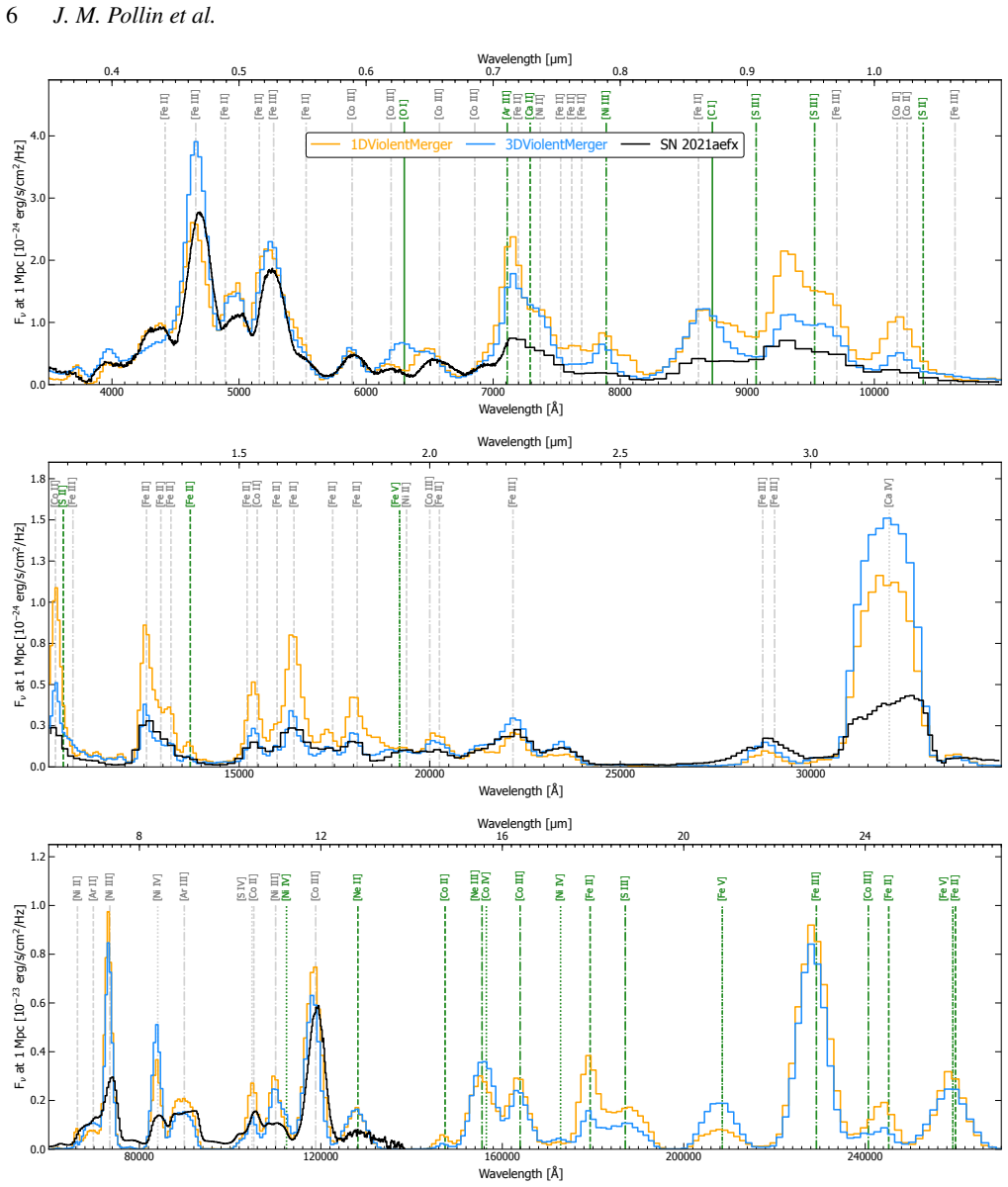
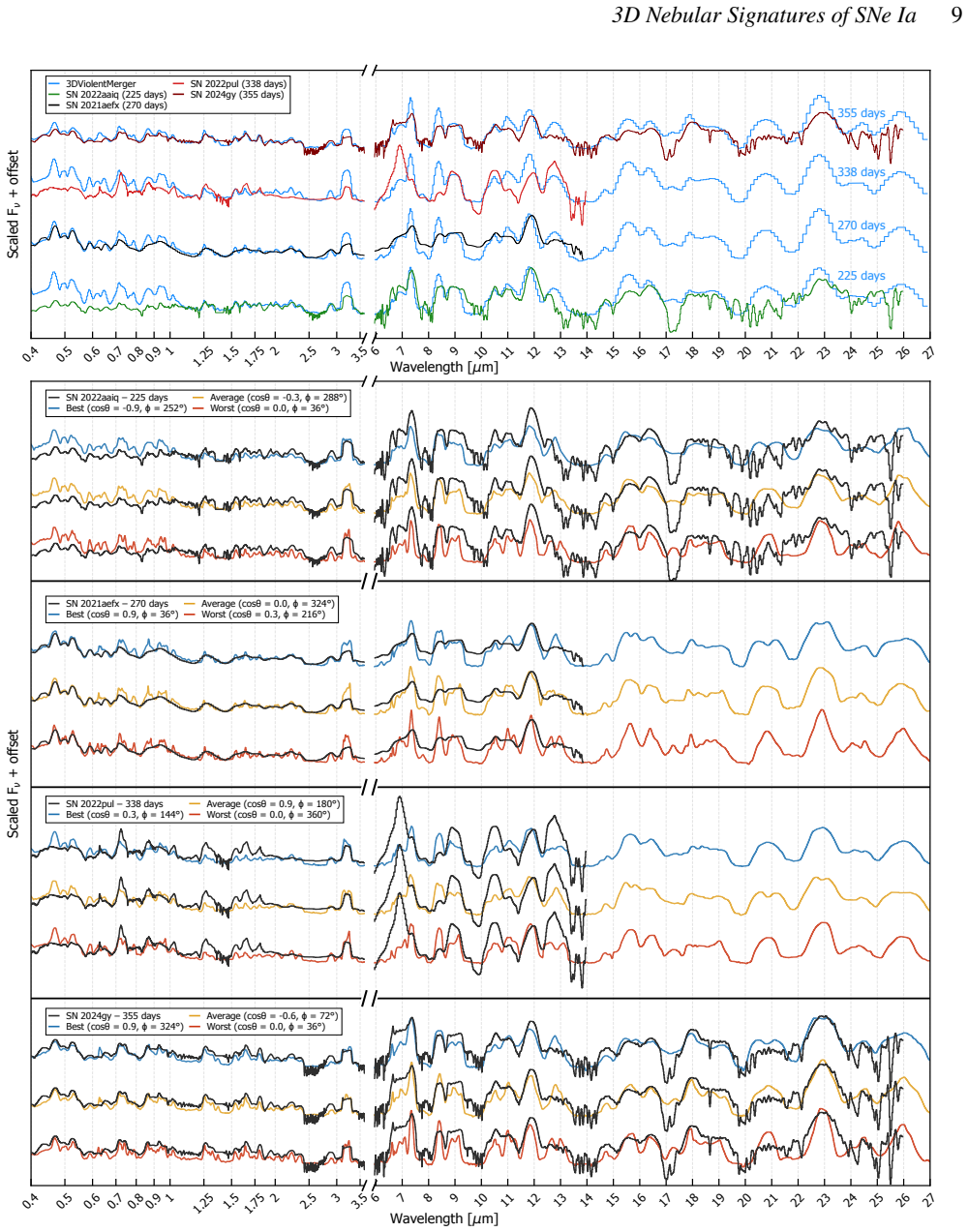
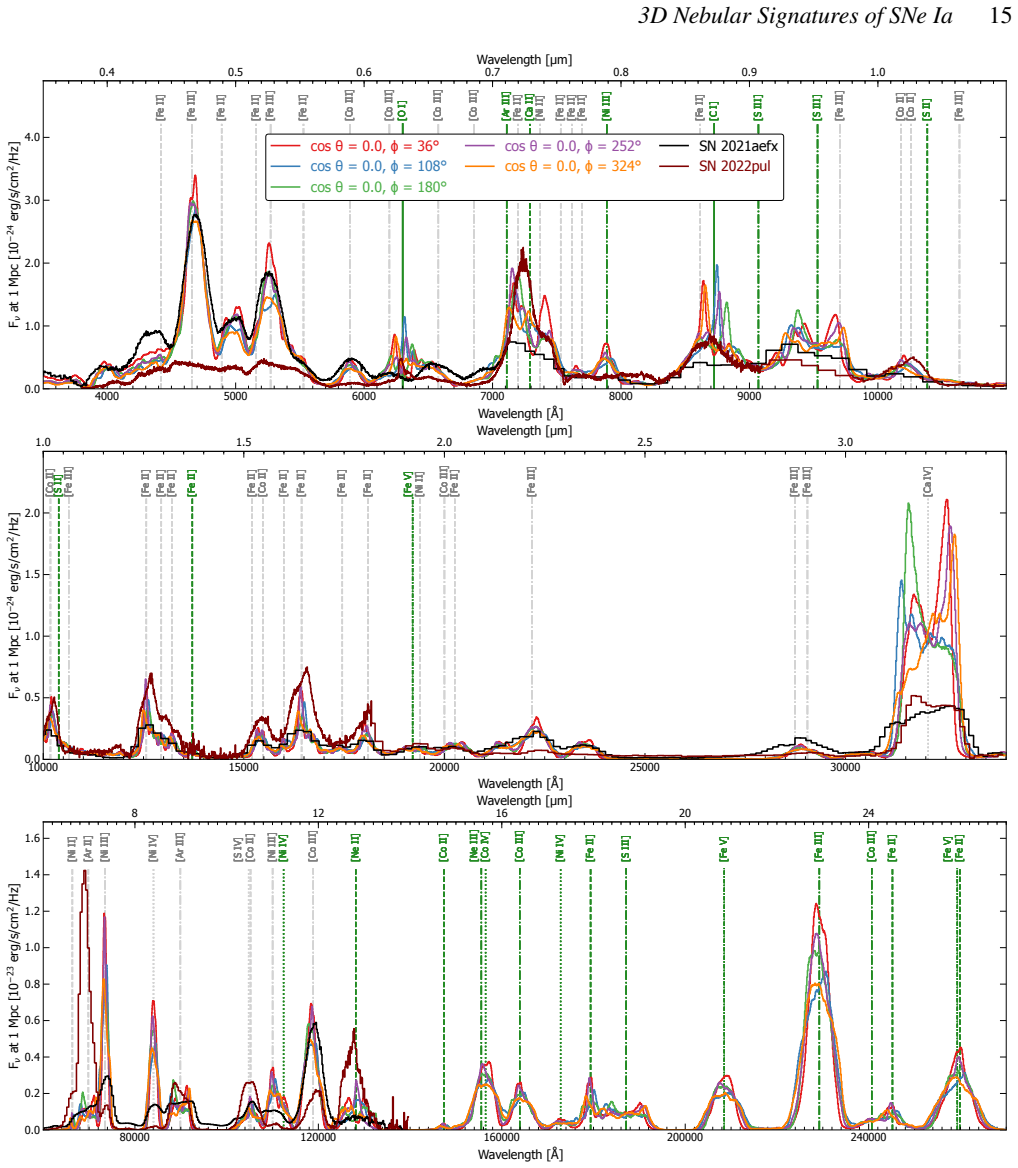
By applying full NLTE radiative transfer including non-thermal electrons to the 3D hydrodynamical output of a violent merger, the authors show that multidimensional effects improve the ionization state and reveal [O I] features from unburned material associated with the secondary, while the model reproduces much of the spectrum of SN 2021aefx yet underpredicts [Ni II] and produces strong high-ionization stable-Ni lines; viewing-angle variations are large and distinct from D6-like double-detonation scenarios.
What carries the argument
The 3D hydrodynamical structure and composition of the 1.1 + 0.7 solar mass violent merger combined with full NLTE treatment of excitation, ionization, and non-thermal electrons.
If this is right
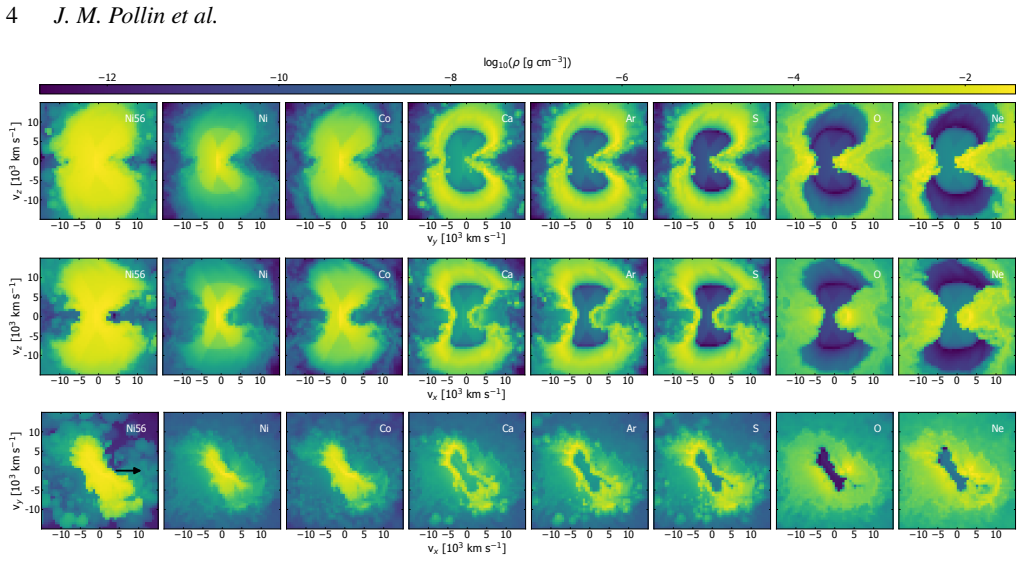
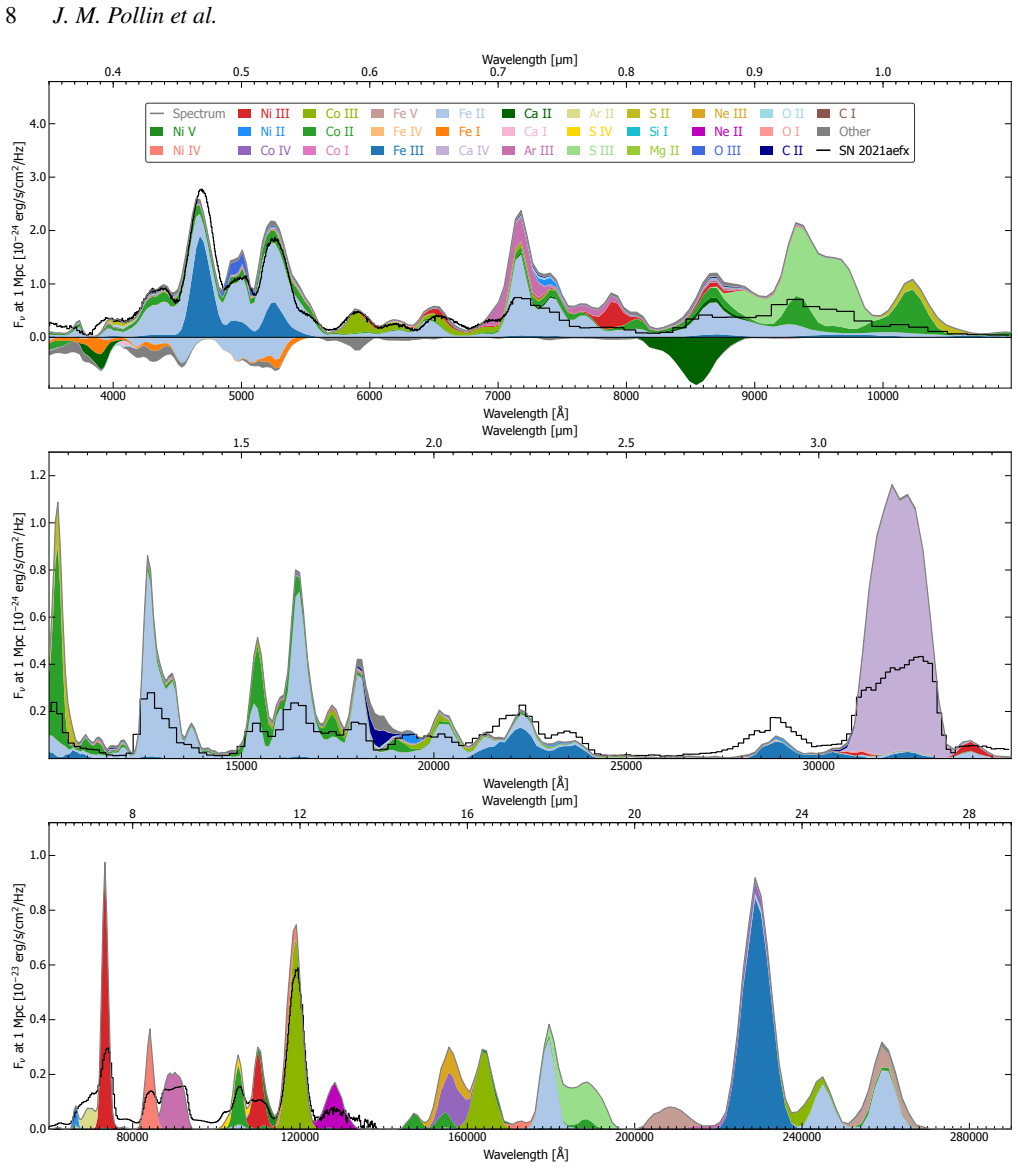
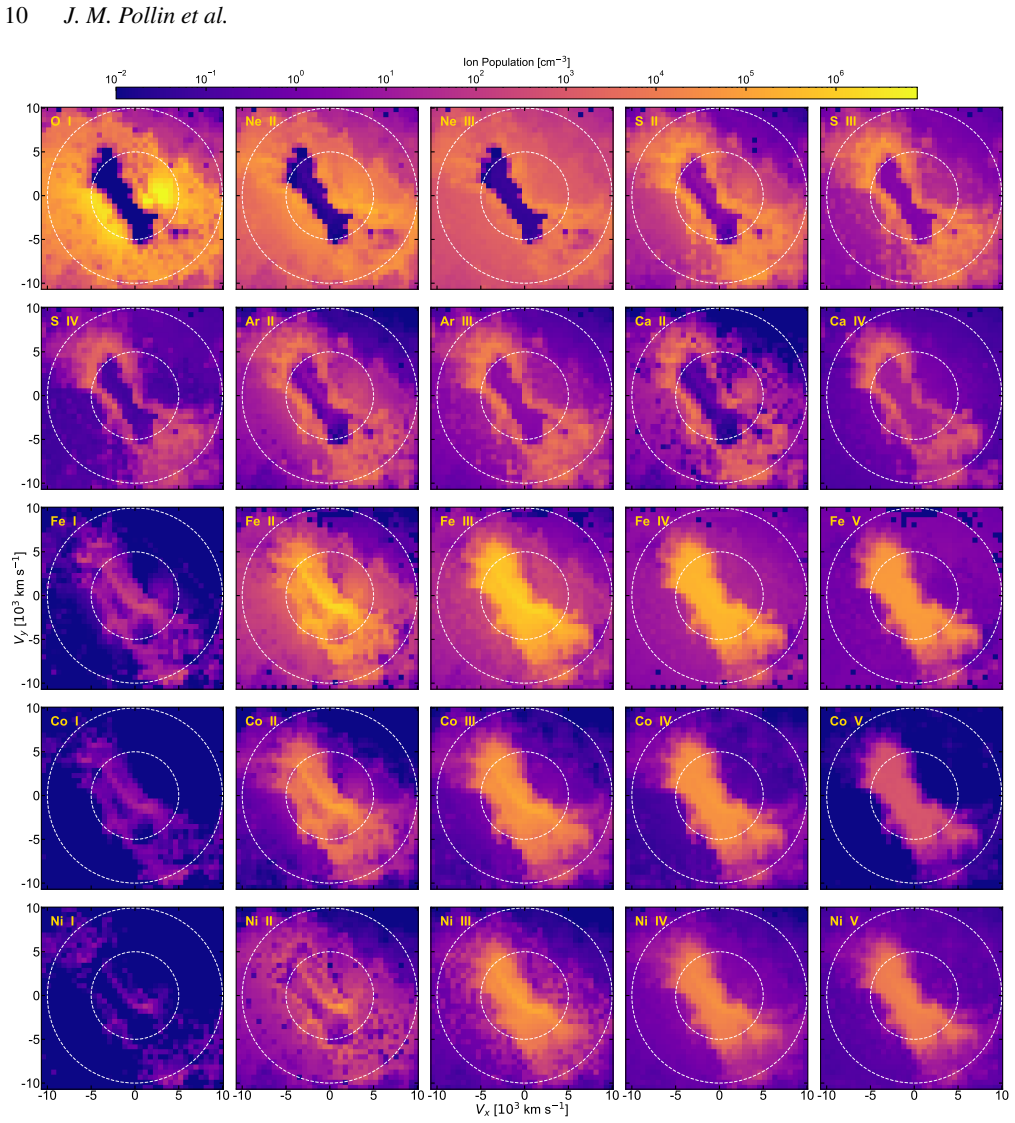
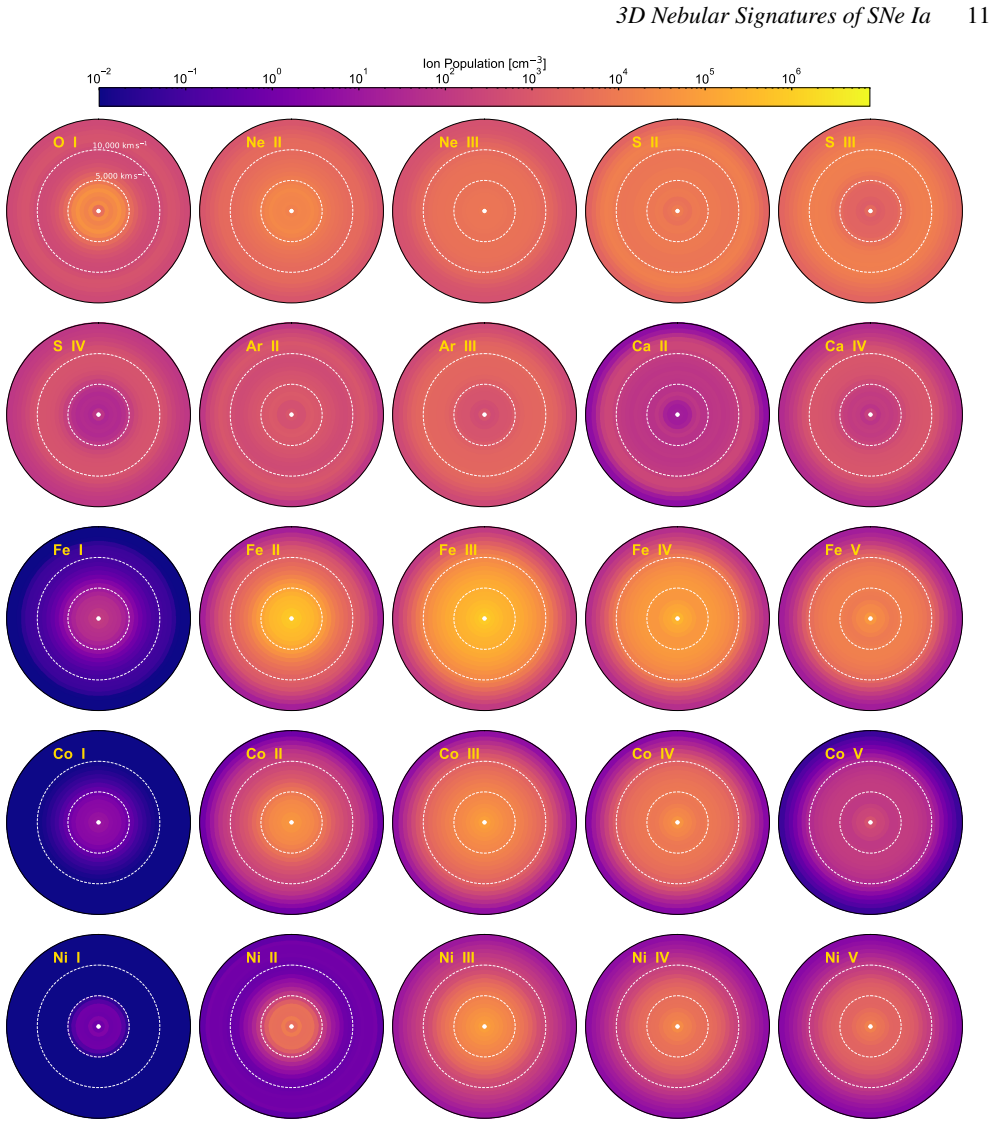
- Multidimensional modelling improves the ionisation state and reveals features absent from 1D calculations, most notably [O I] from unburned material associated with the secondary.
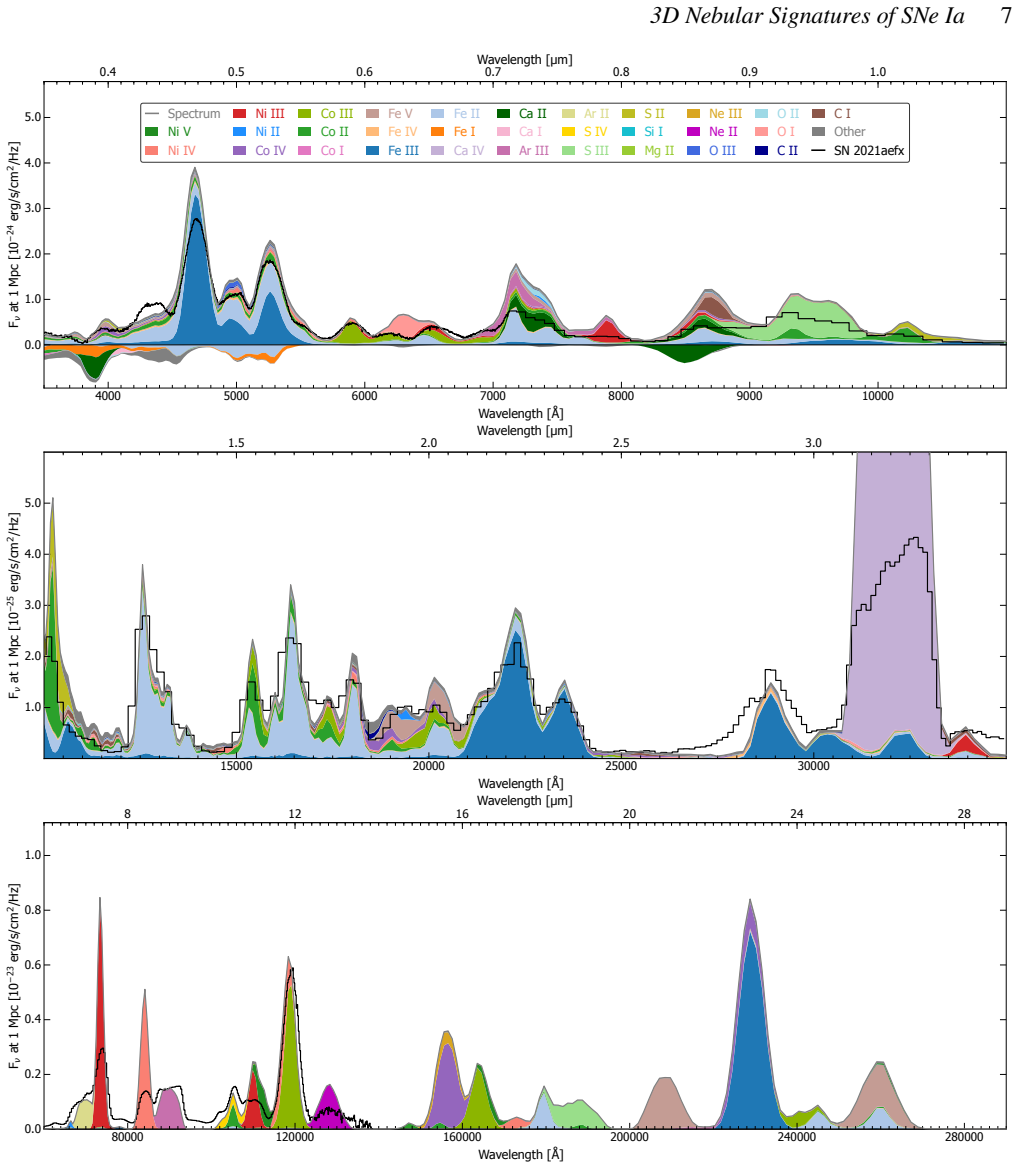
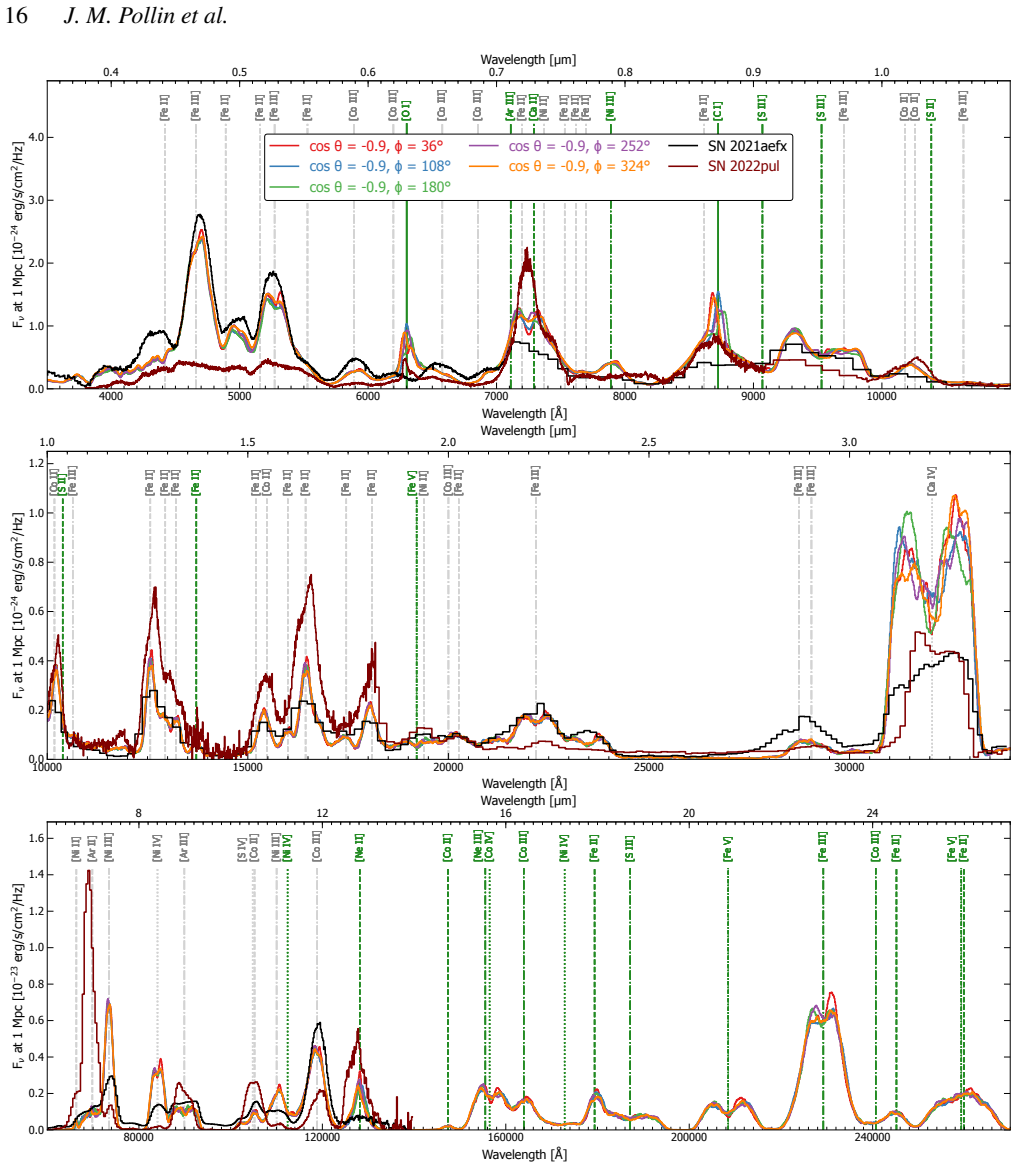
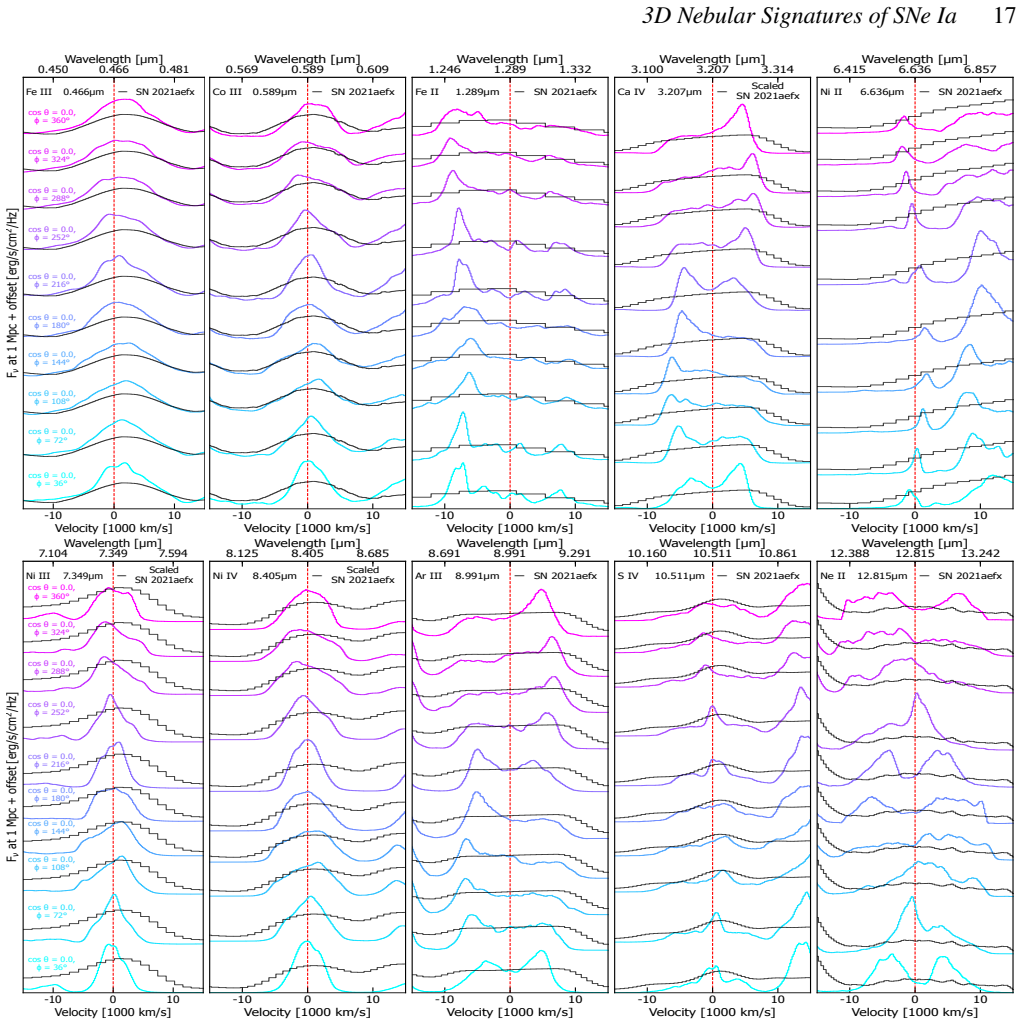
- The model reproduces much of the panchromatic spectrum of the normal SN 2021aefx but underpredicts [Ni II] while producing strong high-ionisation stable-Ni features.
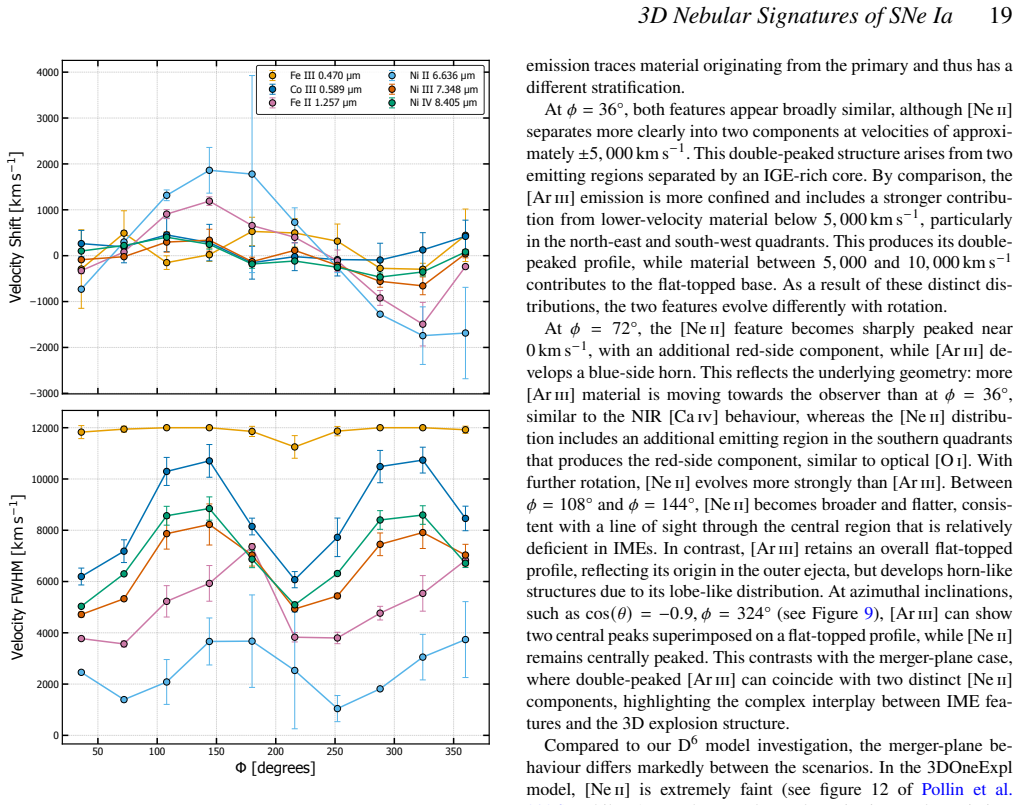
- Viewing-angle variation is substantial, with signatures distinct from D^6-like scenarios.
- JWST nebular samples combined with multidimensional modelling can discriminate between progenitor channels.
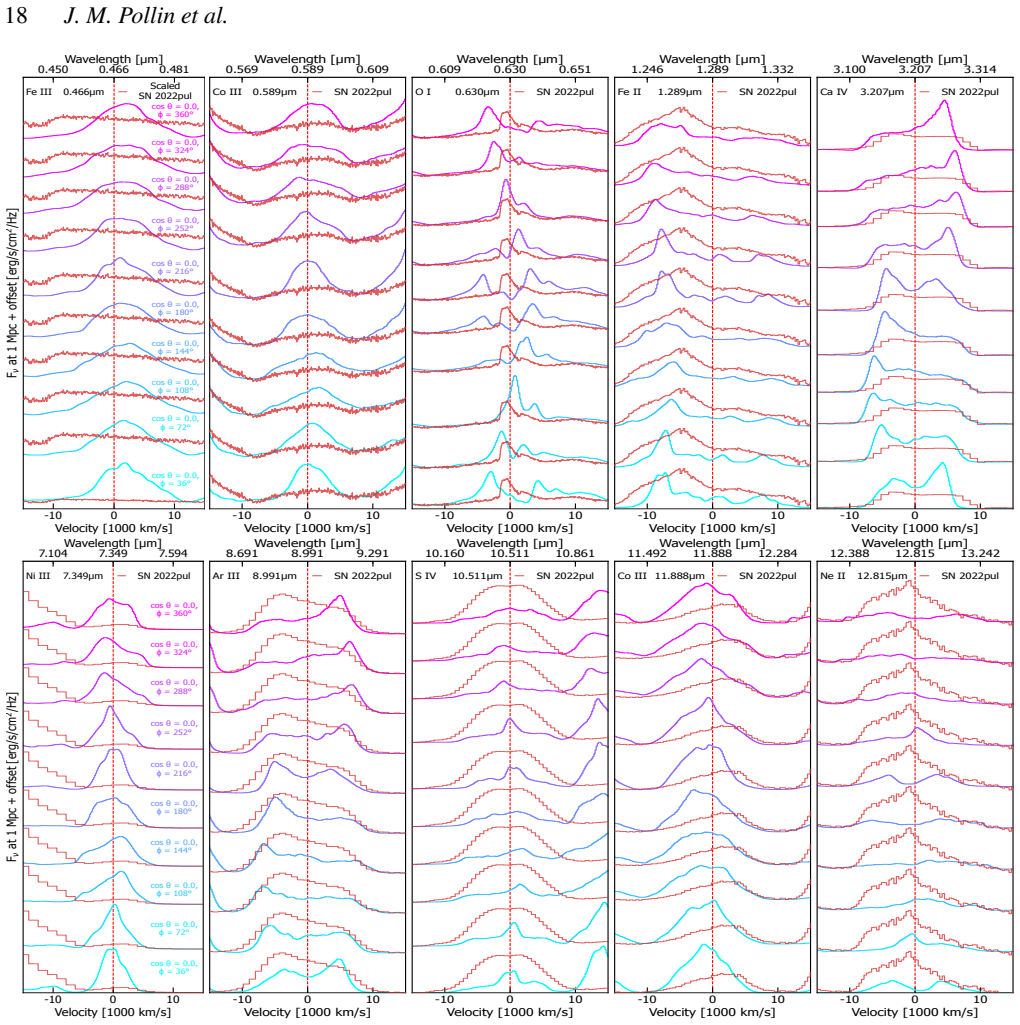
- The calculations suggest that SN 2022pul may require a similar merger configuration involving full disruption of the secondary or a more massive companion.
Where Pith is reading between the lines
- If the input 3D structure is realistic, then nebular spectra can be used to map the distribution of unburned material left by the secondary.
- The dependence of nickel lines on ionization state implies that abundance measurements from 1D models may need systematic corrections when applied to merger events.
- Different viewing angles could produce observable spectral diversity that future multi-epoch observations might detect.
Load-bearing premise
The hydrodynamical structure and composition taken from the input violent-merger simulation accurately represent the physical conditions required for the subsequent NLTE radiative transfer to produce reliable spectra.
What would settle it
Absence of [O I] emission or lack of strong viewing-angle variation in nebular spectra of events similar to SN 2021aefx would contradict the predictions of this 3D violent-merger model.
Figures
read the original abstract
Binary systems composed of two carbon-oxygen white dwarfs (WDs) are a leading progenitor candidate for Type Ia supernovae. One widely discussed scenario is the dynamically driven double-degenerate double-detonation (D$^6$) of a sub-Chandrasekhar-mass WD binary, where detonations are triggered by dynamical interaction. However, some systems are expected to undergo violent mergers, in which the primary ignites through direct carbon ignition as the secondary strikes its surface. We present the first 3D nebular-phase radiative-transfer calculations of a violent merger, using a $1.1 M_\odot$ and $0.7 M_\odot$ sub-Chandrasekhar binary. Our simulations employ a full NLTE (non local thermodynamic equilibrium) treatment of excitation and ionisation, including non-thermal electron contributions. By comparing 1D and 3D realisations, we show that multidimensional modelling improves the ionisation state and reveals features absent from 1D calculations, most notably [O I] from unburned material associated with the secondary. The model reproduces much of the panchromatic spectrum of the normal SN 2021aefx, but underpredicts [Ni II] while producing strong high-ionisation stable-Ni features, illustrating that stable-Ni signatures depend not only on abundance, but also on ionisation state. Although the model does not reproduce the strong [Ar II] and [Ne II] emission observed in the 03fg-like SN 2022pul, our calculations suggest that this event may require a similar merger configuration, involving full disruption of the secondary or a more massive companion with more extensive burning. Finally, viewing-angle variation is substantial, with signatures distinct from D$^6$-like scenarios, suggesting that JWST nebular samples, combined with multidimensional modelling, can discriminate between channels.
Editorial analysis
A structured set of objections, weighed in public.
Referee Report
Summary. The paper presents the first 3D NLTE nebular-phase radiative-transfer calculations for a violent white-dwarf merger using a 1.1 + 0.7 solar-mass binary. It compares 1D and 3D realisations to show that multidimensional modelling improves the ionisation state and reveals [O I] emission from unburned secondary material absent in 1D. The model reproduces much of the panchromatic spectrum of SN 2021aefx (underpredicting [Ni II] while producing strong high-ionisation stable-Ni features) but does not match the strong [Ar II] and [Ne II] in the 03fg-like SN 2022pul, while finding substantial viewing-angle variation distinct from D^6 scenarios.
Significance. If the hydrodynamical input is representative, this is a significant pioneering calculation demonstrating the necessity of 3D NLTE modelling (including non-thermal electrons) for accurate nebular spectra of violent mergers. The forward-modelling approach, explicit 1D–3D comparison, and discussion of viewing-angle diagnostics provide a concrete framework for using future JWST samples to discriminate progenitor channels.
major comments (1)
- [Abstract] Abstract: the claim that 3D modelling reveals [O I] from unburned secondary material and produces viewing-angle signatures distinct from D^6 scenarios is load-bearing on the adopted 1.1 + 0.7 Msun violent-merger hydrodynamical simulation. Systematic offsets in oxygen distribution, density profile or ignition geometry would directly alter the predicted line strengths and angular dependence independent of the NLTE solver; the manuscript should quantify this sensitivity.
minor comments (1)
- The abstract refers to 'panchromatic spectrum' comparisons; specifying the exact wavelength coverage and which ions dominate the fit would improve clarity.
Simulated Author's Rebuttal
We thank the referee for their positive assessment and constructive feedback. We address the major comment below.
read point-by-point responses
-
Referee: [Abstract] Abstract: the claim that 3D modelling reveals [O I] from unburned secondary material and produces viewing-angle signatures distinct from D^6 scenarios is load-bearing on the adopted 1.1 + 0.7 Msun violent-merger hydrodynamical simulation. Systematic offsets in oxygen distribution, density profile or ignition geometry would directly alter the predicted line strengths and angular dependence independent of the NLTE solver; the manuscript should quantify this sensitivity.
Authors: We agree that the specific predictions for [O I] emission and viewing-angle signatures depend on the details of the adopted 1.1 + 0.7 M⊙ hydrodynamical simulation. Our study isolates the effects of 3D NLTE radiative transfer by comparing 1D and 3D realisations of the same input structure, demonstrating that multidimensional effects improve ionisation and produce [O I] from secondary material. The viewing-angle variations reflect the asymmetric 3D geometry of this violent merger, which differs from D^6 scenarios. However, a quantitative assessment of sensitivity to changes in oxygen distribution, density profile or ignition geometry would require additional hydrodynamical models, which lies beyond the scope of this first 3D NLTE calculation. We will revise the abstract (and add a corresponding statement in the discussion) to explicitly note that the results are for this specific binary configuration and that systematic exploration of hydrodynamical variations is an important topic for future work. This will appropriately qualify the claims without altering the core demonstration of multidimensional effects. revision: partial
- Quantification of the sensitivity of the [O I] line strengths and viewing-angle signatures to systematic variations in the hydrodynamical input (oxygen distribution, density profile or ignition geometry)
Circularity Check
No significant circularity; forward modeling from fixed hydro input
full rationale
The paper executes a one-way forward chain: a pre-existing 3D hydrodynamical merger simulation (1.1 + 0.7 M⊙) supplies density, composition and velocity structure; NLTE radiative transfer is then applied without any parameter adjustment or fitting to the target supernovae spectra. Comparisons to SN 2021aefx and SN 2022pul are post-hoc evaluations only. No equations or claims reduce the output spectra to the input abundances by construction, no fitted parameters are relabeled as predictions, and no self-citation chain is invoked to justify the central NLTE results. The 3D-versus-1D ionisation differences arise directly from the geometry of the supplied hydro model rather than from any circular redefinition.
Axiom & Free-Parameter Ledger
free parameters (1)
- Binary component masses =
1.1 M_sun primary, 0.7 M_sun secondary
axioms (1)
- domain assumption Hydrodynamical merger simulation supplies correct 3D density, velocity, and abundance structure for radiative transfer input.
Reference graph
Works this paper leans on
-
[1]
ARTIS Collaboration Shingles L. J., Collins C. E., Holas A., Callan F., Sim S.,2024,artistools(v2024.12.9),doi:10.5281/zenodo.14337284,https: //doi.org/10.5281/zenodo.14337284 ARTIS Collaboration et al., 2025, artis (v2025.08.01), doi:10.5281/zenodo.16684298,https://doi.org/10.5281/ zenodo.16684298 6 https://github.com/artis-mcrt/artistools/ 3D Nebular Si...
discussion (0)
Sign in with ORCID, Apple, or X to comment. Anyone can read and Pith papers without signing in.