Relational Aesthesis in Permacomputing Practice: Building a Solar Powered Website from Reclaimed Materials
Pith reviewed 2026-06-28 21:36 UTC · model grok-4.3
The pith
A case study of relocating a website to a solar-powered server from reclaimed parts demonstrates that permacomputing practices can shift communities toward greater autonomy and responsibility in digital systems.
A machine-rendered reading of the paper's core claim, the machinery that carries it, and where it could break.
Core claim
The documented experience of building and maintaining the solar-powered reclaimed server shows that permacomputing can reconfigure material and perceptual relations by visibilizing and visceralizing digital infrastructures, that community practices can overcome resulting frictions, and that these steps cultivate greater collective autonomy, agency, and responsibility in how communities engage with and create meaning in digital systems.
What carries the argument
The research-through-design case study of moving a website to a self-hosted solar-powered server built from reclaimed electronics, guided by permacomputing principles and relational aesthesis.
If this is right
- Digital infrastructures become sites of direct material accountability rather than invisible services.
- Communities gain practical routes to reduce dependence on distant data centers and maximalist hardware.
- Relational changes in perception of technology support more deliberate decisions about reuse and sufficiency.
- Community networks formed around such projects can sustain the practices beyond individual efforts.
- These approaches supply situated methods for engaging computing amid socio-ecological constraints.
Where Pith is reading between the lines
- Similar projects in different regions could test whether the autonomy effects vary with local material availability and cultural contexts.
- The emphasis on visibilizing infrastructure might extend to other domains such as shared community networks or educational tools.
- Longer-term tracking of energy use and maintenance labor in these setups would clarify whether the responsibility gains persist over years.
- The single-case format leaves open whether institutional or collective versions of the same relocation would encounter different frictions.
Load-bearing premise
Interpretive observations from this single personal project conducted by the authors themselves can stand as evidence that the claimed effects on collective relations to technology will occur when similar practices are taken up more widely.
What would settle it
A follow-up observation of several independent groups adopting comparable reclaimed solar setups and reporting sustained increases in measured agency and responsibility toward their digital tools would either confirm or refute the generalization from this case.
Figures
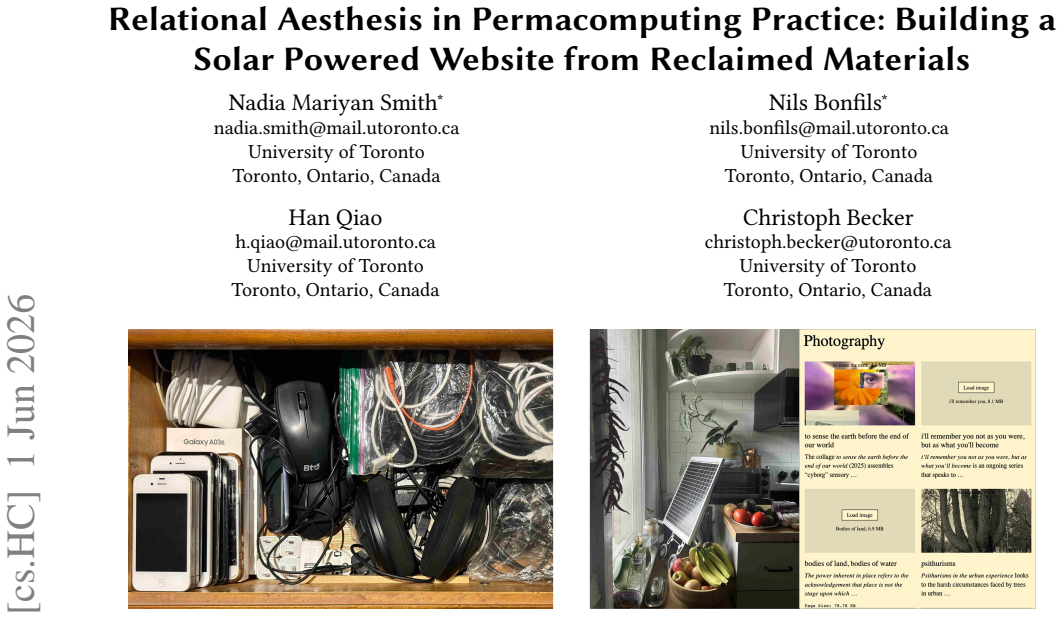
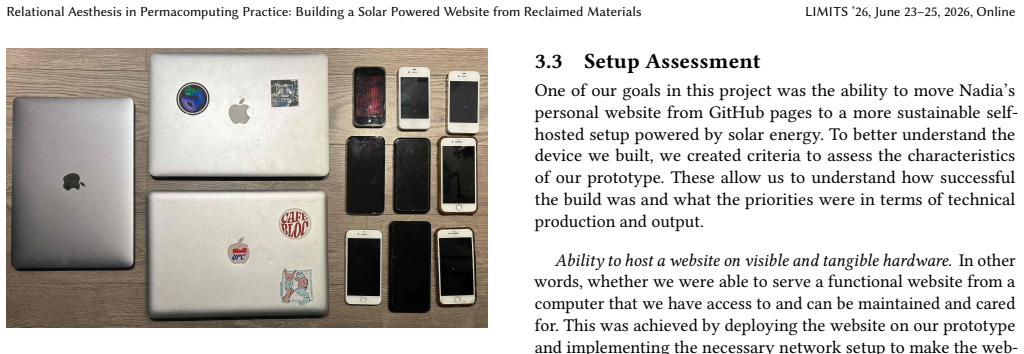
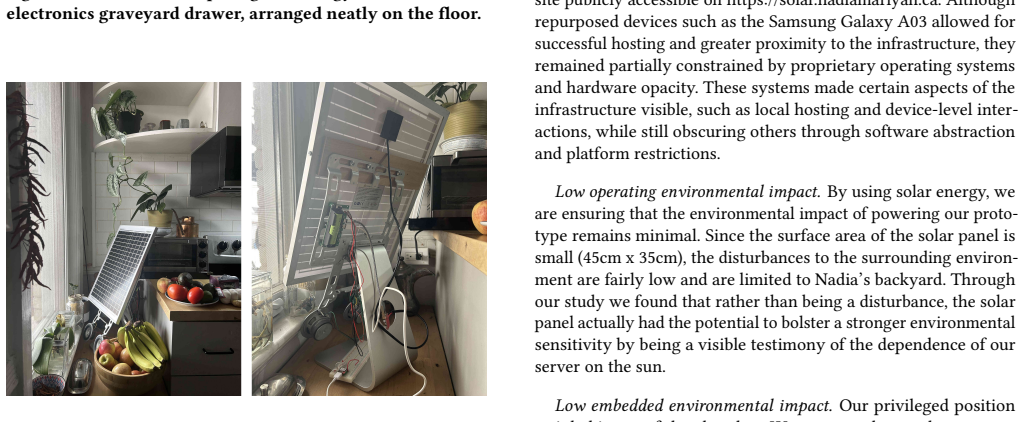
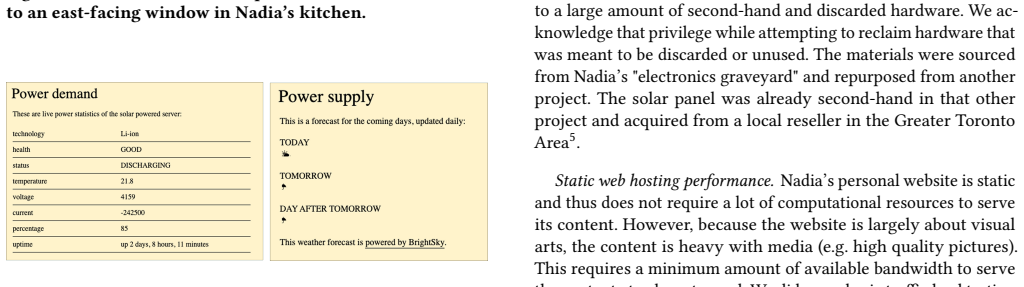
read the original abstract
Permacomputing is a nascent concept and community of practice concerned with developing alternative computing systems grounded in principles of resilience, reuse, sufficiency, and ecological limits. However, research engaging with permacomputing remains in an early stage of development, raising concerns about whether permacomputing can move beyond reflective critique to become a meaningful alternative practice. Through a research-through-design case study, we documented our experience moving a personal website from a data centre in Texas to a self-hosted solar-powered server built from reclaimed electronics. Guided by permacomputing principles and relational aesthesis, we explore what it takes for permacomputing to reconfigure material and perceptual relations. Our findings reveal the frictions of moving away from a maximalist techno-aesthetic while attempting to re-use already existing technologies, potential ways to overcome these challenges through building a community of practice, and the transformative potential of visibilizing and visceralizing digital infrastructures to cultivate more responsible ways of relating to technology. This paper contributes to emerging research on permacomputing and its aesthetics by bringing it into dialogue with theories of non-place and relational aesthesis. Rather than functioning as a purely symbolic gesture, permacomputing practices can cultivate greater collective autonomy, agency, and responsibility in how communities engage and create meaning within digital infrastructures. In the context of socio-ecological crises and anti-colonial transformation, our research offers a situated approach to building and relating to computing technologies in the ashes of dominant technological paradigms.
Editorial analysis
A structured set of objections, weighed in public.
Referee Report
Summary. The paper reports a research-through-design case study in which the authors migrated a personal website to a self-hosted solar-powered server constructed from reclaimed electronics, guided by permacomputing principles and relational aesthesis. Drawing on this single autoethnographic experience, the authors identify material and perceptual frictions in departing from maximalist techno-aesthetics, note the role of community practice in addressing them, and conclude that such practices can cultivate greater collective autonomy, agency, and responsibility in digital infrastructures rather than remaining purely symbolic.
Significance. If the interpretive claims hold, the work contributes to the early-stage permacomputing literature by supplying a concrete, documented example of principle application and by linking the practice to theories of non-place and relational aesthesis. It surfaces practical challenges of reuse and sufficiency that could usefully inform future sustainable HCI research, provided the leap from personal reflection to collective transformation is more carefully qualified.
major comments (2)
- [Abstract] Abstract (final paragraph) and conclusion: the central claim that 'permacomputing practices can cultivate greater collective autonomy, agency, and responsibility' is presented as a finding of the study, yet the evidence consists solely of the authors' own experience with one website migration; no data on other practitioners, community adoption, or observable shifts in relations to infrastructure are reported, rendering the extrapolation load-bearing for the paper's contribution.
- [Findings] Findings / discussion of transformative potential: the argument that visibilizing and visceralizing infrastructures produces responsible collective relations rests on the authors' post-hoc interpretation of their personal case without an explicit mechanism for falsification or external corroboration, which weakens the warrant for scaling the observed effects beyond the individual level.
minor comments (2)
- [Case study description] The operationalization of 'relational aesthesis' during the design process is described at a high level; adding concrete examples of how specific aesthetic decisions (e.g., choice of reclaimed hardware or interface constraints) enacted the concept would improve traceability.
- [Introduction] Terminology such as 'visibilizing and visceralizing' is introduced without a dedicated definition or reference; a brief glossary or footnote would aid readers unfamiliar with the permacomputing lexicon.
Simulated Author's Rebuttal
We thank the referee for their constructive comments, which help clarify the scope of claims appropriate to a single-case research-through-design study. We respond to each major comment below and indicate the revisions that will be incorporated.
read point-by-point responses
-
Referee: [Abstract] Abstract (final paragraph) and conclusion: the central claim that 'permacomputing practices can cultivate greater collective autonomy, agency, and responsibility' is presented as a finding of the study, yet the evidence consists solely of the authors' own experience with one website migration; no data on other practitioners, community adoption, or observable shifts in relations to infrastructure are reported, rendering the extrapolation load-bearing for the paper's contribution.
Authors: We agree that the current phrasing presents the claim as a direct finding when the supporting evidence is limited to one autoethnographic case. In the revised manuscript we will edit the final paragraph of the abstract and the conclusion to qualify the statement, changing it to indicate that the case suggests the potential for such cultivation rather than demonstrating it as an established outcome. We will also insert an explicit note on the single-case limitation and the need for further empirical work on community-level effects. revision: yes
-
Referee: [Findings] Findings / discussion of transformative potential: the argument that visibilizing and visceralizing infrastructures produces responsible collective relations rests on the authors' post-hoc interpretation of their personal case without an explicit mechanism for falsification or external corroboration, which weakens the warrant for scaling the observed effects beyond the individual level.
Authors: The referee correctly observes that the discussion of collective transformation is interpretive and derived from a single personal case. As a research-through-design study, the work does not employ falsification procedures. We will revise the discussion section to state the interpretive basis more explicitly, to delineate the limits on scaling claims to collective relations, and to propose future directions (such as community workshops) that could provide external corroboration. These changes will strengthen the warrant without altering the methodological approach. revision: yes
Circularity Check
No circularity: qualitative case study with no derivations or fitted predictions
full rationale
The paper is a research-through-design autoethnographic case study describing one personal website migration. It contains no equations, parameters, predictions, or formal derivations. Claims rest on interpretive reflection rather than any reduction of outputs to inputs by construction. No self-citation chains or ansatzes are invoked as load-bearing mathematical facts. This is the expected non-finding for descriptive work; the central claim is presented as situated interpretation, not a derived result.
Axiom & Free-Parameter Ledger
axioms (2)
- domain assumption Permacomputing principles of resilience, reuse, sufficiency, and ecological limits provide a valid and useful framework for alternative computing practices.
- domain assumption Relational aesthesis and theories of non-place offer productive lenses for interpreting material and perceptual relations in digital infrastructure.
Reference graph
Works this paper leans on
-
[1]
Roel Roscam Abbing. 2021. ‘This Is a Solar-Powered Website, Which Means It Sometimes Goes Offline’: A Design Inquiry into Degrowth and ICT. InComputing within Limits. LIMITS. doi:10.21428/bf6fb269.e78d19f6
-
[2]
1995.Non-Places: Introduction to an Anthropology of Supermodernity
Marc Augé. 1995.Non-Places: Introduction to an Anthropology of Supermodernity. Verso
1995
-
[3]
Fatemeh Bakhshoudeh and Rob Comber. 2025. Designing with the Solar Internet: Towards Constraint-Based Design for Sustainable Consumption. InProceedings of the 2025 CHI Conference on Human Factors in Computing Systems (CHI ’25). Association for Computing Machinery, New York, NY, USA, 1–18. doi:10.1145/ 3706598.3713101
-
[4]
Jeffrey Bardzell, Shaowen Bardzell, and Lone Koefoed Hansen. 2015. Immod- est Proposals: Research Through Design and Knowledge. InProceedings of the 33rd Annual ACM Conference on Human Factors in Computing Systems (CHI ’15). Association for Computing Machinery, New York, NY, USA, 2093–2102. doi:10.1145/2702123.2702400
-
[5]
2023.Insolvent: How to Reorient Computing for Just Sustain- ability
Christoph Becker. 2023.Insolvent: How to Reorient Computing for Just Sustain- ability. MIT Press, Cambridge, MA, USA
2023
-
[6]
Tega Brain, Alex Nathanson, and Benedetta Piantella. 2022. Solar Protocol: Exploring Energy-Centered Design. InComputing within Limits. LIMITS
2022
-
[7]
2018.Designs for the Pluriverse: Radical Interdependence, Auton- omy, and the Making of Worlds
Arturo Escobar. 2018.Designs for the Pluriverse: Radical Interdependence, Auton- omy, and the Making of Worlds. Duke University press
2018
-
[8]
David Franquesa and Leandro Navarro. 2018. Devices as a Commons: Limits to Premature Recycling. InProceedings of the 2018 Workshop on Computing within Limits (LIMITS ’18). Association for Computing Machinery, New York, NY, USA, 1–10. doi:10.1145/3232617.3232624
-
[9]
Christopher Frayling. 1994. Research in Art and Design (Royal College of Art Research Papers, Vol 1, No 1, 1993/4). (1994). https://researchonline.rca.ac.uk/384/ Num Pages: 9 Place: London Publisher: Royal College of Art
1994
-
[10]
William Gaver. 2012. What should we expect from research through design?. In Proceedings of the SIGCHI Conference on Human Factors in Computing Systems (CHI ’12). Association for Computing Machinery, New York, NY, USA, 937–946. doi:10.1145/2207676.2208538
-
[11]
Elisa Giaccardi and Pieter Jan Stappers. 2017. Research through Design. https://www.interaction–design.org/literature/book/the
2017
-
[12]
Danny Godin and Mithra Zahedi. 2014. Aspects of Research through Design: A Literature Review.DRS Biennial Conference Series(June 2014). https://dl. designresearchsociety.org/drs-conference-papers/drs2014/researchpapers/85
2014
-
[13]
Dylan A. Hazelwood and Michael G. Pecht. 2021. Life Extension of Electronic Products: A Case Study of Smartphones.IEEE Access9 (2021), 144726–144739. doi:10.1109/ACCESS.2021.3121733
-
[14]
Ortiz, Jeffrey Browne, Diana Franklin, John Y
Xun Li, Pablo J. Ortiz, Jeffrey Browne, Diana Franklin, John Y. Oliver, Roland Geyer, Yuanyuan Zhou, and Frederic T. Chong. 2010. Smartphone Evolution and Reuse: Establishing a More Sustainable Model. In2010 39th International Conference on Parallel Processing Workshops. 476–484. doi:10.1109/ICPPW.2010.70
-
[15]
2021.Hospicing Modernity: Facing Humanity’s Wrongs and the Implications for Social Activism
Vanessa Machado de Oliveira. 2021.Hospicing Modernity: Facing Humanity’s Wrongs and the Implications for Social Activism. North Atlantic Books
2021
-
[16]
Angella Mackey, David NG McCallum, Oscar Tomico, and Martijn de Waal
-
[17]
InProceedings of the 2025 CHI Conference on Human Factors in Computing Systems (CHI ’25)
What Comes After Noticing?: Reflections on Noticing Solar Energy and What Came Next. InProceedings of the 2025 CHI Conference on Human Factors in Computing Systems (CHI ’25). Association for Computing Machinery, New York, NY, USA, 1–14. doi:10.1145/3706598.3713239
-
[18]
Aymeric Mansoux, Brendan Howell, Dušan Barok, and Ville-Matias Heikkilä
-
[19]
InNinth Computing within Limits 2023
Permacomputing Aesthetics: Potential and Limits of Constraints in Compu- tational Art, Design and Culture. InNinth Computing within Limits 2023(Virtual, 2023-06-14). LIMITS. doi:10.21428/bf6fb269.6690fc2e
-
[20]
permacomputing.net. 2025. Permacomputing/ principles. https:// permacomputing.net/principles/
2025
-
[21]
Chris Preist, Daniel Schien, and Eli Blevis. 2016. Understanding and Mitigating the Effects of Device and Cloud Service Design Decisions on the Environmental Footprint of Digital Infrastructure. InProceedings of the 2016 CHI Conference on Human Factors in Computing Systems (CHI ’16). Association for Computing Machinery, New York, NY, USA, 1324–1337. doi:1...
-
[22]
Clara Rigaud. 2025. Zombitron: Towards a Toolbox for Repurposing Obsolete Smartphones into New Interactive Systems. (2025)
2025
-
[23]
Donald A. Schön. 1983.The reflective practitioner: how professionals think in action. Basic Books, New York
1983
-
[24]
Sarah Sharma. 2009. Baring Life and Lifestyle in the Non-Place. 23, 1 (2009), 129–148. doi:10.1080/09502380802016246
-
[25]
Gilbert Simondon. 2012. On Techno-Aesthetics. 14, 1 (2012) (2012), 1–8
2012
-
[26]
Eric Snodgrass, Helen Pritchard, Miranda Moss, Daniel Gustafsson, and Jorge Luis Zapico. 2024. Windternet: Designing Grid-Liberated Servers for Regenerative Energy Communities.LIMITS ’(2024)
2024
-
[27]
Brian Sutherland. 2021. Design Aspirations for Energy Autarkic Information Systems in a Future with Limits.LIMITS Workshop on Computing within Limits (June 2021). doi:10.21428/bf6fb269.8b56b095
-
[28]
Jennifer Switzer, Gabriel Marcano, Ryan Kastner, and Pat Pannuto. 2023. Junk- yard Computing: Repurposing Discarded Smartphones to Minimize Carbon. InProceedings of the 28th ACM International Conference on Architectural Sup- port for Programming Languages and Operating Systems, Volume 2 (ASPLOS 2023). Association for Computing Machinery, New York, NY, USA...
- [29]
-
[30]
Frederick Van Amstel, Rodrigo F. Gonzatto, and Saito Carmem. 2026. Coloniality of Making in Design Philosophy. InDesign Philosophy after the Technology Turn (1st ed ed.). Bloomsbury Visual Arts, 41–60. doi:10.5040/9781350494480
- [31]
-
[32]
Wilson, Grace Smalley, James R
Garrath T. Wilson, Grace Smalley, James R. Suckling, Debra Lilley, Jacquetta Lee, and Richard Mawle. 2017. The Hibernating Mobile Phone: Dead Storage as a Barrier to Efficient Electronic Waste Recovery.Waste Management60 (Feb. 2017), 521–533. doi:10.1016/j.wasman.2016.12.023
-
[33]
John Zimmerman, Jodi Forlizzi, and Shelley Evenson. 2007. Research through design as a method for interaction design research in HCI. InProceedings of the SIGCHI Conference on Human Factors in Computing Systems (CHI ’07). Association for Computing Machinery, New York, NY, USA, 493–502. doi:10.1145/1240624. 1240704
discussion (0)
Sign in with ORCID, Apple, or X to comment. Anyone can read and Pith papers without signing in.