Universality for rainbow oriented cycles in perturbed digraphs
Pith reviewed 2026-06-28 22:02 UTC · model grok-4.3
The pith
Randomly perturbed digraphs contain rainbow copies of every oriented cycle of every length with high probability.
A machine-rendered reading of the paper's core claim, the machinery that carries it, and where it could break.
Core claim
In an n-vertex digraph with all in- and out-degrees linear in n, after the addition of a linear number of random edges and a uniform random coloring of all edges with n colors, there is with high probability a rainbow copy of every orientation of every cycle of length from 3 to n.
What carries the argument
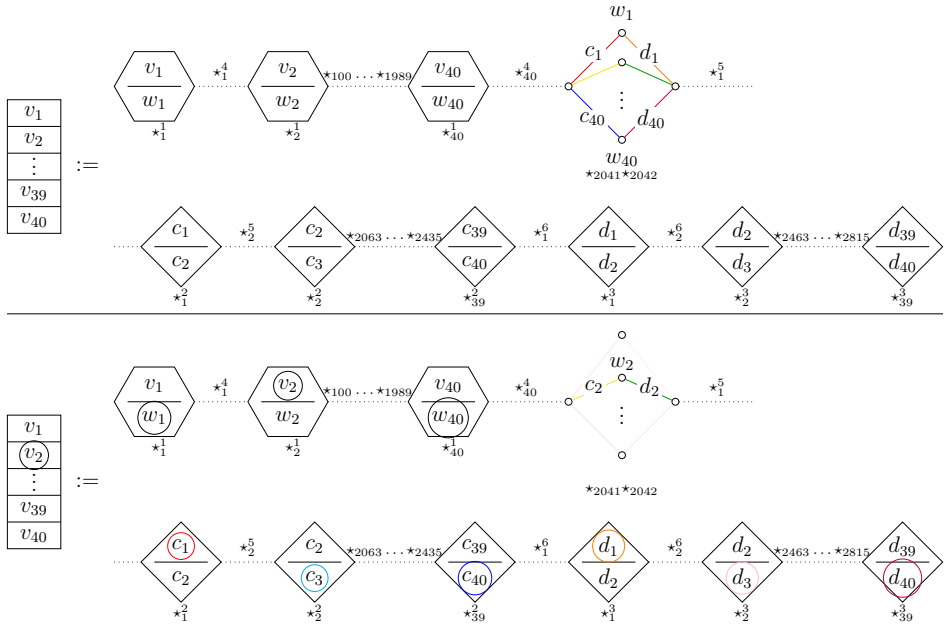
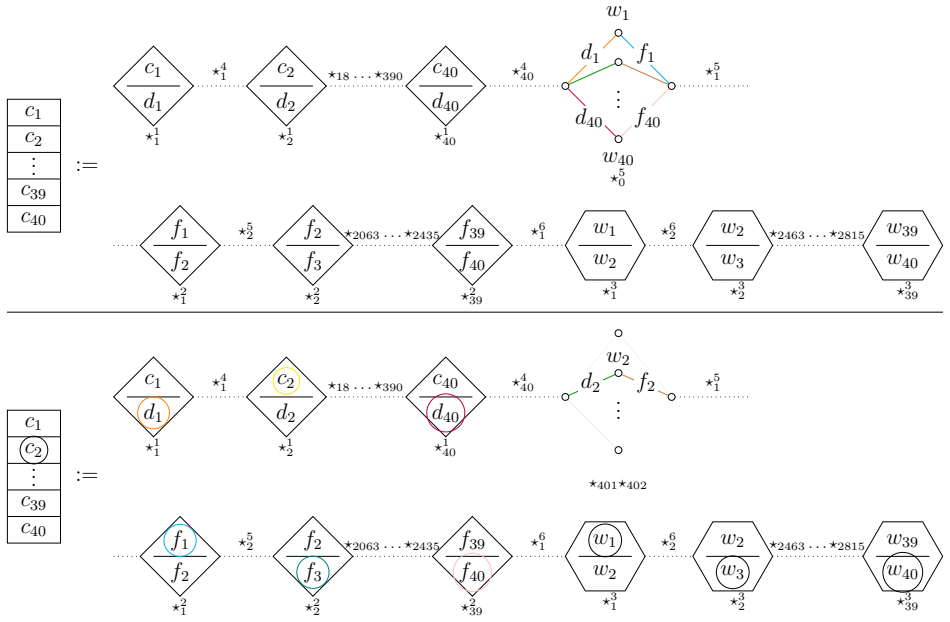
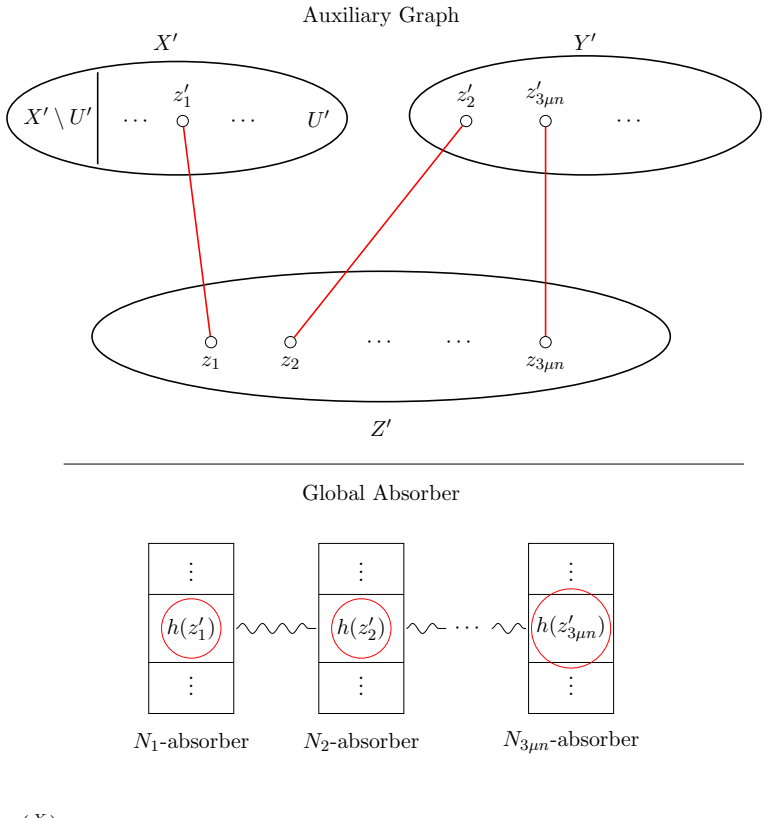
Montgomery's distributive absorption method, which successively embeds small rainbow oriented paths and absorbs them into larger rainbow cycles while preserving the rainbow property across all orientations.
If this is right
- Every orientation of every k-cycle for 3 ≤ k ≤ n appears simultaneously as a rainbow subgraph.
- The linear number of random edges suffices once the base degrees are linear.
- The same perturbed model yields both the uncolored universality result and the rainbow Hamilton-cycle result for consistent orientations as special cases.
- The distributive absorption technique succeeds in maintaining the rainbow condition while handling all orientations at once.
Where Pith is reading between the lines
- The same absorption framework could be tested on rainbow directed paths or on rainbow copies of other oriented graphs such as tournaments of fixed size.
- If the number of colors were reduced to cn for c<1, long cycles would necessarily repeat colors, so the rainbow property would fail for lengths larger than roughly 1/c.
- An undirected version might follow by replacing each undirected edge with a pair of opposite arcs and applying the same perturbation and coloring.
Load-bearing premise
The base digraph must already have in-degrees and out-degrees linear in n before the random edges are added, because the absorption argument relies on this minimum density.
What would settle it
Exhibit a concrete n-vertex digraph whose minimum in- and out-degree is linear in n, add a linear number of random edges, color the edges uniformly with n colors, and show that some orientation of some cycle length k (for example k=4) has no rainbow copy; if this occurs with probability bounded away from zero, the claim fails.
Figures
read the original abstract
A randomly perturbed digraph is an $n$-vertex directed graph with all out- and in-degrees linear in $n$, to which a linear number (depending on the degree) of random edges have been randomly added. We show that randomly perturbed digraphs whose edges have been colored uniformly with $n$ colors have a rainbow copy of every orientation of every possible length cycle, simultaneously, with high probability. This is a common generalization of work of Araujo, Balogh, Krueger, Piga, and Treglown in the uncolored setting and Katsamaktsis, Letzter, and Sgueglia for consistently oriented spanning cycles. Our proof uses Montgomery's distributive absorption method.
Editorial analysis
A structured set of objections, weighed in public.
Referee Report
Summary. The manuscript proves that an n-vertex digraph with all in- and out-degrees linear in n, after the addition of a linear number of random edges and a uniform random edge-coloring with n colors, contains with high probability a rainbow copy of every orientation of every cycle of every length from 3 to n, simultaneously. The argument is presented as a common generalization of the uncolored perturbed-digraph result of Araujo-Balogh-Krueger-Piga-Treglown and the rainbow directed Hamilton-cycle result of Katsamaktsis-Letzter-Sgueglia, obtained via Montgomery's distributive absorption method.
Significance. If correct, the result supplies a strong simultaneous-universality statement that unifies two active lines of research on perturbed digraphs and rainbow subgraphs. The extension of absorption techniques to handle all orientations and all lengths under a single random coloring is technically non-trivial; the paper appears to manage the necessary color-availability counting and union-bound arguments within the known regime for absorption lemmas. The explicit credit to prior theorems and the parameter-free character of the final statement (once the linear constants are fixed) are positive features.
minor comments (2)
- [Abstract] Abstract: the parenthetical remark 'linear number (depending on the degree)' leaves the precise functional dependence on the minimum degree implicit; a single sentence clarifying the admissible range of constants would improve readability for readers familiar with the absorption literature.
- [Introduction] The introduction would benefit from a short paragraph explicitly stating the linear constants required by the absorption lemmas invoked from Montgomery and from the two cited papers, so that the reader can immediately compare the hypotheses.
Simulated Author's Rebuttal
We thank the referee for their positive assessment of the manuscript and for recommending acceptance. The report correctly identifies the result as a common generalization of the perturbed-digraph theorem of Araujo-Balogh-Krueger-Piga-Treglown and the rainbow directed Hamilton-cycle theorem of Katsamaktsis-Letzter-Sgueglia, obtained via Montgomery's distributive absorption method.
Circularity Check
Minor self-citation in cited prior work; central claim independent
full rationale
The paper presents a probabilistic existence result as a common generalization of two external theorems (uncolored perturbed digraphs and rainbow directed Hamilton cycles) via Montgomery's distributive absorption. One cited work shares an author (Krueger), but this is a standard non-load-bearing citation; the hypotheses match known regimes for absorption lemmas without any internal fitting, self-definition, or reduction of predictions to inputs by construction. The derivation is self-contained against external benchmarks.
Axiom & Free-Parameter Ledger
Reference graph
Works this paper leans on
-
[1]
Aigner-Horev and D
E. Aigner-Horev and D. Hefetz. Rainbow Hamilton cycles in randomly colored randomly perturbed dense graphs.SIAM Journal on Discrete Mathematics, 35(3):1569–1577, 2021
2021
-
[2]
Ajtai, J
M. Ajtai, J. Koml´ os, and E. Szemer´ edi. First occurrence of Hamilton cycles in random graphs.North-Holland Mathematics Studies, 115(C):173–178, 1985
1985
-
[3]
Anastos and A
M. Anastos and A. Frieze. How many randomly colored edges make a randomly colored dense graph rainbow Hamiltonian or rainbow connected?Journal of Graph Theory, 92(4):405–414, 2019
2019
-
[4]
L. D. Andersen. Hamilton circuits with many colours in properly edge-coloured complete graphs.Mathematica Scandinavica, pages 5–14, 1989
1989
-
[5]
Araujo, J
I. Araujo, J. Balogh, R. A. Krueger, S. Piga, and A. Treglown. On oriented cycles in randomly perturbed digraphs.Combinatorics, Probability and Computing, 33(2):157– 178, 2024
2024
-
[6]
Bal and A
D. Bal and A. Frieze. Rainbow matchings and Hamilton cycles in random graphs. Random Structures & Algorithms, 48(3):503–523, 2016
2016
-
[7]
Balogh and T
J. Balogh and T. Molla. Long rainbow cycles and Hamiltonian cycles using many colors in properly edge-colored complete graphs.European Journal of Combinatorics, 79:140– 151, 2019
2019
-
[8]
Barber, S
B. Barber, S. Glock, D. K¨ uhn, A. Lo, R. Montgomery, and D. Osthus. Minimalist designs.Random Structures & Algorithms, 57(1):47–63, 2020
2020
-
[9]
Benzing, A
F. Benzing, A. Pokrovskiy, and B. Sudakov. Long directed rainbow cycles and rainbow spanning trees.European Journal of Combinatorics, 88:103102, 2020. 33
2020
-
[10]
Bohman, A
T. Bohman, A. Frieze, and R. Martin. How many random edges make a dense graph Hamiltonian?Random Structures & Algorithms, 22(1):33–42, 2003
2003
-
[11]
Bollob´ as
B. Bollob´ as. The evolution of sparse graphs.Graph theory and combinatorics (Cam- bridge, 1983), pages 35–57, 1984
1983
-
[12]
B´ ar´ any
I. B´ ar´ any. A generalization of Carath´ eodory’s theorem.Discrete Mathematics, 40(2):141–152, 1982
1982
-
[13]
Cooper and A
C. Cooper and A. Frieze. Multi-coloured Hamilton cycles in random edge-coloured graphs.Combinatorics, Probability and Computing, 11(2):129–133, 2002
2002
-
[14]
DeBiasio, D
L. DeBiasio, D. K¨ uhn, T. Molla, D. Osthus, and A. Taylor. Arbitrary orientations of Hamilton cycles in digraphs.SIAM Journal on Discrete Mathematics, 29(3):1553–1584, 2015
2015
-
[15]
DeBiasio and T
L. DeBiasio and T. Molla. Semi-degree threshold for anti-directed Hamiltonian cycles. The Electronic Journal of Combinatorics, 22(4):P4.34, 2015
2015
-
[16]
Refined Absorption: A New Proof of the Existence Conjecture
M. Delcourt and L. Postle. Refined absorption: A new proof of the existence conjecture. arXiv preprint arXiv:2402.17855, 2024
- [17]
-
[18]
G. A. Dirac. Some theorems on abstract graphs.Proceedings of the London Mathematical Society, 3(1):69–81, 1952
1952
-
[19]
A. Ferber. Closing gaps in problems related to Hamilton cycles in random graphs and hypergraphs.The Electronic Journal of Combinatorics, 22(1):P1.61, 2015
2015
-
[20]
Ferber and M
A. Ferber and M. Krivelevich. Rainbow Hamilton cycles in random graphs and hyper- graphs. InRecent trends in combinatorics, pages 167–189. Springer, 2016
2016
-
[21]
Frieze and P.-S
A. Frieze and P.-S. Loh. Rainbow Hamilton cycles in random graphs.Random Structures & Algorithms, 44(3):328–354, 2014
2014
-
[22]
Ghouila-Houri
A. Ghouila-Houri. Une condition suffisante dexistence dun circuit Hamiltonien.Comptes Rendus Hebdomadaires Des Seances De L Academie Des Sciences, 251(4):495–497, 1960
1960
-
[23]
Glock, D
S. Glock, D. K¨ uhn, A. Lo, and D. Osthus.The existence of designs via iterative absorp- tion: hypergraph F-designs for arbitrary F, volume 284, monograph 1046. American Mathematical Society, 2023
2023
-
[24]
Gould, T
S. Gould, T. Kelly, D. K¨ uhn, and D. Osthus. Almost all optimally coloured complete graphs contain a rainbow Hamilton path.Journal of Combinatorial Theory, Series B, 156:57–100, 2022. 34
2022
-
[25]
Hahn-Klimroth, G
M. Hahn-Klimroth, G. Maesaka, Y. Mogge, S. Mohr, and O. Parczyk. Random pertur- bation of sparse graphs.The Electronic Journal of Combinatorics, 28(2):P2.26, 2021
2021
-
[26]
S. Janson. New versions of Suen’s correlation inequality.Random Structures and Algo- rithms, 13(3-4):467–483, 1998
1998
-
[27]
Joos and J
F. Joos and J. Kim. On a rainbow version of Dirac’s theorem.Bulletin of the London Mathematical Society, 52(3):498–504, 2020
2020
-
[28]
R. M. Karp.Reducibility among Combinatorial Problems. Springer US, Boston, MA, pages 85–103, 1972
1972
-
[29]
Katsamaktsis, S
K. Katsamaktsis, S. Letzter, and A. Sgueglia. Rainbow Hamiltonicity in uniformly coloured perturbed digraphs.Combinatorics, Probability and Computing, 33(5):624– 642, 2024
2024
- [30]
-
[31]
Long paths and Hamiltonicity in random graphs
M. Krivelevich. Long paths and Hamiltonicity in random graphs.arXiv preprint arXiv:1507.00205, 2015
work page internal anchor Pith review Pith/arXiv arXiv 2015
-
[32]
McDiarmid
C. McDiarmid. General first-passage percolation.Advances in Applied Probability, 15(1):149–161, 1983
1983
-
[33]
Montgomery
R. Montgomery. Spanning trees in random graphs.Advances in Mathematics, 356:106793, 2019
2019
-
[34]
R. Montgomery. A proof of the Ryser–Brualdi–Stein conjecture for large evenn.arXiv preprint arXiv:2310.19779, 2023
-
[35]
Montgomery
R. Montgomery. Spanning cycles in random directed graphs.Random Structures & Algorithms, 65(3):535–575, 2024
2024
-
[36]
Pokrovskiy.Rainbow Subgraphs and their Applications
A. Pokrovskiy.Rainbow Subgraphs and their Applications. London Mathematical Society Lecture Note Series. Cambridge University Press, pages 191–214, 2022
2022
-
[37]
L. P´ osa. Hamiltonian circuits in random graphs.Discrete Mathematics, 14(4):359–364, 1976
1976
-
[38]
R¨ odl, A
V. R¨ odl, A. Ruci´ nski, and E. Szemer´ edi. A dirac-type theorem for 3-uniform hyper- graphs.Combinatorics, Probability and Computing, 15(1-2):229–251, 2006
2006
-
[39]
W. Sun, G. Wang, and L. Wei. Transversal structures in graph systems: A survey. arXiv preprint arXiv:2412.01121, 2024. 35
work page internal anchor Pith review Pith/arXiv arXiv 2024
discussion (0)
Sign in with ORCID, Apple, or X to comment. Anyone can read and Pith papers without signing in.