RocketSmith: Agentic Additive Manufacturing of High-Powered Rockets
Pith reviewed 2026-06-30 11:41 UTC · model grok-4.3
The pith
An LLM-orchestrated agentic system automates rocket design for additive manufacturing and produces four stable-flying high-power rockets that reach 80% of predicted altitude.
A machine-rendered reading of the paper's core claim, the machinery that carries it, and where it could break.
Core claim
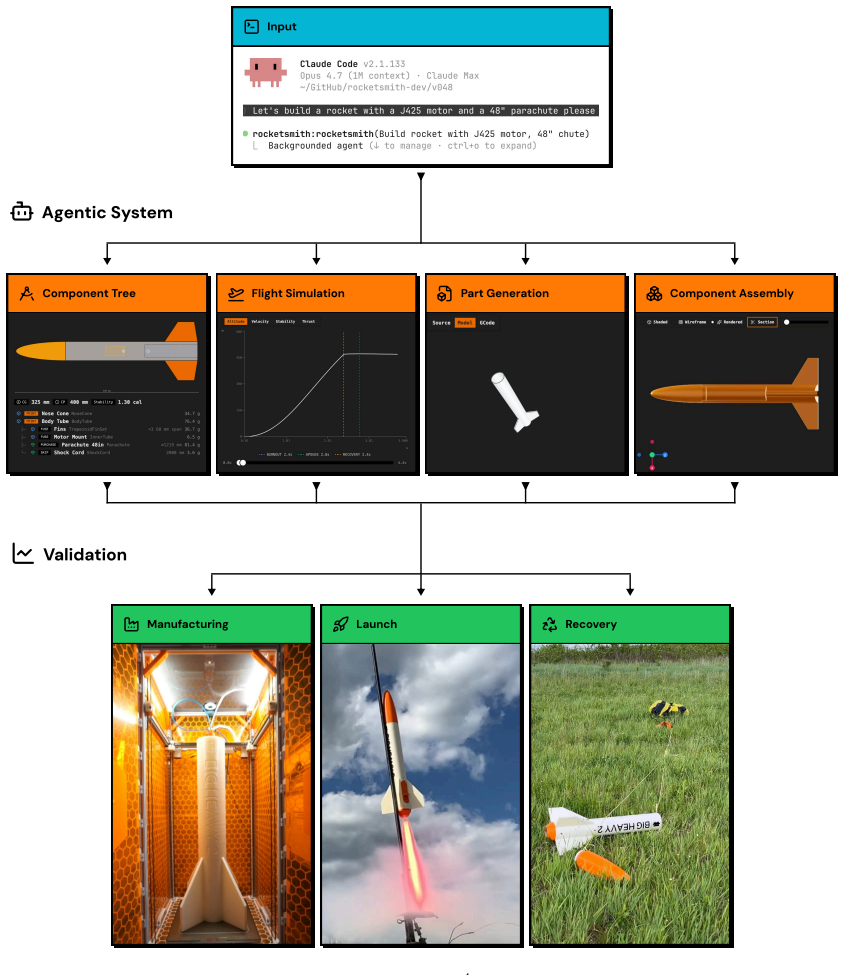
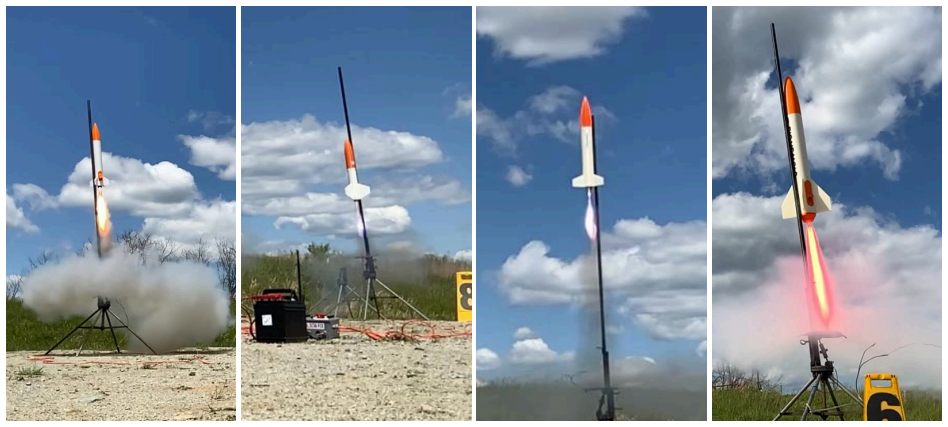
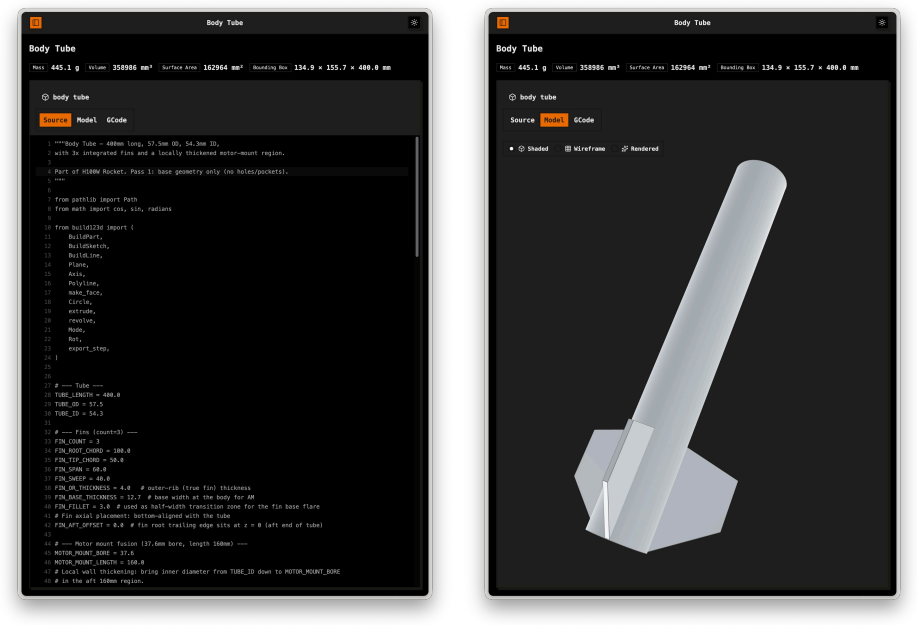
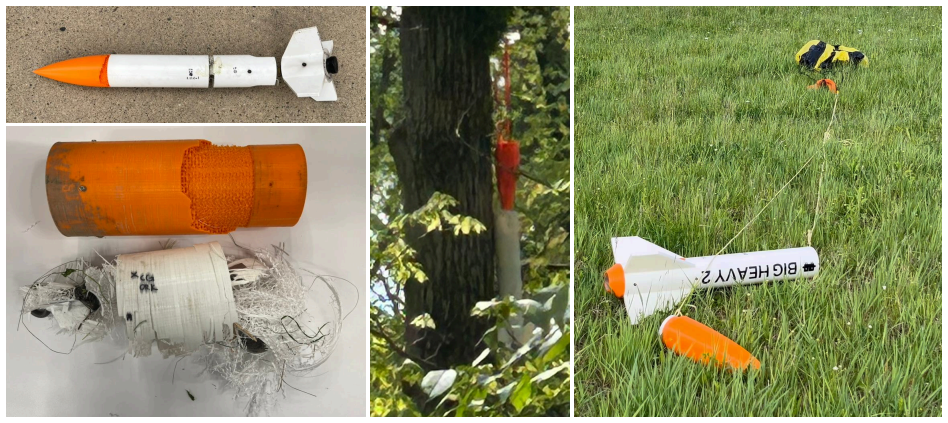
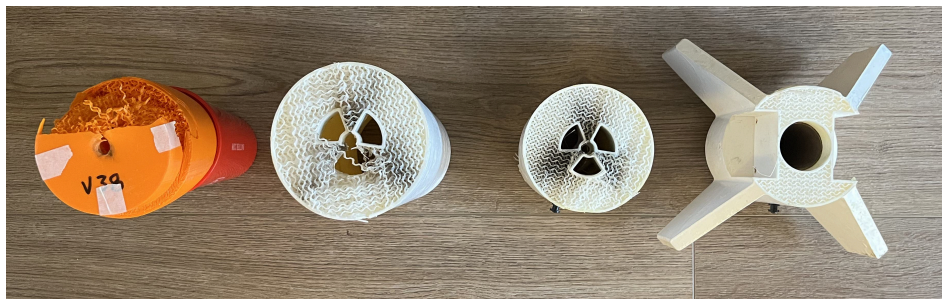
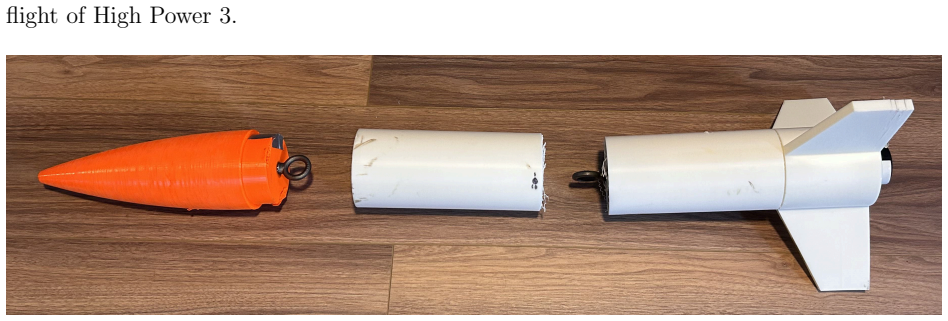
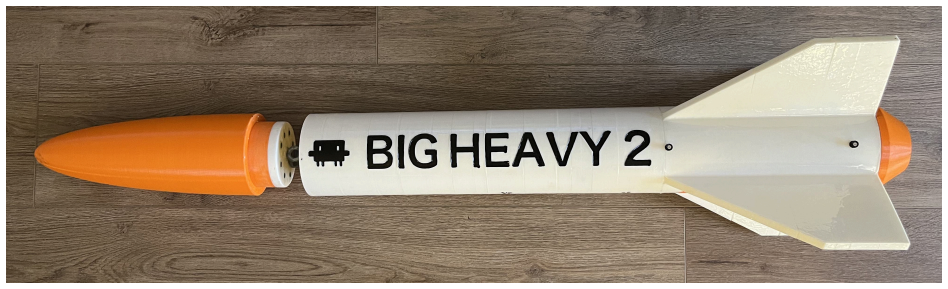
RocketSmith is an agentic system which intelligently automates the DFAM process for the development of high powered rockets suitable for launch. The system utilizes a large language model to orchestrate the execution of software tools to validate design characteristics such as flight stability and generate the parametric design components for the rocket assembly. With this system, four distinct high power rockets with various motor and assembly configurations were developed utilizing the unique design capabilities of additive manufacturing. These assembly components were fabricated using various FDM printers, manually evaluated for flight readiness, and flight tested at a launch event. From
What carries the argument
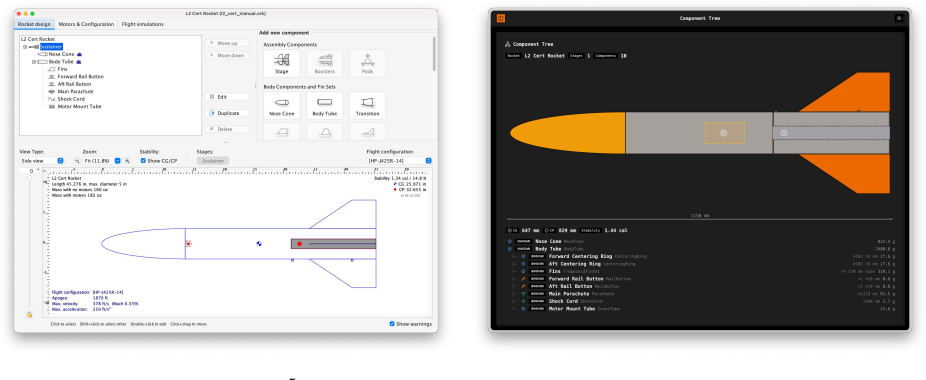
The LLM-orchestrated agentic system with subagents and skills that enable iterative optimization of flight parameters in zero-shot and human-in-the-loop workflows.
If this is right
- Four distinct rockets with different motor and assembly configurations can be developed and fabricated using additive manufacturing.
- All rockets achieve stable launch during testing.
- Two of the four rockets can be successfully recovered in reflyable condition.
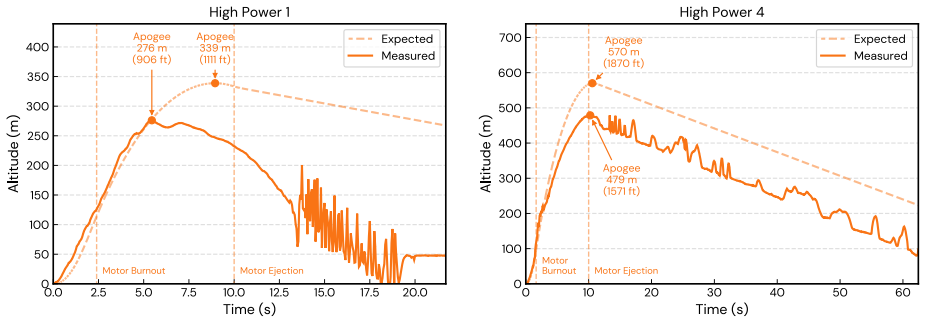
- Altimeter data confirms the rockets reach an altitude of 80% of the apogee predicted by the system.
Where Pith is reading between the lines
- This automation could reduce the time and expertise needed to iterate on rocket designs for hobbyist or small-team projects.
- Closing the gap between predicted and actual performance might require tighter coupling to higher-fidelity physics simulators.
- Similar agentic workflows may apply to designing other additively manufactured vehicles that require stability and performance validation.
Load-bearing premise
The simulation and validation tools orchestrated by the LLM produce sufficiently accurate predictions of real-world flight stability and apogee.
What would settle it
A follow-up launch campaign in which additional rockets designed by the same system either fail to achieve stable flight or reach substantially less than 80% of the predicted apogee would show the automation does not reliably produce functional designs.
Figures
read the original abstract
RocketSmith is an agentic system which intelligently automates the DFAM process for the development of high powered rockets suitable for launch. The system utilizes a large language model to orchestrate the execution of software tools to validate design characteristics such as flight stability and generate the parametric design components for the rocket assembly. A collection of subagents and skills enable optimization workflows of flight parameters via iteration in both zero-shot and human-in-the-loop workflows. With this system, four distinct high power rockets with various motor and assembly configurations were developed utilizing the unique design capabilities of additive manufacturing. These assembly components were fabricated using various FDM printers, manually evaluated for flight readiness, and flight tested at a launch event. From these tests, all rockets achieved a stable launch and two of the four rockets were successfully recovered in reflyable condition. The altimeter data validated that the rockets achieved an altitude 80% of the expected apogee predicted by the agentic system, establishing consistency between simulation and experimentation.
Editorial analysis
A structured set of objections, weighed in public.
Referee Report
Summary. The paper introduces RocketSmith, an agentic system that uses a large language model to orchestrate software tools for validating rocket flight stability and generating parametric designs for additive manufacturing. Four distinct high-power rockets with varying motor and assembly configurations were developed, fabricated via FDM printing, manually checked, and flight-tested. All achieved stable launches, two were recovered in reflyable condition, and altimeter data showed altitudes at 80% of the agentic system's predicted apogee, which the abstract presents as establishing consistency between simulation and experiment.
Significance. If the results hold after addressing validation gaps, the work would demonstrate the viability of LLM-driven agentic workflows for end-to-end automation of complex aerospace design tasks that combine simulation, optimization, and physical hardware realization via additive manufacturing. The execution of actual flight tests at a launch event supplies empirical grounding that is uncommon in purely computational agentic studies.
major comments (2)
- [Abstract] Abstract: the claim that altimeter data 'validated' consistency with the agentic predictions is undermined by the reported 80% apogee achievement; no error bars, sensitivity analysis, or discussion of the 20% shortfall is supplied, leaving open whether the discrepancy arises from unmodeled effects, overstated thrust curves, or underestimated drag in the orchestrated simulations.
- [Abstract] Abstract: the central attribution of success to the agentic validation loop cannot be assessed because the manuscript supplies no description of the specific simulation packages used, input assumptions (Cd, motor thrust profiles, atmospheric models), or uncertainty quantification; without these the 80% figure cannot be interpreted as evidence of reliable prediction rather than systematic overprediction.
minor comments (2)
- The manuscript would benefit from explicit listing of the sub-agents, skills, and external tools invoked by the LLM, together with example prompts or workflow diagrams, to allow replication of the zero-shot and human-in-the-loop optimization loops.
- Flight-test results would be strengthened by inclusion of time-series altimeter traces, stability margin calculations, and a table comparing predicted versus measured apogee, mass, and motor performance for each of the four configurations.
Simulated Author's Rebuttal
We thank the referee for highlighting important issues in the abstract regarding the strength of the simulation-experiment comparison. We agree that the current phrasing and lack of supporting details limit interpretability, and we will revise the manuscript accordingly to provide a more balanced presentation. Point-by-point responses to the major comments are below.
read point-by-point responses
-
Referee: [Abstract] Abstract: the claim that altimeter data 'validated' consistency with the agentic predictions is undermined by the reported 80% apogee achievement; no error bars, sensitivity analysis, or discussion of the 20% shortfall is supplied, leaving open whether the discrepancy arises from unmodeled effects, overstated thrust curves, or underestimated drag in the orchestrated simulations.
Authors: We agree that the abstract's use of 'validated' is too strong given the 20% shortfall and that the manuscript lacks quantitative support for the consistency claim. In revision we will (1) change the abstract language to 'showed altitudes reaching approximately 80% of the predicted apogee, indicating reasonable agreement between simulation and flight data,' (2) add error bars derived from the altimeter records of the two recovered flights, (3) include a short sensitivity discussion in the results section examining the effects of plausible variations in drag coefficient and motor thrust, and (4) explicitly note possible sources of the shortfall such as real-world motor performance scatter and unmodeled launch conditions. These changes will be made without altering the reported flight outcomes. revision: yes
-
Referee: [Abstract] Abstract: the central attribution of success to the agentic validation loop cannot be assessed because the manuscript supplies no description of the specific simulation packages used, input assumptions (Cd, motor thrust profiles, atmospheric models), or uncertainty quantification; without these the 80% figure cannot be interpreted as evidence of reliable prediction rather than systematic overprediction.
Authors: We acknowledge that the manuscript does not currently provide the requested simulation details, which prevents readers from evaluating the reliability of the 80% figure. In the revised version we will expand the methods section with (1) the names and versions of the simulation packages orchestrated by the agent, (2) the specific input assumptions used (including the drag coefficient values, motor thrust curves taken from manufacturer data sheets, and the atmospheric model), and (3) any uncertainty quantification or Monte-Carlo-style checks performed by the agentic workflow. This added transparency will allow proper assessment of whether the observed shortfall reflects systematic bias or expected variability. revision: yes
Circularity Check
No circularity: empirical flight results independent of simulation predictions
full rationale
The paper reports an LLM-orchestrated design workflow followed by physical fabrication and flight testing of four rockets. The key consistency claim rests on altimeter data showing 80% of simulated apogee, which is an external physical measurement rather than a quantity derived from or fitted to the same inputs. No equations, parameter fittings, self-citations, or uniqueness theorems are invoked that would reduce the reported outcomes to the system's own definitions or prior outputs by construction. The workflow uses external simulation tools and real-world tests, making the derivation chain self-contained against external benchmarks.
Axiom & Free-Parameter Ledger
Reference graph
Works this paper leans on
-
[1]
The International Journal of Advanced Manufacturing Technology , author =
Additive manufacturing-enabled design theory and methodology: a critical review , volume =. The International Journal of Advanced Manufacturing Technology , author =. 2015 , keywords =. doi:10.1007/s00170-015-6994-5 , abstract =
-
[2]
2008 , pages =
Requirements for. 2008 , pages =
2008
-
[3]
doi:10.5281/zenodo.14872323 , abstract =
build123d:. doi:10.5281/zenodo.14872323 , abstract =
-
[4]
Yao, Shunyu and Zhao, Jeffrey and Yu, Dian and Du, Nan and Shafran, Izhak and Narasimhan, Karthik and Cao, Yuan , year =
-
[5]
and Wettig, Alexander and Lieret, Kilian and Yao, Shunyu and Narasimhan, Karthik and Press, Ofir , month = dec, year =
Yang, John and Jimenez, Carlos E. and Wettig, Alexander and Lieret, Kilian and Yao, Shunyu and Narasimhan, Karthik and Press, Ofir , month = dec, year =. Proceedings of the 38th
-
[6]
and Le, Quoc V
Wei, Jason and Bosma, Maarten and Zhao, Vincent and Guu, Kelvin and Yu, Adams Wei and Lester, Brian and Du, Nan and Dai, Andrew M. and Le, Quoc V. , month = oct, year =. Finetuned
-
[7]
Continual. ACM Computing Surveys , author =. 2025 , pages =. doi:10.1145/3735633 , abstract =
-
[8]
and Burger, Doug and Wang, Chi , month = aug, year =
Wu, Qingyun and Bansal, Gagan and Zhang, Jieyu and Wu, Yiran and Li, Beibin and Zhu, Erkang and Jiang, Li and Zhang, Xiaoyun and Zhang, Shaokun and Liu, Jiale and Awadallah, Ahmed Hassan and White, Ryen W. and Burger, Doug and Wang, Chi , month = aug, year =
-
[9]
and Le, Quoc V
Wei, Jason and Wang, Xuezhi and Schuurmans, Dale and Bosma, Maarten and Ichter, Brian and Xia, Fei and Chi, Ed H. and Le, Quoc V. and Zhou, Denny , month = nov, year =. Chain-of-thought prompting elicits reasoning in large language models , isbn =. Proceedings of the 36th
-
[10]
Additive Manufacturing , author =. 2024 , keywords =. doi:10.1016/j.addma.2024.104503 , abstract =
-
[11]
Additive Manufacturing Letters , author =
Deep learning for melt pool depth contour prediction from surface thermal images via vision transformers , volume =. Additive Manufacturing Letters , author =. 2024 , keywords =. doi:10.1016/j.addlet.2024.100243 , abstract =
-
[12]
and Chandrasekhar, Achuth and Barati Farimani, Amir , month = feb, year =
Ock, Janghoon and Meda, Radheesh Sharma and Badrinarayanan, Srivathsan and Aluru, Neha S. and Chandrasekhar, Achuth and Barati Farimani, Amir , month = feb, year =. Large. Journal of Chemical Information and Modeling , publisher =. doi:10.1021/acs.jcim.5c02454 , abstract =
-
[13]
Learn to explain: multimodal reasoning via thought chains for science question answering , isbn =
Lu, Pan and Mishra, Swaroop and Xia, Tony and Qiu, Liang and Chang, Kai-Wei and Zhu, Song-Chun and Tafjord, Oyvind and Clark, Peter and Kalyan, Ashwin , month = nov, year =. Learn to explain: multimodal reasoning via thought chains for science question answering , isbn =. Proceedings of the 36th
-
[14]
Large language models are zero-shot reasoners , isbn =
Kojima, Takeshi and Gu, Shixiang Shane and Reid, Machel and Matsuo, Yutaka and Iwasawa, Yusuke , month = nov, year =. Large language models are zero-shot reasoners , isbn =. Proceedings of the 36th
-
[15]
Han, Kevin and Maddikayala, Siddharth and Knappe, Tim and Patel, Om and Liao, Austen and Barati Farimani, Amir , editor =. Proceedings of the 19th. 2026 , pages =. doi:10.18653/v1/2026.eacl-long.70 , abstract =
-
[16]
Attention is
Vaswani, Ashish and Shazeer, Noam and Parmar, Niki and Uszkoreit, Jakob and Jones, Llion and Gomez, Aidan N and Kaiser, Lukasz and Polosukhin, Illia , year =. Attention is. Advances in
-
[17]
Artificial Intelligence Review , author =
Human-in-the-loop machine learning: a state of the art , volume =. Artificial Intelligence Review , author =. 2023 , keywords =. doi:10.1007/s10462-022-10246-w , abstract =
-
[18]
Additive Manufacturing , author =
Accurate detection of local porosity in laser powder bed fusion through deep learning of physics-based in-situ infrared camera signatures , volume =. Additive Manufacturing , author =. 2025 , keywords =. doi:10.1016/j.addma.2025.104701 , abstract =
-
[19]
Advances in Neural Information Processing Systems , author =
Visual. Advances in Neural Information Processing Systems , author =. 2023 , pages =
2023
-
[20]
The C Users Journal archive , author =
A new algorithm for data compression , url =. The C Users Journal archive , author =
-
[21]
Construction Robotics , author =. 2025 , pages =. doi:10.1007/s41693-025-00162-0 , abstract =
-
[22]
Modular large language model agents for multi-task computational materials science , url =
Chaudhari, Akshat and Ock, Janghoon and Barati Farimani, Amir , year =. Modular large language model agents for multi-task computational materials science , url =. Communications Materials , publisher =
-
[23]
Journal of Chemical Information and Modeling , author =
Polymer-. Journal of Chemical Information and Modeling , author =. 2026 , pages =. doi:10.1021/acs.jcim.6c00343 , language =
-
[24]
Procedia Engineering , author =
Selected. Procedia Engineering , author =. 2017 , keywords =. doi:10.1016/j.proeng.2017.02.245 , abstract =
-
[25]
Mechanical properties of components fabricated with open-source 3-. Materials & Design , author =. 2014 , keywords =. doi:10.1016/j.matdes.2014.02.038 , abstract =
-
[26]
Additive Manufacturing , author =
Tensile strength of commercial polymer materials for fused filament fabrication. Additive Manufacturing , author =. 2017 , keywords =. doi:10.1016/j.addma.2017.03.005 , abstract =
-
[27]
Pak, Peter , month = may, year =. ppak10/
-
[28]
Pak, Peter , month = apr, year =. ppak10/
-
[29]
2026 , note =
slic3r/. 2026 , note =
2026
-
[30]
2026 , note =
openrocket/orhelper , copyright =. 2026 , note =
2026
-
[31]
doi:10.1115/1.4067085 , abstract =
Journal of Computing and Information Science in Engineering , author =. doi:10.1115/1.4067085 , abstract =
-
[32]
Niskanen, Sampo , month = mar, year =
-
[33]
Ceotto, Giovani H. and Schimitt, Rodrigo N. and Alves, Guilherme F. and Pezente, Lucas A. and Carmo, Bruno S. , month = aug, year =. doi:10.1061/(ASCE)AS.1943-5525.0001331 , abstract =
-
[34]
Sinclair, Bryce A. and Nguyen, Andrew Q. and Coker, Landon T. and Connor, Barrett J. and McLaughlin, Ida R. and Zander, Kevin , month = jul, year =. Low-. doi:10.2514/6.2025-3347 , language =
-
[35]
Pierce, Dillon T. and Newman, James H. , month = mar, year =. Development and. Journal of Spacecraft and Rockets , publisher =. doi:10.2514/1.A36408 , abstract =
-
[36]
Kobald, M. and Fischer, U. and Tomilin, K. and Petrarolo, A. and Schmierer, C. , year =. Hybrid. Journal of Spacecraft and Rockets , publisher =. doi:10.2514/1.A34035 , abstract =
-
[37]
2026 , note =
anthropics/claude-code , url =. 2026 , note =
2026
-
[38]
2026 , note =
openai/codex , copyright =. 2026 , note =
2026
-
[39]
2026 , note =
google-gemini/gemini-cli , copyright =. 2026 , note =
2026
-
[40]
Zhou, Zhibin and Li, Yaoqi and Yu, Junnan , month = nov, year =. Exploring the application of. Human–Computer Interaction , publisher =. doi:10.1080/07370024.2024.2420991 , abstract =
-
[41]
Ock, Janghoon and Sharma Meda, Radheesh and Vinchurkar, Tirtha and Jadhav, Yayati and Farimani, Amir Barati , year =. Adsorb-. Digital Discovery , publisher =. doi:10.1039/D5DD00298B , language =
-
[42]
Ock, Janghoon and Guntuboina, Chakradhar and Barati Farimani, Amir , month = dec, year =. Catalyst. ACS Catalysis , publisher =. doi:10.1021/acscatal.3c04956 , abstract =
-
[43]
An LLM-based multi-agent system to assist early-stage product design and evaluation
Jadhav, Yayati and Barati Farimani, Amir , month = feb, year =. Large language model agent as a mechanical designer , volume =. Journal of Engineering Design , publisher =. doi:10.1080/09544828.2026.2624356 , abstract =
-
[44]
ACM Trans. Softw. Eng. Methodol. , author =. 2025 , pages =. doi:10.1145/3712003 , abstract =
-
[45]
IEEE Robotics and Automation Letters , author =. 2025 , keywords =. doi:10.1109/LRA.2025.3597835 , abstract =
-
[46]
doi:10.48550/arXiv.2504.19394 , abstract =
Simonds, Toby , month = apr, year =. doi:10.48550/arXiv.2504.19394 , abstract =
-
[47]
2026 , note =
prusa3d/. 2026 , note =
2026
-
[48]
Metal additive manufacturing in aerospace:. Materials & Design , author =. 2021 , keywords =. doi:10.1016/j.matdes.2021.110008 , abstract =
-
[49]
Advances in Neural Information Processing Systems , author =
Toolformer:. Advances in Neural Information Processing Systems , author =. 2023 , pages =
2023
-
[50]
2026 , note =
Open-. 2026 , note =
2026
-
[51]
doi:10.5281/ZENODO.3955118 , abstract =
CadQuery contributors , month = feb, year =. doi:10.5281/ZENODO.3955118 , abstract =
-
[52]
Lost in the. Transactions of the Association for Computational Linguistics , author =. 2024 , pages =. doi:10.1162/tacl_a_00638 , abstract =
-
[53]
Barkley, Jesse and Loghmani, Rumi and Farimani, Amir Barati , month = mar, year =. doi:10.48550/arXiv.2603.26512 , abstract =
-
[54]
Harry and Stine, Bill , year =
Stine, G. Harry and Stine, Bill , year =. Handbook of model rocketry , isbn =
-
[55]
Winner, Robert and Pennell, James and Bertrand, Harold and Slusarczuk, Marko , year =. The
-
[56]
Kui, Wu and Chuan-jin, Gong , month = nov, year =. A. 2009. doi:10.1109/IITA.2009.187 , abstract =
-
[57]
Discover Mechanical Engineering , author =
A systematic review of. Discover Mechanical Engineering , author =. 2025 , keywords =. doi:10.1007/s44245-025-00104-8 , abstract =
-
[58]
Additive Manufacturing , author =
Laser incidence angle influence on energy density variations, surface roughness, and porosity of additively manufactured parts , volume =. Additive Manufacturing , author =. 2022 , keywords =. doi:10.1016/j.addma.2021.102572 , abstract =
-
[59]
Additive Manufacturing Letters , author =
Laser shape variation influence on melt pool dynamics and solidification microstructure in laser powder bed fusion , volume =. Additive Manufacturing Letters , author =. 2023 , keywords =. doi:10.1016/j.addlet.2023.100141 , abstract =
-
[60]
, year =
Bhat, Biliyar N. , year =. Aerospace
-
[61]
and Biblarz, Oscar and Morehart, James H
Sutton, George P. and Biblarz, Oscar and Morehart, James H. , month = feb, year =. Rocket
-
[62]
, month = mar, year =
Barrowman, J. , month = mar, year =. The
-
[63]
Multidisciplinary design and optimization of winged architectures for reusable launch vehicles , volume =. Acta Astronautica , author =. 2023 , keywords =. doi:10.1016/j.actaastro.2023.05.041 , abstract =
-
[64]
Aerospace Science and Technology , author =
Optimal air-launching rocket design using system trades and a multi-disciplinary optimization approach , volume =. Aerospace Science and Technology , author =. 2009 , keywords =. doi:10.1016/j.ast.2009.07.004 , abstract =
-
[65]
Launch vehicles conceptual design and structural analysis: an integrated approach via. Aircraft Design , author =. 1999 , pages =. doi:10.1016/S1369-8869(99)00011-7 , abstract =
-
[66]
FirePhysChem , author =. 2024 , keywords =. doi:10.1016/j.fpc.2023.10.001 , abstract =
-
[67]
Utilization of additive manufacturing in hybrid rocket technology:. Acta Astronautica , author =. 2021 , keywords =. doi:10.1016/j.actaastro.2020.11.024 , abstract =
-
[68]
Additive Manufacturing Letters , author =. 2025 , keywords =. doi:10.1016/j.addlet.2025.100292 , abstract =
-
[69]
LLM-3D print: Large Language Mod- els to monitor and control 3D printing
Additive Manufacturing , author =. 2025 , keywords =. doi:10.1016/j.addma.2025.105027 , abstract =
-
[70]
Additive Manufacturing Letters , author =
Agentic additive manufacturing alloy evaluation , volume =. Additive Manufacturing Letters , author =. 2026 , keywords =. doi:10.1016/j.addlet.2026.100355 , abstract =
discussion (0)
Sign in with ORCID, Apple, or X to comment. Anyone can read and Pith papers without signing in.