Robust Radiative Cooling in Functionalizable Silica Microsphere Paints
Pith reviewed 2026-06-28 18:34 UTC · model grok-4.3
The pith
Silica microsphere coatings for radiative cooling show performance independent of particle diameter in the diffusive regime.
A machine-rendered reading of the paper's core claim, the machinery that carries it, and where it could break.
Core claim
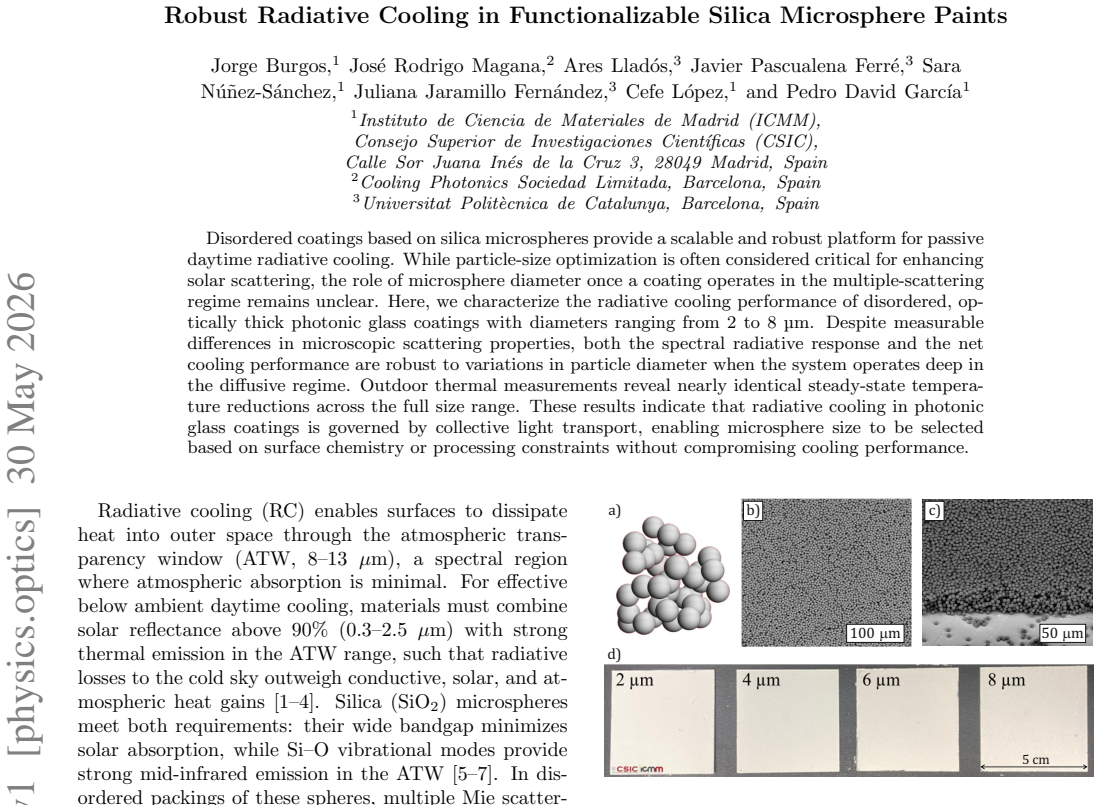
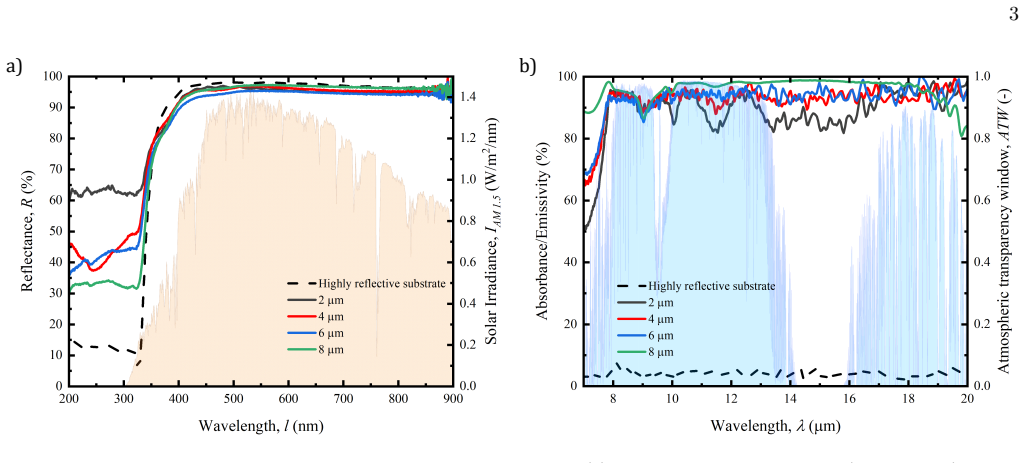
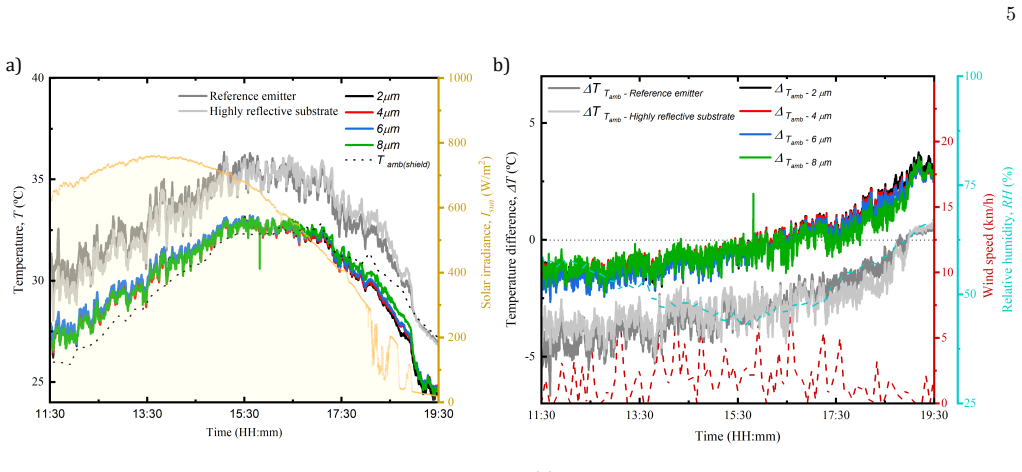
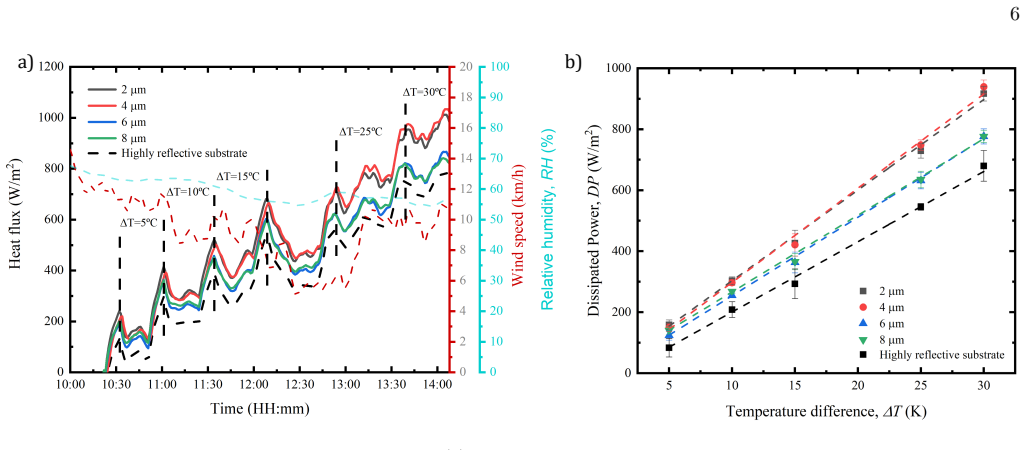
Disordered coatings based on silica microspheres provide a scalable and robust platform for passive daytime radiative cooling. Both the spectral radiative response and the net cooling performance are robust to variations in particle diameter when the system operates deep in the diffusive regime. Outdoor thermal measurements reveal nearly identical steady-state temperature reductions across the full size range from 2 to 8 micrometers.
What carries the argument
The diffusive multiple-scattering regime in optically thick photonic glass coatings, where collective light transport determines the radiative properties independent of individual microsphere scattering details.
If this is right
- Microsphere size can be selected based on surface chemistry or processing constraints without compromising cooling performance.
- Radiative cooling in these coatings is governed by collective light transport rather than single-particle optimization.
- Scalable manufacturing is facilitated by tolerance to diameter variations in the 2-8 micrometer range.
- The approach enables robust passive daytime cooling platforms using disordered silica microspheres.
Where Pith is reading between the lines
- Production processes could prioritize larger particles for better flow or coating uniformity while retaining cooling efficacy.
- Similar robustness might hold for other disordered particle systems in optics if they reach the diffusive limit.
- Design of radiative coolers could shift focus from particle size tuning to optimizing optical thickness and material properties.
Load-bearing premise
The coatings are optically thick and operate deep in the diffusive multiple-scattering regime for the entire 2-8 micrometer diameter range, with outdoor measurements isolating particle-size effects without major confounding variables.
What would settle it
Observing significantly different steady-state temperature reductions for coatings with different microsphere diameters under identical outdoor conditions would falsify the claim of robustness.
Figures
read the original abstract
Disordered coatings based on silica microspheres provide a scalable and robust platform for passive daytime radiative cooling. While particle-size optimization is often considered critical for enhancing solar scattering, the role of microsphere diameter once a coating operates in the multiple-scattering regime remains unclear. Here, we characterize the radiative cooling performance of disordered, optically thick photonic glass coatings with diameters ranging from 2 to 8 um. Despite measurable differences in microscopic scattering properties, both the spectral radiative response and the net cooling performance are robust to variations in particle diameter when the system operates deep in the diffusive regime. Outdoor thermal measurements reveal nearly identical steady-state temperature reductions across the full size range. These results indicate that radiative cooling in photonic glass coatings is governed by collective light transport, enabling microsphere size to be selected based on surface chemistry or processing constraints without compromising cooling performance.
Editorial analysis
A structured set of objections, weighed in public.
Referee Report
Summary. The manuscript reports that disordered, optically thick silica microsphere coatings (diameters 2–8 μm) for passive daytime radiative cooling exhibit robustness in both spectral radiative response and net cooling performance once operating deep in the diffusive multiple-scattering regime. Outdoor thermal measurements show nearly identical steady-state temperature reductions across the full size range, indicating that cooling is governed by collective light transport rather than individual particle scattering details. This allows microsphere size to be chosen based on surface chemistry or processing needs without compromising performance.
Significance. If the reported robustness holds, the result is significant for scalable radiative cooling applications because it relaxes the need for precise particle-size optimization, enabling functionalizable coatings. The work provides concrete experimental support (spectral data plus outdoor steady-state measurements) for collective transport in photonic glasses and demonstrates practical invariance over a technologically relevant diameter window.
minor comments (3)
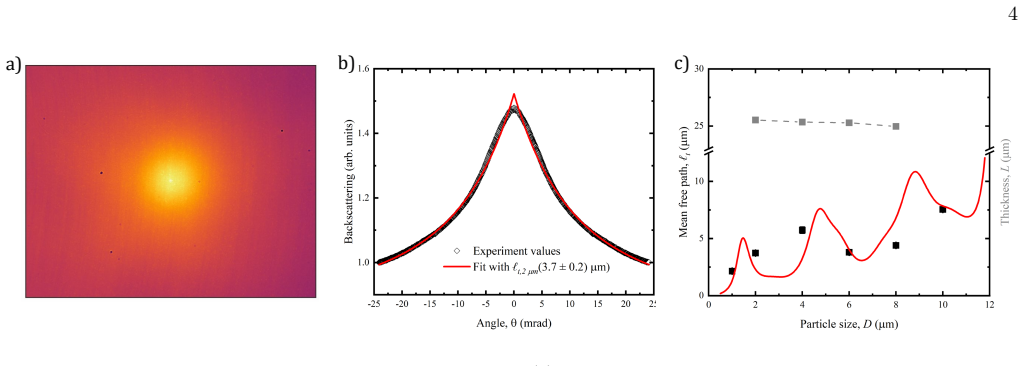
- [§3] §3 (Experimental Methods): The optical-thickness verification and transport-mean-free-path estimates should be presented with explicit numerical values or a supplementary table for each diameter to allow readers to confirm the 'deep diffusive regime' condition independently.
- [Figure 4] Figure 4 and associated text: The outdoor temperature-reduction data would benefit from an explicit statement of how substrate and humidity variations were controlled or shown to be negligible across the sample set.
- The manuscript would be strengthened by adding a brief comparison (even qualitative) to existing literature on size-dependent scattering in the diffusive limit of photonic glasses.
Simulated Author's Rebuttal
We thank the referee for the positive summary and significance assessment of our work on robust radiative cooling performance in disordered silica microsphere coatings. The recommendation for minor revision is noted. No major comments were provided in the report, so we have no specific points requiring rebuttal or revision at this stage.
Circularity Check
No significant circularity; claims rest on direct experimental observations
full rationale
The paper reports experimental characterization of silica microsphere coatings, with the central claim of robustness to particle diameter (2-8 um) in the diffusive regime supported by measured spectral responses and outdoor steady-state temperature reductions that are nearly identical across sizes. No equations, fitted parameters, or theoretical derivations are presented that reduce any prediction to its inputs by construction. The work contains no load-bearing self-citations, ansatzes, or uniqueness theorems; it is an empirical study whose results are falsifiable via the reported measurements rather than tautological.
Axiom & Free-Parameter Ledger
Reference graph
Works this paper leans on
-
[1]
M. M. Hossain and M. Gu, Radiative cooling: Principles, progress, and potentials.Adv. Sci.2016,3(7), 1500360. DOI: 10.1002/advs.201500360
-
[2]
B. Zhao, M. Hu, X. Ao, N. Chen, and G. Pei, Radiative cooling: A review of fundamentals, materials, applica- tions, and prospects.Appl. Energy2019,236, 489–513. DOI: 10.1016/j.apenergy.2018.12.018
-
[3]
P. Liuet al., Functional radiative cooling: Basic con- cepts, materials, and best practices in measurements. ACS Appl. Electron. Mater.2023,5(12), 6395–6422. DOI: 10.1021/acsaelm.3c01023
-
[4]
J. P. Bijarniya, J. Sarkar, and P. Maiti, Review on passive daytime radiative cooling: Fundamentals, recent researches, challenges and opportunities.Re- new. Sustain. Energy Rev.2021,143, 110263. DOI: 10.1016/j.rser.2020.110263
-
[5]
A. P. Raman, M. A. Anoma, L. Zhu, E. Rephaeli, and S. Fan, Passive radiative cooling below ambient air tem- perature under direct sunlight.Nature2014,515(7528), 540–544. DOI: 10.1038/nature13883
-
[6]
Y. Zhai, Y. Ma, S. N. David, D. Zhao, R. Lou, G. Tan, R. Yang, and X. Yin, Scalable-manufactured random- ized glass–polymer hybrid metamaterial for daytime ra- diative cooling.Science2017,355(6329), 1062–1066. DOI: 10.1126/science.aai7899
-
[7]
S. Atiganyanun, J. B. Plumley, S. J. Han, K. Hsu, J. Cytrynbaum, T. L. Peng, S. M. Han, and S. E. Han, Effective radiative cooling by paint-format microsphere- based photonic random media.ACS Photonics2018,5 (4), 1181–1187. DOI: 10.1021/acsphotonics.7b01492
-
[8]
J. Kanget al., Design strategies, manufacturing, and applications of radiative cooling technologies.Nanopho- tonics2025,14(15), 2355–2395. DOI: 10.1515/nanoph- 2025-0159
-
[9]
P. D. Garc´ ıa, R. Sapienza, ´A. Blanco, and C. L´ opez, Photonic glass: A novel random material for light. Adv. Mater.2007,19(18), 2597–2602. DOI: 10.1002/adma.200602426
-
[10]
P. P. Ghimire and M. Jaroniec, Renaissance of St¨ ober method for synthesis of colloidal particles: New develop- ments and opportunities.J. Colloid Interface Sci.2021, 584, 838–865. DOI: 10.1016/j.jcis.2020.10.014
-
[11]
C. Park, C. Park, S. Park, J. Lee, Y. S. Kim, and Y. Yoo, Hybrid emitters with raspberry-like hollow SiO 2 spheres for passive daytime radiative cooling.Chem. Eng. J.2023,459, 141652. DOI: 10.1016/j.cej.2023.141652
-
[12]
J. Jaramillo-Fernandez, G. L. Whitworth, J. A. Pariente, A. Blanco, P. D. Garcia, C. Lopez, and C. M. Sotomayor- Torres, A self-assembled 2D thermofunctional material for radiative cooling.Small2019,15(52), 1905290. DOI: 10.1002/smll.201905290
-
[13]
H. Bao, C. Yan, B. Wang, X. Fang, C. Y. Zhao, and X. Ruan, Double-layer nanoparticle-based coat- ings for efficient terrestrial radiative cooling.Sol. Energy Mater. Sol. Cells2017,168, 78–84. DOI: 10.1016/j.solmat.2017.04.020
-
[14]
X. Tian, H. Wang, Y. Lu, M. Wang, J. Wang, H. Liu, W. Zhou, G. Zhao, J. Gao, F. Sun, X. Meng, and Z. Qu, Auto-deposited microparticle composite coating for low-cost and efficient daytime radiative cooling.ACS Appl. Mater. Interfaces2025,17(5), 8274–8284. DOI: 10.1021/acsami.4c18499
-
[17]
E. Akkermans, P. E. Wolf, and R. Maynard, Coherent backscattering of light by disordered media: Analysis of the peak line shape.Phys. Rev. Lett.1986,56(14), 1471–1474. DOI: 10.1103/PhysRevLett.56.1471. 8
-
[18]
G. J. Aubry, L. Schertel, M. Chen, H. Weyer, C. M. Aegerter, S. Polarz, H. C¨ olfen, and G. Maret, Res- onant transport and near-field effects in photonic glasses. Phys. Rev. A2017,96(4), 043871. DOI: 10.1103/Phys- RevA.96.043871
-
[19]
G. L. Whitworth, J. Jaramillo-Fernandez, J. A. Pariente, P. D. Garcia, A. Blanco, C. Lopez, and C. M. Sotomayor- Torres, Simulations of micro-sphere/shell 2D silica pho- tonic crystals for radiative cooling.Opt. Express2021, 29(11), 16857–16866. DOI: 10.1364/OE.420989
-
[20]
X. Huanget al., Do-it-yourself radiative cooler as a radia- tive cooling standard and cooling component for device design.J. Photonics Energy2022,12(1), 012112. DOI: 10.1117/1.JPE.12.012112. 9 Supplementary Information Robust Radiative Cooling in F unctionalizable Silica Microsphere Paints Coherent Backscattering The black symbols show the transport mean ...
discussion (0)
Sign in with ORCID, Apple, or X to comment. Anyone can read and Pith papers without signing in.