Recursive Identification of EIV-ARX Models for Time Varying SISO Processes
Pith reviewed 2026-06-28 18:32 UTC · model grok-4.3
The pith
A recursive algorithm updates EIV-ARX model parameters and noise variances in real time for time-varying SISO processes.
A machine-rendered reading of the paper's core claim, the machinery that carries it, and where it could break.
Core claim
The rARX-DIPCA algorithm recursively updates model parameters and noise variances for EIV-ARX models of time-varying SISO processes by building on recursive iterative PCA, without requiring storage of historical data beyond a specified lag window, while simultaneously identifying process order, time delay, and noise variances.
What carries the argument
The rARX-DIPCA algorithm, which applies recursive iterative PCA to perform online covariance updates within a finite lag window for tracking changes in EIV-ARX parameters and variances.
If this is right
- Enables real-time adaptation to sensor degradation and changes in model coefficients.
- Simultaneously identifies process order, time delay, and noise variances during operation.
- Maintains computational efficiency through online covariance updates without full data storage.
- Demonstrates effective tracking performance on benchmark systems.
Where Pith is reading between the lines
- The approach may reduce storage and recomputation costs in continuous industrial monitoring compared to batch methods.
- It could support integration with adaptive controllers that require ongoing model updates.
- Extension to cases with multiple inputs or outputs would require generalizing the recursive PCA step.
Load-bearing premise
An EIV-ARX structure adequately represents the underlying time-varying SISO process and the recursive iterative PCA updates accurately track parameters and variances using only a finite lag window.
What would settle it
A simulation in which true model coefficients or noise variances change abruptly within the lag window and the algorithm fails to update its estimates accordingly.
Figures

read the original abstract
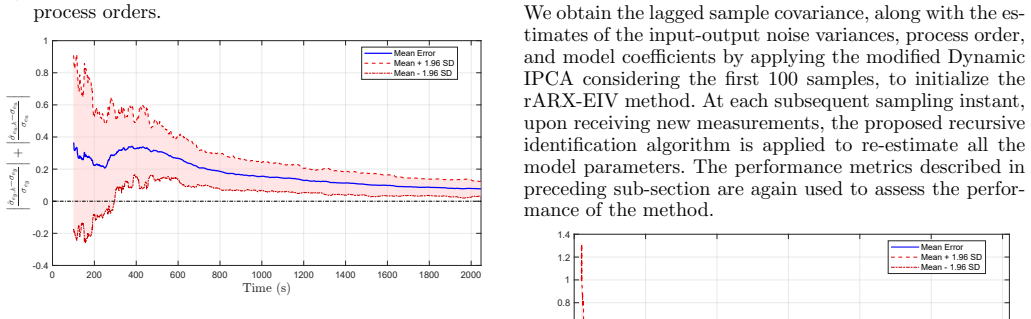
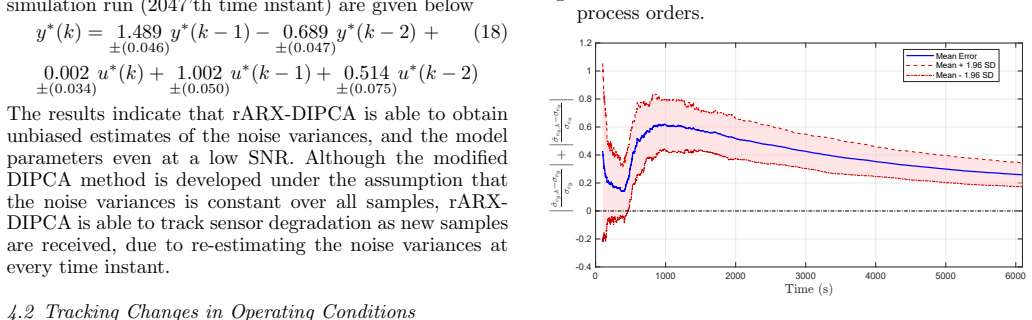
This paper proposes a recursive algorithm, rARX-DIPCA, for identifying errors-in-variables autoregressive models with exogenous input (EIV-ARX), for tracking time-varying SISO processes. Building on a recently developed recursive iterative PCA method, the proposed algorithm recursively updates model parameters and noise variances as new measurements arrive, without storing historical data beyond a specified lag window. The method enables real-time adaptation to sensor degradation, and changes in model coefficients. The algorithm simultaneously identifies process order, time delay, and noise variances while maintaining computational efficiency through online covariance updates. Simulation studies on benchmark systems demonstrate effective tracking performance and practical applicability.
Editorial analysis
A structured set of objections, weighed in public.
Referee Report
Summary. The manuscript proposes the rARX-DIPCA algorithm, which extends a recently developed recursive iterative PCA method to identify EIV-ARX models for time-varying SISO processes. The algorithm recursively updates model parameters and noise variances online as new measurements arrive, using covariance updates over a finite lag window without storing full historical data. It simultaneously identifies process order, time delay, and noise variances, and is claimed to enable real-time adaptation to changes in coefficients and sensor degradation, with simulation studies on benchmark systems demonstrating effective tracking performance.
Significance. If substantiated, the approach would provide a memory-efficient online method for EIV identification in non-stationary settings, which is valuable for real-time applications such as adaptive control. The combination of recursive PCA updates with joint identification of order, delay, and variances, while avoiding full data storage, represents a practical strength for implementation on resource-constrained systems.
major comments (3)
- [Abstract] Abstract: the claim that 'simulation studies on benchmark systems demonstrate effective tracking performance' provides no quantitative metrics, error bars, baseline comparisons, or details on the procedures for order and delay identification. This is load-bearing for the central claim of practical applicability, as the only supporting evidence remains unverifiable.
- [Algorithm description] The recursive covariance update over the finite lag window (described in the algorithm section): no analysis, bounds, or forgetting factor is provided to ensure that process statistics remain approximately stationary within each window when coefficients or noise levels vary on a comparable timescale. If violated, the accumulated covariance becomes a mixture of regimes, biasing the DIPCA iteration and noise separation.
- [Algorithm description] The central claim that the method identifies process order, time delay, and noise variances recursively: no derivation or convergence argument is supplied showing that the online DIPCA updates recover these quantities consistently under time variation, leaving the joint identification procedure without theoretical support.
minor comments (1)
- [Algorithm description] The lag window size is listed as a free parameter but its selection procedure or sensitivity is not discussed, which affects reproducibility.
Simulated Author's Rebuttal
We thank the referee for the constructive feedback on our manuscript. We address each major comment below and outline the corresponding revisions.
read point-by-point responses
-
Referee: [Abstract] Abstract: the claim that 'simulation studies on benchmark systems demonstrate effective tracking performance' provides no quantitative metrics, error bars, baseline comparisons, or details on the procedures for order and delay identification. This is load-bearing for the central claim of practical applicability, as the only supporting evidence remains unverifiable.
Authors: We agree that the abstract should be strengthened with quantitative details. In the revised version, we will expand the abstract to report specific metrics such as average parameter estimation errors with standard deviations from Monte Carlo runs, comparisons against non-recursive EIV methods, and a concise description of the order and delay identification steps used in the benchmark simulations. revision: yes
-
Referee: [Algorithm description] The recursive covariance update over the finite lag window (described in the algorithm section): no analysis, bounds, or forgetting factor is provided to ensure that process statistics remain approximately stationary within each window when coefficients or noise levels vary on a comparable timescale. If violated, the accumulated covariance becomes a mixture of regimes, biasing the DIPCA iteration and noise separation.
Authors: This point is well taken. The current manuscript relies on an implicit local-stationarity assumption within the lag window but does not supply explicit bounds or a forgetting factor. We will revise the algorithm section to include (i) a guideline for selecting window length relative to expected variation rate and (ii) an optional exponential forgetting factor in the covariance recursion, together with a short discussion of the resulting bias-variance trade-off. revision: yes
-
Referee: [Algorithm description] The central claim that the method identifies process order, time delay, and noise variances recursively: no derivation or convergence argument is supplied showing that the online DIPCA updates recover these quantities consistently under time variation, leaving the joint identification procedure without theoretical support.
Authors: The recursive identification re-applies the batch DIPCA procedure to the updated covariance matrix at each time step. While the manuscript does not contain a formal convergence proof for the time-varying case, the approach inherits consistency properties from the underlying batch DIPCA under the local-stationarity assumption enforced by the sliding window. We will add a clarifying remark in the algorithm section that states this inheritance and the conditions (sufficiently slow variation relative to window length) under which consistent tracking is expected, supported by the reported simulation evidence. revision: partial
Circularity Check
Recursive EIV-ARX method extends prior PCA without reducing claims to self-fit or definition
full rationale
The paper proposes rARX-DIPCA as a recursive extension of an existing iterative PCA approach for online EIV-ARX identification in time-varying SISO systems. It uses online covariance updates over a finite lag window to track parameters, variances, order, and delay. No equations or steps in the provided description reduce a claimed prediction or result to a fitted input or self-definition by construction. Simulation studies on benchmarks supply independent validation. Any self-citation to the base recursive PCA method is not load-bearing for the central integration claim, as the new algorithm adds specific handling for EIV-ARX structure, time delay, and order selection. This qualifies as normal extension rather than circularity.
Axiom & Free-Parameter Ledger
free parameters (1)
- lag window size
Reference graph
Works this paper leans on
-
[1]
Cao, P., Luo, X., and Song, X. (2018). Modeling and iden- tification for soft sensor systems based on the separation of multi-dynamic and static characteristics.Chinese Journal of Chemical Engineering, 26(1), 137–143
2018
-
[2]
Diversi, R., Guidorzi, R., and Soverini, U. (2010). Identi- fication of ARX and ARARX models in the presence of input and output noises.European Journal of Control, 16(3), 242–255
2010
-
[3]
and Nicholson, H
Fernando, K. and Nicholson, H. (1985). Identification of linear systems with input and output noise: the Koopmans-Levin method.IEE Proceedings D (Control Theory and Applications), 132, 30–36
1985
-
[4]
Ikenoue, M., Kanae, S., Yang, Z.J., and Wada, K. (2005). Identification of noisy input-output system using bias- compensated least-squares method.IF AC Proceedings Volumes, 38(1), 803–808. 16th IFAC World Congress
2005
-
[5]
Li, W., Yue, H., Valle-Cervantes, S., and Qin, S. (2000). Recursive PCA for adaptive process monitoring.Journal of Process Control, 10(5), 471–486
2000
-
[6]
Maurya, D., Tangirala, A.K., and Narasimhan, S. (2018). Identification of errors-in-variables models using dy- namic iterative principal component analysis.Indus- trial & Engineering Chemistry Research, 57(35), 11939– 11954
2018
-
[7]
Maurya, D., Tangirala, A.K., and Narasimhan, S. (2022). Identification of errors-in-variables ARX models us- ing modified dynamic iterative PCA.Journal of the Franklin Institute, 359(13), 7069–7090
2022
-
[8]
Picci, G., Falconi, L., Ferrante, A., and Zorzi, M. (2023). Hidden factor estimation in dynamic generalized factor analysis models.Automatica, 149, 110834
2023
-
[9]
and Narasimhan, S
Pradeep, M. and Narasimhan, S. (2025). Recursive it- erative principal component analysis.Computers & Chemical Engineering, 201, 109170
2025
-
[10]
Prakash, J., Narasimhan, S., and Patwardhan, S.C. (2005). Integrating model based fault diagnosis with model predictive control.Industrial & Engineering Chemistry Research, 44(12), 4344–4360
2005
-
[11]
and Huang, B
Prakash, O. and Huang, B. (2025). Real-time update of data-driven reduced and full order models with applica- tions.Computers & Chemical Engineering, 194, 108923. S¨ oderstr¨ om, T. and Stoica, P. (2002). Instrumental vari- able methods for system identification.Circuits, Sys- tems and Signal Processing, 21(1), 1–9
2025
-
[12]
Zhang, J., Guo, F., Hao, K., Chen, L., and Huang, B. (2022). Identification of errors-in-variables ARX model with time varying time delay.Journal of Process Con- trol, 115, 134–144
2022
-
[13]
Zhao, Y., Fatehi, A., and Huang, B. (2018). Robust estimation of ARX models with time varying time delays using Variational Bayesian approach.IEEE Transactions on Cybernetics, 48(2), 532–542
2018
-
[14]
Zheng, W.X. (2002). A bias correction method for iden- tification of linear dynamic errors-in-variables models. IEEE Transactions on Automatic Control, 47(7), 1142– 1147
2002
discussion (0)
Sign in with ORCID, Apple, or X to comment. Anyone can read and Pith papers without signing in.