Frontlines and faultlines: How the Russo-Ukrainian conflict reshapes the landscape of scientific research
Pith reviewed 2026-06-28 16:08 UTC · model grok-4.3
The pith
The 2014 and 2022 escalations triggered Ukrainian scholar migration that caused talent loss, topic shifts, and fractured global research networks.
A machine-rendered reading of the paper's core claim, the machinery that carries it, and where it could break.
Core claim
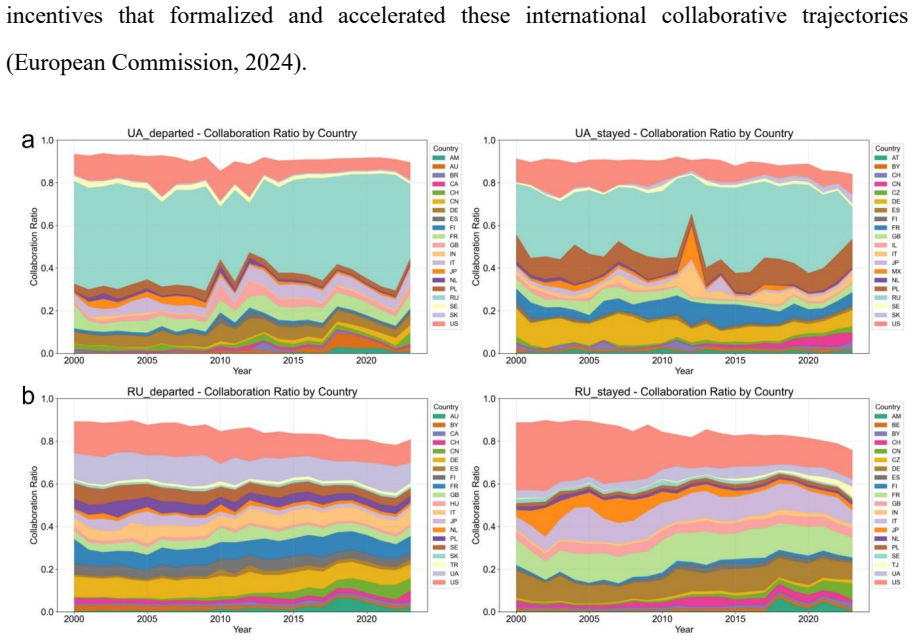
Significant migration followed the 2014 and 2022 events, causing severe talent loss and a sharp decline in domestic research visibility in Ukraine. Migrated Ukrainian scholars shifted toward internationalized basic sciences, whereas active scholars who remained focused on applied fields relevant to national resilience and reconstruction. Global networks fractured: traditional ties between Russia and the West, as well as between Ukraine and Russia, dissolved. These were replaced by new alignments between Russia and neighboring countries, and between Ukraine and the West. Migrating Ukrainian scholars face challenges assuming key research roles, though academic communities in smaller host natio
What carries the argument
Analysis of publication data to track scholar migration, research topic changes, and shifts in international collaboration networks across 193 regions.
If this is right
- Ukraine experiences severe talent loss and reduced domestic research visibility after the escalations.
- Migrated Ukrainian scholars move into international basic sciences while those remaining focus on applied resilience and reconstruction fields.
- Traditional Russia-West and Ukraine-Russia research ties dissolve and are replaced by new alignments with neighboring countries and the West respectively.
- Migrating Ukrainian scholars encounter difficulty assuming key research roles, though some gain leadership positions in smaller host nations.
- Russian scholars experience reduced research prominence in most countries following sanctions.
Where Pith is reading between the lines
- The same migration-driven split between basic and applied research priorities could appear in other countries facing prolonged geopolitical conflict.
- Smaller nations that receive migrating scholars may gain long-term research leadership capacity in specific fields.
- Database tracking of publication and collaboration changes offers a method to monitor how future crises affect national scientific systems.
Load-bearing premise
Observed changes in publication volume, topic focus, and collaboration patterns can be causally attributed to the 2014 and 2022 conflict events rather than other economic, policy, or data-coverage factors, and publication databases accurately capture scholar migration and research activity.
What would settle it
A demonstration that similar drops in output, topic shifts, or network changes occurred at the same rate in non-involved countries or during non-conflict periods would undermine the causal link to the Russo-Ukrainian events.
Figures
read the original abstract
Geopolitical conflict poses significant challenges to research and innovation policy by disrupting scientific systems and talent mobility. This study analyzes the impact of the conflict between Russia and Ukraine, particularly the escalations in 2014 and 2022, on the academic landscapes of both countries. We analyzed publication data from 2000 to 2023, encompassing over 1.8 million papers, one million scholars, and 2300 institutions across Ukraine and Russia, alongside collaboration data spanning 193 regions. We tracked scholar migration, research topics, and evolving international networks. Significant migration followed the 2014 and 2022 events, causing severe talent loss and a sharp decline in domestic research visibility in Ukraine. Migrated Ukrainian scholars shifted toward internationalized basic sciences, whereas active scholars who remained focused on applied fields relevant to national resilience and reconstruction. Both groups experienced decreased output in resource dependent fields, particularly medical research. Global networks fractured: traditional ties between Russia and the West, as well as between Ukraine and Russia, dissolved. These were replaced by new alignments between Russia and neighboring countries, and between Ukraine and the West. Migrating Ukrainian scholars face challenges assuming key research roles, though academic communities in smaller host nations showed a trend toward leadership positions. Concurrently, Russian scholars saw a decline in research prominence across most countries due to international sanctions. These findings reveal how conflict disrupts national scientific capacity, fractures global research networks, and affects individual academic careers, highlighting the need for targeted policies to support vulnerable academic communities during crises.
Editorial analysis
A structured set of objections, weighed in public.
Referee Report
Summary. The paper analyzes over 1.8 million publications from 2000-2023 involving one million scholars and 2300 institutions in Ukraine and Russia to examine the effects of the 2014 and 2022 escalations in the Russo-Ukrainian conflict. It claims that these events triggered significant scholar migration from Ukraine resulting in talent loss and reduced domestic research visibility, with migrants shifting to internationalized basic sciences and remaining scholars focusing on applied fields; it further reports fracturing of Russia-West and Ukraine-Russia collaboration networks, replaced by new alignments, alongside declines in Russian scholar prominence due to sanctions.
Significance. If the causal attributions and migration inferences hold after proper controls, the study would provide large-scale evidence on how geopolitical conflicts disrupt national scientific systems, alter research priorities, and reconfigure global collaboration networks, with direct relevance to science policy for crisis response and talent retention.
major comments (2)
- [Abstract] Abstract: The headline claims of causal impacts from the 2014 and 2022 events on migration, topic shifts, and network fracturing rest on observational timing correlations in publication data without any described identification strategy (e.g., difference-in-differences, synthetic controls, or placebo event dates) to rule out confounders such as database coverage changes, COVID timing, economic sanctions, or funding shifts.
- [Abstract] Abstract: Inference of scholar migration from affiliation changes and the accuracy of publication databases for capturing actual mobility are presented without validation against external records or robustness checks, which is load-bearing for the talent-loss and network-fracture conclusions.
Simulated Author's Rebuttal
We thank the referee for their constructive comments, which identify key limitations in causal interpretation and data validation. We respond to each major comment below.
read point-by-point responses
-
Referee: [Abstract] Abstract: The headline claims of causal impacts from the 2014 and 2022 events on migration, topic shifts, and network fracturing rest on observational timing correlations in publication data without any described identification strategy (e.g., difference-in-differences, synthetic controls, or placebo event dates) to rule out confounders such as database coverage changes, COVID timing, economic sanctions, or funding shifts.
Authors: We agree that the analysis relies on observational timing correlations rather than a formal identification strategy. The global scope of the publication data makes construction of unaffected control groups for difference-in-differences or synthetic controls difficult, and no such strategy is described in the manuscript. We will revise the abstract to replace causal language (e.g., "causing") with associative phrasing and will add explicit discussion of potential confounders and robustness checks (such as pre-trend comparisons and alternative event windows) in the methods and limitations sections of the revised manuscript. revision: yes
-
Referee: [Abstract] Abstract: Inference of scholar migration from affiliation changes and the accuracy of publication databases for capturing actual mobility are presented without validation against external records or robustness checks, which is load-bearing for the talent-loss and network-fracture conclusions.
Authors: Migration is inferred from affiliation changes in the publication records, and the manuscript does not include external validation or dedicated robustness checks for this inference. We acknowledge this as a limitation for the talent-loss conclusions. We will add a new subsection on data limitations, potential biases in affiliation-based mobility detection, and sensitivity analyses. Comprehensive external validation at the scale of one million scholars is not feasible with public data, but we will reference available smaller-scale migration studies for context. revision: yes
Circularity Check
No circularity: purely observational data description with no derivations or fitted predictions
full rationale
The paper performs a descriptive analysis of publication records (>1.8M papers) tracking affiliation changes, topic shifts, and collaboration edges around 2014/2022 events. No equations, parameters, or predictive models are present; all claims are direct summaries of observed counts and patterns in the dataset. No self-citations are invoked to justify uniqueness theorems, ansatzes, or load-bearing premises. The analysis is self-contained because it reports raw empirical patterns without reducing any result to a fitted input or self-referential definition. Causal attribution concerns exist but fall outside circularity criteria, which require explicit reduction of a claimed derivation to its own inputs by construction.
Axiom & Free-Parameter Ledger
Reference graph
Works this paper leans on
-
[1]
https://doi.org/https://doi.org/10.1016/j.respol.2013.05.005 Karmadonova, T. (2023). The long way home: Migration trends of Ukrainian researchers in the modern world (1991‒2023). History of Science and Technology, 13(2), 263 –
-
[2]
https://doi.org/10.32703/2415-7422-2023-13-2-263-279 Kitajima, K., & Okamura, K. (2025). The altering landscape of US –China science collaboration: from convergence to divergence. Humanities and Social Sciences Communications, 12(1). https://doi.org/10.1057/s41599-025-04550-3 Kurapov, A., Pavlenko, V ., Drozdov, A., Korchakova, N., & Pavlova, I. (2024). I...
-
[3]
Introduction to Metadata Harvesting and Attribution Constraints ................... 48
-
[4]
Macro-Level Work Metadata Missingness: Global Baseline (2000–2023) ..... 48
2000
-
[5]
Institutional Entity Missingness: Knowledge Base Integrity........................... 49
-
[6]
Annual Missingness Trends in Active Research Infrastructure ....................... 49
-
[7]
50 SUPPLEMENTARY NOTE 2: INTERNAL METADATA AUDIT AND CLASSIFICATION 46 LOGIC FOR RUSSIAN AND UKRAINIAN SCHOLARS
Summary of Global Metadata Limitations ...................................................... 50 SUPPLEMENTARY NOTE 2: INTERNAL METADATA AUDIT AND CLASSIFICATION 46 LOGIC FOR RUSSIAN AND UKRAINIAN SCHOLARS ....................................... 51
-
[8]
Internal Metadata Integrity of the RU/UA Target Populations ........................ 51
-
[9]
Disclosure of the Invisible Population and Journal-level Metadata Attrition .. 51
-
[10]
Institutional Registry and Structural Visibility ................................................ 52
-
[11]
53 SUPPLEMENTARY NOTE 3: QUANTITATIVE ASSESSMENT OF MULTIPLE AFFILIATIONS AND INTERNATIONAL CO-APPOINTMENTS
Cautious Assessment of Statistical Trend Robustness ..................................... 53 SUPPLEMENTARY NOTE 3: QUANTITATIVE ASSESSMENT OF MULTIPLE AFFILIATIONS AND INTERNATIONAL CO-APPOINTMENTS .......................... 54
-
[12]
Rationale for Evaluating Co-affiliation Trends ................................................ 54
-
[13]
Annual Distribution of Multiple Affiliations ................................................... 54
-
[14]
Divergent Characteristics and Trend Analysis of RU and UA Co-affiliations 56
-
[15]
Methodological Treatment: The Conservative Domestic Anchor Protocol ..... 58
-
[16]
59 SUPPLEMENTARY NOTE 4: QUANTITATIVE AUDIT OF AUTHOR DISAMBIGUATION AND PROFILE FRAGMENTATION
Methodological Implications ........................................................................... 59 SUPPLEMENTARY NOTE 4: QUANTITATIVE AUDIT OF AUTHOR DISAMBIGUATION AND PROFILE FRAGMENTATION ......................................................................... 59
-
[17]
Overview .......................................................................................................... 59
-
[18]
Audit Findings .................................................................................................. 59 SUPPLEMENTARY NOTE 5: ROBUSTNESS OF ITS ANALYSIS WITH A ONE YEAR LAG ............................................................................................................................. 61 SUPPLEMENTARY NOTE 6: ANALYSIS OF AUTHORSH...
-
[19]
Characteristics of Authorship Distribution ...................................................... 62
-
[20]
62 SUPPLEMENTARY NOTE 7: PLACEBO TESTING USING THE DOUBLY ROBUST DIFFERENCE-IN-DIFFERENCES (DRDID) METHOD
Observation of Hyper-authorship..................................................................... 62 SUPPLEMENTARY NOTE 7: PLACEBO TESTING USING THE DOUBLY ROBUST DIFFERENCE-IN-DIFFERENCES (DRDID) METHOD ......................................... 64 SUPPLEMENTARY NOTE 8: DESTINATION DISTRIBUTION OF UKRAINIAN AND RUSSIAN SCHOLARS DISPLACED IN 2022 .........
2022
-
[21]
Introduction ...................................................................................................... 68
-
[22]
Disciplinary Heterogeneity and Structural Reorientation of Scientific Networks 70
-
[23]
Spatial Reconfiguration and Absolute Scale of Regional Realignment........... 73
-
[24]
75 SUPPLEMENTARY NOTE 10: QUANTITATIVE CONTEXT OF HOST COUNTRY RESEARCH CAPACITY AND SCALE DIFFERENCES
Conclusion ....................................................................................................... 75 SUPPLEMENTARY NOTE 10: QUANTITATIVE CONTEXT OF HOST COUNTRY RESEARCH CAPACITY AND SCALE DIFFERENCES .......................................... 76 SUPPLEMENTARY NOTE 11: MULTIDISCIPLINARY ANALYSIS OF AUTHORSHIP ROLE TRANSITIONS ...............
2000
-
[25]
As an endogenous characteristic of such systems, there exists a significant proportion of records where institutional and geographic identifiers are not successfully resolved
Introduction to Metadata Harvesting and Attribution Constraints The OpenAlex database operates as a large-scale, open-access aggregator of scholarly metadata, utilizing automated harvesting and algorithmic disambiguation. As an endogenous characteristic of such systems, there exists a significant proportion of records where institutional and geographic id...
2000
-
[26]
No Country Info
Macro-Level Work Metadata Missingness: Global Baseline (2000–2023) The most direct measure of metadata missingness is the work -level country code availability. We define "No Country Info" as instances where a publication record fails to link any of its authors to a standardized country code. Table S1 presents the comprehe nsive annual distribution of thi...
2000
-
[27]
Table S2 discloses the metadata status of all unique institut ions currently indexed in the OpenAlex Knowledge Base
Institutional Entity Missingness: Knowledge Base Integrity While work -level missingness involves the failure of algorithmic linking, institution -level missingness refers to the absence of geographic attributes within the database's core entity registry. Table S2 discloses the metadata status of all unique institut ions currently indexed in the OpenAlex ...
-
[28]
Active Institutions
Annual Missingness Trends in Active Research Infrastructure To disclose the dynamic quality of the institutional knowledge base, we audited the "Active Institutions" (those appearing in at least one publication) for each year from 2000 to 2023 , as shown in Table S3. This measures the database's ability to geocode the entities participating in global rese...
2000
-
[29]
The data reveals a significant linkage gap within the database architecture
Summary of Global Metadata Limitations The multi-level disclosure presented in this Note establishes the technical boundaries of the OpenAlex metadata for the period 2000–2023. The data reveals a significant linkage gap within the database architecture. While 56.01% of individual work -level records lack standardized country-level attribution, the underly...
2000
-
[30]
Internal Metadata Integrity of the RU/UA Target Populations Before evaluating migration trends, it is necessary to disclose the metadata quality specifically within the identified Russian and Ukrainian (RU/UA) scholarly populations. It is important to clarify that this audit pertains exclusively to the visible coho rt, consisting of those scholars whose r...
2000
-
[31]
As 52 disclosed in Supplementary Note 1, the OpenAlex global baseline exhibits a 56.01% institution missing rate at the work-level
Disclosure of the Invisible Population and Journal-level Metadata Attrition Despite the high internal fidelity shown in Table S 4, the study must cautiously acknowledge that these figures do not imply absolute completeness of the entire scholarly population. As 52 disclosed in Supplementary Note 1, the OpenAlex global baseline exhibits a 56.01% institutio...
-
[32]
However, this registry serves only as a secondary infrastructure rather than an absolute solution to metadata gaps
Institutional Registry and Structural Visibility The study partially relies on the Institutional Registry, which demonstrates a 89.19% global geographic coverage, as a supportive framework. However, this registry serves only as a secondary infrastructure rather than an absolute solution to metadata gaps. The geographic information in the registry can only...
-
[33]
Cautious Assessment of Statistical Trend Robustness While acknowledging the risks of data omission, the study maintains that the structural trends identified by the Interrupted Time Series analysis remain statistically informative. The systematic bias introduced by missing data is expected to be relatively consistent across the temporal axis, provided tha...
2014
-
[34]
Rationale for Evaluating Co-affiliation Trends In contemporary bibliometric analysis, tracking geographic mobility is inherently complicated by the increasing prevalence of multiple affiliations. Scholars frequently engage in joint appointments, visiting positions, or cross -border collaborations, leadi ng to the concurrent listing of several institutions...
2000
-
[35]
The absolute counts for these metrics are presented in Table S 5 (for Russia) and Table S6 (for Ukraine)
Annual Distribution of Multiple Affiliations To delineate the scope of this metadata complexity, we extracted longitudinal metrics for each year, including the total number of active scholars, the total number of scholars who reported more than one institutional affiliation on a single paper, and a specific subset of these scholars whose multiple affiliat...
2000
-
[36]
Figure S1
Divergent Characteristics and Trend Analysis of RU and UA Co-affiliations A longitudinal analysis of the ratios presented in Figure S 1 reveals significant divergences in the evolution of scholarly networks between the two countries, particularly following major geopolitical shifts. Figure S1. Comparative Trends of Co-affiliation Ratios for Russian and Uk...
2000
-
[37]
departure
Methodological Treatment: The Conservative Domestic Anchor Protocol The divergent trends observed in Table S 5, Table S6, and Figure S1 underscore the necessity of a robust filtering mechanism. Given the prevalence and increasing trajectory of cross-border co-affiliations in both countries —particularly in Ukraine —interpreting any appearance of a foreign...
-
[38]
Consequently, the scholar is not classified as having departed
When a scholar’s publication record in a given year includes a paper listing both domestic and foreign institutions, the record is interpreted as maintaining an active domestic connection. Consequently, the scholar is not classified as having departed
-
[39]
Furthermore, if a scholar publishes some papers solely with domestic affiliations and others solely with foreign affiliations within the same calendar year, they are still considered to have maintained a domestic presence
-
[40]
A migration event is exclusively triggered and recorded only when a scholar’s entire publication portfolio for a given year lists foreign institutions only, with zero observable links to domestic entities. 59
-
[41]
These rigorous filtering criteria are intentionally designed to preserve the integrity of the longitudinal tracking mechanism
Methodological Implications By transparently disclosing the scale and trend differences of cross -border co-affiliations for both Russia and Ukraine, we acknowledge that institutional belonging in global academic mobility is not a simple binary state but possesses a high degree of complexity. These rigorous filtering criteria are intentionally designed to...
-
[42]
profile splitting,
Overview In large -scale bibliometric research utilizing automated databases such as OpenAlex, the precision of author disambiguation is a critical factor for data integrity. A common challenge in these infrastructures is "profile splitting," where the scholarly out put of a single individual is fragmented across multiple unique identifiers (IDs). To ensu...
-
[43]
Display Names
Audit Findings The audit encompassed all scholarly records associated with Russian and Ukrainian affiliations recorded between 2000 and 2023. We evaluated disambiguation performance by calculating 60 the ratio between unique Author IDs and unique "Display Names" (after standardizing for character encoding, transliteration variants, and naming conventions)...
2000
-
[44]
As illustrated in the provided distribution charts, the number of authors per paper for both Ukrainian and Russian cohorts follows a classic long- tail distribution
Characteristics of Authorship Distribution To ensure the empirical rigor of this study, we conducted a systematic review of the authorship scale across the analyzed publication corpus. As illustrated in the provided distribution charts, the number of authors per paper for both Ukrainian and Russian cohorts follows a classic long- tail distribution. The va...
-
[45]
mega -collaboration
Observation of Hyper-authorship Our data also captures the phenomenon of hyper -authorship, where a single publication involves an exceptionally high number of contributors. For instance, within the observed window, our dataset identifies a total of 1,300 publications for the Ukrainian cohort and 2,309 publications for the Russian cohort that involve more...
2000
-
[46]
Introduction While Section 4.3 of the main text highlights the macro -level impact of geopolitical conflicts on the international academic collaboration networks of Russian and Ukrainian scholars, aggregate-level metrics may obscure underlying disciplinary heterogeneity. To provide a more granular empirical foundation, this supplementary note utilizes a d...
-
[47]
Eastward Shift
Disciplinary Heterogeneity and Structural Reorientation of Scientific Networks 2.1 Russia: The "Eastward Shift" in Applied Hard Sciences and Network Fragmentation in Soft Sciences The data indicates that geopolitical tensions have had a notable, yet asymmetric, decoupling 71 effect on scholars remaining in Russia (RU_stayed). In applied and hard science f...
2010
-
[48]
Eurasian pivot
Spatial Reconfiguration and Absolute Scale of Regional Realignment The net change in publication counts between 2021 and 2023, as illustrated in Figure S7, offers a more direct observation of the spatial reorganization of research networks. This shift in absolute values reveals a profound divergence in the regional collaborative strategies adopted by diff...
2021
-
[49]
Big Science
Conclusion Longitudinal data analysis covering 26 core disciplines and two mobility statuses suggests that geopolitical factors have induced a multi -dimensional structural reorganization of research networks rather than a uniform global scientific fracture. At the disciplinary level, the findings indicate that Russian applied hard sciences exhibit a tend...
2000
-
[50]
role inversion
In experimental sciences such as Chemistry, Engineering, and Materials Science, first - authorship shares for stayed scholars frequently remained above 0.9, reflecting a high degree of research autonomy and leadership within their domestic institutional frameworks. 80 Figure S9. Annual proportions of authorship roles for Russian stayed and departed schola...
2022
discussion (0)
Sign in with ORCID, Apple, or X to comment. Anyone can read and Pith papers without signing in.