REVIEW 2 major objections 1 minor 49 references
Stabilization-free virtual element methods based on finite element interpolation
T0 review · 2 major / 1 minor · reviewed 2026-06-28 · grok-4.3
Pith's one-line read A finite element interpolation operator enables stabilization-free virtual element methods for diffusion and reaction problems.
desk verdict The paper gives concrete interpolation operators to drop stabilization in VEM but the relaxed second scheme's handling of variable coefficients needs closer checking. read the letter →
The pith
A machine-rendered reading of the paper's core claim, the machinery that carries it, and where it could break.
The reading
What carries the argument
The finite element interpolation operator from the virtual element space to a local finite element space, which enables the removal of stabilization terms while preserving necessary consistency and stability properties.
What would settle it
A numerical experiment on a problem with strong nonlinearity where the method fails to achieve the expected optimal convergence rate despite using the proposed interpolation operator.
Extended reading notes
Core claim
By constructing a computable, polynomial-preserving, and norm-equivalent interpolation operator from the virtual element space to a local finite element space, stabilization terms can be eliminated from the discretizations of both diffusion and reaction terms in virtual element methods, leading to two types of schemes that achieve optimal convergence rates.
Load-bearing premise
A computable, polynomial-preserving, and norm-equivalent interpolation operator from the virtual element space to a local finite element space can be constructed for both conforming and nonconforming cases in two and three dimensions while preserving the properties needed for stability and optimal convergence.
Editorial extensions
If this is right
- The proposed schemes achieve optimal convergence without stabilization terms for both linear and potentially nonlinear problems.
- The relaxed scheme offers fewer degrees of freedom and simpler construction, making it suitable for complex problems with variable coefficients or nonlinearities.
- The framework extends to other polytopal discretization methods such as hybrid high-order and weak Galerkin methods.
- Concrete interpolation operators are available for conforming and nonconforming virtual elements in 2D and 3D.
Reading between the lines
- If the operator construction generalizes well, it could reduce computational cost in large-scale simulations by avoiding stabilization parameter tuning.
- The relaxed scheme might allow easier integration with existing finite element codes for hybrid discretizations.
- Extensions to time-dependent or coupled problems could follow from the same interpolation strategy.
Editorial analysis
A structured set of objections, weighed in public.
Referee Report
Summary. The manuscript introduces a framework for stabilization-free virtual element methods based on constructing computable, polynomial-preserving, norm-equivalent interpolation operators from the virtual element space to a local finite element space. This enables two schemes: the first preserves polynomial consistency of the bilinear forms to retain standard consistency and stability, while the second relaxes this requirement for simpler implementation, fewer degrees of freedom, and applicability to nonlinear or variable-coefficient problems. Concrete operators are provided for conforming and nonconforming VEMs in two and three dimensions, with numerical experiments confirming optimal convergence rates. The framework is positioned for extension to other polytopal methods such as HHO and weak Galerkin.
Significance. If the error analysis for the relaxed second scheme is complete, the work would offer a meaningful simplification of VEM discretizations while preserving optimal rates, with concrete operator constructions and numerical validation as strengths. The explicit handling of both conforming and nonconforming cases across dimensions and the suggestion of broader applicability to variable-coefficient problems add value to the polytopal discretization literature.
major comments (2)
- [Abstract (paragraph beginning 'The core idea is to construct...')] Abstract (paragraph on the second scheme): the claim that the second scheme 'retains optimal convergence' for variable-coefficient or nonlinear problems is load-bearing for the central contribution, yet the description provides no additional approximation property beyond norm-equivalence to control the consistency error term that arises when coefficients vary inside elements (standard VEM analysis relies on exact polynomial reproduction to bound this term). Without this, the relaxed consistency may not deliver the advertised rates.
- [Construction of concrete interpolation operators] Description of operator construction (2D/3D conforming and nonconforming cases): the assumption that a single interpolation operator can be simultaneously polynomial-preserving, norm-equivalent, and computable while supporting the relaxed scheme's stability for both diffusion and reaction terms is stated but not shown to hold with the quantitative constants needed for the error estimates; this underpins both schemes and requires explicit verification.
minor comments (1)
- [Abstract (final sentence)] The abstract mentions extension to HHO and WG methods but provides no outline of how the interpolation strategy would transfer; a brief remark on the necessary adjustments would improve clarity.
Simulated Author's Rebuttal
We thank the referee for the careful reading and constructive feedback. We address the two major comments point by point below.
read point-by-point responses
-
Referee: Abstract (paragraph on the second scheme): the claim that the second scheme 'retains optimal convergence' for variable-coefficient or nonlinear problems is load-bearing for the central contribution, yet the description provides no additional approximation property beyond norm-equivalence to control the consistency error term that arises when coefficients vary inside elements (standard VEM analysis relies on exact polynomial reproduction to bound this term). Without this, the relaxed consistency may not deliver the advertised rates.
Authors: The error analysis for the second scheme (Theorem 5.2 and Remarks 5.3–5.4) shows that norm-equivalence of the interpolation operator to the local FE space suffices to bound the consistency error for variable coefficients via standard FE approximation properties; exact polynomial reproduction of the bilinear form is not required. We will revise the abstract to briefly note this and add a short clarifying paragraph in the introduction. revision: partial
-
Referee: Description of operator construction (2D/3D conforming and nonconforming cases): the assumption that a single interpolation operator can be simultaneously polynomial-preserving, norm-equivalent, and computable while supporting the relaxed scheme's stability for both diffusion and reaction terms is stated but not shown to hold with the quantitative constants needed for the error estimates; this underpins both schemes and requires explicit verification.
Authors: The operators are constructed in Sections 3 (2D) and 4 (3D) with explicit proofs of polynomial preservation and norm-equivalence (including constants) in Lemmas 3.1–3.4 and 4.1–4.2; these constants are used directly in the stability and error estimates of Section 5 for both terms. We will add cross-references from the construction sections to the specific constants employed in the analysis. revision: partial
Circularity Check
No circularity: derivation rests on explicit construction of new interpolation operators
full rationale
The paper's central contribution is the explicit construction of a computable, polynomial-preserving, norm-equivalent interpolation operator from the virtual element space to a local finite element space, which is then used to define two stabilization-free schemes (one preserving polynomial consistency, one relaxing it). This construction is presented as the core idea and is verified by concrete operators in 2D/3D and by numerical experiments; no step equates a claimed result to its own inputs by definition, renames a fitted quantity as a prediction, or reduces the convergence claim to a self-citation chain. The second scheme's applicability to variable-coefficient problems is asserted on the basis of the operator properties rather than by tautological re-expression of the inputs.
Assumptions & free parameters
Cite this review
Pith. "Pith review of Stabilization-free virtual element methods based on finite element interpolation." pith.science (2026). https://pith.science/paper/AJLP7WAV
@misc{pith2026260601614,
  author       = {Pith},
  title        = {Pith review of: Stabilization-free virtual element methods based on finite element interpolation},
  year         = {2026},
  howpublished = {\url{https://pith.science/paper/AJLP7WAV}},
  note         = {Machine review of arXiv:2606.01614}
}
read the original abstract
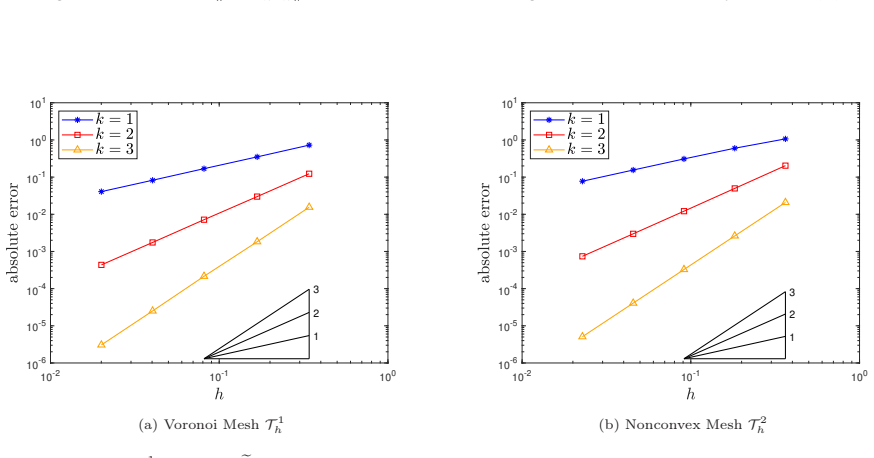
In this paper, we introduce a new framework for designing stabilization-free virtual element methods (VEMs) based on an finite element interpolation-based strategy, where we can simultaneously eliminate the stabilization terms in the discretizations of diffusion and reaction terms. The core idea is to construct a computable, polynomial-preserving, and norm-equivalent interpolation operator from the virtual element space to a (local) finite element space. Leveraging the properties of this operator, we design two types of stabilization-free schemes. The first scheme requires the interpolation to preserve the polynomial consistency related to the bilinear forms, thereby maintaining both consistency and stability as in the standard VEM. The second scheme relaxes this consistency requirement. While it may not satisfy the standard polynomial consistency, the second scheme retains optimal convergence with simpler construction, fewer degrees of freedom and, more importantly, applicable to more complex problems such as those involving nonlinearities or variable coefficients. We construct concrete interpolation operators for both conforming and nonconforming virtual elements in two and three dimensions. These operators are then employed to realize stabilization-free schemes for conforming and nonconforming VEMs. Numerical experiments confirm the optimal convergence rates of the proposed methods. The presented framework can be extended to design stabilization-free schemes for other polytopal discretization methods, such as the hybrid high-order method and the weak Galerkin method.
Figures


Figures from the paper (2 more)

Reference graph
Works this paper leans on
-
[1]
Ahmad, A
B. Ahmad, A. Alsaedi, F. Brezzi, L. D. Marini, and A. Russo , Equivalent projectors for virtual element methods , Comput. Math. Appl., 66 (2013), pp. 376–391. 23
2013
-
[2]
P. F. Antonietti, L. Beirão da Veiga, M. Botti, G. V acca, and M . Verani , A virtual ele- ment method for non-Newtonian pseudoplastic Stokes flows , Comput. Methods Appl. Mech. Engrg., 428, Article number: 117079 (2024)
2024
-
[3]
P. F. Antonietti, S. Berrone, A. Borio, A. D’Auria, M. Verani , and S. Weisser , Anisotropic a posteriori error estimate for the virtual element method, IMA J. Numer. Anal., 42 (2022), pp. 1273–1312
2022
-
[4]
P. F. Antonietti, G. Manzini, and M. Verani , The fully nonconforming virtual element method for biharmonic problems , Math. Models Methods Appl. Sci., 28 (2018), pp. 387–407
2018
-
[5]
P. F. Antonietti, G. V acca, and M. Verani , Virtual element method for the Navier–Stokes equation coupled with the heat equation , IMA J. Numer. Anal., 43 (2023), pp. 3396–3429
2023
-
[6]
Ayuso de Dios, K
B. Ayuso de Dios, K. Lipnikov, and G. Manzini , The nonconforming virtual element method , ESAIM Math. Model. Numer. Anal., 50 (2016), pp. 879–904
2016
-
[7]
Beirão da Veiga, F
L. Beirão da Veiga, F. Brezzi, A. Cangiani, G. Manzini, L. D. M arini, and A. Russo , Basic principles of virtual element methods , Math. Models Methods Appl. Sci., 23 (2013), pp. 199– 214
2013
-
[8]
Beirão da Veiga, F
L. Beirão da Veiga, F. Brezzi, L. D. Marini, and A. Russo , H(div) and H(curl)-conforming virtual element methods , Numer. Math., 133 (2016), pp. 303–332
2016
Show all 49 references
-
[9]
Fluids, 141 (2016), pp
, Serendipity nodal VEM spaces , Comput. Fluids, 141 (2016), pp. 2–12
2016
-
[10]
Beirão da Veiga, F
L. Beirão da Veiga, F. Dassi, and G. V acca , The Stokes complex for virtual elements in three dimensions, Math. Models Methods Appl. Sci., 30 (2020), pp. 477–512
2020
-
[11]
Beirão da Veiga, C
L. Beirão da Veiga, C. Lov adina, and A. Russo , Stability analysis for the virtual element method, Math. Models Methods Appl. Sci., 27 (2017), pp. 2557–2594
2017
-
[12]
Beirão da Veiga, C
L. Beirão da Veiga, C. Lov adina, and G. V acca , Divergence free virtual elements for the Stokes problem on polygonal meshes , ESAIM Math. Model. Numer. Anal., 51 (2017), pp. 509–535
2017
-
[13]
Beirão da Veiga, L
L. Beirão da Veiga, L. Mascotto, and J. Meng , Interpolation and stability estimates for edge and face virtual elements of general order , Math. Models Methods Appl. Sci., 32 (2022), pp. 1589– 1631
2022
-
[14]
Beirão da Veiga, D
L. Beirão da Veiga, D. Mora, and G. V acca , The Stokes complex for virtual elements with application to Navier-Stokes flows , J. Sci. Comput., 81 (2019), pp. 990–1018
2019
-
[15]
Berrone, A
S. Berrone, A. Borio, D. F assino, and F. Marcon , Stabilization-free virtual element method for 2D second order elliptic equations , Comput. Methods Appl. Mech. Engrg., 438, Article number: 117839 (2025)
2025
-
[16]
Berrone, A
S. Berrone, A. Borio, and F. Marcon , A stabilization-free virtual element method based on divergence-free projections, Comput. Methods Appl. Mech. Engrg., 424, Article number: 1 16885 (2024)
2024
-
[17]
, Lowest order stabilization free virtual element method for t he 2D Poisson equation , Comput. Math. Appl., 177 (2025), pp. 78–99
2025
-
[18]
Berrone, A
S. Berrone, A. Borio, F. Marcon, and G. Teora , A first-order stabilization-free virtual element method, Appl. Math. Lett., 142, Article number: 108641 (2023)
2023
-
[19]
Borio, C
A. Borio, C. Lov adina, F. Marcon, and M. Visinoni , A lowest order stabilization-free mixed virtual element method , Comput. Math. Appl., 160 (2024), pp. 161–170
2024
-
[20]
S. C. Brenner, Q. Guan, and L.-Y. Sung , Some estimates for virtual element methods , Comput. Meth. Appl. Mat., 17 (2017), pp. 553–574
2017
-
[21]
S. C. Brenner and L.-Y. Sung , Virtual element methods on meshes with small edges or faces , Math. Models Methods Appl. Sci., 28 (2018), pp. 1291–1336. 24
2018
-
[22]
Brezzi and L
F. Brezzi and L. D. Marini , Virtual element methods for plate bending problems , Comput. Meth- ods Appl. Mech. Engrg., 253 (2013), pp. 455–462
2013
-
[23]
Cangiani, G
A. Cangiani, G. Manzini, and O. J. Sutton , Conforming and nonconforming virtual element methods for elliptic problems , IMA J. Numer. Anal., 37 (2017), pp. 1317–1354
2017
-
[24]
Carstensen, R
C. Carstensen, R. Khot, and A. K. Pani , Nonconforming virtual elements for the biharmonic equation with Morley degrees of freedom on polygonal meshes , SIAM J. Numer. Anal., 61 (2023), pp. 2460–2484
2023
-
[25]
Chen and N
A. Chen and N. Sukumar , Stabilization-free serendipity virtual element method for plane elasticity, Comput. Methods Appl. Mech. Engrg., 404, Article number: 11 5784 (2023)
2023
-
[26]
, Stabilization-free virtual element method for plane elasti city, Comput. Math. Appl., 138 (2023), pp. 88–105
2023
-
[27]
C. Chen, L. Chen, X. Huang, and H. Wei , Geometric decomposition and efficient implementa- tion of high order face and edge elements , Commun. Comput. Phys., 35 (2024), pp. 1045–1072
2024
-
[28]
C. Chen, X. Huang, and H. Wei , H m-conforming virtual elements in arbitrary dimension , SIAM J. Numer. Anal., 60 (2022), pp. 3099–3123
2022
-
[29]
, Virtual element methods without extrinsic stabilization , SIAM J. Numer. Anal., 62 (2024), pp. 567–591
2024
-
[30]
Chen and J
L. Chen and J. Huang , Some error analysis on virtual element methods , Calcolo, 55 (2018), pp. 1–23
2018
-
[31]
Chen and X
L. Chen and X. Huang , Nonconforming virtual element method for 2m-th order partial differential equations in Rn, Math. Comput., 89 (2020), pp. 1711–1744
2020
-
[32]
Chen and F
L. Chen and F. W ang , A divergence free weak virtual element method for the Stokes p roblem on polytopal meshes, J. Sci. Comput., 78 (2019), pp. 864–886
2019
-
[33]
Ciarlet , The finite element method for elliptic problems , North Holland, Amsterdam, 1978
P. Ciarlet , The finite element method for elliptic problems , North Holland, Amsterdam, 1978
1978
-
[34]
Dassi and L
F. Dassi and L. Mascotto , Exploring high-order three dimensional virtual elements: Ba ses and stabilizations, Comput. Math. Appl., 75 (2018), pp. 3379–3401
2018
-
[35]
D. A. Di Pietro, A. Ern, and S. Lemaire , A Review of Hybrid High-Order Methods: Formula- tions, Computational Aspects, Comparison with Other Method s, Springer International Publishing, Cham, 2016, pp. 205–236
2016
-
[36]
Mascotto , The role of stabilization in the virtual element method: A surv ey, Comput
L. Mascotto , The role of stabilization in the virtual element method: A surv ey, Comput. Math. Appl., 151 (2023), pp. 244–251
2023
-
[37]
Mascotto, I
L. Mascotto, I. Perugia, and A. Pichler , Non-conforming harmonic virtual element method: h- and p-versions, J. Sci. Comput., 77 (2018), pp. 1874—1908
2018
-
[38]
J. Meng, X. W ang, L. Bu, and L. Mei , A lowest-order free-stabilization virtual element method for the Laplacian eigenvalue problem , J. Comput. Appl. Math., 417, Article number: 114013 (2022)
2022
-
[39]
W ang and X
J. W ang and X. Ye , A weak Galerkin mixed finite element method for second-order e lliptic prob- lems, Math. Comput., 83 (2014), pp. 2101–2126
2014
-
[40]
, A weak Galerkin finite element method for second-order ellipt ic problems , J. Comput. Appl. Math., 241 (2017), pp. 103–115
2017
-
[41]
H. Wei, X. Huang, and A. Li , Piecewise divergence-free nonconforming virtual elements for Stokes problem in any dimensions , SIAM J. Numer. Anal., 59 (2021), pp. 1835–1856
2021
-
[42]
B.-B. Xu, F. Peng, and P. Wriggers , Stabilization-free virtual element method for finite strain applications, Comput. Methods Appl. Mech. Engrg., 417, Article number: 1 16555 (2023)
2023
-
[43]
Xu and P
B.-B. Xu and P. Wriggers , 3D stabilization-free virtual element method for linear ela stic analysis, Comput. Methods Appl. Mech. Engrg., 421, Artical Number: 11 6826 (2024). 25
2024
-
[44]
J. Zhao, S. Chen, and B. Zhang , The nonconforming virtual element method for plate bending problems, Math. Models Methods Appl. Sci., 26 (2016), pp. 1671–1687
2016
-
[45]
J. Zhao, S. Mao, B. Zhang, and F. W ang , The interior penalty virtual element method for the biharmonic problem, Math. Comput., 92 (2023), pp. 1543–1574
2023
-
[46]
Zhao and B
J. Zhao and B. Zhang , The curl-curl conforming virtual element method for the quad-cu rl problem, Math. Models Methods Appl. Sci., 31 (2021), pp. 1659–1690
2021
-
[47]
J. Zhao, B. Zhang, S. Chen, and S. Mao , The Morley-type virtual element for plate bending problems, J. Sci. Comput., 76 (2018), pp. 610–629
2018
-
[48]
J. Zhao, B. Zhang, S. Mao, and S. Chen , The divergence-free nonconforming virtual element for the Stokes problem , SIAM J. Numer. Anal., 57 (2019), pp. 2730–2759
2019
-
[49]
Methods Appl
, The nonconforming virtual element method for the Darcy-Stoke s problem, Comput. Methods Appl. Mech. Engrg., 370, Article number: 113251 (2020). 26
2020
Reviewed June 28, 2026 · model on record in the stance chip above.
Discussion (0). Continue with ORCID to comment.