Possible High-Energy Neutrino Emission from Dark Matter Annihilation in the Disrupting Dwarf Galaxy Bo\"{o}tes~III
Pith reviewed 2026-06-28 13:35 UTC · model grok-4.3
The pith
IceCube data shows a 3.1 sigma neutrino excess at Boötes III consistent with 26.5 TeV dark matter annihilating to neutrinos.
A machine-rendered reading of the paper's core claim, the machinery that carries it, and where it could break.
Core claim
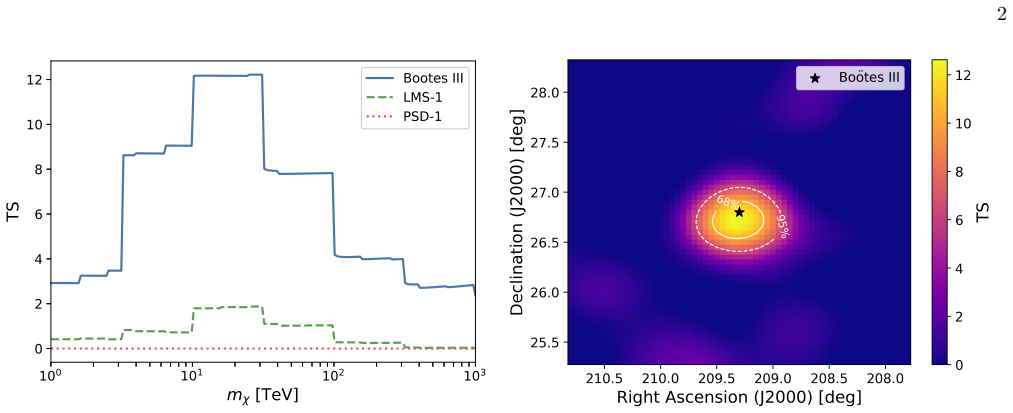
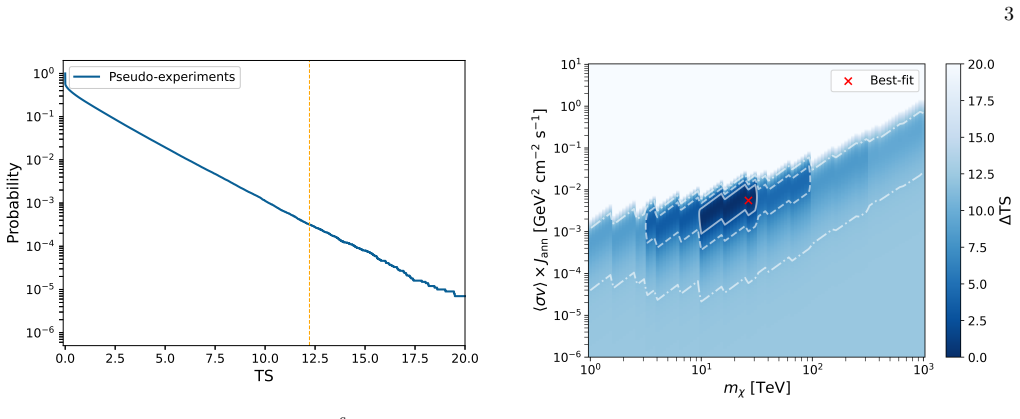
Under the χχ→νν̄ annihilation hypothesis, analysis of IceCube's ten-year track dataset identifies the most significant excess among the three tested stream cores at the location of the disrupting dwarf galaxy Boötes III, returning a best-fit dark matter mass of 26.5 TeV and a post-trial significance of 3.1 sigma. The corresponding limit on the J-factor, log10(J_ann / GeV² cm^{-5}) ≳ 19.1^{+0.3}_{-0.5}, lies broadly consistent with empirical estimates for this target, establishing it as the first candidate for a high-energy neutrino signal associated with dark matter annihilation.
What carries the argument
Point-source likelihood analysis of IceCube track events centered on stellar-stream cores, testing the χχ→νν̄ annihilation channel to extract best-fit mass and J-factor constraints.
Load-bearing premise
The observed neutrino excess at the Boötes III position is produced by dark matter annihilation into neutrinos instead of an unmodeled background fluctuation or unrelated astrophysical source.
What would settle it
A larger IceCube dataset or observations from a next-generation neutrino telescope that find no excess above background at the Boötes III coordinates under the same annihilation channel would falsify the dark matter interpretation.
Figures
read the original abstract
We report the first search for high-energy neutrino emissions from dark matter (DM) annihilation in stellar-stream cores. Motivated by a recent gamma-ray study that proposed these cores as a new class of indirect DM targets, we analyze three stream cores in the Northern Hemisphere using the public ten-year track-like neutrino data released by IceCube. Under the $\chi\chi\to\nu\bar{\nu}$ annihilation hypothesis, the most significant excess among the three targets is found at the position of the nearby dwarf galaxy Bo\"{o}tes~III, the core of the Styx stream, with a best-fit DM mass of 26.5\,TeV. The excess has a post-trial significance of $3.1\sigma$. Considering the existing IceCube dwarf-galaxy limit for the same channel, we obtain a limit on the J-factor $J_{\rm ann}$, $\log_{10}(J_{\rm ann}/{\rm GeV^2\,cm^{-5}})\gtrsim 19.1^{+0.3}_{-0.5}$. This limit is broadly consistent with empirical estimates of $J_{\rm ann}$ for Bo\"{o}tes~III. The results provide the first candidate target with a possible HE neutrino signal associated with DM annihilation. This neutrino excess and the general existence of DM-induced neutrino signals from other similar sources will be confirmed with the near-future large high-energy neutrino detectors, thus enabling us to probe the nature of DM particles.
Editorial analysis
A structured set of objections, weighed in public.
Referee Report
Summary. The paper presents the first search for high-energy neutrinos from dark matter annihilation in the cores of stellar streams, analyzing three Northern Hemisphere targets with ten years of IceCube track-like data under the χχ→νν̄ hypothesis. The most significant excess is reported at Boötes III (core of the Styx stream) with a best-fit DM mass of 26.5 TeV and a post-trial significance of 3.1σ (accounting for the three targets). From this, the authors derive a lower limit on the annihilation J-factor, log10(J_ann/GeV² cm^{-5}) ≳ 19.1^{+0.3}_{-0.5}, which is stated to be consistent with empirical estimates, positioning Boötes III as a candidate DM neutrino source.
Significance. If the reported excess is robust, the work would establish stellar-stream cores as a new class of indirect-detection targets and provide the first neutrino candidate associated with DM annihilation. The use of public IceCube data and the focus on a previously unexamined target class are strengths. However, the marginal post-trial significance and the J-factor limit's dependence on a prior IceCube bound limit the immediate impact; confirmation would require independent verification with future detectors as noted by the authors.
major comments (2)
- [Abstract] Abstract: the post-trial significance of 3.1σ is stated to account for the three targets, but the manuscript does not specify whether the look-elsewhere effect from maximizing the test statistic over the continuous DM mass parameter (best-fit value 26.5 TeV, typically scanned over at least 1–100 TeV) is included via Monte Carlo trials or an analytic correction. If the mass scan is not fully corrected, the quoted significance is inflated and the distinction from background fluctuation is weakened.
- [Abstract] Abstract and results section: the reported J_ann limit is obtained by direct reference to the existing IceCube dwarf-galaxy bound for the same channel rather than an independent measurement or re-derivation from the neutrino excess itself. This creates partial dependence on prior results, reducing the novelty of the J-factor constraint even though the neutrino excess is new.
minor comments (1)
- [Abstract] The abstract provides no error bars on the best-fit mass or details on background modeling; adding these would improve clarity.
Simulated Author's Rebuttal
We thank the referee for their careful reading and constructive comments on our manuscript. We provide point-by-point responses to the major comments below.
read point-by-point responses
-
Referee: [Abstract] Abstract: the post-trial significance of 3.1σ is stated to account for the three targets, but the manuscript does not specify whether the look-elsewhere effect from maximizing the test statistic over the continuous DM mass parameter (best-fit value 26.5 TeV, typically scanned over at least 1–100 TeV) is included via Monte Carlo trials or an analytic correction. If the mass scan is not fully corrected, the quoted significance is inflated and the distinction from background fluctuation is weakened.
Authors: We agree that the quoted post-trial significance of 3.1σ is stated to account only for the three targets, and the manuscript does not describe whether an additional correction for the continuous DM mass scan was applied. To address this, we will perform supplementary Monte Carlo trials that include maximization over the DM mass parameter and report the updated post-trial significance in the revised manuscript. revision: yes
-
Referee: [Abstract] Abstract and results section: the reported J_ann limit is obtained by direct reference to the existing IceCube dwarf-galaxy bound for the same channel rather than an independent measurement or re-derivation from the neutrino excess itself. This creates partial dependence on prior results, reducing the novelty of the J-factor constraint even though the neutrino excess is new.
Authors: We acknowledge that the reported lower limit on J_ann is obtained by reference to the existing IceCube dwarf-galaxy bound rather than being independently derived from the observed excess. This is a consequence of the marginal significance of the excess. The primary result of the work remains the identification of a neutrino excess from a previously unexamined target class. We will revise the text to clarify the dependence on the prior bound and to emphasize the independent aspects of the analysis. revision: partial
Circularity Check
No significant circularity; derivation is data-driven and uses external inputs
full rationale
The paper performs an observational search on public IceCube track-like neutrino data for three stellar stream cores under the χχ→νν̄ hypothesis. The reported 3.1σ post-trial excess at Boötes III is obtained directly from a likelihood analysis of that dataset, with the post-trial factor stated to account for the three targets. The J_ann lower limit is constructed by combining the observed excess flux with an external IceCube upper limit on ⟨σv⟩ from other dwarf galaxies; this is an independent prior result, not a self-referential step. No self-citations, self-definitional equations, fitted parameters renamed as predictions, or ansatz smuggling are present. Concerns about mass-scan trials factors pertain to statistical coverage, not circularity.
Axiom & Free-Parameter Ledger
free parameters (1)
- DM mass =
26.5 TeV
axioms (1)
- domain assumption Annihilation proceeds exclusively via the χχ → νν̄ channel
Reference graph
Works this paper leans on
-
[1]
2σ and ∼ 3σ , respectively [ 9–11], and diffuse neutrino emission from the Galactic plane at the 4 . 5σ level [ 12]. The origin of a large fraction of the astrophysical neutrino flux remains to be investigated. Previously, searches for DM-induced neutrinos using IceCube data have targeted the Galactic center [ 13–16], the Galactic halo [ 17], the Sun [ 18–2...
Pith/arXiv arXiv 2026
-
[2]
2 at mχ = 26
The largest and only significant excess is at the position of Bo¨ otes III, with TS = 12 . 2 at mχ = 26. 5 TeV. The corresponding best-fit signal number is ns = 17 +8 − 7, where the uncer- tainty is at a 68% confidence level (C.L.) obtained from the one-dimensional likelihood scan [ 40]. To estimate the significance of the excess at Bo¨ otes III, we generate ...
2023
-
[3]
G. Bertone, D. Hooper, and J. Silk, Phys. Rep. 405, 279 (2005) , arXiv:hep-ph/0404175 [hep-ph]
Pith/arXiv arXiv 2005
-
[4]
L. Roszkowski, E. M. Sessolo, and S. Trojanowski, Reports on Progress in Physics 81, 066201 (2018) , arXiv:1707.06277 [hep-ph]
Pith/arXiv arXiv 2018
-
[5]
J. M. Gaskins, Contemporary Physics 57, 496 (2016) , arXiv:1604.00014 [astro-ph.HE]
Pith/arXiv arXiv 2016
-
[6]
C. A. Arg¨ uelles, A. Diaz, A. Kheirandish, A. Olivares-Del-Campo, I. Safa, and A. C. Vin- cent, Reviews of Modern Physics 93, 035007 (2021) , arXiv:1912.09486 [hep-ph]
arXiv 2021
-
[7]
M. G. Aartsen et al. (Icecube Collaboration), Journal of Instrumentation 12, P03012 (2017)
2017
-
[8]
M. G. Aartsen et al. (Icecube Collaboration), Phys. Rev. Lett. 111, 021103 (2013)
2013
-
[9]
M. G. Aartsen et al. , Science 361, eaat1378 (2018)
2018
-
[10]
M. G. Aartsen et al. (Icecube Collaboration), Science 361, 147 (2018)
2018
-
[11]
Abbasi et al
R. Abbasi et al. (IceCube Collaboration), Science 378, 538 (2022)
2022
-
[12]
Neronov, D
A. Neronov, D. Savchenko, and D. V. Semikoz, Phys. Rev. Lett. 132, 101002 (2024)
2024
-
[13]
Abbasi et al
R. Abbasi et al. (Icecube Collaboration), Astrophys. J. 981, 131 (2025)
2025
-
[14]
Abbasi et al
R. Abbasi et al. (Icecube Collaboration), Science 380, 1338 (2023)
2023
-
[15]
Abbasi et al., arXiv e-prints , arXiv:1210.3557 (2012) , arXiv:1210.3557 [hep-ex]
R. Abbasi et al., arXiv e-prints , arXiv:1210.3557 (2012) , arXiv:1210.3557 [hep-ex]
Pith/arXiv arXiv 2012
-
[16]
A. Albert et al. , Phys. Rev. D 102, 082002 (2020) , arXiv:2003.06614 [astro-ph.HE]
arXiv 2020
-
[17]
N. Iovine and IceCube Collaboration, Journal of Instrumentation 16, C09009 (2021) , arXiv:2107.11224 [astro-ph.HE]
arXiv 2021
-
[18]
Abbasi et al., arXiv e-prints , arXiv:2511.00918 (2025) , arXiv:2511.00918 [astro-ph.HE]
R. Abbasi et al., arXiv e-prints , arXiv:2511.00918 (2025) , arXiv:2511.00918 [astro-ph.HE]
Pith/arXiv arXiv 2025
-
[19]
R. Abbasi et al. , Phys. Rev. D 84, 022004 (2011) , arXiv:1101.3349 [astro-ph.HE]
Pith/arXiv arXiv 2011
-
[20]
R. Abbasi et al. , Phys. Rev. D 85, 042002 (2012) , arXiv:1112.1840 [astro-ph.HE]
Pith/arXiv arXiv 2012
-
[21]
M. G. Aartsen et al. , European Physical Journal C 77, 146 (2017) , arXiv:1612.05949 [astro-ph.HE]
Pith/arXiv arXiv 2017
-
[22]
R. Abbasi et al. , Phys. Rev. D 105, 062004 (2022) , arXiv:2111.09970 [astro-ph.HE]
arXiv 2022
-
[23]
M. G. Aartsen et al. , European Physical Journal C 77, 82 (2017) , arXiv:1609.01492 [astro-ph.HE]
Pith/arXiv arXiv 2017
-
[24]
Abbasi et al., European Physical Journal C 85, 490 (2025) , arXiv:2412.12972 [astro-ph.HE]
R. Abbasi et al., European Physical Journal C 85, 490 (2025) , arXiv:2412.12972 [astro-ph.HE]
arXiv 2025
-
[25]
M. G. Aartsen et al. , Phys. Rev. D 88, 122001 (2013) , arXiv:1307.3473 [astro-ph.HE]
Pith/arXiv arXiv 2013
- [26]
-
[27]
Y.-F. L¨ u, B.-Y. Zhu, R.-L. Li, X.-K. Guo, T.-C. Liu, Y.-B. Huang, and Y.-F. Liang, Research in Astronomy and Astrophysics 24, 035008 (2024) , arXiv:2401.06571 [astro-ph.HE]
arXiv 2024
-
[28]
Abbasi et al., arXiv e-prints , arXiv:2511.19385 (2025) , arXiv:2511.19385 [astro-ph.HE]
R. Abbasi et al., arXiv e-prints , arXiv:2511.19385 (2025) , arXiv:2511.19385 [astro-ph.HE]
arXiv 2025
-
[29]
C. Fern´ andez-Su´ arez and M. ´A. S´ anchez-Conde, J. Cosml. Astropart. Phys. 2025, 003 (2025) , arXiv:2502.15656 [astro-ph.HE]
arXiv 2025
-
[30]
M. L. Mateo, Annu. Rev. Astron. Astrophys. 36, 435 (1998) , arXiv:astro-ph/9810070 [astro-ph]
Pith/arXiv arXiv 1998
-
[31]
J. D. Simon and M. Geha, Astrophys. J. 670, 313 (2007) , arXiv:0706.0516 [astro-ph]
Pith/arXiv arXiv 2007
-
[32]
J. Pe˜ narrubia, J. F. Navarro, and A. W. McConnachie, Astrophys. J. 673, 226 (2008) , arXiv:0708.3087 [astro-ph]
Pith/arXiv arXiv 2008
-
[33]
A. Aguirre-Santaella, M. A. S´ anchez-Conde, G. Ogiya, J. St¨ ucker, and R. E. An- gulo, Mon. Not. R. Astron. Soc. 518, 93 (2023) , arXiv:2207.08652 [astro-ph.GA]
arXiv 2023
-
[34]
C. J. Grillmair, Astrophys. J. 693, 1118 (2009) , arXiv:0811.3965 [astro-ph] . 5
Pith/arXiv arXiv 2009
-
[35]
J. L. Carlin, C. J. Grillmair, R. R. Mu˜ noz, D. L. Nidever, and S. R. Majewski, Astrophys. J. Lett. 702, L9 (2009) , arXiv:0907.3738 [astro-ph.GA]
Pith/arXiv arXiv 2009
-
[36]
J. L. Carlin and D. J. Sand, Astrophys. J. 865, 7 (2018) , arXiv:1805.11624 [astro-ph.GA]
Pith/arXiv arXiv 2018
-
[37]
R. Abbasi et al. (IceCube Collaboration), arXiv e-prints , arXiv:2101.09836 (2021)
arXiv 2021
-
[38]
M. G. Aartsen et al. (IceCube Collaboration), Phys. Rev. Lett. 124, 051103 (2020)
2020
-
[39]
Braun, J
J. Braun, J. Dumm, F. De Palma, C. Finley, A. Karle, and T. Montaruli, Astroparticle Physics 29, 299 (2008)
2008
-
[40]
K. K. Boddy, J. Kumar, A. B. Pace, J. Runburg, and L. E. Strigari, Phys. Rev. D 102, 023029 (2020) , arXiv:1909.13197 [astro-ph.CO]
arXiv 2020
-
[41]
C. W. Bauer, N. L. Rodd, and B. R. Webber, JHEP 06, 121 (2021) , arXiv:2007.15001 [hep-ph]
arXiv 2021
-
[42]
S. Ji, Z. Wang, D. Zheng, and J. Zheng, Astrophys. J. 990, 142 (2025) , arXiv:2507.19724 [astro-ph.HE]
arXiv 2025
-
[43]
E. Gross and O. Vitells, European Physical Journal C 70, 525 (2010) , arXiv:1005.1891 [physics.data-an]
Pith/arXiv arXiv 2010
-
[44]
S. S. Wilks, Annals Math. Statist. 9, 60 (1938)
1938
-
[45]
A. Geringer-Sameth, M. G. Walker, S. M. Koushi- appas, S. E. Koposov, V. Belokurov, G. Torrealba, and N. W. Evans, Phys. Rev. Lett. 115, 081101 (2015) , arXiv:1503.02320 [astro-ph.HE]
Pith/arXiv arXiv 2015
-
[46]
A. McDaniel, M. Ajello, C. M. Karwin, M. Di Mauro, A. Drlica-Wagner, and M. A. S´ anchez-Conde, Phys. Rev. D 109, 063024 (2024) , arXiv:2311.04982 [astro-ph.HE]
arXiv 2024
-
[47]
R. Abbasi et al. , Astrophys. J. Lett. 1000, L26 (2026) , arXiv:2510.13403 [astro-ph.HE]
arXiv 2026
-
[48]
A. Y. Lien, H. A. Krimm, C. B. Markwardt, K. Oh, L. Marcotulli, R. Mushotzky, N. R. Collins, S. D. Barthelmy, W. H. Baumgartner, S. B. Cenko, M. Koss, S. Laha, T. Sakamoto, D. M. Palmer, and T. Parsotan, Astrophys. J. 989, 161 (2025) , arXiv:2506.04109 [astro-ph.HE]
arXiv 2025
-
[49]
J. Ballet, P. Bruel, T. H. Burnett, B. Lott, and The Fermi-LAT collabora- tion, arXiv e-prints , arXiv:2307.12546 (2023) , arXiv:2307.12546 [astro-ph.HE]
Pith/arXiv arXiv 2023
-
[50]
S. Adri´ an-Mart ´ ınez et al. , Journal of Physics G Nuclear Physics 43, 084001 (2016) , arXiv:1601.07459 [astro-ph.IM]
Pith/arXiv arXiv 2016
-
[51]
I. Belolaptikov et al. , in 37th International Cosmic Ray Conference (2022) p. 2, arXiv:2109.14344 [astro-ph.HE]
arXiv 2022
-
[52]
Z. P. Ye et al. , Nature Astronomy 7, 1497 (2023)
2023
-
[53]
Huang, Z
T.-Q. Huang, Z. Cao, M. Chen, J. Liu, Z. Wang, X. You, and Y. Qi, PoS ICRC2023, 1080 (2023)
2023
- [54]
-
[55]
B. Zhou, M. Kamionkowski, and Y.- f. Liang, Phys. Rev. D 103, 123018 (2021) , arXiv:2103.12813 [astro-ph.HE]
arXiv 2021
-
[56]
R. Abbasi et al. , Astrophys. J. 938, 38 (2022) , arXiv:2207.04946 [astro-ph.HE]
arXiv 2022
- [57]
-
[58]
T.-Q. Huang and Z. Li, Mon. Not. R. Astron. Soc. 514, 852 (2022) , arXiv:2112.14062 [astro-ph.HE] . 6 SUPPLEMENTAL MATERIAL IceCube Data analysis The public IceCube ten-year point-source dataset [ 35] has been widely used in previous searches for neutrino emissions [ 10, 36, 40, 53–55]. We grouped the data into five event samples corresponding to different ...
arXiv 2022
discussion (0)
Sign in with ORCID, Apple, or X to comment. Anyone can read and Pith papers without signing in.