Chaotic spin dynamics of elongated spinor condensates
Pith reviewed 2026-06-28 11:47 UTC · model grok-4.3
The pith
Elongated spin-1 condensates can develop coexisting dynamical domains separated by an interface that behaves as a spatial excited-state quantum phase transition, with local spin dynamics entering a chaotic regime.
A machine-rendered reading of the paper's core claim, the machinery that carries it, and where it could break.
Core claim
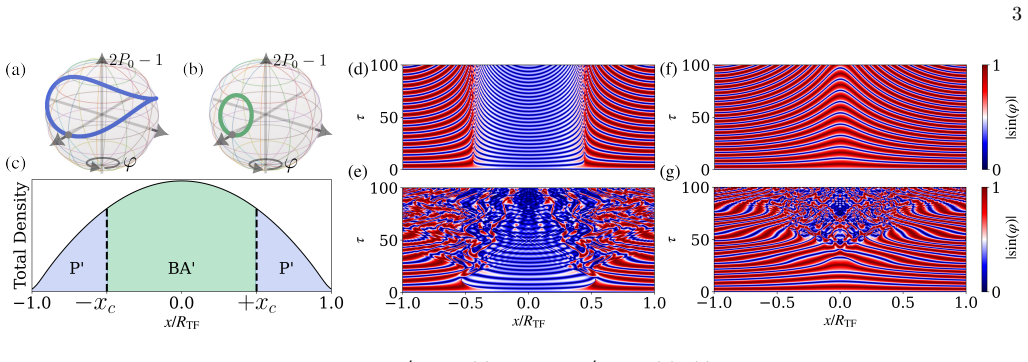
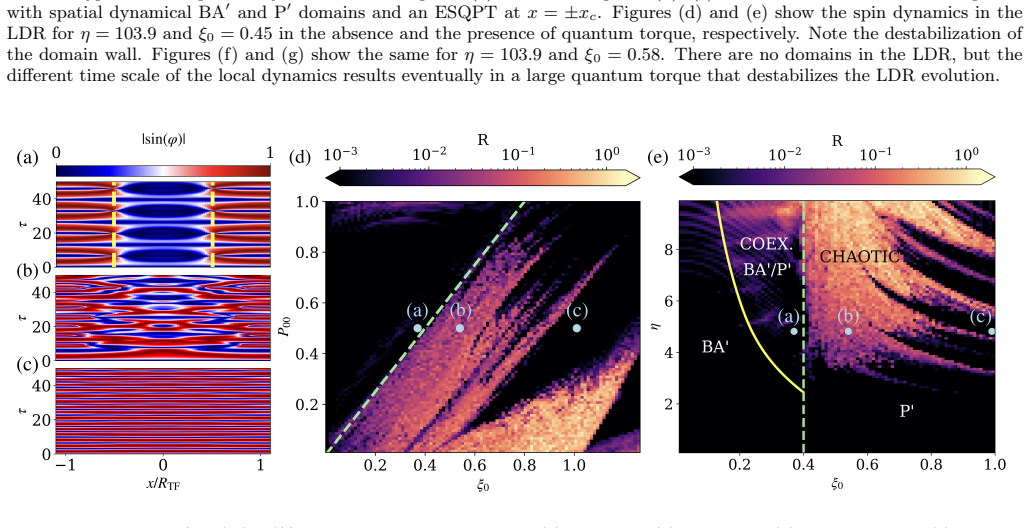
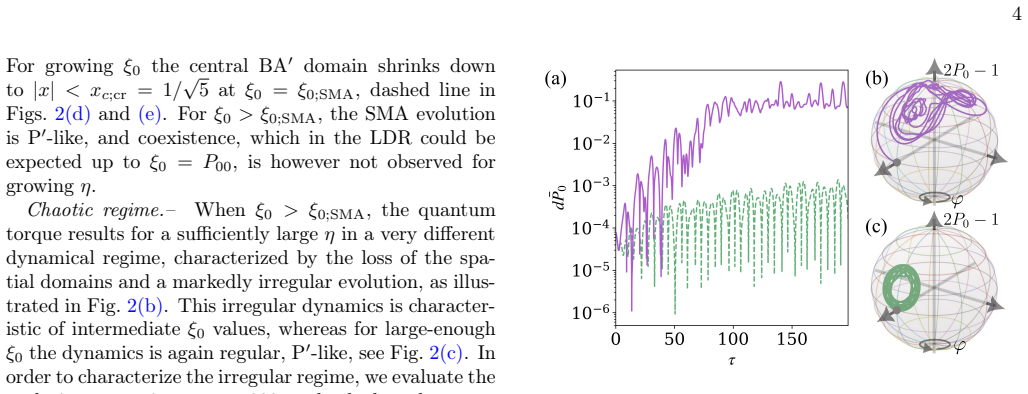
Elongated spin-1 condensates exhibit highly non-trivial local magnetization dynamics stemming from the inhomogeneous density profile. After an initial global quench, the system can display coexistence of markedly different dynamical domains separated by a robust interface that acts as a spatial excited-state quantum phase transition. The local spinor dynamics may also enter a chaotic regime characterized by irregular evolution and exponential sensitivity to initial conditions, with a universal phase diagram distinguishing regular and chaotic regimes.
What carries the argument
The inhomogeneous density profile, which drives the interplay of nonlinear and quantum effects leading to domain interfaces and chaotic local spinor dynamics.
If this is right
- Different dynamical domains can coexist inside a single elongated condensate after a quench.
- A robust interface separates these domains and functions as a spatial excited-state quantum phase transition.
- Local spin dynamics can switch into a chaotic regime with irregular time evolution.
- A universal phase diagram separates regular from chaotic regimes across parameter space.
- These domain and chaos features can be tested in current spinor condensate experiments.
Where Pith is reading between the lines
- The presence of such an interface might affect global spin transport or coherence across the condensate in ways not yet quantified.
- Chaotic local dynamics could reduce the fidelity of spin-based quantum operations or sensing protocols that rely on precise magnetization control.
- Similar domain interfaces might appear in other trapped quantum gases with strong density gradients, suggesting the elongated geometry is not strictly required.
Load-bearing premise
The inhomogeneous density profile is assumed to be the main driver of the non-trivial dynamics through its interplay with nonlinear and quantum effects.
What would settle it
Local magnetization measurements in an elongated spin-1 condensate after a global quench that show no domain separation, no interface, and no exponential divergence of nearby trajectories would falsify the claims of coexisting domains and chaotic regimes.
Figures
read the original abstract
Elongated spin-$1$ condensates present a highly non-trivial local magnetization dynamics, due to the interplay between nonlinear and quantum effects stemming from the inhomogeneous density profile. This interplay results in different dynamical regimes after an initial global quench. In particular, we show that the system may display the coexistence of markedly different dynamical domains separated by a robust interface that acts as a spatial excited-state quantum phase transition. Furthermore, the local spinor dynamics may enter a chaotic regime characterized by irregular evolution and exponential sensitivity to initial conditions. We map the universal phase diagram distinguishing regular and chaotic regimes, which may be probed in on-going experiments.
Editorial analysis
A structured set of objections, weighed in public.
Referee Report
Summary. The paper examines spin dynamics in elongated spin-1 Bose-Einstein condensates after a global quench. It claims that the inhomogeneous density profile drives non-trivial local magnetization evolution, leading to coexisting dynamical domains separated by a robust interface interpreted as a spatial excited-state quantum phase transition. The local dynamics can enter a chaotic regime marked by irregular evolution and exponential sensitivity to initial conditions. A universal phase diagram is mapped to distinguish regular and chaotic regimes, with potential experimental accessibility.
Significance. If the numerical evidence and diagnostics hold, the identification of a spatial excited-state QPT interface and the mapping of a chaos-regularity phase diagram in a realistic spinor condensate geometry would advance understanding of quantum chaos and non-equilibrium phase transitions in ultracold gases. The work is grounded in a standard mean-field spinor model and emphasizes experimental relevance.
major comments (3)
- [§3] §3 (or equivalent results section): the diagnosis of chaos relies on irregular evolution and exponential sensitivity, but the manuscript provides no explicit computation of Lyapunov exponents, power spectra, or Poincaré sections to quantify the transition; without these, the claim that the regime is chaotic rather than simply irregular remains under-supported.
- [§2] §2 (model/equations): the central assumption that the inhomogeneous density profile is the key driver is stated but the specific Gross-Pitaevskii or spinor equations, truncation, or numerical discretization used to evolve the system and locate the interface are not detailed, preventing assessment of whether the reported interface is robust or an artifact of the approximation.
- [phase diagram figure] Phase diagram figure (presumably Fig. 4 or equivalent): the boundaries between regular and chaotic regimes are presented as universal, yet no parameter scan or scaling analysis is shown to demonstrate independence from trap aspect ratio or interaction strengths beyond the plotted range.
minor comments (2)
- [abstract] The abstract states results without referencing the underlying equations or numerical diagnostics; a brief parenthetical mention of the method (e.g., 'via integration of the spin-1 Gross-Pitaevskii equation') would improve clarity.
- [§2] Notation for the spinor components and the definition of the interface location should be introduced consistently in the text before the first results figure.
Simulated Author's Rebuttal
We thank the referee for the careful reading and constructive comments on our manuscript. We address each major point below and outline the revisions we will make.
read point-by-point responses
-
Referee: [§3] §3 (or equivalent results section): the diagnosis of chaos relies on irregular evolution and exponential sensitivity, but the manuscript provides no explicit computation of Lyapunov exponents, power spectra, or Poincaré sections to quantify the transition; without these, the claim that the regime is chaotic rather than simply irregular remains under-supported.
Authors: We agree that explicit quantitative diagnostics would strengthen the chaos identification. In the revised manuscript we will add computations of the largest Lyapunov exponent (via the standard tangent-space method) for representative trajectories in the purported chaotic regime, together with power spectra of the local magnetization showing the expected broadband character. These will be included in the results section. revision: yes
-
Referee: [§2] §2 (model/equations): the central assumption that the inhomogeneous density profile is the key driver is stated but the specific Gross-Pitaevskii or spinor equations, truncation, or numerical discretization used to evolve the system and locate the interface are not detailed, preventing assessment of whether the reported interface is robust or an artifact of the approximation.
Authors: The underlying model is the standard mean-field spin-1 Gross-Pitaevskii system. We will expand the methods section to write the coupled equations explicitly, specify the numerical scheme (split-step Fourier propagation), grid resolution, time-step convergence tests, and the precise criterion used to locate the dynamical interface from the magnetization profiles. This will allow independent verification that the interface is not a numerical artifact. revision: yes
-
Referee: [phase diagram figure] Phase diagram figure (presumably Fig. 4 or equivalent): the boundaries between regular and chaotic regimes are presented as universal, yet no parameter scan or scaling analysis is shown to demonstrate independence from trap aspect ratio or interaction strengths beyond the plotted range.
Authors: The phase boundaries are expressed in dimensionless combinations of quench amplitude and spin-dependent interaction strength that follow from the scaling properties of the elongated Thomas-Fermi profile. We will add a brief scaling argument and a supplementary parameter scan (varying aspect ratio over 10–100 while keeping the dimensionless parameters fixed) to confirm that the boundaries remain stable within the regime of validity of the model. revision: partial
Circularity Check
No significant circularity detected
full rationale
The paper derives dynamical regimes (coexisting domains, spatial excited-state QPT interface, chaotic local spinor evolution) from the inhomogeneous density profile in elongated spin-1 condensates via nonlinear and quantum effects. The universal phase diagram is presented as the direct outcome of this model, to be probed experimentally. No self-definitional reductions, fitted parameters renamed as predictions, or load-bearing self-citations appear in the provided abstract or claims. The derivation chain is self-contained and externally falsifiable.
Axiom & Free-Parameter Ledger
Reference graph
Works this paper leans on
-
[1]
(2), (3), and (4)
In- tegrating over theyzplane, and introducingc 1D ≡ c 2πl2 ⊥ , the GPEs acquire the form: iℏ ˙ψ0 = h ˆHx +g 1D¯n i ψ0+c1D |ψs|2ψ0 +ψ 2 s ψ∗ 0 ,(3) iℏ ˙ψs = h ˆHx +q+g 1D¯n i ψs+c1D |ψ0|2ψs +ψ 2 0ψ∗ s .(4) The results discussed below are obtained from numerical simulations of Eqs. (2), (3), and (4). Single-mode approximation.–Ifη≡R T F /ls < 1, withl s ≡ℏ...
-
[2]
Bloch, J
I. Bloch, J. Dalibard, and W. Zwerger, Many-body physics with ultracold gases, Rev. Mod. Phys.80, 885 (2008)
2008
-
[3]
Polkovnikov, K
A. Polkovnikov, K. Sengupta, A. Silva, and M. Vengalat- tore, Colloquium: Nonequilibrium dynamics of closed in- teracting quantum systems, Rev. Mod. Phys.83, 863 (2011)
2011
-
[4]
Kawaguchi and M
Y. Kawaguchi and M. Ueda, Spinor bose–einstein con- densates, Physics Reports520, 253 (2012)
2012
-
[5]
Chang, C
M.-S. Chang, C. D. Hamley, M. D. Barrett, J. A. Sauer, K. M. Fortier, W. Zhang, L. You, and M. S. Chapman, Observationofspinordynamicsinopticallytrapped 87Rb bose-einstein condensates, Phys. Rev. Lett.92, 140403 (2004)
2004
-
[6]
Schmaljohann, M
H. Schmaljohann, M. Erhard, J. Kronjäger, M. Kottke, S. van Staa, L. Cacciapuoti, J. J. Arlt, K. Bongs, and K. Sengstock, Dynamics off= 2spinor bose-einstein condensates, Phys. Rev. Lett.92, 040402 (2004)
2004
-
[7]
L. E. Sadler, J. M. Higbie, S. R. Leslie, M. Vengalattore, and D. M. Stamper-Kurn, Spontaneous symmetry break- inginaquenchedferromagneticspinorbose–einsteincon- densate, Nature443, 312 (2006)
2006
-
[8]
Evrard, A
B. Evrard, A. Qu, J. Dalibard, and F. Gerbier, From many-body oscillations to thermalization in an isolated spinor gas, Phys. Rev. Lett.126, 063401 (2021)
2021
-
[9]
L. A. Williamson and P. B. Blakie, Universal coarsening dynamics of a quenched ferromagnetic spin-1 condensate, Phys. Rev. Lett.116, 025301 (2016)
2016
-
[10]
S. Huh, K. Mukherjee, K. Kwon, J. Seo, J. Hur, S. I. Mistakidis, H. R. Sadeghpour, and J.-y. Choi, Universal- ity class of a spinor bose–einstein condensate far from equilibrium, Nature Physics20, 402 (2024)
2024
-
[11]
Kronjäger, K
J. Kronjäger, K. Sengstock, and K. Bongs, Chaotic dy- namics in spinor bose-einstein condensates, New Journal of Physics10, 045028 (2008)
2008
-
[12]
Tsubota and K
M. Tsubota and K. Fujimoto, Spin turbulence in spinor bose-einstein condensates, Journal of Physics: Confer- ence Series497, 012002 (2014)
2014
-
[13]
J. Kim, J. Jung, J. Lee, D. Hong, and Y. Shin, Chaos- assisted turbulence in spinor bose-einstein condensates, Phys. Rev. Res.6, L032030 (2024)
2024
-
[14]
Meyer-Hoppe, F
B. Meyer-Hoppe, F. Anders, P. Feldmann, L. Santos, and C. Klempt, Excited-state phase diagram of a ferromag- netic quantum gas, Phys. Rev. Lett.131, 243402 (2023)
2023
-
[15]
Stransky, M
P. Stransky, M. Macek, and P. Cejnar, Excited-state quantum phase transitions in systems with two degrees of freedom: Level density, level dynamics, thermal prop- erties, Annals of Physics345, 73 (2014)
2014
-
[16]
Leyvraz and W
F. Leyvraz and W. D. Heiss, Large-nscaling behavior of the lipkin-meshkov-glick model, Phys. Rev. Lett.95, 050402 (2005)
2005
-
[17]
Pérez-Fernández, P
P. Pérez-Fernández, P. Cejnar, J. M. Arias, J. Dukelsky, J. E. García-Ramos, and A. Relaño, Quantum quench in- fluenced by an excited-state phase transition, Phys. Rev. A83, 033802 (2011)
2011
-
[18]
Brandes, Excited-state quantum phase transitions in dicke superradiance models, Phys
T. Brandes, Excited-state quantum phase transitions in dicke superradiance models, Phys. Rev. E88, 032133 (2013)
2013
-
[19]
Dietz, F
B. Dietz, F. Iachello, M. Miski-Oglu, N. Pietralla, A. Richter, L. von Smekal, and J. Wambach, Lifshitz and excited-state quantum phase transitions in microwave dirac billiards, Phys. Rev. B88, 104101 (2013)
2013
-
[20]
Larese, F
D. Larese, F. Pérez-Bernal, and F. Iachello, Signatures of quantum phase transitions and excited state quantum phase transitions in the vibrational bending dynamics of triatomic molecules, Journal of Molecular Structure 1051, 310 (2013)
2013
-
[21]
Scherer, B
M. Scherer, B. Lücke, G. Gebreyesus, O. Topic, F. Deuretzbacher, W. Ertmer, L. Santos, J. J. Arlt, and C. Klempt, Spontaneous breaking of spatial and spin symmetry in spinor condensates, Phys. Rev. Lett.105, 135302 (2010)
2010
-
[22]
J. Jie, S. Zhong, Q. Zhang, I. Morgenstern, H. G. Ooi, Q. Guan, A. Bhagat, D. Nematollahi, A. Schwettmann, and D. Blume, Dynamical mean-field-driven spinor- condensate physics beyond the single-mode approxima- tion, Phys. Rev. A107, 053309 (2023)
2023
-
[23]
L. D. Landau and E. Lifshitz, On the theory of the dis- persionofmagneticpermeabilityinferromagneticbodies, Phys. Z. Sowjet.8, 153 (1935)
1935
-
[24]
V. G. Bar’yakhtar and B. A. Ivanov, The landau-lifshitz equation: 80 years of history, advances, and prospects, Low Temperature Physics41, 663 (2015)
2015
-
[25]
Farolfi, A
A. Farolfi, A. Zenesini, D. Trypogeorgos, C. Mordini, A. Gallemí, A. Roy, A. Recati, G. Lamporesi, and G. Fer- rari, Quantum-torque-induced breaking of magnetic in- terfaces in ultracold gases, Nature Physics17, 1359 (2021)
2021
-
[26]
Feldmann, C
P. Feldmann, C. Klempt, A. Smerzi, L. Santos, and M. Gessner, Interferometric order parameter for excited- state quantum phase transitions in bose-einstein conden- sates, Phys. Rev. Lett.126, 230602 (2021)
2021
discussion (0)
Sign in with ORCID, Apple, or X to comment. Anyone can read and Pith papers without signing in.