Suppression of differential light shifts in ground and metastable trapped-ion qubits
Pith reviewed 2026-06-28 11:32 UTC · model grok-4.3
The pith
Tuning laser polarization in a bias field suppresses differential light shifts for both ground and metastable clock qubits in 171Yb+.
A machine-rendered reading of the paper's core claim, the machinery that carries it, and where it could break.
Core claim
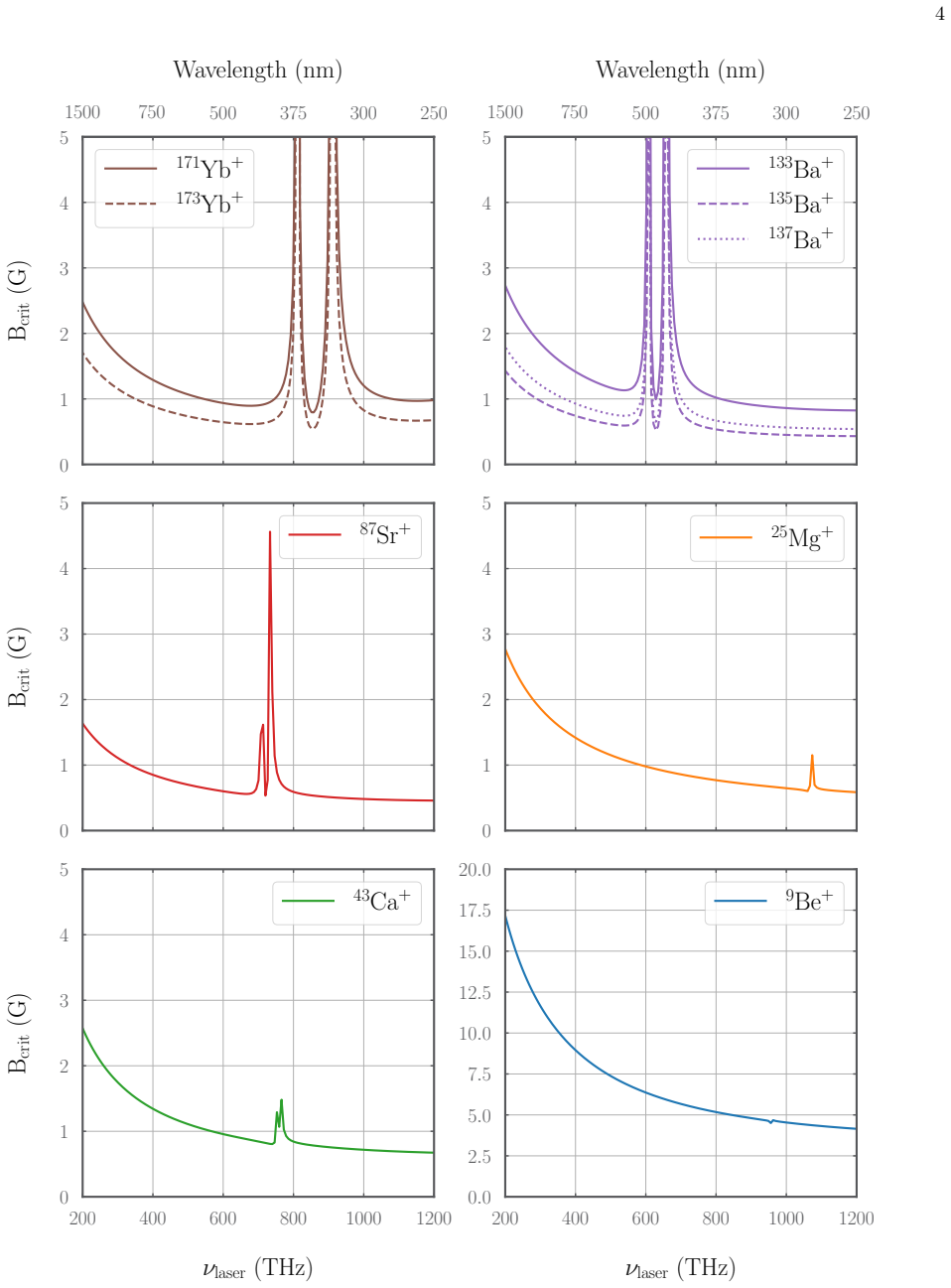
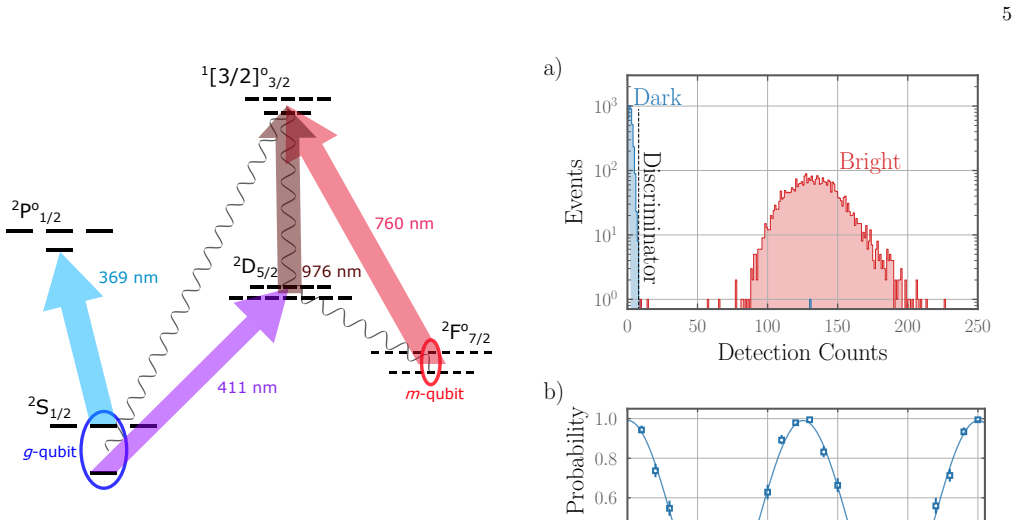
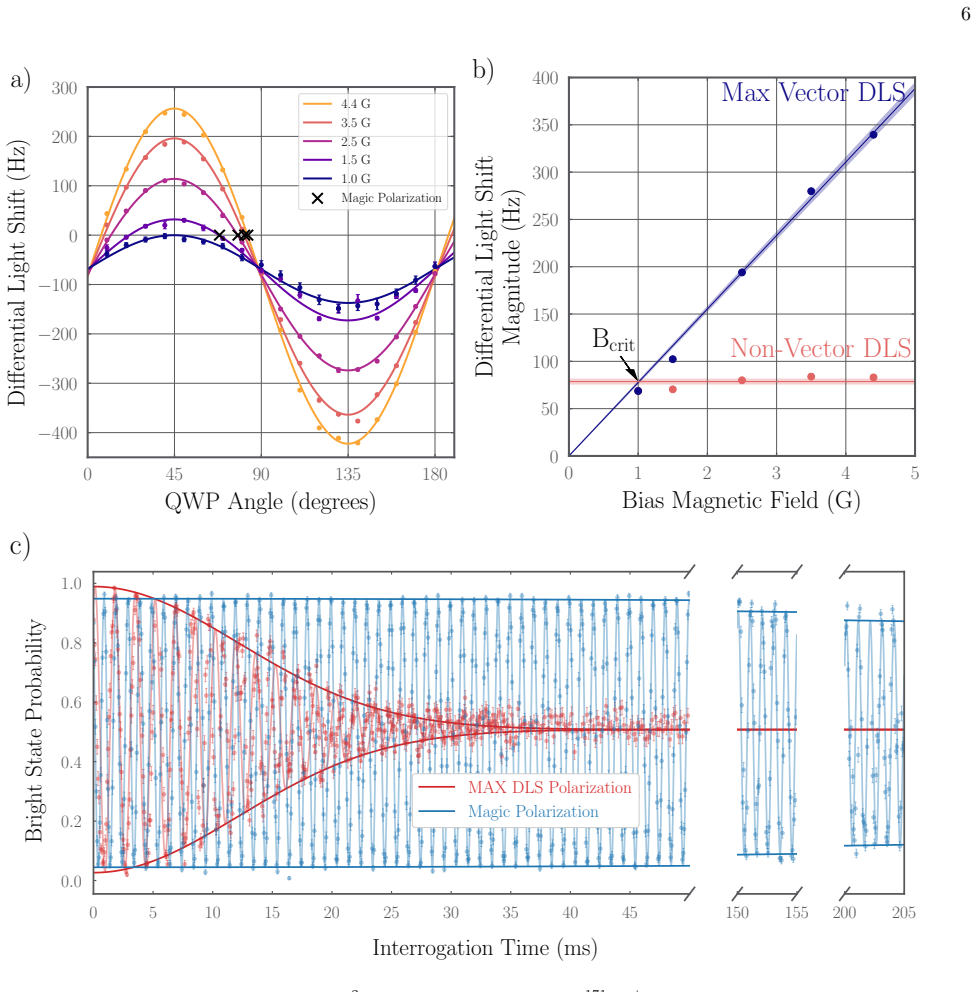
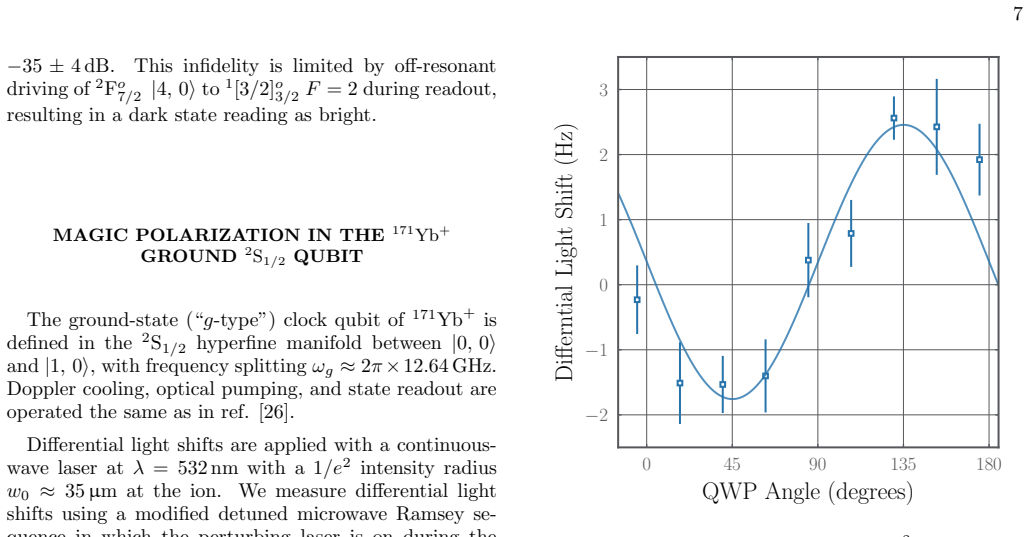
The total differential light shift on hyperfine clock qubits is suppressed when the vector differential light shift, tuned by laser polarization in the presence of a magnetic field, exactly cancels the scalar and tensor contributions. This magic polarization condition is verified experimentally for both the ground 2S1/2 and metastable 2F7/2 clock qubits of 171Yb+. Calculations show that the minimum bias fields needed for ground-state clock qubits of other commonly trapped ion species lie below the field strengths already typical in experiments. Methods for metastable clock-qubit control in 171Yb+ achieve a state preparation and measurement infidelity of 2.9+3.0-1.5×10^{-4}.
What carries the argument
The magic polarization condition, in which the vector differential light shift is tuned via polarization to cancel the scalar and tensor shifts under a bias magnetic field.
If this is right
- Differential light shifts are suppressed for the ground-state clock qubits of 171Yb+.
- Differential light shifts are also suppressed for the metastable clock qubits of 171Yb+.
- The minimum bias magnetic fields required to achieve suppression in ground-state clock qubits of other common trapped-ion species are below typical experimental values.
- Metastable clock-qubit control in 171Yb+ reaches state-preparation and measurement infidelity of 2.9×10^{-4}.
Where Pith is reading between the lines
- Higher laser intensities might become usable without increasing light-shift errors.
- The method could be tested on hyperfine qubits in other ion species to check how widely the cancellation applies.
- The low reported infidelity indicates the metastable state could support longer coherence times in precision measurements once light shifts are removed.
Load-bearing premise
The vector differential light shift can be set by polarization to exactly cancel the scalar and tensor contributions without introducing new uncontrolled systematics or reducing qubit coherence.
What would settle it
A scan of differential light shift versus polarization angle that shows no minimum at the calculated magic angle or leaves a residual shift larger than the suppressed level predicted by the model.
Figures

read the original abstract
In the presence of a magnetic field, hyperfine clock qubits can acquire a vector differential light shift that can be tuned via polarization to suppress the total differential light shift of high-power, off-resonant laser light. We experimentally measure this "magic" polarization condition, suppressing differential light shifts in both the ${}^2\mathrm{S}_{1/2}$ ground and ${}^2\mathrm{F}_{7/2}^o$ metastable clock qubits of $^{171}\mathrm{Yb}^+$. We present calculations of the minimum bias magnetic fields required to suppress differential light shifts in the ground state clock qubits of commonly trapped ion species, finding that they are below the strengths of fields already typically present in experiments. We further present methods for metastable clock-qubit control in $^{171}\mathrm{Yb}^+$, demonstrating a state preparation and measurement infidelity of $2.9^{+3.0}_{-1.5}\times10^{-4}$ ($-35 \pm 4 \, \mathrm{dB}$).
Editorial analysis
A structured set of objections, weighed in public.
Referee Report
Summary. The manuscript experimentally measures a 'magic' polarization condition that suppresses differential light shifts in both the ²S₁/₂ ground-state and ²F₇/₂^o metastable clock qubits of ¹⁷¹Yb⁺ by tuning the vector differential light shift induced by a bias magnetic field. It also presents calculations of the minimum bias magnetic fields needed for ground-state clock qubits in other commonly trapped ion species (finding them below typical lab values) and demonstrates methods for metastable clock-qubit control in ¹⁷¹Yb⁺ with a reported state-preparation-and-measurement infidelity of 2.9^{+3.0}_{-1.5}×10^{-4} (-35 ± 4 dB).
Significance. If the result holds, the work supplies a practical, experimentally verified route to suppressing differential light shifts in both ground and metastable trapped-ion qubits without requiring unusually large bias fields, which is relevant for coherence-limited quantum information processing and optical clocks. The calculations for other species and the low SPAM infidelity for the metastable qubit constitute additional technical contributions that increase the result's applicability.
minor comments (2)
- The abstract reports the SPAM infidelity with asymmetric error bars together with an equivalent dB value; the manuscript should include a brief statement of how the dB conversion is performed and whether it incorporates the asymmetry.
- The calculations for minimum bias fields in other species rely on standard atomic-physics formulas; the manuscript should cite the specific expressions or references used so that the numerical values can be reproduced independently.
Simulated Author's Rebuttal
We thank the referee for their positive summary, significance assessment, and recommendation for minor revision. No specific major comments were provided in the report.
Circularity Check
No significant circularity; central result is experimental measurement using standard formulas.
full rationale
The paper's core contribution is an experimental measurement of the magic polarization condition that suppresses differential light shifts in both ground and metastable qubits of 171Yb+. Supporting calculations for minimum bias fields in other species rely on standard atomic-physics expressions for scalar, vector, and tensor light shifts, not on parameters fitted from the present data. No self-definitional steps, fitted inputs renamed as predictions, or load-bearing self-citations appear in the provided abstract or description. The derivation chain is self-contained against external benchmarks.
Axiom & Free-Parameter Ledger
free parameters (1)
- magic polarization angle
axioms (1)
- domain assumption Standard hyperfine-structure and AC-Stark-shift formulas apply without modification to the 171Yb+ levels under the stated laser and magnetic-field conditions.
Reference graph
Works this paper leans on
-
[1]
have been shown to give rise to a “magic” polar- ization condition in neutral atoms that suppresses this source of decoherence [6, 7]. Recently, this magic con- dition was demonstrated in the ground state qubits of trapped ionic species 133Ba+ [4] and 171Yb+ [8] as well. In this paper, we explore extensions of magic polariza- tion to ground state qubits o...
Pith/arXiv arXiv 2026
-
[2]
HFI-mediated polarizabilites ˆβ(K) contribute to the αF ′F ′ −α F F term in Eq. (4). For ground-state alkali- metal atoms, scalar contribution ˆβ(0) strongly domi- nates [10]. The same inequalityβ (0) ≫β (2) also holds for the alkali-likeS 1/2 ions considered here. A detailed analysis reveals thatβ (2) is dominated by the center dia- gram which requires H...
2000
-
[3]
C. J. Ballance, T. P. Harty, N. M. Linke, M. A. Sepiol, and D. M. Lucas, High-fidelity quantum logic gates us- ing trapped-ion hyperfine qubits, Phys. Rev. Lett.117, 060504 (2016)
2016
-
[4]
J. P. Gaebler, T. R. Tan, Y. Lin, Y. Wan, R. Bowler, A. C. Keith, S. Glancy, K. Coakley, E. Knill, D. Leibfried, and D. J. Wineland, High-fidelity universal gate set for 9Be + ion qubits, Phys. Rev. Lett.117, 060505 (2016)
2016
-
[5]
D. T. C. Allcock, W. C. Campbell, J. Chiaverini, I. L. Chuang, E. R. Hudson, I. D. Moore, A. Rans- ford, C. Roman, J. M. Sage, and D. J. Wineland, omgblueprint for trapped ion quantum comput- ing with metastable states., Appl. Phys. Lett.119, https://doi.org/10.1063/5.0069544 (2021)
-
[6]
S. R. Vizvary, Z. J. Wall, M. J. Boguslawski, M. Bareian, A. Derevianko, W. C. Campbell, and E. R. Hudson, Elim- inating qubit-type cross-talk in theomgprotocol, Phys. Rev. Lett.132, 263201 (2024)
2024
-
[7]
Lundblad, M
N. Lundblad, M. Schlosser, and J. V. Porto, Experimen- tal observation of magic-wavelength behavior of 87Rb atoms in an optical lattice, Physical Review A81, 031611 (2010)
2010
-
[8]
M. H. Schleier-Smith, I. D. Leroux, and V. Vuleti´ c, States of an ensemble of two-level atoms with reduced quantum uncertainty, Phys. Rev. Lett.104, 073604 (2010)
2010
-
[9]
Chicireanu, K
R. Chicireanu, K. D. Nelson, S. Olmschenk, N. Lundblad, A. Derevianko, and J. V. Porto, Differential light-shift cancellation in a magnetic-field-insensitive transition of 87Rb, Phys. Rev. Lett.106, 063002 (2011)
2011
-
[10]
Tu, C.-Y
H. Tu, C.-Y. Luan, M. Zou, Z. Yin, K. Rehan, and K. Kim, Precision polarization tuning for light shift mit- igation in trapped-ion qubits, Phys. Rev. Res.7, 043002 (2025)
2025
-
[11]
Rosenbusch, S
P. Rosenbusch, S. Ghezali, V. A. Dzuba, V. V. Flam- baum, K. Beloy, and A. Derevianko, ac Stark shift of the Cs microwave atomic clock transitions, Phys. Rev. A79, 13404 (2009)
2009
-
[12]
Beloy, A
K. Beloy, A. Derevianko, V. Dzuba, and V. Flambaum, Micromagic Clock: microwave clock based on atoms in an engineered optical lattice, Phys. Rev. Lett102, 120801 (2009)
2009
-
[13]
Chicireanu, K
R. Chicireanu, K. D. Nelson, S. Olmschenk, N. Lund- blad, A. Derevianko, and J. Porto, Differential Light Shift Cancellation in a Magnetic-Field-Insensitive Transition of 87Rb, Phys. Rev. Lett.106, 063002 (2011)
2011
-
[14]
Derevianko, Theory of magic optical traps for Zeeman- insensitive clock transitions in alkali-metal atoms, Phys
A. Derevianko, Theory of magic optical traps for Zeeman- insensitive clock transitions in alkali-metal atoms, Phys. Rev. A81, 051606(R) (2010)
2010
-
[15]
Beloy, U
K. Beloy, U. I. Safronova, and A. Derevianko, High- Accuracy Calculation of the Blackbody Radiation Shift in the 133Cs Primary Frequency Standard, Phys. Rev. Lett.97, 40801 (2006)
2006
-
[16]
H. B. Tran Tan and A. Derevianko, Precision theoret- ical determination of electric-dipole matrix elements in atomic cesium, Phys. Rev. A107, 042809 (2023)
2023
-
[17]
Beloy and A
K. Beloy and A. Derevianko, Application of the dual- kinetic-balance sets in the relativistic many-body prob- lem of atomic structure, Comp. Phys. Comm.179, 310 (2008)
2008
-
[18]
U. I. Safronova and M. S. Safronova, Third-order rel- ativistic many-body calculations of energies, transition rates, hyperfine constants, and blackbody radiation shift in 171Yb+, Phys. Rev. A79, 022512 (2009)
2009
-
[19]
B. K. Sahoo and B. P. Das, Parity nonconservation in ytterbium ion, Phys. Rev. A84, 010502(R) (2011)
2011
-
[20]
Shao, Y.-B
H. Shao, Y.-B. Tang, H.-L. Yue, F.-F. Wu, Z.-X. Ma, Y. Huang, L.-Y. Tang, H. Guan, and K.-L. Gao, Precision determination of dipole transition elements with a single ion, Photon. Res.12, 2242 (2024)
2024
-
[21]
Feldker, H
T. Feldker, H. F¨ urst, N. V. Ewald, J. Joger, and R. Ger- ritsma, Spectroscopy of the 2s1/2 →2 p3/2 transition in yb ii: Isotope shifts, hyperfine splitting, and branching ratios, Phys. Rev. A97, 032511 (2018)
2018
-
[22]
5.8), [Online]
A.∼Kramida, Yu.∼Ralchenko, and J.∼Reader, No Ti- tle, NIST Atomic Spectra Database (ver. 5.8), [Online]. Available:https://physics.nist.gov/asd[2021, Octo- ber 3]. National Institute of Standards and Technology, Gaithersburg, MD. (2020)
2021
-
[23]
Derevianko, M
A. Derevianko, M. S. Safronova, and W. R. Johnson, Ab initio calculations of off-diagonal hyperfine interaction in cesium, Phys. Rev. A60, R1741 (1999)
1999
-
[24]
R. Lange, A. A. Peshkov, N. Huntemann, C. Tamm, A. Surzhykov, and E. Peik, Lifetime of the 2F7/2 level in Yb + for spontaneous emission of electric octupole radiation, Physical Review Letters127, 213001 (2021), arXiv:2107.11229 [physics.atom-ph]
Pith/arXiv arXiv 2021
-
[25]
Ransford, C
A. Ransford, C. Roman, T. Dellaert, P. McMillin, and W. C. Campbell, Weak dissipation for high-fidelity qubit- state preparation and measurement, Physical Review A - Atomic, Molecular, and Optical Physics104, 3 (2021)
2021
-
[26]
R. W. Berends, E. H. Pinnington, B. Guo, and Q. Ji, Beam-laser lifetime measurements for four resonance lev- els of Yb II, Journal of Physics B: Atomic, Molecular and Optical Physics26, L701 (1993). 9
1993
-
[27]
Sugiyama, Laser cooling of single 174Yb+ ions stored in a RF trap, Japanese Journal of Applied Physics38, 2141 (1999)
K. Sugiyama, Laser cooling of single 174Yb+ ions stored in a RF trap, Japanese Journal of Applied Physics38, 2141 (1999)
1999
-
[28]
C. L. Edmunds, T. R. Tan, A. R. Milne, A. Singh, M. J. Biercuk, and C. Hempel, Scalable hyperfine qubit state detection via electron shelving in the 2D5/2 and 2F7/2 manifolds in 171Yb+, Phys. Rev. A104, 012606 (2021)
2021
-
[29]
A. Roy, S. De, B. Arora, and B. K. Sahoo, Accurate determination of black-body radiation shift, magic and tune-out wavelengths for the 6S1/2\rightarrow 5D3/2 clock transition in Yb+, Journal of Physics B: Atomic, Molecular and Optical Physics50, 205201 (2017)
2017
-
[30]
Dellaert,Metastable States, Magic Polarization, and Hyperfine Spectroscopy in 171Yb+ and 173Yb+, Phd the- sis, University of California, Los Angeles (2025)
T. Dellaert,Metastable States, Magic Polarization, and Hyperfine Spectroscopy in 171Yb+ and 173Yb+, Phd the- sis, University of California, Los Angeles (2025)
2025
discussion (0)
Sign in with ORCID, Apple, or X to comment. Anyone can read and Pith papers without signing in.