Sensitivity of the Neutron Star Equation of State Inferences to Mass and Radius Measurements
Pith reviewed 2026-06-28 09:22 UTC · model grok-4.3
The pith
Theoretical constraints plus the 2-solar-mass limit dominate neutron-star equation-of-state inferences over most densities.
A machine-rendered reading of the paper's core claim, the machinery that carries it, and where it could break.
Core claim
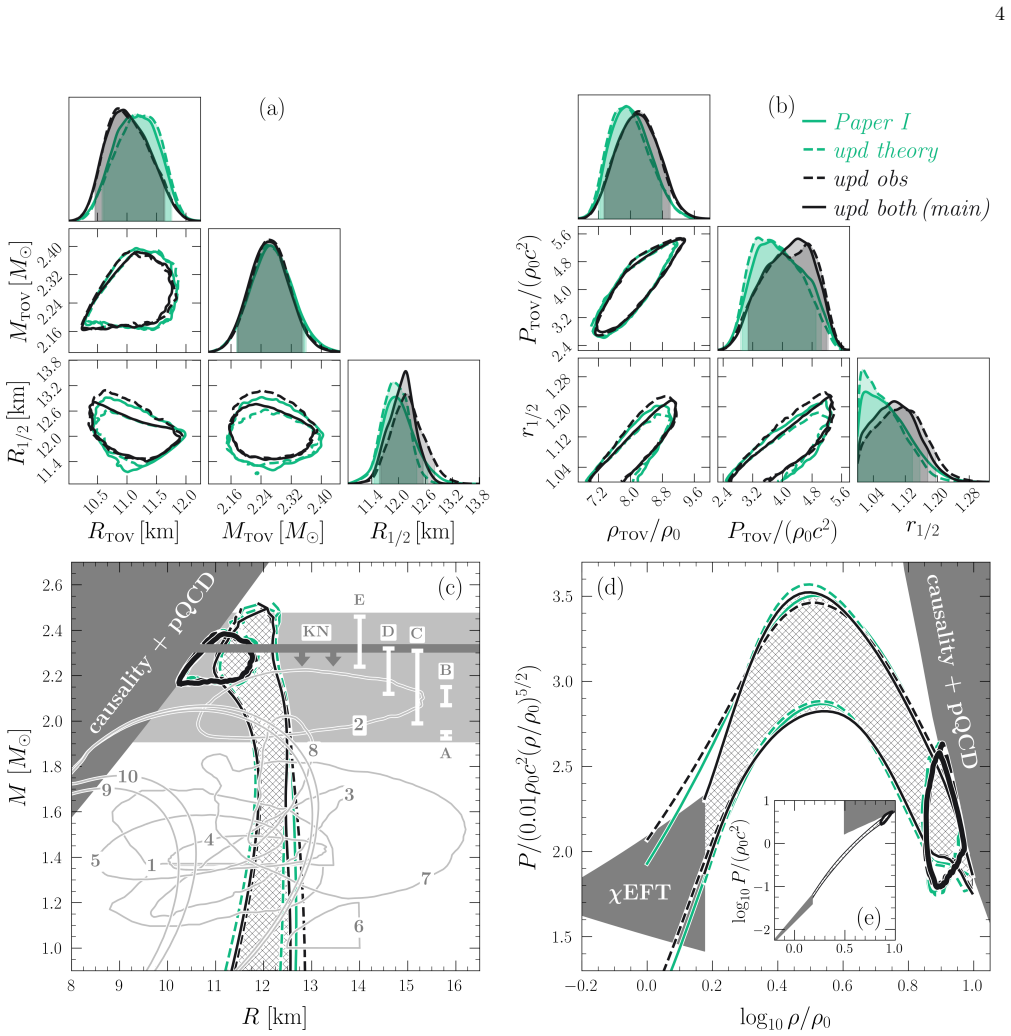
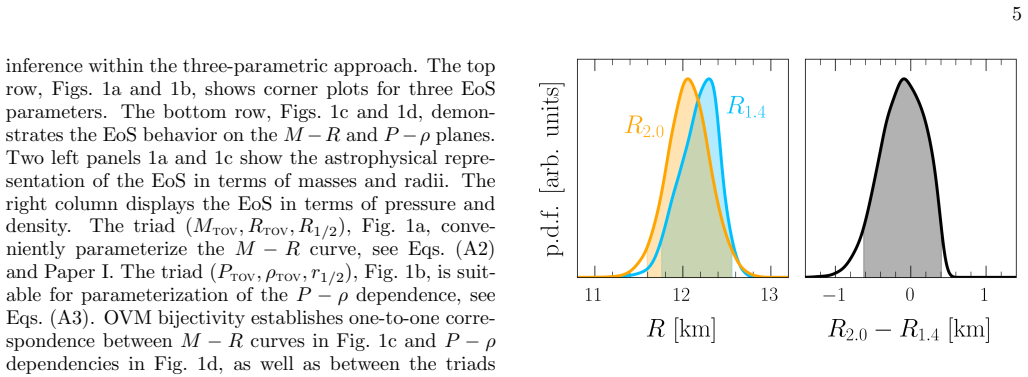
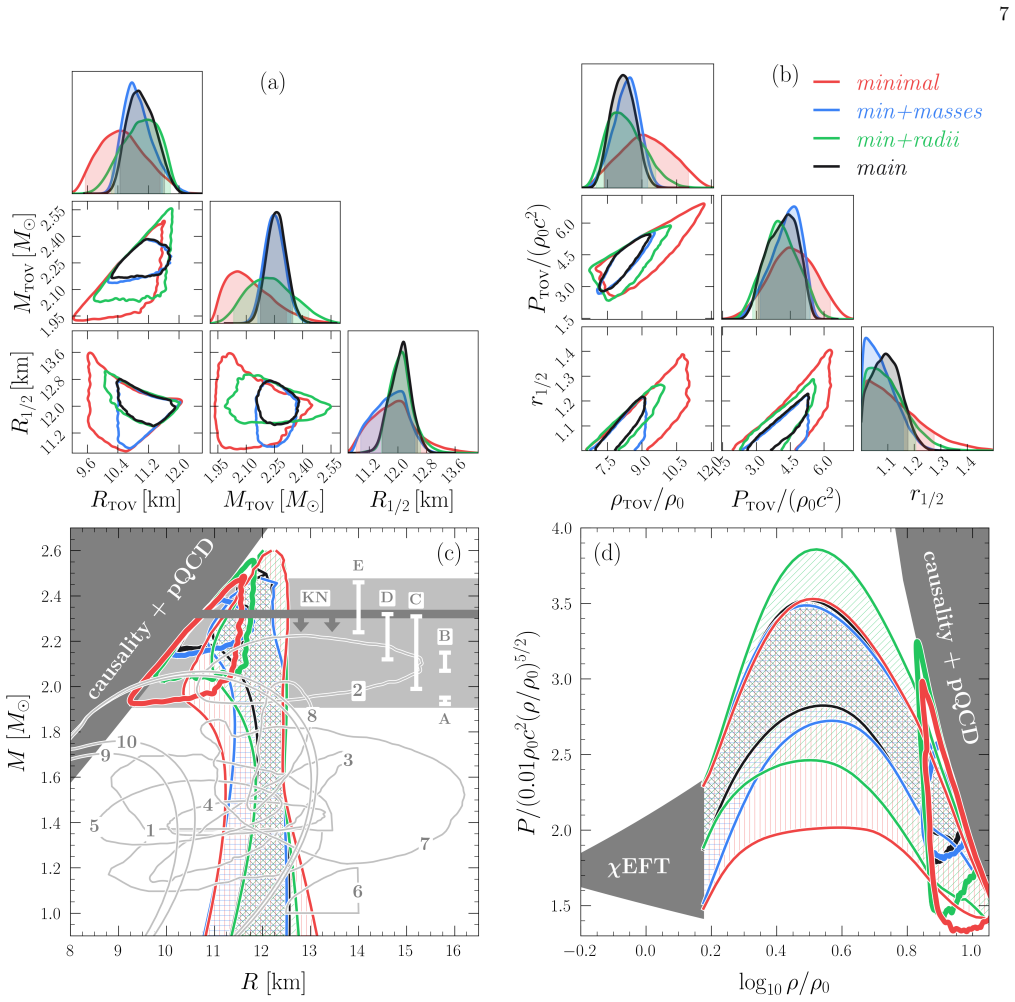
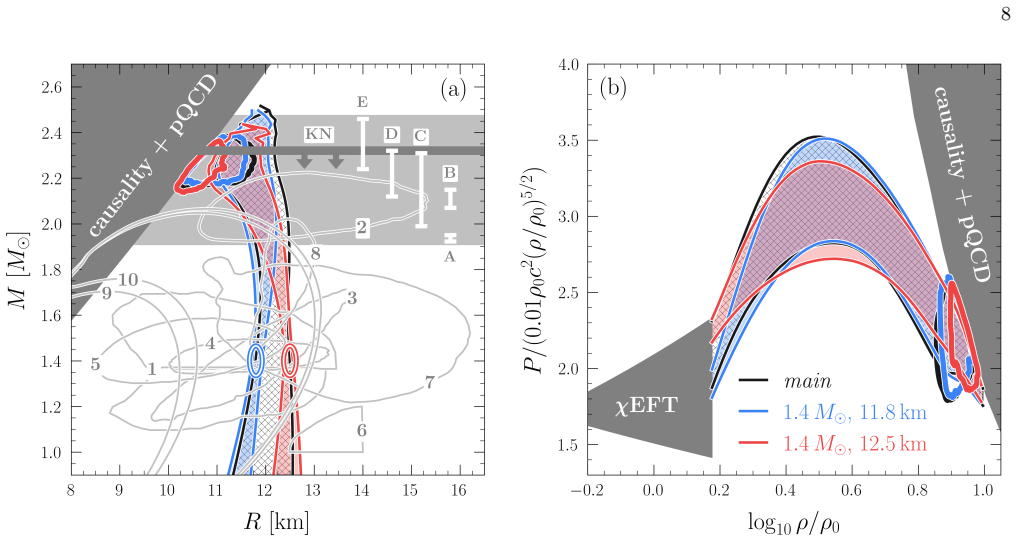
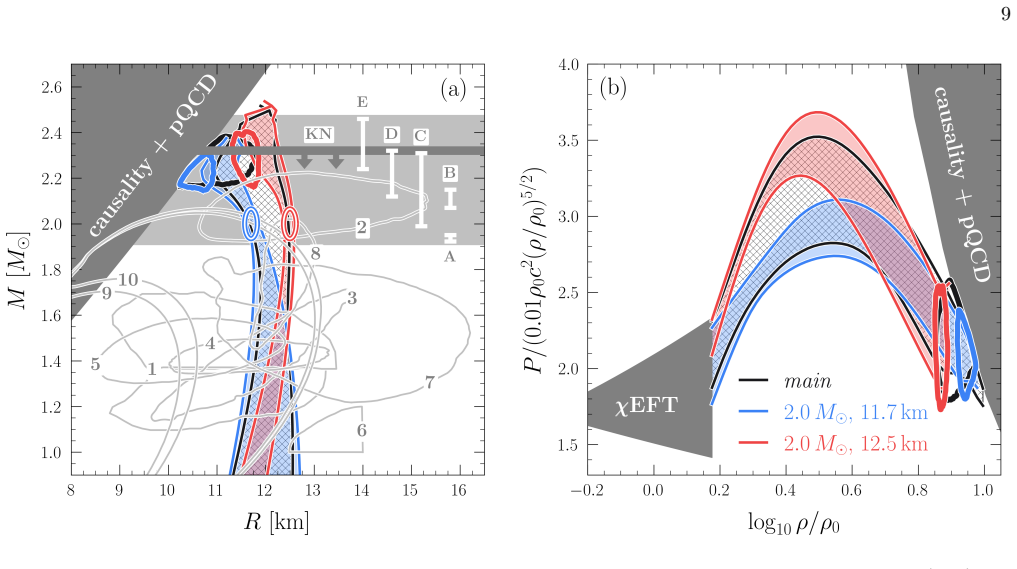
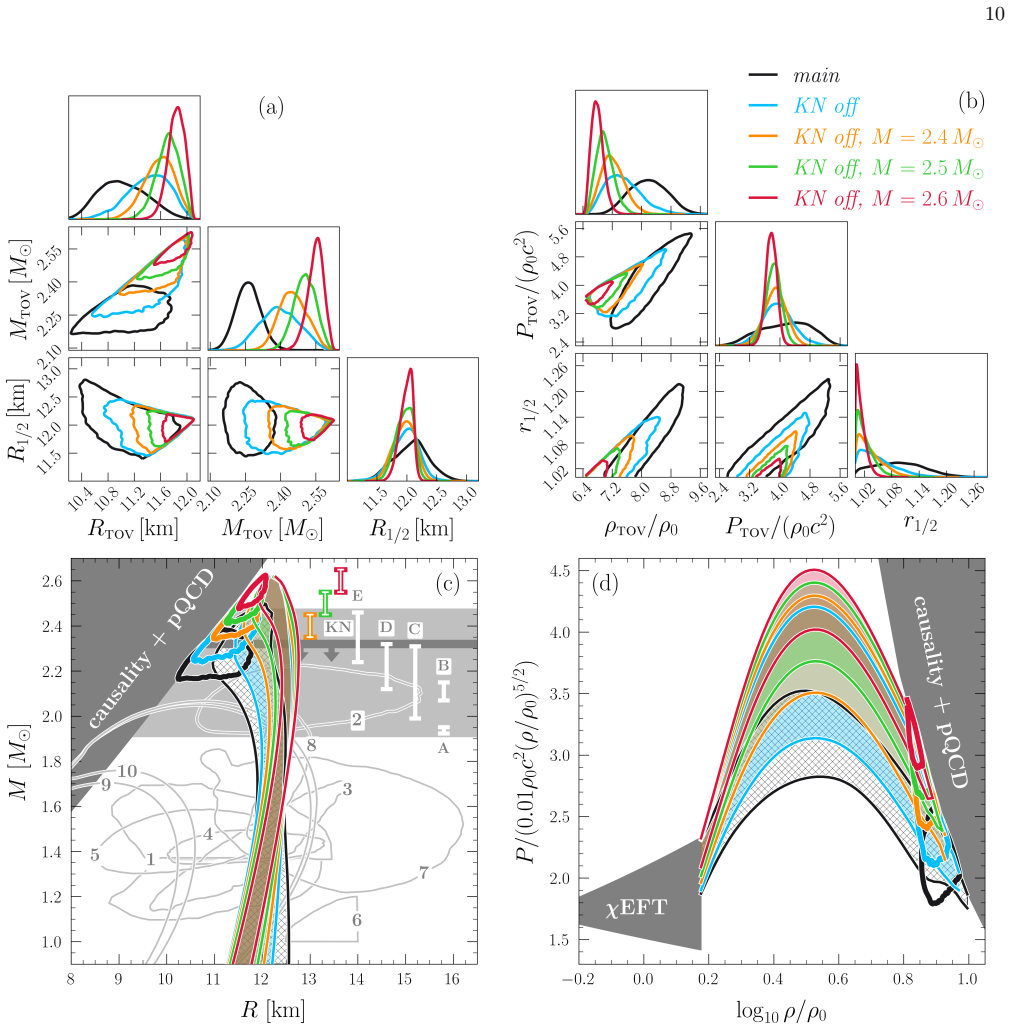
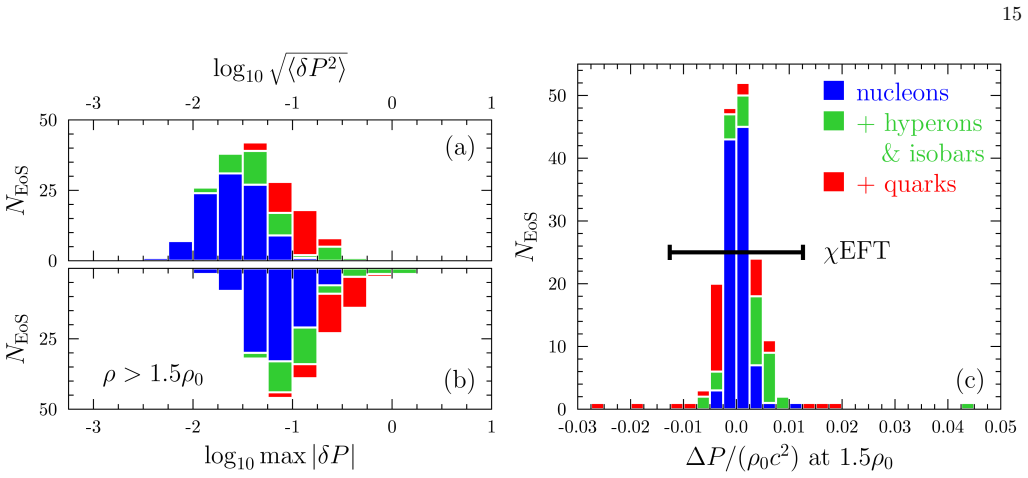
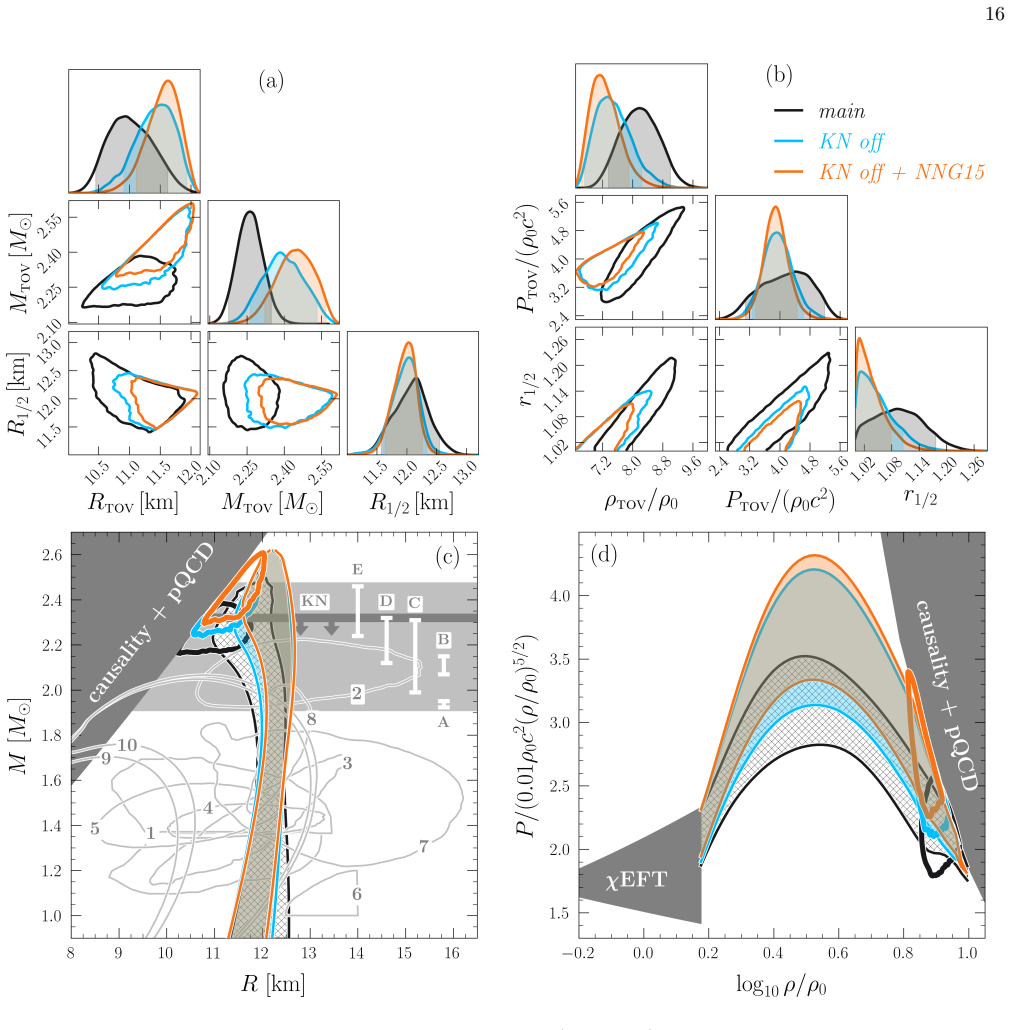
Updated constraints from recent mass and radius measurements combined with chiral effective field theory and perturbative QCD remain consistent with but tighter than earlier results. The theoretical constraints together with the requirement that the maximal neutron-star mass exceeds 2 M_⊙ dominate the equation-of-state inference over most densities. Radius measurements mainly refine the constraints at densities below roughly 2 times nuclear saturation density, whereas measurements of masses well above 2 M_⊙ improve the constraints over a wider density range. A future measurement that refines the maximal mass would have the largest impact, yet even a precise 2.5-2.6 M_⊙ detection would not al
What carries the argument
Bayesian inference framework that combines chiral effective field theory at low densities, perturbative QCD at high densities, and direct mass-radius observational constraints while isolating the effect of each class of input.
If this is right
- Radius measurements mainly refine equation-of-state constraints at densities below about twice nuclear saturation density.
- Measurements of neutron-star masses well above 2 solar masses tighten constraints across a wider density range.
- Refining the value of the maximal neutron-star mass produces the largest change in the inferred equation of state.
- A confirmed neutron star at 2.5-2.6 solar masses would not change the qualitative shape of the allowed equation of state.
- Observations lying well outside the current allowed region would require new physics inside neutron-star cores.
Where Pith is reading between the lines
- If the chiral effective field theory or perturbative QCD inputs contain unrecognized errors, their dominance over observational data would shrink and radius measurements could become more influential even at moderate densities.
- An independent upper limit on the maximum neutron-star mass from gravitational-wave or electromagnetic observations could be combined with the present framework to test consistency without relying on the same mass-radius data.
- The method could be extended to include additional observables such as tidal deformability from binary mergers to check whether they remain sub-dominant to the theoretical bounds.
- A detection of a neutron star whose properties force a revision of the low-density or high-density theoretical anchors would directly challenge the assumption that those anchors remain valid up to the densities probed by neutron stars.
Load-bearing premise
The analysis assumes that inputs from chiral effective field theory at low densities and perturbative QCD at high densities are reliable and that the neutron-star mass and radius measurements can be directly translated into equation-of-state constraints without large unaccounted systematic errors.
What would settle it
A single precise mass or radius measurement lying well outside the region allowed by the combined theoretical bounds and current observations, or an inconsistency between the low-density and high-density theoretical inputs when confronted with data, would falsify the dominance of the present framework.
Figures
read the original abstract
We examine how inferences of the neutron-star equation of state depend on mass and radius observations. We update previous results with recent measurements combined with theoretical input from chiral effective field theory and perturbative quantum chromodynamics. The revised constraints are consistent with, but tighter than, those obtained in earlier work. Isolating the effects of different classes of observations we find that the theoretical constraints, together with the requirement that the maximal neutron-star mass exceeds $2\,M_\odot$, dominate the equation-of-state inference over most densities. Radius measurements mainly refine the constraints at the low-density regime, $\rho \lesssim 2\rho_0$, whereas measurements of masses well above $2\,M_\odot$ improve the constraints over a wider density range. Finally, we explore the impact of possible future observations. The largest impact would arise from a measurement that refines the value of the maximal neutron star mass. It can be, e.g., a detection of an extremely massive neutron star or an improved upper limit. However, even a precise measurement a $2.5-2.6\,M_\odot$ NS will not alter our knowledge of the equation of state qualitatively. Conversely, observations lying well outside the present allowed region, would point to new physics in neutron-star cores and require a revision of the current framework.
Editorial analysis
A structured set of objections, weighed in public.
Referee Report
Summary. The manuscript updates prior neutron-star equation-of-state (EOS) constraints by folding in recent mass and radius measurements together with theoretical input from chiral effective field theory at low density and perturbative QCD at high density. It isolates the separate contributions of different observation classes and concludes that the theoretical priors plus the requirement M_max > 2 M_⊙ dominate the posterior over most densities; radius data mainly tighten the low-density regime (ρ ≲ 2ρ₀) while masses ≫ 2 M_⊙ affect a broader range. The work also examines the prospective impact of future measurements, finding that refinement of the maximum mass would produce the largest change.
Significance. If the dominance result holds, the paper supplies a useful quantitative ranking of constraint sources that can inform observational strategy and the relative priority of ab initio calculations versus new mass-radius data. The explicit isolation of observation classes against a fixed theoretical baseline is a methodological strength that allows direct comparison of posterior widths.
major comments (1)
- [Methods / likelihood construction (likely §2–3)] The abstract and available text state that the likelihood combines external chiral-EFT and pQCD calculations with observational data, yet the explicit functional form of the joint posterior (or the precise manner in which the M_max > 2 M_⊙ cut is imposed) is not shown; without this construction it is impossible to confirm that the reported dominance is not an artifact of the particular prior implementation or of unstated correlations between the theoretical bands and the observational likelihoods.
minor comments (2)
- Figure captions should explicitly list which data sets and theoretical bands are included in each posterior curve so that the isolation procedure can be reproduced from the figures alone.
- [Discussion of future observations] The statement that a future 2.5–2.6 M_⊙ measurement “will not alter our knowledge qualitatively” should be accompanied by a quantitative metric (e.g., change in 68 % credible interval width at a reference density) rather than a qualitative assertion.
Simulated Author's Rebuttal
We thank the referee for their careful reading of the manuscript and for the constructive comment. We address the major comment below.
read point-by-point responses
-
Referee: The abstract and available text state that the likelihood combines external chiral-EFT and pQCD calculations with observational data, yet the explicit functional form of the joint posterior (or the precise manner in which the M_max > 2 M_⊙ cut is imposed) is not shown; without this construction it is impossible to confirm that the reported dominance is not an artifact of the particular prior implementation or of unstated correlations between the theoretical bands and the observational likelihoods.
Authors: We agree that an explicit statement of the joint posterior is needed for full transparency and to allow independent verification that the reported dominance of theoretical inputs and the M_max > 2 M_⊙ requirement is robust. In the revised manuscript we will add a short subsection (likely in §2) that writes the posterior explicitly as P(EOS | data) ∝ L_chiral(EOS) × L_pQCD(EOS) × ∏_i L_obs,i(M_i, R_i | EOS) × Θ(M_max(EOS) − 2 M_⊙), where the theoretical likelihoods are taken directly from the published chiral-EFT and pQCD bands (treated as independent priors on the EOS parameters) and the observational likelihoods are the standard Gaussian or kernel-density forms for each mass-radius measurement. No additional cross-correlations between the theoretical bands and the data are introduced beyond those already present in the EOS parametrization. This addition will directly address the concern and confirm that the isolation of constraint sources is not an artifact of the implementation. revision: yes
Circularity Check
No significant circularity
full rationale
The paper's central claim—that chiral EFT + pQCD priors plus the M_max > 2 M_⊙ requirement dominate the EOS posterior over most densities—is obtained by explicit comparison of posteriors constructed from independent external theoretical inputs and separate observational datasets. No equation or procedure in the derivation reduces a reported constraint to a quantity defined by the paper's own fitted parameters or by a self-citation chain whose validity is presupposed. Radius and mass measurements are treated as external data whose effects are isolated rather than redefined; the dominance result follows from the relative widths of the resulting posteriors and does not rely on renaming or smuggling an ansatz. The analysis is therefore self-contained against external benchmarks.
Axiom & Free-Parameter Ledger
axioms (3)
- domain assumption Chiral effective field theory supplies reliable constraints on the equation of state at densities up to roughly 2 rho_0
- domain assumption Perturbative quantum chromodynamics supplies reliable constraints at high densities
- domain assumption Observed neutron-star masses and radii can be mapped directly onto equation-of-state constraints without large systematic biases
Reference graph
Works this paper leans on
-
[1]
old” the- oretical aspects;upd theory:“old
used in Paper I to lower values 1.806±0.037M⊙ [45]. As the radius of this star is unknown, it only constrainsM tov from below, and this constraint is negligible with respect to those coming from other heavier NSs. •Excluding PSR J2215+5135, since the recent study of its mass [46] shows that the results are not robust with respect to model systematics. •Up...
-
[2]
J. M. Lattimer, Neutron Stars and the Nuclear Matter Equation of State, Annual Review of Nuclear and Particle Science71, 433 (2021)
2021
-
[3]
K. Chatziioannou, H. T. Cromartie, S. Gandolfi, I. Tews, D. Radice, A. W. Steiner, and A. L. Watts, Neutron stars and the dense matter equation of state, Reviews of Mod- ern Physics97, 045007 (2025), arXiv:2407.11153 [nucl- th]
arXiv 2025
-
[4]
D. D. Ofengeim, E. E. Kolomeitsev, and P. S. Shternin, Neutron star equation of state, inEncyclopedia of Astro- physics, Volume 3, Vol. 3 (2026) pp. 160–204
2026
-
[5]
R. C. Tolman, Static Solutions of Einstein’s Field Equa- tions for Spheres of Fluid, Physical Review55, 364 (1939)
1939
-
[6]
J. R. Oppenheimer and G. M. Volkoff, On Massive Neu- tron Cores, Physical Review55, 374 (1939)
1939
-
[7]
Lindblom, Determining the Nuclear Equation of State from Neutron-Star Masses and Radii, Astrophys
L. Lindblom, Determining the Nuclear Equation of State from Neutron-Star Masses and Radii, Astrophys. J.398, 569 (1992)
1992
-
[8]
J. M. Lattimer and M. Prakash, Neutron Star Structure and the Equation of State, Astrophys. J.550, 426 (2001), arXiv:astro-ph/0002232 [astro-ph]
Pith/arXiv arXiv 2001
-
[9]
K. Yagi and N. Yunes, I-Love-Q relations in neutron stars and their applications to astrophysics, gravita- tional waves, and fundamental physics, Phys. Rev. D88, 023009 (2013), arXiv:1303.1528 [gr-qc]
Pith/arXiv arXiv 2013
-
[10]
K. Yagi and N. Yunes, Binary Love relations, Clas- sical and Quantum Gravity33, 13LT01 (2016), arXiv:1512.02639 [gr-qc]
Pith/arXiv arXiv 2016
-
[11]
U. H. Gerlach, Equation of State at Supranuclear Densi- ties and the Existence of a Third Family of Superdense Stars, Physical Review172, 1325 (1968)
1968
-
[12]
Foreman-Mackey, D
D. Foreman-Mackey, D. W. Hogg, D. Lang, and J. Good- man, emcee: The MCMC Hammer, Publications of the Astronomical Society of the Pacific125, 306 (2013)
2013
-
[13]
F. Feroz, M. P. Hobson, and M. Bridges, MULTINEST: an efficient and robust Bayesian inference tool for cos- mology and particle physics, Mon. Not. R. Astron. Soc. 398, 1601 (2009), arXiv:0809.3437 [astro-ph]
Pith/arXiv arXiv 2009
-
[14]
J. N¨ attil¨ a, A. W. Steiner, J. J. E. Kajava, V. F. Suleimanov, and J. Poutanen, Equation of state con- straints for the cold dense matter inside neutron stars using the cooling tail method, Astron. Astrophys.591, A25 (2016), arXiv:1509.06561 [astro-ph.HE]
Pith/arXiv arXiv 2016
- [15]
-
[16]
L. Brandes, W. Weise, and N. Kaiser, Evidence against a strong first-order phase transition in neutron star cores: Impact of new data, Phys. Rev. D108, 094014 (2023), arXiv:2306.06218 [nucl-th]
arXiv 2023
-
[17]
N. Rutherford, M. Mendes, I. Svensson, A. Schwenk, A. L. Watts, and et al., Constraining the Dense Matter Equation of State with New NICER Mass–Radius Mea- surements and New Chiral Effective Field Theory Inputs, Astrophys. J. Lett.971, L19 (2024), arXiv:2407.06790 [astro-ph.HE]
arXiv 2024
-
[18]
L. Brandes and W. Weise, Implications of latest NICER data for the neutron star equation of state, Phys. Rev. D 111, 034005 (2025), arXiv:2412.05923 [nucl-th]
arXiv 2025
- [19]
-
[20]
Komoltsev, First-order phase transitions in the cores of neutron stars, Phys
O. Komoltsev, First-order phase transitions in the cores of neutron stars, Phys. Rev. D110, L071502 (2024), arXiv:2404.05637 [nucl-th]
arXiv 2024
-
[21]
S.-P. Tang, Y.-J. Huang, and Y.-Z. Fan, Phase transition and nuclear symmetry energy from neutron star observa- tions: Constraints in light of PSR J0614-3329, Phys. Rev. D112, 083009 (2025), arXiv:2507.10025 [astro-ph.HE]
arXiv 2025
- [22]
-
[23]
I. Cuceu and S. Robles, Direct nonparametric multi- messenger constraints on the equation of state of cold dense nuclear matter, Phys. Rev. D111, 123029 (2025), arXiv:2410.23407 [astro-ph.HE]
arXiv 2025
-
[24]
Biswas, Equation of State Extrapolation Systemat- ics: Parametric vs
B. Biswas, Equation of State Extrapolation Systemat- ics: Parametric vs. Nonparametric Inference of Neutron Star Structure, arXiv e-prints , arXiv:2509.06145 (2025), arXiv:2509.06145 [astro-ph.HE]
Pith/arXiv arXiv 2025
-
[25]
Lindblom, Spectral representations of neutron-star equations of state, Phys
L. Lindblom, Spectral representations of neutron-star equations of state, Phys. Rev. D82, 103011 (2010), arXiv:1009.0738 [astro-ph.HE]
Pith/arXiv arXiv 2010
-
[26]
L. Brandes, C. Modi, A. Ghosh, D. Farrell, L. Lindblom, and et al., Neural simulation-based inference of the neu- tron star equation of state directly from telescope spec- tra, J. Cosmology & Astropaticles.2024, 009 (2024), arXiv:2403.00287 [astro-ph.HE]
arXiv 2024
-
[27]
S. Soma, L. Wang, S. Shi, H. St¨ ocker, K. Zhou, and et al., Neural network reconstruction of the dense matter equa- tion of state from neutron star observables, J. Cosmol- ogy & Astropaticles.2022, 071 (2022), arXiv:2201.01756 [hep-ph]
arXiv 2022
-
[28]
D. D. Ofengeim, P. S. Shternin, and T. Piran, Three- parameter characterization of neutron star mass-radius relation and equation of state, Phys. Rev. D110, 103046 (2024), arXiv:2404.17647 [astro-ph.HE]
arXiv 2024
- [29]
- [30]
-
[31]
O. Komoltsev and A. Kurkela, How Perturbative QCD Constrains the Equation of State at Neutron- Star Densities, Phys. Rev. Lett.128, 202701 (2022), arXiv:2111.05350 [nucl-th]
arXiv 2022
-
[32]
D. D. Ofengeim, Universal properties of maximum-mass neutron stars: A new tool to explore superdense mat- ter, Phys. Rev. D101, 103029 (2020), arXiv:2005.03549 [astro-ph.HE]
arXiv 2020
-
[33]
D. D. Ofengeim, P. S. Shternin, and T. Piran, Max- imal Mass Neutron Star as a Key to Superdense 13 Matter Physics, Astronomy Letters49, 567 (2023), arXiv:2310.16847 [astro-ph.HE]
arXiv 2023
- [34]
-
[35]
P. B. Demorest, T. Pennucci, S. M. Ransom, M. S. E. Roberts, J. W. T. Hessels, and et al., A two-solar-mass neutron star measured using Shapiro delay, Nature (Lon- don)467, 1081 (2010), arXiv:1010.5788 [astro-ph.HE]
Pith/arXiv arXiv 2010
- [36]
-
[37]
J. Antoniadis, P. C. C. Freire, N. Wex, T. M. Tauris, R. S. Lynch, and et al., A Massive Pulsar in a Compact Rela- tivistic Binary, Science340, 448 (2013), arXiv:1304.6875 [astro-ph.HE]
Pith/arXiv arXiv 2013
-
[38]
R. W. Romani, D. Kandel, A. V. Filippenko, T. G. Brink, W. Zheng, and et al., PSR J0952-0607: The Fastest and Heaviest Known Galactic Neutron Star, Astrophys. J. Lett.934, L17 (2022), arXiv:2207.05124 [astro-ph.HE]
arXiv 2022
-
[39]
R. W. Romani, M. Beleznay, A. V. Filippenko, T. G. Brink, W. Zheng, and et al., PSR J0952-0607: Tightening a Record-high Neutron Star Mass, Astrophys. J.996, 101 (2026), arXiv:2512.05099 [astro-ph.HE]
arXiv 2026
-
[40]
L. Rezzolla, E. R. Most, and L. R. Weih, Using Gravitational-wave Observations and Quasi-universal Relations to Constrain the Maximum Mass of Neu- tron Stars, Astrophys. J. Lett.852, L25 (2018), arXiv:1711.00314 [astro-ph.HE]
Pith/arXiv arXiv 2018
-
[41]
A. Nathanail, E. R. Most, and L. Rezzolla, GW170817 and GW190814: Tension on the Maximum Mass, Astro- phys. J. Lett.908, L28 (2021), arXiv:2101.01735 [astro- ph.HE]
arXiv 2021
-
[42]
T. E. Riley, A. L. Watts, P. S. Ray, S. Bogdanov, S. Guil- lot, and et al., A NICER View of the Massive Pul- sar PSR J0740+6620 Informed by Radio Timing and XMM-Newton Spectroscopy, Astrophys. J. Lett.918, L27 (2021), arXiv:2105.06980 [astro-ph.HE]
arXiv 2021
- [43]
-
[44]
M. C. Miller, F. K. Lamb, A. J. Dittmann, S. Bog- danov, Z. Arzoumanian, K. C. Gendreau, S. Guillot, A. K. Harding, W. C. G. Ho, J. M. Lattimer, R. M. Lud- lam, S. Mahmoodifar, S. M. Morsink, P. S. Ray, T. E. Strohmayer, K. S. Wood, T. Enoto, R. Foster, T. Oka- jima, G. Prigozhin, and Y. Soong, PSR J0030+0451 Mass and Radius from NICER Data and Implicatio...
Pith/arXiv arXiv 2019
-
[45]
S. Vinciguerra, T. Salmi, A. L. Watts, D. Choudhury, T. E. Riley, and et al., An Updated Mass-Radius Analysis of the 2017-2018 NICER Data Set of PSR J0030+0451, Astrophys. J.961, 62 (2024), arXiv:2308.09469 [astro- ph.HE]
arXiv 2017
- [46]
-
[47]
A. G. Sullivan and R. W. Romani, The Intrabinary Shock and Companion Star of Redback Pulsar J2215+5135, Astrophys. J.974, 315 (2024), arXiv:2405.13889 [astro- ph.HE]
arXiv 2024
-
[48]
L. Mauviard, S. Guillot, T. Salmi, D. Choudhury, B. Dorsman, and et al., A NICER View of the 1.4 M ⊙ Edge-on Pulsar PSR J0614-3329, Astrophys. J.995, 60 (2025), arXiv:2506.14883 [astro-ph.HE]
arXiv 2025
- [49]
-
[50]
B. P. Abbott, R. Abbott, T. D. Abbott,et al., GW170817: Observation of Gravitational Waves from a Binary Neutron Star Inspiral, Phys. Rev. Lett.119, 161101 (2017), arXiv:1710.05832 [gr-qc]
Pith/arXiv arXiv 2017
-
[51]
B. P. Abbott, R. Abbott, T. D. Abbott, S. Abraham, F. Acernese, K. Ackley, C. Adams, R. X. Adhikari, V. B. Adya, C. Affeldt, and et al., GW190425: Observation of a Compact Binary Coalescence with Total Mass∼3.4 M ⊙, Astrophys. J. Lett.892, L3 (2020), arXiv:2001.01761 [astro-ph.HE]
arXiv 2020
-
[52]
R. Abbott, T. D. Abbott, S. Abraham, F. Acernese, K. Ackley, C. Adams, R. X. Adhikari, V. B. Adya, C. Af- feldt, M. Agathos, and et al., GW190814: Gravitational Waves from the Coalescence of a 23 Solar Mass Black Hole with a 2.6 Solar Mass Compact Object, Astrophys. J. Lett.896, L44 (2020), arXiv:2006.12611 [astro-ph.HE]
Pith/arXiv arXiv 2020
-
[53]
C. Drischler, S. Han, J. M. Lattimer, M. Prakash, S. Reddy, and et al., Limiting masses and radii of neutron stars and their implications, Phys. Rev. C103, 045808 (2021), arXiv:2009.06441 [nucl-th]
arXiv 2021
-
[54]
N. K. Glendenning, ed.,Compact Stars: Nuclear Physics, Particle Physics, and General Relativity, 2nd ed., As- tronomy and Astrophysics Library (Springer-Verlag, New York, 2000)
2000
-
[55]
A. Ayriyan, O. Ivanytskyi, and D. Blaschke, Bayesian inference favors quark matter in neutron star in- teriors, arXiv e-prints , arXiv:2509.02554 (2025), arXiv:2509.02554 [nucl-th]
Pith/arXiv arXiv 2025
- [56]
- [57]
-
[58]
H.-Y. Chen and O. Gottlieb, Inferring Neutron Star Nuclear Properties from Gravitational-Wave and Gamma-Ray Burst Observations, arXiv e-prints , arXiv:2506.18151 (2025), arXiv:2506.18151 [astro- ph.HE]
arXiv 2025
-
[59]
J. M. Lattimer and B. F. Schutz, Constraining the Equa- tion of State with Moment of Inertia Measurements, Astrophys. J.629, 979 (2005), arXiv:astro-ph/0411470 [astro-ph]
Pith/arXiv arXiv 2005
-
[60]
F. Iacovelli, M. Mancarella, C. Mondal, A. Puecher, T. Dietrich, and et al., Nuclear physics constraints from binary neutron star mergers in the Einstein Telescope era, Phys. Rev. D108, 122006 (2023), arXiv:2308.12378 [gr-qc]. 14
arXiv 2023
-
[61]
K. Yagi and N. Yunes, I-Love-Q: Unexpected Universal Relations for Neutron Stars and Quark Stars, Science 341, 365 (2013), arXiv:1302.4499 [gr-qc]
Pith/arXiv arXiv 2013
-
[62]
N. Andersson and K. D. Kokkotas, Towards gravitational wave asteroseismology, Mon. Not. R. Astron. Soc.299, 1059 (1998), arXiv:gr-qc/9711088 [gr-qc]
Pith/arXiv arXiv 1998
-
[63]
C. E. Rhoades and R. Ruffini, Maximum Mass of a Neu- tron Star, Phys. Rev. Lett.32, 324 (1974). Appendix A: Three-parametric representation of NS EoS Here we list the set of approximations that give the three-parametric representation of the NS EoS and allow one to perform the explicit IOVM from aM−Rcurve in the rangeM= 1M ⊙...Mtov to aP−ρdependence in th...
1974
discussion (0)
Sign in with ORCID, Apple, or X to comment. Anyone can read and Pith papers without signing in.