Surrogate Modeling of Interconnector Flows: A Machine Learning Alternative to Full-Scale Power System Simulations with Application to Cross-Border Electricity Exchange
Pith reviewed 2026-06-28 08:53 UTC · model grok-4.3
The pith
Machine learning surrogates generate interconnector flow profiles that match full European power simulations in reduced models with up to 500 times faster runtime.
A machine-rendered reading of the paper's core claim, the machinery that carries it, and where it could break.
Core claim
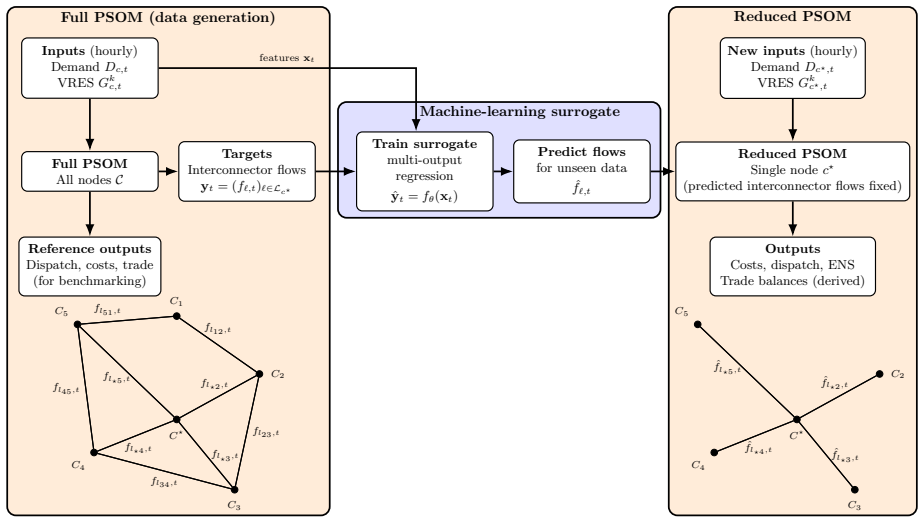
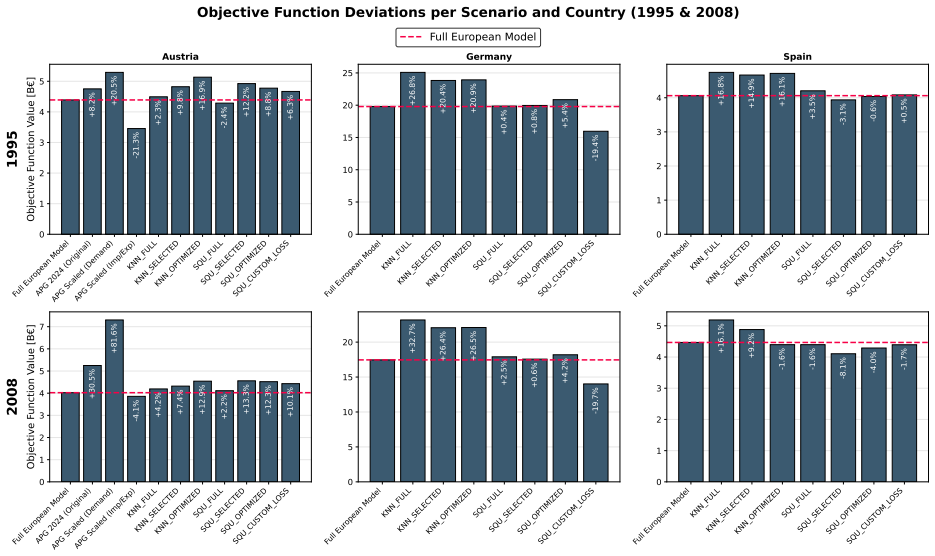
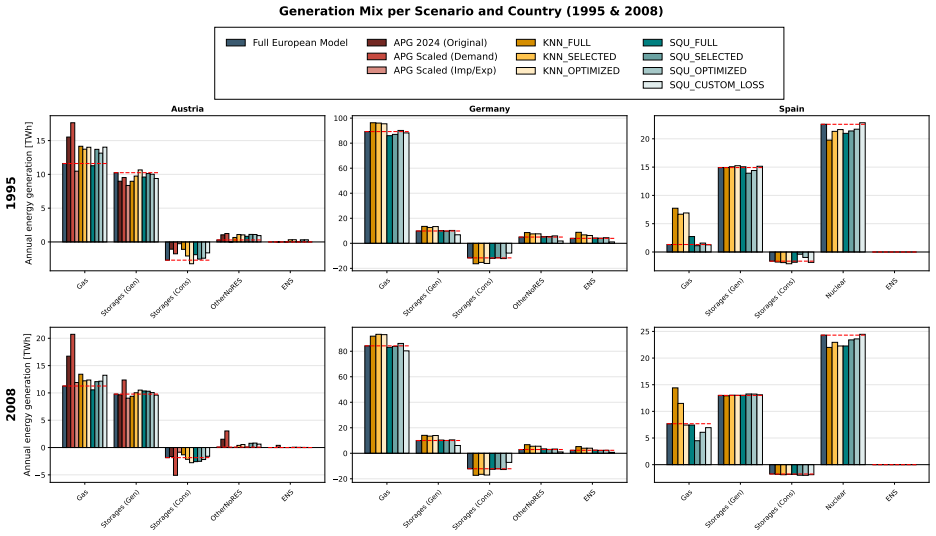
A feedforward neural network surrogate trained on the 2030 National Trends scenario, using a custom loss that penalizes physically impossible flow patterns, produces interconnector-level flow time series. When these flows are imposed as fixed boundaries in single-node-per-country DC optimal power flow models, the optimization results closely match those of the full European simulation while cutting runtime by up to 500 times.
What carries the argument
The SQU feedforward neural network surrogate that maps nodal time series to interconnector flows under a custom physical-feasibility loss.
If this is right
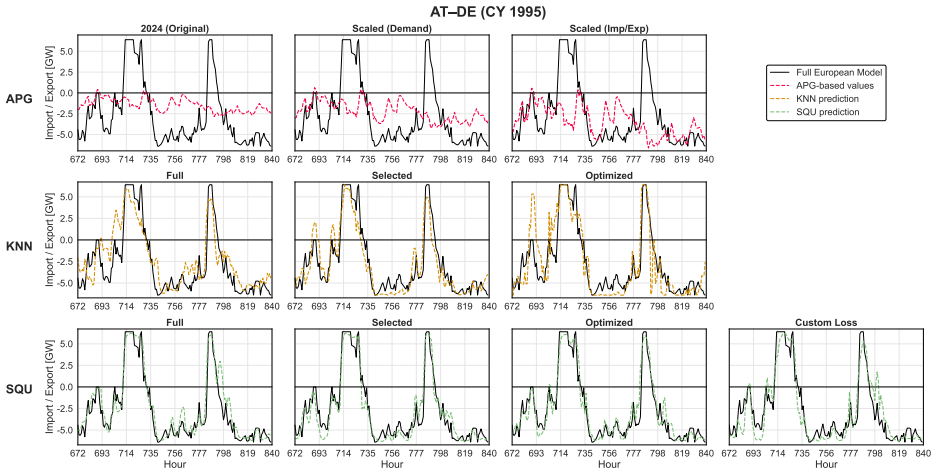
- SQU models generalize more robustly to unseen climate years than k-nearest neighbors or scaled historical benchmarks.
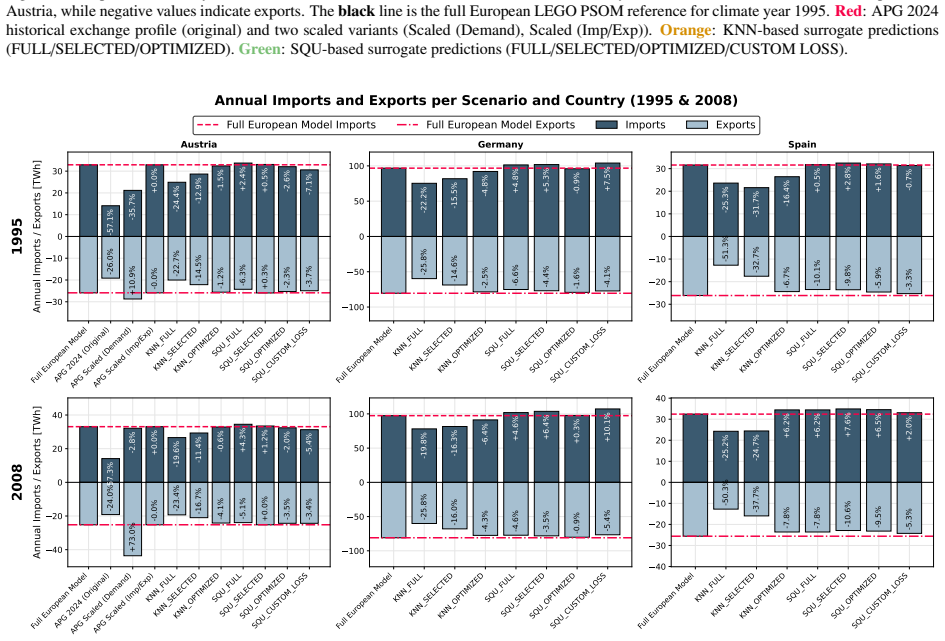
- Imposing the generated flows as fixed boundaries yields decision-relevant results that track full-simulation outcomes.
- Runtime reductions of several hundred times enable many more scenarios or higher temporal resolution inside reduced models.
- The custom loss term improves the physical feasibility of the surrogate flows when they are later used inside optimization.
Where Pith is reading between the lines
- The same surrogate approach could be retrained on data from other continents or finer geographic resolutions without changing the overall framework.
- Testing performance under substantially higher or lower renewable shares than the 2030 training scenario would reveal how far the learned mapping can be extrapolated.
- Coupling the surrogate with stochastic or robust optimization formulations could explicitly handle uncertainty in the generated flows.
- The method might be extended to produce flows that also respect AC power-flow or stability constraints beyond the DC approximation used here.
Load-bearing premise
The mapping learned on the 2030 National Trends scenario and the training climate years remains sufficiently accurate and physically feasible for new climate years or modestly altered system assumptions inside the reduced model.
What would settle it
Train the surrogate on one set of climate years, then apply it to a withheld climate year, impose the resulting flows in the single-node PSOM, and compare the objective value and generation mix against a full European simulation for that same year; large divergence falsifies the claim.
Figures
read the original abstract
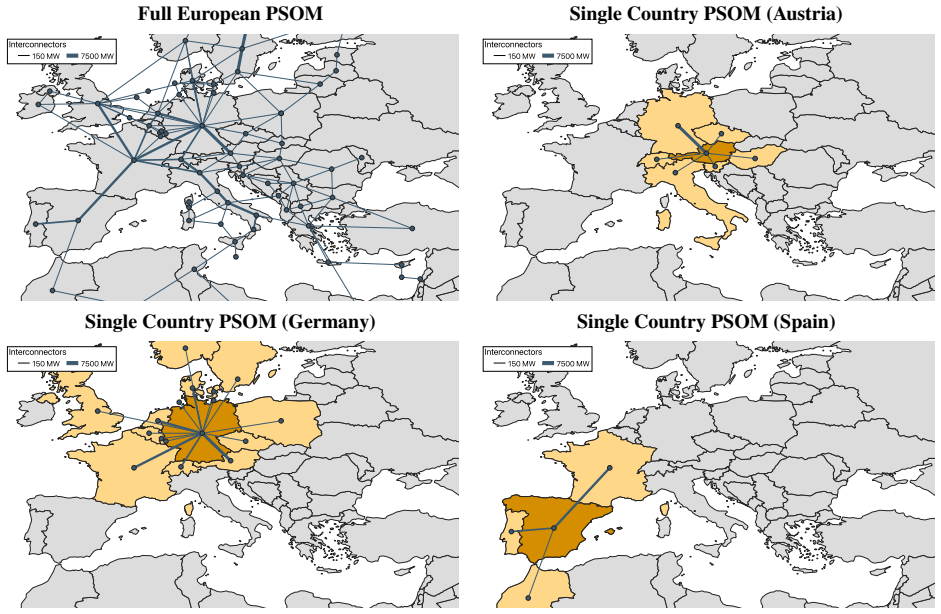
Cross-border electricity exchanges are crucial for operating and planning highly renewable power systems. Many studies reduce spatial granularity to keep the models tractable and prescribe cross-border exchanges exogenously, often by reusing historical import/export time series. Such assumptions become inconsistent as renewable penetration changes the magnitude and timing of flows. This paper proposes a machine-learning (ML) surrogate framework that maps available nodal time series data (e.g., hourly demand and renewable generation) to synthetic, interconnector-level flow time series. The goal is to provide consistent flow profiles that are used as fixed boundary conditions in reduced power system optimization models (PSOMs). To improve downstream feasibility when surrogate flows are imposed in optimization, we further introduce a custom loss for the neural-network surrogate that penalizes physically impossible flow patterns. We demonstrate the framework on a pan-European single-node per country DC optimal power flow setting using the open-source LEGO PSOM with ENTSO-E TYNDP 2024 National Trends assumptions for 2030. We assess two model classes: k-nearest neighbors (KNN) and feedforward neural networks (SQU), using both full and reduced feature sets. The SQU models generalize more robustly than KNN to unseen climate years and substantially improve upon scaled historical benchmarks in terms of predictive accuracy. When imposed as fixed boundary flows in single-node PSOMs, the ML-generated profiles produce outcomes that closely match the results of the full European simulation, while delivering substantial runtime reductions (up to ~500x). These results indicate that ML-based flow surrogates can provide decision-relevant interconnector flows for tractable reduced studies in high-renewable systems.
Editorial analysis
A structured set of objections, weighed in public.
Referee Report
Summary. The paper proposes an ML surrogate framework (KNN and SQU feedforward networks) that maps nodal hourly demand and renewable generation time series to synthetic interconnector flow profiles. Trained on the ENTSO-E TYNDP 2024 National Trends 2030 scenario, the surrogates are intended as fixed boundary conditions in reduced single-node-per-country DCOPF models (using open-source LEGO PSOM). SQU models are reported to generalize better than KNN to unseen climate years, outperform scaled historical benchmarks, and—when imposed in the reduced PSOM—produce outcomes that closely match full European simulation results while achieving up to ~500x runtime reduction. A custom loss penalizing physically impossible flows is introduced to improve downstream feasibility.
Significance. If validated more broadly, the approach addresses a practical inconsistency in reduced PSOM studies by replacing historical flow reuse with scenario-consistent, ML-generated profiles. Strengths include the custom loss for feasibility, explicit comparison against both KNN and historical baselines, use of an open-source PSOM, and quantified runtime gains. The work is relevant for high-renewable planning where full-scale simulations remain intractable.
major comments (2)
- [PSOM imposition experiments / Results] The central validation (imposition of surrogate flows as fixed boundaries in the single-node PSOM) is performed exclusively under the National Trends 2030 assumptions used for training. No experiments are reported in which generation capacities, transmission limits, or cost parameters inside the reduced model are altered, even though such changes would shift the optimal interconnector flow mapping and potentially invalidate the fixed surrogate outputs (see the section describing PSOM imposition experiments and the associated results).
- [Generalization experiments / Abstract] Generalization is demonstrated only to unseen climate years within the same 2030 National Trends scenario. The claim that the surrogates provide 'decision-relevant' flows for 'tractable reduced studies in high-renewable systems' therefore rests on an untested assumption that the learned mapping remains accurate under modest changes to system assumptions (see abstract claim and the generalization experiments).
minor comments (3)
- [PSOM results] Clarify the precise quantitative criterion used for 'closely match' in the PSOM outcomes (e.g., which metrics, tolerance, and number of time steps or countries are compared).
- [Predictive accuracy results] Provide error bars or statistical significance tests for the reported accuracy improvements of SQU over KNN and historical benchmarks across climate years.
- [Methods / Custom loss] The exact formulation of the custom loss and any ablation study showing its effect on downstream PSOM feasibility should be stated explicitly (currently referenced only qualitatively).
Simulated Author's Rebuttal
We thank the referee for the constructive feedback on our manuscript. The comments correctly identify the scope of our validation experiments, and we address each point below with clarifications on the intended use case of the surrogates.
read point-by-point responses
-
Referee: The central validation (imposition of surrogate flows as fixed boundaries in the single-node PSOM) is performed exclusively under the National Trends 2030 assumptions used for training. No experiments are reported in which generation capacities, transmission limits, or cost parameters inside the reduced model are altered, even though such changes would shift the optimal interconnector flow mapping and potentially invalidate the fixed surrogate outputs.
Authors: We agree that all PSOM imposition experiments use the same National Trends 2030 assumptions as the training data. The surrogate is explicitly trained to map nodal demand and renewable time series to the interconnector flows that arise under that scenario's generation mix and dispatch logic. Changing capacities, transmission limits, or costs inside the reduced model would alter the underlying economic optimum and could render the fixed surrogate flows suboptimal or infeasible. Our experiments therefore demonstrate consistency only when the reduced model retains the scenario assumptions used for training. We will add an explicit limitations paragraph in the revised manuscript stating this boundary condition and recommending that the surrogate be retrained when internal model parameters deviate materially from the training scenario. revision: partial
-
Referee: Generalization is demonstrated only to unseen climate years within the same 2030 National Trends scenario. The claim that the surrogates provide 'decision-relevant' flows for 'tractable reduced studies in high-renewable systems' therefore rests on an untested assumption that the learned mapping remains accurate under modest changes to system assumptions.
Authors: The generalization tests are confined to different climate years under the identical 2030 National Trends capacity and cost assumptions. The abstract phrasing is intended to position the method for high-renewable planning studies that adopt comparable scenario frameworks, but we acknowledge that the claim would be stronger with validation across altered capacity mixes. We will revise the abstract to qualify the applicability statement and insert a dedicated limitations subsection that notes the current generalization scope. revision: partial
Circularity Check
No significant circularity; surrogate performance measured against external full-scale simulation
full rationale
The paper trains ML surrogates (KNN and SQU) on interconnector flows generated by a full pan-European DCOPF simulation under the 2030 National Trends scenario, then evaluates generalization on unseen climate years and imposes the surrogate flows as fixed boundaries in a reduced single-node-per-country PSOM. Reported outcomes (matching full-simulation results and runtime gains) are compared directly to the external full-scale model and to scaled historical benchmarks. No equations, custom loss, or self-citations reduce these metrics to quantities defined by the fitted parameters themselves; the central claim rests on independent external benchmarks rather than self-referential definitions or fitted-input predictions.
Axiom & Free-Parameter Ledger
Reference graph
Works this paper leans on
-
[1]
URL:https://eur-lex.europa.eu/legal-c ontent/EN/TXT/?uri=CELEX:32019R0943
European Union, Regulation (EU) 2019/943 of the European Parliament and of the Council of 5 June 2019 on the internal market for electricity, 2019. URL:https://eur-lex.europa.eu/legal-c ontent/EN/TXT/?uri=CELEX:32019R0943
2019
-
[3]
C. Crozier, K. Baker, The effect of renewable electricity generation on the value of cross-border interconnection, Applied Energy 324 (2022) 119717. URL:https://www.sciencedirect. com/science/article/pii/S0306261922010 08X. doi:10.1016/j.apenergy.2022.119717
-
[4]
E. A. Unger, G. F. Ulfarsson, S. M. Gardarsson, T. Matthiasson, The effect of wind energy produc- tion on cross-border electricity pricing: The case of western Denmark in the Nord Pool market, Eco- nomic Analysis and Policy 58 (2018) 121–130. URL:https://www.sciencedirect.com/ science/article/pii/S0313592617302011. doi:10.1016/j.eap.2018.01.006
-
[5]
J. Bedi, D. Toshniwal, Deep learning framework to forecast electricity demand, Applied Energy 238 (2019) 1312–1326. URL:https://www.sc iencedirect.com/science/article/pii/S0 306261919301217. doi:10.1016/j.apenergy .2019.01.113
-
[6]
Gajowniczek, T
K. Gajowniczek, T. Zabkowski, Two-Stage Elec- tricity Demand Modeling Using Machine Learn- ing Algorithms, Energies 10 (2017) 1547. URL: https://www.mdpi.com/1996-1073/10/10/
2017
-
[7]
doi:10.3390/en10101547, number: 10
-
[8]
Nowotarski, R
J. Nowotarski, R. Weron, Recent advances in elec- tricity price forecasting: A review of probabilistic forecasting, Renewable and Sustainable Energy Reviews 81 (2018) 1548–1568. URL:https: //www.sciencedirect.com/science/arti cle/pii/S1364032117308808. doi:10.1016/ j.rser.2017.05.234
2018
-
[9]
J. Lago, G. Marcjasz, B. De Schutter, R. Weron, Forecasting day-ahead electricity prices: A review of state-of-the-art algorithms, best practices and an open-access benchmark, Applied Energy 293 (2021) 116983. URL:https://www.scienced irect.com/science/article/pii/S0306261 921004529. doi:10.1016/j.apenergy.2021. 116983
-
[11]
L. Tschora, E. Pierre, M. Plantevit, C. Robardet, Electricity price forecasting on the day-ahead mar- ket using machine learning, Applied Energy 313 (2022) 118752. URL:https://www.scienced irect.com/science/article/pii/S0306261 922002057. doi:10.1016/j.apenergy.2022. 118752
-
[14]
Y . Eren, I. Küçükdemiral, A comprehensive re- view on deep learning approaches for short-term load forecasting, Renewable and Sustainable En- ergy Reviews 189 (2024) 114031. URL:https: //www.sciencedirect.com/science/articl e/pii/S1364032123008894. doi:10.1016/j. rser.2023.114031
work page doi:10.1016/j 2024
-
[15]
B. Biswal, S. Deb, S. Datta, T. S. Ustun, U. Cali, Review on smart grid load forecasting for smart energy management using machine learning and deep learning techniques, Energy Reports 12 (2024) 3654–3670. URL:https://www.scie ncedirect.com/science/article/pii/S235 2484724006346. doi:10.1016/j.egyr.2024. 09.056
-
[16]
Mohammadi, V .-H
S. Mohammadi, V .-H. Bui, W. Su, B. Wang, Sur- rogate Modeling for Solving OPF: A Review, Sus- tainability 16 (2024) 9851. URL:https://www. mdpi.com/2071-1050/16/22/9851. doi:10.3 390/su16229851, number: 22
2024
-
[17]
S. Pineda, J. M. Morales, Is learning for the unit commitment problem a low-hanging fruit?, Elec- tric Power Systems Research 207 (2022) 107851. URL:https://www.sciencedirect.com/sc ience/article/pii/S0378779622000815. doi:10.1016/j.epsr.2022.107851. 20
-
[18]
F. Pourahmadi, J. Kazempour, Unit Commitment Predictor With a Performance Guarantee: A Sup- port Vector Machine Classifier, IEEE Transac- tions on Power Systems 40 (2025) 715–727. URL: https://ieeexplore.ieee.org/document/1 0530167. doi:10.1109/TPWRS.2024.3400405
-
[19]
Y . Zhu, G. Cui, A. Liu, Q.-S. Jia, X. Guan, Q. Zhai, Q. Guo, X. Guo, A Reinforcement Learning Embedded Surrogate Lagrangian Relax- ation Method for Fast Solving Unit Commitment Problems, IEEE Transactions on Power Systems (2025) 1–12. URL:https://ieeexplore.i eee.org/abstract/document/10847790. doi:10.1109/TPWRS.2025.3529700
-
[20]
G. Huang, T. Mao, B. Zhang, R. Cheng, M. Ou, An Intelligent Algorithm for Solving Unit Com- mitments Based on Deep Reinforcement Learning, Sustainability 15 (2023) 11084. URL:https: //www.mdpi.com/2071-1050/15/14/11084. doi:10.3390/su151411084, number: 14
-
[21]
Kledzik, J
V . Kledzik, J. Haker, Predicting cross-border power flow using weather data, Ph.D. thesis, KTH Royal Institute of Technology, 2024. URL:http s://www.diva-portal.org/smash/record.j sf?pid=diva2%3A1946084&dswid=4245
2024
-
[22]
U. J. Frey, S. Sasanpour, T. Breuer, J. Buschmann, K.-K. Cao, Tackling the multitude of uncertain- ties in energy systems analysis by model cou- pling and high-performance computing, Fron- tiers in Environmental Economics 3 (2024). URL: https://www.frontiersin.org/journa ls/environmental- economics/article s/10.3389/frevc.2024.1398358/full. doi:10.3389/fr...
-
[23]
Aravena, A
I. Aravena, A. Papavasiliou, Renewable Energy Integration in Zonal Markets, IEEE Transactions on Power Systems 32 (2017) 1334–1349. URL:ht tps://ieeexplore.ieee.org/document/750
2017
-
[24]
doi:10.1109/TPWRS.2016.2585222
-
[25]
S. Wogrin, D. Tejada-Arango, R. Gaugl, T. Klatzer, U. Bachhiesl, LEGO: The open-source Low-carbon Expansion Generation Optimization model, SoftwareX 19 (2022). URL:https: //doi.org/10.1016/j.softx.2022.101141. doi:10.1016/j.softx.2022.101141
-
[26]
S. Wogrin, D. Tejada-Arango, S. Delikaraoglou, A. Botterud, Assessing the impact of inertia and reactive power constraints in generation expansion planning, Applied Energy 280 (2020) 115925. doi:10.1016/J.APENERGY.2020.115925
-
[27]
Pedregosa, G
F. Pedregosa, G. Varoquaux, A. Gramfort, V . Michel, B. Thirion, O. Grisel, M. Blondel, P. Prettenhofer, R. Weiss, V . Dubourg, J. Van- derplas, A. Passos, D. Cournapeau, M. Brucher, M. Perrot, E. Duchesnay, Scikit-learn: Machine Learning in Python, Journal of Machine Learning Research 12 (2011) 2825–2830
2011
-
[28]
Chollet, et al., Keras, 2015
F. Chollet, et al., Keras, 2015. URL:https://ke ras.io
2015
-
[29]
Akiba, S
T. Akiba, S. Sano, T. Yanase, T. Ohta, M. Koyama, Optuna: A Next-generation Hyperparameter Op- timization Framework, in: Proceedings of the 25th ACM SIGKDD International Conference on Knowledge Discovery and Data Mining, 2019
2019
-
[30]
J. Pizarroso, J. Portela, A. Muñoz, NeuralSens: Sensitivity Analysis of Neural Networks, Journal of Statistical Software 102 (2022) 1–36. URL:ht tps://doi.org/10.18637/jss.v102.i07. doi:10.18637/jss.v102.i07
-
[31]
URL:https: //2024.entsos-tyndp-scenarios.eu/
ENTSO-E, TYNDP 2024 - Scenario Report, Tech- nical Report, ENTSO-E, 2025. URL:https: //2024.entsos-tyndp-scenarios.eu/
2024
-
[32]
Brown, M
T. Brown, M. Victoria, E. Zeyen, F. Hof- mann, F. Neumann, M. Frysztacki, J. Hampp, D. Schlachtberger, J. Hörsch, A. Schledorn, C. Schauß, K. van Greevenbroek, M. Millinger, P. Glaum, B. Xiong, T. Seibold, PyPSA-Eur: An Open Sector-Coupled Optimisation Model of the European Energy System, 2026. URL:https: //github.com/pypsa/pypsa-eur
2026
-
[33]
URL:https://tyndp.entsoe.eu/ resources/tyndp-2024-implementation-g uidelines-march
ENTSO-E, TYNDP 2024 -Implementation Guide- lines, 2024. URL:https://tyndp.entsoe.eu/ resources/tyndp-2024-implementation-g uidelines-march. 21
2024
discussion (0)
Sign in with ORCID, Apple, or X to comment. Anyone can read and Pith papers without signing in.