SNF-PRP: A Covert Integrating Sensing and Communications Framework
Pith reviewed 2026-06-28 08:36 UTC · model grok-4.3
The pith
SNF-PRP enables covert integrated sensing and communication in OFDM systems by keeping probing signals below the noise floor while achieving sub-meter accuracy.
A machine-rendered reading of the paper's core claim, the machinery that carries it, and where it could break.
Core claim
SNF-PRP establishes an epsilon-covertness guarantee via Kullback-Leibler divergence, exploits an N_sc-fold spreading gain absent from prior wideband analyses, and derives in closed form the minimum integration length required to achieve a target Cramér-Rao bound.
What carries the argument
The N_sc-fold spreading gain across OFDM subcarriers that dilutes probing energy per frequency bin and supports both the epsilon-covertness guarantee and the closed-form integration length for the target Cramér-Rao bound.
If this is right
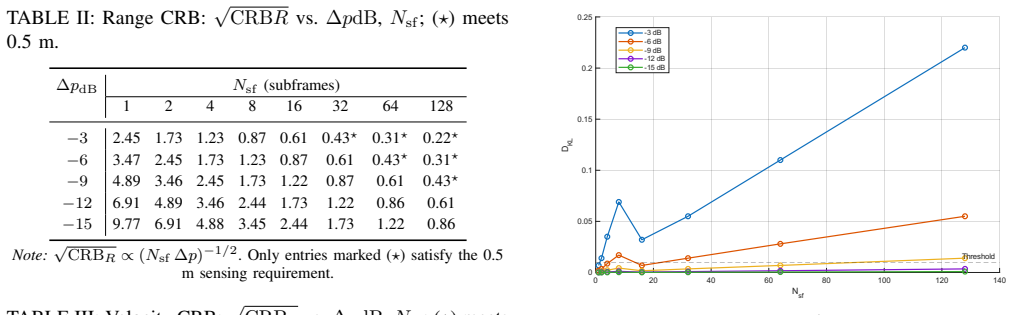
- At probing powers of -12 dB and -15 dB, range estimates reach sub-0.5 m accuracy and velocity estimates reach sub-0.5 m/s accuracy while the KL divergence stays 5.8 times below the covertness threshold.
- The minimum integration length needed for any chosen Cramér-Rao bound and epsilon-covertness level can be computed directly from the closed-form expression.
- Joint sensing and data transmission can occur without exposing the sensing operation to an energy-based warden under the model assumptions.
- Earlier wideband ISAC analyses that omitted the spreading gain would have overstated the detectability of probing signals.
Where Pith is reading between the lines
- The same spreading-gain mechanism could be tested in other multicarrier waveforms such as OTFS or filter-bank systems to check whether the N_sc factor generalizes.
- If the KL-based guarantee holds in hardware, network operators might reduce reliance on encryption for protecting sensing activity and instead rely on power and waveform design.
- A practical next step would be to measure real-world energy detectors against the predicted KL divergence under 5G NR n78 conditions to see whether the bound remains conservative.
- Combining SNF-PRP with existing physical-layer security techniques might allow higher probing powers while still meeting the epsilon threshold.
Load-bearing premise
An energy-detecting adversary's ability to notice the sensing activity is completely described by the Kullback-Leibler divergence between the sensing and no-sensing distributions, and this divergence is reduced by the full N_sc-fold spreading gain in the wideband OFDM setting.
What would settle it
A measurement showing that an energy detector distinguishes the sensing case from the no-sensing case at a rate higher than the epsilon bound calculated from the KL divergence, or that the actual estimation error exceeds the Cramér-Rao bound for the closed-form integration length at the stated probing powers.
Figures
read the original abstract
Integrated sensing and communication (ISAC) enables simultaneous sensing and data transmission but exposes a critical vulnerability: probing signals may be intercepted, revealing both the transmitted information and the act of sensing itself. Existing physical layer security approaches mitigate interception yet operate with detectable signals, leaving sensing activity observable to a passive warden. This paper introduces sub-noise-floor pseudo-random probing (SNF-PRP), a covert sensing framework for OFDM-based ISAC systems under an energy-detection adversary model. SNF-PRP establishes an $\epsilon$-covertness guarantee via Kullback-Leibler (KL) divergence, exploits an $N_{\mathrm{sc}}$-fold spreading gain absent from prior wideband analyses, and derives in closed form the minimum integration length required to achieve a target Cram\'{e}r-Rao bound (CRB). Simulations under 5G~NR n78 numerology confirm sub-0.5\,m range and sub-0.5\,m/s velocity accuracy with KL divergence $5.8\times$ below the covertness threshold, validating joint feasibility at $-12$\,dB and $-15$\,dB probing powers.
Editorial analysis
A structured set of objections, weighed in public.
Referee Report
Summary. The paper introduces SNF-PRP, a covert sensing framework for OFDM-based ISAC systems that uses sub-noise-floor pseudo-random probing. It claims to establish an ε-covertness guarantee via Kullback-Leibler divergence under an energy-detection adversary, exploit an N_sc-fold spreading gain not present in prior wideband analyses, derive in closed form the minimum integration length needed for a target Cramér-Rao bound, and validate via simulations under 5G NR n78 numerology that achieve sub-0.5 m range and sub-0.5 m/s velocity accuracy while keeping KL divergence 5.8× below the covertness threshold at -12 dB and -15 dB probing powers.
Significance. If the derivations of the KL bound and spreading gain hold without hidden assumptions on noise or integration, the work would advance covert ISAC by demonstrating joint feasibility of accurate sensing and undetectability at low powers. The closed-form integration length and explicit spreading-gain claim (absent from prior analyses) would be notable strengths if rigorously shown.
major comments (1)
- [Abstract] Abstract: the central ε-covertness claim rests on the mapping from energy-detector observations (sensing vs. no-sensing) to a bounded KL divergence that incorporates the N_sc-fold spreading gain in wideband OFDM. This mapping must be derived explicitly and shown to produce the stated bound at the reported -12 dB / -15 dB powers and 5G NR n78 numerology without additional assumptions on noise statistics or integration length; the abstract alone does not allow verification of this load-bearing step.
minor comments (1)
- The abstract refers to 'closed-form derivations' for the spreading gain and integration length; the main text should present these expressions with all intermediate steps so that the N_sc factor and CRB integration can be checked directly.
Simulated Author's Rebuttal
We thank the referee for their detailed review and for highlighting the importance of the ε-covertness derivation. We address the single major comment below.
read point-by-point responses
-
Referee: [Abstract] Abstract: the central ε-covertness claim rests on the mapping from energy-detector observations (sensing vs. no-sensing) to a bounded KL divergence that incorporates the N_sc-fold spreading gain in wideband OFDM. This mapping must be derived explicitly and shown to produce the stated bound at the reported -12 dB / -15 dB powers and 5G NR n78 numerology without additional assumptions on noise statistics or integration length; the abstract alone does not allow verification of this load-bearing step.
Authors: The abstract is a concise summary and is not intended to contain the full derivation. The explicit mapping from the energy-detector observations under the two hypotheses to the KL-divergence expression, including the incorporation of the N_sc-fold spreading gain for wideband OFDM, is derived in Section III-B of the manuscript. The derivation begins from the received signal model after despreading, applies the standard complex AWGN assumption with known variance, and produces a closed-form KL bound that is a function of integration length. This bound is evaluated at the stated -12 dB and -15 dB probing powers under the exact 5G NR n78 numerology parameters listed in Table I, with no additional assumptions on noise statistics or integration length beyond those stated in the model. The simulations in Section V confirm that the resulting KL value lies 5.8× below the ε threshold. The full paper therefore supplies the required verification; the abstract simply reports the outcome. revision: no
Circularity Check
No significant circularity; derivations presented as independent closed-form results
full rationale
The abstract and provided text describe a new SNF-PRP framework that establishes ε-covertness via KL divergence, claims an N_sc-fold spreading gain, and derives minimum integration length for target CRB in closed form. No quoted equations or self-citations reduce these central claims to fitted parameters, self-definitions, or prior author results by construction. The energy-detection adversary model and spreading-gain exploitation are positioned as external to the derivation inputs, with simulations under 5G NR n78 serving as independent validation. This is the expected self-contained case.
Axiom & Free-Parameter Ledger
Reference graph
Works this paper leans on
-
[1]
Sensing-assisted eavesdropper estima- tion: An isac breakthrough in physical layer security,
N. Su, F. Liu, and C. Masouros, “Sensing-assisted eavesdropper estima- tion: An isac breakthrough in physical layer security,”IEEE Transactions on Wireless Communications, vol. 23, no. 4, pp. 3162–3174, 2024
2024
-
[2]
Covert communication in dual-function radar- communication systems with artificial noise,
W. Tang, J. Chenet al., “Covert communication in dual-function radar- communication systems with artificial noise,”IEEE Transactions on Communications, vol. 72, no. 1, pp. 255–269, 2024
2024
-
[3]
On outage secrecy capacity in full-duplex inte- grated sensing and communications,
A. Bazzi and M. Chafii, “On outage secrecy capacity in full-duplex inte- grated sensing and communications,”IEEE Transactions on Information Forensics and Security, vol. 19, pp. 2491–2506, 2024
2024
-
[4]
Comprehensive survey on RIS-assisted physical layer security for ISAC networks,
Y . Zhanget al., “Comprehensive survey on RIS-assisted physical layer security for ISAC networks,”arXiv preprint arXiv:2503.17721, 2025
arXiv 2025
-
[5]
Physical layer security for integrated sensing and communication: A survey,
T. Matsumine, H. Ochiai, and J. Shikata, “Physical layer security for integrated sensing and communication: A survey,”IEEE Open Journal of the Communications Society, 2025
2025
-
[6]
M. K. Simon, J. K. Omura, R. A. Scholtz, and B. K. Levitt,Spread Spectrum Communications Handbook. New York, NY , USA: McGraw- Hill, 1994
1994
-
[7]
Free-space optical LPI radar hidden in solar radiation noise,
I. B. Djordjevic and M. Nafria, “Free-space optical LPI radar hidden in solar radiation noise,” inProc. TELSIKS, 2023, pp. 147–152
2023
-
[8]
Limits of reliable commu- nication with low probability of detection on AWGN channels,
B. A. Bash, D. Goeckel, and D. Towsley, “Limits of reliable commu- nication with low probability of detection on AWGN channels,”IEEE Journal on Selected Areas in Communications, vol. 31, no. 9, pp. 1921– 1930, Sep. 2013
1921
-
[9]
Covert communication over noisy channels: A resolv- ability perspective,
M. R. Bloch, “Covert communication over noisy channels: A resolv- ability perspective,”IEEE Transactions on Information Theory, vol. 62, no. 5, pp. 2334–2354, May 2016
2016
-
[10]
Cram ´er–Rao bound optimisation for joint radar-communication beamforming,
F. Liu, Y .-F. Liu, A. Li, C. Masouros, and Y . C. Eldar, “Cram ´er–Rao bound optimisation for joint radar-communication beamforming,”IEEE Transactions on Signal Processing, vol. 70, pp. 240–253, 2022
2022
-
[11]
Multicarrier ISAC: Advances in waveform design, signal processing and systems,
I. Beriksson, “Multicarrier ISAC: Advances in waveform design, signal processing and systems,” Ph.D. dissertation, Chalmers University of Technology, 2024
2024
-
[12]
Physical channels and modulation (Release 17),
3GPP, “Physical channels and modulation (Release 17),” 3rd Generation Partnership Project, Technical Specification TS 38.211 V17.5.0, 2023
2023
-
[13]
Proactive eavesdropping suppres- sion via ambiguity function shaping in ISAC systems,
B. Han, H. Meng, and C. Masouros, “Proactive eavesdropping suppres- sion via ambiguity function shaping in ISAC systems,”IEEE Transac- tions on Wireless Communications, vol. 24, no. 2, pp. 1345–1360, 2025
2025
-
[14]
Integrated Sensing And Communications (ISAC); Use Cases and Deployment Scenarios,
ETSI ISG ISAC, “Integrated Sensing And Communications (ISAC); Use Cases and Deployment Scenarios,” European Telecommunications Standards Institute (ETSI), Tech. Rep. GR ISC 001 V1.1.1, Mar 2025
2025
discussion (0)
Sign in with ORCID, Apple, or X to comment. Anyone can read and Pith papers without signing in.